






Washington – Saeed Arqat
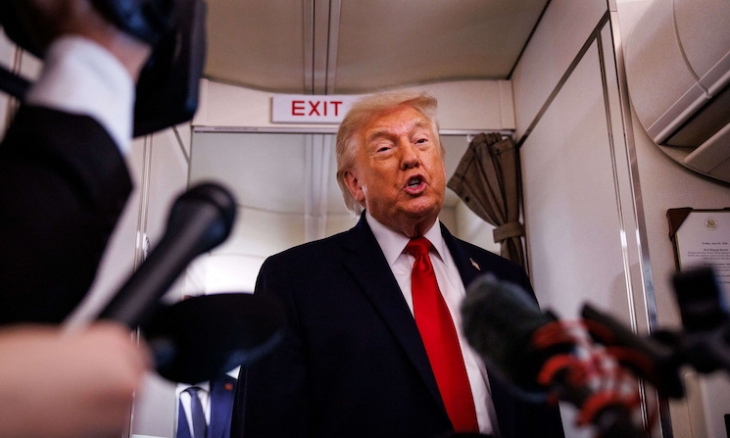
In his press conference held at noon in his Mar-a-Lago resort on Saturday afternoon, the American President Donald Trump made unprecedented statements regarding Venezuela, announcing that the United States would take over the "administration of the country" temporarily, following a military operation that he said succeeded in paralyzing Venezuelan capabilities and capturing the Venezuelan President Nicolas Maduro. These statements, which came in a press conference laden with political and military messages, did not conceal the essence of the new American approach: direct intervention, actual administration, and a clear link between military force, oil, and the Monroe Doctrine.
It is noted that the Monroe Doctrine dates back to the fifth American President James Monroe in 1823; the Monroe Doctrine, which is considered a fundamental part of American foreign policy since that time, came as a warning to European powers against any additional colonization or intervention in the Americas, as this region is an area of influence for the United States.
Trump clearly stated that Washington would administer Venezuela until ensuring a "safe, sound, and wise" transition, repeating this description more than once, in a notable indication that the United States does not trust the Venezuelans' ability, or any internal path, to produce stable authority without external supervision. Despite his statement that he does not want to "intervene in someone else's access to power," the mere announcement of administering a sovereign country entails direct intervention in the core of the political process.
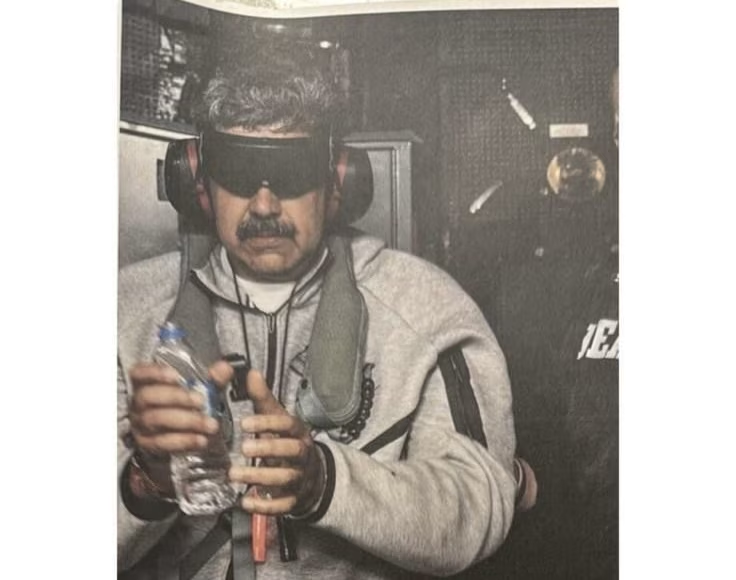
In an attempt to justify this shocking step, Trump presented the military operation as a stunning display of power, saying that all Venezuelan military capabilities became incapacitated within hours, and that American army forces, in cooperation with law enforcement agencies, managed to capture Maduro "in the dead of night." He confirmed that the attack was overwhelming and swift, and resulted in no American losses, neither in lives nor equipment, presenting the operation as a model of American military efficiency.
However, the most dangerous part in Trump's statements was not the military aspect alone, but what followed it of a clear political and economic declaration. He affirmed that the United States would rebuild Venezuela's oil infrastructure, and that American oil companies would invest billions of dollars to repair and restart it, with those companies bearing the costs directly. This public link between military intervention and oil management brought to mind historical models of resource-based intervention, but this time it came without ambiguity.
In this context, Trump clearly indicated that he is implementing the Monroe Doctrine, affirming that the Western Hemisphere falls within the American strategic sphere, and that what is happening in Venezuela is a matter concerning American security and interests. This statement, which revives a doctrine dating back to the 19th century, revealed the logic of hegemony underlying the discourse, where political and economic control is presented as "stability" and "temporary administration."
On the official level, American officials said that the "Delta Force" unit carried out the operation to capture Maduro, while Secretary of State Marco Rubio confirmed that the Venezuelan president has faced criminal charges in the United States for years, and that he "is not a legitimate president." This legal discourse, which portrays military intervention as an extension of enforcing American justice, sparked widespread criticism, especially in the absence of any international mandate or congressional decision.
In a notable escalation in the American discourse towards Cuba, Secretary of State Rubio threatened the possibility of repeating what he described as the "regime change" model that the United States followed in Venezuela, hinting that Havana might face a similar path if it continues, according to his expression, to challenge American interests. Rubio's statements came in the context of his defense of the American operation against Venezuela, where he considered that the message is directed to Washington's adversaries in the region, with Cuba at the forefront, that the United States is ready to use force to impose its political will. Rubio added that the Cuban leadership "knows the consequences well," in a reference interpreted by observers as a direct threat to revive intervention policies and regime change in Latin America
These developments come after months of gradual military escalation in the region, including the gathering of aircraft carriers, the seizure of oil tankers, and raids on boats that Washington says are linked to drug trafficking. It seems that the latest operation was not a surprising event, but the result of a long path of pressure that ended with imposing a fait accompli by force.
Trump's statements about readiness to launch a second attack "much larger" if necessary, and about the presence of American ground forces inside Venezuela, deepened fears of turning the "temporary administration" into an actual occupation with an open end. While the president spoke of peace, freedom, and justice for the Venezuelan people, the fundamental question remained suspended: Can these values be imposed by force, or is what is happening a repackaging of hegemony in a more explicit language?
The Monroe Doctrine in the 21st Century Formula
Trump's revival of the Monroe Doctrine is not just a historical invocation, but a blunt redefinition of American influence in Latin America. The difference today is that the discourse is no longer covered by diplomacy or alliances, but declared clearly: control in exchange for stability. This shift reflects the transition of American policy from managing influence to imposing it, which may open the door to long-term regional conflicts.
Oil as the Essence of the Decision, Not Its Result
When an American president directly links military intervention to restarting oil operations and achieving profits, talk of democracy becomes marginal. Oil here is not a side result of stability, but its main driver. This public admission undermines traditional moral narratives, and reinforces the impression that sovereignty is traded for resources, not popular legitimacy.
The Absent Legitimacy and Venezuela's Future
Perhaps the most dangerous thing in the scene is not the overthrow of Maduro, but the legal and political vacuum that follows it. Administering a country by force, without international mandate or clear time frame, places Venezuela before an uncertain future. Previous experiences indicate that "temporary administration" often prolongs, and that the cost of rebuilding externally imposed states is high in human and political terms.
Share your opinion
Trump: Managing Venezuela by Force, and Placing Its Oil Under American Custody