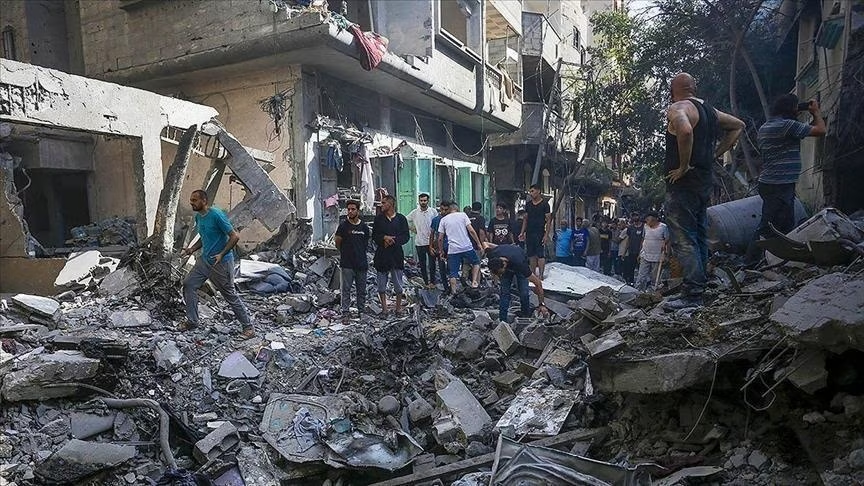







With the ceasefire in the Gaza Strip on October 10 last year, Palestinian displaced people resorted to living inside their buildings damaged by Israeli bombing during months of genocide, after tents failed to provide them with the minimum protection and safety.
The destroyed buildings, whose remaining walls suffer from large cracks, increase the risk of collapse with every weather depression that strikes the sector and is accompanied by strong winds and rains.
Under those roofs from which iron bars and large cement blocks hang, thousands of Palestinians, including children, were forced to live in the absence of safe alternatives, with Israel preventing the entry of mobile homes (caravans) to shelter them.
These risks became a tragic reality on Tuesday, following a partial collapse in a building west of Gaza City, resulting in the death of a Palestinian and the injury of four others, in addition to the flooding and scattering of thousands of tents due to the stormy depression that struck the sector on Monday evening.
This depression is the second to hit the sector in less than a week, where the first polar one "Birun" caused the death of 14 Palestinians, including 11 due to the collapse of more than 13 damaged buildings, and 3 due to the cold, in addition to the complete or partial damage and flooding of 53,000 tents, according to official data.
Civil Defense spokesman Mahmoud Basil warned in a statement of the danger of collapse of thousands of buildings damaged by the genocide as a result of "the intensification of winds and rains".
During the two years of genocide, Israel completely destroyed 268,000 housing units, severely damaged 148,000 making them uninhabitable, and partially damaged 153,000, according to the latest data from the Gaza Government Media Office.
The destruction of these housing units is part of the comprehensive genocide that the sector was subjected to, affecting 90 percent of its civilian infrastructure.
Israel continues, in the areas under its control pursuant to the agreement, to blow up and demolish what remains of residential buildings and homes, thus dissipating the Palestinians' hopes of returning to their homes after the complete withdrawal of the army from the sector.
The genocide war that Israel started on October 8, 2023, and left more than 70,000 dead and over 171,000 injured, ended with an agreement concluded between Hamas and Tel Aviv through mediators on October 10 last year, which the army violated hundreds of times with bombing, demolition, and killing.
Basil called for urgent international intervention to save Palestinians from any possible death due to repeated collapses, and to bring in safe shelters for them.
** Compulsory choice
Hiyam Abu Nada, one of those who resorted to the destroyed buildings, inside the "Hamd City" residential complex in the south of the sector, which witnessed intensive Israeli bombing.
In a statement, Abu Nada, who was displaced from Shujaiya east of Gaza, says that there is no alternative place to take refuge after Israel destroyed most of the homes in her neighborhood, and still occupies large parts of it.
She noted that despite the dangers threatening her family members, the lack of alternatives forced them to live inside the cracked buildings.
She adds that she hears sounds of small collapses in the walls due to rainwater seeping into them, continuing: "The sand collapses and falls into our eyes."
She points out that what remains of the walls in the destroyed buildings does not prevent frost from seeping into their bodies.
As for Mustafa Abu Nada, he says that the buildings damaged by the genocide "do not constitute a safe shelter (..) at any moment they could collapse on us".
He indicates that they live in the collapsing buildings "compelled despite the fear in the absence of other shelter places".
He explained that the cold conditions caused his children to contract illnesses, and that he spends the night trying to reduce water leakage inside the house by collecting it in plastic containers.
This is confirmed by Aouni Al-Haj, one of the residents of "Hamd City", saying: "We are forced to live here. Because we are unable to live inside the tents."
He reports that most buildings in the area are threatened with collapse, and they are constantly in contact with the civil defense to remove cement blocks hanging from the roofs.
As for Fatheya Obeid, who lost her husband during the war and her son was arrested, she says that the dangerous place forms a last refuge for families, noting the presence of an infant inside it amid fears of its impact by the depression.
** Harsh moments
In western Gaza City, at the Rashad Al-Shawa Cultural Center, which was heavily targeted by Israel during the genocide, the displaced Halima Aslim lives with her children amid collapse risks.
Aslim, who set up a tent under the center's roof, says she goes through harsh moments during nighttime hours with every weather depression that strikes the sector, where she spends those times awake fearing a sudden collapse.
She adds: "Our life here is full of fear, at any moment the building could collapse", describing the place she thought would be a safe shelter for her children as "a source of terror".
Aslim points to questions that haunt her whenever news of collapsing buildings reaches her, saying: "What will happen to us?".
As for Mahmoud Hamouda, displaced to the same center, he expresses his fears of the building's roof collapsing on the tent that shelters his children, amid visible cracks and fissures.
He calls for the necessity of providing mobile homes to shelter Palestinians who are pursued by death from the risk of building collapses and rains.
** Attempt to survive
Using clay, the Shaer family in Khan Yunis is trying to rebuild some walls on what remains of their destroyed home, which is about a kilometer away from the Israeli army's position.
Mohammed Al-Shaer explains that this attempt came after tents proved unable to provide real shelter for Palestinians.
He continues: "We gathered some stones resulting from the rubble of destroyed buildings, and we build a room from them using clay."
Al-Shaer resorts to using clay to build the room, due to the absence of cement needed for construction, because of Israel's closure of crossings and preventing its entry.
The Shaer family lives between two dangers, the first being the arrival of bullets fired randomly by the Israeli army, and the second the possibility of the room collapsing with any weather depression, noting that clay loses its cohesion with rains.
He indicates that living in this place comes compulsorily, after life inside fabric tents was difficult whether in summer or during winter.
In front of the place sits "Um Imad", who lost 3 of her sons while the army arrested the fourth during his way to receive aid four months ago, cooking food for her family using firewood, as an alternative to cooking gas.
She explains that the war took them back "a century" after they were forced to build using clay, amid her fears of collapses due to rains or floods.
Despite the ceasefire, Israel reneges on fulfilling its commitments, including opening crossings and bringing in the sector's basic needs, headed by 300,000 tents and mobile homes, as confirmed by Palestinian government reports.
The buildings damaged by the genocide do not constitute a safe shelter, at any moment they could collapse on us.


Share your opinion
Displaced people in Gaza face the risk of collapse of damaged buildings as weather depressions intensify