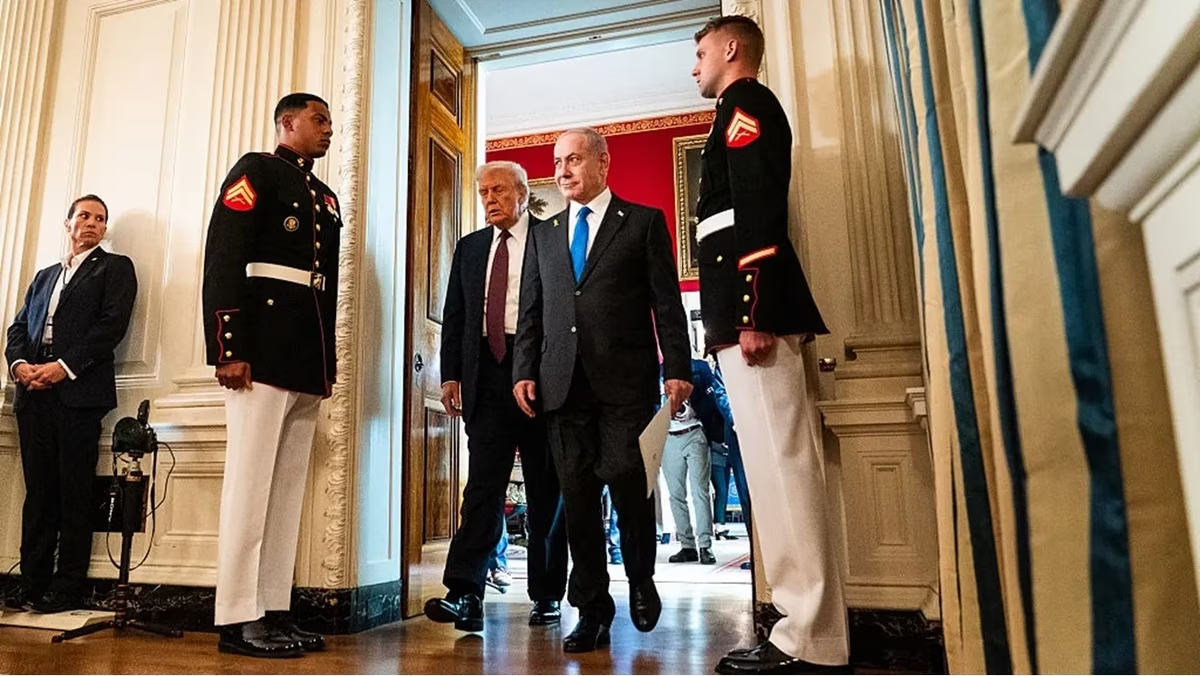







The US President Donald Trump intends to hold a meeting with Israeli Prime Minister Benjamin Netanyahu at the end of this month, to agree on proceeding with his plan to end the war on the Gaza Strip, and achieve what Americans call "stability" in the Middle East, which is embodied in Trump's plan that he began implementing by stopping the firing, more than two months ago, because that transition was not only as difficult as most observers and followers expected, but it is still stagnant, threatening the plan with cessation, and thus the entire American project in the Middle East with non-realization, or perhaps the goal turns into its complete opposite, and this is due to one of its reasons the complete mismatch between the American and Israeli positions regarding the details of implementing that plan, which differs completely from what it was during the war in the past two years.
And saying that the positions do not coincide does not mean in any way that they are contradictory or opposing, but this is due to more than one reason in our estimation, including what relates to the reference for decision-making on both sides, as the American side with Trump has become very pragmatic, and it makes its decisions according to multiple international and regional calculations, while the Israeli decision-making has become very ideological, especially in light of the alliance of the right with the far right, and its most important calculations are internal ones, therefore Trump has so far been forced to conduct a series of meetings with Netanyahu during his first year in the White House, as he did not do with any other foreign official, and if we add to the personal direct meetings of the two men, their phone calls, as well as sending American envoys, this shows us that the political coordination between them has become more difficult than field coordination, and that this happens despite the political rapprochement between them, as they represent the conservative right in both countries, meaning that the matter might have been even more difficult if the Democrats were in the White House, or if the Israeli government was leftist for example.
In any case, the disagreement despite this does not seem deep between them, as they share in defining the goal, which is achieving "stability", for Tel Aviv sees in achieving calm and security especially in the occupied Palestinian land, its opportunity to continue the process of Judaization and Hebraization, and thus annexation, without noise and without opposition, and without being exposed to any punitive European measures, or the like, while Washington sees in "stabilizing" the Middle East, after it was confirmed that Gaza was the one that ignited it, its opportunity to continue the economic investment program, which provides it with the ability to compete with Chinese economic growth, and it has come to see in "rebuilding Gaza" specifically one of the items of that investment program, so that it can continue working on implementing the global trade route from India to the Israeli ports on the eastern Mediterranean, and the gateway to all this or the decisive knot has become what is called the next phase of Trump's plan.
And the second phase, as is known, after implementing the first phase, after removing the Israeli pretext, related to handing over the bodies of the dead, is embodied in the gradual withdrawal of the Israeli army from the zero zone, as well as starting the reconstruction, after the entry of aid and the United Nations taking over it has been completed fully, as the second phase also includes forming a local civilian administration for the sector, with starting to disarm the armed factions, to ensure no repetition of the military confrontation between Israel and the Gaza Strip again.
In these details there is a gap between the American and Israeli positions, where Israel is not interested in stopping the war, as is the case with the Americans, on the one hand, and on the other hand, Israel prefers to stop and not move to the second phase, so that it remains occupying half of the Gaza Strip, empty of population, therefore it sets crippling conditions, especially regarding the nature of the stabilization forces and their role and function, or their mission, as well as regarding the executive board, and it was not satisfied with rejecting handing over Gaza to the Palestinian Authority only, but stipulated that there be no role for Qatar in the reconstruction, and that Turkish soldiers do not participate in the stabilization force.
And the truth is that America has a different position from Israel regarding the Qatari and Turkish roles, in reconstruction and in the stabilization force respectively, because America considers Qatar, like Saudi Arabia, one of its very important regional allies in the Middle East, and Trump himself said that America has very important allies in the Middle East, and that Israel is not its only ally in the region, and Qatar in turn refused to sign a "blank check" regarding reconstruction, but pushed the American position to accept the idea that Israel itself participates in that task, so it seems that an agreement has actually been reached that Israel will remove the rubble it caused, which exceeds a billion dollars in cost, and it is more than 68 million tons, as for Turkey, while it shows readiness to send its soldiers to participate in the international stabilization force, it says that the mission of this force is to maintain the ceasefire, and it seems that Israel has failed so far to "impose" its desire to exclude Qatar and Turkey from the scene of "the day after" the war.
The Americans seem to agree with the Israelis on the goal that the peace council be international and chaired by Trump himself, while the executive board is local, and they are not interested in it being completely temporary, that is, leading to handing over Gaza to the Palestinian Authority after two years, as they agree with Israel that the stabilization force disarms Gaza, and here the "horse's bridle" appears, the very big difference between the Americans and Israelis on the one hand, and the sponsors of Trump's plan, specifically the eight Arab Islamic countries, especially Qatar, Egypt and Turkey, that is, the three countries that sponsored the agreement with America.
The Arab Islamic side aims first to consolidate the ceasefire, then to actually move to the second phase, which confirms the full entry of aid, and the start of reconstruction, and the implementation of everything that came in the plan literally, and Egypt in particular sees that in exchange for handing over the peace council to America, Washington must grant it the task of forming the executive board of Gaza, which must be as stated in the plan, Palestinian local related to the Authority, and most importantly temporary for two years, as that administration must rely on a Palestinian police, which Egypt has actually prepared with the Authority, until it became ready to take on its duties as soon as it is allowed to do so.
The most important remains - in our estimation - the mission entrusted to the stabilization force, which is not an international force, that is, not affiliated with the United Nations, as is the case with "UNIFIL" in Lebanon, that is, separating the forces and monitoring the borders as is known internationally, therefore there is a gap through which differences enter between the parties, and if Israel insists that the mission of this force is to clash with Hamas and the armed factions in Gaza, as it tries to do with the Lebanese government and its army in Lebanon, that is, that the international stabilization force performs the occupational mission on behalf of Israel, and Netanyahu and Eyal Zamir summarized that by saying that if the stabilization force does not perform this mission, the Israeli army will do it, and this means the threat of returning to war, and if that happened, it could be said that the mission of occupying Gaza has become international in nature, and between that, the mission of the stabilization force is to end the occupation, by removing Israel from the zero zone, in addition to preventing it from returning to war, by strict monitoring of its violations of the ceasefire.
This is the real conflict, as for the "disagreement" between America and Israel, it is due to the fact that no country in the world has been encouraged to participate in the stabilization force to perform the Israeli occupational mission, or at least in light of the foggy vision, therefore and because Turkey specifically represents the second military force in NATO, and shows readiness to participate in the stabilization force in Gaza, which pushes the Americans to agree to that participation, that is, including agreeing to what the Turks say that their mission is to separate the warring parties, thus things proceed in the midst of a process of pulling and loosening, indicating that the regional conflict that is still ongoing between Israel on the one hand and most Middle Eastern countries on the other hand, and it will not end except with the disappearance of the Israeli occupation, not from Gaza only, but from all Palestine, and this begins with consolidating the mission of separating the forces, and with America itself turning into a party that manages the regional conflict in a way that preserves its interests achieved by consensus with the interests of all Middle Eastern countries, not with Israel only.
The regional conflict that is still ongoing between Israel on the one hand and most Middle Eastern countries on the other hand.

Share your opinion
Trump's Plan.. Regional Conflict and Conflicting Interests