






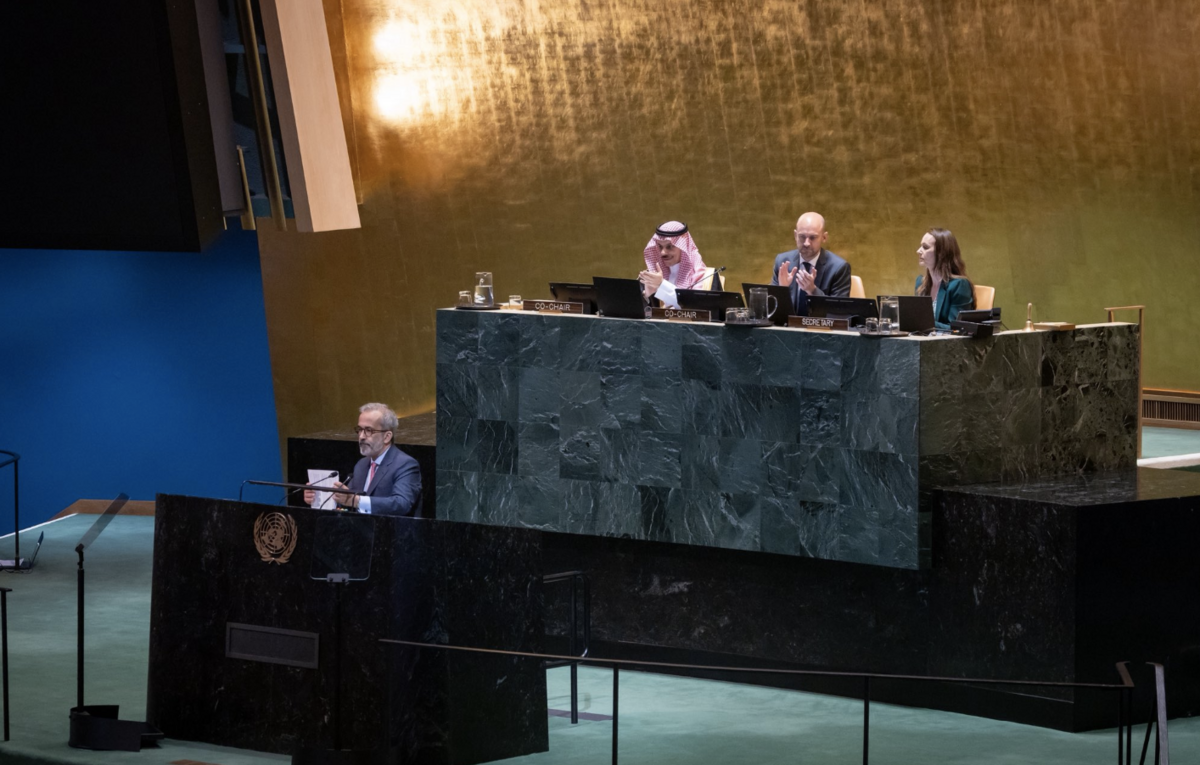
The plenary session of the high-level international conference on the peaceful settlement of the Palestinian issue and the implementation of the two-state solution continued this Wednesday evening in the United Nations General Assembly Hall in New York, co-chaired by the Kingdom of Saudi Arabia and France.
Malta's representative: We will recognize the State of Palestine next September.
The representative of Malta noted that his country has consistently supported the inalienable right of the Palestinian people to self-determination.
"For this reason, the Government of Malta has taken a preliminary decision to formally recognize the State of Palestine during the next session of the United Nations General Assembly in September," he said.
He explained that this decision reflects Malta's commitment to international law, justice, and the right of peoples to self-determination.
He added, "We believe that recognition is not just a symbolic measure — it is a concrete step toward achieving a just and lasting peace."
“Such concrete steps are necessary if we are to be true to the spirit of what we are calling for,” he stressed.

Vatican representative affirms Holy See's support for two-state solution
"Jerusalem is a city of universal religious and cultural significance," said Archbishop Gabriele Caccia, the Vatican's permanent observer to the United Nations. He added that it is "holy to Christians, Jews, and Muslims alike." Therefore, he emphasized, "it requires a status that transcends political divisions and ensures the preservation of its unique identity."
In this context, he called for a "special regime with international guarantees" capable of preserving the dignity and rights of all residents of Jerusalem and "believers of the three monotheistic religions," as well as protecting the city's "sacred character and exceptional religious and cultural heritage."
He also expressed his support for the two-state solution, noting that the Holy See recognized the State of Israel in 1993 and the State of Palestine in 2015.

Malaysia calls for halting arms and ammunition supplies to Israel
The Malaysian representative called for "a halt to the supply of weapons, ammunition, and equipment to Israel that enable it to expand and deepen its occupation."
In this context, he noted that his country has banned ships flying the Israeli flag, as well as ships bound for Israel, from docking in Malaysian ports.
"This is another concrete step that all countries can take," he added.
He also stressed that the international community must "unequivocally reject Israel's attempts to undermine the United Nations," including by countering its actions aimed at discrediting, intimidating, and undermining the credibility of UN officials.
He also called for defending and supporting the United Nations Relief and Works Agency for Palestine Refugees (UNRWA).
He added that Israel must be forced to allow unimpeded access to humanitarian aid, stressing, "We condemn the deadly trap called the Gaza Humanitarian Facility, which has caused the deaths of nearly 1,000 Palestinians while seeking food aid."

Belize Representative: Recognizing the State of Palestine is a crucial and necessary step
“While recognizing the State of Palestine is crucial and a necessary step forward, it is only the beginning,” said the representative of Belize.
He stressed that the international community must provide "all possible support" to establish and strengthen Palestinian institutions to enable them to "govern and administer a modern, democratic state living side by side with Israel within secure and recognized borders."
At the same time, he stressed the need for the international community to address the worsening humanitarian catastrophe in Gaza "directly." It must ensure the unimpeded flow of aid and provide Palestine with the financial, material, and technical assistance necessary to support reconstruction efforts.
However, he pointed out that achieving all of this requires a real political process.
"Israel must come to the negotiating table," he said, adding, "Confidence in the region must be restored, but first the violence must stop."

Kenyan representative calls for immediate ceasefire
The Kenyan representative expressed concern that "the absence of decisive and coordinated action," coupled with "hardened positions that perpetuate the status quo as unchangeable," would lead to "prolonged humanitarian suffering and strategic disintegration."
"This conference represents one of the few remaining opportunities to transform consensus into concrete and irreversible steps," he said.
He called for an "immediate ceasefire" in the Gaza Strip and ensuring "the unhindered provision of humanitarian aid."
He also urged the establishment of strong, jointly monitored security arrangements to protect civilians on both sides, "linked to criteria that reinforce the two-state solution roadmap."
He proposed the establishment of a multinational oversight body to monitor compliance, deter, and report transparently to the international community.
He concluded by saying: “The world is watching, and by adhering to three basic pillars — politics, economics, and security — we can establish lasting peace.”

The conference, which concludes today, Wednesday, is being attended by a large number of UN member states, international and regional organizations, specialized UN bodies, and civil society organizations. The State of Palestine will be represented by Prime Minister Mohammad Mustafa.
The New York Declaration, issued by the conference, affirmed the agreement to take concrete, time-bound steps towards a peaceful settlement of the Palestinian issue and the implementation of the two-state solution.
He stressed the need for collective action to end the war in Gaza, ensure Israel's withdrawal from the Gaza Strip, and hand it over to the Palestinian Authority "in accordance with the principle of one government, one law, one weapon."
He stressed that war, occupation, and forced displacement will not achieve peace or security, and that only a political solution can achieve that. He emphasized that ending the Palestinian-Israeli conflict and implementing the two-state solution is the only way to fulfill legitimate aspirations, in accordance with international law.
The New York Declaration emphasized that Gaza is an integral part of the Palestinian state and must be unified with the West Bank. It also emphasized that, following a ceasefire, a transitional administrative committee must be established immediately to operate in Gaza under the umbrella of the Palestinian National Authority.
The declaration affirmed its commitment to mobilizing political and financial support for the Palestinian Authority to help it strengthen its institutional capacities, implement its reform program, and assume its responsibilities throughout the occupied Palestinian territories. It also emphasized the need for the immediate release of withheld Palestinian tax revenues and the establishment of a new framework for the transfer of clearance revenues, leading to full Palestinian control over the tax system, as well as the full integration of Palestine into the international monetary and financial system and ensuring sustainable, long-term banking relations.
He called for preserving the legal and historical status quo at Islamic and Christian holy sites in Jerusalem, and for a commitment to adopting restrictive measures against violent extremist settlers and entities and individuals who support illegal settlements, in accordance with international law.
He called on Israel to issue a clear and public commitment to the two-state solution, including a sovereign and viable Palestinian state, to immediately end violence and incitement against Palestinians, to cease all settlement activities, land seizures, and annexation actions in the occupied Palestinian territories, including East Jerusalem, to publicly abandon any annexation projects or settlement policies, and to put an end to settler violence.
The New York Declaration affirmed that coexistence and normal relations between the peoples and countries of the region can only be achieved by ending the occupation and establishing a sovereign Palestinian state.
Powered by Froala Editor
Share your opinion
The work of the United Nations conference on settling the Palestinian issue and implementing the two-state solution continues.