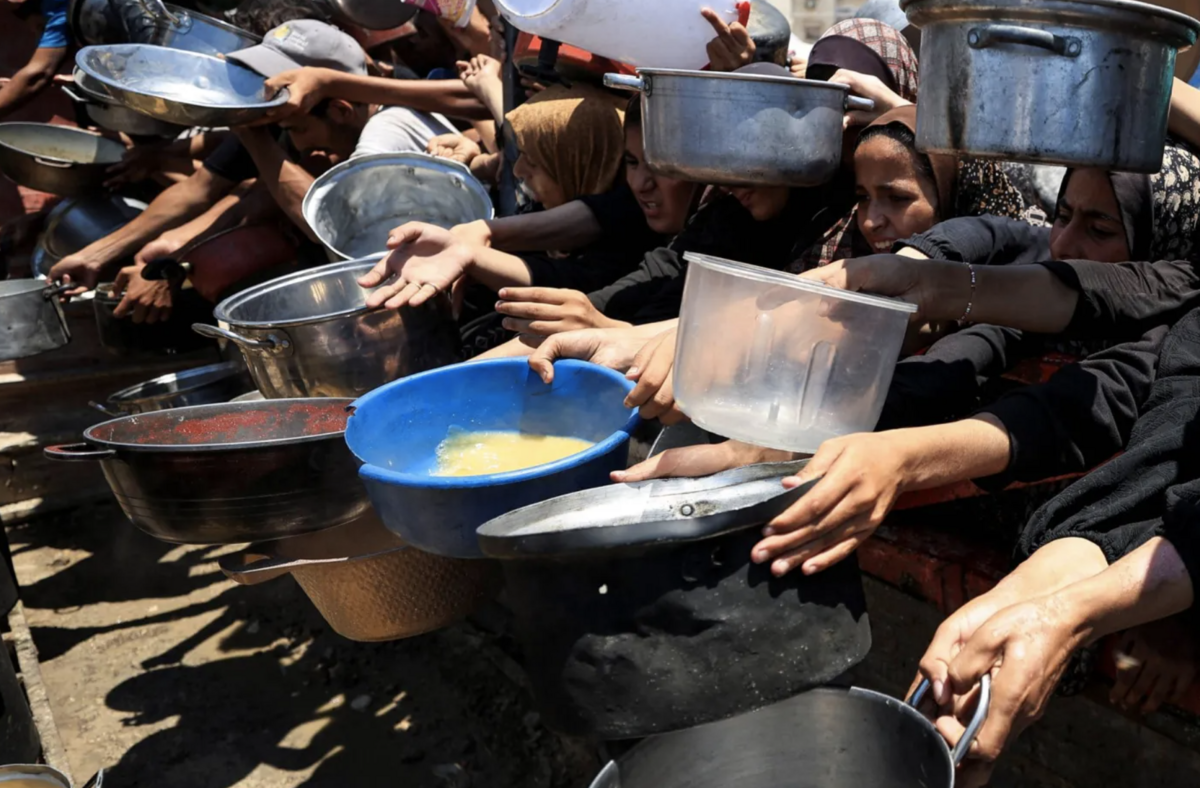







The leading international body on food crises, the Integrated Food Security Phase Classification, or IPC, said in a new warning issued Tuesday that a "worst-case scenario of famine" is currently unfolding in the Gaza Strip, predicting "widespread deaths" without immediate action.
The warning, which has not yet reached the level of a formal declaration of famine, comes in the wake of widespread outrage over images of emaciated children in Gaza and reports of dozens of hunger-related deaths nearly 22 months into Israel's war of extermination on the devastated territory.
According to observers, international pressure prompted Israel over the weekend to announce measures that included daily humanitarian pauses in fighting in parts of Gaza and airdrops of supplies. The United Nations and Palestinians on the ground say that most things have not changed, and that desperate crowds continue to overwhelm transport trucks, emptying them before they reach their destinations.
The Integrated Food Security Phase Classification, or IPC, report said Gaza has been teetering on the brink of famine for two years, but recent developments have "significantly exacerbated the situation," including the "increasingly stringent blockade" by Israel.
The UN-backed Integrated Food Security Phase Classification (IPC) issued several similar warnings during the war in Gaza, including one last May that Israel described as "flawed."
The Israeli occupation authorities responded at the time, saying that "even according to the Integrated Phase Classification analysis," there was no famine in Gaza, and noted that previous IPC predictions of imminent famine had "repeatedly failed to materialize."
However, the situation has deteriorated over the past year to the point that the Integrated Phase Classification issued its highest warning level, without officially declaring famine in Gaza.
Officially declaring famine, which is rare, requires field reports in Gaza, which Israel prohibits, largely preventing officials from accessing and moving within Gaza.
The Integrated Phase Classification has only declared famine a few times - in Somalia in 2011, South Sudan in 2017 and 2020, and parts of Darfur in western Sudan last year.
But independent experts say they don't need an official announcement to know what they're seeing in Gaza. Just as a family doctor can diagnose a patient based on symptoms without having to send samples to a lab and wait for results, so too can we interpret Gaza's symptoms. This is a famine, Alex de Waal, author of "Mass Starvation: The History and Future of Famine" and executive director of the World Peace Foundation, told the Associated Press.
To declare a famine, an area is classified as experiencing famine when all three of the following conditions are met: At least 20% of households are severely food insecure or starving; At least 30% of children between six months and five years of age are acutely malnourished or wasted (too thin for their height); and At least two people, or four children under five, die every day from hunger or the combination of malnutrition and disease.
The report, based on information available as of July 25, stated that the crisis has reached an "alarming and deadly turning point." It added that data indicates that famine thresholds have been reached for food consumption in most of Gaza—the lowest level since the war began—and for acute malnutrition in Gaza City.
The report indicated that nearly 17 out of every 100 children under the age of five in Gaza City suffer from acute malnutrition. The report showed that mounting evidence points to "widespread famine," the collapse of basic health services, and more. According to the United Nations World Food Program, one in three people in Gaza goes without food for days at a time.
Gaza hospitals reported a rapid increase in hunger-related deaths of children under five.
A previous analysis by the International Planning Center in May warned that Gaza would likely fall into famine if Israel did not lift its blockade and halt its military campaign. Its new warning called for immediate and widespread action, warning that "failure to act now will lead to widespread deaths across much of the Strip."
For its part, the World Food Programme warned on Tuesday that the unfolding catastrophe in Gaza is reminiscent of the famines of the last century in Ethiopia and Biafra, Nigeria.
"This (in Gaza) is unlike anything we have seen in this century," Ross Smith, the World Food Programme's emergency director, told reporters in Geneva.
"It's reminiscent of previous disasters in Ethiopia or Biafra in the last century. We need urgent action now," he said, speaking via video link from Rome. While the Integrated Phase Classification has not officially classified the situation as "famine," Jean-Martin Bauer, director of food security and nutrition analysis at the World Food Programme, insisted that "what we are seeing is growing evidence of famine." He added, "All the indicators are clear now."
Israel has imposed varying restrictions on aid throughout the war. On March 2, it cut off the entry of all goods, including fuel, food, and medicine, to pressure Hamas to release the hostages. Israel eased these restrictions at the end of May and moved forward with a new US-backed aid delivery system, the Gaza Humanitarian Foundation (GHF), which has been wracked by chaos and violence. Its four centers are considered a "killing trap for Palestinians," according to experts.
Powered by Froala Editor



Share your opinion
The Integrated Food Security Phase Classification warns that famine is now ravaging Gaza.