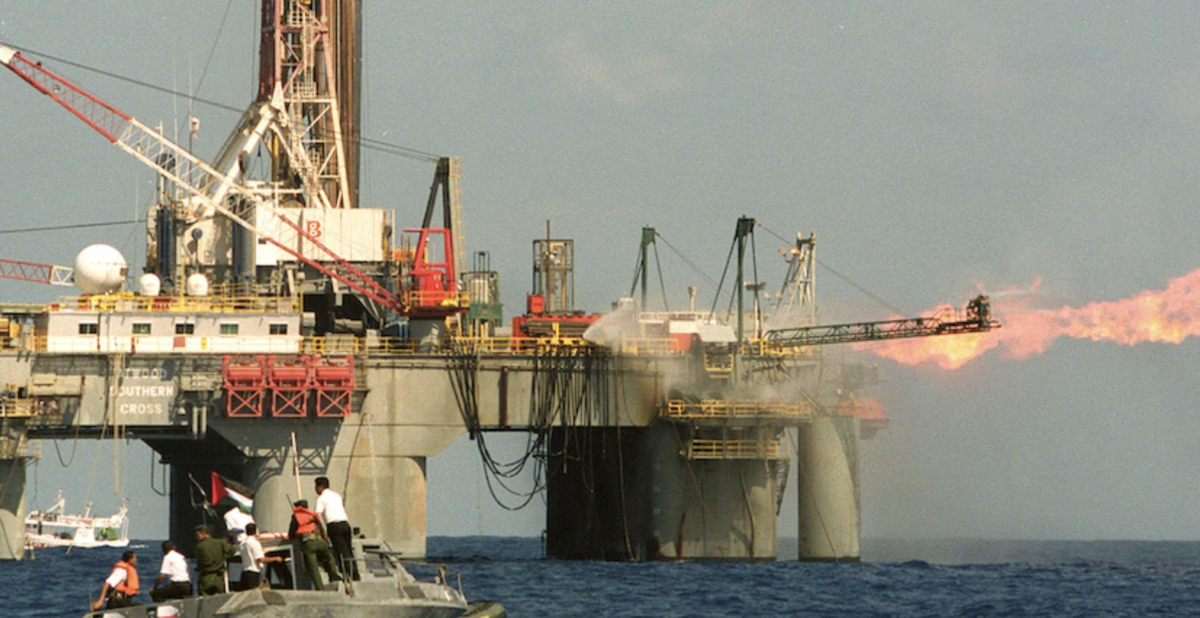







Recognizing Palestine as a state would unequivocally establish its right to develop natural gas resources in the Gaza Marine field, according to an expert who worked on the stalled project, The Guardian reported Sunday.
Michael Baron, author of a new book on Palestine's untapped gas reserves, notes that the field could generate $4 billion in revenue at current prices, and the Palestinian Authority would logically receive $100 million annually over 15 years.
He said the revenues "will not turn Palestinians into new Qataris or Singaporeans, but will be their own revenues, not the aid on which the Palestinian economy depends."
It's worth noting that plans to develop the field date back nearly 30 years, during which time legal disputes over ownership have halted exploration. A law firm representing Palestinian human rights organizations sent a warning letter to the Italian state-owned company Eni, urging it not to exploit gas fields in an area known as Area Z, where six licenses have been granted by the Israeli Ministry of Energy.
In their letter, the lawyers point out that approximately 62% of the area lies in maritime areas claimed by Palestine, and therefore, "Israel cannot legally take any exploration rights in areas legally granted to the Palestinians."
Palestine declared its maritime borders, including its exclusive economic zone, when it joined the United Nations Convention on the Law of the Sea in 2015, and outlined a detailed claim in 2019. Israel is not a signatory to the UN Convention on the Law of the Sea.
Baron said that recognition of Palestine, especially by countries with major oil companies registered in their jurisdiction, would effectively end the legal ambiguity and provide the Palestinian Authority not only with a new and secure source of income but also with a regular supply of energy independent of Israel. Since the legal letter, Eni has informed lobby groups in Italy that "the licenses have not yet been issued, and no exploration activities are underway."
Global Witness alleges that the East Mediterranean Gas Pipeline, which runs parallel to the Gaza coast, is illegal because it passes through Palestinian waters and generates no revenue for the Palestinian Authority.
The 90-kilometer (56-mile) pipeline transports gas from Ashkelon in Israel to El Arish in Egypt, where it is then processed into liquefied natural gas for export, including to Europe.
"The 1993 Oslo Accords clearly grant the Palestinian National Authority jurisdiction over territorial waters, subsoil, and the authority to legislate and license oil and gas exploration," Baron said. "Control of natural resources was a key component of Palestinian leader Yasser Arafat's state-building agenda. Israeli exploitation of Palestinian resources was, and remains, a fundamental part of the conflict."
Gas was discovered in the Gaza Marine field in 2000 in a joint venture owned by BG Group, a privatized subsidiary of British Gas, and the Palestinian Contractors Association. The project was intended to use the gas in Gaza's only power plant to end the Strip's persistent energy shortage. In his book, "The Story of Gaza Marine," Baron argues that the fate of the project represents a microcosm of how Israel seeks to increase Palestinian dependence on it while simultaneously seeking to separate Palestinians from Israelis.
The project has faced challenges related to commercial viability and an Israeli court ruling that the water is a “no man’s land,” partly because the Palestinian Authority is not a sovereign entity with clear powers to grant licenses.
The court also did not rule on whether the rights to Palestinian territorial waters clearly established in the Oslo Accords included a Palestinian "exclusive economic zone," an area typically extending 200 miles off the coast. The agreements were intended as an interim arrangement prior to full statehood and therefore did not define the full maritime border.
Territorial waters are usually defined as only 12 or 20 miles from the coast, and Israel has long argued that any license for the Gaza Marine project 20 miles off the coast of Gaza should be viewed as a gift from Israel to the Palestinian Authority, not a right.
After Hamas took control of the Gaza Strip in 2007, Israel, unwilling to let the revenues fall into its hands, obstructed development, prompting BG Group to suspend the project and eventually withdraw. In June 2023, Israel approved plans by the Egyptian gas company EGAS to develop the field, but the war on Gaza began a few months later.
The Gaza Marine field's reserves are estimated at only 30 billion cubic meters of natural gas, a tiny fraction of the more than 1,000 billion cubic meters found in Israeli territorial waters.
Baron argued that Israel possesses its own gas supplies, and as long as a unified Palestinian state is recognized, Israel will have no legal incentive or right to prevent Palestine from exploiting its greatest natural resources.
The debate over private sector investment in Israel's recognized occupation of Palestine was highlighted last week by a report published by the UN Special Rapporteur on Palestine, Francesca Albanese, in which she warned companies against supporting what the International Court of Justice has deemed an illegal occupation. She claims that the ICJ's rulings impose a primary responsibility on companies "to refrain from engaging in and/or withdraw completely and unconditionally from any dealings with Israel, and to ensure that any dealings with Palestinians enable their self-determination." Israel has rejected Albanese's conclusions outright.






Share your opinion
Expert: Palestinian gas off the coast of Gaza could achieve self-sufficiency for the Palestinian state.