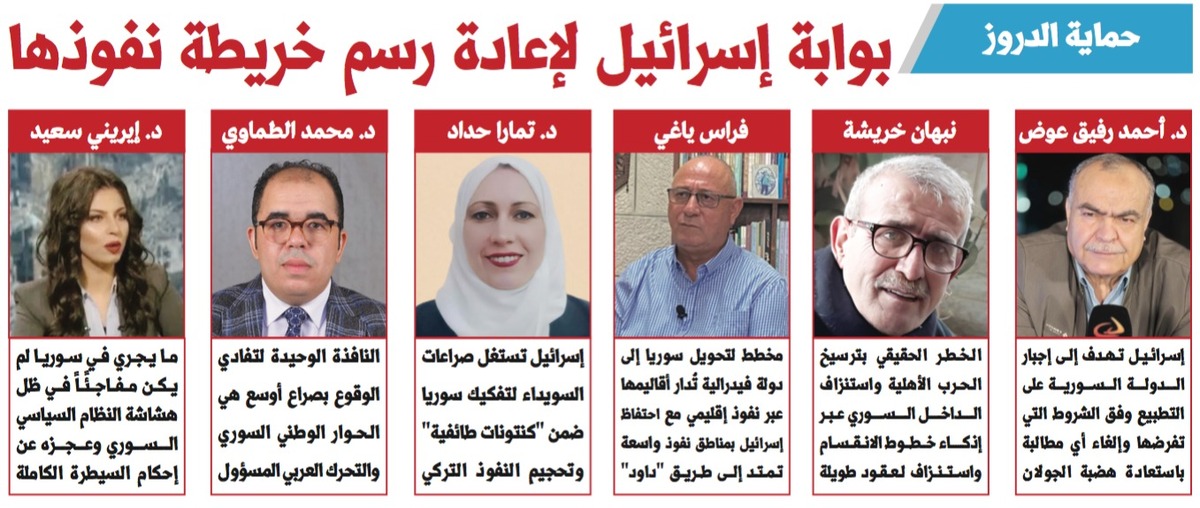







Dr. Ahmed Rafiq Awad: Israel aims to force the Syrian state to normalize relations under its own conditions and cancel any demand to restore the Golan Heights.
Nabhan Khreisha: The real danger lies in the entrenchment of the civil war and the depletion of the Syrian interior by fueling division lines and draining it for decades.
Firas Yaghi: There is a plan to transform Syria into a federal state whose regions are governed through regional influence, while Israel retains broad areas of influence extending to the "Road of David."
Dr. Tamara Haddad: Israel is exploiting the conflicts in Sweida to divide Syria into "sectarian cantons" and limit Turkish influence.
Dr. Muhammad al-Tamawi: The only way to avoid a wider conflict is through Syrian national dialogue and responsible Arab action.
Dr. Irene Said: What is happening in Syria was not surprising, given the fragility of the Syrian political system and its inability to assert complete control.
Despite attempts to contain the crisis in Syria's Sweida province and Syrian President Ahmad al-Sharaa's announcement that an agreement had been reached, fears of renewed strife persist, amid growing warnings of Israeli attacks that have already occurred and may occur again.
In separate interviews with "I," writers, political analysts, specialists, and university professors believe that Israeli attacks and interventions target southern Syria under the guise of protecting the Druze. Others argue that what is happening transcends sectarian dimensions and conceals a project to reshape the maps of influence in the region. The situation raises serious questions about Tel Aviv's intentions to impose a security reality extending from the Golan Heights to the depths of Iraq.
Writers, analysts, specialists, and university professors assert that Israel seeks to establish demilitarized zones between the Golan Heights and Jabal al-Arab to ensure its freedom of movement and prevent any armed formations that might impede its expansion. This, in parallel, is the implementation of the so-called "David's Corridor" project, which represents a practical step toward linking transportation networks in accordance with Israel's strategic interests.
They warn that Israel's goal is not limited to normalization with Damascus on its own terms, but extends to imposing complete hegemony over Syrian decision-making. A greater danger looms on the horizon: the dismantling of the social fabric and the transformation of Syria into a soft arena open to long-term conflicts that could spill over into surrounding countries.
Tel Aviv plans to kill several birds with one stone
Writer and political analyst Dr. Ahmed Rafiq Awad warns that Israel, by claiming to protect members of the Druze community in Syria, is actually seeking to achieve strategic goals far beyond its declared humanitarian slogans. He asserts that Tel Aviv plans to kill several birds with one stone by imposing its control over vast areas between the Golan Heights and Jabal al-Druze (Jabal al-Arab).
Awad explains that Israel aims to make this large area, which is much larger than the Gaza Strip, a completely demilitarized zone, free of any Palestinian organizations, armed factions, or local forces that might pose a threat to its security, allowing it to move freely within it.
Awad points out that some believe this move could pave the way for Israel to reach western Iraq, extending all the way to the Euphrates River, via the so-called "David's Corridor," a strategic project to reshape the transportation network throughout the region and connect it to Israeli interests.
Awad asserts that Israel also aims, through these steps, to compel the Syrian state to normalize relations under its own terms, including signing an agreement that would eliminate any future claim to the occupied Golan Heights. This would cement Israel's occupation as a fait accompli. Tel Aviv also seeks to prevent the formation of a Sunni axis that could serve as an alternative to the axis that has been battered and weakened in recent years.
Awad explains that Israel's goals are not limited to imposing normalization, but extend to imposing complete hegemony over Syrian decision-making and political behavior in Damascus, which effectively means the region entering a new phase of Israeli regional influence.
The policy of destroying the social fabric through minorities
Awad warns that this control will have direct repercussions for Lebanon, Iraq, the Palestinians, and Jordan, giving Israel a strategic advantage in imposing its agenda, not through integration and coexistence, but rather through hegemony and comprehensive control.
Awad asserts that Israel has historically adopted a policy of destroying the social fabric through minorities, as happened in Lebanon with some Christians, and in Iraq and Syria with the Kurds. Today, it is using the same pretext by protecting the Druze. It is also attempting to dismantle Palestinian society from within by inciting regionalism and tribalism, as part of the "divide and conquer" policy pursued by every occupier.
Awad warns that maintaining the status quo will lead the entire region into a phase of "Israeli hegemony," where Israel becomes the leader and protector of the region. This is an extremely dangerous situation for Arab states and societies, posing a direct threat to the unity of the nation-state and its ability to protect its social and political fabric.
A new fragmentation project to undermine the structure of the Syrian state
For his part, journalist Nabhan Khreisheh warns that the recent Israeli attacks on military sites in Damascus and southern Syria, which coincide with the outbreak of clashes in the Sweida province between Druze groups and regime forces, are not merely a response to what Tel Aviv calls "security threats" or a bid to protect minorities. Rather, they fall within a broader context that suggests a new fragmentation project is underway, undermining the structure of the Syrian state and preventing any regional power from reasserting control over it.
Khreisha points out that after Israel transferred military units from the Gaza front to the northern border, it raised the slogan of "protecting the Druze" as a cover to stir up sensitive sectarian tensions.
Khreisha believes that Tel Aviv is well aware that the collapse of stability in southern Syria offers it a rare strategic window to dismantle the Syrian central government and keep Damascus hostage to internal conflict, while the regime and its allies struggle to regain full control.
According to Khreisheh, Israel's exploitation of familial and political ties with the Druze in the Golan Heights and historic Palestine aims, in practice, to transform them into a "human security belt" separating it from the Syrian interior and providing it with a buffer zone under the pretext of humanitarianism. However, in essence, it is a tool for security exploitation par excellence.
In Khreisha's estimation, the situation in southern Syria is more complex than Israel's bet on a declared partition. As-Suwayda is not an island isolated from a broader sectarian and tribal environment, and any separate Druze entity could ignite major tensions and provoke regional powers. Israel, therefore, is leaning toward a de facto "soft zone" formula, rather than demarcating clear borders.
The real danger is the entrenchment of the logic of civil war.
Khreisha believes that the real danger lies not in the direct success of the partition project, but rather in the entrenchment of the logic of civil war and the exhaustion of Syria's interior by inflaming the division lines, thus transforming Syria into a depleted arena for decades to come. This doubles the responsibility on national and regional powers to contain this strife before it becomes a reality that is difficult to change.
Khreisha places this scenario within a broader regional picture, where the crises in Gaza, Syria, Lebanon, and the West Bank intertwine within a single equation. The war on Gaza, which has lasted for more than twenty months, has transformed into a war of attrition that threatens to shift Israel's strategic weight toward new fronts, northward in Syria and Lebanon and eastward in the West Bank, with the aim of shuffling the cards and fragmenting any axis supporting Gaza.
Khreisha summarizes the features of the next phase with three possible scenarios: the first, the soft fragmentation of Syria through loose regions rather than official entities, reminiscent of the experience of southern Lebanon; the second, the descent of the Palestinian-Israeli conflict into small regional wars that exhaust everyone; and the third, the rise of identity-based and sectarian tendencies, transforming minorities into geographical tools for external action rather than national components.
Journalist Nabhan Khreisha asks: Will the Middle East remain hostage to maps imposed from abroad, or does it possess the will to create a new regional contract that will block the path to partition and open war?
Israel is working to consolidate its security influence in southern Syria.
For his part, writer and political analyst Firas Yaghi believes that the repeated Israeli strikes on Syrian territory are not isolated from a broader project to reshape Syria's geographic and political map. Yaghi asserts that Israel, despite its reluctance to create a state of total chaos within Syria for fear of opening the way for Iranian and Hezbollah expansion, is working to consolidate its security influence in the south of the country, extending to the eastern regions, with the aim of ensuring its control and securing its vital interests.
According to Yaghi, the Israeli plan is based on transforming Syria into a federal state with a weak, unified center, while the regions are administered by different regional sponsors. This would leave the southwestern regions under direct Israeli control, while extending its influence through the southeast toward the Kurdish regions of Hasakah, Deir ez-Zor, and the Syrian Jazira, in what is known as the "David's Road."
Yaghi explains that, through this approach, Israel is not seeking to protect the Druze as much as it is using them as a bargaining chip to reshape the internal balance. He emphasizes that the idea of a Druze state, a Kurdish state, an Alawite state, and even a Sunni state all fall within the framework of a soft partition that does not eliminate the Syrian state as a unified entity on paper, but rather effectively divides it into functional cantons.
In contrast, Yaghi points out that recent mediation attempts, conducted through Arab and non-Arab channels, were aimed at arranging security understandings between Israel and Syria. However, Israel wanted to send a message to the Syrian regime—headed by Ahmed al-Sharaa—that it had misjudged the situation and believed it could impose its agenda based on a green light in the Sweida and Jabal al-Arab regions. However, Israel asserts that its influence in Sweida is an integral part of its broader project in southern Syria.
Israel operates with an American green light on all issues.
Yaghi explains that Israel is operating with an American green light, which is not limited to the Syrian issue alone, but extends to the entire region. The recent meeting between Netanyahu and Trump discussed all the hot issues, but it turned out that no final resolution was reached on any of them. This has returned the situation to square one, making it seem as though Israel is starting its project all over again: "from Gaza to Lebanon, Syria, Iran, and even the West Bank."
Yaghi believes that Netanyahu is seeking to impose a new fait accompli based on a "geopolitical shift," which does not require a formal change of borders. Rather, he would be satisfied with expanding settlement annexation in the West Bank and resolving the issues of Jerusalem and refugees, while simultaneously imposing Israeli guardianship over the components of the region's countries and providing them with security protection. This would entail building alliances similar to the Abraham Accords.
Yaghi warns that Netanyahu will not back down from this path, which guarantees his continued hold on power and the ability to overcome the domestic charges against him. He is working to market himself as a leader who has revitalized Israel as a dominant regional power and built the second Israeli state.
However, according to Yaghi, the success of this plan will clash with the interests of major regional powers such as Egypt, Turkey, and Iran, and Netanyahu's dreams remain hostage to the balance of power that will be shaped by the repercussions of the multiple wars raging in the region.
Middle East map engineering from the southern Syrian gateway
For her part, writer and political researcher Dr. Tamara Haddad believes that Israel is exploiting the ongoing conflicts and clashes within the Sweida Governorate between certain Druze groups, specifically the Sheikh al-Hijri group and Syrian Bedouins, on the one hand, and the intervention of Syrian security forces, on the other, to achieve a broader goal: reengineering the map of the Middle East through southern Syria.
Haddad believes that Israeli Prime Minister Benjamin Netanyahu is still seeking to implement his vision of dividing Syria into sectarian, religious, and ethnic "cantons," resembling a new Sykes-Picot map, but in a more fragmented version.
Haddad explains that the plan includes the establishment of a "Suwayda state" extending from southern Syria to the north of the occupied Palestinian territories, and possibly extending to include a portion of Lebanese territory. The goal is to create a Druze entity that would separate Syria's interior from the border with Israel and provide it with a long-term security buffer zone.
According to Haddad, Israel is pushing to deepen the internal division between Druze figures who support remaining under the banner of a unified Syrian state and others who are drawn to cooperation with Israel, such as the Sheikh al-Hijri group and some figures associated with the leader of the Druze community in Israel, Muwaffaq Tarif. This division creates chaos and prevents Druze unity, facilitating foreign intervention and making the southern arena vulnerable to the use of weapons and open conflict.
Political messages extend beyond Syria to Türkiye
Haddad points out that the repeated Israeli strikes targeting sites of sovereign symbolism, such as the presidential and general staff headquarters in Damascus, carry political messages that extend beyond Syria itself. They are also a direct message to Turkey, which is expanding its influence through military bases in northern Syria.
Haddad notes that Israel seeks to limit Turkish influence and send clear signals that it will not allow Ankara to become a dominant player in the Syrian conflict.
Haddad believes this scenario coincides with the continued development of the "safe corridor" or "David's Corridor," which Israel dreams of establishing to connect its borders with Iraq.
Haddad emphasizes that the absence of serious local initiatives within Syria to contain the tensions could open the door to escalating chaos, especially given the absence of a unified Druze leadership capable of reaching a clear agreement with the Syrian state. This would give Israel a pretext for further military interventions at a time and place of its choosing.
Haddad believes the complexity of the Syrian situation is increasing with the fragmentation of control between the Syrian regime and the coastal regions, Homs, and Hama, and the presence of the US-backed Syrian Democratic Forces east of the Euphrates River, alongside the control of Turkish-backed opposition factions in the north. Meanwhile, Israel continues its attacks under the pretext of "preventing Iranian expansion."
Haddad points out that the region stands on the cusp of an open escalation that may fall short of a full-scale war, but is likely to lead to intermittent wars and a policy of continuous bombing, with Israel advancing toward southern Syria and Lebanon. This is amidst a regional competition for influence that could explode at any moment unless genuine efforts are made to contain this crisis and prevent Syria from disintegrating into fragile cantons that serve Israeli security alone.
A scene in which sectarian, geopolitical and security dimensions intertwine
Egyptian researcher in political economy and international relations and professor of political science, Dr. Mohamed El-Tamawy, says that what is happening today in southern Syria, specifically in the Suwayda Governorate, reflects a highly complex landscape in which sectarian, geopolitical, and security dimensions intertwine. He explains that recent events cannot be separated from the broader regional context, which is being reshaped in the absence of any serious political solutions.
Al-Tamawi believes that the Israeli military movements, including repeated strikes on Syrian territory, coupled with the transfer of two military divisions from the Gaza front to the northern border with Syria, clearly indicate Israeli preparations to expand the rules of engagement to new fronts.
Al-Tamawi points out that the timing of the Israeli actions coincides strikingly with the internal clashes taking place in Sweida, a Druze-majority city. This brings to the forefront Israel's long-standing and new attempts to exploit sectarian tensions to impose areas of influence or present itself as a "false protector" of a specific sect, serving the agenda of a soft partition of Syrian territory.
Although members of the Druze community, as Tamawi explains, have consistently rejected any foreign interference in their internal affairs, Tel Aviv is attempting to exploit moments of division and institutional weakness within Syria to create new realities on the ground that will consolidate its security and political presence in the south.
At the same time, Al-Tamawi stresses that partition is not inevitable if there is a Syrian national will capable of thwarting such scenarios.
The region is going through a "re-mapping" phase.
Al-Tamawi believes the region is currently undergoing a "mapping reshuffle," whether on the borders of Syria, Gaza, or Lebanon. He points out that the ongoing Israeli escalation aims to drag these fronts into a simultaneous clash that will exacerbate chaos and hinder any path to a settlement.
Al-Tamawi explains that the political impasse and the decline of traditional international roles leave the Syrian arena empty for re-fragmentation projects through sectarian and ethnic conflicts.
Al-Tamawi believes that the popular movements in Sweida, while seemingly local, express deeper frustrations within Syrian society, which continues to suffer the effects of a long, unresolved war. Given the continued international silence regarding Israeli violations, the possibility of the situation exploding into a wider conflict is becoming more real than ever.
Al-Tamawi asserts that the only way to avoid this catastrophic scenario lies in two parallel paths: the first is a genuine Syrian national dialogue that reorganizes the country's internal affairs, and the second is a responsible Arab effort to restore Syria to its natural environment before foreign powers complete their plans to divide it into fragile spheres of influence that serve only the interests of others.
Israel exploits the Druze issue as a strategic card
For her part, Egyptian academic and political analyst Dr. Irene Said believes that what is happening in Syria is not surprising, given the fragility of the Syrian political system and its inability to assert complete control. She asserts that Israeli intervention has played a crucial role in inflaming the situation, especially with the expansion of military attacks that have reached the heart of the capital, Damascus.
Saeed points out that the events in Sweida would not have remained confined had Israel not played a role in redirecting the compass of the internal Syrian conflict and linking it to broader issues.
Saeed explains that Israel relies on the Druze as a strategic asset to leverage when necessary, whether through negotiating through them or by tightening its security grip on southern Syria, in line with its interests in repositioning itself geopolitically within Syrian territory.
Saeed believes that Tel Aviv is not content with rapid military strikes, but rather seeks to create a reality similar to what is happening in Gaza, where military operations have become a tool for changing facts on the ground, rather than merely tactical targets.
Saeed explains that Israeli Prime Minister Benjamin Netanyahu is pursuing strategic gains, even if this is done independently of direct American directives. This is especially true given the clear understandings between the Syrian regime and US President Donald Trump in previous stages, with the Syrian regime showing tacit acceptance of the Israeli presence in southern Syria without any significant real confrontation.
Expanding Israel's borders and influence
Saeed believes that Israel is seeking to reshape the map of the Middle East to allow it to expand its borders and influence, citing Ben-Gurion's statement that Israel's borders will be determined by its people, indicating that the ceiling of Israeli ambitions extends beyond what the official discourse declares, from "the river to the sea."
However, Saeed believes there are factors that could limit these plans, most notably the Arab role led by Cairo, the deep network of economic interests linking the Gulf to Washington, and Trump's desire—still present in American Republican movements—to avoid the region being drawn into a comprehensive war whose repercussions would be difficult to control.
Saeed asserts that the opportunity still exists for Arab powers to block the occupying state's plans by seriously engaging in negotiations to halt the Gaza war, paving the way for a comprehensive strategic map that would also ensure calm in Lebanon and Syria.
Saeed stresses that this requires Arab regimes to demonstrate a greater degree of political prudence, tighten control over state institutions, and defuse internal divisions that the occupation exploits to achieve territorial gains.

Share your opinion
Protecting the Druze: Israel's gateway to redrawing its map of influence