






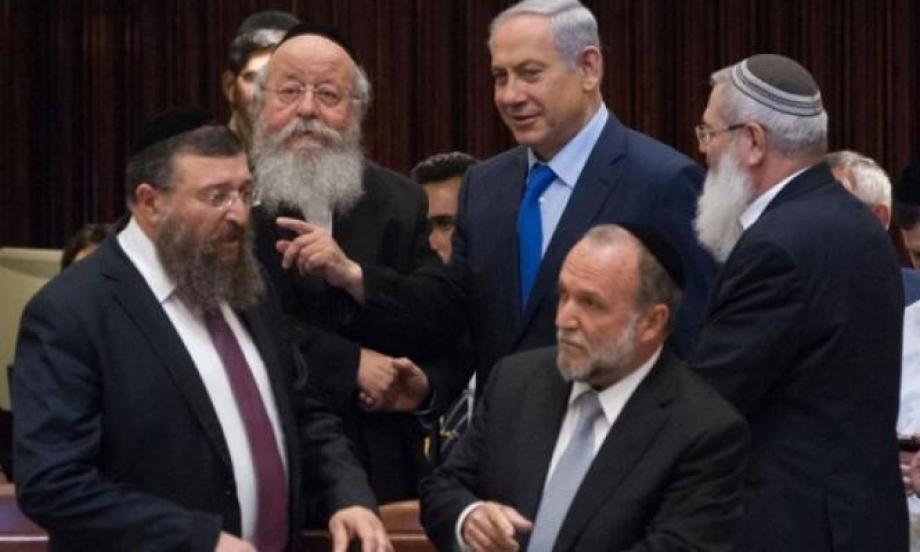
Johnny Mansour: If Shas responds to the call to withdraw, given that the draft law will affect party members, supporters, and advocates, the government will fall.
Sawsan Sarour: The withdrawal of United Torah Judaism and even Shas, the second Haredi party in Netanyahu's government, will not lead to the dissolution of the Knesset.
Mustafa Ibrahim: Despite the fragility of Netanyahu's government and the political heat, there are no real indications yet that it is about to fall.
Amir Makhoul: Deri will not bring down the government, and he is maneuvering on his religious authority. He may seek to bring it down only if Netanyahu is interested in doing so.
Ismail Musalmani: United Torah Judaism's withdrawal from Netanyahu's government is an extremely serious political blow, and the coalition is now in an unprecedented state of fragility.
Dr. Ali Al-Awar: Netanyahu's government will remain strong at this stage because the Knesset will enter a two-month summer recess.
The withdrawal of the religious Agudat Yisrael party from the Israeli government on Tuesday, hours after a similar move by its partner, the Degel HaTorah party, leaves Netanyahu's government with the minimum required to survive: 61 seats out of 120 in the Knesset. The Israeli Broadcasting Corporation reported that Aryeh Deri, head of the religious Shas party (11 seats), had informed officials in his party that he was preparing to withdraw from the government in the coming days.
Agudat Yisrael and Degel HaTorah together form the United Torah Judaism alliance of ultra-Orthodox Israelis of Western origin. It holds seven seats in the Knesset. Its resignation came after the government failed to advance a bill allowing ultra-Orthodox Israelis to obtain exemptions from military service. All of this precedes
The Israeli Knesset will go on its summer recess in a few days for two months and will not return until next October.
Writers, analysts, and experts who spoke to "Y" considered the withdrawal of United Torah Judaism from Netanyahu's government an extremely serious political blow, as it has placed the coalition in an unprecedented state of fragility. They emphasized that despite the fragility of Netanyahu's government and the political heat, there are no real indications yet that it is about to fall.
Some analysts and experts said that if Shas responds to the call to withdraw, given that the draft law will affect party members, supporters, and advocates, the government will fall. However, others explained that Deri will not bring down the government and is maneuvering on his religious credentials. He may seek to bring it down only if Netanyahu is interested in doing so.
The Netanyahu government's lifespan is nearing its end.
Historian and Israeli affairs researcher Johnny Mansour said, "It appears that the Netanyahu government's term is nearing its end after two ultra-Orthodox parties announced their withdrawal from the coalition and the government itself."
Mansour believes this announcement came against the backdrop of these two parties' rejection of the amended version of the conscription law reached two days earlier with the ruling Likud party.
He added: "The two Haredi parties have requested the cancellation of 73,000 conscription orders for Haredi religious members who are members of religious, educational, and civil institutions and perform duties they consider more important than and substitute for military service. However, at the same time, the two parties believe that the breach of the agreement with them has prompted them to take this step."
Mansour emphasized that the resignation and withdrawal from the government coalition take effect 48 hours after the resignation and withdrawal letters are submitted. Netanyahu thus finds himself facing a major dilemma: a fragile and weak government versus an opposition camp joined by Degel HaTorah and United Torah Judaism.
government with a slim majority
He added, "However, despite this, the government coalition has 61 votes, a very slim majority." He noted that Netanyahu fears that these two parties are exerting pressure on a third ultra-Orthodox party in the government, the Shas movement of religious Mizrahi Jews, which holds 11 seats.
Mansour said: "If Shas responds to the call to withdraw, because the draft law will affect party members, supporters, and advocates, the government will fall. But if Netanyahu succeeds in this maneuver, which he is a champion of, he will extend the life of his government for a few days until the Knesset goes into summer recess. At that point, the government will remain under the title of a 'caretaker government,' until the Knesset convenes and new elections are announced."
Mansour believes that in this way, Netanyahu has exhausted all the time he wanted for his political career by assuming this government, which is more right-wing and extremist than any Israeli government in history. He asserts that the next few hours will be filled with rapidly evolving events in this regard.
Two major dilemmas posed a challenge to the survival of Netanyahu's government.
For her part, journalist Sawsan Sarour, an observer and critic of the Israeli political scene, emphasized that two fundamental dilemmas posed a real challenge to the survival of Netanyahu's government. One began early on, with the government's launch, and deepened during the ongoing war on Gaza. This dilemma relates to the issue of exempting ultra-Orthodox Jews from military service. The other, also related to the war on Gaza, is reaching a deal to end the conflict.
She noted that during the months of the ongoing war, which has reached its 21st month, the Religious Zionism party, led by Finance Minister Bezalel Smotrich, and the Jewish Home party, led by Internal Security Minister Ben-Gvir, have dominated the scene with their categorical refusal to reach ceasefire agreements in Gaza. They have posed a real threat on more than one occasion, even leading to the resignation of Minister Ben-Gvir and his party from the government at the beginning of this year in rejection of the January 19th deal.
On the other hand, Degel HaTorah and Agudat Yisrael, which together form the United Torah Judaism bloc in the Knesset with a total of seven members, remained neutral, without any tangible impact on the real threat to the Israeli government, in order to conclude deals to return the Israeli detainees in the Gaza Strip for religious and humanitarian reasons. However, their sole concern was how to evade recruitment into the ranks of the Israeli army.
Several months of evasion, procrastination and evasion
Sarour explained that Israeli Prime Minister Benjamin Netanyahu succeeded, over the course of months of long negotiations, in evading, stalling, and avoiding a resolution to the issue due to the overwhelming refusal, even within his own Likud party, to exempt the Haredim from military service. This led to the day when his "magic" stopped, his cunning was exposed, and he was no longer capable of deceiving anyone.
She noted that the government coalition relies on 67 Knesset members (following the withdrawal of MK Avi Maoz, leader of the settler "Noam" party, in March of this year) out of a total of 120 members. With the withdrawal of the seven MKs from "United Torah Judaism," the coalition's strength drops to 60 seats, which, on the one hand, hinders its work in the Knesset.
On the other hand, journalist Surur mentioned that the Israeli Knesset will go on its summer recess on the 27th of this month, just ten days away, which means that the impact of the United Torah Judaism party's withdrawal at this particular time was planned, programmed, and engineered to avoid causing serious damage, especially since the party's withdrawal did not bring any benefit to the Israeli opposition, as the party refused to request the dissolution of the Knesset and hold early elections.
Surur summarized the internal scene in Israel by saying: “The withdrawal of United Torah Judaism from the government, and even the withdrawal of Shas, the second Haredi party in this government, will not lead to the dissolution of the Knesset during the few remaining days of this summer session. Therefore, the Knesset will go on summer recess, giving Netanyahu time to regain his magic and maneuver once again. If he fails, the festive day marking the start of the Knesset’s winter session on October 20 of this year will turn into the fateful day on which the dissolution of the Knesset will also be announced. Therefore, Israel will head to early elections at the beginning of next year, 2026. During this period, until the elections, Netanyahu will continue to head a minority government.”
The issue of exempting religious institute students from military service
In turn, Mustafa Ibrahim, a writer specializing in Israeli affairs, said that the withdrawal of the Ashkenazi Haredi parties, Degel HaTorah and United Torah Judaism—a coalition made up of the two Ashkenazi (Western) Haredi parties—means that Netanyahu is now in jeopardy regarding the law exempting yeshiva students from military service.
He added: This is a very sensitive issue in Israel, and there is pressure from within the Likud party on Netanyahu to move forward with passing this law.
Ibrahim pointed out that "these parties, as Israeli media reports, have become accustomed to living off the Israeli public interest," explaining that their withdrawal has deepened the government's fragility. Although the party holds six seats, the balance of power between the government and the opposition has become almost equal, with the coalition now holding only 61 seats.
He believed this gave Netanyahu limited room to maneuver, saying, "Netanyahu, the experienced politician, is trying to maintain his government until the Knesset goes on recess, but he knows that this government has become fragile, especially since it will not be able to pass any bold or sensitive laws during the recess without prior preparation."
He pointed out that going on vacation gives Netanyahu a brief window of opportunity to continue, and that this may coincide with the approaching announcement of a ceasefire in Gaza, allowing his government to survive temporarily, although it remains threatened at any time. He said: "Despite Netanyahu's attempts to play on contradictions, his government is weakening day by day."
Ibrahim addressed the position of the Shas party, the ultra-Orthodox party led by Aryeh Deri, whom he described as a close friend of Netanyahu's, saying, "I don't think Shas will leave the government despite the embarrassment it is facing."
He added that the two Ashkenazi Haredi parties may be aiming to achieve political gains by pressuring Netanyahu, and that this may be part of a temporary tactic aimed at improving their standing before the upcoming elections.
The government will not collapse in the near future.
Ibrahim pointed out that the leaders of these parties prefer to remain in the political arena and maneuver within it rather than withdraw completely, because they can reap benefits even if Netanyahu is no longer able to fully satisfy them.
He emphasized that the government is unlikely to collapse in the near future, as Netanyahu will continue to work to consolidate his government at least until after October 21. He may then announce the dissolution of the Knesset if he feels ready to call early elections.
In another context, Ibrahim said that the Ashkenazi Haredim do not pose a threat to the government regarding the prisoner exchange deal or the Gaza truce, but may even support these issues.
He added, "This phase may be exploited politically to return to the path of judicial reform, and the coalition may seek to dismiss the attorney general who refused to attend the last hearing."
Ibrahim concluded, "Despite the fragility of the government and the political heat, there are no real indications yet that Benjamin Netanyahu's government is about to fall. However, if he fails to satisfy the Haredim, the crisis could escalate to include the Likud party, which is insisting on passing the draft exemption law amid pressure from the army and a shortage of recruits."
Anticipating the Shas party's decision
For his part, Amir Makhoul of the Progress Center for Policy Studies confirmed that the Israeli political arena is awaiting the Shas party's decision on whether to remain in the ruling coalition or resign.
He said: "Following the resignation of the Haredi Torah Judaism bloc, which, with its two main factions, Degel HaTorah and United Torah Judaism, comprises seven members, the ruling coalition has shrunk for the first time since December 2022 to 61 members out of 120. This is a legally binding situation, but it is not necessarily politically stable. He pointed out that the resignation will take effect on July 17, 48 hours after the resignation letters are submitted, and they can legally withdraw it during this period.
Makhoul believes that if Shas withdraws from the ruling coalition, Netanyahu's government will become a minority government, and it would not necessarily fall unless there is a majority to bring it down. This means that the two ultra-Orthodox parties would form an alliance with the opposition parties, and this is unlikely, at least for now, since their constituency, and exclusively the Shas constituency, opposes an alliance with Lapid and Lieberman, who raise the flag of discord with the ultra-Orthodox, specifically regarding their refusal to serve in the army.
Makhoul asserted that the resignation of the Torah Jews movement has increased the political standing of the Shas movement, led by Aryeh Deri, vis-à-vis Netanyahu. He noted that the Shas political leadership, unlike a number of its religious leaders, is not interested in withdrawing and causing new elections in which it could lose power along with its historical ally, the Likud party.
Netanyahu is besieged by the deal's international, American, and Israeli implications.
He added that both Haredi blocs want to conclude a deal and stop the war on Gaza. However, Shas, in particular, is greatly concerned about the expansion of Kahanist supporters within its ranks, whose positions share those of Ben-Gvir, who is keen for his party, "Jewish Power," to inherit the Shas constituency. Smotrich, meanwhile, is pursuing this approach against Torah Jews. However, Smotrich's chances are weaker than Ben-Gvir's, even though he attacks the Haredim for not serving in the army.
Makhoul emphasized that the move, led by Shas Chairman Aryeh Deri, is aimed at maintaining the historic alliance with Likud. Deri will not bring down the government and maneuver on his religious credentials, and he may seek to bring down the government only if Netanyahu is interested in doing so.
He believes that the fundamental political variable currently is that Netanyahu is besieged by the deal's international, American, and internal Israeli demands, including from the military. He has begun to talk about the deal and ending the war on Gaza. Concluding the deal and ending the war are in Netanyahu's favor, as 75% of public opinion, including large segments of Likud voters, are interested in the deal and ending the war.
He said: "Netanyahu wants the elections to revolve around the Haredi conscription law, not the war on Gaza, which has long been an Israeli dilemma, and which is increasingly perceived locally and internationally as a political war to secure his ruling coalition."
Makhoul emphasized that the timing of the crisis is more like a play for time by the Shas chairman, as the Knesset is due to recess during which it will be impossible to hold a no-confidence vote against the government without a special majority.
The beginning of the "political death throes" phase
For his part, Israeli affairs analyst Ismail Musalmani asserted that the United Torah Judaism party's withdrawal from Benjamin Netanyahu's government constitutes an extremely serious political blow, considering that the government is now in a state of unprecedented coalition fragility.
He explained that United Torah Judaism, the Ashkenazi ultra-Orthodox party, along with Shas, forms the religious bloc on which Netanyahu relies. He added, "The party holds seven seats, and without it, Netanyahu would lose his parliamentary majority, which has fallen from 68 to just 61 seats. This means that the government is no longer able to pass laws on its own."
Musalmani pointed out that the direct reason for the withdrawal was the conscription law, emphasizing that the Haredi leadership feels that Netanyahu has failed to secure immunity for yeshiva students, especially after mounting pressure from the Supreme Court. There is a real fear of the imposition of conscription, which poses a direct threat to their religious identity.
He added, "This withdrawal does not mean the immediate fall of the government, but it represents the beginning of a phase of 'political death throes.'"
He continued: "The government is no longer capable of legislating alone. If a motion of no confidence is submitted and the opposition and right-wing rebels rush to support it, we could be facing the end of this coalition."
Muslimani stressed that Netanyahu has only 48 hours to convince the party to return, noting that "the door to retreat is still open if immediate concessions are made."
Several possible scenarios
Analyst Muslimani put forward several possible scenarios, the most prominent of which are:
- A fragile and temporary restoration of the coalition. “Netanyahu may succeed in quickly reconsolidating the party, but the government’s continuation until the end of 2025 will be fraught with risks.”
- Gradual collapse “If laws cannot be passed, disintegration will begin and the government will collapse.”
- A surprise settlement: A political deal may occur that includes major issues such as Gaza, conscription, or the Supreme Court, but it remains a weak possibility.
Regarding the opposition, Musalmani noted that it is united only around the goal of ousting Netanyahu, but is politically divided.
He warned, "Without a clear political program and real unity, the chances of forming an alternative government remain uncertain.
Maslamani concluded by saying, "The withdrawal of United Torah Judaism is the most serious internal challenge facing the Netanyahu government since its formation. Its fate now depends on its ability to resolve this crisis without imploding the rest of the coalition."
Withdrawal from the government, not from the coalition
For his part, Dr. Ali Al-Awar, a specialist in regional and international conflict resolution at Ben-Gurion University, confirmed that Israeli Prime Minister Benjamin Netanyahu is experiencing a governmental crisis following the announcement by the Degel HaTorah and United Torah Judaism parties of their withdrawal from the government. Although this withdrawal poses a threat to his government, it is not considered a major threat; rather, it paves the way for the possibility of early elections.
Al-Awar explained that the two Haredi parties withdrew from the government, but did not announce their withdrawal from the governing coalition. This is extremely important, as Netanyahu still maintains his parliamentary coalition, preventing his government from immediately falling.
He added that Degel HaTorah's withdrawal will not lead to the government's collapse, especially since the Shas party remains part of the coalition, which maintains Netanyahu's government's cohesion for the time being.
He pointed out that this withdrawal has created an internal crisis for Netanyahu, but it does not pose a real threat to the government's survival. Rather, it could be considered a political prelude to early elections in the coming period.
The impact of the withdrawal will be limited.
He pointed out that the government will remain in place and strong at this stage, as the Knesset will enter a two-month summer recess, which will hinder the possibility of passing laws or taking steps that could lead to the government's downfall. Therefore, the impact of the withdrawal will be limited during this period.
Al-Awar explained that the Shas party had threatened to withdraw, but had not officially announced its departure from the government or coalition, which reinforces the government's stability at the present time.
He believes that Netanyahu's government maintains its strength thanks to the presence of key partners such as Itamar Ben-Gvir and Bezalel Smotrich, as well as recent developments on the ground in the Gaza Strip, which could push Netanyahu toward a potential political deal with Hamas, providing him with additional political support within the Israeli public.
Al-Awar indicated that Netanyahu seeks to maintain his government's strength until the Knesset returns from its recess next October, suggesting that the first session after the recess will likely see a date set for early elections, possibly in January of next year.




Share your opinion
United Torah Judaism withdraws: The "fox" will not stop maneuvering to remain in power