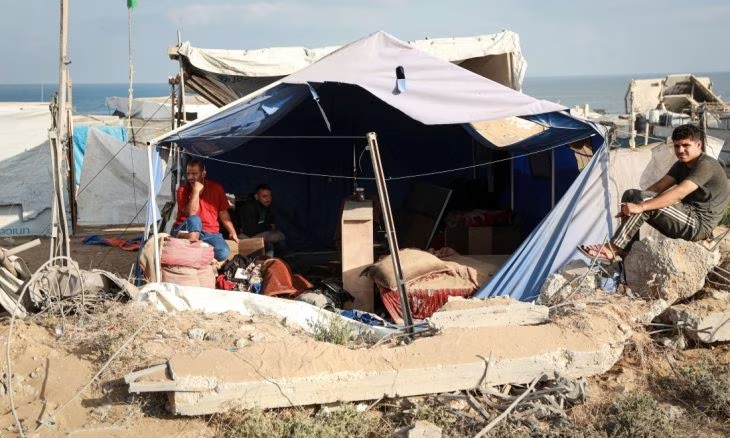







The suffering of displaced Palestinians in the Gaza Strip is escalating as plastic tents become fertile ground for the spread of insects and rodents, turning the lives of thousands of families into a daily hell. In the Al-Mawasi area west of Khan Yunis, residents face nightly battles with swarms of mosquitoes, flies, and rats that attack children's bodies and prevent them from sleeping amid rising temperatures.
Field testimonies from inside the camps describe a tragic reality, where women are forced to perform arduous manual labor, such as washing and cooking over open fires, due to electricity and water outages. Sources confirm that insect bites have left inflamed skin patches on children, while families are unable to provide even the simplest therapeutic ointments or insect repellents, which are prohibited from entering.
This environmental deterioration is directly linked to the accumulation of solid waste piles that have become adjacent to the displaced people's tents, after municipal crews were unable to reach the main landfills. Estimates indicate that there are about one million tons of garbage collected in 23 temporary dumps, turning them into breeding grounds for rats and cockroaches that have begun to attack residents' food and bodies.
Municipal sources reported that the occupation authorities have prevented trucks from reaching the central landfills located in the eastern areas, which are within what is known as the 'Yellow Line,' since the beginning of the aggression. This prohibition has led to the accumulation of waste in populated areas, increasing the emission of foul odors and the spread of disease-carrying pests among the displaced.
Regarding infrastructure, Munther Salem, Director General of the Water Authority, confirmed that the destruction rate of water and sanitation networks has reached about 90%. This systematic destruction has led to sewage overflowing into the streets and between tents, doubling the risks of environmental pollution and the outbreak of intestinal and skin diseases among vulnerable groups.
The Union of Municipalities of the Gaza Strip warned of the complete collapse of the basic services system due to continuous targeting and the prevention of entry of maintenance supplies and fuel. The Union explained that the continuation of this situation threatens an uncontrollable health catastrophe, especially with the disruption of water pumping and treatment stations that require urgent spare parts.
For his part, Jens Laerke, spokesperson for the United Nations Office for the Coordination of Humanitarian Affairs (OCHA), indicated that the accumulation of solid waste represents a major problem that has not found a solution. Laerke affirmed that international organizations have the capacity to address the crisis, but lack the necessary access and facilities to remove these makeshift dumps.
In the medical field, doctors working in UNRWA clinics expressed their fear of the emergence of deadly diseases not seen in the region for decades, such as plague. A doctor in Nuseirat camp explained that the current conditions of waste accumulation and the spread of rats create an ideal environment for the transmission of dangerous infections, amid a severe shortage of medicines and laboratories.
The Ministry of Social Development recorded in a recent report more than 70,000 injuries related to rodents and environmental pests since the beginning of this year. The report confirmed that the lack of food and clean water, coinciding with rising temperatures, portends a humanitarian catastrophe threatening the lives of hundreds of thousands of citizens, especially children and the elderly.
World Health Organization reports indicate that more than 80% of displacement sites have already reported the spread of contagious skin diseases such as scabies, lice, and bed bugs. The organization attributes this spread to severe overcrowding and lack of personal hygiene due to water loss, as well as restrictions on the entry of necessary medical equipment.
Displaced people in central Gaza City and Nuseirat camp suffer from unprecedented sizes of rats that have begun to attack residents while they sleep, causing direct physical injuries. Local sources say that medical clinics receive daily cases suffering from rodent bites, which requires special vaccines and medicines that are often unavailable.
The occupation authorities continue to tighten the siege by preventing the entry of cooking gas and fuel, forcing residents to use plastic and waste to light fires, which adds air pollution to the environmental crisis. This overlap of visual, auditory, aerial, and water pollution creates an uninhabitable environment in overcrowded shelters.
Competent authorities confirm that the only solution to stop this deterioration lies in allowing the entry of heavy equipment and insecticides and opening roads to the main landfills. Without urgent international intervention to pressure the occupation, the Gaza Strip is heading towards a health explosion whose effects may extend beyond the besieged Strip, due to the interaction of carcinogenic environmental factors.
Gaza residents remain trapped in an endless cycle of suffering, where death pursues them either by aircraft missiles or by silent epidemics that devour their bodies. With each passing day without radical solutions, the piles of waste grow higher, and with them, the list of diseases that plague a society exhausted by long years of war and siege.
Currently, nothing prevents the spread of diseases like the plague; all conditions are ripe for it in the absence of medicines and pesticides.

شارك برأيك
Gaza Between the Hammer of Bombing and the Anvil of Epidemics: Rats and Insects Devour the Bodies of Displaced People