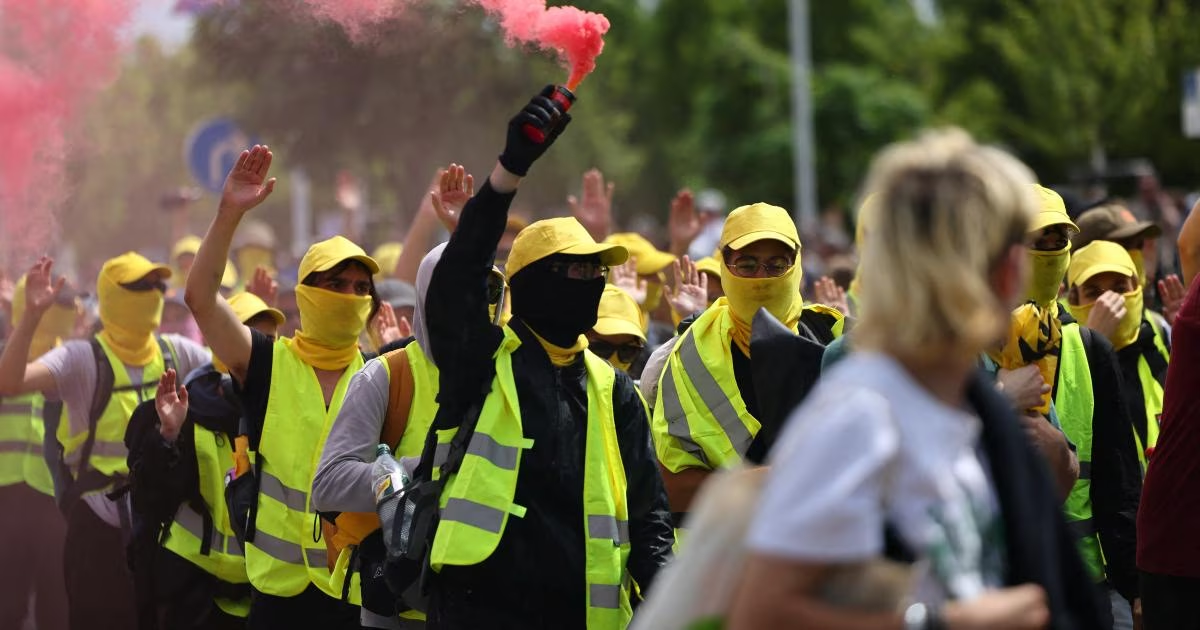







Thousands of demonstrators gathered in the city of Erfurt, eastern Germany, on Saturday, to express their categorical rejection of the policies of the far-right 'Alternative for Germany' party. Protesters carried out extensive closures of the main roads leading to the convention center hosting the party's annual meeting, in a symbolic and practical attempt to obstruct the arrival of participating delegations.
According to estimates from field security sources, the number of participants in these protests exceeded 15,000 people, spread around the city and its center. German authorities mobilized riot police, with additional police reinforcements brought in from other federal states to ensure that the situation did not get out of control and to secure the conference.
Trade unions and civil society organizations, along with left-wing political forces, formed the backbone of these protest movements, which were characterized by sitting in the streets to block traffic. Demonstrators raised slogans warning of the rise of the far-right and its threat to democratic values and pluralism in German society, under close security surveillance by security forces.
Meanwhile, the 'Alternative' party renewed confidence in its current leadership by re-electing Alice Weidel and Tino Chrupalla to lead the party for a new term. This step comes at a time when the party is witnessing a remarkable rise in national opinion polls, where it is strongly competing and sometimes surpassing the conservative bloc led by Friedrich Merz.
_The opening sessions of the conference were marked by a sharp escalation in tone, with party leaders describing the protesters outside as 'enemies of democracy'. Alice Weidel, in her speech to the conferees, emphasized the party's hardline stances, stressing that Germany would not be a place for illegal immigrants, and promised to adopt unprecedented deportation measures if the party came to power.
For his part, the controversial leader Björn Höcke delivered a speech focusing on what he considered a decline in the level of services and general conditions in the country, using daily issues to confirm his vision of 'state deterioration'. This discourse reflects the party's strategy to attract voters by focusing on livelihood crises and linking them to the current government's policies regarding immigration.
These political movements gain double importance as they precede crucial local elections in the states of Saxony-Anhalt and Mecklenburg-Vorpommern in the east of the country. Through this conference, the party seeks to translate its growing popularity in polls into actual electoral gains that enable it to directly influence political decision-making within the German states.
Criminals and illegal immigrants have no place in Germany, and we will work on strict deportation policies.
شارك برأيك
Thousands of protesters block roads to 'Alternative' party conference in Germany amid security reinforcements