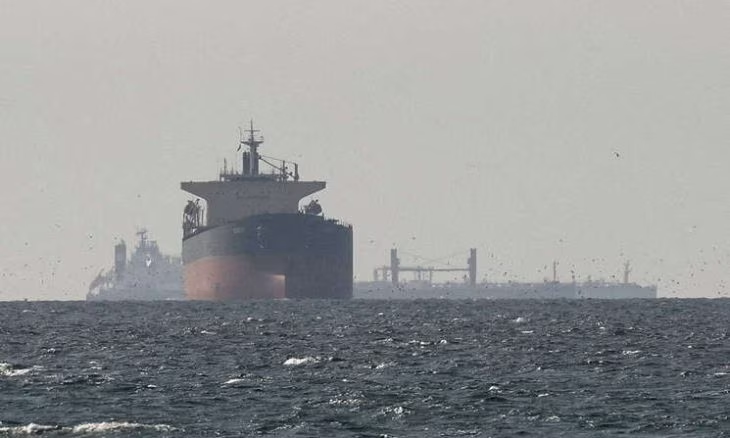







Recent navigation data has indicated a gradual improvement in the movement of oil and liquefied natural gas (LNG) tankers through the Strait of Hormuz today, Monday. This development comes after a state of partial paralysis and slowdown that prevailed in the strategic waterway following the Iranian Revolutionary Guard's announcement of the strait's re-closure earlier this week.
Informed sources reported that the recent Iranian move was a direct response to attacks launched by Israel on Lebanese territories, which led to an immediate decline in the number of passing ships. Tehran had ended a previous closure of the strait last week after understandings with Washington that stipulated a 60-day ceasefire extension to open the door for diplomatic negotiations.
Analysis by 'Kpler,' a company specializing in ship tracking, showed that four Qatari LNG tankers headed towards the strait today, Monday. This is the first time these tankers, namely 'Wadi Al Sail,' 'Mekaines,' 'Al Sadd,' and 'Mesaimeer,' have passed through the Iranian route since the recent military tensions began in the region.
In a related context, two giant tankers, each with a capacity of two million barrels of crude oil, entered the Gulf waters, with one of them announcing its final destination as the Iraqi port of Basra. These movements reflect shipping companies' desire to resume operations despite high security risks and continuous threats of closing the waterway.
For its part, the 'Marine Traffic' platform indicated that two smaller crude oil tankers departed the strait towards the Gulf of Oman, carrying a total of two million barrels of crude. This coincided with a report by 'Clarkson's' shipping brokerage firm confirming that the general trend of navigation has started to become positive, although the number of ships remains below pre-conflict levels.
Kpler data revealed a sharp disparity in traffic, with only five ships crossing the strait on Sunday, compared to about 26 ships the previous day. The passing ships included three giant tankers carrying Saudi crude oil and fuel oil, one of which was en route to Japanese ports.
The Joint Maritime Information Center, led by the US Navy, confirmed a significant increase in commercial navigation traffic using the southern routes through Oman's territorial waters. The statement also indicated that some ships continue their course through the northern passage under Iranian control, suggesting a kind of undeclared de-escalation on the ground.
Regarding Iranian exports, the head of the National Iranian Oil Company stated that more than 25 million barrels of oil have crossed the 'siege line' since last Monday. London Stock Exchange data monitored the departure of three sanctioned giant tankers, 'Elfa,' 'Virgo,' and 'Vigor,' loaded with Iranian oil from Kharg Island.
In an attempt to secure energy supplies, Abu Dhabi National Oil Company (ADNOC) and Kuwait Oil Company offered tenders for crude oil sales with flexible loading options. These options include the possibility of loading from within the Strait of Hormuz or from external terminals to avoid any sudden disruption that might affect navigation in the waterway.
The South Korean Ministry of Oceans and Fisheries announced that two of its vessels successfully crossed the strait following the signing of a temporary ceasefire agreement between Washington and Tehran. The ministry did not disclose the names of the vessels for security reasons, amid the continued caution among global shipping companies.
In Japan, a spokesperson for the Shipowners' Association stated that the number of Japanese-linked ships in the Gulf region has decreased to 37 vessels. This figure represents a decline compared to about 45 vessels present in the region at the start of the military conflict, reflecting Tokyo's risk reduction strategy.
Navigation data showed that two gas tankers controlled by ADNOC, 'Al Hamra' and 'Mubaraz,' delivered shipments to gas terminals in India today, Monday. These two tankers had undertaken what were described as 'dark' voyages, where their Automatic Identification System (AIS) was turned off while crossing sensitive areas in the strait.
Sources in the shipping sector explained that ships resorting to turning off transponders has become a common tactic to avoid targeting or detection amid current tensions. This measure sometimes leads to a lack of accurate data available to global tracking systems, meaning the actual number of passing ships may be higher than recorded.
Finally, the US Central Command stated that on Saturday, 55 commercial vessels crossed the strait, carrying more than 17 million barrels of oil for global markets. This convoy included giant tankers from the UAE, Kuwait, and Iraq, confirming the continued flow of global energy supplies despite repeated Iranian threats.
Daily ship traffic remains below 125 vessels, which is the usual rate before the outbreak of hostilities, but the general trend is positive.
شارك برأيك
Gradual Breakthrough in Navigation in the Strait of Hormuz Following Iran's Announcement of its Closure