






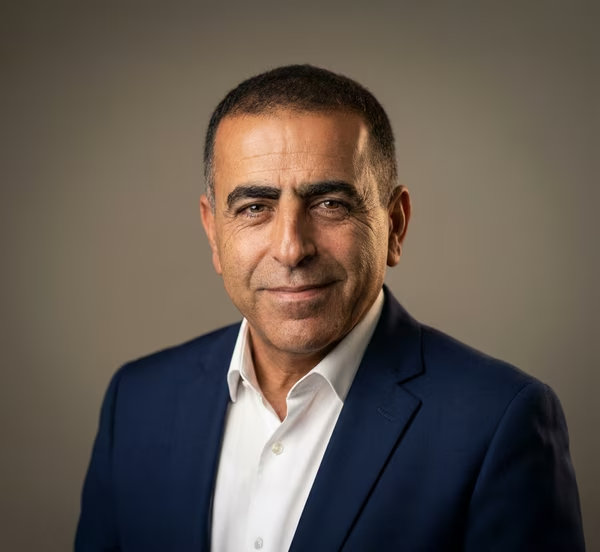
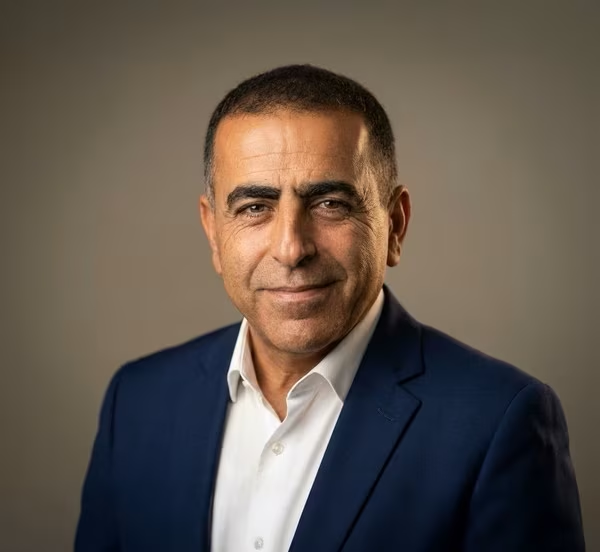
Dr. Ibrahim Nairat
In the West Bank, the future does not appear as a straight path leading to a clear outcome, but rather as a situation open to multiple possibilities where politics intersects with geography, security with economics, and the daily with the strategic. There is a growing feeling that what is happening is not just a fleeting phase, but a long pattern of reshaping reality under constant pressure, without a definitive horizon to rely on or a clear moment of resolution to build upon.
In this context, the question of the future recurs: What next? And does the West Bank hold a major transformation that could redraw the entire scene and overturn the balances, or is what we see the most that current circumstances can produce in terms of continuous conflict management without resolution, with everything remaining in a state of slow motion that reaches neither an explosion nor a settlement?
One of the most prominent paths is the continuation of the status quo, where there is neither a political settlement nor a comprehensive explosion. In this framework, security control over the land continues, and settlement expansion proceeds gradually, while the Palestinian Authority remains in a position of limited powers, facing accumulated economic and administrative crises, and dealing with a reality that changes before it without full ability to control its direction. In contrast, tensions do not disappear, but appear in the form of intermittent confrontations, individual operations, and security reactions, within a state of unstable calm; it appears stable from the outside but carries within it a slow change in facts, where small transformations accumulate until they become a different reality over time without official announcement.
In addition, another path emerges, represented by the escalation of intermittent waves of confrontation that do not take the form of an organized intifada, but are distributed across cycles of escalation and de-escalation. In this pattern, individual or local operations recur, and hotspots emerge in specific areas, with more severe security responses, in a scene not led by a single center or subject to unified leadership, but formed by multi-party interactions influenced by field, economic, and social conditions. This type of escalation does not fundamentally change the general structure of the conflict, but it exhausts it, puts it under constant pressure, increases its fragility, and makes the idea of stability itself more difficult to achieve.
And in a third, deeper layer of possibilities, a slower but highly impactful path can be observed, represented by the gradual erosion of the existing political system. Here, there is no sudden collapse or clear moment of fall, but a gradual decline in the ability of institutions to perform their functions, widening gaps in administration and governance, declining public trust, and the emergence of local forces or decentralized social and security networks filling the vacuum in some areas. This path reshapes reality in an undeclared way, where the actual structure of authority on the ground changes without a major political announcement or official transition, and over time it becomes difficult to distinguish between what exists and what is forming.
At the same time, an internal dimension emerges, no less important than political and field factors, represented by the strained relationship between society in the West Bank and political leaders at various levels. With the accumulation of crises and the exacerbation of economic and social conditions, from rising unemployment rates, declining growth opportunities, and the pressure of daily life under continuous restrictions, there is a growing sense that the ability to influence the course of events has become limited for all political actors. This feeling does not mean a complete collapse of trust, but it reflects a gradual shift in the general mood, where a part of society tends to assign broader responsibilities to the leadership system with all its spectrums, amid a growing feeling that the actual impact on reality has become weak compared to the magnitude of the accumulated challenges. And as the gap between expectations and reality widens, the question of political effectiveness becomes more prominent, not only towards the authority, but towards all existing forms of political representation.
In contrast, the possibility of a widespread explosion remains present in the analysis, although it depends on the accumulation of exceptional factors that are not easily available individually. This scenario could form if a major security escalation intertwines with a severe political or economic collapse, or a shocking event that widely re-mobilizes the scene, or a moment of comprehensive loss of confidence in the possibility of the current situation continuing. Then the scene could shift from a state of daily conflict management to a widespread confrontation in which popular participation expands, the nature of political and field action changes, and the traditional boundaries between different areas and hotspots recede, but this path remains conditional on complex circumstances and cannot be considered an inevitable or necessarily imminent outcome.
Between these paths, there is a less prominent but theoretically existing possibility of a partial re-engineering of the situation through limited political, security, or economic arrangements. In this scenario, regional or international understandings or interventions may emerge that lead to improvements in some aspects of movement, economy, or local administration, without reaching a radical solution to the conflict and without changing its essence, which means a new management of balances more than a transformation in the nature of the problem itself.
But what makes the West Bank a highly complex case is that these scenarios do not compete as separate alternatives, but coexist within the same reality and operate simultaneously. The scene moves in more than one direction at the same moment: relative stability in one place, escalation in another, and slow erosion in the structure of governance, with the possibilities of explosion or partial de-escalation remaining open depending on the interaction of local, regional, and international factors, and on unexpected transformations that may suddenly appear without clear precursors.
In this sense, the “unknown” in the West Bank does not seem to be a single hidden event awaiting its moment of appearance, but rather the product of a continuous interaction between multiple forces that shape reality day by day, so that the future itself becomes the result of this interaction and not a predetermined destination. Therefore, the West Bank does not face a single answer for the future, but a wide spectrum of possibilities, one of which may advance over the other at a certain moment without prior warning.
In the end, the question remains open to more than one possibility: Will the West Bank continue to manage a long, unresolved conflict, with the continuous reproduction of the same reality in different forms, or will it enter a phase of deeper transformations that redefine the shape of the entire scene, either gradually in the long term or through sudden transformations that rearrange all that exists?
شارك برأيك
The West Bank and Scenarios of Transformation: Fragile Stability on the Brink of a Deferred Explosion