






Washington Message
Washington – Said Arikat – 6/4/2026
News Analysis
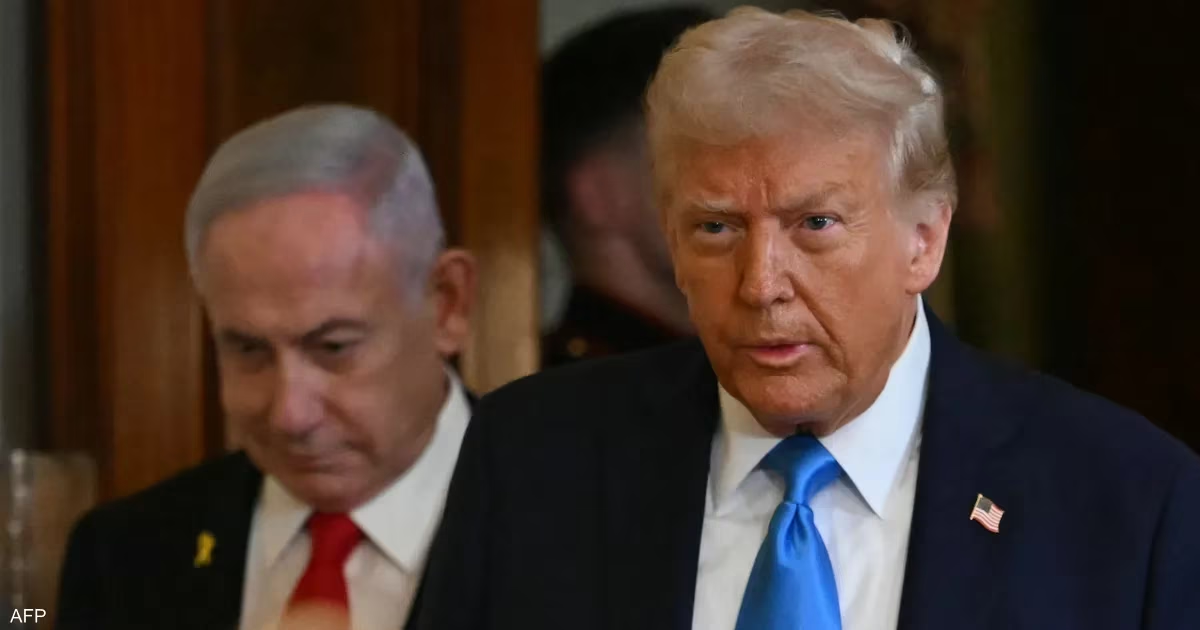
Republican Representative Thomas Massie reopened the debate about the nature of the relationship between Washington and Tel Aviv, and the seriousness of the American administration in exerting any real pressure on the Israeli government, following reports of a sharp tension between US President Donald Trump and Israeli Prime Minister Benjamin Netanyahu against the backdrop of Israeli military escalation in Lebanon and continued regional tension.
Massie's statements came in response to media reports that Trump had directed harsh and unprecedented criticism at Netanyahu during a phone call between them, expressing his dissatisfaction with Israeli military policies that threaten to expand the scope of the conflict in the region. However, the Republican representative, known for his anti-foreign military aid stances, considered that these statements, no matter how severe, remain without real political value unless accompanied by practical measures.
Massie said that ending the wars Israel is fighting does not require speeches or angry phone calls, but rather a clear American decision to freeze military and financial aid. He believed that the continued flow of American support gives the Israeli government a feeling that it is immune from any accountability or real pressure, which makes public criticism merely media messages that do not change anything on the ground.
He added that the United States possesses enormous leverage if it wanted to use it, noting that stopping aid for a short period would be enough to force Israel to reconsider its military and political calculations. He also linked the continuation of conflicts in the region to global economic repercussions, considering that de-escalating conflicts could contribute to stabilizing energy markets and lowering fuel prices.
Massie's statements come at a time when questions are increasing within American political circles regarding the limits of unconditional support Washington provides to Israel, especially after long months of continuous wars in Gaza and Lebanon and ongoing tension with Iran. While successive American administrations talk about the importance of restraint and avoiding escalation, critics note that American military and political support has not stopped, which weakens the credibility of any warning messages Washington sends to Tel Aviv.
According to reports, Trump informed Netanyahu during the call that his military policies were harming Israel's image and international standing, and that they were increasing its isolation on the global stage. Although this language is sharper than usual in public discourse between the two sides, observers point out that US-Israeli relations have previously witnessed similar disagreements that did not reflect on the volume of aid or the level of strategic cooperation.
This was not the first time that signs of divergence between Washington and Tel Aviv appeared. In recent years, there have been repeated disagreements over the management of regional wars, mechanisms for dealing with the Iranian file, and the future of Gaza, but these disagreements remained within the framework of tactical differences, while the strategic alliance remained unchanged.
Massie's statements reveal a growing rift within the American conservative movement itself regarding the relationship with Israel. After decades of near-complete consensus within the Republican Party on providing unlimited support to Tel Aviv, limited but influential voices have begun to question the political and economic cost of this open commitment. This shift does not reflect sympathy for Israel's adversaries as much as it expresses a growing isolationist tendency within segments of the American right that believe foreign wars drain American resources and embroil Washington in crises that do not serve its direct interests.
In another post, Massie directed direct criticism at Netanyahu, considering that his insistence on prolonging confrontations with Iran raises serious questions about the role he played in pushing the American administration towards more escalatory options. He believed that the continued obstacles to any political settlement reinforce the impression that some Israeli parties do not see an interest in ending the state of war, but rather consider it a means to maintain internal political balances that serve their survival in power.
These accusations are particularly important because they come from a Republican representative who cannot be accused of belonging to the liberal or leftist camp critical of Israel. Therefore, they reflect deeper shifts in the American political mood, where the debate is no longer limited to the moral or humanitarian aspects of wars, but has extended to the question of American national interests themselves. This trend gains strength as fears increase of the United States being drawn into broad regional confrontations that may impose financial and military burdens that are difficult to justify to the American public.
Massie's stance also has a personal and political dimension, as it comes after his loss in the primary elections to a Trump-backed candidate in one of the most expensive electoral competitions in the history of House elections. The race witnessed an unprecedented flow of money from pro-Israel lobbying groups and donors, exceeding $30 million, which brought back to the forefront the old debate about the influence of political money in shaping the positions of members of Congress on Middle East issues.
Massie's experience points to a growing phenomenon in American politics, which is the use of massive electoral spending to punish voices that deviate from the traditional consensus on Israel. Many observers fear that this will narrow the space for democratic debate within Congress, so that the cost of political dissent becomes so high that it pushes many to silence. However, the increasing criticism from figures belonging to different intellectual currents suggests that the debate about the nature of the American-Israeli relationship will not recede, but is likely to expand further in the coming years.
Ultimately, observers believe that the core of the issue does not lie in the severity of the words exchanged between Trump and Netanyahu, but in the more important question: Does Washington have the political will to use its enormous influence over Israel when its policies conflict with American interests? So far, the answer, in the view of critics like Massie, seems to be that the declared disagreements are still closer to managing differences than to exerting real pressure capable of changing facts on the ground.
شارك برأيك
Massie: Trump-Netanyahu rift is mere talk unless Washington stops military aid to Israel