






By: Said Arikat
May 12, 2026
News Analysis
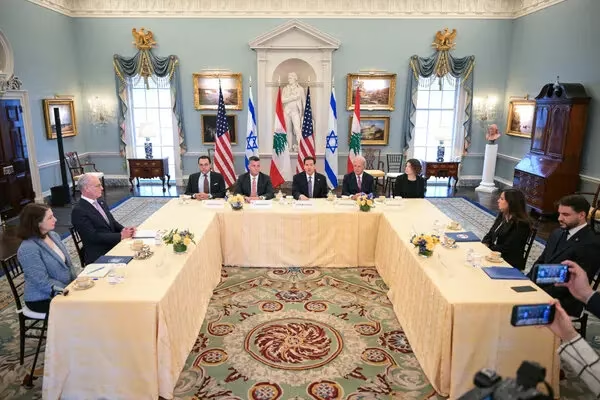
Washington, D.C- On Thursday, May 14, the Lebanese and Israeli ambassadors to Washington are scheduled to meet for a third round of US-sponsored talks aimed at reducing tensions along the Lebanese-Israeli frontier. So far, the previous meetings have been largely ceremonial, producing little beyond cautious statements about de-escalation and continued dialogue. Yet even if these encounters remain symbolic for now, the political trajectory they represent carries profound risks for Lebanon.
Lebanon’s possible entry into direct negotiations with Israel would not simply mark a diplomatic adjustment. It would represent a strategic transformation capable of reshaping the nature of the conflict itself. The central issue is not whether talks can temporarily calm the border or prevent another war. The deeper danger lies in the imbalance of power between the two sides and in Israel’s long history of using negotiations to consolidate regional advantage rather than pursue equitable peace.
Israel enters any negotiations backed fully by the military, economic, and diplomatic power of the United States. Lebanon, by contrast, approaches the table weakened by economic collapse, political paralysis, and severe institutional fragility. Under such conditions, negotiations rarely become exercises in mutual compromise. More often, they evolve into mechanisms through which the stronger side gradually imposes its priorities on the weaker one.
This pattern has defined much of the region’s diplomatic history. Agreements presented internationally as frameworks for “stability” and “security” have frequently normalized Israeli power while leaving the core questions of sovereignty, occupation, and rights unresolved. Lebanon risks entering precisely such a process.
Supporters of direct talks argue that Lebanon desperately needs stability after years of financial devastation, social despair, and repeated military confrontation. Many Lebanese understandably seek any path that could spare the country another catastrophic war. But stability built on structural imbalance is inherently fragile. Negotiations conducted under economic desperation and external pressure rarely produce fair outcomes. Instead, they tend to institutionalize weakness while deepening dependency.
Lebanese skepticism toward direct talks is rooted not in abstraction, but in lived experience. During the recent war, Israel forcibly displaced more than 800,000 Lebanese civilians from towns and villages across the south. Entire residential neighborhoods, farms, shops, and businesses were systematically destroyed, leaving large areas resembling the devastation seen in Gaza. Streets were flattened, infrastructure shattered, and entire communities uprooted. For many Lebanese, entering direct negotiations after such destruction appears less like diplomacy than an attempt to normalize relations through coercion and exhaustion.
At the same time, direct negotiations would hand Israel an important political victory at a moment of growing international scrutiny over its conduct toward Palestinians. Israel faces mounting accusations of collective punishment, war crimes, and systematic violations of international law. Bringing another Arab state into direct political engagement serves a broader Israeli objective: reducing its regional isolation and reframing itself as a normal actor despite continuing conflict and occupation.
This is why even supposedly “technical” or “security-related” talks cannot be separated from their wider political implications. Border discussions evolve into security coordination; security coordination gradually becomes normalization; normalization eventually reshapes public consciousness until the original nature of the conflict itself is obscured. What begins as limited engagement can slowly evolve into long-term political accommodation.
For Lebanon, the danger extends beyond foreign policy. Direct negotiations with Israel could reopen dangerous internal fractures inside a country still shaped by sectarian distrust, unresolved memories of civil war, and competing regional loyalties. Any Lebanese leadership perceived as moving toward normalization would likely face fierce opposition from political and social forces that continue to view Israel as an occupying and expansionist power responsible for repeated destruction inside Lebanon.
In such a volatile environment, negotiations could quickly become a catalyst for domestic instability. Political disagreements over relations with Israel have historically carried existential implications in Lebanon. External pressure aimed at altering Lebanon’s strategic posture — especially regarding Hezbollah and resistance politics — could deepen sectarian polarization and destabilize the fragile balance that has prevented large-scale internal conflict in recent years.
Israel’s own strategic perspective reinforces these concerns. Israeli policy has long viewed Lebanon primarily through a security lens, focusing less on Lebanese sovereignty than on how Lebanon can be managed, pressured, or reshaped to fit Israeli security priorities. Any direct negotiations would therefore be unlikely to remain confined to border disputes alone.
Over time, talks could expand into demands concerning Hezbollah’s weapons, internal Lebanese political arrangements, security mechanisms, and broader regional alignments tied to American and Israeli interests. Under the language of “de-escalation,” Lebanon could gradually find itself pressured into concessions far beyond its original negotiating mandate.
The role of the United States further complicates matters. Washington presents itself as a mediator, yet it remains Israel’s closest strategic ally, providing military aid, diplomatic protection, and political backing across international institutions. This imbalance shapes outcomes. US-sponsored negotiations have repeatedly pressured weaker Arab actors toward “pragmatic compromises,” while Israeli demands are framed as legitimate security concerns.
In the end, the greatest danger of direct negotiations lies not only in what Lebanon may concede formally at the table, but in the political trajectory such talks could unleash inside Lebanon itself. In a country still haunted by the legacy of civil war, forcing a divisive realignment around Israel may not produce stability at all. It may instead deepen internal fractures and push Lebanon toward another dangerous era of rupture.
شارك برأيك
Direct Talks with Israel Could Push Lebanon Toward Internal Rupture