






Washington – Said Arikat – 4/18/2026
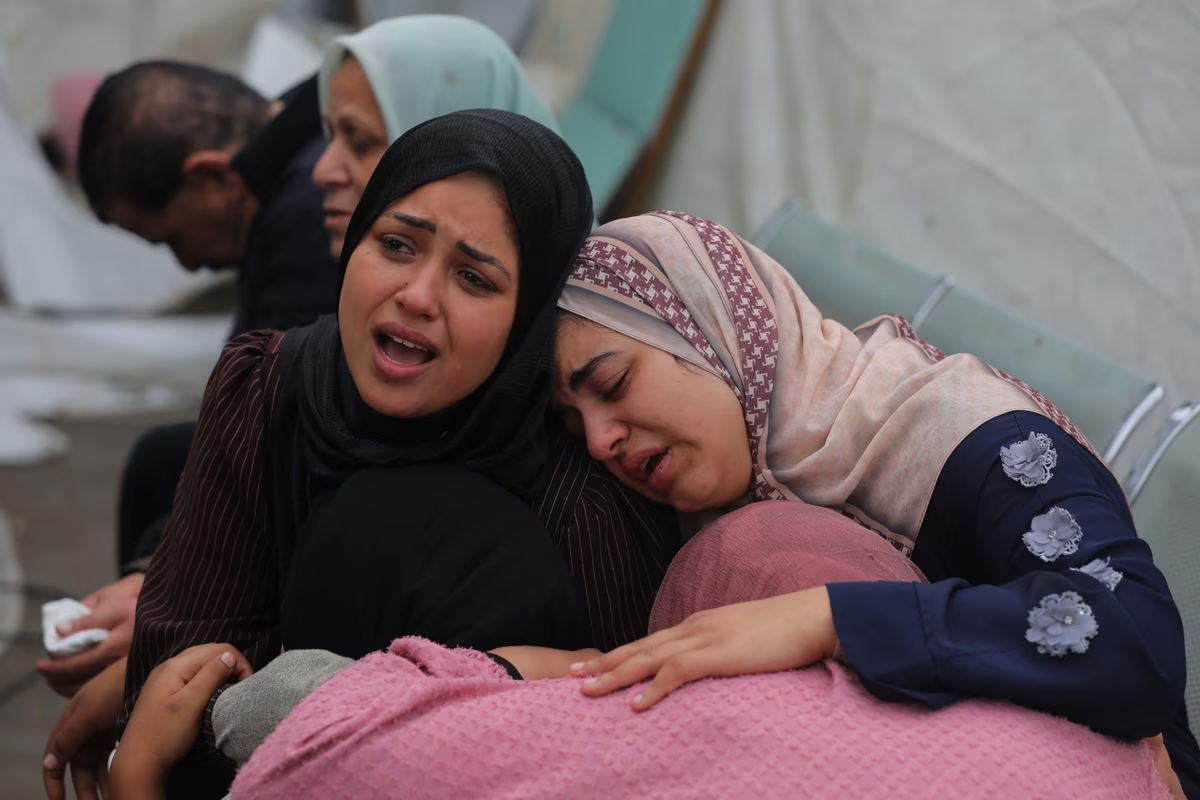
In a scene that encapsulates the brutality of war and the depth of human tragedy, UN Women announced on Friday that more than 38,000 women and girls had been killed in the Gaza Strip by the end of 2025, due to Israeli shelling and ground military operations. This toll places women and girls at the heart of the catastrophe that has swept through the Strip for more than two years.
Speaking at a press briefing in Geneva, the agency's spokesperson, Sofia Kaltorp, stated that the period from October 2023 to January 2025 saw the deaths of more than 22,000 women and 16,000 girls, at a rate of at least 47 women and girls killed daily. These numbers may seem dry on the surface, but they carry within them images of mothers torn from their children, girls whose dreams were suffocated under the rubble, and families whose human pillars collapsed in moments.
The agency clarified that these figures may not represent the full truth, as many bodies remain buried under the rubble, while documentation and reporting systems face harsh conditions due to infrastructure collapse and the ongoing siege. Between the official figures and what the rubble conceals, the chasm of loss widens further and further.
Kaltorp emphasized that the proportion of women and girls among the casualties in this war far exceeded what was recorded in previous wars on Gaza, reaching 15% during the 2008-2009 war and 22% in the 2014 war, while in this round, it has crossed unprecedented boundaries, reflecting the expanded scope of targeting and the collapse of humanitarian protection rules.
But death was not the only face of the tragedy. The agency noted that approximately 11,000 women and girls suffered severe injuries leading to permanent disabilities, turning survival itself into another form of suffering. Women emerged from under the rubble with exhausted bodies, carrying scars that will accompany them for life, in an environment lacking medical care, rehabilitation, and psychological support.
Concurrently, the war redrew the social fabric of Palestinian society within the Strip. Tens of thousands of families are now headed by women who lost husbands and breadwinners, forced to bear the burdens of the family in conditions where providing a minimum standard of living is impossible. No income, no services, no clear horizon, while the mother becomes the last support for a family besieged by hunger and fear.
Approximately one million women and girls also experienced repeated displacement, while about 790,000 females faced critical or catastrophic levels of food insecurity. Between a torn tent and aid waiting lines, the daily journey of searching for water, bread, medicine, and survival is repeated.
The agency indicated that the regional war that escalated after the US-Israeli attack on Iran in February 2025 further complicated the situation in Gaza, due to the closure of crossings and tightened restrictions on aid entry. Despite a fragile ceasefire announced in October 2025, the Ministry of Health in Gaza reported the killing of at least 766 Palestinians since its implementation, while the killing of women and girls continued in recent months, according to the UN agency, making it a war not only measured by the number of dead, but by the number of mothers who are gone, the children who never grew up, and the homes that lost their voice and warmth.
These figures reveal that women in Gaza are no longer mere collateral victims of the conflict, but have become central to the bloody equation of war. When women are killed on this scale, society is targeted in its ability to continue and rebuild. In afflicted societies, women are not isolated individuals, but the core of the family, care, and social cohesion. Therefore, the attrition of women means weakening the entire social structure, transforming the effects of war from temporary destruction into long-term scars that extend across future generations.
The international community's silence in the face of this toll raises deep ethical and political questions. When figures are issued by UN institutions, and then pass as fleeting news in the global scene, the imbalance becomes more than just diplomatic impotence; it is a crisis in the value of humanity itself. If these numbers occurred anywhere else, capitals would shake and platforms would be filled with condemnation. But in Gaza, it seems that the tragedy is consumed as news and then folded away, as if the lives of the victims weigh less in the balance of international politics.
Perhaps more dangerous than direct death is what follows: a society of widows, orphans, permanently disabled individuals, and girls who grew up amidst fear, hunger, and homelessness. These are not immediate losses, but a harsh foundation for a future burdened with psychological, social, and economic trauma. Rebuilding stones is possible, but restoring humans requires many years, political will, and absent justice. Without real accountability, Gaza will remain an open laboratory for reproducing tragedy generation after generation.
شارك برأيك
Gaza Bleeds in Women's Silence: UN Women Confirms 38,000 Women and Girls Killed by Israel During Genocide War