






Washington – Saeed Erikat - 16/4/2026
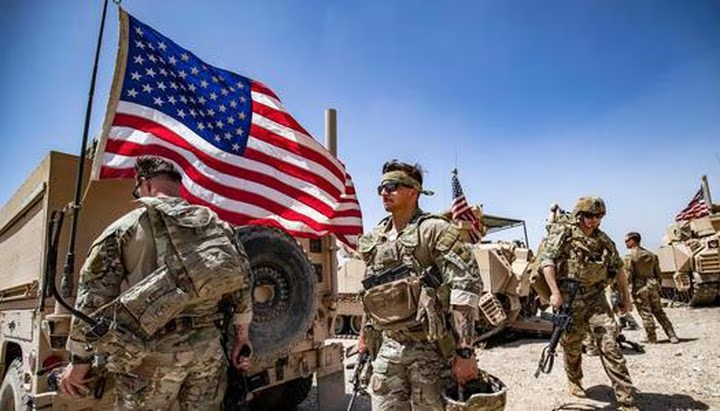
On Wednesday, The Washington Post, citing unnamed American officials, revealed that the United States is preparing to send thousands of additional troops to the Middle East, in parallel with considering resuming a bombing campaign against Iran or moving towards ground operation scenarios within its territory. This escalation reflects a qualitative shift in Washington's approach to the Iranian issue.
According to the report, the reinforcements include about six thousand soldiers aboard the aircraft carrier USS George H.W. Bush and its accompanying warships. Notably, the carrier took a long route around South Africa instead of passing through the Mediterranean and the Suez Canal, a move that suggests precise security calculations, likely related to concerns about potential threats in the Bab al-Mandab Strait.
In parallel, an additional force of about 4,200 American soldiers, including thousands of Marines, is heading from the Pacific aboard the Boxer Amphibious Ready Group, expected to arrive in the region by the end of April. With the completion of this buildup, the number of American forces deployed in the Middle East is expected to exceed sixty thousand, a scene that recalls moments of major tension in the history of the American military presence in the region.
This deployment, along with the tightening of the American blockade on Iranian ports, is presented as a pressure tool to compel Tehran to engage in a diplomatic settlement according to American terms. However, these terms, as proposed by President Donald Trump, go beyond the traditional ceiling for negotiation, as he insists on Iran completely and permanently halting uranium enrichment, even for civilian purposes, a demand widely described as unattainable, which puts the path to de-escalation on the brink of collapse.
The situation becomes more complex with the approaching end of the ceasefire deadline on April 22, amid reports that the American administration is considering carrying out "limited" strikes inside Iran as a means of enforcing compliance. However, such an option, even if presented as tactical, carries the risk of sliding into an open confrontation that could go beyond localized strikes.
Regarding ground options, the report indicated that decision-making circles in Washington discussed a wide range of scenarios, ranging from specialized special forces operations targeting Iranian nuclear materials, and the landing of Marines in coastal areas and strategic islands to secure navigation lines, to taking control of Kharg Island, as a vital node in Iran's oil export network in the Gulf.
Conflicting statements confuse the American domestic scene
Amid this escalation, President Donald Trump's conflicting positions emerged, reflecting a degree of confusion in official discourse. While he emphasizes in some statements his preference for diplomatic solutions and avoiding long wars, he returns in other positions to hint at the use of military force and imposing maximum conditions on Tehran. This fluctuation not only affects external relations but also reverberates within the United States itself, where criticism is escalating from political and media circles that see the lack of strategic clarity as a factor that confuses allies and undermines public confidence in the administration's ability to manage a crisis of this magnitude.
These developments reveal a renewed tendency in American policy to use military force as a negotiating tool, even in issues that require long and complex diplomatic paths. This approach, while achieving immediate pressure, often leads to counterproductive results, as it strengthens the rigidity of adversaries' positions and pushes them to seek strategic alternatives, either through escalation or through building counter-alliances. Moreover, insisting on maximum, practically unenforceable conditions, empties the negotiation process of its content, turning it into mere cover for pre-determined military actions.
The American military buildup in the Middle East also reflects Washington's continued reliance on a traditional security approach, despite profound shifts in the structure of the international system. At a time when major powers are diversifying their tools of influence through economy, technology, and multilateral diplomacy, the United States seems to be reproducing old patterns of dominance. This approach not only drains resources but also weakens Washington's ability to build sustainable partnerships, as its regional partners view the cost of engaging in open conflicts with concern.
According to experts, the most dangerous aspect of this policy is the absence of a comprehensive vision for the post-escalation phase. Recent history shows that American military interventions, when not accompanied by a clear political strategy, lead to complex security vacuums that are difficult to contain. In the Iranian case, any widespread confrontation could quickly extend beyond its geographical boundaries, to include energy corridors and global markets, threatening economic and political repercussions that would affect the American domestic scene itself. Thus, military adventure transforms from a deterrent tool into a source of long-term instability.
شارك برأيك
The United States strengthens its military presence in the Middle East and hints at escalatory options within Iran