






Washington – Saeed Erikat – 4/14/2026
News Analysis
The crisis between the United States and Iran has entered a highly sensitive phase, with increasing indications of a possible resumption of negotiations in the coming days, despite the absence of any decisive resolution on the matter so far. According to an American official quoted by the "Associated Press" agency, a new round of talks might resume perhaps on Thursday, without official confirmation of either its final date or its potential venue. This comes amidst intensive diplomatic efforts led by Pakistan, in an attempt to bring both parties back to the negotiating table after the collapse of the previous round.
In contrast, this fragile diplomatic activity reflects an escalating on-the-ground reality, where the United States has begun imposing strict naval measures on Iranian ports, described as an actual naval blockade, which portends serious repercussions for regional security and global economic stability, especially with the fragile ceasefire still tenuously holding.
In this context, US Vice President J.D. Vance stated on Monday that the United States sees the possibility of reaching a “grand bargain” with Iran, but he stressed that the next step is up to Tehran. In an interview with "Fox News," Vance clarified that the Islamabad talks "were not entirely bad," indicating that the Iranian side showed some flexibility and moved towards the American position, but these steps "were not enough to satisfy Washington," according to his expression.
Vance affirmed that the primary condition for the American administration is the complete disarmament of Iran from any uranium enrichment capability, adding: "We want to get enriched uranium completely out of Iran." He also linked the possibility of concluding the desired deal to Tehran abandoning its pursuit of nuclear weapons and stopping what he described as "support for terrorism," reflecting the continued deep gap between the positions of the two parties.
The previous round of talks, which lasted about 21 hours in the Pakistani capital Islamabad, ended on April 11 without reaching an agreement, despite being the highest level since 1979. According to diplomatic sources, disagreements focused on complex strategic issues, most notably the Iranian nuclear program, Tehran's regional role, and security arrangements in the Strait of Hormuz.
Following the announcement of the failure of negotiations, signs of military escalation began to appear, with reports indicating that the US Navy began, as of April 13, implementing strict measures to monitor Iranian ports, in a step aimed, according to Washington, at preventing arms smuggling and imposing further economic pressure. However, Tehran considered this step a dangerous escalation, warning that it could lead to widespread disruptions in global energy markets, especially if shipping in the Gulf is affected.
These measures were accompanied by a tough American tone, with President Donald Trump threatening to target any Iranian ships attempting to break the blockade or threaten US forces. In contrast, Iran affirmed that any infringement on its maritime sovereignty would be met with a firm response, stressing that the security of the Strait of Hormuz represents a "red line."
Regarding negotiating obstacles, gaps remain on key issues, foremost among them Iran's insistence on retaining its right to enrich uranium and its adherence to its regional role, against American demands for a comprehensive halt to high-level enrichment, a reduction of regional influence, and linking any sanctions relief to tangible concessions.
Despite this deadlock, Pakistan continues its mediation efforts, with its Foreign Minister Ishaq Dar seeking to bridge viewpoints, leveraging his country's balanced relations with both parties. Estimates suggest that the success of this mediation will remain contingent on the extent of Washington's and Tehran's willingness to make mutual concessions.
Meanwhile, international concerns are growing about the repercussions of the naval blockade, given the Gulf's importance as a vital corridor for energy supplies. Any disruption in oil traffic through the Strait of Hormuz could lead to a sharp rise in prices and threaten global economic stability at a stage already characterized by market fragility.
This blockade also complements the system of economic sanctions that the United States seeks to tighten, by targeting Iranian oil exports and its commercial networks, which pushes Tehran to seek alternatives, either through circumvention channels or by strengthening its relations with rival international powers.
The rapid collapse of negotiations reveals a structural flaw in the American approach, which combines military escalation and diplomatic engagement without providing sufficient ground for trust. The "maximum pressure" policy may succeed in weakening the adversary economically, but it rarely pushes it to make strategic concessions that affect the core of its national security. On the contrary, these pressures often reinforce the hardline tendency of Iranian decision-makers, pushing them to adopt more rigid positions, which complicates the chances of reaching a sustainable settlement.
In contrast, the Iranian position based on full adherence to its nuclear and regional rights poses significant challenges, as it clashes with an international reality that does not easily allow for the consecration of such a role without cost. Insistence on this approach, amidst escalating blockade and pressures, could lead to further isolation and restrict Tehran's economic options. Hence, there is an urgent need to adopt a more flexible approach that balances sovereign constants with the requirements of realistic engagement in the international system.
As for Pakistani mediation, it faces a complex test in a highly turbulent political and security environment. Its success depends not only on bringing the two parties together but also on its ability to formulate innovative compromises that take into account the sensitivities of the issues at hand. In light of the deep distrust between Washington and Tehran, this mediation could represent a rare opportunity to avoid escalation, but it remains contingent on a political will that so far appears hesitant, if not entirely absent.
شارك برأيك
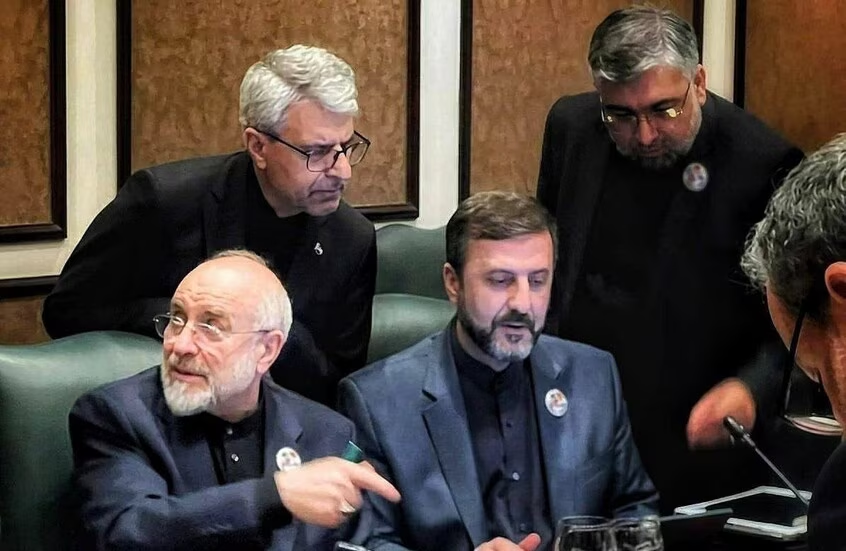
Indicators for the resumption of Washington-Tehran negotiations amidst escalating naval blockade