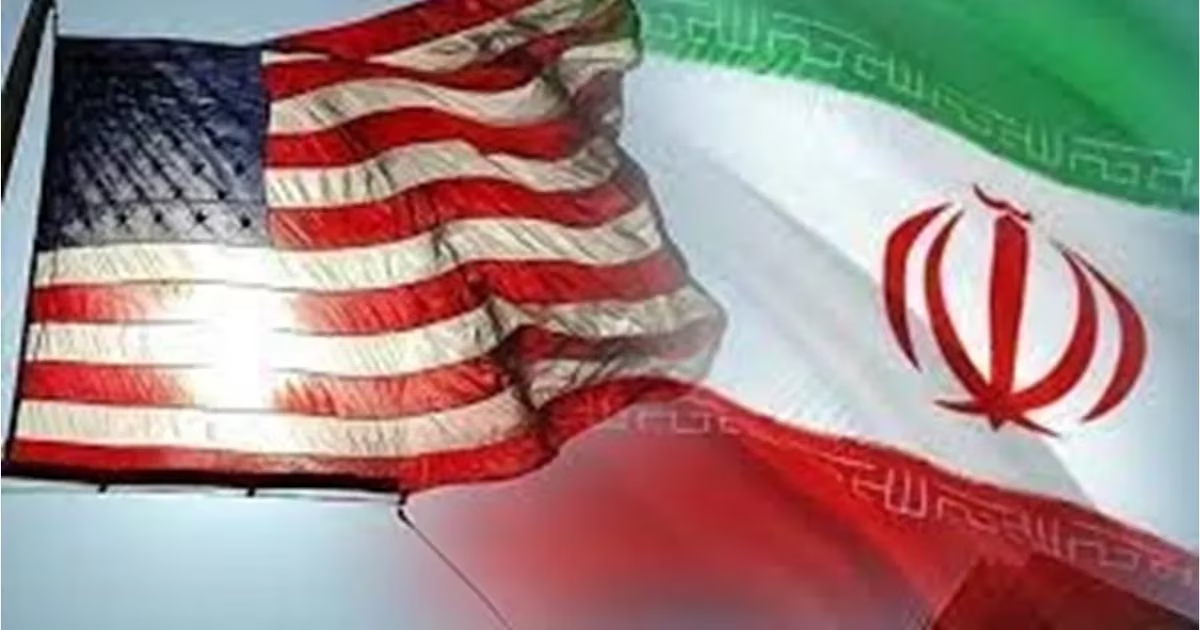







Current developments in the international political scene do not appear to be merely a traditional conflict between a victor and a vanquished, but rather closer to an open confrontation temporarily frozen under a fragile negotiating cover. Each party enters the dialogue table burdened with a high ceiling of conditions, attempting to market a special narrative to its audience, implying that it has managed to impose its rhythm on the other party.
Upon closer inspection of the details, it becomes clear that what is presented as American points and Iranian proposals is nothing more than an expression of two completely contradictory visions. The United States, through the 15-point package it put forward, is trying to promote its success in shifting negotiations to the core sensitive issues that concern its national security and the security of its allies.
The American vision includes radical demands, including dismantling Iran's military nuclear program, halting enrichment operations, controlling the ballistic missile system, and ending Tehran's regional influence. Washington considers that merely including these items on the table represents a political achievement that proves its ability to exert pressure.
In contrast, Iran refuses to deal with these items as a fait accompli or self-evident truths, but rather places them in the context of 'proposals under negotiation.' Tehran promotes to its audience that the United States' acceptance of opening the door to dialogue and a temporary ceasefire is a direct result of its steadfastness and its rejection of dictates under the weight of economic pressures.
Tehran put forward ten counter-items through which it aims to redefine the international agenda, shifting it from a technical focus on the nuclear program to a broader discussion that includes comprehensive regional security. Iran seeks to obtain clear guarantees of non-aggression and sanctions relief as a fundamental condition for any future progress.
The paradox is clearly evident in the 'nuclear versus security' file, where Washington sets red lines related to halting enrichment and dismantling facilities. Meanwhile, Tehran avoids clear commitment to these issues, promoting that the top priority has become to ensure non-exposure to military attack and to end the ongoing state of war.
As for the sanctions file, the gap appears wide; the United States affirms its readiness to lift sanctions only within a comprehensive deal that guarantees major Iranian concessions. Meanwhile, Iran insists that lifting sanctions is a fundamental and unconditional sovereign right, and places it as a central item in any dialogue, away from the logic of bartering.
Regarding regional influence, Washington stipulates an end to support for factions and proxies in the region as evidence of good intentions and progress in the diplomatic path. Iran responds by demanding a halt to military strikes on its allies, considering that its regional role serves the interest of 'protecting stability' and consolidating its position as an indispensable power.
The Strait of Hormuz stands out as one of the most complex points of contention, where the United States demands guaranteed freedom of international navigation without any restrictions or threats. In contrast, Iran promotes itself as a regulatory and control authority by proposing the idea of transit fees, transforming the file from an international security issue into a sovereign and economic card.
Even the issue of a ceasefire is interpreted contradictorily; Washington presents it as a necessary step to create an atmosphere for serious negotiation. Meanwhile, Tehran considers it a forced American concession that came after the failure of the 'maximum pressure' policy to force the Iranian leadership to surrender under fire.
Minute contentious details, such as the inclusion of the term 'enrichment' in some drafts but not others, are used as tools in the media war between the two parties. Washington uses them to say that Iran is evading its obligations, while Tehran uses them to confirm that the final conditions have not yet been settled and that it still has the ability to modify.
The conclusion indicates that each party is not promoting what has actually been agreed upon, but rather what it has succeeded in introducing into the international discussion agenda. Washington boasts of forcing its adversary to discuss dismantling its capabilities, and Tehran boasts of forcing Washington to recognize its security conditions and halt military operations.
The current truce appears to be no more than a fragile tactical pause in a long and extended conflict, lacking the solid foundations that ensure its sustainability. It is likely that each party will use this time to rearrange its cards and strengthen its field and political capabilities in preparation for upcoming rounds that seem inevitable in the absence of radical solutions.
Ultimately, the 'victory' declared by both sides remains merely a media formulation directed at internal consumption rather than a tangible political reality. The distance between the American ceiling and the Iranian ceiling is still very wide, and the bitter truth is that no one has yet settled the conflict in their favor.
The scene looks as if everyone has won in their own narrative, while the truth is that no one has settled anything yet, and what happened was a consolidation of negotiating positions, not the achievement of their goals.
شارك برأيك
The Battle of Narratives Between Washington and Tehran: When Political Marketing Precedes Field Results