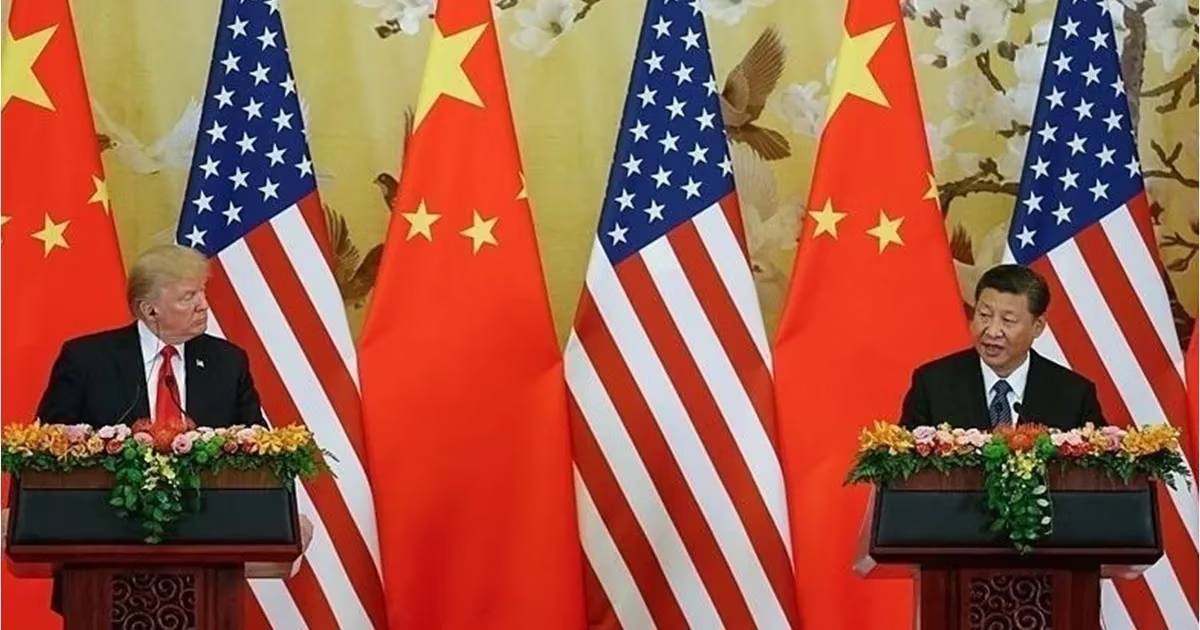







The Economist magazine stated in a recent editorial that promoting war against Iran as a tool to change the balance of power in the Middle East could be completely counterproductive. While proponents of military action see it as a means to weaken the Iranian regime and curb its nuclear ambitions, analysis suggests that the ultimate goal is to subjugate China by controlling global energy corridors.
The magazine explained that the American logic is based on demonstrating the ability to control the flow of oil, making the Chinese economy vulnerable to blackmail or strategic pressure. Washington also aims, through this military display, to restore eroded deterrence and prove its field superiority in the face of Chinese hesitation to protect regional allies.
In contrast, experts and officials in Beijing view this war as 'misguided and arrogant,' and a grave strategic mistake that will ultimately drain American resources. According to diplomatic sources, China has chosen to stand aside and observe Washington sinking into a long-term conflict that weakens its global grip.
Chinese leaders believe that American aggression, as they describe it, reinforces President Xi Jinping's vision of the necessity to focus on national security rather than mere economic growth. They believe that American military involvement will create a strategic vacuum in other regions, which China can exploit to enhance its diplomatic and economic presence.
Reports indicated that Beijing views President Donald Trump's reckless threats and the absence of a clear strategy as evidence of the American administration's confusion. Chinese analysts considered that the display of military power clearly contradicts the absence of achievable political goals, putting Washington on a path to inevitable failure.
Political circles in Beijing hope that the war will solidify the narrative regarding the decline of the United States' unipolar power. Washington's entanglement in the Middle East's chaos for many years will inevitably distract its attention from the East Asia region, the arena where China seeks to shape the features of the twenty-first century.
On the economic front, China has worked to fortify itself against any shocks in energy supplies by building a massive strategic crude oil reserve of up to 1.3 billion barrels. This reserve, along with the diversification of energy sources between nuclear and renewable, gives Beijing the ability to withstand any disturbances in the Strait of Hormuz for several months.
Beijing did not stop at defense; it also developed counter-pressure tools, including the threat to restrict the supply of rare earth metals essential for advanced technological industries. China also seeks to dominate the supply chains of pharmaceutical molecules and electronic chips, in addition to its leadership in quantum computing and robotics.
Chinese economic circles expect the war to create major investment opportunities, especially in reconstruction in Gulf countries and Iran after the end of military operations. The concern about the interruption of fossil fuels will also lead to an increase in global demand for Chinese green technology, such as solar panels and advanced batteries.
China may exploit the weakness Trump might face as a result of involvement in Iran to extract trade and political concessions in upcoming summits. Beijing aspires to reach agreements that limit tariffs and export controls, and perhaps push Washington to take a clearer stance against Taiwan's independence and support 'peaceful reunification.'
Despite this strategic optimism, China cautiously monitors the US military's use of artificial intelligence in coordinating complex combat operations. This technological development in the field prompts Beijing to be more cautious in scenarios of direct military confrontation, especially regarding the sensitive issue of Taiwan.
Analysts believe that the decline of the United States, if it continues at this pace, may completely spare China the option of war to achieve its national goals. However, there remain concerns that the continuation of the conflict could cause severe damage to Chinese exports, although other international powers may be more affected.
A blind spot in Chinese analysis is the reluctance to imagine the United States transforming into a 'rebel power' that undermines the existing global order. China, despite its criticism of Washington, has historically benefited from the stability provided by the rules-based international system to develop its export-oriented economy.
In conclusion, China is betting that the chaos created by Washington will ultimately lead to American isolation and a decline in its reliability among allies. However, the possibility remains that the United States could reinvent its role and adapt to the new reality, which could leave Beijing facing unstable global challenges.
Never interrupt your enemy when he is making a grave mistake; this is how Beijing views American involvement in a new war in the Middle East.
شارك برأيك
The Economist: Confrontation with Iran is an American gamble that could hand China the keys to global dominance