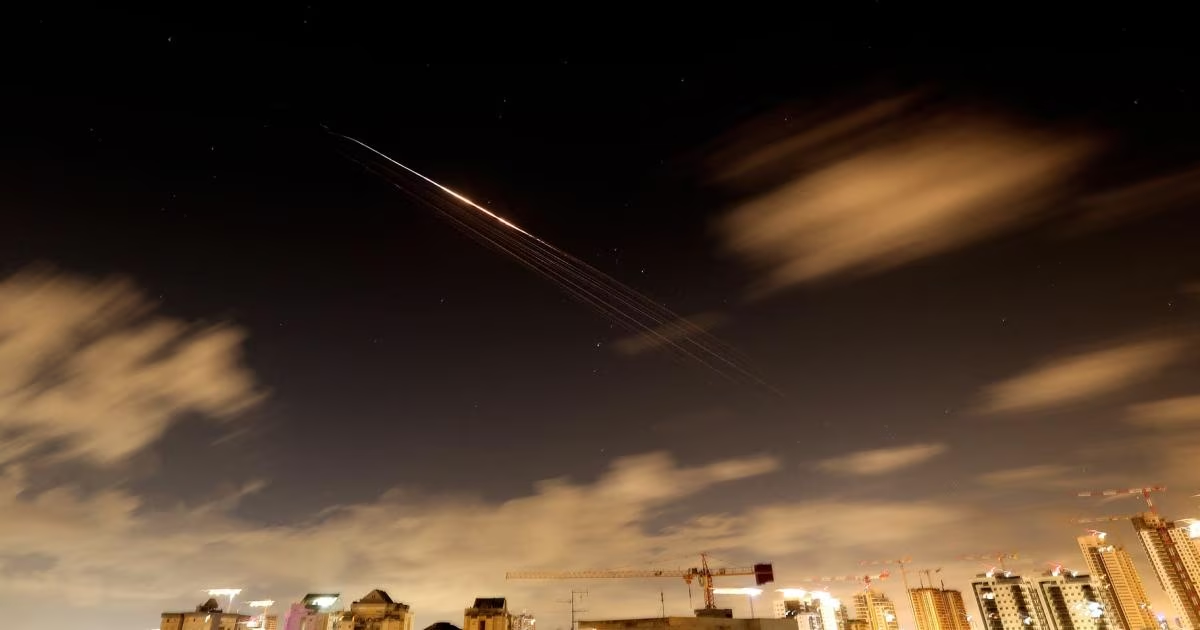







The Iranian capital, Tehran, witnessed violent explosions shaking the northern neighborhoods of the city early this Friday morning, amidst a state of security and military alert. Field sources confirmed that the sounds of explosions coincided with reports of intense aerial activity in the region's skies, causing concern among local residents.
In a related development, official Iranian media reported that the airstrikes were not limited to the capital but also extended to targets in the city of Kashan, part of Isfahan province. The strikes also hit the cities of Tabriz and Urmia in the northwest of the country, indicating an expansion of Israeli targeting within Iranian territory.
For its part, the Israeli army issued an official statement announcing the conclusion of a wave of concentrated airstrikes targeting what it described as 'infrastructure belonging to the Iranian regime.' The statement clarified that the operations focused on the vicinity of Tehran, confirming that the aircraft returned safely to their bases after accurately executing their assigned missions.
In response to these raids, the Iranian Revolutionary Guard announced the launch of the eighty-third wave of 'Operation True Promise 4' against Israeli targets. The Revolutionary Guard clarified that this operation comes as part of a continuous response to Israeli and American military movements targeting Iranian sovereignty and vital facilities.
Sources from Tehran indicated that the new wave of attacks used a diverse arsenal of weapons, including long and medium-range missile systems. Suicide drones and multiple, precise warheads were also integrated into the attack to ensure bypassing air defense systems and reaching designated targets.
According to the Revolutionary Guard's statement, the Iranian strikes focused on sensitive economic and military facilities, including oil tanks and depots in various areas. The shelling also targeted a strategic military site in the coastal city of Ashdod, in addition to shelling the city of Modi'in in central Israel.
On the Israeli side, sirens blared continuously in greater Tel Aviv and surrounding areas, following the detection of a barrage of missiles launched from Iranian territory. Sources confirmed that a state of panic prevailed at Ben Gurion Airport and the city of Lod, where settlers rushed to shelters immediately after warning systems were activated.
Israeli military sources stated that air defenses launched interceptor missiles in an attempt to counter the widespread Iranian attack. Despite interception attempts, the exact extent of these systems' success in shooting down all targets is not yet clear, amidst reports of shrapnel and missiles falling in populated areas.
Preliminary reports indicate that Iran may have used cluster munitions in its latest attack, a type of weapon that Tehran has intensified its use of recently. Hebrew Channel 12 confirmed that a cluster missile fell in the central region, while the official broadcasting authority indicated the detection of shrapnel falling in three different locations.
This escalation comes in the context of an open confrontation that began in late February and has so far resulted in hundreds of deaths and injuries on both sides. The region is experiencing a state of high alert amidst the continued exchange of missile strikes that have targeted prominent leaders, threatening to slide the situation towards a comprehensive regional war.
We have begun the 83rd wave of Operation True Promise 4 to include attacks on Israeli military sites and facilities.
شارك برأيك
Unprecedented Escalation: Revolutionary Guard Launches 83rd Wave of Attacks Against Israel, Explosions Rock Tehran