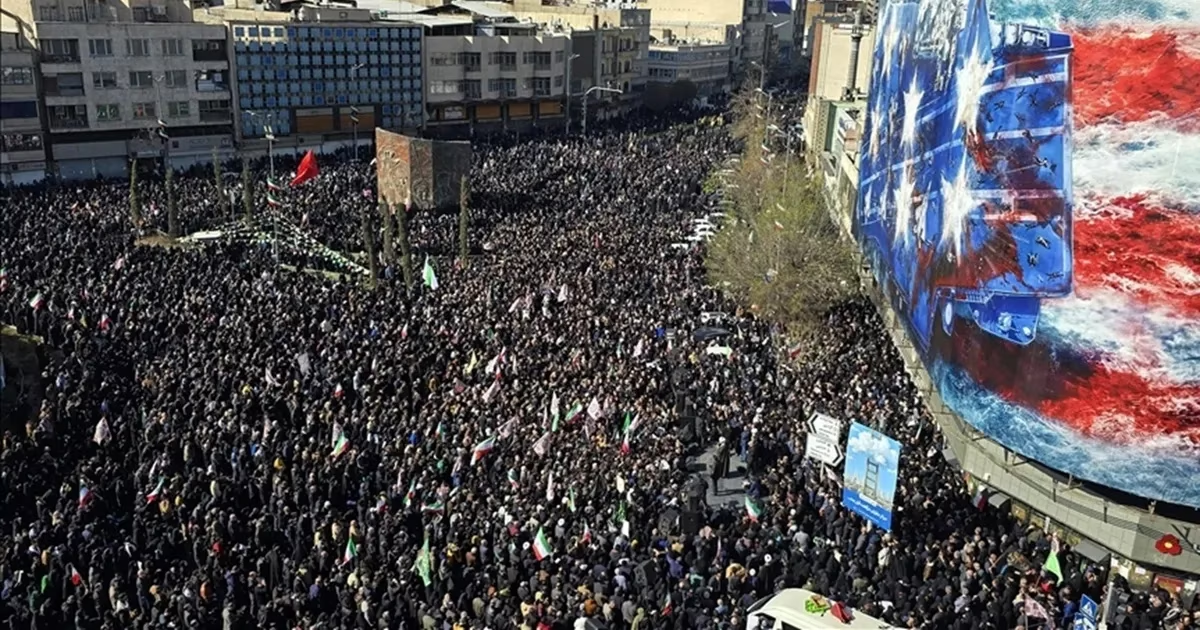







In moments of major transformation witnessed by the region, political questions emerge as a mirror reflecting the depth of division in our way of thinking and forming our stances. The ongoing war today between Iran on one hand, and Israel and the United States on the other, has brought to the forefront an old debate characterized by intensity and fragmentation in Arab and Islamic positions. This debate reminds us of the symbolic stories of 'Byzantine debate' where people were preoccupied with marginal details while the walls of their cities were collapsing before invaders.
The current situation is not just a fleeting military confrontation, but a real test of political, religious, and social consciousness. The division we see today reflects a disconnect between thought and reality, where elites and the general public are immersed in sterile debates while the real danger surrounds everyone. These traditional stories characterize the state of civilizational weakness that recurs when words become isolated from action and field reality.
Politicians often resort to mixing religion with politics to produce rigid positions that are difficult to retract, which is clearly seen in the current conflict. The confrontation between Iran and the American-Israeli axis is not purely religious or nationalistic, but a complex struggle for power and influence. Religious identities are used here as effective mobilization tools to galvanize spirits and legitimize military actions under a guise of sanctity.
The United States and Israel frame the conflict as a confrontation with the 'Shiite Iranian threat' to divert attention from the Palestinian issue. In contrast, Iran presents itself as the patron of the 'Axis of Resistance' in confronting 'global arrogance,' a discourse aimed at legitimizing its regional influence. Between these two discourses, the Arab individual finds himself torn between contradictory readings of political and doctrinal reality.
The Arab street is divided into three main factions regarding this conflict, each with its own premises. The first faction views Iran as a doctrinal enemy whose danger surpasses the Israeli threat, stemming from a narrow identity-based perspective. The second faction aligns politically with Iran to confront the Zionist project, which it sees as an existential threat targeting the entire nation regardless of sectarian differences.
The third faction adopts the position of the 'gloating spectator,' seeing any harm inflicted upon Iran as punishment for its policies in Arab countries such as Syria, Iraq, and Yemen. This position ignores the high human cost of war and disregards the flames that may strike civilians. These three positions are not just fleeting opinions, but an expression of psychological and social identities struggling within the collective consciousness.
The jurisprudential rule 'no denial in what is differed upon' is absent from the reality of Muslims today, which turns differences of opinion into deep religious animosity. Reality indicates that disagreements do not die but are renewed on every occasion, whether simple jurisprudential or major political. This inability to manage differences turns issues into existential crises that increase the state of fragmentation and general weakness.
The disagreements among Muslims are no longer just differences in viewpoints, but have transformed into psychological identities that give their adherents a sense of moral superiority. They are also linked to a social memory formed through bitter experiences and diverse nationalities, affected by the artificial 'Sykes-Picot' borders. Each party tries to clothe its political position in a religious garment to give it symbolic power capable of mobilizing followers.
To understand this division, one must return to the historical roots of the Sunni-Shiite conflict, which began as a political struggle for power after the death of the Prophet (peace be upon him). Over time, this political dispute transformed into a doctrinal gap, then into political borders between major empires like the Ottomans and Safavids. Today, these symbolic wounds, such as the events of Karbala and the Great Fitna, are invoked to fuel contemporary conflicts.
International powers exploit this historical division to fragment the region and achieve geopolitical goals cloaked in religion. While Iran issues the discourse of the 'oppressed,' its adversaries focus on contentious issues such as 'insulting the companions' despite fatwas prohibiting it. This mutual instrumentalization of history makes peoples fuel for wars that serve only the interests of major powers and external hegemony.
The fundamental question we must ask today is not with whom we stand, but how we understand the conflict without becoming tools in the hands of others. The true measure of protecting consciousness lies in realizing that states do not necessarily represent religion, but rather their political interests. It must also be emphasized that Palestine remains the central issue that should not be lost in the crowd of sectarian disputes.
Our preoccupation with 'Byzantine' debate over doctrinal and historical details gives colonial powers a golden opportunity to reshape the region according to their interests. The Sunni-Shiite conflict should not be used to obscure the more important question about the causes of the nation's weakness and civilizational decline. We need a conscious reading that distinguishes between religious constants and political maneuvers that use the sacred to achieve worldly goals.
The current war is a test of our maturity and our ability to overcome the open wounds that are reopened in every new conflict. History is being written before our eyes today, and our ability to understand is the dividing line between being active on our land or merely marginal observers. Continuing to be divided means remaining in the role of 'boys' who collect stray balls on the fields of adults, taking blows without the ability to respond.
In conclusion, consciousness remains the most powerful weapon in confronting attempts at fragmentation and political domestication. Overcoming the psychological and political 'Sykes-Picot' requires courage in reviewing positions and freeing oneself from the captivity of historical conflicts that no longer serve anyone but the enemies of the nation. The path to the future begins with understanding the present, away from the convulsions of the past and the alignments of powers that see us only as tools for their own projects.
The current war is not just a military confrontation, but a test of our political consciousness and our ability to read the conflict without becoming tools used by one side or another.
شارك برأيك
Between the Hammer of 'Sykes-Picot' and the Anvil of Byzantine Debate: A Reading of the Division in Arab Consciousness Towards the Regional Conflict