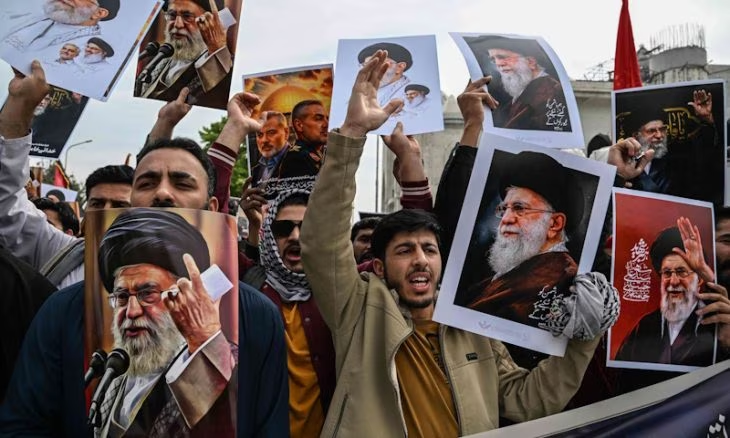







A report published by the 'Washington Post' stated that the Iranian regime continues to exert full control over the state's joints, despite the heavy losses and devastating blows it has recently suffered. The report clarified that the structure of the ruling regime in Tehran has shown a surprising ability to persist, astonishing Western experts and officials who monitored the course of military operations.
Despite the intense war waged by the United States and Israel, the Iranian leadership has maintained its internal cohesion remarkably. According to European and Arab officials familiar with the situation assessments, these circumstances have not affected the regime's grip on power, although they have hindered some protocol procedures such as choosing a successor to the Supreme Leader.
Assessments indicate that Tehran had prepared itself in advance for this type of existential conflict by building flexible command structures. These structures were specifically designed to withstand direct targeted strikes, allowing the regime to continue directing regional retaliatory strikes within hours of being attacked.
On the ground, sources reported an intense security presence in the streets of major Iranian cities, where paramilitary Basij forces continue to patrol on motorcycles. This security presence aims to prevent any attempts at internal unrest and ensure that the streets remain under the strict control of sovereign agencies.
In contrast, the US administration boasted about the success of its operations in eliminating a number of senior Iranian leaders and destroying command and control centers. The US Secretary of Defense stated that what he described as the 'ruling council' had been scattered between dead and hiding in shelters, considering this a decisive blow to the regime's decision-making capability.
However, European and Arab intelligence assessments still adopt a different view from the official American narrative regarding imminent collapse. A prominent European official confirmed to the newspaper that there are no indications of defections within military ranks or the outbreak of widespread popular uprisings so far.
Experts attribute this resilience to the 'multi-level system' adopted by Tehran in distributing power and military responsibilities. This system ensures the immediate appointment of replacements for any key figure who is assassinated, which indeed happened after the killing of the Minister of Defense in recent airstrikes.
Washington's allies in the region had estimated that the assassination of top leaders would be a turning point that would ignite an internal revolution against the regime. However, the reality on the ground showed unexpected unity within state agencies, confusing the calculations of observers who expected the Iranian internal front to quickly fracture.
Iran is currently facing an almost complete internet blackout, making it extremely difficult to obtain accurate information from within. Nevertheless, visual analyses show severe damage to government buildings and vital military installations as a result of continuous bombardment targeting thousands of sites.
For his part, analyst Gregory Brew believes that Iran has been significantly weakened militarily after the destruction of most of its naval fleet and ballistic missile stockpiles. He pointed out that the bombing destroys the physical infrastructure of the Islamic Republic, but it may not necessarily succeed in dismantling the organizational structure of the security forces that spread rapidly.
Sources indicate that police and Basij forces deliberately evacuate barracks and known buildings to avoid direct aerial targeting. These tactics allow them to reappear and carry out their duties as soon as the raids stop, benefiting from not needing heavy weapons in internal security operations.
Iran's Foreign Minister had previously hinted in statements that military units operate according to 'pre-set general instructions' that grant them autonomy in movement. This approach reduces the impact of communication disruptions with the central command and ensures the continuation of combat and security operations in various regions.
With the escalation of Iranian retaliatory attacks against neighboring countries, Tehran appears to be betting on a 'long-breath' strategy in confronting adversaries. The Iranian leadership believes that its ability to withstand economic and field hardships exceeds the ability of the United States and its allies to continue an open war.
In conclusion, officials warn that the Iranian regime is designed to survive and will not easily relinquish its power, no matter how severe external pressures become. The current Iranian gamble is to inflict as much damage as possible on the region to force Washington to seek a path to de-escalation and exit the cycle of conflict.
There is no indication of anything collapsing in the regime, nothing, zero; control remains complete.
شارك برأيك
Washington Post: Iranian regime structure shows surprising cohesion despite severe American and Israeli strikes