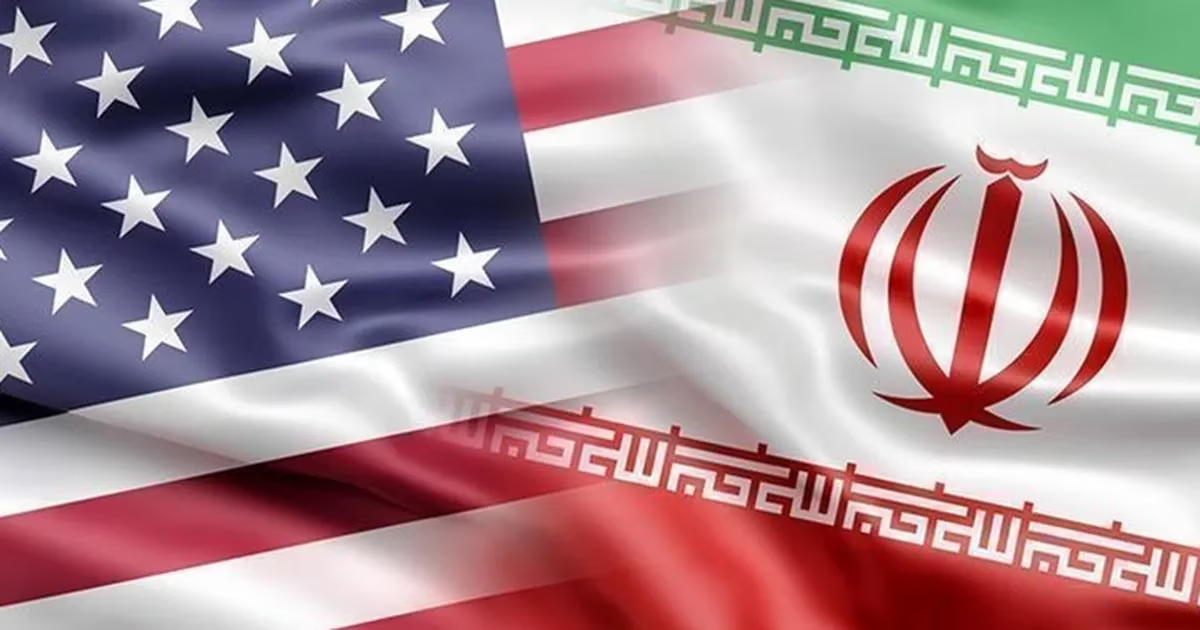







Intelligence sources revealed secret Iranian moves that took place following the widespread American-Israeli attack, where officials in Tehran attempted to open indirect communication channels with the US Central Intelligence Agency (CIA). According to press reports, these attempts aimed to explore potential conditions for halting the intense aerial bombardment targeting key Iranian state institutions, despite official denials from the remaining Iranian leadership of any desire for dialogue with Washington.
Informed sources stated that the Iranian offer was passed through the intelligence agency of a third country, raising questions about the ability of current officials in Tehran to conclude binding agreements given the state of chaos resulting from the systematic targeting of leaders. These moves come at a time when the Iranian government is experiencing unprecedented pressure after losing historical figures in the initial raids of the military operation that began last February.
For his part, US President Donald Trump showed a rigid stance towards these initiatives, stating via social media platforms that it was too late for diplomatic talks. Trump expressed to reporters his belief that most of the leaders Washington had been targeting had already been eliminated, indicating that the leadership structure in Tehran was rapidly eroding under the weight of continuous strikes.
In a related context, the Israeli government is exerting intense pressure on the Trump administration to ignore any Iranian negotiation offers, with officials in Tel Aviv demanding the continuation of the military campaign for several additional weeks. The Israeli strategy aims to inflict permanent damage on Iranian military capabilities, leading to the complete collapse of the existing political system, which Washington sees as an option requiring careful evaluation.
It appears that Trump has begun to back away from the idea of supporting a comprehensive popular revolution in Iran, preferring instead the emergence of 'pragmatic' figures from within the current political structure, specifically from the Revolutionary Guard. The White House aspires to reach an agreement that ensures the complete dismantling of Iranian missile and nuclear programs, and the cessation of support for armed groups in the region, in exchange for allowing some leaders to remain in their positions.
Trump explicitly indicated that his preferred model for dealing with Tehran is the 'Venezuela scenario,' where military and economic pressure is applied to force the new leadership to grant the United States broad control over resources, especially oil. Observers believe that this approach reflects Washington's desire to achieve quick economic and geopolitical gains without engaging in a complex and long-term nation-building process.
On the ground, previous reports confirmed the martyrdom of Iranian Supreme Leader Ali Khamenei and Commander Mohammad Pakpour, which prompted the Revolutionary Guard to activate a decentralized leadership strategy under the supervision of Ahmed Vahidi. This strategy aims to ensure the continuation of military operations and counter-responses even if communication with the center is cut off, complicating American-Israeli calculations about the 'decisive point.'
The US administration faces increasing internal pressures due to the exorbitant cost of military operations, estimated at about one billion dollars per day, as well as a significant 6% rise in global oil prices. This financial bleeding worries Trump's Republican allies, who fear long-term economic repercussions that could affect internal stability in the United States.
On the Israeli side, economic losses reached about 9.4 billion shekels weekly, prompting some economic circles to demand a reduction in the alert level to mitigate damages. Despite these losses, the Israeli military leadership insists that the current opportunity to change the face of the Middle East will not be repeated, and must be exploited to the end regardless of immediate costs.
Intelligence assessments prepared by the CIA indicate the difficulty of predicting the type of leadership that will emerge in Iran after the end of military operations, as all scenarios remain open to the possibilities of chaos. Experts warn that the collapse of the central government could lead to civil wars in areas inhabited by ethnic minorities, turning Iran into an enlarged version of the Syrian or Libyan models.
Despite Trump's previous calls for the Iranian people to take charge of their affairs, he expressed skepticism about the ability of any popular revolution to produce a pro-Western democratic system under wartime conditions. Trump said that the worst-case scenario is replacing the current regime with another that harbors the same hostility towards Washington, emphasizing the necessity of a 'strong person' to restore stability and protect common interests.
When asked about the possibility of supporting Reza Pahlavi, the son of the former Shah, Trump did not show great enthusiasm, preferring to search for a figure with genuine popularity and influence on the ground within existing institutions. This approach reflects Trump's pragmatism, which seeks a 'strong man' who can regulate the rhythm of the exhausted Iranian state and ensure the flow of global energy supplies without threat.
The major dilemma facing Washington remains finding a mediator with sufficient legitimacy to convince the Iranian interior of any commitments towards the United States, especially given the hardline rhetoric currently adopted by the Revolutionary Guard. Trump describes the current leaders as 'mentally ill,' which practically closes the door to any diplomatic settlement with the known figures of the old regime.
In conclusion, all eyes are on what the coming weeks of military confrontation will bring, amid Israeli insistence on a decisive outcome, and American hesitation between ending the mission or seeking a political solution. With the continued bleeding of the global economy and rising energy prices, the 'Venezuela scenario' remains the most likely card on Trump's agenda for dealing with the explosive Iranian issue.
I believe that what we did in Venezuela is the optimal scenario, where leaders can be chosen.
شارك برأيك
Behind the Scenes of Iranian Attempts to Negotiate with Washington... and Trump Hints at a 'Venezuela Scenario'