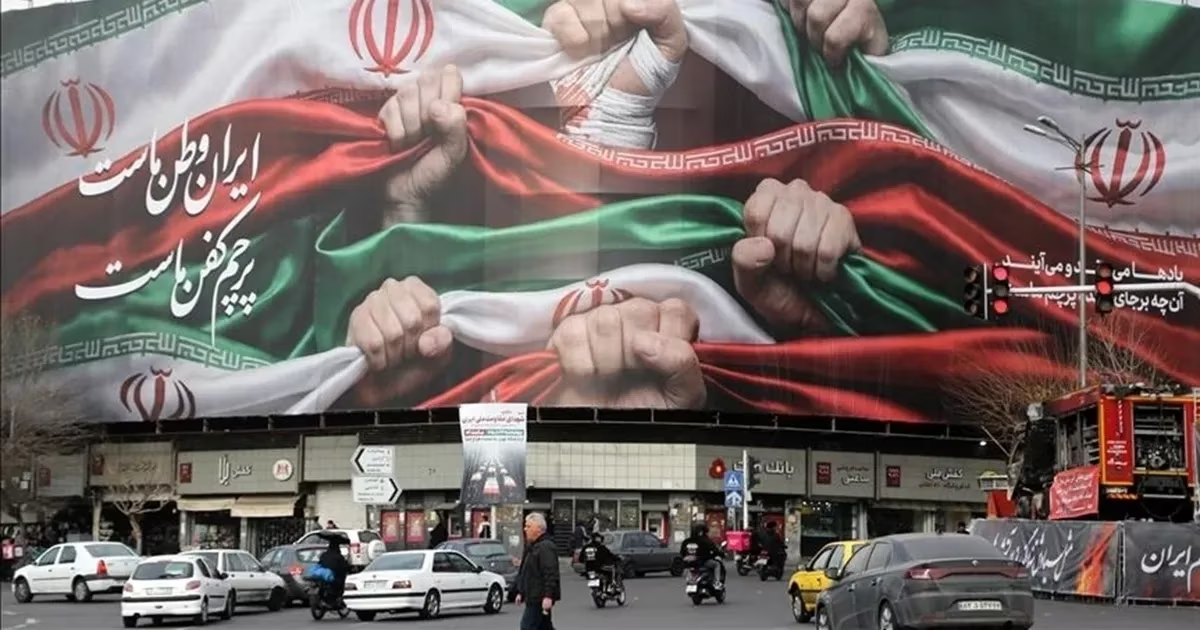







The United States today faces a growing strategic dilemma as the region slides towards a comprehensive confrontation with Iran, with observers suggesting that Washington may find itself trapped in a long-term war of attrition. This scenario brings to mind the Russian experience in Ukraine, where a swift operation turned into an exhausting conflict that drained Moscow's military and economic capabilities and plunged Europe into spirals of inflation and severe energy crises.
The geopolitical nature of the Middle East makes any clash with Tehran an unconventional front whose boundaries are difficult to control, as the repercussions automatically extend to Lebanon, the Gulf, and vital maritime passages. Instead of a swift military resolution, the features of a conflict based on mutual strikes and constant deployment emerge, consuming American resources monthly without a clear end in sight.
Given these facts, a 'golden opportunity' arises for both Russia and China, who are observing the scene with cold blood, seeking to turn American involvement into a strategic burden that disrupts Washington's international focus. This intervention does not require armies on the ground but relies on what can be called 'soft intervention' aimed at keeping tensions alive without reaching a stage of full explosion or complete extinction.
Political and diplomatic support represents the first pillar of this intervention, as Moscow and Beijing use international platforms to undermine Western consensus against Tehran and obstruct pressing decisions in the Security Council. This path grants the Iranian regime room for political maneuvering and breaks the international isolation that Washington is trying to impose, thus prolonging Iranian resilience in the face of military pressures.
Economically, Eastern powers are working to expand trade channels and circumvent Western sanctions by providing alternative markets for Iranian energy and technology. The goal here is not to save the Iranian economy entirely, but to prevent its sudden collapse, which might impose a swift military or political resolution that does not serve the long-term attrition interests sought by Washington's rival powers.
Indirect technical and military cooperation constitutes a dangerous dimension in this equation, through the transfer of dual-use technology and support for air defense systems and cyber warfare. Satellite services also play a pivotal role in monitoring American naval and air movements, which raises the cost of confrontation and makes the field more complex for American military planning.
The battle is not limited to the military field but extends to the international narrative through digital networks and media to shape a discourse that holds Washington responsible for global escalation. This type of psychological warfare aims to weaken the cohesion of Western public opinion towards long military involvement and turn the external conflict into an internal political burden that pressures Washington's allied governments.
On the ground, sources revealed that the volume of airstrikes in the first hours of the confrontation was double what was carried out on the day of 'shock and awe' in Iraq in 2003, targeting nearly 2,000 Iranian targets. Despite this military momentum and the killing of major leading figures, the Iranian response with hundreds of missiles and drones proved Tehran's ability to inflict losses on American bases in the region.
The effects of the war quickly began to appear on the global economy, with oil prices rising by 6% immediately after the operations began, threatening a return of global inflation waves. In contrast, shares of major American arms companies such as 'Lockheed Martin' and 'RTX' rebounded, reflecting the contradiction between the economic interests of the military-industrial sector and the burdens borne by the state budget.
American attrition in the Middle East gives Moscow an opportunity to consolidate its positions in Ukraine away from intense Western military pressure, and allows Beijing to expand its influence in Asia and Africa. This strategic distraction of Washington is the ultimate goal of rising powers who see the United States' entanglement in the 'sands of the Gulf' as a means to reshape the multipolar world order.
Domestically in Israel, Prime Minister Benjamin Netanyahu seeks to exploit this moment to dismantle the Iranian regime and empower the opposition, with ambitions to expand regional alliances to include India and Greece. However, renewed statements about the 'Greater Israel' project raise concerns among regional allies and further complicate the political landscape surrounding the ongoing military operations.
The Turkish position adds another layer of complexity, with some Israeli circles describing Ankara as the 'new Iran' despite its NATO membership, indicating a crack in the allied front. Turkey, which possesses the second-largest military force in the alliance and advanced defense systems, insists on a two-state solution as a strategic option, putting it at odds with Israeli expansionist ambitions.
The killing of American soldiers in Kuwait and the complete halt of navigation in the Gulf puts the American administration to a difficult test of endurance and response without sliding into an endless comprehensive war. Attrition here does not mean direct military defeat, but rather the inability to resolve and entering a costly spiral that affects the American interior, allies, and the global economy alike.
Ultimately, the question is no longer who possesses the greater military power, but who has the ability to endure over time and resource erosion. If the confrontation continues in this pattern, Washington may find itself in the same predicament that Moscow faced; a war that is never fully lost but never won, while competitors reap the benefits of this slow erosion.
Modern wars are not always decided by a knockout blow, but by the slow erosion of will, economy, and the ability to manage more than one crisis at a time.
شارك برأيك
Washington's Attrition in the Gulf: How Russia and China Capitalize on the 'Iranian Predicament'?