






High-level sources reported that the Iranian Revolutionary Guard Corps (IRGC) has fully tightened its grip on the decision-making process in the Islamic Republic, following a series of strikes targeting its senior leaders. The military establishment is currently pushing for a hardline strategy based on intensifying drone and missile attacks across the region, in response to increasing military pressure.
Anticipating any leadership vacuum, the Revolutionary Guard delegated extensive powers to lower ranks within the military before the recent attacks. This strategy aims to enhance the regime's resilience, despite the risks of battlefield miscalculation or the expansion of a comprehensive confrontation in the region.
In a notable field development, Iranian forces launched a ballistic missile towards Turkish territory, a NATO member, indicating an unprecedented escalation in military operations. This move comes at a time of growing international concerns that the conflict could spiral out of control as mid-ranking officers are granted powers to launch direct attacks.
Domestically, observers believe that the pivotal role the Revolutionary Guard now plays at all levels of the regime will reinforce the repressive security approach. This absolute control is likely to undermine any potential for popular protests, making it difficult for external powers betting on an internal uprising to change the regime.
Research reports indicate that the selection of the next Supreme Leader, following the death of Ayatollah Ali Khamenei, will unprecedentedly enhance the Revolutionary Guard's influence. Mojtaba Khamenei's name stands out as a strong candidate for succession, given his close ties with military leaders and widespread support from the more hardline lower ranks within the institution.
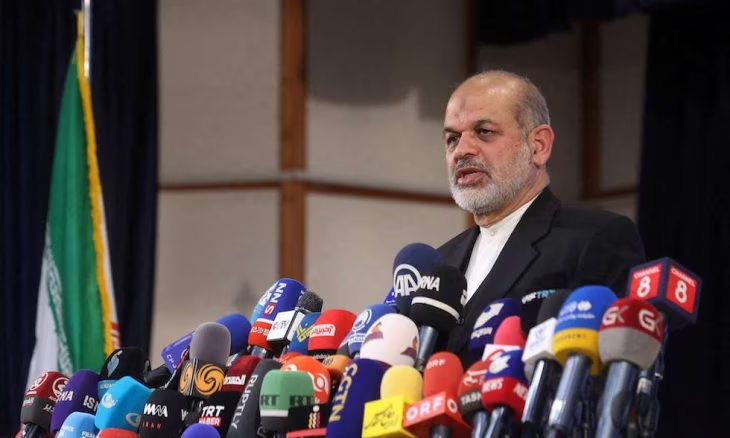
Regional sources confirmed that the Revolutionary Guard is now involved in all major sovereign decisions, bypassing traditional political structures. The sources explained that Ahmad Vahidi, who recently assumed leadership of the Guard, attends all high-level meetings to ensure the regime's survival and achieve its strategic objectives under current circumstances.
For his part, Reza Talaeinik, Deputy Minister of Defense, revealed details of the 'Successors' plan, which ensures leadership continuity even if the first tier is eliminated. He explained that every leadership position in the military structure has three ready replacements to immediately take over duties, preventing any confusion in managing combat operations.
The roots of the decentralization strategy currently pursued by the Guard date back about two decades, developed after lessons learned from the collapse of Iraqi forces in 2003. The plan aims to ensure that every Iranian province can defend itself independently if communication with the central command in Tehran is cut off.
This military system acts as a dual enforcement body: it is the spearhead in responding to external attacks and the primary tool for enforcing internal security. Despite losses among intelligence and aviation unit commanders, the institution attempts to demonstrate strategic cohesion in the face of continuous threats targeting its various ranks.
Sources indicate that the Revolutionary Guard, despite occasional internal rivalries, shows exceptional unity when the country faces existential threats. Slight signs of deterioration in the command structure have begun to appear through an increase in attacks on civilian targets in the Gulf region, which may be a deliberate strategy to demonstrate the cost of attacking Iran.
In official statements, Iranian Foreign Minister Abbas Araqchi confirmed that military responses were planned in advance with high precision. He explained that field units operate based on general and pre-prepared instructions, and do not await direct and immediate orders from the political leadership, which gives them flexibility and speed in execution.
The Revolutionary Guard possesses a vast economic and political empire that makes it a 'state within a state' since its establishment after the 1979 revolution. Its construction arms, such as the 'Khatam al-Anbiya' group, manage huge contracts in the energy sector, providing the military institution with financial independence and the ability to fund its operations away from the general budget.
The regime currently relies on a political leadership comprising figures with strong military backgrounds in the Revolutionary Guard, such as President Masoud Pezeshkian and Parliament Speaker Mohammad Bagher Ghalibaf. These leaders, forged by years of war with Iraq, adopt the military institution's vision in managing the current crisis with the West and Israel.
In conclusion, the Revolutionary Guard remains the primary guarantor of the Iranian regime's survival, using 'Basij' forces to suppress any internal unrest, and its network of proxies in the region to threaten external interests. With the escalation of confrontation, it appears that the military institution has made its choice to move towards a comprehensive confrontation to protect the achievements of the revolution.
The entire idea lies in decentralization so that if a particular province is attacked, it can defend itself and maintain the authority and rule of the regime.
شارك برأيك
Revolutionary Guard Tightens Grip on Decision-Making in Iran, Activates 'Decentralized Command' Strategy