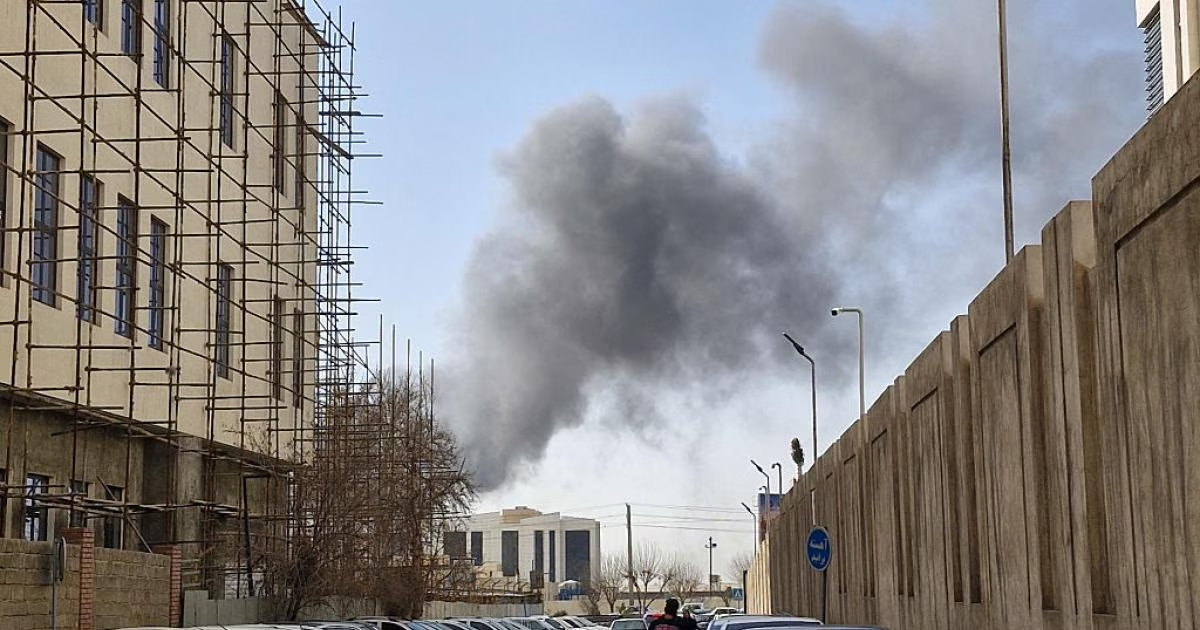







The joint military attack launched by Israel and the United States against Iranian territory raised deep questions about Washington's seriousness in the diplomatic path. This escalation comes at a time when negotiation channels were witnessing intense activity to reach a comprehensive settlement of the nuclear issue.
Data indicates that the aggression, which lasted for about 12 days, came a few days before the start of the sixth round of direct talks. This timing was considered by observers as a fatal blow to the chances of building trust between Tehran and the current US administration led by Donald Trump.
For his part, Iranian Foreign Minister Abbas Araghchi adopted a cautious approach towards American promises, aware of the possibility of Washington reneging on understandings. Nevertheless, the Iranian leadership considered that the risk of entering new negotiations was worth the experiment to avoid military escalation.
In the context of mediation, the Sultanate of Oman made diligent efforts to bridge the views between the two parties through high-level meetings in Washington. Omani Foreign Minister Badr Al Busaidi confirmed that the parties were on the verge of announcing a historic breakthrough in the thorny issue.
The draft agreement that was being worked on included unprecedented provisions related to strict nuclear oversight. Under it, Tehran agreed to liquidate its entire stockpile of highly enriched uranium, a demand that Western powers had long called for.
Iranian concessions were not limited to this, but also included granting the International Atomic Energy Agency full and unconditional access to facilities. A remarkable development also emerged with the approval of American weapons inspectors entering alongside international inspectors to ensure absolute transparency.
Future enrichment operations in Iran were supposed to be limited to civilian and research needs only. Optimism prevailed in diplomatic circles about the possibility of signing the final principles agreement during the week that witnessed the military attacks.
However, the coordinated military operations undermined this diplomatic path, leaving the region facing open scenarios of confrontation. Analysts believe that this attack reflects the dominance of the hawkish current in Washington and Tel Aviv at the expense of peaceful political solutions.
In his justification for the military action, US President Donald Trump ignored talking about the progress made in the secret negotiations. He merely indicated that Iranian activities pose a direct threat to American interests and bases and its allies in the region and the world.
The US administration is currently facing increasing internal criticism regarding the feasibility of resorting to force in light of the availability of a diplomatic alternative. Opponents accuse Trump of succumbing to Israeli pressure aimed at preventing any potential rapprochement that could end the decades-long state of tension.
The White House is also criticized for not providing sufficient clarifications to Congress or international allies about the objectives of this sudden escalation. It appears that the lack of coordination has confused allies who were counting on the success of Omani mediation to calm the situation in the Middle East.
The question remains about the ability of the Iranian regime to return to the negotiating table after this direct military strike. The trust, which was already shaky, suffered a rift that may be difficult to repair in the foreseeable future, opening the door to a new arms race.
A peace agreement was imminent, and talks were on the verge of achieving a major breakthrough that would surpass the 2015 agreement.
شارك برأيك
Washington and Tel Aviv's aggression against Iran thwarts an imminent nuclear deal