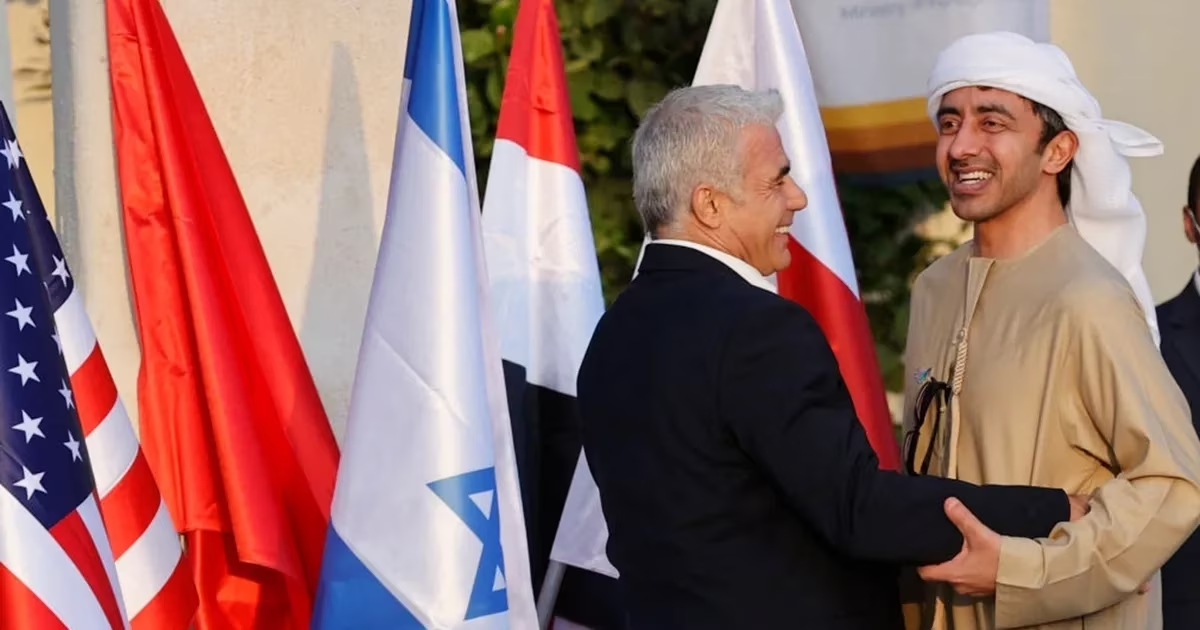







The leader of the Israeli opposition, Yair Lapid, sparked a wave of political controversy after explicitly announcing his support for the so-called "Greater Israel" plan, which aims to seize vast areas in the Arab world extending from the Euphrates River to the Nile River. Lapid claimed during a recent press conference that the biblical borders are completely clear and not open to interpretation, emphasizing that the Zionist vision derives its legitimacy from religious texts.
Lapid considered the Bible to be the exclusive "deed of ownership" for Jews over these lands, indicating that Israeli ambitions are not limited to current borders but follow what is stated in ancient religious interpretations. He explained that his stance stems from the desire to provide what he described as a "safe haven and vast space" for future generations of Israelis, regardless of the national sovereignty of neighboring countries.
These statements came in response to positions announced by the US Ambassador to Israel, Mike Huckabee, who expressed no objection to Israel's control over the entire Middle East region. Lapid affirmed, in response to a question about whether this control would include countries like Lebanon, Jordan, and Syria, that he supports any move that grants Israel greater geographical space and superior security power in the region.
When asked about the geographical extent he aspires to, the leader of the "Yesh Atid" party replied that the area should be "as much as possible," a clear indication of the absence of any limit to expansionist ambitions. Lapid did not exclude Iraq from this discussion, stressing that the matter concerns Israeli national security and the biblical mandate that grants them the right to expand eastward and westward.
Lapid indicated that there are practical and political considerations that may affect the speed of implementation, but he stressed that the fundamental principle remains constant and does not change with political circumstances. He added that the Jewish people, who lived in exile for two thousand years, now have the right to return to their vast historical borders, which include the territories of sovereign Arab states, according to his expression.
These positions reinforce fears of extremist right-wing tendencies within Israeli political circles, both in the government and the opposition, as Lapid's vision intersects with previous statements by Prime Minister Benjamin Netanyahu. Netanyahu had stated in August of last year his close connection to the vision of "Greater Israel," indicating a Zionist consensus on targeting Arab geography.
It is worth noting that Israel, whose state was declared in 1948 on the ruins of displaced Palestinian cities and villages, has not yet officially demarcated its final borders. Observers believe that this deliberate ambiguity aims to leave the door open for ongoing annexation and occupation operations, which began with the occupation of the rest of Palestine in 1967, leading to current threats to neighboring countries.
In a related context, the statements by US Ambassador Mike Huckabee paved the way for this public discussion, as he relied in media interviews on religious interpretations that grant Israel a purported right from the Nile to the Euphrates. These claims directly affect the sovereignty of pivotal countries in the region such as Egypt, Syria, and Iraq, which sparked widespread condemnation in Arab diplomatic circles.
Analysts believe that Lapid's talk of "biblical borders" reflects a shift in his political discourse towards the religious nationalist right to gain popular support, which is consistent with the expansionist policy pursued by the occupation authorities in the West Bank and Jerusalem. These statements disregard all international laws and United Nations resolutions that consider the territories occupied in 1967 as Palestinian territories from which Israel must withdraw.
In conclusion, these statements place the international community before its responsibilities regarding the escalating Israeli threats to regional peace and security, as Israeli ambitions are no longer mere slogans raised by extremist groups, but have become part of the official discourse of opposition and government leaders alike. The question remains about Arab and international reactions to this plan, which aims to redraw the entire map of the region.
Our deed of ownership to the land of Israel is the Bible, and therefore the borders are the borders of the Bible.
شارك برأيك
Lapid Adopts the "Greater Israel" Plan: Our Borders Are from the Euphrates to the Nile, and Our Document Is the Bible