







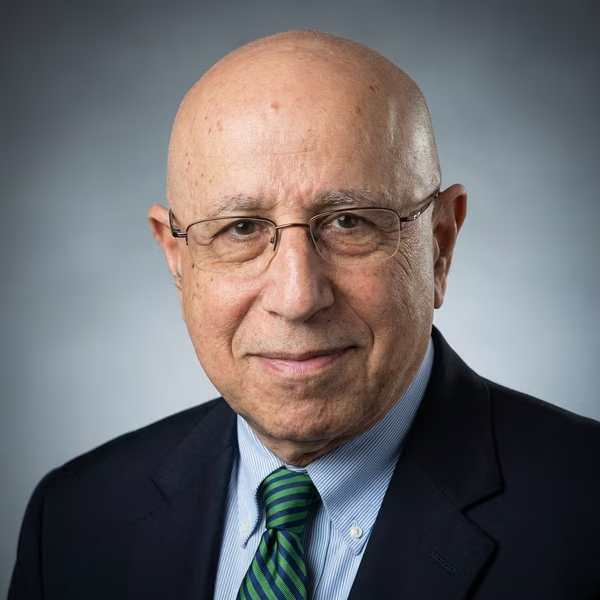
Washington – Said Arikat
US President Donald Trump is preparing to launch one of the most controversial diplomatic initiatives at the Economic Forum in Davos, by organizing a signing ceremony for what is known as the "Peace Council," a new international body that Washington seeks to present as an alternative reference for managing global conflicts, foremost among them the second phase of Trump's peace plan in Gaza. However, this step, intended to be a display of American leadership, appears to be surrounded by widespread international hesitation and increasing skepticism about its true objectives.
According to an official invitation that was circulated and confirmed by a US official, the signing ceremony is scheduled to be held on Thursday at 10:30 AM, with limited attendance from leaders and officials, at a time not without political implications. The choice of Davos, as a global economic platform, reflects the US administration's desire to link peace with governance and investment, but at the same time raises questions about the absence of broader international institutional coverage.
It is worth noting that international concern stems not only from the nature of the nascent council but also from the way Washington seeks to present it. While the council was initially promoted as a mechanism to oversee the administration of Gaza in the post-war phase, the final charter – which international media outlets reviewed – was completely devoid of any direct reference to Gaza, and laden with implicit criticisms of the United Nations, considering that existing institutions "have repeatedly failed" and need a more "bold" alternative.
Invitations to join were extended to dozens of countries, including major and regional powers from Europe, Asia, and the Middle East. A number of leaders confirmed receiving the invitation, but responses ranged from reservation to silence, indicating the extent of hesitation in granting this initiative early political legitimacy. Israel stands out as a special case, as Prime Minister Benjamin Netanyahu received the invitation, but openly expressed his displeasure with the composition of the "Gaza Executive Council," particularly the involvement of Turkey and Qatar in pivotal roles.
According to observers, this Israeli displeasure did not remain within the diplomatic framework, but was translated into direct contacts with Washington, during which Netanyahu expressed Tel Aviv's "surprise" at the formula by which the Executive Council was announced. Despite his attempt to publicly downplay the influence of Qatar and Turkey, the facts indicate that this council will effectively be the body overseeing the administration of Gaza in the post-war phase, which puts Israel in a new equation it had not anticipated.
In parallel, Israeli reports revealed that Netanyahu's government ignored American demands to reopen the Rafah crossing, a step that reflects the extent of the divergence between the two sides regarding the implementation of Trump's twenty-point plan. Israel justifies its position by linking any on-the-ground step to the disarmament of Hamas and the recovery of the last hostage's body, while Washington believes that obstructing the crossing undermines the broader political path.
On the international level, the financial clause in the Peace Council's charter – which stipulates a payment of one billion dollars for permanent membership – constituted a major flashpoint. France explicitly announced its rejection of this condition, considering it contrary to its commitments within the United Nations, a position reflected in its foreign minister's statement to parliament. Similar positions were issued by Canada and Poland, amid fears that the council would turn into a paid club subject to a single political will.
Trump did not hesitate to respond in his usual manner, threatening punitive trade measures against hesitant countries, in a speech that intensified criticisms that see the council as an American attempt to circumvent the existing international system, rather than reform it. In this context, academics and experts warned that the initiative could be interpreted as a "power grab" rather than a comprehensive peace project.
The launch of the Peace Council from Davos reflects Trump's vision of international relations as deals managed by force and financial influence, not through institutional consensus. The condition of payment for membership, and granting the US President almost absolute authority in forming and excluding members of the council, undermines any claim of neutrality or pluralism. This model may attract some countries seeking Washington's approval, but it alienates the majority who see the United Nations, despite its flaws, as the only legitimate framework for managing international peace and security.
In the Palestinian context, the Peace Council appears to be an attempt to re-engineer the post-war phase in Gaza outside traditional references. However, bypassing the United Nations, marginalizing local actors, and imposing controversial executive structures, threatens to reproduce the same legitimacy crises that failed previous initiatives. Sustainable peace is not imposed from above, nor is it managed through closed councils, but requires genuine political and popular acceptance on the ground.
Internationally, the lukewarm response to Trump's initiative reflects a growing awareness that the global system is undergoing a rebalancing, which does not allow for unilateral alternatives to multilateral institutions. Even traditional allies of the United States have become more cautious about engaging in projects that might put them in direct confrontation with their international obligations. In this sense, the Peace Council may turn into a test of the limits of American influence, rather than a coronation.
شارك برأيك
Trump launches "Peace Council" from Davos on Thursday amid international coolness and questions about legitimacy and role