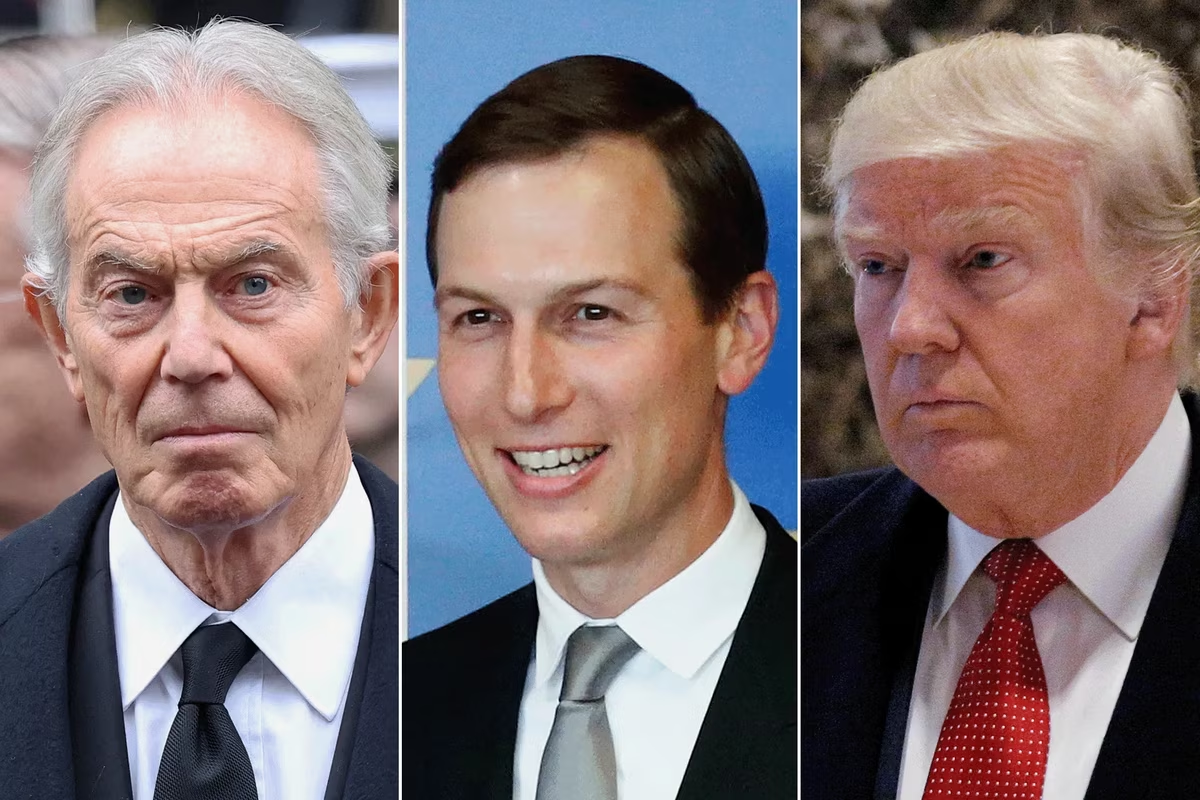







On January 16, 2026, US President Donald Trump announced the establishment of what he called the “Gaza Peace Council,” as the second phase of his plan to end the war in the Strip, which came into effect in October, following the announcement of a ceasefire agreement. The White House revealed the members of the council, which Trump will chair, and includes prominent political and economic figures from within and outside the US administration, among them US Secretary of State Marco Rubio, Special Envoy for the Middle East Steve Witkoff, former British Prime Minister Tony Blair, Trump’s son-in-law and former advisor Jared Kushner, in addition to World Bank President Ajay Banga, and businessmen Mark Rowan and Robert Gabriel. According to the White House statement, the council is supposed to be a strategic administrative body to navigate the transitional phase in Gaza, by overseeing reconstruction, attracting investments, managing regional relations, and supporting a Palestinian technocratic government. However, reading these objectives in their political context leads us to a fundamental question: Are we truly facing a peace project, or an American strategy to re-impose sovereignty on the Middle East and manage the crisis without resolving it?
Despite Washington's attempt to give the council an international character, its composition reveals an almost complete American dominance over decision-making; the council includes figures loyal to Trump's policy, and their mere presence restores the centrality of American decision-making in Palestine after years of war and mediations. In contrast, political representation for the Palestinian side, the primary party concerned with the crisis, was absent, whether from resistance factions or elected members, which reflects a perception that change in Gaza can only be managed from outside. In this context, it seems that supporting a technocratic government is merely part of a broader plan aimed at separating politics from administration, and transforming governance in the Gaza Strip into a technical administration under international supervision, excluding Palestinian sovereignty and the right to self-determination, and producing guardianship, not peace.
However, the most dangerous aspect of the council's announcement is the accompanying explicit speech by Trump, in which he asserts that Hamas will disarm voluntarily or by force, in a direct threatening language that empties the idea of peace of its content, and redefines it as a mechanism of military subjugation, while ignoring that weapons in the Palestinian context are not a luxury or rebellion, but are directly linked to the continuation of the Israeli occupation and its ongoing violations and breaches, which makes the option of disarmament unrealistic.
Thus, it is clear that the Gaza Peace Council was not established to address the roots of the Palestinian-Israeli conflict, but rather to manage the crisis without resolving it, and to restore American power and decision-making in the Middle East. This plan falls within broader international moves by Washington to re-impose its system established during World War II, and its leading role, in addition to demonstrating its ability to manage crises in the presence of strong competitors such as Russia and China.
In conclusion, the council lacks neutrality, and the foundations upon which peace is built are absent from it, namely the recognition of the Palestinian people's right to self-determination and their involvement in decision-making.
On January 16, 2026, US President Donald Trump announced the establishment of what he called the “Gaza Peace Council,” as the second phase of his plan to end the war in the Strip, which came into effect in October, following the announcement of a ceasefire agreement. The White House revealed the members of the council, which Trump will chair, and includes prominent political and economic figures from within and outside the US administration, among them US Secretary of State Marco Rubio, Special Envoy for the Middle East Steve Witkoff, former British Prime Minister Tony Blair, Trump’s son-in-law and former advisor Jared Kushner, in addition to World Bank President Ajay Banga, and businessmen Mark Rowan and Robert Gabriel. According to the White House statement, the council is supposed to be a strategic administrative body to navigate the transitional phase in Gaza, by overseeing reconstruction, attracting investments, managing regional relations, and supporting a Palestinian technocratic government. However, reading these objectives in their political context leads us to a fundamental question: Are we truly facing a peace project, or an American strategy to re-impose sovereignty on the Middle East and manage the crisis without resolving it?
Despite Washington's attempt to give the council an international character, its composition reveals an almost complete American dominance over decision-making; the council includes figures loyal to Trump's policy, and their mere presence restores the centrality of American decision-making in Palestine after years of war and mediations. In contrast, political representation for the Palestinian side, the primary party concerned with the crisis, was absent, whether from resistance factions or elected members, which reflects a perception that change in Gaza can only be managed from outside. In this context, it seems that supporting a technocratic government is merely part of a broader plan aimed at separating politics from administration, and transforming governance in the Gaza Strip into a technical administration under international supervision, excluding Palestinian sovereignty and the right to self-determination, and producing guardianship, not peace.
However, the most dangerous aspect of the council's announcement is the accompanying explicit speech by Trump, in which he asserts that Hamas will disarm voluntarily or by force, in a direct threatening language that empties the idea of peace of its content, and redefines it as a mechanism of military subjugation, while ignoring that weapons in the Palestinian context are not a luxury or rebellion, but are directly linked to the continuation of the Israeli occupation and its ongoing violations and breaches, which makes the option of disarmament unrealistic.
Thus, it is clear that the Gaza Peace Council was not established to address the roots of the Palestinian-Israeli conflict, but rather to manage the crisis without resolving it, and to restore American power and decision-making in the Middle East. This plan falls within broader international moves by Washington to re-impose its system established during World War II, and its leading role, in addition to demonstrating its ability to manage crises in the presence of strong competitors such as Russia and China.
In conclusion, the council lacks neutrality, and the foundations upon which peace is built are absent from it, namely the recognition of the Palestinian people's right to self-determination and their involvement in decision-making.
On January 16, 2026, US President Donald Trump announced the establishment of what he called the “Gaza Peace Council,” as the second phase of his plan to end the war in the Strip, which came into effect in October, following the announcement of a ceasefire agreement. The White House revealed the members of the council, which Trump will chair, and includes prominent political and economic figures from within and outside the US administration, among them US Secretary of State Marco Rubio, Special Envoy for the Middle East Steve Witkoff, former British Prime Minister Tony Blair, Trump’s son-in-law and former advisor Jared Kushner, in addition to World Bank President Ajay Banga, and businessmen Mark Rowan and Robert Gabriel. According to the White House statement, the council is supposed to be a strategic administrative body to navigate the transitional phase in Gaza, by overseeing reconstruction, attracting investments, managing regional relations, and supporting a Palestinian technocratic government. However, reading these objectives in their political context leads us to a fundamental question: Are we truly facing a peace project, or an American strategy to re-impose sovereignty on the Middle East and manage the crisis without resolving it?
Despite Washington's attempt to give the council an international character, its composition reveals an almost complete American dominance over decision-making; the council includes figures loyal to Trump's policy, and their mere presence restores the centrality of American decision-making in Palestine after years of war and mediations. In contrast, political representation for the Palestinian side, the primary party concerned with the crisis, was absent, whether from resistance factions or elected members, which reflects a perception that change in Gaza can only be managed from outside. In this context, it seems that supporting a technocratic government is merely part of a broader plan aimed at separating politics from administration, and transforming governance in the Gaza Strip into a technical administration under international supervision, excluding Palestinian sovereignty and the right to self-determination, and producing guardianship, not peace.
However, the most dangerous aspect of the council's announcement is the accompanying explicit speech by Trump, in which he asserts that Hamas will disarm voluntarily or by force, in a direct threatening language that empties the idea of peace of its content, and redefines it as a mechanism of military subjugation, while ignoring that weapons in the Palestinian context are not a luxury or rebellion, but are directly linked to the continuation of the Israeli occupation and its ongoing violations and breaches, which makes the option of disarmament unrealistic.
Thus, it is clear that the Gaza Peace Council was not established to address the roots of the Palestinian-Israeli conflict, but rather to manage the crisis without resolving it, and to restore American power and decision-making in the Middle East. This plan falls within broader international moves by Washington to re-impose its system established during World War II, and its leading role, in addition to demonstrating its ability to manage crises in the presence of strong competitors such as Russia and China.
In conclusion, the council lacks neutrality, and the foundations upon which peace is built are absent from it, namely the recognition of the Palestinian people's right to self-determination and their involvement in decision-making.
The Gaza Peace Council was not established to address the roots of the Palestinian-Israeli conflict, but rather to manage the crisis without resolving it.
شارك برأيك
Gaza Peace Council: Crisis Resolution or Political Subjugation?