






Washington – Saeed Arikat
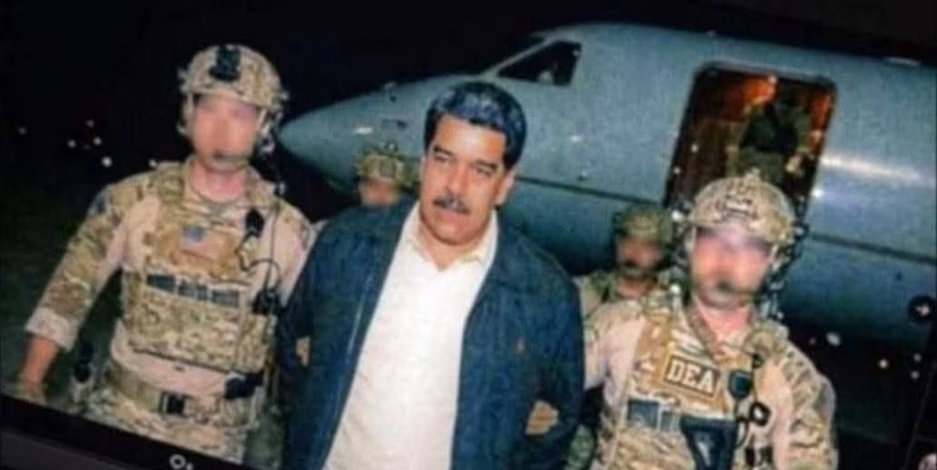
In an unprecedented political and military shock in the history of modern Latin America, the world awoke to the news of the United States bombing the Venezuelan capital Caracas and arresting President Nicolás Maduro and his wife, in a swift operation that broke entrenched taboos in international relations, redefined the limits of American power, and raised heavy questions about the legitimacy of "internationalizing justice" through military force, and the future of a global system that has become more fragile and less predictable.
The operation, announced by US President Donald Trump himself via his "Truth Social" platform, was not presented as a traditional military action, but as the direct execution of an arrest warrant against a sovereign head of state. Trump described the strike as "successful and extensive," and confirmed the transfer of Maduro and his wife out of the country in preparation for their trial in the United States, with details to be presented later in a press conference. With this announcement, Washington not only used force but also ensured to give a domestic legal character to a cross-border military act.
The United States had first accused Maduro of drug trafficking in 2020, but it escalated the level unprecedentedly after Trump's return to power, when it designated him as the leader of a terrorist gang for drug trafficking and offered a record bounty of $50 million for anyone who contributes to his arrest. However, this campaign, despite its intensity, lacked sufficient public evidence, which raised widespread doubts about whether the case was truly legal or a political tool to overthrow an adversarial regime.
Even the characterization of what is known as the "Sun Cartel" remained controversial. Instead of a centralized organization led by the Venezuelan presidency, numerous reports and analyses point to a loose network including corrupt officials from mid-levels, opportunistic military personnel, and organized criminals, operating under state leniency and turning a blind eye, without being subject to direct management from the presidential palace. This disparity between the severity of the accusation and the vagueness of the facts increased the fragility of the American narrative before the international public opinion.
Republican Senator Mike Lee revealed via the "X" platform that Secretary of State Marco Rubio informed him that Maduro was arrested by American elements, and that the military operation was carried out to protect the force executing the arrest warrant. Lee went on to justify the strike by relying on the “Second Article” of the American Constitution, considering that the president has the authority to use force to protect Americans from a "real or imminent" threat, which is an expanded and dangerous interpretation of presidential powers outside the framework of international authorization.
In contrast, American sources told the New York Times that the operation resulted in no losses among US forces. But the Venezuelan narrative was completely different. Vice President Delcy Rodríguez confirmed that the government was unable to locate Maduro and his wife after the bombing, and demanded that Washington provide proof that they are alive, pointing to the killing of Venezuelan civilians and military personnel in the air raids.
Rodríguez described what happened as "blatant aggression," and announced the activation of popular militias and comprehensive defense plans, calling on the people to take to the streets to defend sovereignty and independence, invoking the legacy of Simón Bolívar as a historical symbol of resistance to foreign intervention. This speech was not directed only inward but carried a clear message abroad that Venezuela considers what happened a serious transgression that will not pass without consequences.
Internationally, Russia hastened to condemn the American attack, considering it an act of armed aggression, affirming its solidarity with the Venezuelan people and its support for the Bolivarian path and the protection of national sovereignty. This position once again reflected the depth of international division, where regional crises turn into testing grounds for broader global balances between Washington and its rivals.
The shock caused by the United States does not lie only in the arrest of a head of state, but in enshrining a new principle that sees military force as a direct tool for applying American law beyond its borders. This shift represents a dangerous retreat from international norms, transforming Washington from an influential player in the global system into a party reshaping it by force, which portends chaos if other powers decide to emulate this approach.
The Venezuelan case reveals the dilemma of "politicizing justice" in international politics. When criminal accusations are used to justify military intervention, the credibility of the rights discourse itself erodes. The absence of convincing public evidence weakens the American narrative and gives its adversaries the opportunity to portray the operation as a vengeful act, even turning Maduro, despite his controversial record, into a symbol of resistance in the eyes of his supporters.
More dangerous than the event itself is the precedent it establishes. If arresting heads of state by bombing becomes a legitimate option, the international system enters a new phase of instability. Weaker countries will be the most vulnerable, alliances will become more militarized, while opportunities for diplomatic solutions recede, pushing the world a step further toward the logic of the law of the strong instead of the strength of legitimacy.
In conclusion, the bombing of Caracas was not just a security operation, but a political earthquake that will have long-term repercussions. And between two contradictory narratives, the truth remains hostage to the balance of power, as the world stands before an open question: Was what happened a shocking exception, or the beginning of a harsher and more turbulent era in international relations.
شارك برأيك
Bombing Caracas and Kidnapping Maduro: The American Shock That Broke Taboos and Opened the Door to International Chaos