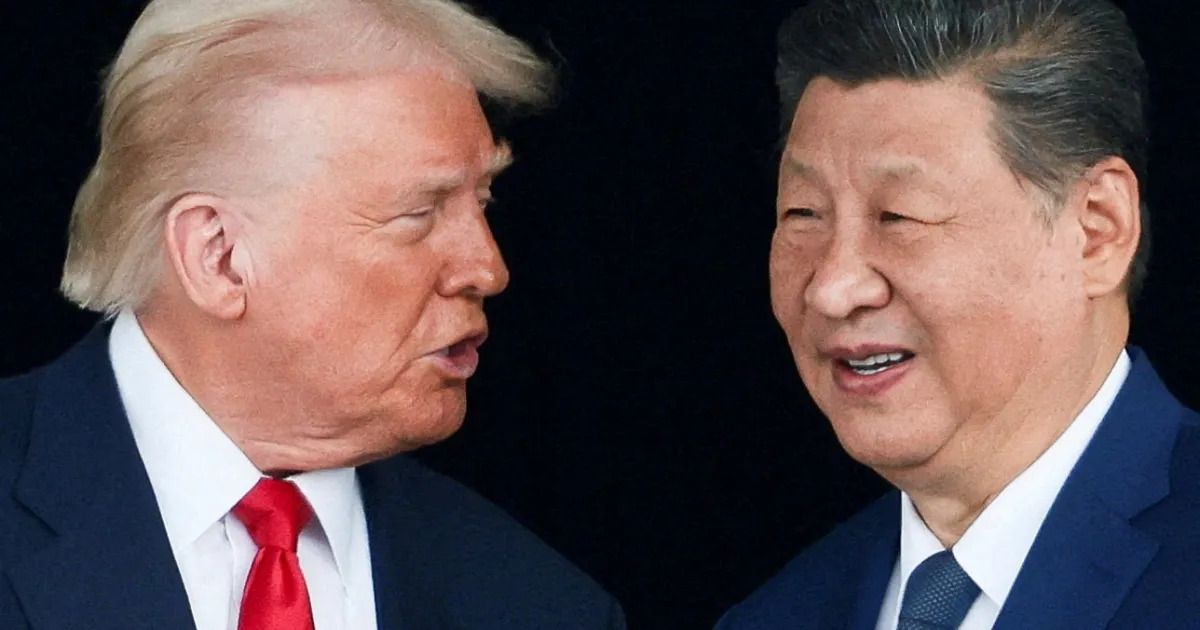







U.S. President Donald Trump praised the strength of relations with China, describing them as "very strong," following a phone call with his Chinese counterpart Xi Jinping that addressed the Taiwan issue, according to the Chinese Foreign Ministry.
Trump stated in a post on Truth Social, "Our relationship with China is very strong; this call was a follow-up to our very successful meeting in South Korea three weeks ago," noting that he accepted Xi's invitation to visit Beijing next April, while the Chinese president is expected to visit the United States later in 2026.
For its part, the Chinese Foreign Ministry said the call focused on the future of bilateral relations and trade issues between the two countries, in addition to the Ukrainian file, but the largest focus was on Taiwan.
The ministry added that the Chinese president emphasized during his call with Trump that "Taiwan's return to China" is a fundamental part of Beijing's vision for the international system after World War II, asserting that China and the United States "have worked together in the past to protect the international system, and they must continue to do so today."
Trump did not mention the Taiwan issue in his post on Truth Social.
White House spokesperson Caroline Levitt announced that the call, which lasted about an hour, addressed issues of trade, Ukraine, fentanyl, and U.S. agricultural products, stating that Washington is "satisfied with the pace of progress," and that Beijing "shares the same sentiment."
The call comes weeks after the two leaders met in Busan, South Korea, where they agreed on a framework for a trade agreement that includes Washington suspending 100% tariffs on Chinese imports in exchange for Beijing delaying the implementation of a licensing system for exporting rare earth metals.
The agreement also stipulates a reduction in U.S. tariffs and China purchasing at least 12 million tons of U.S. soybeans this year, and 25 million tons in 2026.
Military response threat Beijing considers the democratic island part of its territory and has not ruled out the use of force to subdue it, while Taiwan rejects Beijing's claims, stating that the people of Taiwan are the only ones who can determine their future.
Although it does not support Taiwan's independence, Washington is the largest supplier of weapons and military equipment to the island.
Japanese Prime Minister Sanae Takaichi hinted at the possibility of a military response if Taiwan is attacked by China, while Beijing warned—in a message delivered to the UN Secretary-General—of a firm response if Japan intervenes militarily in the Taiwan Strait.
Chinese Foreign Ministry spokesperson Lin Jian stated that the Japanese Prime Minister's remarks are provocative and blatant, warning that Beijing would deliver a "direct and severe blow" if Japan dared to intervene militarily.
The escalation between the two sides peaked after the Chinese Consul General in Osaka, Xiu Jian, posted threats that reached the point of hinting at killing Takaichi, before later deleting them from his account on the X platform.
Chinese Defense Ministry spokesperson Jiang Bin described the Japanese Prime Minister's words regarding any Chinese attack on Taiwan as irresponsible and extremely dangerous.
Jiang added in a statement, "If the Japanese side does not learn lessons from history and dares to take risks, or even use force to intervene in the Taiwan issue, it will only face a crushing defeat at the hands of the steel-willed People's Liberation Army and pay a heavy price."
Our relationship with China is very strong; this call was a follow-up to our very successful meeting in South Korea.
شارك برأيك
Trump accepts Xi's invitation to visit China and praises the strong relations with it.