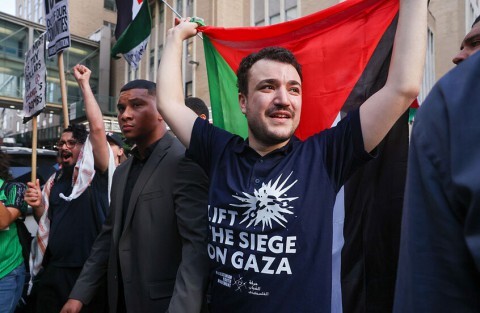







Palestinian activist and graduate student Mahmoud Khalil filed a lawsuit against the administration of U.S. President Donald Trump, demanding the disclosure of any communications that took place between it and several American organizations opposed to Palestinians, prior to his arrest on March 8, 2025. The lawsuit comes after the administration refused to respond to an official request submitted by Khalil under the "Freedom of Information Act" to obtain relevant documents.
Khalil, who holds permanent residency in the United States and is married to an American citizen, is seeking the full disclosure of correspondence between government agencies—including the Department of Homeland Security, the Department of State, the Department of Justice, and the Immigration and Customs Enforcement— and entities including: Canary Mission, Betar, Documenting Jew Hatred on Campus, Columbia Alumni for Israel, Middle East Forum, Shirion Collective, Capital Research Center, and CAMERA, which are organizations linked to Israeli intelligence agencies either directly or indirectly. Mahmoud Khalil states that "the public has the right to know the extent of cooperation between the government and these groups that target every voice criticizing the genocide in Gaza."
This lawsuit comes in a broader context that goes beyond the direct legal nature, as it reveals a complex structure of influence connecting the Trump administration with several organizations that actively monitor and target pro-Palestinian voices within the United States, especially in universities. Khalil's arrest in 2025 was not an isolated incident, but part of a wide-ranging government campaign based on accusations of "anti-Semitism" that affected students and academics who participated in anti-Israel protests at Columbia University and elsewhere.
After Khalil's arrest, organizations such as Canary Mission and Betar USA quickly announced their role in the process, reflecting the extent of influence these groups seek to exert on state agencies. Betar explicitly stated that it shared information about activists criticizing Israel with U.S. Secretary of State Marco Rubio this year, raising further questions about the possibility of undisclosed official communication channels.
Evidence of this coordination became clearer during the trial that concluded with a ruling affirming that Khalil's arrest was part of an unconstitutional "ideological deportation" policy. In a notable testimony, Peter Hatch, assistant director of intelligence at the Department of Homeland Security's Immigration and Customs Enforcement (ICE), stated that the agency formed a "Tiger Team," a group of officers summoned from various departments to gather intelligence reports on students, academics, and activists supportive of Palestine. He also revealed that the agency reviewed over 5,000 names provided by Canary Mission.
These platforms, which present themselves as "documenting hatred against the United States, Israel, and Jews," have effectively turned into blacklists targeting individuals who criticize Israeli policies, including dissenting Jewish voices. Critics argue that their primary mission is to silence pro-Palestinian discourse by deliberately conflating criticism of the Israeli government with anti-Semitism, a strategy that is increasingly effective within American academic and political institutions.
The case did not stop at the arrest; Khalil was deported to a detention center in Louisiana, far from his pregnant wife and attorney, where he spent three months under harsh conditions before a federal judge ordered his release. He became a father while in detention, without being allowed to attend the birth of his child. After his release, the Trump administration continued attempts to deport him to Syria or Algeria, claiming there was incomplete information in his green card application. However, a court in New Jersey issued a ruling preventing his deportation or detention until his case was resolved, before the government later appealed the decision.
It is noted that the current lawsuit, according to experts, is not merely a request for documents, but an attempt to uncover the nature of the relationship between state institutions and special interest groups that have long been accused of fueling anti-Palestinian rights discourse. It highlights an expanding trend within the United States, characterized by the use of legal and security tools to redefine political activism around Palestine as a security threat, rather than a legitimate democratic practice.
While Khalil seeks $20 million in damages, as presented in an administrative complaint during the summer, his case stands out as a striking example of the intersection of politics, security, and civil rights in the context of the Palestinian-Israeli conflict, and as a window that may open for a broader review of the role of private organizations in shaping federal policies directed against movements in solidarity with Palestine.


شارك برأيك
Mahmoud Khalil files a lawsuit to compel the Trump administration to disclose its communications with anti-Palestinian organizations.