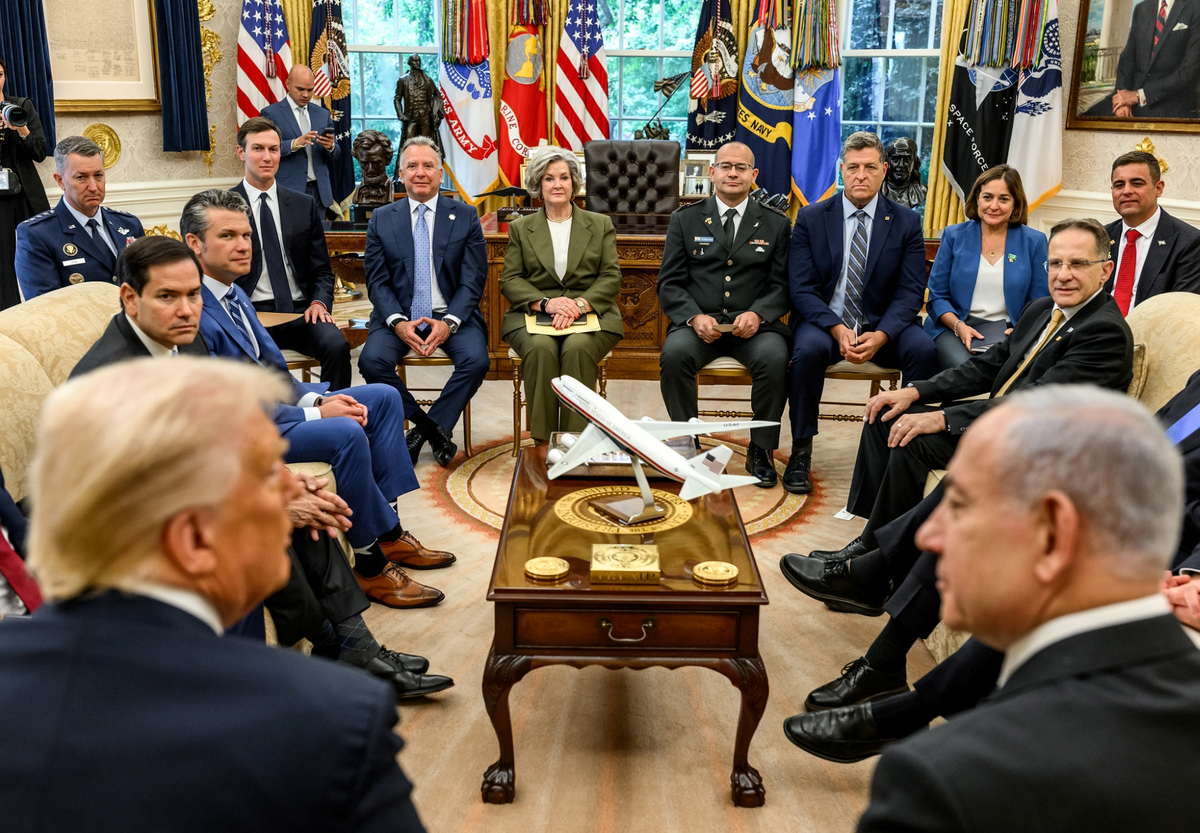







The French website Orient 21 stated that "President Donald Trump's peace plan," which announced a ceasefire in exchange for a prisoner exchange between Israel and the Islamic Resistance Movement (Hamas), is nothing but a reproduction of old thinking and political approaches dating back to the beginning of the millennium, when the "Quartet for the Middle East" emerged in 2002.
The site explained - in an article by Christian Jauré - that the Quartet, which then included the United States, Russia, the European Union, and the United Nations, was an attempt to revive the peace process after the collapse of the Oslo Agreement, and a product of the post-September 11, 2001 era in the United States.
The author pointed out that the Quartet was part of Washington's efforts to unify its diplomatic efforts under the banner of "the war on terror," and to pressure Palestinian leader Yasser Arafat to engage in the new American approach. Since then, managing the Israeli-Palestinian conflict has become part of an American security system aimed at protecting Israel and subduing the Palestinians, rather than achieving actual peace.
The author believes that Trump's 2025 plan, like the "roadmap" presented by the Quartet in 2003, is merely a tool to impose "peace the American way," based on disarming the Palestinians, dismantling resistance, and establishing a local technocratic authority with no political character.
The initial points of the plan stipulate that "Gaza will be a demilitarized area, free of terrorism, and under the supervision of international monitors," which practically means disarming Hamas and the factions under direct American oversight.
Jauré interprets this statement as a continuation of the Western security approach, which conflates international terrorism with national resistance, treating Gaza as a security file rather than a political one.
The new plan is based on establishing a temporary transitional authority in Gaza, managed by an international Palestinian technocratic committee unrelated to Hamas, which will only handle daily service management. It is likely to include 7 to 10 members, with only one of them being Palestinian, possibly a businessman or a security figure, such as Mohammed Dahlan, whose name has resurfaced despite his declining popularity in Gaza.
The overall supervision will be in the hands of the "International Peace Council," which will be chaired personally by Trump, with membership including international figures, among them former British Prime Minister Tony Blair, who previously represented the "Quartet" in 2007 and focused then on cosmetic economic projects that did not change the reality of occupation.
The author reminded that the Quartet was a facade for American diplomacy, with Washington controlling its decisions and using it to pressure the Palestinian side through its European and Arab allies. He confirmed that this is happening again today, as there are no mechanisms for accountability or responsibility within the "Peace Council," and no one knows who will evaluate its decisions or bear their consequences.
Thus, according to the author, international institutions are turning into tools to entrench American uniqueness and protect Israeli interests, while the Palestinians are excluded from any real role in determining their fate.
Trump's plan clarifies that the main goal is Israel's security, not the establishment of a Palestinian state, as it stipulates the creation of a new Palestinian security force under international supervision to secure the borders and prevent any attacks or infiltrations into Israeli territory, in a reproduction of the security logic that prevailed during Arafat's era, when the Palestinian Authority was required to combat "terrorism" instead of resisting occupation.
Trump's plan shifts from the idea of "peace for development" to "profit for peace," as Trump, being a businessman before being a president, sees the destruction of Gaza as an opportunity to build "modern cities" akin to Dubai or Monaco.
Jared Kushner, Trump's son-in-law, has promoted since 2024 the idea of transforming Gaza into a "global resort," while Trump himself stated in 2025 that "Gaza could become the Riviera of the Middle East."
The plan includes launching the "Trump Economic Development Program," which attracts major global real estate developers to establish massive investment projects on the Mediterranean coast, but it raises an embarrassing question that did not escape the author, who wondered: "Does this mean the displacement of Gaza's residents to make way for these giant projects?"
Jauré concluded that "Trump's plan" is not a peace project as much as it is a political and economic guardianship plan to subject Gaza to American oversight, with a formal role

شارك برأيك
Gaza from the Quartet to Trump's Plan.. A French Writer: The Same Recipes and the Same Failure