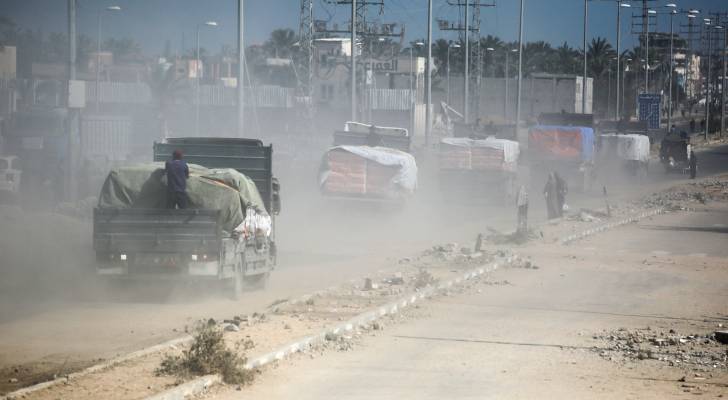







The UN humanitarian affairs official, Tom Fletcher, called on the occupying entity today, Wednesday, to 'immediately' open all crossings to allow aid into the Gaza Strip, emphasizing that the real test of the ceasefire agreement is not through photos and press conferences, but by feeding children and providing medicine to hospitals.
This urgent UN call comes at a critical time, just days after the fragile ceasefire agreement came into effect, amid an unprecedented humanitarian disaster that has led the UN to officially declare famine in parts of the territory.
Despite allowing limited amounts of aid to enter in recent days, relief organizations confirm that this represents only 'a tiny fraction of what is needed.'
In an interview with AFP from Cairo, the UN Under-Secretary-General for Humanitarian Affairs, Tom Fletcher, clearly stated the organization's position: 'We demand unrestricted access... We want this to happen now under the ceasefire agreement.'
Fletcher noted that 'the test of this agreement is not through photos and press conferences... the test is that we feed our children, provide anesthesia in hospitals, and set up tents over people's heads.'
Fletcher revealed that he participated in the Sharm El-Sheikh summit, and that US President Donald Trump and world leaders 'were clear that we must be allowed to provide aid on a large scale.'
The UN official confirmed that 'the teams are ready, and the goods are ready,' but what is currently entering is 'dozens of trucks at best... instead of the hundreds of trucks we need to see crossing.'
Fletcher's statements, as he heads tomorrow to the Rafah crossing, represent direct diplomatic pressure on the occupying entity, as they unequivocally link the credibility of the ceasefire agreement to the immediate and unconditional implementation of the humanitarian clause.
The reference to the existence of international consensus at the Sharm El-Sheikh summit, with President Trump participating, is an attempt to use the political momentum of the summit as leverage to compel the occupation to fulfill its commitments.
Diplomatically, these demands place the occupation before its responsibilities, making the aid file the standard by which the world will measure its seriousness in adhering to the agreement.
The UN's call adds a new dimension to the crisis, asserting that any political progress remains ink on paper unless translated into tangible improvements in the lives of civilians on the ground.
With humanitarian teams ready to intervene on a large scale, the ball is now in the court of the occupation, whose decisions regarding the opening of crossings will determine whether the ceasefire agreement will turn into a real beginning to end the suffering, or remain just a fragile truce on the brink of a humanitarian disaster.
The real test of the ceasefire agreement is not through photos and press conferences, but by feeding children and providing medicine to hospitals.
شارك برأيك
A UN official demands the occupation to immediately open all crossings of Gaza: "This is the true test of the agreement."