






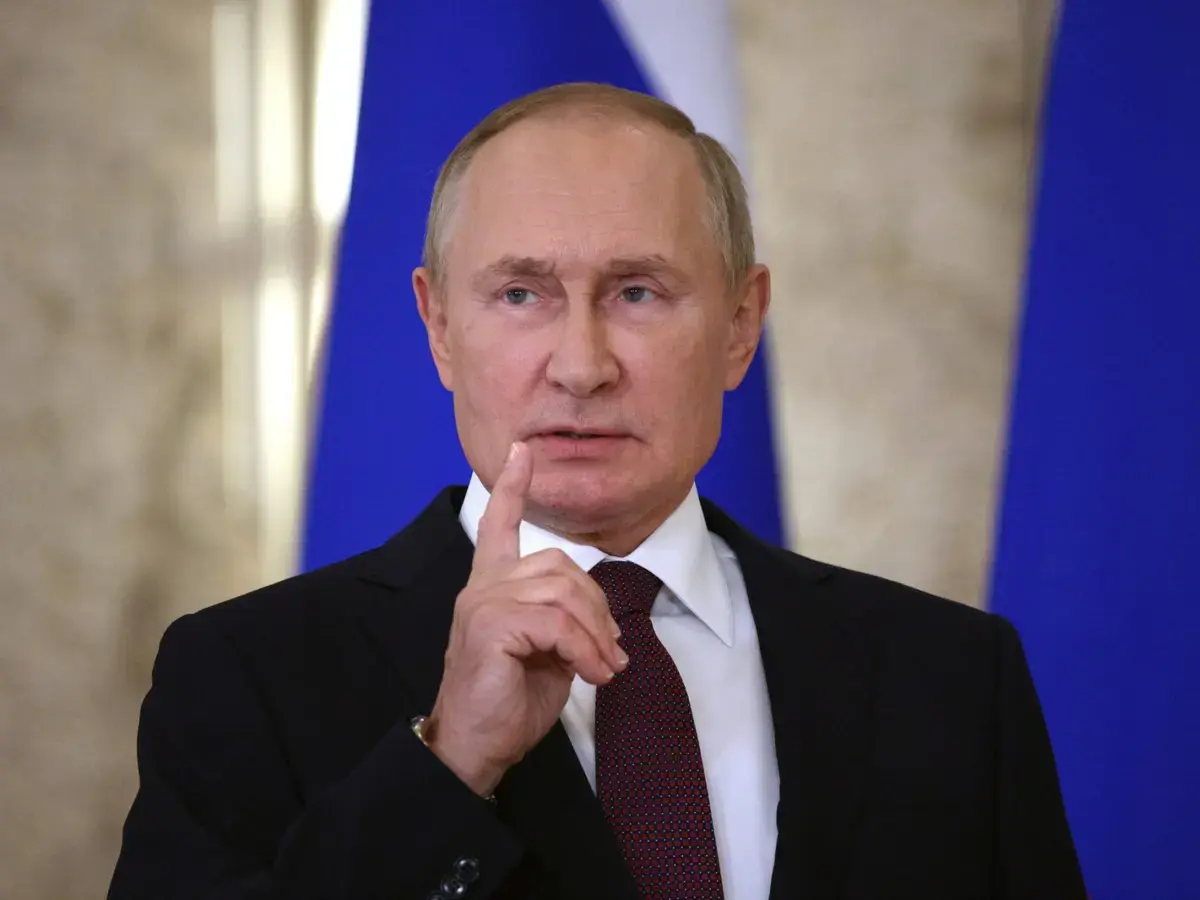
Professor Jamal Harfoush: President Putin’s signature on the possibility of using nuclear weapons is a dangerous shift in the rules of international deterrence
Talal Okal: Netanyahu will not back down from striking the Iranian nuclear program and may receive support and participation from the Trump administration
Dr. Dalal Erekat: Wars end at the negotiating table, and tensions usually precede diplomatic and political solutions
Nizar Nazzal: The world is approaching a dangerous scene that may lead to the use of "nuclear" and the possibility of slipping into a third world war
Dr. Raed Abu Badawi: The Biden administration wants to prepare Ukraine for a stronger negotiating position in preparation for Trump’s rule after supporting it with missiles
Dr. Saad Nimr: Nuclear threats, despite their seriousness, will remain part of the deterrence discourse and will not become a reality
International tensions and warnings of the world sliding towards a nuclear confrontation are escalating, due to the Russian-Ukrainian war and the escalation between Israel and Iran.
In separate interviews with “I”, writers, political analysts and university professors believe that fears are increasing about the effects of this complex crisis on global security and stability, stressing that the declared positions reflect a turbulent international reality, where nuclear threats have become part of the new deterrence game, at a time when major powers are competing for regional and international influence.
They point out that Russian moves, manifested in President Vladimir Putin signing a decree allowing the use of nuclear weapons, are an indication of dangerous changes that threaten the international system based on old balances.
On the other hand, the book and university professors point out that Israel stands at a strategic crossroads with the escalation of its threats to strike Iranian nuclear facilities, which could ignite a large-scale regional conflict.
In contrast, writers and university professors believe that diplomacy, despite the great challenges, remains the most appropriate way to ease tensions and prevent the world from sliding into an uncontainable third world war.
A global crisis of strategic dimensions characterised by nuclear threats.
Professor Dr. Jamal Harfoush, Professor of Scientific Research Methods and Political Studies at the University of the Academic Research Center in Brazil, believes that the world today is facing a complex and intertwined crisis with strategic dimensions characterized by direct nuclear threats and systematic regional escalation.
Harfoush asserts that Israel's repeated threats to strike Iranian nuclear facilities are not just passing statements, but rather come within a long-term strategy aimed at undermining and restricting Iran's growing influence in the Middle East.
Harfoush believes that this Israeli escalation increases the possibility of a large-scale regional conflict, especially in light of the increasing turmoil in international alliances and the divergence of interests between the great powers.
On the other hand, Harfush refers to the decree issued by Russian President Vladimir Putin regarding the possibility of using nuclear weapons, describing it as a dangerous shift in the rules of international deterrence.
Harfoush explains that the world is witnessing a transition from a stage in which nuclear weapons were considered a last resort to a new stage represented by the actual threat of nuclear escalation.
This shift, according to Harfoush, reflects the erosion of the international system based on the principles of the United Nations Charter, as legal rules are no longer able to control the behavior of major powers, which increases the complexity of the international scene and threatens the stability of the global system.
He believes that the continuation of the regional war for a long period may be part of an implicit American strategy, aiming to use the current conflicts as a political pressure card.
Harfoush points out that the US administration may benefit from prolonging these crises, especially in light of the internal political division that the country is witnessing, while some parties are counting on a transitional phase between the administration of President Joe Biden and the return of President-elect Donald Trump, who may seek to invest in the next phase to achieve strategic gains, which complicates diplomatic efforts and delays reaching peaceful solutions.
Regarding the issue of using nuclear weapons, Harfoush confirms that this option is not excluded, but it is subject to complex military and political calculations. From a military perspective, the use of nuclear weapons requires the availability of targets of decisive strategic value, and the ability to achieve a relative balance after executing the strike, which makes it difficult to resort to it even in the most severe scenarios.
Legally, Harfoush stresses that the use of nuclear weapons represents a flagrant violation of the principles of international humanitarian law and the United Nations Charter, as it leads to widespread destruction and leaves behind catastrophic human losses.
Exploiting legal loopholes or claiming “self-defense”
But Harfoush warns that some major powers such as Russia or the United States may resort to exploiting legal loopholes or claiming “self-defense” as an excuse to justify the use of this type of weapon.
Politically, Harfoush believes that resorting to nuclear weapons will lead to a major turning point in the international system, as it will redraw international alliances and weaken international institutions, such as the United Nations, which could push the world into a state of unprecedented chaos.
Harfoush points out that signs of a third world war are looming on the horizon, but questions remain about the form of this war in the modern era, which no longer depends only on traditional military confrontations, but also includes economic, cyber, and information wars.
Harfoush believes that the simultaneous escalation between major powers in multiple geographical theaters, such as Ukraine and the Middle East, increases the risk of a comprehensive conflict.
Harfoush believes that the frantic race to strengthen nuclear arsenals further complicates the situation, while Trump’s statements on these issues reflect an awareness of the nature of geopolitical transformations, as competition between the great powers revolves around resources and strategic regions, at a time when the world is sharply divided between East and West.
Despite the importance of diplomacy as a tool to reduce tensions, Harfouch points out that it faces major challenges due to the erosion of trust between the actors.
The current crises, according to Harfoush, require a new negotiating framework that goes beyond traditional models, and requires the availability of real political will, supported by effective international guarantees.
However, Harfouche stresses that diplomatic solutions will not be effective unless the international system is reformed to become more just and transparent, with the need to involve regional parties in decision-making.
The world is living in the atmosphere of a third world war
Writer and political analyst Talal Okal believes that the world is practically living in the atmosphere of a third world war, the features of which began to take shape with the Russian war on Ukraine, which came as a result of a series of American moves and provocations that threaten Russia's strategic security.
The United States, according to Awkal, has spared no effort in mobilizing NATO's economic and military capabilities with the aim of defeating Russia, and in the face of this challenge, China, North Korea, and Iran have shown their explicit support for Russia, thus forming a strong opposition front.
Awkal points out that US President Joe Biden, taking advantage of his remaining time in the White House, gave Ukraine the green light to use long-range US missiles to bombard the Russian interior, which is considered a crossing of Russian red lines. This prompted Russia to amend and activate its nuclear doctrine, which threatens an unprecedented escalation of the conflict in the European arena, in an attempt to block the promises of President-elect Donald Trump, who pledged to stop the war if he returns to power. Thus, the tension between the policies pursued by Biden and those that Trump might adopt if he wins the elections again is highlighted.
Regarding the situation in Asia, Awkal points out that Taiwan remains an explosive hotbed, especially since Trump promises to put competition with China and containing it at the top of his foreign policy priorities.
Awkal believes that this dynamic in Asia poses a constant threat, and keeps the situation explosive at any moment.
As for the Middle East, Awkal explains that the situation represents another episode in the new world war, embodied in particular in the struggle over who controls the region, which explains the intense Western support for Israel.
In this context, Awkal believes that Israeli Prime Minister Benjamin Netanyahu will not back down from his dream of striking the Iranian nuclear program, a goal that may receive support and participation from the Trump administration after his return to power. However, the question hanging over him here is: Will Israel dare to implement this plan during Biden’s term, or will it wait for the Trump administration?
Awkal also points out that launching a military strike against Iran requires, in return, neutralizing the fronts currently open against Israel, especially in light of the enormous pressure exerted by the axis of resistance, which directly threatens the Israeli home front.
Despite the potential role of diplomacy in achieving tactical truces, Awkal believes that the conflict in the region will not subside, stressing that the Palestinian cause, with its land and people, will remain at the heart of this escalating conflict.
The secret of nuclear balance is crossing international red lines
Dr. Dalal Araikat, Professor of Diplomacy and Conflict Resolution at the Arab American University, believes that the world is going through a dangerous phase that is witnessing an unprecedented entanglement of regional and international crises, warning that escalating tensions on multiple fronts threaten global stability.
Erekat specifically highlights the repeated Israeli threats to strike Iranian nuclear facilities, along with the continued Russian escalation in Ukraine, noting that this prolongs the war and reflects a decline in commitment to international laws, amid an increasing focus on military options.
According to Erekat, the major powers are seeking to change the balance of power in their favor, which increases the likelihood of major clashes. If the parties continue with this approach, we may find ourselves facing a catastrophic scenario that requires intensive global action to limit escalation and prevent a slide into a large-scale direct confrontation.
Despite the escalating threats to use nuclear weapons, Erekat points out that actually resorting to this option would be devastating for everyone, as nuclear deterrence is based on the concept of mutual fear of the collapse of the global order and the annihilation of humanity.
Erekat believes that breaking the nuclear balance means crossing international red lines, which will lead to the complete isolation of any party that uses nuclear weapons.
However, Erekat believes that the ongoing threats put the world on constant alert and raise growing concerns about the possibility of escalation.
Erekat stresses that the danger of a third world war still exists, although it is not certain, in light of the current situation.
Erekat explains that the parties involved in the conflicts are aware of the magnitude of the catastrophe that could result from a comprehensive escalation, noting that the provocative statements, whether from US President-elect Donald Trump or other world leaders, may reflect part of the global political game, but at the same time highlight the growing concern about the accumulation of crises and conflicts.
Erekat stresses the importance of seeking diplomatic solutions and rebuilding trust between the conflicting parties, as diplomacy is still a possible option, but it faces major obstacles in light of the military escalation and political stubbornness.
Erekat points out that history confirms that wars eventually end at the negotiating table, and tensions usually precede diplomatic and political solutions, which requires the international community to intensify efforts to open channels of dialogue, even if they are indirect, and to work hard to calm the escalating tensions.
Erekat believes that the international community cannot stand idly by, but rather must activate the role of international institutions such as the United Nations, to intensify pressure to resume negotiations before reaching the point of no return.
Erekat points out that Trump's statements about establishing a world free of wars are based on a vision that focuses on prosperity and investment, through profitable scenarios that can satisfy the various conflicting parties, but they remain part of a political discourse that may be far from the crisis-ridden reality.
Tactical nuclear strikes with limited impact over a narrow geographical area
Nizar Nazzal, a researcher specializing in Israeli affairs and conflict issues, warns that the world is approaching a dangerous scene that may lead to the use of nuclear weapons, but not in the broad strategic sense that destroys entire cities, but rather through tactical nuclear strikes with limited impact on a narrow geographical area, pointing to the possibility of slipping into a third world war.
Nazzal explains that these developments come against the backdrop of the escalation of the conflict between Russia and Ukraine, as the United States has given Ukraine the green light to use missiles capable of striking deep inside Russia, in a clear escalation that threatens to turn the conflict into dangerous levels.
On the other hand, Nazzal warns that Israel may exploit the regional chaos to carry out an attack on Iranian nuclear facilities.
"This is the golden moment for Netanyahu, who is trying to exploit the instability extending from Gaza to the West Bank and the stalled negotiations in Lebanon, to strike Iranian nuclear facilities," Nazzal said.
Nazzal believes that the tension on the northern front, and the increasing talk about an Israeli desire to expand the scope of its operations to southern Syria, reflects Israeli preparations for the possibility of targeting the Iranian nuclear program, with possible American assistance.
Regarding Iranian reactions, Nazzal explains that Tehran may have reconsidered any preemptive attacks on Israel, and that it is preparing for the repercussions of any potential attack on its nuclear facilities.
“Having Trump in power gives the Israelis greater comfort and clear support, which increases the chances of carrying out such a strike,” Nazzal says.
Nazzal warns that any Israeli attack on these facilities could cause massive chaos in the region, and may lead to the leakage of nuclear radiation and widespread chaos in the Middle East.
As for the possibility of a third world war breaking out, Nazzal believes that this scenario may be imminent if the conflict escalates, whether on the Ukrainian-Russian front or if a conflict breaks out between the United States and China, something Trump has warned of more than once.
"Russia is a major power with enormous potential, and if it is exposed to Ukrainian attacks that hit the Russian depth, things may move towards the use of tactical nuclear weapons, and thus the possibility of expanding the conflict," Nazzal said.
On the other hand, Nazzal points out that the world is witnessing changes in the balance of power that do not please the United States, as there is the rise of new powers such as China and Russia, which seek to reshape the global order in a way that reduces American hegemony.
In this context, Nazzal points out that these complex dynamics increase the chances of a third world war, especially with the continuation of tensions in other regions such as the two Koreas, Iran and Israel.
"It has become difficult to find comprehensive diplomatic solutions that satisfy all parties, which increases the chances of a comprehensive military escalation," Nazzal says.
Nazzal expresses his pessimism, saying: “I believe that the world is moving steadily towards a third world war. We are witnessing a narrowing of options for political solutions, and military escalation has become the most likely possibility.”
Possible modification of Russian nuclear doctrine
In turn, Dr. Raed Abu Badawiyya, professor of international law and international relations at the Arab American University, believes that the circulating reports about a possible amendment to the Russian nuclear doctrine, which has not yet been officially approved, came as a Russian response to the American move that allowed Ukraine to use long-range missiles to strike deep inside Russia. However, Kiev has not used these missiles yet, which leaves the door open to other interpretations about the context of this escalation.
Abu Badawiya believes that there is a development in the escalation between Moscow and Washington, as the administration of US President Joe Biden is working to encourage Ukraine to direct painful strikes at Russia, with the aim of improving Kiev's position in any future negotiations.
Abu Badawiya believes that the matter is not related to a military escalation following America’s quest to support Ukraine with missiles; rather, the Biden administration wants to prepare Ukraine for a stronger negotiating position in preparation for the rule of Trump, who has repeatedly announced that he intends to end the war after winning the US presidential elections.
Abu Badawiya points out that this American strategy comes as expectations indicate that President-elect Donald Trump will push to put an end to this Russian-Ukrainian war after taking over the reins of power in the White House.
Preparing the ground for diplomatic solutions
Abu Badawiya believes that these political dynamics seek to prepare the ground for diplomatic solutions, with the possibility of starting informal talks driven by international initiatives.
It refers to the Turkish proposal, in which Türkiye, led by President Recep Tayyip Erdogan, seeks to provide a solution to the conflict during the G20 summit.
Abu Badawiya explains that the Turkish proposal includes halting military operations, establishing an international buffer zone, and postponing Ukraine’s accession to NATO for at least ten years, noting that some American circles are suggesting up to 20 years as a possible postponement.
Abu Badawiya points out that this proposal has begun to gain increasing acceptance among some European countries, which realize that Trump's return may mean forcing Ukraine to sit at the negotiating table.
Abu Badawiya points out that Europe is the most affected by this conflict, as European countries may not be able to support Ukraine independently of the United States, which makes the future of aid dependent on shifts in American policy.
Abu Badawiya believes that Trump, after taking power, will not stop military support for Ukraine directly, but may keep it in place in one way or another until the negotiating table is secured.
The Turkish proposal is the basis for any possible settlement.
According to Abu Badawiya, the near future is likely to witness tangible steps towards ending the conflict through international mediation, which will not allow a diplomatic victory for any party without balanced gains.
At the same time, the Turkish proposal, according to Abu Badawiya, remains the basis for any possible settlement, while ensuring that Ukraine's defensive capabilities are enhanced with advanced weapons to ward off any subsequent Russian threats.
Abu Badawiya points to essential details including negotiating the areas controlled by Russia, freezing military action, and establishing a buffer zone under international supervision. In return, Ukraine could obtain agreements to enhance its defensive capabilities with qualitative weapons that would guarantee its protection from any future Russian advance. This reflects the current escalation of tensions and talk of mutual nuclear escalation, which remains an unlikely possibility, but keeps everyone on alert.
In general, Abu Badawiya asserts that all current scenarios are moving towards peaceful solutions driven by changing international circumstances, and that diplomatic efforts will play a major role in the near future. The war may not end quickly, but the acceleration of events indicates upcoming negotiations, driven by changes in the White House and increasing international pressure on the parties to the conflict.
Use of nuclear weapons as a deterrent message
Dr. Saad Nimr, Professor of Political Science at Birzeit University, believes that Russian President Vladimir Putin’s recent signing of the possibility of using nuclear weapons comes as a deterrent message directed primarily at Western powers, specifically those allied with the United States of America.
Nimr explains that the Russian move is based on Washington's decision to allow Ukraine to use long-range missiles capable of reaching deep into Russia, which prompted Moscow to resort to nuclear threats as a means of pressure and a means of deterring any escalation attempts.
Nimr believes that with the escalation of global tensions, fears are growing of the possibility of a third world war, especially with the dangerous developments and controversial statements by the leaders of major countries, and the possibility of using advanced nuclear weapons.
On the other hand, Nimr points to the Israeli dimension in this tense scene, as Israeli Prime Minister Benjamin Netanyahu sees the current circumstances as an irreplaceable opportunity to carry out strikes against Iranian nuclear facilities.
"In normal times, it would be very difficult to launch such attacks, but with tensions in the region running high, Netanyahu believes this may be the right moment to deliver a fatal blow to the Iranian nuclear project," Nimer says.
Nimr points out that Netanyahu's calculations depend largely on the possibility of extending the war, and taking advantage of the tension between Iran and Israel, to create a wider space for potential Israeli plans in the region.
Regarding developments related to the United States, Nimr explains that American policy towards these crises is largely dependent on the positions of President-elect Donald Trump.
He says: "Trump previously stated during his election campaign that he would work to end the war in Ukraine, and he does not prefer to engage in long-term wars, but everything depends on how the situation develops on the Ukrainian and Middle Eastern fronts."
Netanyahu will try to influence Trump's policies
Nimr points to Netanyahu's expected attempts to influence Trump's policies, as Netanyahu may seek to convince him of the need to continue supporting Israel, and perhaps try to pressure him to launch attacks against Iran and its allies, under the pretext of eliminating the resistance forces supported by Tehran.
"Despite these mutual threats, the actual resort to nuclear weapons is still far away," he added.
“Even if Russia threatens to use this type of weapon, the situation will remain within the framework of threats only, and the use of nuclear weapons will drag the whole world to the brink of the abyss, and will pose a great danger to Europe and the American bases deployed there. Modern nuclear weapons have enormous destructive capabilities, and if they are used, the catastrophe will be devastating for large parts of the world, including Russia, Europe, and the United States,” he says.
Nimr stresses that nuclear threats, despite their seriousness, will remain part of the deterrence discourse and will not become reality.
Regarding regional scenarios, Nimr stresses that the tension after October 7 has become worrying and has paved the way for the possibility of a regional war. He says: “The world is now facing strong winds of regional war, and the escalation in the Middle East may extend to take on more dangerous dimensions if the United States decides to intervene militarily against Iran. In the event of a large-scale conflict, the American bases in the Arabian Gulf region will be a potential target, which will lead to other interventions and perhaps a new world war.”
Nimr believes that an accurate reading of the situation requires daily and careful monitoring of the actions and field movements of major countries, and not just the statements of their leaders.
Diplomatic path still an option
As for possible solutions, Nimr believes that the diplomatic path is still an available option if the United States has the political will to limit the escalating wars.
Nimer points out that Trump promoted himself during the election period as a peacemaker who would end crises in Ukraine and the Middle East, and if he succeeds in doing so, it could be a major diplomatic move, but it depends on his willingness to put pressure on Netanyahu.
“The relationship between Trump and Netanyahu may seem good, but if Netanyahu violates any of Trump’s demands, it may turn into a hostile relationship,” Nimer says. “Trump is a person who does not follow traditional strategies, but is often influenced by his personal inclinations in dealing with crises.”
Nimr believes that the future of the situation depends on the US administration led by Trump and its ability to read developments accurately, as the diplomatic scenario and military escalation remain open, and the path the world will take depends on the nature of relations between the major international powers and the extent of their commitment to peaceful solutions.
شارك برأيك
After Putin's decree... Is the world on the nuclear brink?