






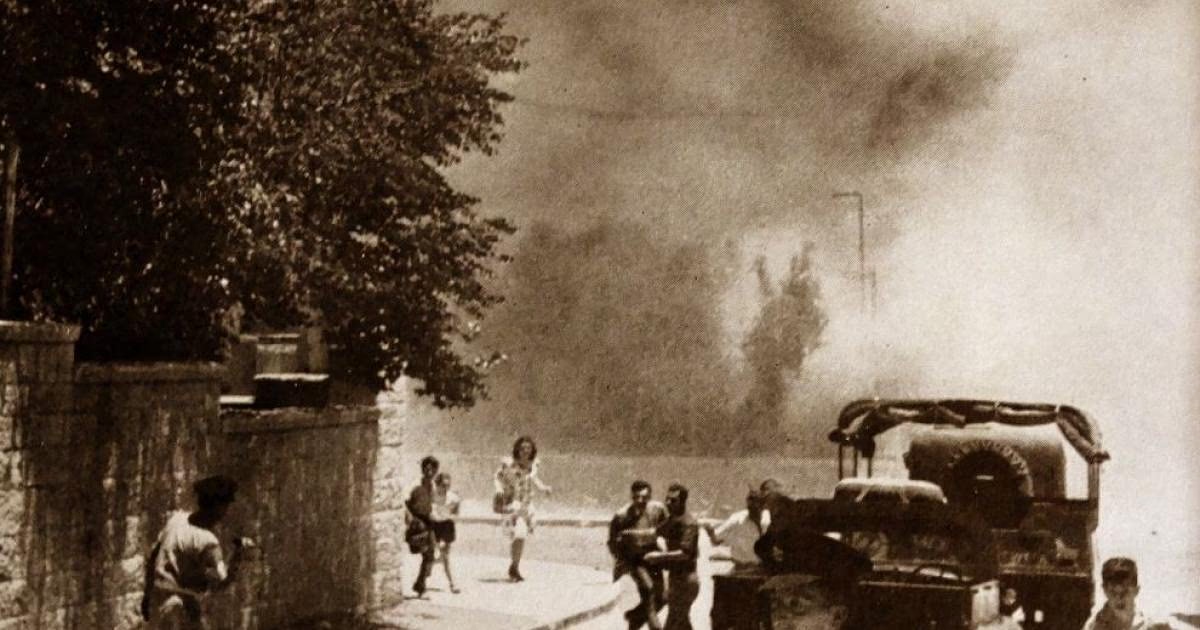
Today marks the eightieth anniversary of one of the bloodiest events in the history of the city of Jerusalem during the British Mandate period, when the armed Zionist 'Irgun' organization targeted the King David Hotel. The operation, which took place on July 22, 1946, targeted the southern wing of the building, which served as a vital administrative and military center for the British authorities in Palestine.
The operation began before noon that day with the arrival of a stolen truck at the hotel's service entrance, from which Zionist elements disguised as Arab workers disembarked for camouflage. The perpetrators transported large metal containers intended for milk transport, but they were filled with hundreds of kilograms of highly explosive materials, and placed them at strategic points within the basement.
At 12:37 PM, a violent explosion shook the foundations of the Holy City, leading to the complete collapse of six floors of the hotel's southwestern wing. The force of the explosion ripped out large parts of the building's historic stone facade, turning government and military offices into a pile of rubble in a matter of moments.
This operation resulted in the deaths of 91 people of different nationalities and religions, the largest proportion of whom were Arabs, with 41 martyrs among them. The list of victims also included 28 Britons and 17 Jews, most of whom were civilian employees and workers who were in the hotel at the moment of the catastrophe, in addition to a number of military personnel.
The King David Hotel, which opened in the 1930s, is an architectural and political symbol in Jerusalem, where British authorities seized large parts of it to convert them into official headquarters. These areas included the government secretariat offices, army command, and intelligence agencies, while other parts remained open to guests and diplomats, making the building a complex and sensitive target.
The attack came in the context of a sharp military escalation between armed Zionist organizations and Britain, after a period of cooperation between 'Irgun', 'Lehi', and 'Haganah'. These organizations aimed, through what was called the 'Hebrew Resistance Movement', to exert armed pressure on London to force it to change its policy towards Zionist immigration and the settlement project in Palestine.
Historical reports indicate that elements of the group engaged in an armed clash with British forces moments before the bombing, after their cover was blown in the service area. Despite the death of a number of attackers and the activation of the alarm bell, the group managed to withdraw, leaving behind the timed explosives that later caused immense destruction.
After the massacre, the 'Irgun' organization quickly claimed responsibility, but tried to absolve itself of the large number of victims by claiming to have sent prior warnings for evacuation. The organization claimed that it made phone calls to the hotel management, the French consulate, and the 'Palestine Post' newspaper to give civilians a chance to leave before the explosion.
In contrast, British authorities strongly denied that any official warning reached the officials who had the authority to issue evacuation orders at that time. The official British narrative confirmed that the attack was sudden and intended to inflict the greatest possible human and material losses among the administrative and military staff.
Documents and testimonies that emerged in later decades revealed that warning calls did indeed occur, but they arrived only a few minutes before the large explosion. Historical sources suggest that the hotel management did not take the reports seriously due to the large number of false threats during that period, and the exclusion of targeting a building that included Jews.
Analytical studies of the event revealed that both the Zionist and British narratives contained exaggerations and contradictions aimed at evading moral and political responsibility for the bloodshed. While there is no evidence that Britain deliberately ignored the warnings, it remains a fact that 'Irgun' planned and carried out the bombing in a building teeming with civilians and unarmed employees.
The King David Hotel bombing marked a crucial turning point in the relationship between armed Zionist organizations, leading to the fracturing of the 'Hebrew Resistance Movement' and the cessation of joint coordination. The operation sparked widespread international and internal condemnation, prompting the Jewish Agency to try to distance itself from the bloody methods employed by 'Irgun'.
On the political front, the bombing dealt a severe blow to the prestige of the British Mandate in Palestine, proving the authorities' inability to protect their most important centers of governance in the heart of Jerusalem. Although this event was not the sole reason for Britain's later departure, it accelerated the pace of reconsideration of the feasibility of remaining in a volatile region.
Today, eighty years later, the King David Hotel remains a witness to one of the most horrific pages of early Zionist terrorism in the city of Jerusalem. The names of the 91 victims, especially the Palestinians among them, remain a constant reminder of the heavy price paid by the indigenous people in the face of the armed gangs that later established the occupation state.
The final toll settled at 91 dead, including 41 Arabs, 28 Britons, and 17 Jews, in one of the deadliest operations during the Mandate period.
שתף את דעתך
80 Years Since the King David Hotel Bombing: The Crime That Shook Jerusalem and the Conflicting Narratives Around 91 Victims