PALESTINE

Tue 12 Dec 2023 3:20 pm - Jerusalem Time

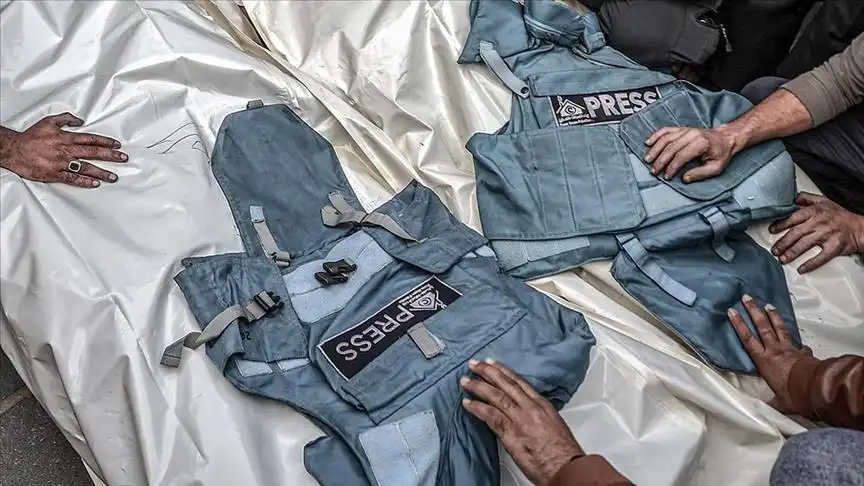
"Gaza Government": Israel deliberately "assassinated" 86 journalists during the war

On Tuesday, the government media office in Gaza accused the Israeli army of “deliberately” assassinating 86 journalists during the war on the Strip, in an attempt to obscure the truth, and called on press unions to pressure Israel to release the detained journalists.


The office said in a statement published on the Telegram platform: “The Israeli occupation army deliberately assassinated 86 journalists and newspapers during the brutal war on the Gaza Strip with the aim of assassinating the Palestinian narrative and an attempt to obscure the truth and prevent information and news from reaching regional and global public opinion.”


It considered that this represents "an attempt to intimidate journalists in the field and force them to remain silent, but Palestinian journalists have contributed in an unprecedented way to exposing the crimes of the occupation against civilians, children and women with all courage, boldness and heroism."


It continued, "As part of the fight against Palestinian journalists, the Israeli occupation army arrested 6 journalists during the war on Gaza, whose identities have not yet been known, in clear and flagrant violation of all international laws and conventions that grant journalists legal immunity while covering field events."


The office sent "a tribute of respect, admiration and appreciation to the journalists, media figures and activists who succeeded greatly in exporting the Palestinian narrative, breaking the occupation's narrative, and exposing its crimes against civilians, children and women, and now the whole world knows the truth."


We also denounce and condemn "in the strongest terms the occupation's crimes against Palestinian journalists, whether male or female, by assassinating, arresting, targeting, or injuring them."


It called on press and media unions and organizations around the world to “condemn the crimes of the Israeli occupation against Palestinian journalists, and to pressure it to release detained journalists who are subjected to investigation, torture, and psychological pressure inside prisons and detention centers.”


Yesterday, the government media office in the Gaza Strip announced, on Monday, that the number of journalists killed during the Israeli war had risen to 86 journalists since October 7, the last of whom was Muhammad Abu Samra, who was killed on Sunday by Israeli targeting.

OPINIONS

Tue 12 Dec 2023 12:45 pm - Jerusalem Time

Gaza: Indeed… Silence Is Worthing Gold

Eyad Abu Shakra

Eyad Abu Shakra

Opinion Writer

I remember that I have taken a particular interest in recent years in the question of the extent to which governments and parties need a spokesperson. Over time, with the expansion of the debate and the accumulation of practices, many in the Arab world have begun to seriously pose a more radical question: why do we need ministries of information in the first place?Here, before going back to the models we had seen in the Arab world before the “setback of” 1967, or “Pravda” and “Izvestia” of the former Soviet Union, I would venture to say that what we have been hearing and seeing in many press conferences held in Western democracies... is not at all better than what we had heard from the “media” in the sixties.

In the Cold War era, audiences understood that the media they were consuming was controlled by totalitarian authorities and that everything they read or heard was more “a point of view” or “justification for a political position” than it was objective reporting or solid analysis. Today, however, the audience finds itself facing a whole host of problems, the most prominent of which are...Firstly, strategic political interests, especially those of the major powers, have not changed and are not expected to fundamentally change, despite the development of media technologies and the challenges of “packaging” and “falsifying” them. Thus, justifying these interests and 'polishing' and promoting them - even with a considerable fabrication - is not as different today than it had been in the past as we might assume.Secondly, Western political culture, which many of us have had the opportunity to experience and whose benefits many of us have enjoyed, is not as absolutely perfect as we may have imagined as we stood before it in awe. 


While it appears civilized, sophisticated, and tolerant under normal circumstances, it sheds these layers of civilization, sophistication, and tolerance when tensions escalate and hostility intensifies. This is exactly what we are seeing today, not only in the atrocities committed against civilians, hospitals, schools, and places of worship in the occupied Palestinian territories, but also in blatantly government crackdowns on freedom of speech in US universities, the British media, and the shameless advertising boycotts aimed at silencing dissent.Thirdly, the blackmail and censorship (even criminalization) referred to above were a natural outcome of a series of developments following the end of the Cold War and the rise of the US as a “unipolar” power after the fall of the Soviet Union. In the past, Washington's pretext for building Israel's military arsenal was “maintaining the balance of power in the Middle East.” 

Since Moscow's fall, however, Washington has begun to openly talk about “the need to maintain Israel’s superiority,” completely disregarding the ”power balance” narrative. Moreover, in the fall of 1975, before Washington became a unipolar power, the UN General Assembly adopted Resolution 3379, which labeled Zionism a form of racism, and called on every country in the world to resist Zionist ideology, which the Resolution asserted was a threat to global peace and security.

However, after the collapse of the Soviet challenge, Washington forced the repeal of this resolution in 1991. From then on, we have seen a shift in the opposite direction, with criticism of Zionism being seen as racist. This push has gained so much momentum that today, any criticism of the Israeli government, regardless of the politics behind it, is seen as an 'anti-Semitic' offense that should be criminalized.Fourthly, the events of October 7th have been exploited to launch a war that has led to unprecedented levels of destruction and displacement, though most of the Arab world sincerely condemned it at the time and it became clear that Hamas officials had not been informed about it.Indeed, the killing and displacement have yet to stop... despite several lies and rumors about the operation being exposed, as well as intelligence reports presenting findings that turned out to be inaccurate or false. Some of these reports referred to the fact that some of Gaza's tunnels had been dug by Israel during its occupation of the Strip, as former Prime Minister Ehud Barak has admitted, and the intelligence narrative relocating Hamas’s alleged command center from the Al-Shifa Hospital to Khan Yunis!Fifthly, defying the global public and a substantial segment of the US public, Washington insisted on using its veto to prevent an end to the exacerbating humanitarian catastrophe in Gaza after nearly 18,000 people were killed in two months. 

The justification given by Washington for its veto against the Arab project premised purely on humanitarian grounds, was that it was “politically unbalanced” because it did not condemn Hamas... and thus “paves the way for another war”!In any case, even though the “pretext” of the US representative was an insult to the intelligence of everyone who heard it, it remains far less problematic than the statements of White House Coordinator for Strategic Communications at the National Security Council, John Kirby, who said at press conference, without batting an eye: “Tell me — name me one more nation, any other nation, that’s doing as much as the United States to alleviate the pain and suffering of the people of Gaza? You can’t. You just can’t.”


After all this, do we still need official spokespeople, responsible media, and respect for logic... let alone humanity and international law??

OPINIONS

Tue 12 Dec 2023 12:42 pm - Jerusalem Time

The Sufferings of the ‘Next Day’

Ghassan Charbel

Ghassan Charbel

Opinion Writer

The “next day” is an expression that has been haunting us for weeks. While it is still general and ambiguous, its features will most likely consist of a number of elements.Those will be determined by the questions raised by the Al-Aqsa Flood operation launched by Hamas on October 7th; by the results of the Iron Swords that Israel unleashed in response to the unprecedented attack in the history of confrontations between Israel and the Palestinian organizations; and by the conclusions that the major powers have drawn from this war, which is taking place on the verge of a widespread regional collapse.The expression is ambiguous because the war is still open; because expanding the killing for additional weeks may change its current features or consolidate them.


The Arab ministers have so far refused to talk about the “next day”, considering that the priority must be an immediate cessation of the war. This does not negate the fact that the phrase is raised in official meetings and repeated in diplomatic corridors. The “next day” is coming, no matter how late.Washington is trying to chart the features of that day. 


It intervened to prevent the Gaza war from turning into a regional war. It provided Israel with unlimited military support. It also offered it political and diplomatic backing, reaching a provocative position by thwarting a draft ceasefire resolution in the Security Council despite the massacre of civilians and children. Washington is moving to revive the two-state solution and exclude Hamas from the scene of the “next day.”Positions and remarks showed that no one has a detailed and clear vision of the stage that will follow the cessation of the war in Gaza. 

There are those who believe that the phrase clearly means another Gaza, in which Hamas is neither armed nor in leadership position. But the expression becomes more ambiguous when talking about alternatives.Will Israel return to occupying the Gaza Strip and installing a civil administration there? It is an option that the major powers oppose and consider a kind of return to experimenting with what has been tried. In addition, the position of President Mahmoud Abbas is clear and categorical: the Palestinian Authority will neither intervene on board Israeli tanks, nor will it assume any role in a scenario that separates the fate of Gaza from that of the West Bank, without a practical mechanism for the establishment of an independent Palestinian state.


The Palestinian Authority is unwilling to play an incomplete and dangerous role, and is also incapable of it. Moreover, it is clear that there is no room for an Arab role on the land of Gaza the “next day”, unless in the context of the establishment of an independent state. As for resorting to an international force to administer Gaza, Israel will reject it in light of its experience in South Lebanon.Among the informed diplomats are those who believe that the “next day” will begin with disappointments and bitterness. 


Israel’s success in destroying Gaza will not exempt it from the painful hour of obligations. Successive Israeli governments conducted a series of wars to assassinate the project of an independent Palestinian state before it was born. It contributed to the marginalization of the Authority and the launching of settlements to devour Palestinian land.Israel acted on the basis that the Palestinian state was like a massive explosive device that would be planted in its side. Today, it is evident that Washington, which supports Israel in shaping the features of the next phase, requires opening the political horizon by supporting the option of an independent Palestinian state.


This option necessitates an Israeli partner, who does not resemble Netanyahu and his government. This means that the “next day” will inevitably see a change in Israel that goes beyond names and parties to strategic choices. But can new Israeli elections produce a government capable of drinking the poison of an independent Palestinian state away from the greed of confiscating lands in what Israel calls “Judea and Samaria”?The rifts that “the next day” will raise in Israeli street will also be acutely felt in Palestinian society, especially in Gaza. 

In 2017, Hamas agreed to the principle of establishing an independent Palestinian state on the lands of 1967, but refrained from recognizing the other state. Anyone who observes international positions will easily conclude that the establishment of a Palestinian state will certainly be conditional on its recognition of the State of Israel and its abandonment of anything that could constitute a threat to the Hebrew state, that is, weapons or some of their types.


Can Hamas, in light of its nature and ideologies, accept a state with these conditions? Did the group unleash the Al-Aqsa Flood in order to later disappear from the scene? What about its solid nucleus? What about its allies?Some people believe that Hamas will find itself facing painful choices the next day. One diplomat reminded me of what happened in 2009 after one of Israel’s rounds of destruction in Gaza. The late Egyptian President Hosni Mubarak held an international conference in Sharm El-Sheikh to rebuild what was destroyed. Billions of dollars were promised at the conference. The diplomat said that the billions did not arrive because Hamas stipulated that it maintain its presence at the Gaza crossings and supervise the reconstruction process. He added: “The reconstruction of Gaza will be impossible the next day if Hamas remains the dominant force in the Strip.”The next day will raise big questions. Can Israel be a normal state with final borders away from old claims? Can it live near an independent Palestinian state? Political blindness prompted Israeli governments to assassinate two opportunities for a settlement. The first is the Oslo Accords, and the second, the Arab Peace Initiative. 


This political blindness has encircled Israel with an explosive belt that is beginning to explode here and there. “The next day” will pose difficult questions for the Palestinians themselves.One day, the late great poet Mahmoud Darwish was recalling his sorrows in Paris. I asked him about Oslo, and he replied that the settlement “is like descending from the tree of dreams into the coldness of reality and the balance of power.” “It also means less dreams and less land.” He added: “We offered the other to accept him and share the country, but he insists on expelling us from it.”How difficult it is to compromise when it comes to dreams and land! For this reason, the “next day” journey will not be easy, but rather burdened with pain and tears. That day will reveal the horror of the massacre committed on the land of Gaza. The expression remains ambiguous, and the war is still open.

PALESTINE

Tue 12 Dec 2023 12:30 pm - Jerusalem Time

Israeli Authorities arrest the Palestinian journalist Rasem Obaidat from Jerusalem

Today, Tuesday, the Israeli occupation forces arrested a journalist, after raiding his home in the town of Jabal Mukaber, south of occupied Jerusalem.


According to local sources, the occupation forces arrested the journalist Rasem Obaidat, after raiding and searching his house, tampering with its contents, and took him to the “Al-Mascobiyya Investigation Center.”

ARAB AND WORLD

Tue 12 Dec 2023 12:19 pm - Jerusalem Time

Blinken: War in Gaza Could Stop When Hamas Surrenders

US Secretary of State Anthony Blinken said on Monday that the war in Gaza could stop when “Hamas surrenders,” leaving Israel to determine the time it needs to stop the fighting.

He then revealed that his country will take whatever other actions are necessary to protect commercial ships in the Red Sea.

Blinken was commenting on a letter sent by five Democratic senators this week calling for increased accountability for Israel’s use of American weapons and the possible sale of 13,000 rounds of tank ammunition for Israel, bypassing congressional review generally required for foreign arms sales. He said the administration of President Joe Biden is trying to make sure that civilians are protected to the maximum extent possible in Gaza and that humanitarian assistance gets in to the maximum extent possible.


Blinken admitted “the terrible human toll” that this conflict is taking on innocent men, women, and children. He claimed that when it comes to the weapons that the US transfers, and the rules that go along with them, “those rules apply to Israel as they do to any other country, including the way they are used and the need, the imperative of respecting international humanitarian law.”

The US top diplomat stated that the war is against “Hamas” that attacked Israel on October 7th, and therefore, he said Washington is sending weapons to Israel to make sure that it has what it needs to defend itself against Hamas.


In an interview with Martha Raddatz of ABC This Week, Blinken said, “Look, this could be over tomorrow. This could be over tomorrow if Hamas got out of the way of civilians instead of hiding behind them, if it put down its weapons, if it surrendered.”Asked about the US being the only country to vote against a UN ceasefire resolution last week, Blinken said the Biden administration has been a strong proponent of humanitarian pauses.“In fact, because of our advocacy, because of the work we did, we got pauses, we got pauses on a daily basis, to make sure that people could get out of the way, that humanitarian supplies could get in,” he said.

Later, when CNN asked him whether the US will continue to back Israel if the war continues for months and months, the US Secretary of State said, “Again, Israel has to make these decisions.”He added, “Everyone wants to see this campaign come to a close as quickly as possible,” adding that “when the major military operation is over... we have to have a durable, sustainable peace, and we have to make sure that we’re on the path to a durable, sustainable peace.”

PALESTINE

Tue 12 Dec 2023 12:05 pm - Jerusalem Time

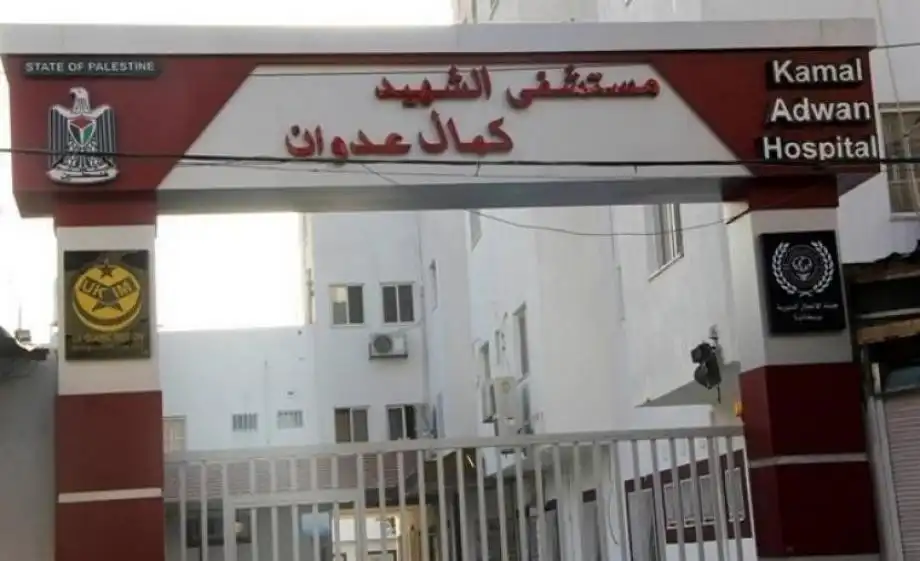
Israeli occupation storms Kamal Adwan Hospital in northern Gaza

Today, Tuesday, Israeli occupation forces stormed the Martyr Kamal Adwan Hospital, in Beit Lahia, north of Gaza, after besieging and bombing it for several days.


The spokesman for the Ministry of Health, Dr. Ashraf Al-Qudra, said in a press statement: The occupation forces began to gather the males, including the medical staff, in the hospital courtyard, expressing his fear that they and the medical staff would be arrested or liquidated.


He called on the United Nations, the World Health Organization and the International Committee of the Red Cross to act immediately to save and protect the lives of those in the hospital.


Yesterday evening, the director of Kamal Adwan Hospital announced that the occupation forces directly bombed the maternity ward, killing two women and their two children, and amputating the feet of a third woman.


Kamal Adwan Hospital Director said: We have 65 injured, 12 children in intensive care, 6 premature babies, 3,000 displaced people, and 100 medical personnel.


He confirmed that the occupation forces are besieging and targeting Kamal Adwan Hospital in the northern Gaza Strip.


The occupation forces had previously stormed most of the hospitals in Gaza and its north, abused medical staff, the displaced, the sick and the injured, and arrested 34 medical staff.


ARAB AND WORLD

Tue 12 Dec 2023 12:05 pm - Jerusalem Time

New York: A protest including American liberals and Orthodox Jews against the American “veto” against the ceasefire in Gaza

New York City witnessed a protest in front of the US Mission to the United Nations building, today, Tuesday, in protest against Washington's use of its veto power a few days ago against a draft resolution in the Security Council calling for an immediate humanitarian ceasefire in the Gaza Strip.


Protesters, including American liberals and Orthodox Jews, gathered in front of the US mission building to the international organization.


The protesters raised Palestinian flags and banners with slogans such as “Stop the occupation,” “Ceasefire now,” and “Resist the occupation.”


The protesters chanted slogans such as “Free Palestine,” “Stop the occupation completely,” “Give back the Palestinians their land,” “Yes to Judaism, no to Zionism,” and “Palestine will be liberated.”


The participants protested the United States' support for Israel and its use of its veto power in the UN Security Council against a draft resolution calling for an immediate humanitarian ceasefire in Gaza.


Some demonstrators prayed in front of the headquarters of the US Permanent Mission to the United Nations.


The protest, which took place under tight security measures, continued in the streets of Manhattan.


On Friday, the United States used its veto in the UN Security Council against a draft resolution calling for an “immediate ceasefire for humanitarian reasons” in the Gaza Strip.

OPINIONS

Tue 12 Dec 2023 11:59 am - Jerusalem Time

The Gaza War Has Convinced Russia It Was Right All Along

Carnegie

Carnegie

Opinion Writer

By Nikita Smagin

Events in the Middle East have helped the Kremlin convince itself that Russia’s foreign policy in recent years has been the right one.

The conflict in the Middle East is the perfect crisis for Russia, which is reaping a whole host of political benefits. The confrontation between Israel and Hamas has not only boosted the Kremlin’s hopes of changing the mood around the war in Ukraine, but also strengthened its belief that the Western-centric system of international relations is breaking down. 

The full-scale invasion of Ukraine in 2022 put an end to most internal Western disagreements when it came to Russia, uniting countries on both sides of the Atlantic. But the Israel-Hamas war has seen divisions resurface at a state level: while the United States insists Israel has a right to self-defense, there have been bitter disagreements between European countries about what position the European Union should take. There are also societal divides, with protests by opponents and supporters of Israel taking place regularly from Washington to Stockholm. Even state agencies are not immune to these differing views, with media reports of widespread discontent among U.S. officials with the White House’s pro-Israel stance. Against this backdrop, the war in Ukraine has slipped down the agenda. The United States has said it will provide help to both Israel and Ukraine. But how long can it really be fully engaged in two major conflicts? Moscow’s hopes that the West will eventually tire of providing open-ended support for Kyiv have never looked so justified. In addition, Washington’s pro-Israel stance undermines the legitimacy of the West’s broader reasons for supporting Ukraine in the eyes of many in the Global South. The moral argument against Russia’s invasion of Ukraine now looks like empty words, particularly in Middle East nations. 


Photos of the ruins in Gaza, reports of thousands of dead children, and the outrage of humanitarian organizations have made a deep impression on people in the developing world. People can argue endlessly about the reasons for the war in Ukraine, or Israel’s operation in Gaza, but for many the conclusion is obvious: the United States was critical of Russia when it killed innocent civilians in Ukraine, and now it is silent when its ally Israel does the same thing in Gaza. A vision of the world in which morals and ideologies are irrelevant—and the only thing that counts are state interests—has long been the dominant one in the Kremlin. And this logic dictates that there is no better outcome for Moscow than the continuation of the Middle East conflict, which is destroying the West’s strategy toward Russia. Moscow does not even have to lift a finger: Israel’s ground operation in Gaza looks unlikely to end anytime soon. When it does, intractable issues will remain. True, the escalation in Gaza is not without risks for Russia, and if pro-Iranian forces get sucked in, it could become a major headache for the Kremlin. Moscow’s ties with Iran mean it has been drifting toward a pro-Tehran position in the Middle East for the last couple of years, but that does not mean it is ready to support Iran in a war with Israel. Such a development would oblige Russia to pick a side, and would have consequences for Russia’s intervention in Syria.

For now, however, a broader military conflagration in the Middle East looks unlikely. Iran and its proxies have stayed out of the Gaza conflict so far, which means they are less likely to intervene further down the line. 


The Israel-Hamas war also poses some domestic dilemmas for the Kremlin. Judging by statements from officials, October’s anti-Semitic pogrom in Dagestan sent shockwaves through the Russian leadership. Nationalism and Russia’s ethnic republics are issues that previously worried the Kremlin. Now, Middle East policy will need to be made with half an eye on public opinion.

At the same time, minimizing these risks should be straightforward. It would be enough to tone down the anti-Israel rhetoric while maintaining some moderate criticism of the country’s actions. Indeed, the pogrom in Dagestan likely convinced the Kremlin that it’s less dangerous to remain on the sidelines in the Israel-Hamas war than to take an active role. 

Finally, events in the Middle East have helped the Kremlin convince itself that Russia’s foreign policy in recent years has been the right one. A charismatic leader should be able to make those around him believe that he is lucky, and that success comes naturally. Whatever the difficulties, President Vladimir Putin apparently believes that every cloud has a silver lining—and he communicates this confidence to his subordinates. Any successes, particularly if they seem to come from nowhere, strengthen both Putin’s fatalism and belief in Putin’s infallibility. Everything is in God’s hands, and God, of course, is on the side of Russia. There are also more rational arguments. Moscow’s bet on the disintegration of a Western-oriented international order appears to be paying off. Today it’s Israel and Palestine; tomorrow, it could be Taiwan and China. As such, the Middle East conflict confirms the hypothesis that Russia cannot be isolated. 

The Global South no longer trusts the West, and that means new opportunities for Moscow. The conflict also shores up the Kremlin’s hope that the difficulties caused by the war in Ukraine will—with time—dissipate on their own. This approach has been tried and tested by Russia many times. Even if the invasion did not go as planned, the logic runs, everything will resolve itself. 


Taken together, all of this means that Russia will remain a passive actor in the Israel-Hamas war. Moscow had no role in triggering the crisis, and couldn’t resolve it even if it wanted to. Russia cannot even play the role of an intermediary, because Israel is nervous of its closeness to Tehran. The only option left is to watch events unfold from a distance and repeat empty phrases about a two-state solution. In the meantime, the benefits the Kremlin is reaping from events in the Middle East only serve to convince the Russian elite that they have chosen the right path.


OPINIONS

Tue 12 Dec 2023 11:39 am - Jerusalem Time

The U.S. Must Change Course on Gaza Today

The New York Times

The New York Times

Opinion Writer

By Michelle Nunn, Tjada D’Oyen McKenna, Jan Egeland, Abby Maxman, Jeremy Konyndyk and Janti SoeriptoMs.


Ms. Nunn is president and C.E.O. of CARE USA. Ms. McKenna is C.E.O. of Mercy Corps. Mr. Egeland is secretary general of the Norwegian Refugee Council. Ms. Maxman is president and C.E.O. of Oxfam America. Mr. Konyndyk is president of Refugees International. Ms. Soeripto is president and C.E.O. of Save the Children U.S.

------------------------------

We are no strangers to human suffering — to conflict, to natural disasters, to some of the world’s largest and gravest catastrophes. We were there when fighting erupted in Khartoum, Sudan. As bombs rained down on Ukraine. When earthquakes leveled southern Turkey and northern Syria. As the Horn of Africa faced its worst drought in years. The list goes on. But as the leaders of some of the world’s largest global humanitarian organizations, we have seen nothing like the siege of Gaza. In the more than two months since the horrifying attack on Israel that killed more than 1,200 people and resulted in some 240 abductions, about 18,000 Gazans — including more than 7,500 children — have been killed, according to the Gazan health ministry. More children have been reported killed in this conflict than in all major global conflicts combined last year. 

The atrocities committed by Hamas on Oct. 7 were unconscionable and depraved, and the taking and holding of hostages is abhorrent. The calls for their release are urgent and justified. But the right to self-defense does not and cannot require unleashing this humanitarian nightmare on millions of civilians. It is not a path to accountability, healing or peace. In no other war we can think of in this century have civilians been so trapped, without any avenue or option to escape to save themselves and their children. Most of our organizations have been operating in Gaza for decades. But we can do nothing remotely adequate to address the level of suffering there without an immediate and complete cease-fire and an end to the siege. The aerial bombardments have rendered our jobs impossible. The withholding of water, fuel, food and other basic goods has created an enormous scale of need that aid alone cannot offset.


Global leaders — and especially the United States government — must understand we cannot save lives under these conditions. A significant change in approach from the U.S. government is needed today to pull Gaza back from this abyss. For a start, the Biden administration must stop its diplomatic interference at the United Nations, blocking calls for a cease-fire. Since the pause in fighting ended, we are again witnessing an exceptionally high level of bombardment, and at increasing ferocity. The few areas left in Gaza that are untouched by bombardment are shrinking by the hour, forcing more and more civilians to seek safety that does not exist. Over 80 percent of 2.3 million Gazans are now displaced. The newest Israeli offensive is now forcing them to cluster in a tiny sliver of land. The bombardment is not the only thing brutally cutting lives short. The siege of — and blockades surrounding — Gaza have led to a critical food scarcity, blocks on medical supplies and electricity, and a lack of clean water. There is barely any medical care to be found in the enclave and few medications. Surgeons are working by the light of their mobile phones, without anesthetics. They are using dishcloths as bandages. The risk of waves of waterborne and infectious disease will only grow in the increasingly overcrowded living conditions for the displaced.

One of our colleagues in Gaza recently described their struggle to feed an orphaned infant who had been rescued from the rubble of an airstrike. The baby had not eaten for days after her mother’s death. Colleagues could only scrounge up powdered milk — not formula, not breast milk, and not a nutritionally suitable infant food — to help stave off her starvation.


Before the war, hundreds of truckloads of aid were needed each day to support Gazans’ daily existence. Only a trickle of that required aid has made it into Gaza in the two months since the war began. But even if more were allowed in, our work in Gaza is dependent on ensuring our teams can move safely to set up warehouses, shelters, health clinics, schools, and water, sanitation and hygiene infrastructure. Today our staff members are not safe. They tell us they’re making the daily choice of staying with their families in one place so that they can die together or go out to seek water and food. Among leaders in Washington, there is constant talk about preparing for the “day after.” But if this relentless bombardment and siege continues, there will be no “day after” for Gaza. It will be too late. Hundreds of thousands of lives hang in the balance today. So far, American diplomacy in this war has not delivered on the goals President Biden has conveyed: protection of innocent civilians, adherence to humanitarian law, more aid delivery. To stop Gaza’s apocalyptic free fall, the Biden administration must take tangible measures like it does in other conflicts to up the ante with all parties to the conflict and bordering countries.


Secretary of State Antony Blinken once said of the war in Ukraine that the targeting of heat, water and electricity was a “brutalization of Ukraine’s people” and “barbaric.” The Biden administration should acknowledge that the same holds true in Gaza. While it has announced measures to deter violence against Palestinian civilians in the West Bank, Blinken and his colleagues should apply similar pressure to stop violence against civilians in Gaza, too.


The harrowing events unfolding before us are shaping a global narrative that if unchanged, will reveal a legacy of indifference in the face of unspeakable suffering, bias in the application of the laws of conflict and impunity for actors that violate international humanitarian law.

The U.S. government must act now — and fight for humanity.

ARAB AND WORLD

Tue 12 Dec 2023 11:37 am - Jerusalem Time

UN General Assembly will vote today on the vetoed draft resolution by Security Council for a ceasefire in Gaza

The United Nations General Assembly will vote - today, Tuesday - on an immediate ceasefire for humanitarian reasons in the more than two-month-long Israeli war on the Gaza Strip, after the United States used its veto against a resolution in this regard in the Security Council.


No country has veto power in the 193-member General Assembly, which is scheduled to vote on a draft similar to the wording of the resolution that was thwarted by the United States in the 15-member Security Council last week.


General Assembly resolutions are not binding, but they carry political weight and reflect global views on the war in the Gaza Strip.


The General Assembly vote coincides with the visit of 12 Security Council envoys to the Egyptian side of the Rafah border crossing, which is the only place where limited humanitarian aid and fuel supplies cross into Gaza.


The United States did not send a representative on the visit.

“With each step, the United States appears more isolated from the mainstream of opinion at the United Nations,” said Richard Gowan, director of the United Nations International Crisis Group.


The United States and Israel oppose the ceasefire because they believe it will only benefit the Islamic Resistance Movement (Hamas), and Washington instead supports a truce to protect civilians and allow the release of detainees.


Last October, the General Assembly called for an immediate humanitarian truce leading to a cessation of hostilities in a resolution that was adopted by a majority of 121 votes in favor and 14 opposed, including the United States, with 44 abstentions.


Some diplomats and observers expect Tuesday's vote to receive greater support.


Die from hunger

Joan said that the situation is different than it was last October, and the length and intensity of the Israeli operations in Gaza have made many United Nations members convinced that a ceasefire is necessary.


The draft General Assembly resolution also calls for the immediate and unconditional release of all detainees and for the warring parties to comply with international law, specifically with regard to the protection of civilians.


Most of Gaza's 2.3 million people have been forced from their homes, and the United Nations has issued dire warnings about the humanitarian situation in the besieged coastal enclave, saying hundreds of thousands of people are starving.


The United Nations World Food Program said that half the population in Gaza is starving.

The Ministry of Health in Gaza announced that the number of martyrs exceeded 18,000, in addition to more than 49,000 wounded, most of them children and women, and that the war caused massive destruction to the infrastructure and an unprecedented humanitarian disaster.


PALESTINE

Tue 12 Dec 2023 11:36 am - Jerusalem Time

Israeli Maariv: Israel is preparing a plan for Egypt and Jordan after the war in Gaza.


Israeli media revealed a new Israeli plan currently being prepared to administer the Gaza Strip after the end of the ongoing war.


Under the title: “An Arab coalition and a security buffer zone...this is what the Gaza Strip should look like the day after the war,” the Israeli newspaper “Maariv” said in a report written by Yaakov Perry, a military analyst, former intelligence officer and former head of the Israeli Shin Bet service, that there is no doubt that Israel's main concern for the day after the war is this solution, as the government promised the residents of the Gaza envelope security peace and the end of Hamas's ruling and military capabilities, otherwise there will be a lot of residents who do not want to return to their homes.


He added that as the fighting progresses and international pressure increases to stop the fighting, ideas and preparations for the post-war period are increasing as to who will govern the Strip and in what form, who will take it upon himself to manage this densely populated region, and who is truly desired and appropriate to manage such a problematic and complex region.


He said that no plan or proposal acceptable to the leadership in Israel has yet been agreed upon, and in addition, there are profound differences between the desire of the United States to hand over control to the Palestinian Authority while strengthening it, and the absolute negative Israeli position towards this solution.


Yaakov Perry, a political analyst at the Hebrew newspaper, said: “The United States will succeed in convincing Egypt to participate effectively and purposefully in the solution, perhaps in exchange for waiving some of its heavy financial obligations to the United States, and after that an Arab coalition must be formed, in which Egypt, Jordan, the Emirates, and Morocco will play an effective role.” , which will take over the civil administration of the sector.”


He added: "It will also be possible to establish a police force on behalf of the United Nations (which will act as civil, criminal and traffic police) and to allow Palestinian intervention in the Gaza Strip. Israel will not object to the participation of the Palestinian Authority representative in the Gaza Strip."


He went on to say: “The coalition that will be formed, but on the condition that the share of power is equal to the participation of others, and the Gaza Strip will be divided into administrative regions, and a president will be appointed for each region, according to which professional staff officers (education, health, etc.) from the coalition countries will be in charge, with Allowing Israel to interfere in security matters, and a perimeter will be created on the Gaza Strip’s borders with Israel, a security buffer zone whose entry will be prohibited, and the transfer between Israel and the Gaza Strip will be implemented at the Erez crossing.”


He continued: “Workers will not be allowed to leave the Gaza Strip to Israel, and there will be no civil relations between the Gaza Strip and Israel, and the residents of Gaza will have the ability to move or work in Arab countries according to arrangements with these countries, and this is a proposed structure that Israel can adopt, while preserving on the security of its territories, and especially the peace and security of its inhabitants.”

Source: Sama News

ARAB AND WORLD

Tue 12 Dec 2023 11:10 am - Jerusalem Time

Can Hamas actually be eliminated? This is what military and security analysts think

By Natasha Turak

The war’s aim, Israel’s government says, is to fully eliminate Hamas — it denies targeting civilians, although even its staunchest ally, the United States, is now saying that it must do more to protect civilian life.“To ‘eliminate’ or destroy Hamas, Israel will have to destroy the root cause of Hamas, its reason for existence,” one retired U.S. general told CNBC.


Israel’s war against Hamas — which has turned the blockaded and then besieged Gaza Strip into a post-apocalyptic wasteland — is now in its third month. 

The offensive, launched on Oct. 7 after Hamas militants killed some 1,200 people in Israel in a brutal terror attack and took another 240 hostage, has now killed more than 18,000 Palestinians in Gaza, health authorities there say. Hospitals have ceased to function, entire families have reportedly been wiped off the registry and scores of aid workers and journalists are among those killed. The aim, Israel’s government says, is to fully eliminate Hamas — it denies targeting civilians, although even its staunchest ally, the United States, is now saying that it must do more to protect civilian life.


Hamas, an Islamist militant and political organization designated as a terrorist group by the U.S. and European Union, has governed the Gaza Strip since 2007. It has a stated goal of destroying the state of Israel, which the United Nations classifies as an occupier over the Palestinian territories since 1967. In the years since Hamas took power in the small enclave, its capabilities, finances and weapons supplies have grown significantly, thanks to financial support from the likes of Iran and Qatar.


CNBC spoke to ten experts in counterterrorism, Middle Eastern history and security, and military operations to get their answers to the question: Can Hamas be, in fact, eliminated?


Hussein Ibish, senior resident scholar at the Arab Gulf States Institute in Washington 

“No. Hamas is not a bunch of individuals, or a set of equipment and infrastructure. It’s a brand, and as long as there are a group of living Palestinians who want to call themselves Hamas, Hamas still exists. It is extremely stupid to declare a war aimed that cannot be accomplished. Yet this is what Israel has done. And unless the Israeli leadership begins to draw down its rhetoric about war aims, Israel perforce will fail because it has set itself unachievable goals and they are writing Hamas’s victory speech with their own proclamations.”


Retired Lt. Gen. Ben Hodges, former Commanding General of U.S. Army Europe

“To ‘eliminate’ or destroy Hamas, Israel will have to destroy the root cause of Hamas, its reason for existence. That means Israel will have to accept progress towards a two-state solution and Palestinian statehood for Gaza and the West Bank. Hamas cannot have a leading role in governing Gaza but Israel’s refusal to accept the two-state solution only guarantees continued efforts by Hamas to destroy Israel. Israel taking away that motivation, and getting the illegal settlement problem solved, will make it much easier for Arab nations to support Israel. It will also require the U.S. to put more pressure on Iran to stop supporting Hamas. At the end of the day, IDF will kill a lot of Hamas and destroy much of their current network and infrastructure. But using lethal kinetic force only, without a political non-kinetic component to the strategy, is unlikely to lead to the ‘elimination’ of Hamas.”


Retired Col. Miri Eisin, Israel Defense Forces; managing director of the International Institute for Counter-Terrorism 

“Can Hamas be eliminated? Yes, the military portion can be eliminated in the sense that you can systematically destroy the weapons, the armaments, the production sites, the positions both above ground and below ground. It’s systematic, it’s slow, but that can be eliminated.Hamas’ ideology is part of the issue. It’s also a social movement and a governance. How to ensure people don’t join Hamas is first and foremost, you have to show that that way does not bring about a better future. That means that hand in hand with defeating Hamas, you have to let the people in Gaza distinguish and try to define the future they want. If I’m not clear enough, if the future they want is the Hamas genocidal version of destroying Israel, then we are going to seclude them, sideline them and make sure that they cannot get to us.”


Ryan Bohl, senior Middle East and North Africa analyst, Rane

“Total eradication of Hamas requires for Israel to not only carry out a military campaign in the Gaza Strip but also now Lebanon, Syria, Iran and even potentially Qatar where Hamas has a presence. But even that is pretty far-fetched given that the IDF hasn’t even successfully eradicated Hamas from the West Bank, which Israel more thoroughly controls.Hamas, like all militant organizations, has the capacity to reorganize and replace lost fighters and leadership so long as the deeper social and political drivers towards its ideology remain present. The only viable way that Hamas could cease to exist is if those ideological drivers disappear or the organization is supplanted by a rival militant group.”


Daniel Byman, director, Georgetown University Security Studies Program


“Hamas is very difficult to eliminate. It has substantial support in Gaza, at least compared with its rivals. In addition, it has deep educational, social welfare, and religious ties as well as being the de-facto government of Gaza. All this means that Israel could kill many Hamas leaders and still not eliminate the organization. The best hope would be to try to keep Hamas weak and off balance while building up rivals, such as the Palestinian Authority — but that is a long-term solution and a difficult one.”Palestinian fighters from the military wing of Hamas take part in a military parade near the border with Israel, to commemorate the 2014 war, which lasted for 51 days of the Israeli-Palestinian conflict.


Michael Knights, senior fellow at The Washington Institute; co-founder, Militia Spotlight platform

“Military campaigns such as the Second World War against Nazism or the war against ISIS don’t eliminate the ideology or even all remnants of the terror regime, but that’s not the point. The point is to get a regime like Hamas as close to elimination as possible with military means, and then hand off a more manageable task to policing and counter-terrorism forces, judiciaries, and political and economic processes.”


Jack Watling, senior research fellow for Land Warfare at the Royal United Services Institute

“It is realistic for the IDF to degrade Hamas’s military capabilities through their ground operation by killing its fighters and destroying their stockpiles of equipment. Furthermore, the removal of Hamas from control of Gaza can deny them the infrastructure that they had used to pose a serious and sustained threat to Israel.The ideology will not be destroyed, nor will Hamas as an organization. Nevertheless, Israel probably feels it can better manage a terrorist group than a hostile proto-state.”


Natan Sachs, director, Brookings Institution Center for Middle East Policy

“Hamas cannot be totally eliminated as an organization or an ideology, but that is not the Israeli goal, precisely. Its ideology is well-rooted in Palestinian society and draws from the broader Muslim Brotherhood family of organizations.But Israel’s goal is actually more limited, it aims to destroy Hamas’s ability to govern the Gaza Strip or to pose a military threat from the Gaza Strip to Israeli civilians as in the October 7th massacre. This is a very difficult task, but one that can be achieved at great cost to the civilian population in Gaza and to Israel. The unresolved question is what or who will govern the Gaza Strip if and when Hamas is toppled completely from power there.”


Dave Des Roches, associate professor at Near East South Asia Center for Strategic Studies, National Defense University

“Can Hamas be eliminated? Yes, it is possible to destroy any military organization, even one which claims a religious justification. Defeating it would require a complete destruction of its command network and most of its weapons facilities. This is not an easy task, and will probably not be possible without occupying most of all of Gaza for at least some period of time. So in order to truly defeat Hamas, the critical aspect is to ensure that Palestinians are free to reject Hamas, if they so chose. What that means is that Hamas adherents must lose the ability to impose their will on Palestinians who chose not to follow them – Hamas will have to lose its weapons and any ability to operate covertly in Gaza. 

This means that there will have to be a political entity which is capable of policing Gaza which is not Hamas. That is unlikely.”  


PALESTINE

Tue 12 Dec 2023 11:01 am - Jerusalem Time

Israeli continuous arrest campaign in West Bank: 50 Palestinians, including two women were arrested

Today, Tuesday, the Israeli occupation forces arrested 50 citizens from various governorates of the West Bank, including two women.


ARAB AND WORLD

Tue 12 Dec 2023 10:50 am - Jerusalem Time

Netanyahu does not rule out the outbreak of war with the Palestinian Authority in West Bank

Today, Tuesday, the Israeli Broadcasting Corporation quoted Israeli Prime Minister Benjamin Netanyahu as saying that the scenario of war breaking out between Palestinian security in the West Bank and the Israeli army is on the table of the government and security services and is being prepared for it if it occurs.


The Broadcasting Authority explained that Netanyahu made these statements during a secret session of the Foreign Affairs and Security Committee in the Israeli Knesset yesterday.


During the closed session, members of the Knesset asked Netanyahu about the possibility of such a scenario occurring, and he said: “Such a scenario is known to us and is on the table. We are discussing it.” “We want to reach a situation where if such an incident occurs, within a few minutes there will be helicopters in the air responding to such an incident.”

In the same session, Netanyahu attacked the Oslo peace agreement with the Palestinians, describing it as a disaster.


He added: "The Oslo Accords are the fundamental mistake. It brought the most anti-Zionist and most anti-Jewish people here."


The day before yesterday, Netanyahu rejected international calls to end the war in the Gaza Strip, describing them as inconsistent with supporting the war goal of eliminating the Hamas movement.


Netanyahu said in a testimony before his government that he told the leaders of France, Germany and other countries: “You cannot support the elimination of Hamas on the one hand, and on the other hand pressure us to end the war, which would prevent the elimination of Hamas.”


ARAB AND WORLD

Tue 12 Dec 2023 10:49 am - Jerusalem Time

Biden’s support of Israel leaves him as isolated as Russia on the world stage, analyst says

By Natasha Turak

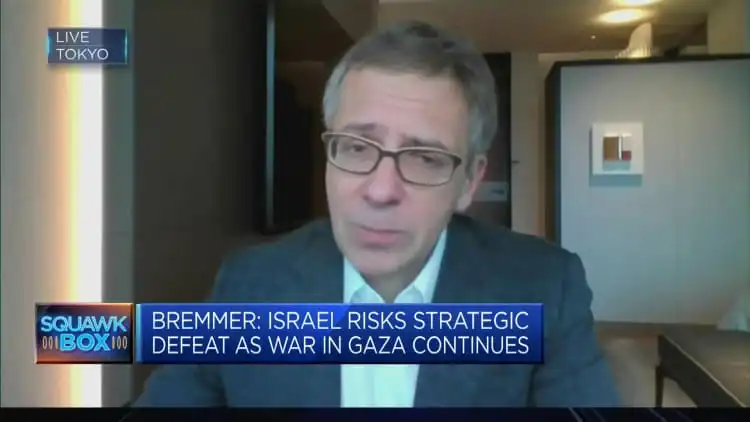
  1. The Biden administration’s steadfast support of Israel in its war against Hamas in Gaza has cost him tremendous political capital internationally, according to Ian Bremmer, the CEO and founder of the Eurasia Group. Washington’s stated unconditional backing of Israel — politically, financially, and militarily — has been a longstanding pillar of its Middle East foreign policy.


When Israel suffered a brutal terrorist attack on Oct. 7 by the Palestinian militant group Hamas that killed some 1,200 people and took more than 240 hostages, Biden flew to the country in a show of solidarity, pledging billions of dollars in military support. The U.S. already provides Israel some $3.1 billion annually in military aid, making it the largest recipient of American foreign aid in the world.But in the ensuing days and weeks, the enormous and disproportionate scale of Palestinian deaths in Gaza caused by Israeli airstrikes and ground offensive operations raised anger in many parts of the world at both Israel and Biden, particularly in the Global South. Protests in major cities, including across Europe and the U.S., in support of Palestinians and demanding a cease-fire have made global headlines.


During multiple United Nations General Assembly votes calling for cease-fires, Israel and the U.S. were often the only countries or among a very small minority voting “against.”“Biden is probably as isolated on the global stage, given how close he is to Israel, closest ally of the United States on this issue, as the Russians were when they first invaded Ukraine, which is a shocking thing to say,” Bremmer, the high-profile geopolitical commentator, told CNBC Tuesday. “But it shows just how challenging this war continuing is going to be for U.S. foreign policy.”A picture taken from southern Israel near the border with the Gaza Strip on December 6, 2023, shows smoke billowing during Israeli bombardment in Gaza amid continuing battles between Israel and the militant group Hamas.

Internationally, numerous leaders and human rights organizations have condemned the U.S. for its continued support of Israel. Biden and other members of his administration including Vice President Kamala Harris and Secretary of State Antony Blinken have said that “far too many” Palestinians have died, and that the way Israel defends itself “matters.” They have helped broker hostage-for-prisoner swaps during a fragile week-long truce and urged the allowance of more aid into Gaza.

But the administration officials hold to the position that Israel “has the right to defend itself,” which critics see as continuing to give Israel carte blanche in its military operations.

A former Egyptian foreign affairs minister, Nabil Fahmy, said last month that the U.S. is “losing a tremendous amount of credibility in the Arab world.” The “U.S. needs to take a serious look at its role. If it wants to support a stable world order based on rule of law, it has to demand everybody respect international law, whether friend or foe,” Fahmy, who served as minister between 2013 and 2014, told CNBC in an interview.


Since Oct. 7, more than 16,200 people have been killed in Gaza, including more than 10,000 women and children, according to Hamas-run health authorities there. Israel declared a siege of the already blockaded territory shortly after the Hamas attacks, cutting off all water, food and fuel to Gaza. Weeks later, the first aid trucks were able to enter the Strip, but the provisions that have made it in so far are woefully inadequate, according to the United Nations.


The situation is also a problem for Biden domestically, Bremmer said. “At home in the United States this is kind of a no-win situation for Biden, because he’s got a majority of Democrats that increasingly are aligned with the Palestinian position, while the Republicans are saying he’s too soft on Israel. And so, I mean, he just really wants this war to be over. He really wants it out of the headlines. And of course, that’s exactly what’s not happening right now.” “In fact, the war on the ground in Gaza is now expanding,” Bremmer added. “The impact on Palestinian civilians is increasing, and the proxy war in the region, particularly the Houthis in Yemen, a proxy for Iran are engaging in their most significant attacks on commercial waterway traffic and on U.S. military vessels in the last 24 hours that we’ve seen since the war started. So this is really a problem from the perspective of the U.S. and this isn’t going to get better anytime soon.” People use the lights on their telephones to search for victims amid the rubble of a smoldering building, following an Israeli strike in Rafah in the southern Gaza Strip on December 6, 2023.


The White House did not immediately reply to a CNBC request for comment, but spokesperson previously told CNBC that “Israel has the right to defend itself in compliance with international law, including international humanitarian law, especially as Hamas terrorists have said that what happened on October 7th ‘will happen again and again and again’ until Israel is annihilated.”The northern half of Gaza has been decimated, with Israeli forces now moving their ground offensive into the southern half of the enclave, after 1.1 million residents of the north evacuated south on the Israeli military’s orders. 

Palestinians in Gaza say they have “nowhere to go” to escape the bombings, and the World Health Organization warns that Gaza’s health system has collapsed and disease is spreading among the population.


Israel says it is not intentionally targeting civilians and that it gives warnings before it attacks certain areas. Its goals are to eliminate Hamas and its military capabilities and to ensure the return of all the hostages captured by the group during its October attack.

ARAB AND WORLD

Tue 12 Dec 2023 10:42 am - Jerusalem Time

Politico: Former US ambassador to Israel says Netanyahu is a ‘clear and present danger’ to Israel

Former U.S. ambassador to Israel Martin Indyk slammed Israeli President Benjamin Netanyahu as Sunday “clear and present danger” to the country, and called on him to resign “before he does even more damage to Israel.”“[Netanyahu’s] determination to stay in power no matter the cost is a clear and present danger to Israel. He needs to resign…yesterday!” Indyk wrote in a post on X Sunday morning. 


His comments came following a New York Times report that Netanyahu not only was aware that Qatar was shuttling millions of dollars a month to Gaza, where it helped prop up the Hamas government, but that he encouraged the payments.

According to the Times report, Netanyahu and other Israeli officials allowed the money to flow into Gaza in the hope that it would help maintain peace and stability in the region, and in the belief that Hamas had neither the desire nor the capacity to launch a large-scale attack. 


The Times previously reported that Israeli officials had blueprints of the Hamas’ plans more than a year before the Oct. 7 attack but chose to regard an actual attack as unlikely.

“He needs to resign before he does even more damage to Israel,” wrote Indyk, who was tasked with working to forge an Israeli-Palestinian peace deal during his roughly year-long tenure as President Barack Obama’s special Mideast envoy in 2013 and 2014.


Indyk’s comments come as calls for Israel to scale back or end its violent campaign in Gaza have accelerated. The U.S. has vowed to stand with Israel, and recently vetoed a ceasefire resolution in the U.N. Security Council — a measure that had support from almost all other Security Council countries. 


However, U.S. officials have also called on Israeli leaders to take measures to avoid civilian casualties. The war poses a challenge to President Joe Biden, as he attempts to balance support for America’s chief ally in the Middle East with calls for a ceasefire from the left, as the civilian death toll in Gaza continues to grow.

Indyk warned in his post that Netanyahu is “currently causing a rift” with Biden, whom he described as “Israel’s only friend in this crisis.”


PALESTINE

Tue 12 Dec 2023 10:30 am - Jerusalem Time

Dozens of settlers storm Al-Aqsa protected by Israeli army

Today, Tuesday, dozens of settlers stormed the courtyards of the holy Al-Aqsa Mosque, under heavy protection from the Israeli occupation police.


According to local sources, the settlers made provocative tours in the courtyards of Al-Aqsa, and performed Talmudic rituals, in light of the increase in calls for incursions, coinciding with the advent of the Jewish holidays, which continue until the end of this week.


In the same context, the occupation police tightened its military measures in the vicinity of Al-Aqsa and the Old City.


OPINIONS

Tue 12 Dec 2023 9:33 am - Jerusalem Time

The resistance is still holding together

op-ed "AlQuds" dot com

op-ed "AlQuds" dot com

Opinion Writer

There is a lot of talk these days about who will rule the Gaza Strip after the defeat of Hamas at the hands of the Israeli occupation forces, as if it had become a given, while what is happening on the ground is exactly the opposite. The resistance is still cohesive and confronts the occupation forces face to face, inflicting heavy losses on it.


Promoting who will rule the Gaza Strip after Hamas is aimed at a psychological war waged by the occupying state in an attempt to sow the seeds of doubt that the resistance will be defeated and that its fate will be liquidation and expulsion from the Gaza Strip and the West Bank, to make citizens beware of that. It is a war launched by the occupying state due to its inability so far to achieve any of the goals that it has raised and is raising so far, by eliminating the resistance, led by Hamas, and liberating Israeli prisoners without an exchange.


Unfortunately, some Palestinians, as well as Arabs, have taken the proposals of the occupation, the United States of America, and some countries of the colonial West seriously, and are preparing themselves for the post-Hamas era, or the post-resistance era, and its defeat, according to Israeli, American, and Western claims.


It is truly shameful to continue betting on America, which is preparing the Palestinian Authority to rule the Gaza Strip after the elimination of Hamas, as if this elimination has become a certainty, while the one who loses in this criminal and aggressive war is the occupying state, and behind it America and the colonial West. The resistance is dealing with a double blow. The occupation is suffering huge losses, which calls for it to triumph over children, women, and the elderly, demolish homes, and destroy infrastructure, schools, hospitals, and places of worship. If this indicates anything, it indicates that the occupation cannot yet resolve the battle and will not be able to later either, and it is better for it and for those who behind it to acknowledge and recognize the national rights of our people instead of an aggressive and destructive war, which only increases the state of hostility between our people and these countries, most notably the occupying state and America.


If the occupying state had been able to achieve any of its goals, America would not have used its veto power in the Security Council over a draft resolution demanding a halt to the war for humanitarian reasons. This confirms that the occupying state, despite the passage of about 70 days since its war of genocide, is incapable of liquidating the resistance.


Giving the United States of America, the occupying state, additional time to achieve any of its high-level goals, through the American veto, which is the third in the Security Council, will be of no use. In the end, the inalienable national rights of our people to return, self-determination, and establishing their independent state must be achieved with Jerusalem as its capital.


The occupying state will not be able to achieve any decisive military victory over the resistance, and the only way for it is to leave the Palestinian land so that our people can be liberated and independent. The rule of the Gaza Strip after the war ends will be decided by our people, not America, Israel, and the complicit West.

ARAB AND WORLD

Tue 12 Dec 2023 9:32 am - Jerusalem Time

Netanyahu: Saudi Arabia and UAE will fund reconstruction of Gaza, and this is the government’s plan for the day after the war

Israeli Prime Minister Benjamin Netanyahu said that “the reconstruction of the Gaza Strip will be funded by Saudi Arabia and the United Arab Emirates” after the end of the Israeli aggression on the Strip and the war against Hamas, according to what Israeli media reported.


The Times of Israel newspaper explained in its report, Monday, December 11, 2023, that Netanyahu’s allegations came during his participation in a session of the Foreign Affairs and Security Committee in the Israeli Knesset, which touched on developments in the ongoing brutal aggression against the Gaza Strip.


The newspaper said that the basis on which Netanyahu's claim is based was not immediately clear, and no oil-rich Gulf country has given any public indication that it is ready to undertake such a mission, to rebuild what was destroyed by the Israeli occupation in the Gaza Strip.


Arab and American officials also repeatedly told the newspaper over the past two months that Arab support for the reconstruction of Gaza is not a given, and that at best it will serve as an alternative until the Palestinian Authority is ready to take responsibility and advance the two-state solution.


Netanyahu also indicated that his government's plan for the day after the war includes "establishing a buffer zone between the Gaza Strip and the Gaza Strip and controlling the Philadelphia (Salah al-Din) axis between the Strip and Egypt."


Netanyahu also attacked the Palestinian Authority, vowing not to allow it to take over the administration of the Gaza Strip after the end of the war. He said that the Oslo Accords "were the biggest mistake committed by Israel," noting that "both sides (Hamas and the Authority) of Palestinian society basically want to eliminate Israel."


Meanwhile, the head of the Labor Party in the occupying state, Merav Michaeli, criticized Netanyahu's policies and his vision for what she described as "the next day," referring to the stage after the end of the aggression that resulted in the martyrdom of more than 18,000 Palestinians in the Gaza Strip.


Addressing Netanyahu, Michaeli said: “I have returned to the campaign of no Palestinian authority and no Palestinian state. I tried it for a long time, and perhaps I believed in it, but it failed miserably. It never presented an alternative to the Palestinian state.”


Michaeli, who only last week announced her retirement from political life, added that “without a vision, the Gulf states will not achieve the goal of restoring and preserving Gaza.”


In response to the Labor Party leader's attack, Netanyahu said, "The idea is for the United Arab Emirates and Saudi Arabia to participate in the reconstruction of the Gaza Strip the day after the war."

Source: Arabic Post


ARAB AND WORLD

Tue 12 Dec 2023 9:26 am - Jerusalem Time

“Netanyahu is in a difficult position.” Biden hints at disagreements with Netanyahu

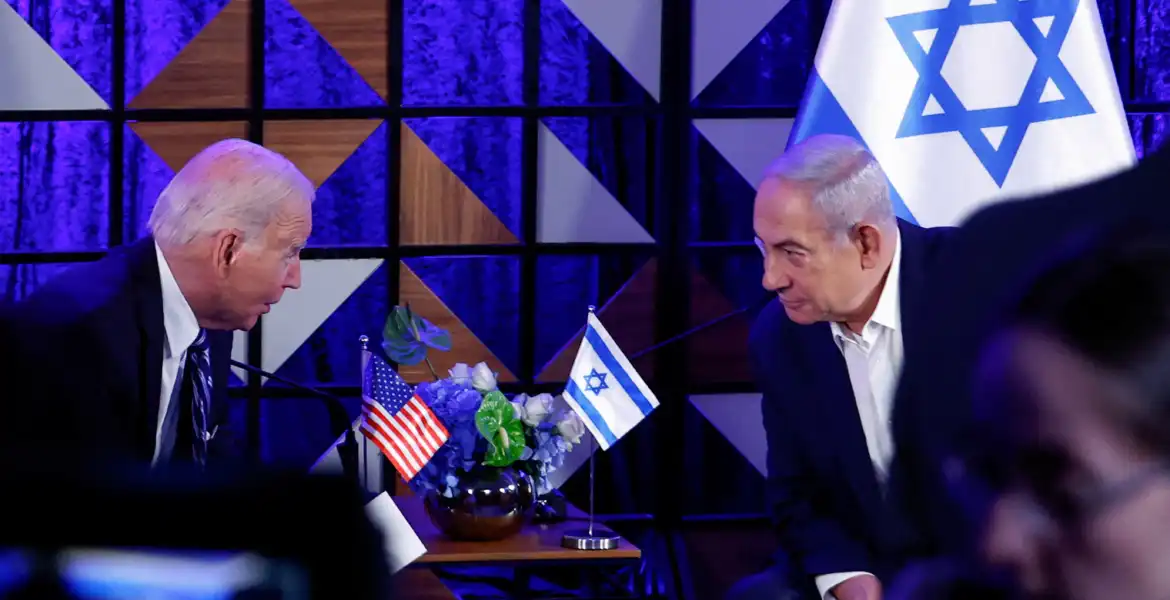
US President Joe Biden, on Monday, December 11, 2023, hinted at the existence of unrest in the relationship between him and Israeli Prime Minister Benjamin Netanyahu, indicating that the latter is in a “difficult position,” and that each of them has had its share of disagreements over the years and at the present time according to what was reported by Reuters.


Biden, who was speaking at a White House reception marking a Jewish holiday, addressed his decades-long relationship with Netanyahu. He pointed to what he had written on an old photo of the two of them, saying, “I wrote at the top: ‘Bibi, I love you but I don’t agree with any damn thing you had to say.’”


"It's almost the same thing today," Biden added, amid intermittent applause from the audience, the majority of whom were Jews, adding that Israel is in a "difficult situation... I have disagreements with some Israeli leaders."


While the US President did not clarify what remaining differences between them are, in recent weeks they have included issues including the current war against Hamas and the treatment of the Palestinians.


Meanwhile, Biden faces severe criticism for his support of the Israeli aggression on the Gaza Strip, which led to the death of 18,205 people and the injury of nearly 50,000, according to the Ministry of Health in Gaza, which sparked sharp criticism within the United States.


Biden also told Jews celebrating the holidays at the White House that regardless of differences with Israeli leadership, his “commitment” to an “independent Jewish state is unwavering.”


The American President added: “Guys, if there were no Israel, there would be no safe Jew in the world.” He said aid to Israel would continue until Hamas was defeated, but warned that public opinion could undergo a shift that would be dangerous to Israel's security.


Biden also said: “We have to be careful. They have to be careful. The entire world public opinion can change overnight. We cannot allow that to happen.”


Biden also said that the United States will continue to work to free the hostages still being held in Gaza, accelerate the provision of humanitarian aid to the Palestinians and “emphasize to our Israeli friends that we need to protect civilian lives.”

Source: Arabic Post


ARAB AND WORLD

Tue 12 Dec 2023 9:23 am - Jerusalem Time

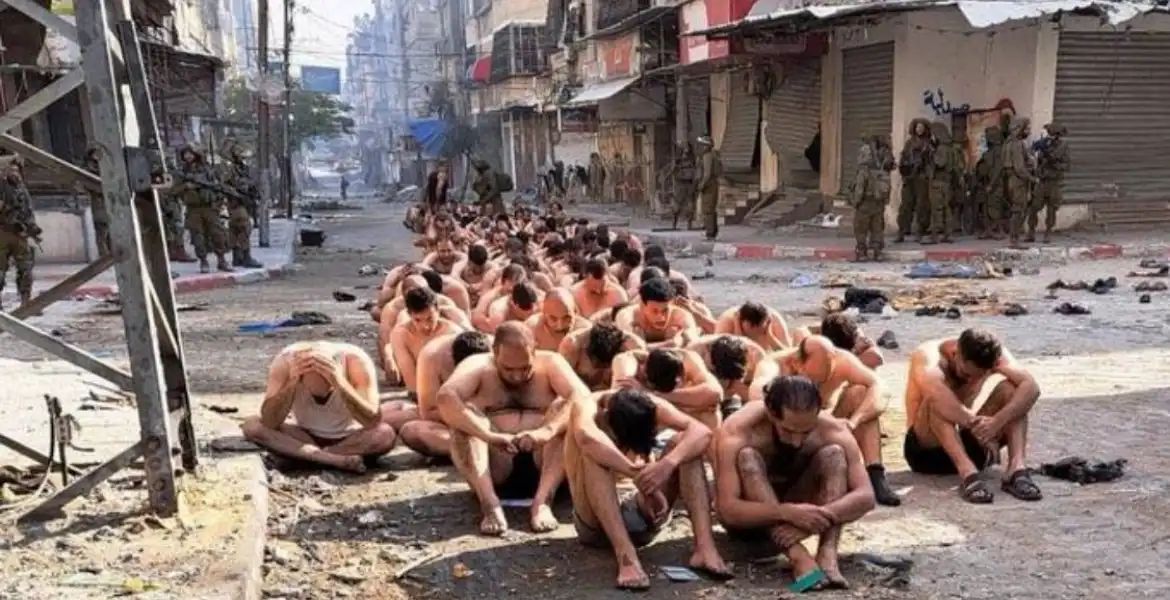
Washington is “disturbed” by pictures of naked Palestinian prisoners in Gaza! Comments on use of white phosphorus

US State Department spokesman Matthew Miller said that the images of the Israeli army arresting dozens of Palestinians in the Gaza Strip while they were almost naked are “extremely disturbing,” according to what Anadolu Agency reported, Tuesday, December 12, 2023.


The American official added in a press conference on Monday: “We found these images very disturbing, and we are seeking more information, whether about the nature of the images or the reason for their publication.”


Miller also said: “We have always been clear with Israel about the need for full compliance with international humanitarian law, and this requires protecting civilians, and treating detained individuals in a humane and dignified manner.”


On Thursday, December 7, the Hebrew Broadcasting Corporation published pictures and a video clip of dozens of Palestinians from the Gaza Strip being taken, almost naked, in cold weather, to Israeli detention centers.


The Palestinians appear in the pictures and video clip sitting on a street in their underwear in a shocking scene, surrounded by a number of Israeli soldiers.


On Friday, the Hamas movement denounced the Israeli army’s arrest of displaced civilians in Gaza, stripping them of their clothes, and photographing them, stressing that this was “the work of mercenaries and terrorist militias devoid of all values, customs and laws.”


The use of white phosphorus in the Gaza Strip

On the other hand, Miller said that the United States is concerned about reports of the use of white phosphorus bombs by Israeli forces in the Gaza Strip.


He also stated that these bombs could be used for military purposes, but everything must be done to minimize harm to civilians.


He pointed out that when the United States provides materials such as white phosphorus to another army, it does so with the expectation that it will be used for legitimate purposes, and in full compliance with humanitarian law and the law of armed conflict.

Source: Agencies


ARAB AND WORLD

Tue 12 Dec 2023 9:06 am - Jerusalem Time

Arabic reports: Ideas for "renewing the Palestinian Authority": Arab attempts and Israeli rejection

Egyptian agencies are making amendments and additions, at a continuous pace, to an Egyptian vision that could gain Palestinian and international acceptance regarding what the situation might be like in Palestine, following the end of the Israeli war on the Gaza Strip, especially with the escalation of talk about the necessity of bringing about a fundamental change in the Palestinian Authority. current.


Cairo puts forward a number of names that could contribute to adopting a scenario of reaching a solution or at least a fundamental change in dealing with the Palestinian issue, in light of the widespread interest in it, internationally and in the Arab world, since the beginning of the Israeli aggression on Gaza.


Attempts to persuade America to pressure Israel

Al-Araby Al-Jadeed learned that Cairo and some other Arab capitals are currently moving towards Washington, in order to persuade it to pressure Tel Aviv to release the leader of the Fatah movement, Marwan Barghouti, who is imprisoned by the occupation, to advance the project of “renewing the Palestinian Authority” in its current form. In exchange for studying proposals for displaced Palestinians in the southern Gaza Strip, and the possibility of receiving some cases temporarily in Egypt.


Source: Tel Aviv refuses to release Marwan Barghouti

An Egyptian source familiar with Cairo's moves to stop the aggression against the Gaza Strip said that the Egyptian and Arab move "comes within the framework of pushing towards implementing the American vision and the Egyptian vision for the new form of the Palestinian Authority, which could include Barghouti."


He added, "If Washington is working seriously to restructure the Palestinian Authority, so that it is prepared to take over the reins in the Gaza Strip after the war stops, it must listen to other points of view."


Barghouti, who has been in occupation prisons for 21 years, faces five life sentences. Opinion polls conducted ahead of the Palestinian legislative elections, which were scheduled for 2021, before canceling them in the same year, showed that Barghouti enjoyed wide popularity.


According to the source, Tel Aviv expressed a categorical rejection of the Arab movements aimed at releasing him, considering that his hands are “stained with the blood of the Israelis,” “according to what prominent officials in the occupation government conveyed to Arab parties that participated in communications related to this matter during the past days.”


A model close to the West Bank

He pointed out that the occupation government “prefers to grant more space to work regarding the future of Gaza after the war, to certain figures, who it believes are capable of creating a model based on governing the Strip in a way that guarantees the management of its daily affairs and livelihood,” in exchange for security coordination with Israel, according to a model Close to the West Bank.


Meanwhile, a source close to the Barghouti family reported, “There have been intense movements over the past few days,” adding that the family “is no longer dealing seriously with such conversations, as they have heard many things from senior Arab officials, during previous periods, that they will make efforts.” To the American administration and the occupation government to release the prisoner Barghouti.


Integrating Hamas into the Palestinian Authority

In parallel, Cairo did not abandon its vision, some of the details of which were revealed by Egyptian sources familiar with the crisis management file of the war on Gaza, two weeks ago.


The sources told Al-Araby Al-Jadeed at the time that the Egyptian vision for the future of the Gaza Strip was based on “merging the Hamas movement into the Palestinian Authority, and its entry into the Palestinian Preventive Security Service, while maintaining President Mahmoud Abbas as ceremonial president.” It added, "This is in order to find a formula for coexistence that does not harm Egyptian national security, the Palestinians, or Israel."


According to the sources, the Egyptian vision depends on creating a new map, prepared by a team of geographical experts, that allows for the “restructuring of the Palestinian state” and the dismantling of some of the settlements built by the occupation, in addition to the establishment of “demilitarized buffer” zones between the Palestinian territories and Israel.


Sources: The official Egyptian vision is based on comprehensive Palestinian reconciliation

Regarding the form of the Palestinian government, the sources explained that “the official Egyptian vision is based on the idea of carrying out comprehensive Palestinian national reconciliation and forming a technocratic government. Among the names proposed for its formation is former Palestinian Prime Minister Salam Fayyad, during a 3-year transitional phase.” She pointed out that this government "in which Egypt will be a guarantor, along with an Arab or international partner or the United Nations."


In this context, the Egyptian-Palestinian political activist, Rami Shaath, said in an interview with Al-Araby Al-Jadeed that Abbas “lost his legitimacy because of his surrender and his contentment with the role of policeman in confronting Israel,” adding that “Palestinian legitimacy is now with the resistance.”


Commenting on the Arab movements, he said, “Arab action has become non-existent, while part of it has become part of the American-Israeli alliance to break the resistance of the Arab world.” He continued: "I do not think that the Palestinian president and the Arab normalizers with Israel want to find a real solution to the Palestinian issue."

Source: Al-Araby Al-Jadeed

ARAB AND WORLD

Tue 12 Dec 2023 8:58 am - Jerusalem Time

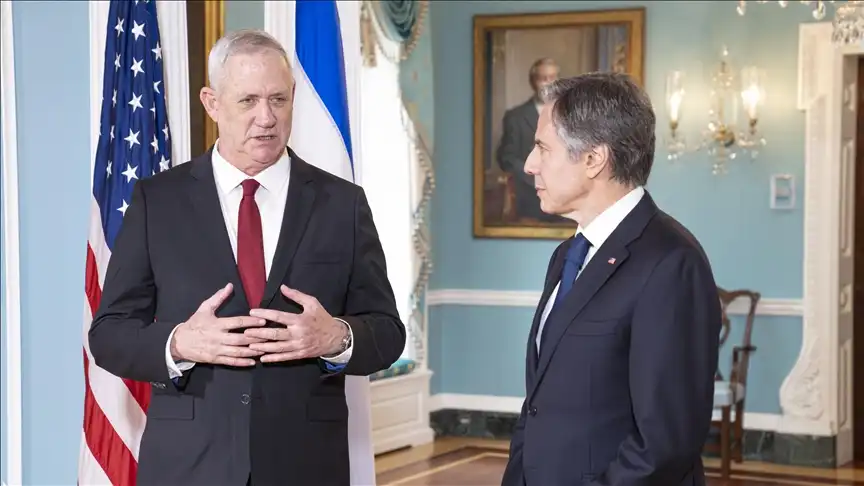
Blinken discussed with Gantz issues of hostages, increasing aid, and avoiding expansion of conflict

US Secretary of State Anthony Blinken spoke by phone yesterday evening (Monday) with Israeli Emergency Government Minister Benny Gantz, and the two speakers discussed existing efforts to facilitate the safe return of the remaining hostages, raise levels of humanitarian aid, and avoid the expansion of the conflict, according to the German News Agency.


US State Department spokesman Matthew Miller said in a statement that Blinken stressed the urgent need to take positive steps to alleviate the escalation of tensions in the West Bank, and also stressed the need for Israel to take all possible measures to avoid harming civilians.


Blinken stressed that his country remains committed to pushing for concrete steps leading to the establishment of a Palestinian state.


Two American officials told NBC that President Joe Biden's administration has limited hope of reaching another truce between Israel and Hamas and the possible release of more detainees in Gaza.


Earlier, an Israeli official participating in the negotiations between Israel and the Hamas movement told the Haaretz newspaper today that the two sides have not presented any new proposals for a ceasefire and the release of the remaining detainees in Gaza since the collapse of the truce on December 1. .


ARAB AND WORLD

Tue 12 Dec 2023 8:55 am - Jerusalem Time

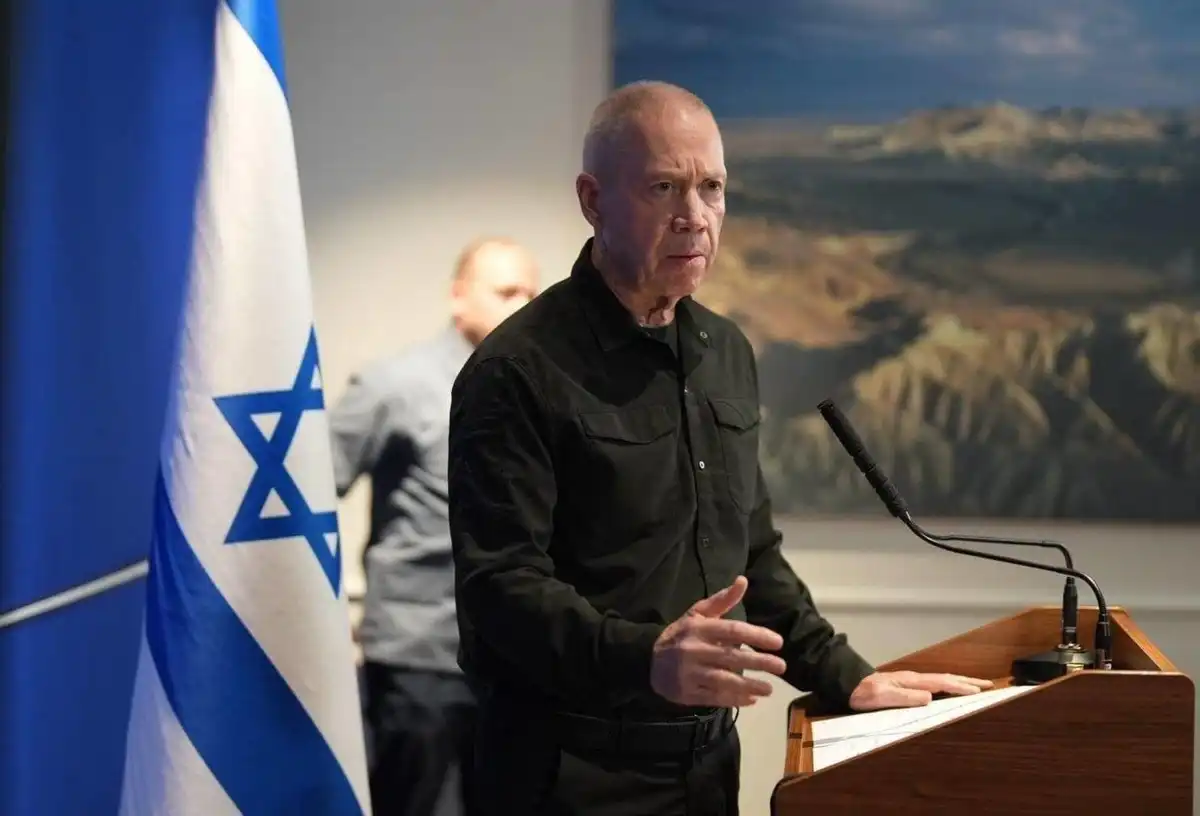
Israeli Defense Minister: Israel does not intend to remain permanently in the Gaza Strip

Israeli Defense Minister Yoav Galant said on Monday that Israel does not intend to remain permanently in the Gaza Strip, and that it is open to discussing alternatives regarding who will control the Strip as long as he is not a group hostile to Israel.


Gallant added that Israel is also open to the possibility of reaching an agreement with the Iranian-backed Lebanese Hezbollah group, provided that this agreement includes a safe zone on the border and appropriate guarantees.


ARAB AND WORLD

Tue 12 Dec 2023 8:45 am - Jerusalem Time

Borrell: The destruction in Gaza is worse than what Germany witnessed during World War II

On Monday, European Union foreign policy chief Josep Borrell described the situation in Gaza as “catastrophic and horrific,” with relatively “greater” destruction than what Germany witnessed during World War II.


After chairing a meeting of European Union foreign ministers, Borrell said that the Israeli army's response to the attacks launched by Hamas on October 7 led to an "incredible number of civilian casualties."


He also expressed the European Union's "concern" about the violence of extremist settlers in the West Bank, and condemned the Israeli government's approval of the construction of 1,700 new housing units in Jerusalem, which Brussels considers a violation of international law.


While noting that the Hamas attacks reinforced the European Union's decision to include it on the list of terrorist organizations, Borrell stressed that he considered the Israeli military operation disproportionate in terms of civilian deaths and damage to civilian property and infrastructure.


“Human suffering poses an unprecedented challenge to the international community,” Borrell said.


According to figures from the Ministry of Health in Gaza, “civilians constitute between 60 and 70 percent of all martyrs,” and “85 percent of the population has been internally displaced.”


Borrell said, “The destruction caused to buildings in Gaza...is somewhat greater than the destruction inflicted on German cities during World War II,” if estimated relatively.


He said that he presented to the foreign ministers of European Union countries a discussion paper to consider “imposing sanctions against extremist settlers in the West Bank” whose attacks against Palestinian residents have increased in intensity.


He indicated that he would soon turn the paper into an official proposal, based on an initiative taken by the United States, which announced last week that it would refuse to grant visas to extremist Israeli settlers.


But he acknowledged that there is no consensus yet on the issue among the governments of European Union countries.


(AFP)


PALESTINE

Tue 12 Dec 2023 8:14 am - Jerusalem Time

Israeli media is talking about a new prisoner exchange deal

Israeli media reported new moves to conclude a prisoner exchange deal between the Palestinian resistance and Israel, indicating that conditions are ripe for that deal.


Israeli Channel 12 quoted Israeli sources as saying that there are new movements to conclude a prisoner exchange deal, and that Israel is ready to listen to the mediators’ proposals regarding a new exchange deal.


Israeli Channel 13 also quoted an Israeli source as saying that the conditions were “ripe” for a return to agreements for a new prisoner exchange deal.


For his part, Israeli Defense Minister Yoav Galant said that the Israeli army's increased pressure will bring proposals regarding new truces that the government is studying.


Gallant added that Israel is open to discussing all possibilities regarding the future of the Gaza Strip, but there will be no role for Hamas in that, as he put it.


Humanitarian truces


Talk about the possible exchange deal comes at a time when the Strategic Policy Coordinator at the US National Security Council, John Kirby, said that reaching a new truce is important in order to release detainees in the Gaza Strip. However, the US State Department said that Washington’s position is to reach humanitarian truces, not a cessation. To shoot in the sector.


A temporary truce began last November 24 and lasted for 7 days between the Islamic Resistance Movement (Hamas) and the Israeli occupation, mediated by the State of Qatar and Egyptian-American coordination, during which 80 Israelis were released in exchange for 240 Palestinian prisoners.


Source: Al Jazeera + agencies


PALESTINE

Tue 12 Dec 2023 8:11 am - Jerusalem Time

A drone bombs two sites in Jenin, killing 3 Palestinians

The Palestinian Ministry of Health reported that 3 Palestinians were killed in an Israeli drone bombing that targeted the Old City and the Sibat neighborhood in the center of the city of Jenin in the occupied West Bank.


Violent clashes broke out near Al-Razi Hospital in Jenin, and a homemade bomb exploded while occupation vehicles were crossing the vicinity of the Jenin camp.


Heavy gunfire also renewed in Jenin as the occupation forces stormed the camp's surroundings, and a strong explosion was heard.


PALESTINE

Tue 12 Dec 2023 8:10 am - Jerusalem Time

Gaza war: Israeli bombing of citizen's houses kills 20 Palestinians in Rafah

Palestinian medical sources said that 20 civilians were killed in the occupation bombing of several homes in Rafah, south of the Gaza Strip, at dawn on Tuesday.


Since yesterday, the occupation army has continued its bombing from Jabalia camp in the northern Gaza Strip to Deir al-Balah in the center and Khan Yunis and Rafah in the south.


The Ministry of Health in the Gaza Strip announced, yesterday evening, Monday, that the number of dead since the beginning of the war had risen to 18,205, while the number of wounded reached 49,645.


PALESTINE

Mon 11 Dec 2023 10:31 pm - Jerusalem Time

Israeli judge in Hadera decided to open an investigation into the death of Palestinian detainee Maree

The Prisoners' and Ex-Prisoners' Affairs Authority and the Palestinian Prisoners' Club reported that the judge of the Israeli occupation court in Hadera decided this evening, Monday, to open an immediate investigation into the case of the death of the prisoner Abd al-Rahman Ahmad Mar'i (33 years old) from the town of Qarawat Bani Hassan in Salfit Governorate.


The Commission and the Prisoner’s Club explained, in a joint statement, Monday evening, that the judge’s decision came after the court found out that the detainee, Maree, was subjected to severe beatings and torture, as there were injuries, signs, and traces of the crime on his body.


The statement explained that the judge asked the occupation police to provide the court with the details of the party that investigated the incident of the death of detainee Maree by the prison administration, provided that the court and the lawyer of the dead’s family are provided with the forensic report until 12/25/2023.


It is noteworthy that the victim Marhee was dead in “Megiddo” prison on 11/13/2023, after a fierce attack launched by the occupation prisons administration on male and female detainees after the 7th of October. Six detainees were dead in prisons since that date, and Maree was the fifth of them.


It is noteworthy that the victim was arrested on February 25, 2023. He is married and the father of four children, the eldest of whom is 11 years old and the youngest of whom is 4 years old.

OPINIONS

Mon 11 Dec 2023 7:58 pm - Jerusalem Time

Israel should learn from French mistakes in Algeria

AlJazeera

AlJazeera

Opinion Writer

By Moncef Khane


On May 7, 1945, Nazi Germany signed the act of military surrender to the Allies. The next day, people all over the world, including in occupied Algeria, took to the streets to celebrate the end of World War II.

An estimated 134,000 Algerians fought with the Allies and 18,000 of them gave their lives to defeat Germany. And so, on May 8,1945, in Setif, a city east of Algiers, some 5000 “Muslims”, as Algerians were called by the colonial power to erase their national identity, marched in celebration. But they also marched clamouring for the end of over a century-long French colonial rule over their country. French police seized banners and eventually opened fire, killing demonstrators. Clashes erupted with 102 French settlers killed.


In the following fortnight, a blood frenzy overtook French authorities and settlers who massacred some 45,000 Algerians. Rural areas around Setif and the town of Guelma believed to be sympathetic to Algerian nationalists were bombarded by the French air force. Settlers avenged their compatriots by hunting down and lynching “the savages”. To establish themselves in Algeria and legitimize their presence there, the colonists had dehumanized the indigenous population to the extent of perceiving them as nothing more than vermin.  This allowed French colonists and their occupation army to kill Algerians in their thousands, with little or no moral qualms. The Setif massacre brought the colonial power another nine years of relative peace but in the end, it only served to harden the Algerian resolve to be free. On November 1, 1954, they embarked on their ultimate war of resistance against French occupation. After eight years of “a savage war of peace” as British historian Alistair Horne put it, Algeria won its independence but at a heavy price: The war claimed the lives of some 1.5 million Algerians; some 20 percent of Algeria’s “Muslims”. 

What is happening in Palestine today, predominately in Gaza but also in the West Bank and East Jerusalem, is of course not identical to the events that marked the end of French rule in Algeria. Yet there are many similarities between them, as the modus operandi of most colonial enterprises follows a set pattern. Colonizers dehumanize indigenous populations to keep them pliant and to justify the use of brutal force against them when they try to resist their subjugation. They ensure that the colonized are powerless militarily, but often make the mistake of assuming this lack of military prowess also means that they lack the strength and resolve to resist oppression and defeat occupation. When they eventually realize their misjudgment and acknowledge that they cannot sustain their position indefinitely, they intensify their brutality to preserve the status quo for as long as possible. This is what happened in occupied Algeria in the latter years of French rule, and this is what we are witnessing in occupied Palestine today. 

When France responded to the killing of 102 settlers by carpet-bombing villages and killing tens of thousands of people, it was hoping to achieve much more than avenging the deaths of its citizens and eliminating “terrorists”. It was using extreme violence to eliminate all native resistance. It wanted to break their will to resist.

Today, Israel is following a similar trajectory. It is now apparent that the goal of Israel’s war on Gaza is not to avenge hundreds of Israeli civilians and military personnel killed on October 7. If vengeance were the primary motive, the killing of over 8,000 Palestinian children and babies and reducing most of the Strip into rubble would have likely been enough for Israel to call it a day.


Killing all “terrorists”, completely annihilating Hamas to ensure the safety of the colony, does not seem to be the primary goal of Israel’s war either. Israel’s leaders undoubtedly know that even if their military could somehow eliminate all “terrorists” in Gaza, it would not be able to eliminate Palestinian aspirations for liberty and resolve to resist the occupation in every way possible. So if the aim is not to avenge the deaths of its citizens, or “eliminate terrorists”, what is Israel trying to achieve? Israel is executing a multifaceted plan to protect, entrench and expand its colonial enterprise. 

It goes something like this: First, break Palestinian will and spirit. Show them that Israel can do as it pleases, with total impunity, and in full view of an impotent world. That no matter how much violence and humiliation they experience, neither fellow Arabs nor the so-called international community would come to the rescue. That not even the sight of premature Palestinian babies suffocating in powerless incubators or the thought of thousands of children wasting away under the rubble could make the Western powers rethink their support of Israel. Second, once their will is sufficiently weakened, order Palestinians to leave their homes and their land. Order them to move, on foot, towards some vaguely defined “safe zone”. Once the displacement is complete, declare that Hamas is in their midst and bomb the “safe zone” anyway. Repeat the cycle until the entire Strip is destroyed, and all surviving Palestinians are pushed out into the Egyptian Sinai. 

Israel will make sure to complete this plan unless, of course, the Western governments, first and foremost the US, have a change of heart and intervene to make the carnage stop. When France was working through its own bloody plan to maintain its occupation in Algeria, then US President John F Kennedy made one such intervention. He clearly voiced his belief that French rule over Algeria was not sustainable in the long term, condemned colonialism, and openly rooted for Algeria’s independence. In the end, the US’s principled stance on the issue during the Kennedy era played an important role in the success of Algeria’s liberation struggle. 

Kennedy was open about his support for Algerian independence even before becoming president. In July 1957, as a young Senator, he delivered a historic speech criticizing the Eisenhower administration’s political and military support for French colonialism and called on the US to support Algerian self-determination. “The most powerful single force in the world today is neither communism nor capitalism, neither the H-bomb nor the guided missile – it is man’s eternal desire to be free and independent,” he said. “Thus the single most important test of American foreign policy today is how we meet the challenge of imperialism, what we do to further man’s desire to be free.” He went on to explain how the French insistence to rule over Algeria, against the will of the Algerian people, is harming the US, NATO and the entire global community, and concluded that “[t]he time has come for the United States to face the harsh realities of the situation and to fulfill its responsibilities as the leader of the free world – in the UN, in NATO, in the administration of our aid programs and in the exercise of our diplomacy – in shaping a course toward political independence for Algeria”. 

Kennedy knew France was fighting a war it can never win, and wanted the US to be honest with its ally. Today, the history is repeating itself. A leading US ally, Israel, is engaged in a war it cannot win against a people suffering under its occupation. But unlike Kennedy, the current US President Joe Biden is not living up to the occasion. 

Rather than telling Israel the hard truth, that it can not extinguish the Palestinian people’s “eternal desire to be free and independent”, President Biden is unconditionally backing the ongoing colonial assault on Palestine. Indeed, just as France was not “defending itself” when it killed hundreds of thousands of Algerians to stop them from achieving independence, Israel is not “defending itself” against Palestinians living under its occupation. It is waging a modern-day colonial war, trying to claim more land, and seemingly committing genocide in the process. Biden should learn from Kennedy, end its support for Israel’s unwinnable war and war crimes, and remain on the right side of history.