PALESTINE

Fri 22 Dec 2023 5:35 pm - Jerusalem Time

Experts: The Israeli war machine in Gaza...the most destructive in modern history

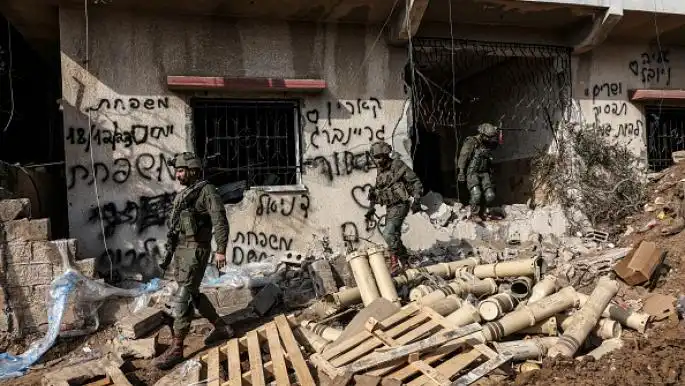
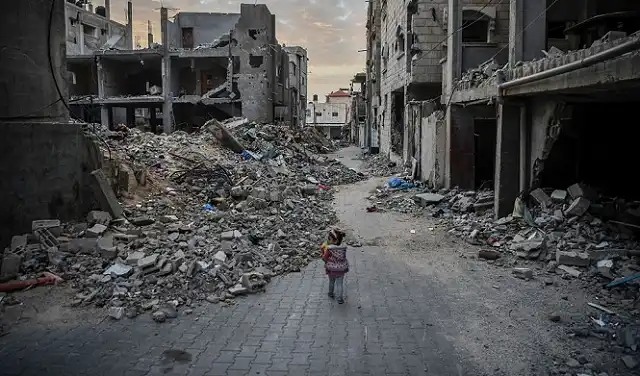
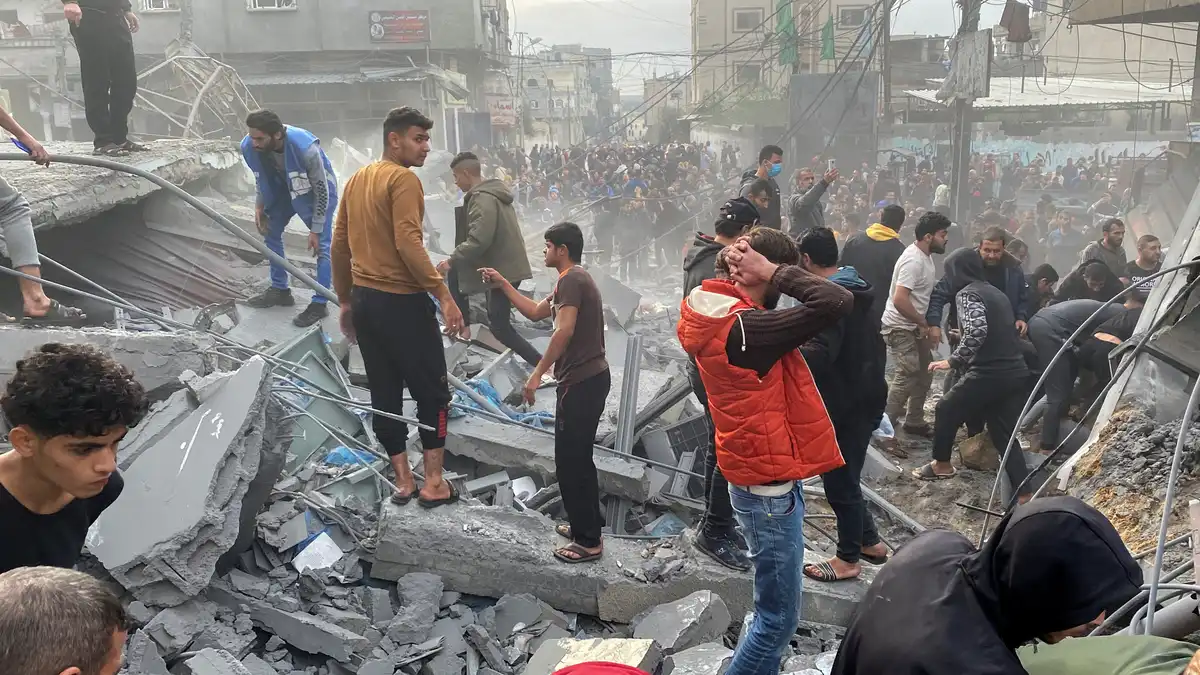
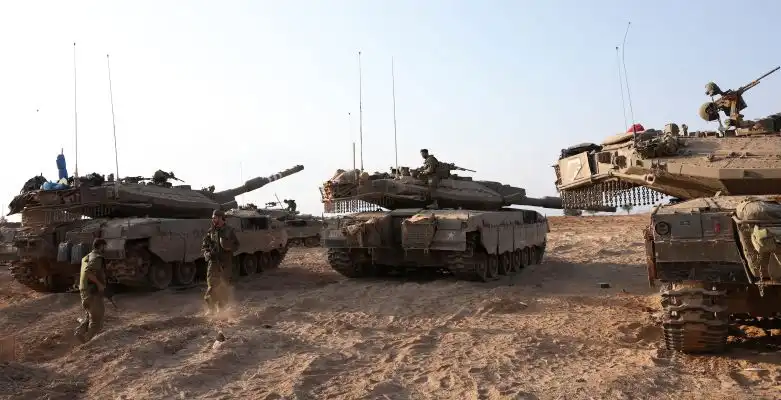
Experts say that the Israeli military campaign in Gaza is now among the bloodiest and most destructive in modern history, in just over two months.

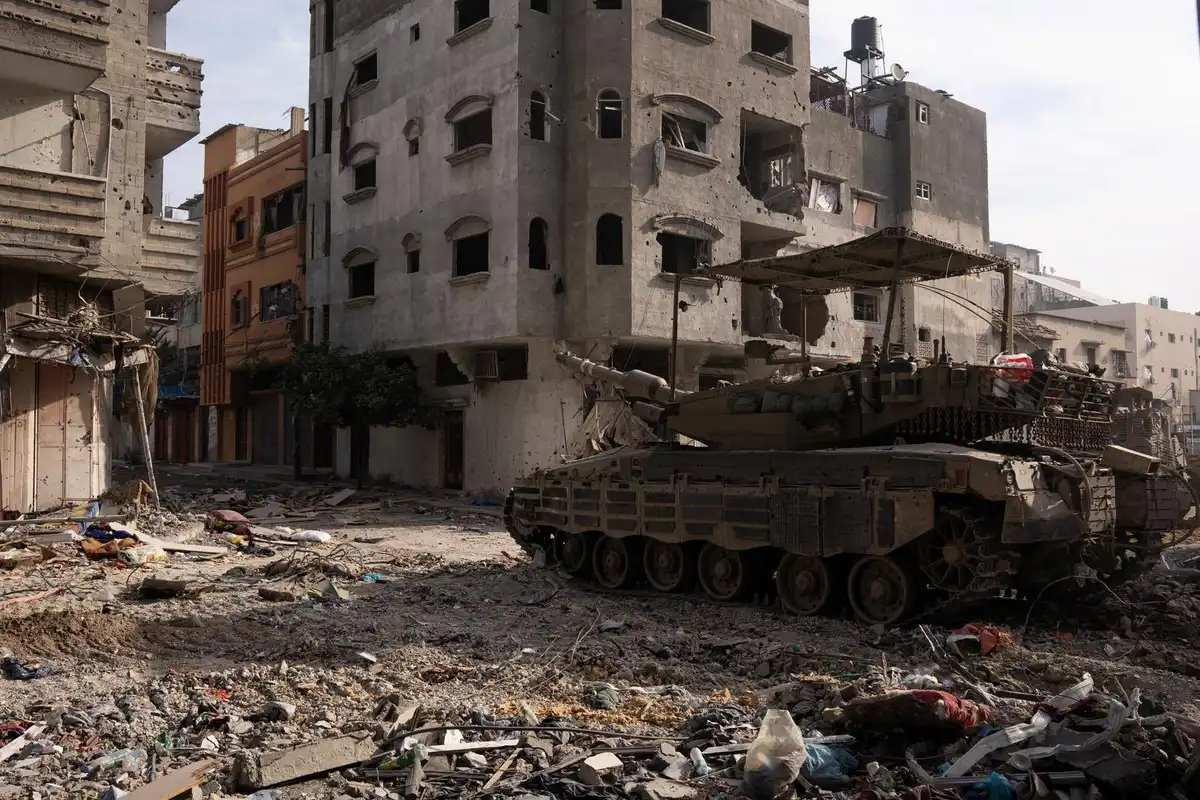
The Israeli attack caused a greater amount of destruction than the destruction that befell Aleppo in Syria between 2012 and 2016, or Mariupol in Ukraine, or the Allied bombing of Germany in World War II.


The war killed more civilians than the US-led coalition did in its three-year campaign against ISIS. The Israeli army has said little about the types of bombs and artillery it is using in Gaza.


But through explosion fragments found in various locations and analysis of raid footage, experts are confident that the vast majority of bombs dropped on the besieged enclave were American-made. They say the weapons include 2,000 pounds (900 kilograms) of “super fortifications” that Hundreds were killed in densely populated areas.


With the number of Palestinian deaths in Gaza exceeding 20,000, the international community is calling for a ceasefire. Israel has vowed to move forward, saying it wants to destroy Hamas' military capabilities following the armed group's cross-border attack on October 7, which killed 1,200 people and took 240 more hostage.


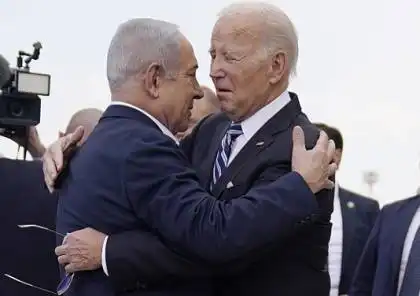
Quietly, the Biden administration continued to supply weapons to Israel, but last week, President Joe Biden publicly admitted that Israel was losing international legitimacy because of what he called its “indiscriminate bombing.”


How much destruction is there in Gaza?


The Israeli attack destroyed more than two-thirds of the buildings in northern Gaza and a quarter of the buildings in the southern area of Khan Yunis, according to an analysis of Copernicus Sentinel-1 satellite data by Cory Shear, of the Graduate Center at the City University of New York, and Jamon van den Hoek. , from Oregon State University. The two are experts in mapping war damage.


The percentage of damaged buildings in the Khan Yunis area nearly doubled during just the first two weeks of the Israeli attack. This includes tens of thousands of homes as well as schools, hospitals, mosques and shops.


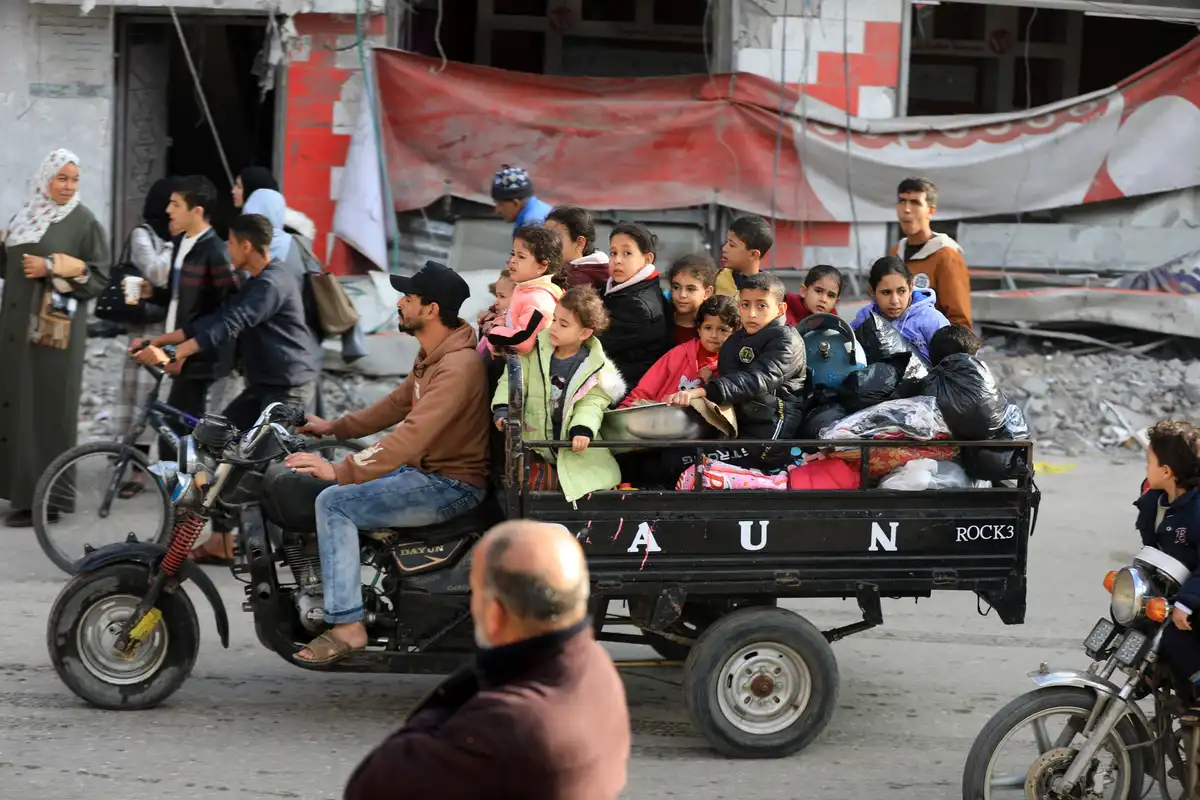
About 70 percent of school buildings across Gaza were damaged, and at least 56 damaged schools served as shelters for displaced civilians, UN monitors said. Observers say that the Israeli raids destroyed 110 mosques and 3 churches.


Israel holds Hamas responsible for civilian deaths by planting militants in civilian infrastructure. These sites also house large numbers of Palestinians who have fled under Israeli evacuation orders.


How large is this destruction historically?

By some measures, the devastation in Gaza has surpassed the Allied bombing of Germany during World War II.


Robert Pape, an American military historian, said that between 1942 and 1945, the Allies attacked 51 major German cities and towns, destroying about 40-50 percent of their urban areas.


This represents 10 percent of buildings across Germany, Pape added, compared to more than 33 percent across Gaza, a densely populated area of just 140 square miles (360 square kilometers).


“Gaza is one of the most severe campaigns of civil punishment in history,” Pape continued, noting that the war on Gaza is one of the most destructive bombing campaigns ever.


The 2017 attack by the US-led coalition to expel ISIS from the Iraqi city of Mosul was considered one of the most intense attacks on the city in generations.


That nine-month battle led to the deaths of about 10,000 civilians, a third of them due to coalition bombing, according to an investigation conducted by The Associated Press at the time.


During the 2014-2017 campaign to defeat ISIS in Iraq, the coalition carried out nearly 15,000 strikes across the country, according to Airwars, an independent group based in London that tracks recent conflicts. By comparison, the Israeli army said last week that it had carried out 22,000 raids in Gaza.


What types of bombs are used?

The Israeli army did not identify the bombs used. It says every strike is approved by legal advisers to ensure it complies with international law.


“We choose the appropriate ammunition for each target, so as not to cause unnecessary damage,” said the army’s chief spokesman, Admiral Daniel Hagari.


Weapons experts were able to draw conclusions by analyzing explosion fragments found at attack sites, satellite images, and video clips circulating on social media. They say the findings offer only a peek at the full scope of air warfare.


So far, US-made Joint Direct Attack Munition (JDAM) bomb fragments and smaller diameter bombs have been found in Gaza, according to Brian Kastner, a weapons investigator for Amnesty International.


JDAM bombs include precision-guided bunker-buster bombs weighing 1,000 and 2,000 pounds (450 and 900 kg).


“It turns the Earth into a liquid,” said Mark Garlasco, a former Pentagon defense official and war crimes investigator for the United Nations. “It destroys entire buildings.”


He explained that a 2,000-pound bomb exploding in the open would mean "instant death" for anyone within about 30 meters (100 feet). Deadly fragments can extend up to 365 meters (1,200 feet).


In an October 31 strike on the Jabalia refugee camp, experts say a 2,000-pound bomb killed more than 100 civilians.


Experts also identified fragments of 2,000-pound SPICE bombs, which are equipped with a GPS guidance system in order to make targeting more precise.


Kastner said that these bombs were produced by the giant Israeli defense company (Rafael), but a statement by the US State Department showed for the first time that some of the technology for these bombs was produced in the United States.


The Israeli military is also dropping unguided “stupid” bombs, according to expert analysis of two photos the Israeli Air Force posted on social media at the start of the war showing fighter planes loaded with unguided bombs.

PALESTINE

Fri 22 Dec 2023 5:32 pm - Jerusalem Time

War on Gaza: More civilian casualties reported in Gaza on 77th day of Israeli aggression

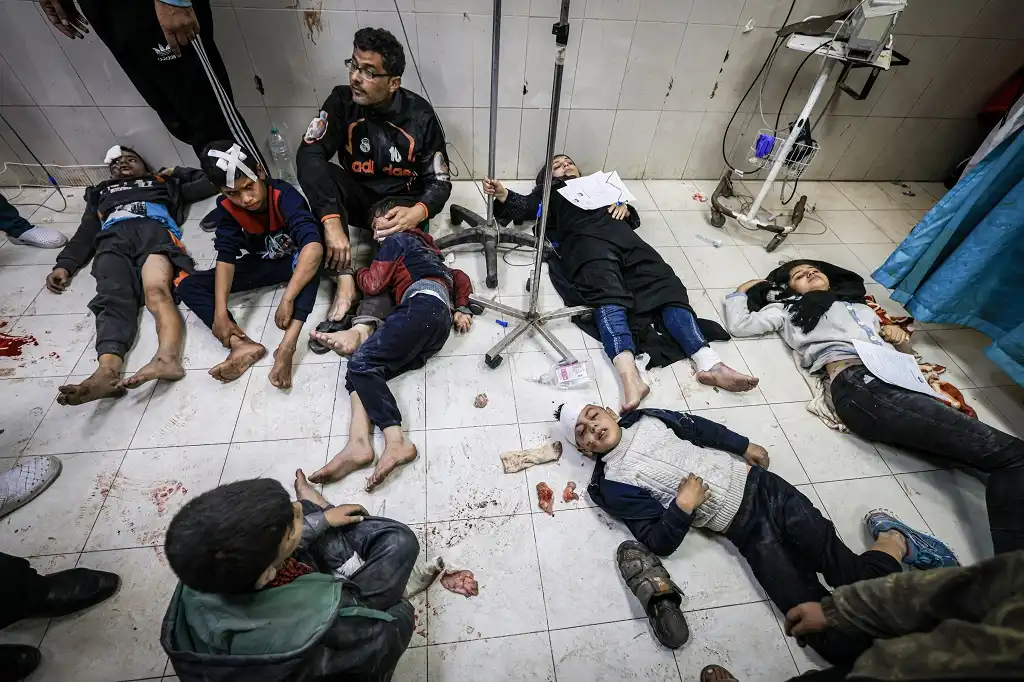
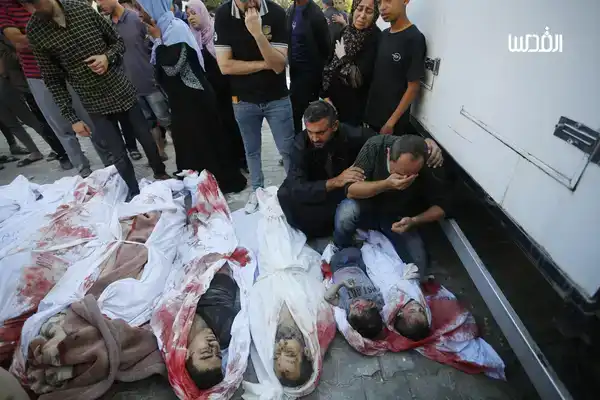
On the 77th day of the aggression against the Gaza Strip, Israeli occupation forces continued their airstrikes and artillery shelling on various areas in the region, resulting in the murder and injury of dozens of civilians, predominantly children and women, according to local sources.


In an Israeli drone airstrike in Khan Yunis, south of the Gaza Strip, a young man was while riding a motorcycle, medical sources said.


Additionally, several civilians were killed and others were injured due to intensive Israeli artillery shelling targeting Jabalia in the northern Gaza Strip.


Meantime, rescue teams managed to retrieve 16 dead bodies and more than 50 injured individuals from the Al-Bursh family home which was targeted and destroyed by Israeli airstrikes in Jabalia, north of the Strip.


Israeli warplanes also carried out multiple airstrikes on Blocks 1 and 2 in Jabalia refugee camp. No reports were available from the scene regarding any casualties, likely due to the outage of telecommunications in many areas of the besieged territory as a result of the prolonged Israeli aggression.


Simultaneously, Israeli artillery targeted the eastern areas of Al-Bureij refugee camp in the central region of the enclave.


The ongoing Israeli aggression on Gaza, which began on October 7, has resulted in the deaths of over 20,000 Palestinians, with 70% of the casualties being women and children, according to a preliminary toll.

OPINIONS

Fri 22 Dec 2023 4:39 pm - Jerusalem Time

Israeli Opinion| We have to acknowledge the loss, so that the Palestinians will acknowledge us

Translation for "Al-Quds" dot com

Translation for "Al-Quds" dot com

Opinion Writer

By Hillel Schocken

We will not win, even if we are together [the slogan “Together we win” that Israeli institutions have raised since the beginning of the attack on Gaza]. We have actually lost, since October 7, in the battle currently taking place in Gaza, in defense of our right to a national homeland in the Land of Israel. Every additional day that passes during the ground maneuver reinforces this failure. When this terrible battle ends, a few weeks later, as a result of international pressure, as expected, Israel will find itself in a more difficult situation than the one it entered on the morning of the “barbaric attack” carried out by Hamas. Is it possible that one good thing can emerge from this failure? Perhaps ending the Palestinian-Israeli conflict, for example?

On October 16, the Israeli war cabinet announced the war’s goals: to undermine Hamas’ authority and eliminate its military capabilities; Eliminate the threat of “Gazan terrorism” towards Israel; Make every effort to resolve the hostage issue; Protecting the state’s borders and its citizens. At the end of the battle, we will not be able to achieve any of these goals.

Opinion polls indicate that our behavior in Gaza strengthens Hamas's position in the hearts of Palestinians, not only in Gaza, but in the West Bank as well. As for whoever wants to eliminate Hamas in Gaza, he will get it here in the West Bank as well. What appears to many to be a maximum effort to free the kidnapped has only partially succeeded, by freeing less than half of them, and every day that the battle continues, the lives of the majority of those remaining in captivity will be endangered. If a deal is actually reached to release these people, we will be forced to release all the Palestinian prisoners in our custody, whether they were arrested on charges of killing Jews or not, and we will also be forced to withdraw from the Gaza Strip and commit to ending the war. The leaders of Hamas, gentlemen, are not stupid. They will not agree to anything less. As for us, we will content ourselves with asking the friendly countries, sponsors of the agreement, to provide guarantees that Israel will not be attacked in the future.

Israel's international standing has actually deteriorated to an unprecedented low, which jeopardizes not only its relations with its friends, first and foremost the United States, but it also exposes Jewish communities around the world to danger, and makes Israelis isolated in the world, as if they were infected with a disease. Leprosy in the Middle Ages. In addition, our regional position has weakened dramatically. As for those who chant the “theory” that Hezbollah is deterred from attacking us, we have news for them: Israel is deterred. Our weakness in the face of Hezbollah was resoundingly confirmed when US President Joe Biden realized what was really happening, and he quickly sent a massive military force to the Mediterranean in order to protect us.

Despite the presence of American deterrence in the region, the organizations within Iran's orbit succeed in disturbing us. Hezbollah has turned tens of thousands of residents of the north into refugees in their country, while the Houthis have completely succeeded in cutting off the Israeli maritime supply line from the south. Thus, the day came when we saw Israel forced, today, to come to terms with what it considered in 1956 and 1967 to be a declaration of war against it.

Without justifying the "barbaric" Palestinian attack on the towns of the Western Negev, we must see in these attacks the current culmination of the violent Palestinian national struggle against the mere existence of the State of Israel, as the national homeland of the Jewish people in the Land of Israel. Throughout 75 years of its existence, Israel has succeeded in curbing this Palestinian ambition to eliminate it, and to claim the right to Palestinian self-determination in the sovereign State of Palestine on the land between the sea and the river. Israel did this initially, by imposing military rule on the Palestinians within the Green Line, by repelling attacks directed at it across the armistice lines, and later, by military control of the residents of the areas occupied during the Six-Day War, in the West Bank and Gaza Strip.

The long years that have passed since then have not made the Palestinians relax. The intensity of their opposition to the mere existence of the State of Israel inflicts an ever-increasing blood and economic price on both sides. In order for the current war not to be merely the beginning of larger waves of violence, and for Israel to remain a national homeland for the Jewish people in the Land of Israel, Israel must consider the goal of eliminating Palestinian opposition to its existence as the highest strategic goal regulating its policies.

The Messianic movement in Israel hopes to achieve, “with God’s help,” this goal by displacing all Palestinians from the West Bank and Gaza Strip. This movement believes that the mass killings in Gaza and the outbreak of settlers in the West Bank, which are taking place under the auspices of the Israeli authorities, aim to “encourage” Palestinians to migrate outside the borders of the area under Israel’s control, a step that means the ethnic cleansing of about 5 million Palestinians. It is difficult to imagine that the world, which will force Israel to stop the war in Gaza soon, in light of the tens of thousands of deaths and injuries, the unprecedented devastation, and the deterioration of the humanitarian situation on a brutal scale, will allow such a solution.


What happened in the Yom Kippur War, and the achievements achieved by the Egyptians in crossing the canal, led to Egypt regaining its dignity, which led to the signing of peace treaties. As for Israel's recognition of its loss in the ongoing war, based on the data described above, it will contribute to restoring the national dignity of the Palestinians, which has been trampled on for 56 years. Apparently, this is a necessary stage in a process that will lead to stopping the fighting in Gaza, and reaching an exchange deal, through which all Palestinian prisoners will be released in exchange for the release of all the kidnapped, whose fate depends on the period that will pass until Israel recognizes this reality. Israel will be forced to recognize the Palestinians' right to an independent, sovereign state, and to conduct negotiations with any leadership chosen by the Palestinians, to end the conflict, based on UN resolutions and the Saudi initiative. Is it possible that the disaster of October 7 heralds the birth of a new horizon in the Middle East?

Source: Institute of Palestine Studies

OPINIONS

Fri 22 Dec 2023 4:26 pm - Jerusalem Time

Israeli opinion| Okay Bibi; We understand what you reject, so what do you accept?

Tova Herzl

Tova Herzl

Opinion Writer

For those who do not know the children's story written by Ishak Avnon about the little bear Lala - the content is clear from the title. Once upon a time, a little bear used to say "no." He would say no, in response to everything they said, suggested, or asked. So, an angel cast a spell on him that blocked all words except one: No. This leads to frustration, difficulty communicating with others, and ultimately, isolation. As expected in legends with a happy ending, Little Bear broke away from the spell, and everything returned safely to its place. 

Currently, the State of Israel is led by its own little bear, who long ago turned into a big, clumsy, and tired bear, who said in recent weeks: “I will not allow Hamastan to be replaced by Fatehistan”; Also, “there will be no Palestinian state”; “We will not give Gaza to outside powers”; "We will not submit to international pressure, including pressure from the United States." He said no, no, no.

The issues being discussed are complex, there are no magic formulas, and it can be said that there are problems in each of the scenarios he rejected. There is a price for every path chosen. But, can someone who said he bears responsibility for the future tell us what is acceptable to him? If not hope, at least give us a plan?


It is exaggerated to write here that we are living in a very difficult period. The constant fear of “allowed to publish” and the stories of massacres that are being published, and are still being published, regarding kidnappings and killings, pictures of demolitions, interviews with those who were evacuated from their homes and are living in a state of frustration, as well as the expected projections on business, and on the economy in general - all of this leads to frustration. 

But what comes after “We will conquer together” (without discussing what is meant by “we conquer” and who “together” is)? Will efforts to maintain the coalition bear fruit? What is the vision that we will follow? Maybe not immediately, while we still face unimaginable challenges, but in 10 years, or in 25 years? What is his plan for Israel in its 100th year, and what will it look like? what is the point? Where are we heading?


It became clear on October 7 that the Abraham Accords and future plans of the same spirit would not hide in our backyard. If a Palestinian state is not established there, what will happen? Accelerate settlement? What is the response of the Palestinians themselves to this? What will the projections be like in the international arena? After he told us who will not rule Gaza, then who can rule it? Israel? If so, what does that mean?


As for internal issues, news was recently published of the intention to increase the years of service in the Army Reserve to allow the army to carry out its missions. On the other hand, and after demands from the Haredi parties, it was approved to cancel the tax on sugar (it exists in 85 countries, and its contribution to health is proven). So, despite the severe crisis that Israel is experiencing, it is not expected that there will be any change in responding to the demands of the Haredi community that is increasing, thus increasing the burden on the rest of society, which is also expected to increase. 

Based on what was previously stated here, it is important to understand whether the government has any long-term goals beyond general slogans that no one will oppose, such as peace, security, prosperity, and brotherhood.

Whoever thinks that the time is not appropriate, should know that - this is the appropriate time. Politicians who determine our fate and future are busy with politics all the time. They make deals, conduct polls, research headlines, and head toward the next election. Saying, “This is not the right time,” means giving them freedom to do whatever they want. Whoever trusts the government and its president is called to bless everything it does. Those who do not trust them - and polls prove that we are the vast majority and increasingly growing - must demand answers.


Who are we, for example? The young woman who immigrated from Australia, married an immigrant from France, and gave birth to 3 children, all of whom are in Gaza. And in the long, sleepless nights, she wants to know what their future is. Or who would like to invest all the compensation money in a tourism initiative, and wants to know what future the country is going towards. What would we say to a young man who is planning to go and complete his university education abroad? When he finishes education, to which Israel will he return, if he returns at all? We do not need details, but rather a general orientation. We know what's not going to happen. But what will happen? Please, tell us, what is it?

ARAB AND WORLD

Fri 22 Dec 2023 4:07 pm - Jerusalem Time

Former Israeli officials call for stopping the Gaza war: Victory over Hamas is not possible

Former senior Israeli officials and writers called for an end to the war waged by the occupation army on the Gaza Strip, given the impossibility of achieving victory and eliminating the Hamas movement.


Former Prime Minister Ehud Olmert urged an immediate halt to the war, because the goals set by Benjamin Netanyahu's government could not be achieved. Olmert said in an article entitled: “Stop the war in exchange for the return of the kidnapped alive,” published by Haaretz newspaper on Friday, that the claims of Netanyahu and members of his government that the Hamas movement can be eliminated through military operations are “unrealistic.”


Olmert argued that Netanyahu himself does not believe that this goal can be achieved, pointing out that the prime minister is acting like a "stage actor", all that means escaping the consequences of responsibility for failing to prevent the implementation of the "Al-Aqsa Flood" operation on the seventh of last October.


He added that Netanyahu, who is driven by internal political considerations, "is aware that there is no realistic ability to achieve the goal of eliminating the Hamas movement, but from the first moment he was not preoccupied with the war on Gaza, but rather with his own personal war of survival."


Olmert pointed out that Netanyahu, by emphasizing the goal of eliminating Hamas despite its unreality, is concerned with holding his partners in the government, army leaders, and intelligence establishment responsible for the end of the war without achieving this goal, claiming that he has always remained committed to achieving it.


The former Israeli Prime Minister added, "Today it appears clearly that although the Israeli army is fighting boldly, decisively, and with the required caution, and is suffering painful human losses, there is no possibility that the expectations enshrined by Netanyahu will be fulfilled, and the Hamas movement will not be eliminated."


Olmert stressed that Israel has two options: “Either it agrees to a ceasefire and returns its prisoners from Hamas through an exchange deal, or it continues fighting so that the war ends without achieving the goal of eliminating Hamas and without recovering the prisoners.”


“Every day deep inside Gaza will deepen the failure.”

For his part, former Minister of Foreign Affairs and Internal Security, Shlomo Ben-Ami, believed that Israel cannot achieve victory over Hamas.


In an analysis published by Haaretz newspaper, Ben Ammi pointed out that since the end of World War II, countries with regular armies have not been able to achieve victories over armed organizations in disproportionate wars.


Ben Ammi considered that, given the geographical and demographic reality in the Gaza Strip, “any modern army, no matter how powerful it is militarily or technologicaly, cannot achieve victory over the Hamas movement, just as the Americans failed in their wars in Vietnam and Afghanistan and the Soviets failed in Afghanistan.”


Ben Ammi believes that, unlike the United States and the Soviet Union; The two countries that could manage a long war, Israel cannot fight long wars.


Ben Ammi rejected the opinion that Hamas launched Operation “Al-Aqsa Flood” for unrealistic motives, pointing out that the movement achieved strategic achievements through this operation, represented by “pushing the Palestinian issue once again to the top of the priorities of the international community, and braking the path of normalization between Israel and the Arab regimes, and forcing Israel to rely in an unprecedented manner on the American military umbrella to avoid the risk of a multi-area war breaking out, in addition to the fact that the movement succeeded in giving itself the main position in the Palestinian national liberation movement.”


He expected that at the end of the war, Hamas would be able to liberate all Palestinian prisoners from occupation prisons.


In this context, writer Hillel Schocken called on Israel to acknowledge defeat against Hamas. He wrote in an article published by the newspaper "Haaretz": "We will not win, even when we are united. We lost the current battle over our right to a national homeland in the Land of Israel on October 7."


According to Schocken, every day that the ground operation continues deep into the Gaza Strip “will deepen the Israeli defeat and failure,” pointing out that Israel will emerge from the current war with a reality “worse than it was before.”

Source: Alaraby Aljadeed

ARAB AND WORLD

Fri 22 Dec 2023 3:57 pm - Jerusalem Time

Poll: 96% of Saudis oppose establishing relations with Israel

In the poll, 87% of Saudis said the war showed “that Israel is so weak and internally divided that it could be defeated one day.”


The Washington Institute for Middle East Policy published the results of an opinion poll in which it said that 96% of Saudis believe that Arab countries should sever all relations with Israel, in protest against the Israeli aggression on the Gaza Strip.


The American New York Times said that this poll constitutes a major challenge to the Biden administration’s efforts to establish diplomatic relations with Israel.


40% of respondents in Saudi Arabia expressed positive attitudes towards the Hamas movement, compared to only 10% in a poll conducted several months before the start of the aggression on Gaza.

The poll, conducted by the institute, which is generally considered supportive of Israel, included 1,000 Saudi people from November 14 to December 6.


The New York Times said in a report it published that before the war, “American political analysts confirmed that young Saudis tended to be less interested in the Palestinian issue than previous generations, and therefore, they may be more receptive to the idea of establishing diplomatic relations with Israel,” while opinion polls showed Different, the opposite appears in the Arab countries as a whole, as interest in the Palestinian issue increased after the Israeli aggression on the Gaza Strip in an unprecedented manner.


According to the newspaper, Saudi officials were pressing “to obtain major concessions from the United States, including access to American nuclear technology and American security guarantees, in exchange for normalizing relations with Israel.”


In the poll, 87% of Saudis said that the war showed “that Israel is so weak and internally divided that it could be defeated one day.”


The poll found that three-quarters of participants support the idea of making an Arab diplomatic effort to achieve peace between the two sides.


ARAB AND WORLD

Fri 22 Dec 2023 3:50 pm - Jerusalem Time

Israeli Poll: Israelis prefer Biden over Trump as president of the United States

An opinion poll showed that 40% of Israelis favor the re-election of US President Joe Biden, compared to only 26.2% who support Republican candidate Donald Trump.


The Times of Israel newspaper said, “The poll results indicate a significant swing in Israelis’ support for the current president, who has made a series of gestures since the Hamas attack on October 7, while his predecessor spent some time in rallies mocking the intelligence failure that led to the destructive attack and criticism of Prime Minister Benjamin Netanyahu."


It pointed out that "Trump once enjoyed overwhelming support from Israelis, as a 2020 poll showed that 63% of Israelis preferred him as president compared to only 17% who said they supported Biden," noting that "the results represent an extremely rare case, the first in two decades at least, where the Israeli public prefers a Democratic presidential candidate to a Republican candidate."


In the poll conducted by the polling company Megdam and published on the podcast of Nadav Perry, a former journalist at Channel 13, Israelis were asked about their thoughts on the performance of Netanyahu, Defense Minister Yoav Galant, Defense Minister Benny Gantz, and opposition leader Yair Lapid.


The poll found that 57% of the public believe that Netanyahu is primarily interested in political issues, compared to only 27% of the public who believe that he is more interested in war-related issues.


On the other hand, 20% of the public believe that Gantz is most interested in political affairs, compared to 73.6% who say he is more interested in war-related affairs.


8% responded that they believe that Gallant is most interested in political affairs, compared to 84.7% who believe that he is more interested in war-related affairs.


Lapid got the worst numbers among the four individuals surveyed, with 64% of the public responding that he is more interested in political issues, compared to 17.9% who believe he is more interested in war-related issues.

ARAB AND WORLD

Fri 22 Dec 2023 2:40 pm - Jerusalem Time

Amnesty International calls for an investigation into the forced disappearance of Palestinian detainees in Gaza

Amnesty International called for an urgent investigation into Israel's "enforced disappearance" of Palestinian detainees from the Gaza Strip, following reports of deaths in military detention centers.


Hundreds of Palestinians are still detained in detention centers in southern Israel, after they were arrested in military operations throughout the Gaza Strip since the outbreak of the war on the Strip on October 7.


“The Israeli army must urgently reveal the fate and whereabouts of every person it has arrested since October 7,” Heba Morayef, Amnesty International’s Regional Director for the Middle East and North Africa, said in a statement.


“Israeli forces must determine the reasons for arresting detainees, and make every effort to provide the families of their detainees with information, especially in light of the interruption of telecommunications that has led to the isolation of the population of Gaza.”


Amnesty International called for an investigation into the "inhuman treatment and forced disappearance" of detainees from Gaza.


The Israeli occupation army said on Tuesday that it was investigating the deaths of detainees arrested in Gaza.


No details were provided regarding the number of detainees who died or the circumstances of their deaths.


Israeli newspaper Haaretz reported on Tuesday that “many of them died” in these detention centers.


The report stated that the prisoners died at the Sde Teman base near the city of Beersheba.


The report said that detainees held in this facility “are blindfolded and handcuffed for most of the day, and the lights are on in the facility throughout the night.”


Concerns about the fate of detainees from Gaza rose last week after Israeli television showed dozens of naked Palestinian men sitting in a Gaza street in military detention.


One clip showed a soldier's arm in the foreground, suggesting that it was filmed by an army member.


In another clip, a group of blindfolded men are seen sitting with their hands tied behind their backs while Israeli soldiers watch them.


Earlier this month, the army announced that more than “500 terrorists” had been arrested in Gaza.

PALESTINE

Fri 22 Dec 2023 2:37 pm - Jerusalem Time

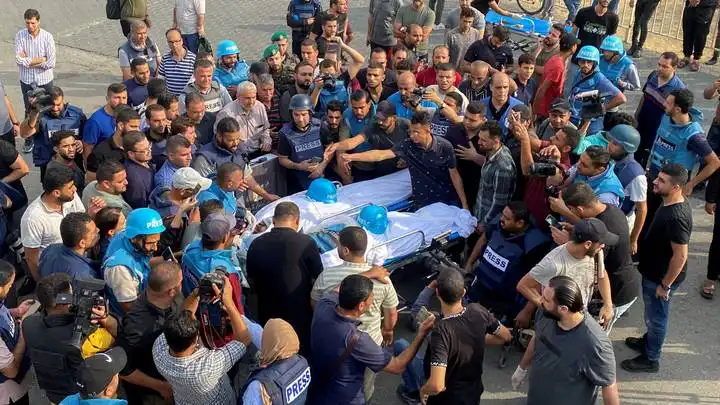
Report: The Gaza war is “the most dangerous ever ” on journalists

Reuters published a report indicating that the US-based Committee to Protect Journalists stated that the first ten weeks of Israel’s war on Gaza were the bloodiest war ever for journalists, with the largest number of journalists killed in one year recorded in one place. 


Most of the journalists and media workers killed as a result of the war were Palestinians, 61 journalists out of 68. The report stated that the committee is “particularly concerned about the existence of a clear pattern of targeting journalists and their families by the Israeli army.”


An Israeli army spokesman said that the forces do not target journalists, according to what Reuters reported.


The committee's data also showed that four Israeli and three Lebanese journalists, including Reuters video journalist Issam al-Abdullah, were killed between October 7 and December 20.


The committee stated that it would continue to investigate the circumstances of the killing of all journalists. It said that these efforts in Gaza were hampered by the destruction of large areas and the killing of family members of journalists, who often represent sources for investigators to look into how journalists were killed.


The committee is a non-profit organization that advocates freedom of the press around the world.


The committee said that the press in Gaza was severely restricted under the weight of intense Israeli bombardment, with frequent communications outages and shortages of food, fuel and shelter, adding that foreign journalists were unable to independently access the Strip for most of the war.


According to Reuters, Sherif Mansour, program coordinator for the Committee to Protect Journalists in the Middle East and North Africa, said, “The Israel-Gaza war is the most dangerous situation we have seen for journalists, and these numbers clearly show that.” He continued, "The Israeli army killed more journalists in ten weeks than any other army or entity killed in one year. With every journalist killed, the war is difficult to document and to understand further."


A report issued by the committee, last May, concluded that Israeli soldiers killed at least 20 journalists in the last twenty-two years and that no one was ever charged or held accountable.


A Reuters investigation earlier this month concluded that an Israeli tank crew killed Al-Abdullah and wounded six journalists by firing two shells in quick succession from Israel while the journalists were filming a cross-border bombing.


Gaza health officials say that nearly 20,000 Palestinians have since been confirmed killed as a result of Israeli attacks, and thousands more are believed to be buried under the rubble.

ARAB AND WORLD

Fri 22 Dec 2023 2:36 pm - Jerusalem Time

Washington Post: Netanyahu asks Biden to put pressure on Egypt to receive the Palestinians

The Washington Post revealed that in the days following the October 7 attack, Israeli Prime Minister Benjamin Netanyahu asked President Biden: If he can pressure the Egyptian president to open his country’s borders and absorb a large portion of the more than two million Palestinians in Gaza?


According to the newspaper, “Biden told Netanyahu that the idea was not accepted by the Egyptian government, which made clear that it was not interested in receiving Palestinians and playing a role in their mass displacement. But many Israeli officials still favored the request, which had not been announced before, which highlights the stark differences between the United States and Israel over what should happen in Gaza in the near and long term after Israel completes its military campaign there.


So far, Biden has provided steadfast support for Israel's military campaign in Gaza even as the Jewish state has faced international condemnation amid an attack that has killed some 20,000 Palestinians. But as part of this support, Biden repeatedly insisted that the Palestinian Authority, which currently rules part of the West Bank, should also govern Gaza after eliminating Hamas, and that Biden stresses the necessity of establishing a Palestinian state.


Netanyahu rejects these principles with increasingly strong public statements, making it unclear how the United States and Israel will resolve fundamental differences over the future of the region. American officials say the most pressing issue is determining who will be responsible for governing the small enclave “the day after,” when the fighting in Gaza ends.


Some Israeli officials also prefer to target the Iran-backed Hezbollah group next, a move American officials have worked for weeks to avoid. American and Israeli officials disagree on how harshly to punish extremist settlers in the West Bank. In other words, Biden and Netanyahu are at odds on almost all the key issues that will become decisive the moment Israel ends its “Iron Swords” military campaign.


This division is partly driven by the domestic politics of the two countries, analysts say. After the October 7 attacks, when Hamas militants infiltrated Israel and killed nearly 1,200 Israelis, Israeli voters moved sharply to the right while Netanyahu's popularity declined, and this is pushing the prime minister to embrace the Extremist right as a means of political survival. For his part, Biden is facing increasing pressure from his Democratic base to stand up to Israel and take concrete steps to help the Palestinians confront devastating images of bloodshed and devastation."


“I think Netanyahu and Biden are speaking to their political base,” said Eitan Gilboa, an expert on US-Israeli relations at Bar-Ilan University. He added: “Biden wants to revitalize the Palestinian Authority without clarifying what that means, and he also wants a two-state solution.” Netanyahu rejects both matters.”


The White House faces internal division over Israel and Gaza


The Palestinian Authority has been plagued for years by corruption and weakness, and voters in Gaza ousted the PA from their government in 2006, a year after Israel withdrew from the Strip in favor of Hamas. But US officials say there is no alternative to the Palestinian Authority as a pragmatic force representing the Palestinians, and Biden often talks about post-war Gaza joining the West Bank under the rule of a “revitalized” Palestinian Authority.

ARAB AND WORLD

Fri 22 Dec 2023 11:25 am - Jerusalem Time

Olmert: There must be an immediate ceasefire in Gaza

Former Israeli Prime Minister Ehud Olmert called for an immediate ceasefire in Gaza, and for Prime Minister Benjamin Netanyahu to be eliminated, he said.


Olmert added that Netanyahu should have realized that there was no possibility of achieving his goals that he announced in Gaza, accusing him of adopting a method of deception, fraud, and political showmanship, and that he represents a state of pure falsehood, as he put it.


He continued, saying, "It has now become clear that there is no chance of achieving the expectations set by Netanyahu in Gaza."


OPINIONS

Fri 22 Dec 2023 9:23 am - Jerusalem Time

A tripartite meeting in Riyadh... and Sinwar in Sinai?!

Translation for "Al-Quds" dot com

Translation for "Al-Quds" dot com

Opinion Writer

By Jan Aziz

Arab diplomatic sources confirm to Asas the accuracy of what the Wall Street Journal published two days ago, about Fatah-Hamas contacts, to discuss developments in Gaza, and to feel the pulse regarding the post-war period in particular.


The same sources reveal that these communications are taking place under the direct supervision of Palestinian Authority President Mahmoud Abbas, who gave the green light to conduct them. This includes searching for some mechanism to reconstitute the authority, and holding elections that lead to the establishment of a comprehensive Palestinian composition, qualified to supposedly negotiate the results of the war and the possibilities after it, leading to proposing and achieving peace on the basis of the two-state solution.


Sources indicate that the key step will be in choosing a new president for the future coalition government of the Palestinian Authority. This suggests that his name has become fermented in Abu Mazen’s head alone. Although he has not yet revealed it to anyone else, even his closest aides. It was likely to be somewhat surprising and outside the list of names circulating, by local and foreign media.


Arab diplomatic sources confirm to Asas the accuracy of what the Wall Street Journal published two days ago, about Fatah-Hamas contacts, to discuss developments in Gaza, and to feel the pulse regarding the post-war period in particular.


Abbas wants to cooperate with Fatah

Diplomatic sources confirm that Abbas has become convinced of new institutional cooperation with Hamas. This explains the attack by some of those close to him: either in an unsuccessful attempt to convince him to abandon his intention to associate with the movement. Or in coordination with him, to put more pressure on the Hamas leadership, to lower its ceilings and accept any joint proposal that Abu Mazen may present to it.


These sources add that Abbas has become determined to follow this path, despite the fact that he was previously the most critical of the movement’s behavior, as well as the behavior of outsiders towards it.


It was revealed that he was very frank in this regard, in his meeting with US Secretary of State Anthony Blinken in Ramallah. He held Washington's policies responsible for what the Authority, Palestine, and the entire region had become. He said to his guest frankly and repeatedly: Did I not tell you? How many times have I warned you?


The sources explain that what Abu Mazen intended by blaming successive American administrations was specifically their leniency with the crazy plans of Israeli officials to support Hamas, with the aim of striking the Authority and undermining the Oslo Accords. This has continued and persisted for more than ten years.


Israel "funded" the Hamas operation

It reveals that Washington, like Tel Aviv, accepted the issue of Qatari funding for the movement, without anticipating its actual purposes and true long-term goals. Regardless of the humanitarian and sound intention of the Doha leadership, Tel Aviv officials were under the illusion that their approval of this funding and their supervision of it would lead to the rationalization of Hamas, its domestication, and its placing it on a path of peaceful action. On the other hand, it also leads to a Palestinian-Palestinian rift that facilitates Israel’s conspiracies against the West Bank-Gaza axis. Diplomatic sources report from the Palestinian Authority that senior Israeli officials directly and personally assumed this mission. Until he left his position about two years ago, the former Mossad director, Yossi Cohen, personally supervised directly the transfer of Qatari funding to Hamas from Doha to the Gaza Strip. This amounted to $30 million per month. While the Israelis were hoping that this money would be spent on Gazan development, relieving them of the responsibility of helping the Strip and lifting their unjust siege of it, and thus diverting the attention of the international community from the crime of turning this region into the largest open human prison, Hamas was using every cent of that money in two areas that are not other than: military equipment and preparation, and salaries for people in Gaza.


Sources indicate that the key step will be in choosing a new president for the future coalition government of the Palestinian Authority. This suggests that his name has become fermented in Abu Mazen’s head alone. Although he has not yet revealed it to anyone else, even his closest aides


The same circles explain that the movement's leadership, in light of the financial surplus it reached, was purchasing huge quantities of basic foodstuffs, until they almost ran out of the Gaza Strip market. Then it took the initiative to distribute it in the form of subsidies to the people of Gaza, which further helped it expand its base of legitimacy among them. All of this is in preparation for the moment of battle.


Sinwar in Sinai... through tunnels?

As for the military supply line, the same sources report from the Palestinian authorities that the line of armament, ammunition, and military logistical support was focused almost exclusively on the Rafah-Sinai axis. This is what many people keep secret. The sources reveal that the Palestinian authorities believe that there are hundreds of tunnels in that area, with a length of more than 15 km each, and a width that can accommodate even trucks. They do not even rule out that senior Hamas leaders, such as Yahya Al-Sinwar, Muhammad Al-Deif and others, are currently stationed there, under the land of Sinai, not under the land of Gaza, and that the Palestinian Authority knew about this matter and its hidden background and considerations that it was unable to reveal, due to well-known Egyptian considerations. But it has been warning Washington about it for years, to no avail.


The same diplomatic circles also reveal that during last September, that is, a few weeks before the October 7 attack, tripartite American-Saudi-Palestinian meetings were held in the Kingdom. During which, representatives of the Palestinian Authority were briefed on the positive breach that had been achieved on the American mediation line between the Kingdom and Israel. The authority was reassured that this progress would bear definite results for the Palestinian issue, and that any normalization between Riyadh and Tel Aviv would inevitably include progress on the path to reaching peace on the basis of the two-state solution, and that on that day the authority repeatedly warned both parties about what was happening in the Gaza Strip, without this being heeded. 


Now these developments are behind everyone. But the consequences on the ground are heavy and harsh for everyone as well. The same sources expect that the war will not end with a death toll of less than 25,000. In addition to the complete and systematic destruction of a comprehensive urban structure, it becomes impossible for more than two million people to live on it.


Therefore, diplomatic sources expect that the opening of the Rafah crossing, in some form and according to certain mechanisms, to receive a portion of the displaced Gazans, will be inevitable in the not too distant future, provided that the research focuses on controlling this opening, its borders, duration, results, and conclusions and nothing else.


The other intractable issue until now relates to the security framework for managing the Strip after the war. The presence of the Israeli occupation army is impossible. The Western forces are rejected by their owners as well as by the owners of the land. As for the Arab forces, it appears to be a thorny issue regarding composition and authority unless Egypt takes the initiative, which is what sources say it expects after the re-election of President Abdel Fattah El-Sisi a few days ago.


Until that time, the Palestinians will continue to pay the price of having a right in a region that only recognizes the right to force.

Source: Assas Media

OPINIONS

Fri 22 Dec 2023 9:07 am - Jerusalem Time

Gaza: Waiting for the worst solutions

Farouk Youssef

Farouk Youssef

Opinion Writer

A strange question, after all the years of struggle, the crowds of martyrs, the millions of displaced people, and the paths of suffering paved with groans and disasters to which the Palestinians are still exposed. Therefore, it is impossible to compare with the words of President Mahmoud Abbas, who refuses to return Gaza to its previous state if he had the opportunity to do so. Abbas's words will not be taken seriously unless a political vacuum occurs in Gaza. This is what could happen if the Islamic Resistance Movement withdraws from political life or if Israel succeeds in eliminating it, two things that will not happen in the worst case scenario.


Heavy gas on all sides

Abu Mazen precedes the events or prepares for them. He is most knowledgeable about what is happening in Gaza politically. Hamas, which rules Gaza, is fighting fiercely today in defense of its independent existence. It is unwilling to transform into one of the political wings of the Palestine Liberation Organization, and it is also desperate for the policy pursued by the Ramallah authority. This is a despair shared by many Palestinians who do not agree with its ideological line. Therefore, the Authority will not be able to return to ruling Gaza with the presence of Hamas. The re-annexation of Gaza in this case is similar to its re-occupation by Israel. An expensive operation that will not lead to positive results.


Israel is not innocent of the malicious role it played in order for there to be no unified Palestinian front to stand against it. Therefore, it thought that the split of Hamas, which put two million Palestinians outside the authority’s control, was in its interest.


Gaza is as heavy on the Authority as it is on Israel. On the other hand, the recent war, with all its complications and repercussions at the global level, produced an Arab position that has become difficult to overcome and retreat from in order to begin peace talks on the ruins of a city and the graves of victims who were not, in the minimum understanding, participating in the conflict, neither in Hamas’s adventure nor in Israel’s madness. Here I do not mean talks with Israel alone, but also with the Palestinian party, which will raise the slogan of rebuilding Gaza, as it did in previous times. 


The war this time is different, not only because of the official Western position aligned behind Israeli barbarism, but also because of the legal status that Iran acquired after the Hamas movement clearly revealed its ideological connection to it. Regardless of Western hypocrisy, Iran is not innocent of involvement in the recent war, as shown by the Iranian media, based on statements by the Supreme Leader, which cannot be considered a measure of the truth.


Error in Israeli estimates

What is certain until this moment is that the forces that could influence Israel do not want to stop its madness. But it is also certain that these forces know that the mind that Israel has lost was not aware of whether Hamas’ plan would lead it into a quagmire from which it would not emerge or whether it would guide it to ways of salvation from a constant source of nuisance. But Israel, for its part, played a suspicious role when it weakened the Palestinian Authority without showing any kind of respect for the European Union that sponsors it. Israel is not innocent of the malicious role it played in order for there to be no unified Palestinian front to stand against it. Therefore, it thought that the split of Hamas, which put two million Palestinians outside the authority’s control, was in its interest. It does not want a final solution based on the fact that it does not respect international laws that stipulate the right of the Palestinians to establish their independent state.


What about international management?

The question that can be considered imaginary until this moment is: “What happens if the Hamas movement collapses in a situation in which Israel insists on taking the war to its extreme?” The question is not about who rules Gaza. Israel and the Palestinian Authority are unwilling to do so. Rather, who will manage the affairs of two million people, the majority of whom lost their homes that were destroyed by the bombing, their sources of livelihood were cut off, and they no longer have anything to support their livelihood in terms of food and medicine, which puts life at its lowest levels. A crowd of wandering people standing on the borders of Israel, whose identity still dictates their affiliation to the Palestinian Authority, whose existence the world once recognized. Regardless of the position on the conflict, the victims’ question will be pressing. But to whom?


There are those who thought about international management. On the other hand, there are those who believe that this idea is a poisoned gift. But Gaza lost all its sources of livelihood after it began living on aid. Real life cannot be built on aid. The Israeli siege was the worst and most inferior weapon of war. That siege placed it in front of a people who only wanted it to disappear. Therefore, the international administration can be considered a kind of protection for Israel.

Source: Assas Media

OPINIONS

Fri 22 Dec 2023 9:01 am - Jerusalem Time

Israelis Abandon Political Left Over Security Concerns After Oct. 7

Sheera Frenkel

Sheera Frenkel

Opinion Writer

Maya Mizrachi grimaced at the group of eight Israelis calling for peace with Palestinians in front of Israel’s military headquarters this month in Tel Aviv.

A year ago, Mizrachi, 25, had protested alongside them, carrying a sign that called for Israel to end its military occupation of the West Bank. Now, she had bumped into them by accident, on her way home from a nearby rally calling for the return of Israeli citizens held hostage in the Gaza Strip. “I don’t think there are more than eight people in all of Israel who would protest against the army right now,” said Mizrachi, who is a student. “I can’t even bring myself to do it.”She is one of a growing number of Israeli citizens eschewing the politics of the left — ideas that include promoting peace talks with the Palestinians, ending Israel’s occupation of the West Bank and supporting a two-state solution — since Oct. 7, when Hamas gunmen crossed into Israel in a surprise attack and killed roughly 1,200 people. In the wellspring of sadness, anger and fear that has gripped Israel since that day, a consensus has emerged that Israel needs to take a harder line with the Palestinians and embrace an even more militarized state. And while public opinion of Prime Minister Benjamin Netanyahu is faltering, support for the policies upheld by his right-wing government is growing. If the left has lost mainstream support, Israel’s peace camp has been driven virtually underground. Activist groups say many members have abandoned the cause, and those who remain committed have struggled to find public places willing to accommodate antiwar protests.

The few calls for a cease-fire, which have gained traction with the public, have been driven by the families of Israeli hostages abducted to Gaza on Oct. 7. Those families have asked the government to pause the fighting to negotiate a return of their loved ones. While those calls grew stronger this week after the Israeli army announced it had mistakenly killed three hostages, most of the families have stressed that they broadly support the war effort, and think it is necessary.

According to polls conducted in the two months since Oct. 7, Israelis have moved decidedly to the right on a number of political issues, including support for settlers in the West Bank, endorsements for far-right politicians, and even the re-establishment of a military occupation of Gaza. “The trauma of what happened on Oct. 7 shifted Israeli society. It made them question the most basic tenets of whether they were safe in their homes,” said Tal Schneider, a political columnist for The Times of Israel. “They are calling now for more — more military, more protection, more hard-line policies.” Left-wing parties in Israel have seen a steady decline over the past 20 years. In Israel’s last election cycle, the center-left Labor Party won only four seats in the Knesset, Israel’s Parliament, a significant decrease from the 19 seats it held in 2015. The Meretz Party, one of the few left-wing Israeli parties to have held a seat in the past decade, failed to get enough votes to qualify in the last election. 

Last week, the head of the Labor Party, Merav Michaeli, announced that she was stepping down amid criticism that she was responsible for the party’s poor poll numbers. “Nobody in this country wants to talk about peace right now,” Schneider said. “Being a leftist has become a dirty word,” she said, adding that while socially progressive causes, like government-backed welfare, remain popular in Israel, they are increasingly divorced from Israel’s left-wing movements. “Many Israelis want more government welfare programs, but a conservative political leadership.” Polls conducted in Israel since Oct. 7 show the extent of the political shift. A survey by Israel’s Channel 12, one of the country’s most popular broadcasters, found that roughly one third of Israelis described themselves as “moving to the right” in the month after the Oct. 7 attacks, while far fewer reported that their politics had shifted more to the left.

In another poll, Israel’s Tel Aviv University found in November the share of Israelis in favor of a two-state solution was down from just a month earlier, falling below one third of respondents. If the war has accelerated the left’s decline, it has also hurt Netanyahu’s popularity. 

For months before the war, the prime minister held together an unruly coalition of far-right parties that controlled 64 seats in Israel’s 120-seat Knesset. Recently, vigils for slain Israelis have turned into protests over Netanyahu’s leadership and calls for him to resign. “The country has lurched to the right, but they no longer want Netanyahu as the leader of the right,” Schneider said. “It is a question of who can represent the new right-wing views held by so many Israelis today.” Longtime Israeli peace activists said Israel’s lurch to the right is tangible. In the offices of Standing Together, an organization jointly founded by Israelis and Palestinians, the mood has been somber since Oct. 7.Membership has dropped, said Alon-Lee Green, a founder of the organization. When the group has tried to hold solidarity rallies between Israelis and Palestinians in public places, they have found themselves turned away by local municipalities and the police. “We are being banned from public places,” Green said. “We are being told there isn’t an audience for our message today,” he added. “There has never been a more difficult time to call for peace.” The group has resorted to renting private venues, like restaurants and wedding halls, to hold their rallies, Green said. He said he understood the urge, among many Israelis, to call for more security and a greater military presence since Oct. 7.“I remember in the days after the attacks, I was constantly looking over my shoulder,” Green said. “You can’t underestimate what that type of thing does to your psyche, to be afraid in that deep way.” But, he said, he ultimately feels more certain than ever that fighting for a peaceful future is the only viable path forward. “I came out of my fear and realized this was the most important moment in my life to fight for peace, even if it feels more out of reach than ever before,” Green said. 

The New York Times

PALESTINE

Fri 22 Dec 2023 8:49 am - Jerusalem Time

War on Gaza...the death toll rises to more than 20 thousand

The Ministry of Health in Gaza reported that 390 Palestinians were martyred and 734 others were injured in the Strip during the past two days.


Since last October 7, the Israeli army has been waging a devastating war on Gaza, leaving more than 20,000 dead, most of them children and women, massive destruction of infrastructure and an unprecedented humanitarian catastrophe, according to the Gaza Strip authorities and the United Nations.


The Ministry of Health in the Gaza Strip reported that the toll of the Israeli aggression had risen to 20,57 dead and 53,320 injuries since the seventh of last October.


Several international organizations have repeatedly confirmed the inability of the health system in the besieged sector to absorb the large number of killed and wounded due to the ongoing Israeli aggression for 76 days, calling for a humanitarian truce and a ceasefire to bring in urgent health aid and evacuate the injured for treatment abroad.


ARAB AND WORLD

Fri 22 Dec 2023 8:31 am - Jerusalem Time

Huffington Post: American efforts to thwart an international conference on Israeli violations in Gaza

Officials in the US State Department are working “secretly” to thwart a meeting to discuss violations of the Geneva Conventions in the war waged by Israel on the Gaza Strip, according to what was published by the American website HuffPost on Thursday, December 21, 2023.


This revelation comes alongside simultaneous US efforts to slow down the most prominent international attempt to alleviate the suffering witnessed by the residents of the Strip: a United Nations Security Council resolution that will lead to a significant increase in the flow of humanitarian aid to the besieged Strip.


The Geneva Conventions embody the basic principles of international humanitarian law, which determine what actions are legal or illegal during a war. Every UN member state is a party to some aspect of it, including the United States and Israel. Therefore, officially acknowledging that Israel violated the agreements in its US-backed attack against Hamas could represent a serious international condemnation against the two countries, and confirm the allegations made by human rights groups that have collected evidence that they describe as evidence of such violations occurring.

Historically neutral Switzerland is the custodian of these agreements, meaning it decides when meetings are held that bring together the parties involved to discuss compliance with international humanitarian law.


According to US State Department documents seen by HuffPost, Palestinian diplomats and a large group of UN member states, including some European countries, are preparing to launch an invitation to Switzerland to hold such a conference, which will focus on the ongoing fighting between Israel and Hamas. Which will cover violations of the Geneva Conventions by all parties.


Amnesty International, Human Rights Watch, and the International Commission of Jurists also support the call to hold an urgent conference, while the Biden administration wants to ensure that the year 2024 does not witness the holding of such events.


Washington's efforts to thwart the conference

By early January, American diplomats plan to pressure their Swiss counterparts to reject the request from Palestinian diplomats and monitoring organizations.


Internal documents reviewed by HuffPost direct US officials to convey their “deep concern” about Palestinian efforts, and present serious arguments against these efforts.


According to these documents, American diplomats must say that the UN General Assembly has not passed a resolution since the beginning of the war on Gaza calling for such a conference, and that the agreements do not include guidance regarding the procedure for calling a conference.


American representatives must also say that holding this conference may mean politicizing the Geneva Conventions. By creating the impression that it is being cited primarily for the purpose of targeting Israel, the documents state. The materials advise US officials to say that the impression could harm the credibility of both Switzerland and the agreements themselves.


For his part, Michael Sfard, a distinguished international human rights lawyer, said that the main impact of such a conference would be that it provides a major international signal of the gravity of the Israeli war on Gaza.


He explained: “The forum is not a court: they cannot rule that war crimes have occurred, and it is not a forum in which evidence is examined and scrutinized. The main importance of such a convening will be political. Any convening is considered important based on the fact that it is a rare (event).


Sfard noted that Israel's main foreign ally, the United States, may also come under scrutiny at such a conference.


He added: "Given that America supports Israel's campaign, it will be affected by anything that accuses Israel of committing crimes or demands that Israel comply with something."


Despite the US position in support of Israel, other world governments say that their sympathy for Israel amid its shock does not excuse what they see as deeply disturbing behavior by Israel in the Gaza Strip.


Since last October 7, the Israeli army has been waging a devastating war on Gaza, which, as of Wednesday, has left 20,000 Palestinians dead and 52,600 wounded, most of them children and women, massive destruction of infrastructure and an unprecedented humanitarian catastrophe, according to the Gaza Strip authorities and the United Nations.


ARAB AND WORLD

Fri 22 Dec 2023 8:20 am - Jerusalem Time

“Netanyahu’s statements about the war hide a bitter reality.” An Israeli newspaper expects reduction of war against Gaza.

The Israeli newspaper Yedioth Ahronoth suggested, in a report published Thursday, December 21, 2021, that Tel Aviv will reduce its aggression against the Gaza Strip soon, noting that the city of Khan Yunis in the Gaza Strip may be the last stop in what the occupation army calls The "difficult phase" of the war, after which the army will move to a narrower scope of its operations.


In the same report, the Arab newspaper considered that the Prime Minister's "resonant" statements regarding the war, in which he insists on continuing it "until victory," hide another "bitter reality" that makes it likely that the operation will be reduced as soon as possible.


Between Netanyahu's words and reality

The Israeli Prime Minister said on Wednesday, December 20: “We will continue the war until the end,” and “the war will continue until Hamas is eliminated, and until victory.” Perhaps this is true from a historical perspective, as the war between Israel and the resistance organizations may last for years, and perhaps even for generations.


However, the perception of things is different among Israeli families whose loved ones were detained in Gaza, among wives who said goodbye to their husbands after they were called to the army on October 7 and have not yet returned, among fathers whose sons or daughters are fighting in the field, and among those whose lives were turned upside down by war.


The Israeli newspaper Yedioth Ahronoth says that resonant statements - such as Netanyahu's statement about the continuation of the war - must be treated with caution. Because talking about future wars is intended to cover up the gloom of the present reality. Therefore, the newspaper believes that the battles in Khan Yunis will be the last stop in what the occupation army calls the “difficult phase” of the war.


"Final arrangements" in Gaza

Likewise, the Israeli newspaper considered that the news published in the past two days about the Israeli army expanding its ground operations in Gaza shows two things: First, the occupation army has not yet been able to “cleanse” the northern gates of the Gaza Strip, and resistance fighters are still sometimes emerging from buildings, barriers and tunnels. Secondly, the occupation army senses that the end of the war is imminent, and therefore it is trying to achieve more achievements before declaring a ceasefire.


Hence, Yedioth Ahronoth claims that Gaza is witnessing these days what could be called the final arrangements for the military operation in Gaza, and the purpose of these arrangements is to facilitate the presence of the Israeli army in the Strip during the next stage.


The newspaper expected that this stage of final arrangements would be completed in the first half of January. It is likely that a large portion of the Israeli reserve soldiers will then return to their homes. The occupation army should work to establish a security strip - one kilometer wide - separating the Strip from the surrounding settlements.


Israeli disappointment

The Israeli newspaper says that the truce contains some bitterness for the Israelis, because the war did not achieve the goals that were set for it.


It also pointed out that the goals set by the Israeli political system for the army were far-fetched, and that it was clear to everyone from day one that annihilation, crushing, and destruction were nothing but hoped-for wishes whose authors were influenced by the severity of the blow that Israel received on October 7.


The Hebrew newspaper stressed that wishes should not be treated as military plans, nor as strategic plans.


It considered that exaggerating expectations would lead to disappointment afterwards, and that calming the war would be more painful for the fighting forces than for others, as well as among the extreme right-wing elements who were looking forward to a multi-front war that would lead to the deportation of millions of Palestinians and the return of settlement in the Gaza Strip.

Source: Arabic Post

ARAB AND WORLD

Fri 22 Dec 2023 7:56 am - Jerusalem Time

Analysis| Waiting for a long war of attrition in Gaza

By Suleiman Abu Irshid

The depth of the failure, or "rot" as expressed by military analyst Amir Oren, was revealed when Hamas turned the door latch and found it open, and it turned out on the seventh of October that Yahya Sinwar had been preparing for this scenario for many years, from the day Netanyahu freed him.

Regardless of the outcome of this war of aggression on Gaza, it is a major failure for Israel with its army, intelligence, security agencies and military and political leadership, as it proved that the failure that occurred on the seventh of October, which led to the collapse of the Israeli defense line in front of the attack of the Palestinian resistance, is a link in a the framework of a declared strategy that It does not only take destruction and displacement as its goals, but also as a means to facilitate the Israeli army’s operations on the ground.


With each new day that passes over the bloody war that enters the second half of its third month, a new intelligence and military failure unfolds, once by finding a huge tunnel with a length of 4 km and a depth of tens of meters that stretches from Jabalia to the "Erez" Crossing and forms an underground route for cars to cross to the border area, and its opening is located within sight of the Israeli observation towers, and only 400 meters from the border wall.


Another was the belated discovery that the commander of the al-Qassam Brigades, Mohammed Deif, the mastermind of the operation of the seventh of October, who they thought was paralyzed, walking on a wheel chair, was standing on his feet and in good health, another was stunned by the discovery of a network of tunnels that included rooms, command headquarters and large lounges in northern Gaza, and another by the presence of Israeli hostages alive before the Israeli army killed them above ground in the Shuja'iya neighborhood in Gaza.


The depth of the failure, or" rot " as expressed by military analyst Amir Oren, was revealed when Hamas turned the latch of the door and found it open, and it turned out on the seventh of October that Yahya Sinwar has been preparing for this scenario for many years, from the day that Netanyahu freed him with a thousand of his comrades in exchange for Gilad Shalit.


Oren says that no plan in any Israeli neighborhood did not foresee the situation prevailing between the months of October and December 23, with a huge amount of reservists in active military service for a long time, and this large number of injured, which is almost equal to the number of regular army soldiers, besides the presence of 150 thousand people evacuated from their homes in the south and North also constitute a kind of reservists.


Or, as Haim Levinson described in Haaretz, the human tendency to choose a good situation, preferring to listen to the greatness of the Air Force and its jets, artificial intelligence, cyber experts, geniuses of 8200 and brave companies, enjoying thinking about the smart Shin Bet agents who make the stone speak, hanging their ears with the conversations of Yahya Sinwar, dreaming of the Mossad, who succeeds in assassinating the director of the nuclear program in the heart of Iran, and it's also good to wake up to the voice of optimistic analysts instead of analysts warning about the upcoming escalation and saying, "the army is not ready, that we are not as strong as we wanted, that our leadership is mediocre, and it may be a failure...".


"Just as we have gradually returned to the pre-October seventh habits, so in self-propaganda we have returned to narcissism, stubbornness and empty threats, we promise to exterminate Beirut and bomb Lebanon, that we are one step away from undermining Hamas and returning prisoners due to military pressure and that we are winning, and perhaps it is better to say that we are winning than to say that we are stuck in a localized run in Gaza,"Levinson adds.


The issue of involvement in Gaza, even if it is occupied, is the most likely option, as military and political leaders are talking about a situation that is more like a long war of attrition that will last for months or at least a year, without a road map for an exit, at a time when Israeli and American views are conflicting between talking about full security control, perhaps cutting the Strip into areas similar to the West Bank and insisting on the non-return of power, to maintain the political and geographical fragmentation, and Biden's vision of not returning to the occupation of Gaza and saying the two-state solution from the American perspective.


All of them are premature scenarios, because the resistance in Gaza is still recovering in the North and South, its rockets are falling in Tel Aviv, and the Israeli army has suffered significant losses in various axes of fighting, and if there is talk about the next day, it also applies to Israel, which apparently failed, despite its long and destructive war, to restore the prestige of its army that was broken and restore its lost psychological balance, and after the end of the war will come a difficult calculation with its political and military leadership responsible for this failure.

Source: arab48

ARAB AND WORLD

Fri 22 Dec 2023 7:51 am - Jerusalem Time

UN Security Council once again postpones voting on a draft resolution on Gaza

According to diplomatic sources, a draft resolution aimed at improving the humanitarian situation in Gaza is scheduled to be voted on today, Friday.


The UN Security Council postponed again until today, Friday, the vote on a draft resolution aimed at improving the humanitarian situation in Gaza, in a text that in its latest version became very weak after it lacked any call to stop the fighting immediately, but the chances of its approval increased by obtaining the support of Washington.


This new postponement came after the United States announced that it was ready to support the latest version of the draft resolution, which calls for taking “urgent measures” to improve humanitarian access to Gaza, but without demanding an immediate halt to the Israeli war on the Gaza Strip.


According to diplomatic sources, the draft resolution is scheduled to be voted on today.


The new text, which is the result of arduous negotiations that took place under the American threat to use its veto power again, no longer resembles at all the original version that the United Arab Emirates presented to the Security Council table last Sunday.


The draft resolution, in its new version drafted yesterday, Thursday, calls for "urgent measures that would immediately allow safe and unhindered access to humanitarian aid, as well as create conditions for a permanent cessation of hostilities."


Thus, the new draft resolution has abandoned the call for an “urgent and permanent cessation of hostilities,” a phrase it included in its original version, as well as the call for an “urgent suspension of hostilities,” a weaker phrase that appeared in a later version, but was dropped in the version. New.


The US Ambassador to the United Nations, Linda Thomas-Greenfield, said yesterday evening, Thursday, that “we worked hard this week with the UAE and others and with Egypt to reach a resolution that we can support.”


She added, "The draft resolution has not been weakened. The draft resolution is very strong, and enjoys the full support of the Arab group."


The American ambassador confirmed that the new text would allow “the provision of humanitarian aid to those in need.”


The Security Council, which has faced widespread criticism for its failure to act since the beginning of the Israeli war on Gaza, has been witnessing arduous negotiations over this text for days.


The vote, which was originally scheduled for last Monday, was postponed several times, most recently yesterday evening, Thursday.


On December 8, the United States used its veto power against a previous draft resolution calling for a “humanitarian ceasefire” in the Gaza Strip.

ARAB AND WORLD

Thu 21 Dec 2023 10:16 pm - Jerusalem Time

US Intelligence: Hamas’s popularity is steadily rising throughout the region

A wave of new analyzes by US intelligence agencies warn that Hamas's credibility and influence have grown significantly across the Middle East over the past two months since the unprecedented attack on October 7 and the start of the Israeli war on the Gaza Strip.


CNN, which published the news, says: “While the ongoing Israeli air campaign has caused the death of thousands of civilians inside Gaza, Hamas, which the United States and Europe classify as a terrorist group, has been able to present itself as the only armed group fighting against a brutal oppressor who kills women and children.” 


Officials familiar with the various assessments say that the movement has succeeded in positioning itself in some parts of the Arab and Islamic world as a defender of the Palestinian cause and an effective fighter against Israel.


Hamas' increasing influence comes in the wake of its bold attack (on November 7) on Israel, which resulted in the killing of about 1,200, including 311 soldiers, according to official Israeli statements, and its performance on the ground in confronting the Israeli occupation forces, and inflicting strong strikes on it despite the ferocity of the war that Israel is waging against Gaza Strip.


The United States has strongly defended Israel's right to defend itself in the wake of the attack, "including its campaign to completely eliminate Hamas," according to the network.


From Hamas's perspective, the October 7 attack on southern Israel was a stunning operational success. In the months that followed, it received credit — particularly in the occupied West Bank — for negotiating the release of hundreds of Palestinian prisoners and detainees held by Israel, in exchange for some of the hostages the group held during the offensive, these sources say. 


“At the same time, Hamas propaganda videos portray the group as highly moral fighters who follow the teachings of Islam — despite the horrific details of the October 7 attack and accusations of sexual violence against Israeli women reported by eyewitnesses that day — along with a deluge of devastating attacks.” 


Images of the suffering of civilians inside Gaza spread widely on Arab social media.

The network quotes a senior American official in the US administration as saying: “Hamas was not a very popular organization (before October 7), but today it has become more popular.”


According to the US intelligence report, “The conflict is more likely to strengthen Hamas’ influence outside Gaza than inside Gaza, where years of misrule have bred mistrust.”


An opinion poll conducted during the first week of November showed that strong support for the October 7 attacks was much higher among Palestinians in the West Bank than in Gaza – 68% versus 47%. While conducting surveys is challenging in wartime, with many Gazans displaced from their homes by Israeli bombing, this finding has been replicated in other surveys.


Various assessments have been circulating within the US government as Biden administration officials begin to publicly warn that the civilian death toll from Israeli bombing threatens to increase Hamas's popularity in the Palestinian territories, and as analysts warn that the bombing may only inspire more terrorism there and abroad.


“In this type of combat, the center of gravity is the civilian population,” US Defense Secretary Lloyd Austin said earlier this month. “If you push them into the enemy’s arms, you are exchanging tactical victory for strategic defeat.”


The network says: “In his office, about a mile from the main square in Ramallah, (well-known Palestinian pollster) Khalil Shikaki reflects on the conflict, and says that the Palestinians overwhelmingly support Hamas’s decision to go to war with Israel. His research company has published, The Palestinian Center for Policy and Survey Research (PCPSR) just released the results of its latest poll on Palestinian attitudes.


Personal interviews were conducted with 750 adults in the West Bank, and personal interviews were conducted with 481 adults in Gaza. Data were collected in Gaza during the last truce, when it was safer for researchers to move around.


The poll, which has a margin of error of four points (instead of the usual three), found that nearly three-quarters (72%) of respondents believed Hamas' decision to launch its attack on Israel on October 7 was "correct."


Less than a quarter (22%) said this was “not true.”

Shikaki said this did not mean support for atrocities: “No one should see this as support for any atrocities that Hamas may have committed on that day.” "


He added: "The Palestinians believe that diplomacy and negotiations are not an option available to them, and that violence and armed struggle are the only means to end the siege imposed on Gaza, and in general to end the Israeli occupation."


This important distinction was highlighted by three of the survey's data points. Nearly 80% of the sample told researchers at the Palestinian Center for Policy Research that killing women and children in their homes is a war crime.

ARAB AND WORLD

Thu 21 Dec 2023 9:44 pm - Jerusalem Time

World Health Organization: There are no longer operating hospitals in the northern Gaza Strip

The World Health Organization said on Thursday that there are no longer functioning hospitals in the northern Gaza Strip, describing the scenes of patients left without food and water as “unbearable.”


The United Nations organization reported that it led missions to two hospitals that were severely damaged, namely Al-Shifa and Al-Ahly Al-Arabi “Al-Baptist” in the northern Gaza Strip on Wednesday.


The representative of the World Health Organization in Palestine, Richard Peppercorn, said, “Our teams cannot describe the catastrophic situation facing the patients and medical teams” who are still there.


The ongoing Israeli aggression on the Gaza Strip since October 7 has resulted in the death of more than 20,000 citizens, 70% of whom are women and children.


The World Health Organization said last month that the emergency department at Al-Shifa Medical Complex, the largest hospital in the Strip, had become a “bloodbath.”


Al-Ahli Hospital became the last hospital institution still in service in the northern Gaza Strip, but its administration announced that the facility would stop working on Tuesday after the Israeli occupation forces stormed it.


The WHO-led mission revealed that Al-Ahli Hospital, which two days ago was “crowded with patients in need of emergency care,” is now “an empty shell,” Pepperkorn told reporters in Geneva via video link from Jerusalem.


He added, "There are no longer operating rooms due to the lack of fuel, electricity, medical supplies, and medical staff, including surgeons and other specialists. They have stopped working completely."


Of Gaza's 36 total hospitals, only nine are now partially functioning, all in the south.


"There are no longer hospitals in service in the north," Pepperkorn continued.


Hospitals protected under international humanitarian law have been repeatedly subjected to Israeli bombing in Gaza since the start of the aggression.


Pepperkorn pointed out that although the goal of the mission's visit on Wednesday was to deliver fuel, the lack of security guarantees meant that they could only deliver medical supplies and medicines, but that was not enough, according to him.


"Without fuel, crews and other essentials, medicines will not make a difference and all patients will die slowly and painfully," he explained.


He said that in Al-Ahli Hospital, there are only 10 employees left who are doing everything in their power to provide basic first aid, while about 80 patients are taking refuge in a church on the hospital grounds and in the orthopedic department.


For his part, Sean Casey, head of the World Health Organization missions to Gaza, who was part of this mission, described the conditions as “incredible.”


At Al-Ahli Hospital, the team was walking in its yard, where bodies were piled up wrapped in white sheets, while the sound of gunfire was heard near the site, according to what Casey told reporters from Rafah in southern Gaza.


“In the church, we saw an unbearable scene,” Casey recounted, describing 30 patients, including young children and some seriously injured, begging for water, not care.


"Currently, it is a place where people wait to die," he added.


He renewed the increasingly urgent call for a ceasefire to allow the entry of sufficient amounts of aid as well as the evacuation of a larger number of patients from Gaza. Asked if time was running out, Casey said: "I think it's too late."


He explained, "We are dealing with starving adults and children... Everywhere we go, people ask us for food. Even in hospitals... people with bleeding wounds ask for food."


He concluded by saying, "If that is not an indication of despair, I don't know what is."

ARAB AND WORLD

Thu 21 Dec 2023 8:52 pm - Jerusalem Time

Washington Post investigation: No evidence that Hamas exploited Al-Shifa Hospital, and its bombing by Israel is a dangerous precedent

An investigation by the American newspaper The Washington Post revealed that the evidence provided by Israel does not rise to the level of showing that the Islamic Resistance Movement (Hamas) used Al-Shifa Hospital as a command and control center.


The investigation added that none of the five buildings in the Shifa Medical Complex identified by the Israeli army are connected to the tunnel network. He also confirmed that there is no evidence of the possibility of entering the tunnels from within the corridors of the Al-Shifa Complex.


The Washington Post explained that its detailed investigation was based on an analysis of open source video clips, satellite images and all materials published by the Israeli army, and stated that legal experts and human rights activists confirmed that the results of this investigation raise critical questions about the bombing of the Shifa Medical Complex.


The newspaper said that the administration of President Joe Biden had declassified the US intelligence assessment that supported Israel's claims, and quoted a senior American official as saying that they were confident of the veracity of the intelligence information that spoke of Hamas' use of the hospital as a command and control center.


"Clues"

But the US government - adds the Washington Post - did not publish any of the declassified materials, nor did any official share the intelligence on which the assessment was based.


It quoted an Israeli occupation army spokesman as saying that the army had published extensive “irrefutable” evidence indicating that Hamas used the Shifa complex for military purposes, but he assured the newspaper that they could not provide other additional evidence.


A prominent member of the US Congress explained to the Washington Post that he was initially convinced of Israel's allegations that Hamas used the Shifa Medical Complex as a control center, but now he doubts that, and stresses that Israel must have more evidence about this matter.


The American newspaper added that the United States' ally bombed the complex - which includes hundreds of patients and thousands of displaced people - in an unprecedented manner, causing the hospital services to collapse and stop service as fuel ran out, and ambulances were unable to collect the wounded from the streets.


A dangerous precedent

A mass grave was also dug inside the complex to bury about 180 people, and among the victims were premature babies who died as a result of the Israeli bombing.


The Washington Post quoted Jeffrey Korn, a law professor at Texas Tech University, as saying: “If in the end you do not find what you said you would find, that justifies doubts about whether your assessment of the military value in conducting the operation was legitimate or not.”


Experts also warned of the precedent that targeting the Shifa Medical Complex would set.


Brian Finucane, a former legal advisor to the US State Department who now serves as a senior advisor to the Crisis Group, stressed that searching for pretexts to justify targeting the hospital will set a precedent for future operations against hospitals during wars.


He stressed that there should not be an assumption that hospitals can be targeted in general based on what Israel put forward regarding the Al-Shifa Complex.

ARAB AND WORLD

Thu 21 Dec 2023 8:45 pm - Jerusalem Time

Netanyahu reiterates his emphasis on continuing the war on Gaza “until its goals are achieved.”

On Thursday, Israeli Prime Minister Benjamin Netanyahu reiterated that Tel Aviv “will not stop” its war on the Gaza Strip until it “achieves all its goals.”


Netanyahu said in a video speech, which he posted on his official account on the “X” platform: “We fight until victory. We will not stop the war until we complete all its goals, eliminating Hamas and releasing all the hostages in Gaza.”


He claimed that "Hamas has two options: surrender or death."


He added, "Gaza will no longer pose any threat to Israel."


Netanyahu repeatedly stressed that the war on Gaza will not stop except by eliminating the Hamas movement in Gaza and releasing all prisoners detained in the Strip.


According to Israeli statistics, Hamas captured about 239 people during its attack on southern Israel on October 7, and exchanged dozens of them during a humanitarian truce that lasted for 7 days until December 1, with Israel, which holds 7,800 Palestinians in its prisons. Among them are children and women.


Since last October 7, the Israeli army has been waging a devastating war on Gaza, which, as of Wednesday, has left 20,000 Palestinian dead and 52,600 wounded, most of them children and women, massive destruction of infrastructure and an unprecedented humanitarian catastrophe, according to the Gaza Strip authorities and the United Nations.

ARAB AND WORLD

Thu 21 Dec 2023 8:43 pm - Jerusalem Time

Macron: We are trying to reach a ceasefire in Gaza

French President Emmanuel Macron said on Thursday that his country is trying to “reach a ceasefire in the Gaza Strip,” which has been subjected to a devastating Israeli war for two and a half months.


This came in a post on his account on the “X” platform, in which he touched on his meeting with Jordanian King Abdullah II as part of his two-day visit to Amman.


Macron noted that France and Jordan are working together to achieve a ceasefire in Gaza as soon as possible and meet the needs of the peoples of the region.


He pointed out that his country has provided aid worth 100 million euros to the residents of Gaza so far, without additional details.


Macron explained that he supports the establishment of a humanitarian aid platform for Gaza in Jordan so that aid can reach the region, and that his country has already contributed to this platform.


In this context, Macron confirmed that 11 tons of humanitarian aid arrived in the Jordanian capital, Amman, today, and additional aid will be sent in the coming days.


The French President stressed the necessity of a two-state solution regarding the Palestinian issue.

PALESTINE

Thu 21 Dec 2023 7:11 pm - Jerusalem Time

Hamas: Netanyahu insists on killing Israeli detainees

Al-Qassam Brigades, the military arm of Hamas, published a video clip of the three detainees who were mistakenly killed by the Israeli occupation army.


Al-Qassam broadcast a video clip on its Telegram channel on Thursday evening, showing scenes of the three detainees during their detention, before the occupation forces killed them with gunfire.


The Al-Qassam Brigades commented on the video: “Despite our keenness to preserve their lives, Netanyahu still insists on killing them..


A preliminary investigation by the Israeli occupation army, after announcing the killing of 3 "Israeli" detainees by the occupation army, revealed that the three detainees raised a white flag in front of the occupation soldiers and were shot out of revenge against the Palestinians, according to Hebrew media.


The Hebrew newspaper Yedioth Ahronoth said that the body of a blonde detainee was what raised the soldiers' suspicions that they were among the detainees.


The occupation army conducted a preliminary investigation into the incident that occurred in Shuja'iya, in which it said that the soldiers who opened fire on the detainees acted in violation of open-fire instructions.


An officer in the occupation army said: "We were not prepared for a scenario in which the kidnapped people roamed freely in the streets of Gaza."


A senior official in the Southern Command explained, according to the Hebrew newspaper, that the Israeli occupation army forces were stationed in a multi-storey building in Shujaiya, in an area where there were no longer any civilians, and a soldier who was in the force recognized three people who came out of a nearby building. They were shirtless, and had a stick with a white cloth on it. The soldier shouted, “Terrorists,” and contrary to Al-Fateh’s instructions, they were shot and two were wounded. The third detainee returned unharmed to the building from which he came.”


According to Hebrew media, the forces asked the third detainee to leave the building, and heard him shouting “Save me” in Hebrew. When he left the building, the battalion commander asked the soldiers to stop shooting, but a soldier from a nearby building opened fire on him and wounded him.


Israeli occupation government Prime Minister Benjamin Netanyahu said that the killing of the three detainees is an unbearable tragedy, and that all of Tel Aviv is in mourning this evening.


Netanyahu added in statements in which he commented on the incident, saying: “I commend the hands of our soldiers who are committed to recovering the detainees, even if it means risking their lives.”


Netanyahu claimed that his army will learn lessons and will continue to make a great effort to return all detainees to their homes safely.


The Al-Qassam Brigades had announced the killing of 3 detained settlers, as a result of an earlier occupation bombing of the Gaza Strip.


Al-Qassam's statement added that the settlers who were killed were: Sherry Silverman Bibas, Kfir Bibas, and Ariel Bibas.

ARAB AND WORLD

Thu 21 Dec 2023 5:55 pm - Jerusalem Time

Quinnipiac poll: Americans' support for Israel declines as the Gaza war continues

Americans are dissatisfied with US support for Israel as its war on Gaza approaches its third month, and the Israeli military faces increasing accusations of disproportionately targeting civilians in the Gaza Strip, according to a poll conducted by the prestigious American Quinnipiac University and published on Wednesday.


Meanwhile, support for aid to Ukraine remains broadly stable but declining among Republicans, the poll said.


“While the Israeli war effort continues to receive full support from the Republican Party, it is clear that Republican voters are losing patience with supporting Ukraine,” Tim Malloy, a polling analyst at the university, said in a statement seen by Jerusalem.


Malloy said that only 45 percent (45%) of voters surveyed say they support sending more military aid to Israel, a decline from last month when 54 percent expressed support for more military aid.


While the poll showed that Republicans still support providing more aid to the Israeli war effort, and a majority of voters still generally say that supporting Israel is in the interest of the United States, 58% of Democrats and 48% of independents said they oppose aid for the Israeli war on Gaza. . According to the poll, 60% of Hispanic voters and 56% of black voters do not agree to providing more military aid to Israel.


Sympathy for Israel also declined broadly, from 54% in November to 49% this month. Voters are also divided on whether Israel's response to the October 7 terrorist attacks was appropriate.


Since Hamas launched those attacks, the United States has become Israel's main ally in the international community, providing it unlimited military and political support in its quest to eliminate the Iranian-backed militant group in the Gaza Strip. But this stance has sparked violent reactions from Arab Americans and progressives in Within the country, as well as other countries that called for a ceasefire and condemned Israel for its conduct in the war.


“Increasing civilian casualties have led to accusations that the IDF is deliberately targeting hospitals, schools and other civilian facilities,” according to the survey.


Meanwhile, 55% of voters say they support providing aid to Ukraine as it repels the Russian invasion, even as the war effort falters and winter limits progress on the battlefield. But the partisan gap is wide, as 77% of Democrats and 51% of independents support providing more military aid to Ukraine, while 51% of Republicans oppose it. This comes as Congress tries to broker a settlement agreement that would allow aid to Ukraine and ensure greater funding for border security.


The Quinnipiac poll surveyed 1,647 registered voters across the country from December 14-18. The margin of error is 2.4 percentage points.

PALESTINE

Thu 21 Dec 2023 3:03 pm - Jerusalem Time

Israeli army arrests 26 Palestinians from the West Bank, including three children

The Israeli occupation arrests 26 citizens from the West Bank, including three children. Today, Thursday, the occupation forces arrested 26 citizens from the West Bank governorates, including 3 children.


ARAB AND WORLD

Thu 21 Dec 2023 2:54 pm - Jerusalem Time

Hebrew newspaper: Israel is planning a ground invasion in Rafah city and the “Philadelphia” area and is afraid of Cairo's reaction...!

"What will Egypt say?"”.. This is how the Israeli newspaper “Yisrael Hayom” began its report on a major dilemma facing the Israeli army in the Palestinian city of Rafah adjacent to the Egyptian border.

The Hebrew newspaper added that during the fighting in Gaza so far, the Israeli army has refrained from conducting a large-scale ground military operation in the city of Rafah in the southern Gaza Strip and its surroundings on the Egyptian border, and that the next issue that is expected to reach the door of the war cabinet is military activity in that area.

"Israel today" has learned that the Israeli government is planning a ground invasion in the city of Rafah and the Philadelphia area, and that when it has to do so it will promote a complete cleansing of the city bordering Egypt, as has happened in other parts of the Gaza Strip.

“So far, the Israeli army has been content with air strikes along the Salah al-Din axis (Philadelphia) adjacent to the Egyptian border, and although it is known that Hamas' military and civilian infrastructure is still located there, there are justified suspicions that smuggling tunnels still exist under the houses of the city, and therefore there is a need for a ground invasion of that area,” it continued.

The dilemma for the Israeli army is that half of these tunnels are in the Gaza Strip and half are under Egyptian sovereignty, and it is possible that they are still active, and as long as the Israeli army has not completely cleared the city, there is no certainty that the flow of weapons will stop.

“Another disputed area is the Philadelphia axis near Rafah, where this axis has enormous strategic importance, and until Israel withdrew from it in 2005, it was pivotal and crucial in preventing the smuggling of weapons into Gaza, and although there is widespread agreement that there would be a great benefit in capturing it, Israel has avoided it so far,” it added.

However, it should be noted that since the outbreak of the war, the IDF has already conducted operations several times in the southern city.

“In this context, it is important to note that Egypt and other regional and international actors are supposed to have an important role in managing the sector the day after the war,” the newspaper continued.

Israeli media had revealed Tel Aviv's request to Cairo to allow it to deploy Israeli troops at the Rafah crossing, in order to thwart any attempt “to smuggle Israeli prisoners or escape Hamas leaders inside the Sinai"”

The Israeli newspaper Maariv said that Israel is currently studying the management of the” Philadelphia axis " – the Salah al – Din axis-adjacent to the Egyptian border with the Gaza Strip, adding that addressing the Philadelphia axis is a particularly complex issue.

According to estimates, it seems that the war will enter a new phase after the end of the current intensive operation in Khan Younis, Shejaiya neighborhood, Jabalia camp, and possibly also in the refugee camps in the central Gaza Strip.

PALESTINE

Thu 21 Dec 2023 2:35 pm - Jerusalem Time

Israel releases Palestinian prisoner Farouk al-Khatib from Ramallah in a difficult condition

The Palestinian Prisoner Club, on Thursday morning, held the Israeli occupation prisons administration fully responsible for the serious health condition of the detainee Farouk Ahmed Ismail al-Khatib (30 years), from the town of Abu shakhidim, northwest of Ramallah, last night, after he spent in his last arrest since August 2023, four months in administrative detention.


According to what the Palestinian Prisoner Club quoted in a statement about the family of the detainee Al-Khatib, their son did not suffer from any chronic diseases before his arrest, except for the problem of tachycardia, as a result of his first arrest, which lasted for four years, and he was released two months before his last arrest. 


Prisoner's club explained that Al-Khatib was subjected to a crime after his arrest, which consisted of being severely beaten by Al-Nahshon forces during his transfer from Ofer Prison to Ramla crossing, and later extended his continued administrative detention despite the aggravation of his serious health condition due to the medical crime carried out against him, in addition to assaulting him until he reached this dangerous stage. 


Over the past period, the prisoner Al-Khatib was detained in Nafha prison after being transferred from Ofer prison, and the longest period of his detention was until he was finally transferred to the Ramla prison clinic, and finally to Soroka Hospital, where he was released last night, through the Nilin military checkpoint. 


The club pointed out that it was supposed that the visit of the detainee Al-Khatib, on Thursday, by one of the lawyers after several claims took place, as the legal teams after the seventh of last October face significant obstacles in carrying out visits to prisoners and detainees in the occupation prisons. 


According to the same source, the case of detainee Al-Khatib is not the only one, such as detainees who were released from the occupation prisons and are in a serious and difficult health situation, over the decades, many sick prisoners rose after their release shortly after the systematic medical crimes committed against them. 


The escalation of occupation crimes against prisoners

In light of the escalation of aggression, systematic crimes, torture and abuse against prisoners and detainees after the seventh of last October, the risks to the fate of hundreds of prisoners are increasing, based on several facts transferred by freed prisoners, in addition to legal teams that were able to carry out limited visits, which confirms the serious and shocking level of the scale of these crimes.  


According to what the Palestinian Prisoner Club reviewed, the medical crimes against prisoners in their intensity after the seventh of October are an extension of the occupation's systematic policy of slow killings, of which medical crimes were one of the most prominent tools. 


After the seventh of last October, the prison administration stopped transferring sick prisoners who need intensive health follow-up to clinics. 

By a decision of the Israeli Ministry of Health and with the blessing of many medical staff, some hospitals and doctors refuse to treat Palestinian prisoners. The prison administration stopped transferring prisoners to hospitals except in very serious cases, which exacerbated the suffering of prisoners, especially with their denial of access even to the prison clinic.


It also deliberately did not provide treatment to hundreds of prisoners and detainees who were subjected to ill-treatment and torture and were left without any treatment despite their injuries, as reflected by dozens of testimonies of detainees who were finally released.

Many patients were subjected to repressions, transfers and abuse, the most prominent of these cases was the case of the prisoner Mansour Mottada, who was repressed and transferred from the Ramla prison clinic to Ofer prison, and his condition is one of the most difficult cases.


The occupation starves the prisoners and touches their lives

Sick prisoners in Israeli prisons face systematic starvation that directly affects their lives. The administration of the occupation prisons has doubly restricted the work of the legal teams in following up many medical files of chronically ill prisoners.


Medical equipment, such as glasses and crutches, were confiscated from some of the prisoners. People with diabetes and those who need special foods because of their health status face difficult and dangerous relapses. The prison administration canceled several examinations of many sick prisoners, which the prisoners had been waiting for a long time to conduct due to procrastination.


It is noteworthy that the numbers of sick and wounded prisoners are escalating with the continuous torture and starvation operations.


PALESTINE

Thu 21 Dec 2023 2:16 pm - Jerusalem Time

Gaza strip: Four Palestinians dead due to Israeli bombing at the Kerem Shalom crossing

4 citizens were killed in an Israeli bombing at the Kerem Shalom crossing, including the crossing director, according to Rafah crossing media.


The Crossings Authority and the Ministry of Health in the Gaza Strip said that the director of the crossing, Bassam Ghaben, was killed along with three others “in a targeting by occupation aircraft of the crossing’s facilities while they were working.”


Last Friday, Israel agreed to bring aid into Gaza “temporarily” through the Kerem Shalom crossing, thus opening a second supply route in addition to the Rafah crossing between Egypt and Gaza.


On Tuesday, the United Nations envoy to the Middle East, Tor Wensland, welcomed the Israeli measures in this regard, describing them as “positive” but “far from sufficient in terms of what is required to deal with the humanitarian catastrophe on the ground.”