PALESTINE

Fri 29 Dec 2023 8:06 pm - Jerusalem Time

UNRWA: An aid convoy to Gaza came under fire from Israeli forces

The United Nations Relief and Works Agency for Palestine Refugees (UNRWA) said on Friday that Israeli occupation forces opened fire on one of its aid convoys in the Gaza Strip.


UNRWA Director in Gaza, Thomas White, wrote on the X platform, “Israeli soldiers opened fire on an aid convoy as it was returning from northern Gaza via a route designated by the Israeli army. The commander of our international convoy and his team were not harmed, but one of the vehicles was damaged.”


He added, as reported by Agence France-Presse, "Aid workers should never be a target." A UNRWA source told Agence France-Presse that the incident occurred on Thursday afternoon.


In this context, the head of United Nations humanitarian operations, Martin Griffiths, criticized the conditions for delivering aid to Gaza, and wrote on the “X” platform that “convoys are targeted by gunfire, and there are delays at crossing points.”


He denounced the fact that humanitarian workers “are themselves displaced and being killed,” while also recalling that “traumatized and exhausted populations” are crowded into “an ever-smaller piece of land.”


He lamented that there were "three levels of inspection before trucks could enter. Confusion and long queues. A growing list of products prohibited from entering."


Griffiths stressed that "the fighting must stop," warning of "an impossible situation for the people of Gaza and for those who come to help them."

PALESTINE

Fri 29 Dec 2023 7:30 pm - Jerusalem Time

Israel continues its crimes against journalists in Gaza and the West Bank

The Journalists Syndicate said that the Israeli occupation forces continued their crimes against Palestinian journalists in all the Palestinian territories, in all criminal forms, including killing, wounding, chasing, confiscating, detaining crews, and preventing them from working.


A statement issued by the union’s Freedoms Committee, today, Friday, said that yesterday, Thursday, the occupation aircraft targeted the home of photographer journalist Ahmed Maher Khair al-Din in the Beit Lahia project in the northern Gaza Strip. His cousin, the journalist Muhammad Khair al-Din, was also martyred, and this morning the specialist in maintaining press cameras was martyred. Abdullah Hammad as a result of the bombing on his house in Deir al-Balah.


On Friday afternoon, the occupation also targeted a group of journalists with tear gas bombs, beatings, abuse, and preventing them from covering the city of Jerusalem while they were covering the occupation forces’ prevention of worshipers from reaching Al-Aqsa Mosque in the Wadi al-Joz area. Among them were known as: Diala Johan, Rami Al-Khatib, Nader Baybars, Christine Rinawi, Izzat Jamjoum, Maram Al-Bukhari, and Baraa Abu Ramoz. Ghassan Eid, Fayez Abu Rmeileh, Latifa Abdel Latif, and Jihad Al-Muhtaseb. Al-Hayat Al-Jadeeda newspaper correspondent, Diala Jweihan, was subjected to abuse and assault by pushing by the occupation soldiers and expelled from the Bab al-Amoud area despite displaying her International Federation of Journalists card, as the occupation soldiers informed her that she was prevented from being present or photographing.


In the city of Dura, south of Hebron, a group of journalists were subjected to a series of violations and persecution by the occupation army, which assaulted Wafa Agency photographer Mashhour Al-Wahwah, his fellow driver for the agency, Ahmed Qazzaz, and the Palestine TV crew consisting of Jihad Al-Qawasmi, photographer Iyad Al-Hashlamoun, and reporter Farah Abdeen, and detained the Al-Jazeera crew consisting of Reporter Muntaser Nassar and photographer Ahmed Amr beat them and seized press equipment, and the Al-Ghad satellite crew, consisting of reporter Raed Al-Sharif and photographer Jamil Salhab, as the occupation fired bullets at them and prevented them from covering.

ARAB AND WORLD

Fri 29 Dec 2023 6:23 pm - Jerusalem Time

An Israeli plan, with American blessing, to displace Gazans to Egypt

An informed source revealed to the "Novosti" agency that there are plans by the Israeli government to settle a large number of Palestinians from the Gaza Strip in Egypt under the pretext of ensuring their safety during the active phase of the war.


The source said: “According to available information, the Israeli government has plans to resettle a large number of Palestinians from the Gaza Strip in Egypt under the pretext of ensuring their safety during the active phase of the military operation and the reconstruction of the Strip after the conflict.”


He pointed out that "in the first stage, we can talk about transferring at least 100,000 people to the territory of a neighboring country."


He added: "In the future, it is planned to deport several more batches of Gaza residents in this way. At the same time, it is clear that West Jerusalem is not interested in their return."


According to the source, “to ensure the approval of Cairo, which is currently categorically opposed to such a scenario, the intention is to involve Washington in the matter.”


The source concluded, "In exchange for the green light from Egypt, the Americans are said to be committed to paying the costs of building and operating the refugee camps, and will also provide Egypt with a large package of financial aid, which is a strong boost in the context of the economic difficulties that this country is going through."


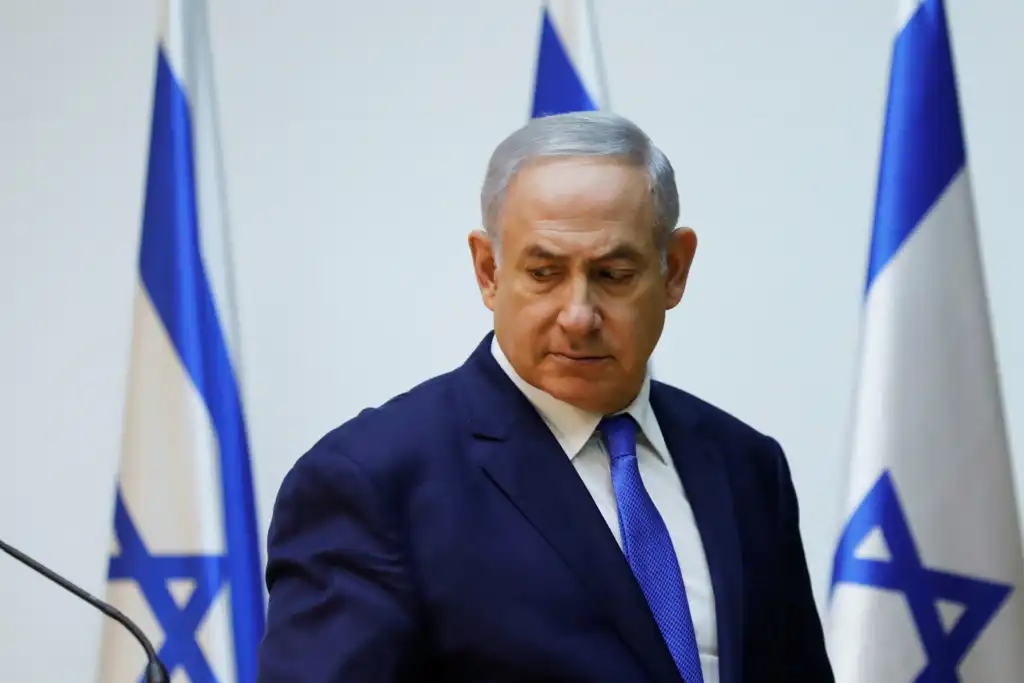
Last Monday, the Islamic Resistance Movement "Hamas" confirmed that Israeli Prime Minister Benjamin Netanyahu's talk about working with countries to pass a voluntary immigration plan for Palestinians is "ridiculous and an attempt to market illusions."


Earlier, Israeli media quoted Netanyahu as saying during a Likud Party session that he is pushing for voluntary migration of Gaza residents to other countries.

Source: Sama News

PALESTINE

Fri 29 Dec 2023 6:08 pm - Jerusalem Time

West Bank: Israeli forces kill a young Palestinian in Jerusalem, and injure others

The young man, Mahmoud Othman Warni (18 years old), was killed by occupation bullets during confrontations in the town of Al-Eizariya, southeast of occupied Jerusalem, while other Palestinians were seriously injured, and others were arrested by the occupation forces during their raids on towns in the occupied West Bank, today, Friday.


In the town of Tuqu', southeast of Bethlehem, a young man was injured by live bullets during confrontations that broke out with the occupation forces.


In detail, the confrontations centered in Khirbet al-Deir, during which the occupation forces fired live bullets and tear gas bombs, resulting in the injury of a young man (20 years old) with a bullet in the abdomen, which was described as serious, and he was subsequently transferred to the hospital.


In the village of Al-Taybeh, west of Jenin, a young man was injured by live bullets fired at him by the occupation army near the apartheid wall erected on citizens’ lands.


According to medical sources at Ibn Sina Hospital, the young man was shot in the main artery in the thigh area, and his injury was described as critical.


In Kafr Qaddum, east of Qalqilya, a child was killed by live bullets and dozens suffocated during the occupation forces’ suppression of a march in the town.


The occupation forces stormed the town after the start of the weekly march, and fired live bullets, stun grenades, and toxic tear gas at the participants, which led to a 16-year-old boy being shot in the abdomen. He was transferred to Qalqilya Hospital to receive treatment.


Dozens of citizens suffocated as a result of inhaling toxic tear gas, and were treated on the field.


In Al-Faraa camp, south of Tubas, three people were injured by live bullets, and 5 others were arrested during the Israeli occupation army’s storming.


Medical sources reported that the occupation forces wounded the young man, Anas Nasr Sawalma, with live bullets in the hand, before attacking the Palestinian Red Crescent ambulance, which was transporting him to the hospital, and arresting him.


Two other young men were also injured, one of whom was shot in the chest and the other in the feet, and they were transferred to the Turkish Tubas Governmental Hospital to receive treatment.


The director of the Prisoners' Club in Tubas, Kamal Bani Odeh, reported that during the storming of the camp, the occupation forces arrested five people, including boys.


Israeli special forces stormed Al-Faraa camp in the morning, then sent in additional reinforcements from the Hamra military checkpoint, and violent confrontations broke out as a result of the occupation, which besieged a house inside the camp, targeted it with a missile, and demanded that those inside it surrender themselves.


4,840 detainees in the West Bank since October 7

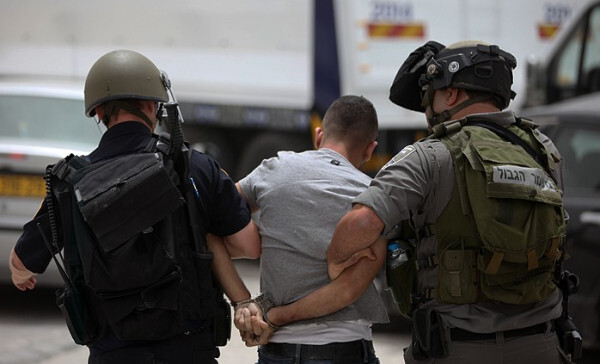
In a related context, the number of detainees from the West Bank in Israeli prisons since October 7 has risen to 4,840 Palestinians, following the arrest of 20 people today, Friday.


This came according to a joint statement issued by the Commission for Prisoners and Ex-Prisoners’ Affairs of the Palestine Liberation Organization and the Palestinian Prisoners’ Club.


The two institutions said in the statement that the Israeli authorities “arrested 20 citizens at dawn on Friday, which brings the number of detainees in the West Bank, including Jerusalem, to about 4,840 Palestinians since last October 7.”


According to the statement, the new arrests were distributed in the governorates of Tulkarm, Tubas, Ramallah, Hebron, Jericho, and the city of Jerusalem.


The statement indicated that the Israeli army launched an arrest campaign that targeted dozens of young men in the town of Deir Abu Mishal, west of Ramallah. They were investigated in the field and the majority of them were later released.


This tally does not include arrests carried out by Israeli forces inside the Gaza Strip, according to the same source.


The campaign of arrests and raids was accompanied by "extensive harassment, severe beatings, and threats against detainees and their families, in addition to field investigations, widespread sabotage and destruction of citizens' homes, and direct shooting to kill," according to the statement.


ARAB AND WORLD

Fri 29 Dec 2023 6:06 pm - Jerusalem Time

Dutch-Israeli soldier injured fighting in Gaza to be sued for 'war crimes' by Arab activist

The new case brought by the newly formed March 30 Movement increasing concerns over European nationals participating in Israel's war on Gaza.


A Lebanese-Belgian activist is attempting to take dual Dutch- and Belgian-Israeli soldiers serving in Gaza to court for alleged involvement in war crimes as Israel continues its devastating war on Gaza.


Dyab Abou Jahjah announced on 25 December in a post on X, formerly Twitter, that the newly formed March 30 Movement (30-3), had officially filed a complaint against Dutch-Israeli citizen and Israeli soldier Jonathan (Yonathan/Yonnie) Ben Hamou.


According to Abou Jahjah the complaint specifically notes that Ben Hamou, as part of the Israeli army action in Gaza, has allegedly engaged in war crimes and genocide. This includes alleged acts of deliberately targeting civilian areas, engaging in collective punishment and targeting noncombatants as part of broader Israeli action in Gaza.


According to Israeli and international media reports, including the Associated Press, Ben Hamou was wounded in action in Gaza, losing his leg to a Hamas rocket launcher during battles in the besieged enclave. An interview with Ben Hamou by Gilad Perez in Rotterdam-based daily newspaper Algemeen Dagblad identified him as half-Dutch, his mother from the city of Rotterdam.


The article states that Ben Hamou is a lieutenant in officer training and not a reservist.

What appears to be Ben Hamou's account on Instagram contains numerous pictures of himself on the frontlines in Gaza. Speaking to The New Arab, Abou Jahjah stated that the case intends to "put an end to the impunity of Israeli war-crime and genocide perpetrators," of which "thousands of European nationals" are participants.


He emphasized that it was the intention of 30-3, which he is chairman of, to "initiate legal proceedings against all Israeli soldiers holding dual Belgian or Dutch citizenship," with the movement planning to collaborate with other European organizations to expand the reach of the initiative.

As well as taking European citizens to their respective national courts, 30-3 will also be represented in the upcoming elections in the city of Brussels under the banner 'VIVA Palestina', with the movement aiming to use "a combination of legal, political, and lobbying strategies that we hope will lead to a significant reevaluation of Belgium and the Netherlands' relations with Israel." "This is a long-term commitment," he stated.


 In the UK, the International Centre of Justice for Palestinians (ICJP) has previously asked the UK government for clarity on the legality of British nationals fighting in the Israeli army, warning that British nationals could be complicit in war crimes. There are two known cases of British nationals who have been killed fighting in Gaza so far.


The New Arab has reached out to the Israeli embassy in the Netherlands for comment but has not received a response by publication time. 


Israeli's military operations in the Gaza Strip, which have been ongoing since the 7 October Hamas attack on southern Israel, which killed 1,139 Israelis, has been described as a human "catastrophe" by the UN's General Secretary, with international law experts warning Israeli action could amount to genocide in the enclave.


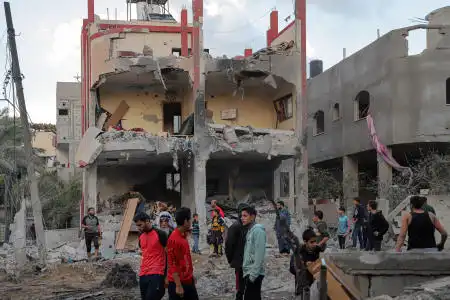
Israel has killed 21,320 Palestinians according to figures from Gaza's health ministry, with a further 55,603 being wounded. Half of all buildings in the enclave are either damaged or destroyed, with close to two million people being displaced as a result.


Israel's blockade of Gaza has led to a severe deterioration of conditions in the enclave, with shortages of many basic necessities, including food, water, and medical supplies such as anaesthesia.


Israel has also been accused of deliberately targeting civilians, including journalists, with The New Arab's Diaa al-Kahlout being rounded up alongside hundreds of Palestinians for interrogation. 105 Journalists have been killed by Israel in Gaza since the beginning of the war.

OPINIONS

Fri 29 Dec 2023 5:52 pm - Jerusalem Time

How Israel Could Lose America

Foreign Policy

Foreign Policy

Opinion Writer

By Shalom Lipner

Israelis are still reeling from the devastating effects of the most colossal intelligence and operational failure in their country’s 75-year history. Israel’s long-held assumption that “smart fences” and the generous flow of foreign money would keep Hamas contained has unraveled. The October 7 raid on southern Israel left staggering numbers of victims—almost 1,200 dead, thousands wounded, more than 240 abducted and taken to the Gaza Strip as hostages, and hundreds of thousands displaced. Israel’s national trauma will endure for the foreseeable future. 

In the immediate aftermath of the assault, the Israeli government declared an emergency mobilization of the Israel Defense Forces, with Prime Minister Benjamin Netanyahu committing to “finish” a war that Israelis “didn’t want.” Now approaching its three-month mark, Operation Swords of Iron—as the Israeli military action in Gaza was initially dubbed—continues unabated, after a brief hiatus in late November during which 105 civilians were freed from Hamas captivity. Netanyahu has announced that the campaign’s aims are to eliminate Hamas, recover all the kidnapped Israeli citizens, and ensure that no element in Gaza can threaten Israel again. But the timetable for the completion of the ambitious IDF offensive remains nebulous, as do the contours of a feasible endgame for Gaza.

What is abundantly clear, however, is that Israel’s latitude to pursue its stated war objectives would be vastly constrained were it not for the emphatic support of the United States. As the fighting persists and gaps emerge between the U.S. and the Israeli positions, Israel has strong reasons to invest in keeping its primary alliance intact. To ensure that its bond with the United States survives this war, Israel must not only manage the current military campaign judiciously but also tackle domestic political problems and determine once and for all how it plans to settle its conflict with the Palestinians.


SWITCHING GEARS

The present chapter in the decades-long relationship between Netanyahu, who returned for his latest stint as Israel’s prime minister last December, and U.S. President Joe Biden got off to a rocky start. Biden—who has often recalled signing a photo for Netanyahu with the words “I don’t agree with a damn thing you say but I love you”—waited four conspicuous weeks after his inauguration before calling the Israeli leader. Many viewed the delay as payback for Netanyahu’s procrastination in congratulating Biden for defeating President Donald Trump in 2020. (When Netanyahu finally called Biden, Trump blasted the prime minister for exhibiting a lack of loyalty.)The Biden administration made no secret of its dissatisfaction with Netanyahu’s choice of coalition partners from Israel’s extreme right—most notably, National Security Minister Itamar Ben-Gvir and Finance Minister Bezalel Smotrich—promising to hold the prime minister personally accountable for the actions of his government. It was not long before Washington acted on that pledge. In January 2023, when Ben-Gvir ascended the Temple Mount, a sensitive religious site that houses the al Aqsa mosque, during his first days in office, U.S. officials sharply condemned the move and eschewed direct engagement with Ben-Gvir. Tensions escalated later that same week, after Justice Minister Yariv Levin unveiled controversial plans for a drastic overhaul of Israel’s judicial system.

Fallout from the apparent disconnect between the U.S. and Israeli governments was particularly embarrassing to Netanyahu, a politician who prides himself on a superior understanding of American politics. The premier was left waiting by his mailbox for a coveted invitation to the White House; he is the first Israeli prime minister in more than 50 years to have been denied an Oval Office meeting during the first year of his term. Smotrich, for his part, was treated as persona non grata when he visited Washington in March. He and Ben-Gvir have been shunned by bipartisan congressional delegations to Israel and, together with other members of their factions, excluded from the guest list for the annual Fourth of July reception hosted by the U.S. embassy in Jerusalem.

Clashes between the Netanyahu government and the Biden administration over the intended transformation of Israel’s judiciary also spilled regularly into public view. In January 2023, Secretary of State Antony Blinken—on his first trip to Israel since the country’s November 2022 election—added quality time with civil society representatives to his itinerary, giving a morale boost to critics of Netanyahu’s agenda and delivering a not-so-subtle hint of U.S. concern about the fate of Israeli democracy.


Israel’s latitude would be constrained were it not for emphatic U.S. support.

The White House expressed similar misgivings. Speaking in June at a celebration of Israel’s 75 years of independence, Vice President Kamala Harris pointedly highlighted “strong institutions, checks and balances, and . . . an independent judiciary” as pillars of democracy in both the United States and Israel. Eli Cohen, Israel’s foreign minister, retorted hours later that Harris probably had not even read the proposed law and that she would not be able to identify a single component of the reform that “bothers her.”


The brutal events of October 7 reset this caustic cycle. Animosities between Biden and Netanyahu did not disappear, but sympathy for Israel’s predicament overrode lingering disagreements. Biden, arriving in Israel on October 18 as the first-ever U.S. president to visit the country amid a war, promised the people of Israel that the United States would “stand with” them. “We’ll walk beside you in those dark days, and we’ll walk beside you in the good days to come,” Biden vowed.

On the whole, U.S. officials have maintained their backing of IDF operations in Gaza, deferring often to Israeli prerogatives. Blinken, asked on December 10 when he expected the IDF to conclude its military campaign, responded bluntly, “These are decisions for Israel to make.” On December 8, casting a veto of a UN Security Council resolution calling for an immediate cease-fire, the U.S. deputy ambassador reasoned that such a halt would “only plant the seeds for the next war, because Hamas has no desire to see a durable peace.” Washington has issued periodic admonitions, such as Secretary of Defense Lloyd Austin’s assertion on December 2 that “protecting Palestinian civilians in Gaza is both a moral duty and a strategic imperative.” But such comments have not diluted the overall impact of a U.S. policy that—as Austin also confirmed—upholds “Israel’s bedrock right to defend itself.”

Biden has preferred to embrace Israel in public and convey U.S. reservations in private conversations with Israeli leaders, evidently reckoning that this strategy grants him more influence over Israel’s calculus than a confrontational approach would. The president’s personal appeals have yielded some results by, for example, helping persuade Israel to abort plans for a preemptive strike against Hezbollah in Lebanon in the days after Hamas’s initial attack. Skeptics of Biden’s methods point to the scale of the destruction the IDF has inflicted in Gaza, despite the efforts of U.S. backroom diplomacy—but the United States is also acting on its vested interest in Israel’s success at routing Hamas, which Washington has designated as a terrorist organization. Either way, Israel has benefited significantly from its ally’s friendship.


FRIENDS IN HIGH PLACES

The United States’ attachment to Israel has evolved gradually since President Harry Truman’s recognition of the Jewish state on May 14, 1948. It was not until the 1960s, under President John F. Kennedy, that Washington began to provide military hardware to Israel. Shipments of Hawk antimissile batteries were soon followed, under Kennedy’s successor, President Lyndon Johnson, by M-48 Patton battle tanks, A-4 Skyhawk light attack aircraft, and F-4 Phantom fighter-bombers. The first explicit U.S. pledge to maintain Israel’s qualitative military edge—an assurance of Israel’s military superiority over its rivals—came in a 1982 letter from President Ronald Reagan to Israeli Prime Minister Menachem Begin.U.S.-Israeli cooperation has been turbulent at times, but it has maintained a steady upward trajectory. U.S. security, diplomatic, and economic assistance has bolstered Israel’s position in a volatile region. Having a “big brother” over its shoulder has enabled Israel to punch above its demographic weight and geographic size, projecting strength well beyond its borders. And the United States’ commitment to Israel has endured through both Democratic and Republican presidents, including the most recent holders of that office.

As president, Trump formally acknowledged Jerusalem as Israel’s capital and the Golan Heights as sovereign Israeli territory. His actions affirmed a broad consensus among Israelis and sent a formidable message to neighboring countries about U.S. support for Israel. Trump’s “Vision for Peace, Prosperity, and a Brighter Future for Israel and the Palestinian People”—a plan that most Israelis expected to fail—never led to U.S. acceptance of the Netanyahu government’s aspiration to extend Israeli sovereignty throughout the West Bank, but it became the catalyst for the Abraham Accords, which brought Israel’s surreptitious ties with the United Arab Emirates and Bahrain into the open. Yousef al-Otaiba, the UAE’s ambassador to the United States and an engineer of the deal, explained the logic in 2021: “The reason it happened, the way it happened, at the time it happened was to prevent annexation.”


This is not to say U.S.-Israeli relations were without problems. In 2017, Trump divulged Israeli intelligence to Russia, possibly revealing sensitive collection methods. He repeatedly accused American Jews who vote for Democratic candidates of being “disloyal to Jewish people and very disloyal to Israel,” not only entrenching Israel as a wedge issue and jeopardizing bipartisan sponsorship of close U.S.-Israeli ties but also stoking anti-Semitism. And his unilateral withdrawal from the Iran nuclear deal without an alternative plan to stymie Iran’s race to acquire nuclear weapons only accelerated Tehran’s progress. Netanyahu encouraged Trump’s decision at the time, but that move has, arguably, made Israel less secure today.

Despite early frictions, the Biden administration’s support for Israel since October 7—expressed in words and deeds—has been uncontestable. U.S. civilian and military officials have been constant fixtures in Israel, often participating in consultations with Israel’s war cabinet. The United States has sent Israel multiple airlifts of bombs and other munitions to replace its depleted inventories. Washington has also intervened to block UN Security Council resolutions that would sanction Israel or insist that the IDF end its mission in Gaza, called attention to the plight of the hostages being held by Hamas, and worked to secure their freedom. It has demanded that other countries condemn the acts of sexual violence that Hamas’s fighters committed against Israeli girls and women.

Speaking at the White House on October 10, Biden warned Israel’s enemies not to join forces with Hamas. “To any country, any organization, anyone thinking of taking advantage of this situation,” he said, “I have one word: Don’t.” Among the chorus of world leaders who have urged similar caution, Biden was the only one who deployed two aircraft carrier strike groups and other military assets to reinforce the warning. The president’s steadfast support has been all the more remarkable as the United States enters an election year, given the vocal criticism of Biden’s Israel policy in some quarters of his own party.


Biden has preferred to embrace Israel in public and convey U.S. reservations in private.

On the other hand, differences have begun to emerge between U.S. perspectives and Israel’s operational priorities. As the fighting in Gaza continues, the United States has lobbied on behalf of “tactical humanitarian pauses,” which—as happened during the truce from November 24 to December 1—would give Hamas time to reestablish internal lines of communication and reposition its forces for additional attacks on IDF troops and missile launches on Israeli cities. (Israel’s government has been amenable to these pauses, another of which is now under negotiation, only for the sake of facilitating hostage releases.) Hamas has also exploited U.S. appeals for Israel to allow more food, fuel, and other aid into Gaza. Although civilian needs are pressing, the terrorist group has been caught commandeering this aid to sustain its hold on power. Biden’s objections to “indiscriminate bombing” by the Israeli Air Force and to the high numbers of civilian casualties in Gaza have compelled Israel to recalibrate the IDF offensive, which some Israeli leaders allege has prolonged its duration and exposed Israeli soldiers to heightened danger.

Overall, however, Israel has gained much from its partnership with the United States. The Abraham Accords advanced the formal integration of Israel into the Middle East, altering the regional map in ways that enhance Israel’s security. Although combat in Gaza has slowed the pace of normalization, Bahrain, Morocco, and the UAE have all indicated that they do not intend to abandon their connections with Israel. And Crown Prince Mohammed bin Salman of Saudi Arabia, in a meeting with U.S. National Security Adviser Jake Sullivan on December 13, expressed interest in the idea of eventually joining their ranks.

The United States’ material and political cover has also been essential to Israel’s ability to restore its lost deterrence after the disaster of October 7. “You may be strong enough on your own to defend yourself—but as long as America exists, you will never, ever have to,” Blinken said in a message to the Israeli people on October 12. The secretary’s precise balance between validating Israel’s independent capabilities and reaffirming the United States’ commitment to its welfare illustrates why Israel cannot afford to lose its best friend.


NO GUARANTEES

Israelis have always attributed staunch U.S. support for their country to a set of shared values—including freedom, pluralism, and democracy—and interests, such as the promotion of peace and stability. That ground is shifting now, especially as younger Americans express dramatically less affinity for Israel than older generations. Joe Biden, who has asserted often that “you don’t have to be a Jew to be a Zionist,” may well be the last Democratic president with impeccable pro-Israeli credentials.

This trend should, and does, worry Israel. The stark reality is that the country has no viable alternative to the succor of the United States. Hedging its bets, as other Middle Eastern countries have done, by building relationships with China and Russia—permanent members of the UN Security Council that have both taken the side of Hamas—is not an option for Israel. And lately, even Biden himself has begun to qualify his statements about the war in Gaza. In a speech on December 12, he affirmed that “Israel’s security can rest on the United States,” but he added that Israel is “starting to lose” its support in other parts of the world. Harris, meanwhile, has advocated a “tougher” line in Washington’s dealings with Netanyahu.

Rather than trying to close this distance from the United States, Netanyahu might actually be seeking to spark a row with Washington in order to improve his own job prospects as his approval ratings plummet. “A prime minister who cannot withstand American pressure should not enter the prime minister’s office,” Netanyahu announced to the Knesset Foreign Affairs and Defense Committee on December 11. But engaging in public brawls with the United States is the last thing Israel needs right now. To avoid a future in which Israel is forced to resist existential perils without recourse to U.S. military arsenals or UN Security Council vetoes, Israeli policymakers must change tack.


Israel has no viable alternative to the succor of the United States.


First, they must take care in prosecuting the Gaza campaign. The inclusion of opposition party members in the war cabinet was a responsible step in that direction. As the war proceeds, the IDF should pursue its aims—which Israelis overwhelmingly endorse—as quickly as possible while minimizing collateral damage and the injury of innocents. To that end, the IDF chain of command should be meticulous in identifying legitimate operational targets, authorizing attacks only when those standards are met. It should also continue to implement ethical protocols for combat. Demonstrating professionalism and integrity will help Israel avoid a repeat of the 2006 war in Lebanon, when the absence of an unambiguous Israeli victory prompted U.S. President George W. Bush to conclude that Israel “mishandled [its] opportunity” to land a decisive blow against Hezbollah and its masters in Iran and Syria.


Israel desperately needs to prioritize national security over politics. A supplementary 2023 budget passed on December 14, which was meant to cover the unanticipated expense of the war in Gaza, diverted precious funds to unrelated bureaucracies—including the Ministry of Jerusalem and Heritage and the Ministry of Settlement and National Missions—to satisfy key constituencies of the Netanyahu coalition instead. There is widespread concern that the 2024 budget will follow the same pattern of allocating resources for political patronage to religious parties at the same time that the United States is being called on to help offset the costs of the war.


Netanyahu also canceled cabinet votes to approve the transfer of tax revenues to the Palestinian Authority and to allow Palestinian laborers from the West Bank to return to work in Israel—the IDF; the Shin Bet, Israel’s internal security agency; and the National Security Council all favor the employment measure, under certain stipulations—in order to avoid tangling with hard-line ministers whose incendiary statements and actions he generally tolerates. The prime minister’s own use of inflammatory rhetoric to shore up his lagging poll numbers, moreover, is sowing divisiveness while Israelis mourn their dead. Repairing Israel’s broken social contract, which had previously enabled its diverse society to coalesce around shared Jewish and democratic principles, and holding new parliamentary elections as soon as the security situation permits are two obvious ways to restore confidence in the country’s elected leadership among both Israeli citizens and Israel’s external backers.


Israel desperately needs to prioritize national security over politics.


Finally, and most urgently, Israel needs to formulate a clear position on the Palestinian issue. When the state of Israel was created 75 years ago, it had to fight off threats to its survival; today, Israel’s stewards must articulate a coherent vision of its ultimate destination. Otherwise, they will struggle to convince the United States and other countries to remain by Israel’s side. Netanyahu must lift his embargo on genuine discussion—within his government and with the Biden administration—of what will come after the Gaza conflict, and define not only what Israel will not countenance but also what outcomes it will accept. The prime minister has rebuffed attempts to have this conversation for fear of destabilizing his ruling coalition. Biden has expressed his frustration with this situation, commenting on December 12 that Netanyahu “has to change,” but the “government in Israel is making it very difficult.”Whether Israel wants one state, two states, or something else, its leaders and citizens need to decide on a course soon. They should recognize also that, no matter what their decision—and it is their decision alone to make—it will have consequences not only for Israel itself but also for its essential relationship with the United States. If the United States were to become sufficiently disenchanted with Israeli policies that Washington imposed conditions on the provision of U.S. military assistance, Israel could find its operating environment drastically restricted. The Biden administration’s recent delay of the export of more than 20,000 M-16 rifles intended for Israeli civil defense teams because of U.S. concerns about settler violence in the West Bank could be a harbinger of further impediments.          


With Hamas vowing to replicate the savagery of October 7 until Israel is “annihilated,” Hezbollah escalating its attacks across Israel’s border with Lebanon, Yemen’s Houthis disrupting Israeli shipping in the Red Sea, and Saudi Arabia still dangling the prospect of normalization, Israel’s next moves could be the difference between deepening violence and progress toward peace.


ARAB AND WORLD

Fri 29 Dec 2023 5:41 pm - Jerusalem Time

A massive Israeli attack in Lebanon and Hezbollah bombs Israeli sites

Today, Friday, the Lebanese Hezbollah continued to fire rockets and shells towards the Upper Galilee regions and bombard Israeli military sites adjacent to the border, while the Israeli army bombed many sites in southern Lebanon, where it said it launched a "massive attack."


Alarm sirens sounded in the north of the country today, after a drone coming from Lebanon was suspected of “infiltrating” the country’s airspace, before the Israeli army said that this was the result of a false alarm.


Yesterday, Thursday, the Israeli army announced the launch of intense air and artillery bombardment on towns and areas in southern Lebanon, targeting “infrastructure” and Hezbollah sites, and claimed that shells were fired from these sites towards Israel.


It also said that he targeted a "cell" during an attempt to launch anti-tank missiles, and another while it was inside a building from which shells were fired earlier today.


On the other hand, Hezbollah announced that it had targeted several Israeli sites “with appropriate weapons, causing direct hits.”

PALESTINE

Fri 29 Dec 2023 4:21 pm - Jerusalem Time

Israeli war crime: “calorie menu” for residents of the Gaza Strip under the pretext of preventing famine

Israel developed a document entitled “Red Lines” following its imposition of the siege on the Gaza Strip, in the year 2007. This document included what foodstuffs are allowed or prohibited to be brought into the Strip, through very precise calculations of the minimum amount of daily calories that must be allowed. By entering the Gaza Strip without causing famine, according to what the Haaretz newspaper reported today, Friday.


Subsequently, Israel conducted calculations about the weekly and monthly quantities of food supplies, and thus the number of trucks allowed to enter the Gaza Strip. According to the document, 170.4 trucks can be entered daily, of which 68.6 trucks whose load is equivalent to the amount of local agricultural production will be reduced, bringing the number of trucks that can be entered into the sector to 101.8 trucks.


At the time, the commander of the Israeli military unit, the Coordinator of Government Activities in the Occupied Territories, admitted that calculating the exact amount of food supplies was aimed at “ascertaining” that there would be a famine due to a shortage of food supplies. The number of trucks increased following the aggression on Gaza at the end of 2008 and the beginning of 2009, and the list of food items also expanded.


Israel has continued to rely on these “red lines” and the “calorie list” that it has included since 2007, even though the population of the Gaza Strip this year was approximately 1.4 million people, while their number has now risen to about 2.3 million people.


After Israel launched the war on the Gaza Strip, on October 7, it prevented food trucks from entering the Strip until October 21, and then allowed only 20 trucks to enter per day, while their number was about 500 trucks before the war.


The number of shipments allowed to enter the Gaza Strip increased in recent weeks, then doubled in the wake of pressure exerted on Israel by the American administration. The newspaper pointed out that "with a simple calculation, the Israeli woman fulfills the conditions of the non-starvation threshold that she set in 2007."


However, following the war, the Gaza Strip lost its full capacity to produce local agricultural, marine, or any other foodstuffs, which were complementary to calculating the quantities of foodstuffs allowed for entry.


In the past, Israel claimed that it was allowed to wage an “economic war against the enemy,” while it now claims that imposing the siege on the Gaza Strip is an existential goal to protect the “direct enemy,” that is, the Hamas movement, and that this “economic war” helps Hamas collapse. But by severely restricting the number of trucks loaded with food and medicine, it “describes the entire population of the Gaza Strip as an enemy. Thus, it is taking away the basis of its claim,” according to the newspaper.


The newspaper referred to other countries in contemporary history that sought to starve civilian populations, including Nazi Germany through the plan of its leader, Adolf Hitler, which caused the death of 4.2 million citizens from starvation in the Soviet Union. This happened in Cambodia as well. In 1945, the United States implemented what it called a “starvation campaign” against Japan.


The strict siege imposed by Saudi Arabia and the UAE on areas in Yemen controlled by the Houthis, who now support Gaza, also caused the death of tens of thousands of Yemenis from hunger and epidemics, describing this as "the most dangerous humanitarian disaster in contemporary history."


In addition, there is the starvation of millions of people in South Sudan, the deadly siege of the Rohingya in Myanmar, and the Syrian regime’s siege of cities such as Homs, Daraa, and Aleppo, causing the death of tens of thousands from starvation.


The newspaper concluded that “Israel is not concerned about the moral aspects of its methods of warfare, including starvation, but as if it is fighting a war that is expected to last for a long time, it must study all the time the legitimacy of this in the international arena, especially in the United States. And the number of calories that will enter To the Gaza Strip will dictate the number of days during which Israel will continue the war, without being considered a war criminal.”

ARAB AND WORLD

Fri 29 Dec 2023 1:54 pm - Jerusalem Time

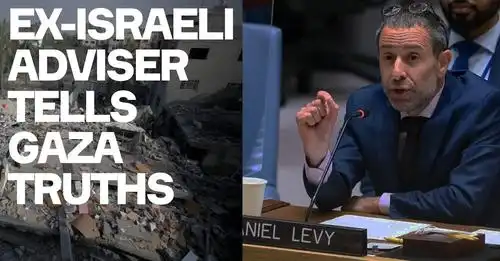
A former advisor to the Israeli delegation from the 1990s "explodes" the current government's narrative

A former advisor to the Israeli delegation from the 1990s "explodes" the current government's narrative


Daniel Levy is a former member of Israel's negotiating team, a Middle East analyst, and commentator - and here he uses his expertise to discuss a two state solution, apartheid, the current onslaught - and what the hell happens next.


ARAB AND WORLD

Fri 29 Dec 2023 1:45 pm - Jerusalem Time

Objectives of Israel’s and Russia’s Wars ‘nearly Identical’ – Did Lavrov Shift Position on Gaza?

In a strange shift, Russia’s Foreign Minister Sergey Lavrov was quoted as saying that Israel’s war on Gaza is identical to Moscow’s military operation against Ukraine.

The comments, attributed to Russia’s top diplomat, were cited by Russia Today in an interview on Thursday with RIA Novosti.“The goals declared by Israel for its ongoing operation against Hamas militants in Gaza seem nearly identical to those put forward by Moscow in its campaign against the Ukrainian government,” RT quoted Lavrov as saying. According to the Palestinian Ministry of Health, 21,320 Palestinians have been killed, and 55,603 wounded in Israel’s ongoing genocide in Gaza starting on October 7. Palestinian and international estimates say that the majority of those killed and wounded are women and children. 


Many international law experts have accused Israel of carrying out a genocide in the besieged Gaza Strip. 


‘Denazification’? 

But according to Lavrov, the Israeli and Russian goals are more or less the same, which include  “demilitarization” and “denazification”. It is unclear how Lavrov, who has historically defended the rights of Palestinians, and earlier in the day, spoke for the need for justice in Palestine, believes that Israel’s action in Gaza includes “denazification”. 

Lavrov’s comments seem like a bizarre contradiction to statements made by top Russian politicians and officials. These comments included a comparison made by Russian President Vladimir Putin on October 13 between the Israeli siege on Gaza and the Nazi siege on Leningrad during World War II. Additionally, Russia’s own ambassador to the United Nations, Vassily Nebenzia, has made similar comparisons in strongly worded statements against the Israeli war. 

Yet, according to RT, Lavrov believes that “the fight against Nazism is what historically unites Russia and the Middle Eastern country (Israel).” 

His words exactly, according to RT, were: “Therefore, we need to be very careful about our common history with Israel and, above all, the history of the fight against Nazism. This is the main thing that unites us historically.” 


Lapid Bad, Netanyahu Good 

Lavrov went on to criticize former Israeli Prime Minister Yair Lapid who condemned Russia’s invasion of Ukraine. “This was unfair,” Lavrov said, in reference to Lapid’s position. The Russian foreign minister compared that to the position of right-wing Israeli Prime Minister Benjamin Netanyahu, who has “not allowed himself to make any statements regarding Russia, despite international criticism and finding himself in ‘a difficult situation’.” 


Lavrov reiterated his country’s position that only a ‘two-state formula’ will bring an end to the Middle East crisis, but without explaining how Moscow can play a part in turning it into a reality.


‘Greatly Offensive’ 

“Lavrov’s position, if the quotes attributed to him by RT are accurate, is bizarre and greatly offensive, to say the least,” Ramzy Baroud, a Palestinian political analyst, said. “Bizarre because it is entirely inconsistent with Russian foreign policy since the start of the Israeli genocide on Gaza, and objectionable because it resembles some kind of a political nod for Israel to continue with its lethal war on Palestinian civilians without worrying about a strong Russian response,” he added. Baroud also said that “Arab governments and Palestinian Resistance groups must demand clarification from Russia following these offensive statements and inquire if they represent an official change of policies regarding Israel and the Palestinian fight for freedom.”

Source: Palestine Chronicle

ARAB AND WORLD

Fri 29 Dec 2023 1:12 pm - Jerusalem Time

Israeli Channel 13: An opinion poll shows Netanyahu losing half of his seats in the Knesset

A public opinion poll in Israel showed a decline in the popularity of the right-wing Likud Party headed by Prime Minister Benjamin Netanyahu, as a poll conducted by the Israeli Channel 13 indicated that Likud would obtain only 16 seats in the Knesset (Parliament) “if elections were held today.” Likud currently has 32 representatives in the 120-seat Knesset.


According to the poll, “If (parliamentary) elections were held today, the “National Unity” party, headed by Minister in the Military Ministerial Council Benny Gantz, would have been the largest, winning 38 seats compared to 12 in the current Knesset. As for the “There is a Future” party, headed by Yair Lapid, it would have maintained It ranks third in the Knesset, with 15 seats, compared to 24 in the current Knesset.


In recent months, public opinion polls indicated a decline in the Likud Party's popularity.


Israeli Channel 13 said: “The collapse of Likud has continued since the outbreak of the war, and if the elections were held today, Prime Minister Benjamin Netanyahu’s party would have won only 16 seats, that is, only one seat more than Yair Lapid’s party.”


The channel pointed out that "if the elections were held today, the parties forming the government would have won only 45 seats, compared to 64 currently."


In addition to Likud, the parties forming the government include Shas, United Torah Judaism, Jewish Power, and Religious Zionism.

To form a government in Israel, it is necessary to obtain the confidence of at least 61 representatives in the Knesset.


On the other hand, the opinion poll indicates the possibility of the opposition parties obtaining 71 seats, and the coalition of the Democratic Front for Peace and the Arab List for Change obtaining 4 seats.


The poll showed that if Netanyahu were replaced as head of the Likud by former Mossad head Yossi Cohen, the party would win 23 seats, compared to 33 for the National Unity Party.


The channel reported that the poll was conducted by Israeli pollster Camille Fox, and included a random sample of 700 Israelis, with a margin of error of 3.7%.


The possibility of holding parliamentary elections does not appear on the horizon in light of the ongoing war on Gaza since last October 7, but Israeli estimates indicate the possibility of Israel returning to the ballot boxes after the war.


Since last October 7, the Israeli occupation army has been waging a devastating war on Gaza, which as of Thursday left 21,320 dead and 55,603 injured, most of them children and women, massive destruction of infrastructure and an unprecedented humanitarian catastrophe, according to the Gaza Strip authorities and the United Nations.


ARAB AND WORLD

Fri 29 Dec 2023 1:09 pm - Jerusalem Time

Israeli Minister attacks Biden over Palestinian Authority funds

On Friday, Israeli Finance Minister Bezalel Smotrich rejected the idea that the United States and its President Joe Biden would control the fate of Israel, stressing that he would not release the Palestinian Authority’s funds as long as he was in government.


“We respect the United States and its president, but we will never leave our fate in the hands of foreigners,” Smotrich said, adding: “Not a single shekel will go to terrorists in Gaza as long as I remain in office.”


This comes as American media revealed a “difficult” phone conversation that Biden had with Israeli Prime Minister Benjamin Netanyahu, last weekend, regarding the decision to withhold part of the taxes it collects for the Palestinian Authority.


An American official told Axios that this part of the call was one of the "difficult and most frustrating conversations," noting that it was "a sign of the growing tensions between Biden and Netanyahu."


According to the site, Netanyahu is facing pressure from the Biden administration to release the funds, and opposition from Smotrich, who threatened to resign, which could put the coalition government in danger.


According to officials, Biden asked Netanyahu to accept the proposal that he himself had put forward several weeks ago, which is to transfer the withheld tax revenues to Norway for safekeeping until an arrangement is reached that would allay Israel’s fears that the money would reach Hamas.


An American official said that the Palestinian Authority had already accepted this proposal, but Netanyahu backed down and said that he did not think this was a good idea anymore.


According to the officials, Biden told Netanyahu that he must confront extremists in his government coalition on this issue, just as he is dealing with political pressure from Congress over the war in Gaza.


Smotrich had issued a "final ultimatum" to Netanyahu, threatening to resign from the government if the clearance funds were transferred to the Palestinian Authority.


This comes at a time when Israeli Ministry of Defense officials recommended transferring the funds deducted by Israel to the Palestinian Authority, and allowing workers from the West Bank to enter to work in Israel, in response to American requests to prevent the situation in the West Bank from exploding.

OPINIONS

Fri 29 Dec 2023 12:03 pm - Jerusalem Time

West Bank: Israeli forces launch a massive raid campaign in several cities

Ramallah - “Al-Quds” dot com

Ramallah - “Al-Quds” dot com

Opinion Writer

From yesterday evening until Friday morning, the Israeli occupation forces arrested at least (20) citizens from the West Bank, including a child, with the continuation of systematic arrests and the comprehensive aggression launched by the occupation against our people.


The arrests were distributed across the governorates of Ramallah, Tulkarm, Hebron, Jericho, Ramallah, and Tubas, in addition to Jerusalem, where a number of family members of the martyr Ahmed Alyan, who died last night, were arrested.


In addition to the arrests recorded, the occupation stormed the town of Deir Abu Mishal/Ramallah, and carried out field investigations with dozens of citizens, in addition to storming citizens’ homes, which was accompanied by widespread sabotage and destruction, while the occupation continued to arrest three citizens from the town.


It is noteworthy that the total number of arrests after October 7 amounted to about (4,840), and this total includes those who were arrested from homes, through military checkpoints, those who were forced to surrender themselves under pressure, and those who were held hostage.


OPINIONS

Fri 29 Dec 2023 11:58 am - Jerusalem Time

The Palestinian people vote

Dr. Mohsen Mohamed Saleh, Director General of the Zaytouna Center for Studies and Consultations.

Dr. Mohsen Mohamed Saleh, Director General of the Zaytouna Center for Studies and Consultations.

Opinion Writer

The latest opinion polls in the West Bank and Gaza Strip show a significant rise in the popularity of the Hamas movement, and a greater popular rally around the line of armed resistance. Despite the hideous massacres and massive destruction caused by the Israeli occupation in its aggression against the Gaza Strip, it has failed miserably in isolating Hamas and the resistance forces from the Palestinian popular incubator


Supporting the Battle of Al-Aqsa Flood:
The poll conducted by the Palestinian Center for Policy and Survey Research in cooperation with the Konrad Adenauer Foundation, the results of which were released on December 13 and included the opinions of the public in the West Bank and Gaza Strip, showed that 72% of Palestinians believe that Hamas’s decision to attack and launch the Al-Aqsa Flood Battle on 7 Last October was right.


62% believe that Hamas will emerge victorious from this battle, and 72% expect that Hamas will succeed in returning to ruling the Gaza Strip after the war, despite “Israel’s” declared intention to eliminate it.
This is consistent with a large majority of 73% believing that “Israel” will not succeed in causing a second Palestinian Nakba, and an overwhelming majority of 85% affirming that “Israel” will fail to displace the population of the Gaza Strip.
It is noteworthy that these results, which show high confidence in Hamas and the resistance, came in the context of a poll in which people’s opinions were taken at the height of a fierce aggression against the Gaza Strip in which “Israel”, whose army is considered among the most powerful armies in the world, allied itself with major powers, led by the United States, against resistance forces that have very little military capabilities compared to their enemies, and live in a poor, besieged environment.
These opinions were also taken after more than 20,000 Palestinians, including more than 6,000 children and 4,000 women, were murdered, 36,000 others were wounded, and about two-thirds of the population of the Gaza Strip were displaced, and at a time when 56% of the respondents from the Gaza Strip stated that they do not have enough food for a day or two, and 64% of them confirm that a member of their family was killed or wounded in this war.

Between the performance of the Ramallah Authority and the performance of Hamas:
According to the same poll, 60% of the Palestinian public prefer Hamas to control the Gaza Strip after the war, while 16% prefer the Palestinian Authority to control a national unity government, but after excluding President Mahmoud Abbas, and only 7% prefer a Palestinian Authority led by President Mahmoud Abbas, which is a percentage Shocking for the Authority, and for President Abbas, as the National Unity Government was widely popular, and 72% of the public were satisfied with Hamas’ performance during the war on the Gaza Strip, while only 14% were satisfied with the Authority’s performance, and were satisfied with the performance of Yahya Al-Sinwar, the leader of Hamas in Gaza. 69% were satisfied with the performance of Yahya Sinwar, the leader of Hamas in Gaza, compared to only 11% who were satisfied with the performance of President Mahmoud Abbas.
On the other hand, 68% of the public believe that the Palestinian Authority has become a burden on the Palestinian people, and 58% even support the dissolution of the Palestinian Authority itself. Only a minority of 20% supports pursuing the path of peaceful negotiations in order to end the occupation, while there is a majority of 69% who support a return to the intifada and armed resistance.
There are 88% calling on President Mahmoud Abbas to resign, and this percentage rises among the people of the West Bank, where Abbas has authority, to 92% and this is a desire that was repeated in previous polls, but it reached a high peak in this poll.


Perhaps this explains what is being circulated Arab and internationally these days, that President Mahmoud Abbas is no longer qualified to continue leading the next stage, and that an alternative must be searched to replace him. Some circles are even discussing the possibility of releasing the Fatah leader Marwan Barghouti from Israeli prisons as he is the only one qualified to unite Fatah's ranks in the face of the rise in Hamas's popularity.

Presidential and legislative elections:
In line with the results of the poll, if presidential elections were to take place in a competition between Fatah President Mahmoud Abbas and Hamas President Ismail Haniyeh, Haniyeh would receive 78% of the votes compared to only 16% for Abbas, and there is no chance for Fatah to win the presidential battle unless Marwan Barghouti participates in it, as he will get 47% compared to 43% for Haniyeh and only 7% for Abbas.
If legislative elections take place, 51% will elect the Hamas (Change and Reform) list, compared to 19% who will elect the Fatah list, and all other lists will receive only 4%.
It is noted that 25% have not yet decided, and when this percentage of undecided people decide, they will most likely choose (as previously experienced) between Hamas and Fatah, which means that the chance of the Hamas list reaching a percentage exceeding 60% is very high.
Perhaps this indicator, which exceeds the percentage of decisiveness, and which the Hamas movement has reached for the first time, gives a strong indication of the extent of the impact of the Al-Aqsa Flood Battle, and the extent of the popularity enjoyed by the resistance work when it takes its strong and effective form.

Wrapping around resistance:
This poll shows that the ongoing Israeli aggression on the Gaza Strip has failed to break the will of the Palestinian people, and that the massacres committed against civilians and massive destruction have not been able to separate the armed resistance from its popular incubator.
The aggression also had adverse repercussions that increased the Palestinian people’s support for the resistance, the desire to sacrifice and avenge the martyrs increased, and the crimes of the occupation turned into fuel for the revolution and its continuation.


This poll reinforces the general Palestinian trend, which appeared in previous polls, which has lost hope in the path of a peaceful settlement, and has begun to see no real opportunity to achieve the “two-state solution” in light of the escalation of Israeli religious and nationalist extremism, and the expansion of Judaization and settlement programs. They believe that the only language the occupation understands is armed resistance.


This poll strongly, and with increasing frequency, raises the issue of the legitimacy of the current Palestinian leadership, which has lost the confidence of the Palestinian street, as it has become necessary to agree on a transitional leadership to prepare for real elections, to rebuild the Palestinian legislative and executive institutions on fair and sound foundations, and in a way that honestly expresses the will of the Palestinian people.

OPINIONS

Fri 29 Dec 2023 11:57 am - Jerusalem Time

Is Israel losing a generation of Americans?

Written by: Dr. Asaad Abdul Rahman

Written by: Dr. Asaad Abdul Rahman

Opinion Writer

In recent years, American youth’s support for the occupation has declined, while their support for the Palestinian cause has increased, especially among university students, whose campuses have been a strong center of activity for the “Boycott Israel and Divestment Movement - BDS,” which resists the occupation, settler colonialism, and Israeli apartheid in order to Real freedom, justice and equality in Palestine, Reaching the right to self-determination for all the Palestinian people in the homeland and the diaspora.
A few months ago, an opinion poll issued by the Pew Research Institute indicated that the feelings of American youth (between 18 and 29 years old) towards both sides of the Palestinian-Israeli conflict have changed significantly, as “61% of them now look positively at the Palestinians, while the percentage towards the Israelis is 56% “.
Since the “Al-Aqsa Flood,” the hysterical Israeli reaction, and the continuation of the genocide in the Gaza Strip, new slogans have spread among American youth, led by “from the river to the sea,” “apartheid,” “land theft,” and “ethnic cleansing” instead of previous slogans focused on “Israel’s right to exist,” “striking terrorists,” and “anti-Semitism,” while the vigils and demonstrations supporting the Palestinian side increased compared to those supporting the occupation, which prompted the American jurist (Richard Goldwasser) to say: “Israel is against “You are about to lose a generation of Americans, and this means the loss of America.”
Later, the latest poll in the United States (conducted by Harris Insight & Analytics and the Center for American Affairs at Harvard University), which the Israeli newspaper Yedioth Ahronoth described as “dramatic,” revealed that “51% of young Americans believe that the preferred solution to Palestinian/Israeli conflict is the end of the State of Israel and its handover to Hamas and the Palestinians,” while “60% said that “Operation Al-Aqsa Flood” can be justified by the plight that the Palestinians are experiencing,” and the majority of Americans between the ages of 18-24 and 25-34 years also indicated that they “believe that Israel is committing genocide.”
On a complementary level, American voters’ support for American military aid to the occupation decreased. According to a new poll conducted by Quinnipiac University and published by the American newspaper The Hill, only 45% of registered voters said that they support the United States sending additional military aid to the occupation, and this is a decrease from a previous poll conducted last November, when “54% of registered voters said they wanted to provide additional military aid to the occupation.”


The poll also showed “Americans’ dissatisfaction with their country’s support for the occupation as the war on the Gaza Strip continues.” It is known that this new poll came just one day after a group of Democrats in the US House of Representatives sent a letter to President Joe Biden in which it said: “We are deeply concerned about the current military strategy of Israeli Prime Minister Benjamin Netanyahu in Gaza and the increasing number of civilian deaths and the humanitarian crisis is unacceptable and is not in line with American interests, nor does it advance the issue of security for our ally, Israel.” It also said, “58% of Democrats and 48% of independents said they oppose aid to the Israeli military campaign in Gaza.”
All of these numbers are astonishing, as are their implications, which reflect a major fact that there are historical transformations taking place within the United States (and others, of course, throughout the world) and will have significant political consequences in terms of shedding light on the Palestinian narrative of the conflict (at the expense of the old/new invented Israeli narrative) and also in terms of revealing the ugly face of the Israeli occupation. However, things always depend on their endings. What is required now is to maintain, and even increase, the momentum of these transformations through a thoughtful plan that we develop and follow up on its implementation in a way that ensures the continued shining of the sun of the Palestinian cause and the decline of the “sun” of the occupation and its state.

PALESTINE

Fri 29 Dec 2023 11:21 am - Jerusalem Time

Wall Street Journal: A raid targeting a Hamas leader resulted in the death of 126 civilians

The Wall Street Journal revealed in an investigative report published on Friday that Israel launched an air strike last October 31 on the Jabalia camp, “aiming to kill Ibrahim al-Biyari, the leader of the Hamas battalion in the camp, who Israeli intelligence believed was directing the battles against the forces” which claimed the lives of dozens of innocent Palestinians in the camp,” according to what the Israeli army told the newspaper.


The newspaper says, "But targeting Al-Biyari was not without a price, as the attack resulted in the killing of at least 126 people, who were left under the rubble of destroyed buildings, in one of the attacks that was considered one of the bloodiest in the Gaza war, according to the "Air-Wars" organization. “It is a non-profit organization associated with the University of London that investigates the killing of civilian victims in conflict zones.”


The newspaper report describes how “the alley-like streets and closely packed buildings in the Block 6 neighborhood of the Jabalia refugee camp in Gaza were filled with people on the afternoon of October 31. Some stood in a long line in front of the local bakery, while others were crammed more tightly than usual into small apartments.”


At approximately 3:30 p.m., Israeli warplanes dropped several large bombs in a tight pattern on the neighborhood. Satellite images showed that the explosions completely destroyed a rectangular block, leaving deep craters where more than a dozen buildings had stood. The strike killed Ibrahim Al-Biyari, the Hamas battalion commander in Jabalia, who Israeli intelligence believed was directing a nearby battle, and dozens of other operatives, according to the Israeli military.


The newspaper explains, “The decision to bomb a crowded urban neighborhood in the middle of the afternoon to kill an enemy commander was a signal early in the war that Israel was willing to use overwhelming force against the Hamas leadership, even if it meant risking large numbers of civilian casualties.


The newspaper notes that in the days and weeks that followed, Israeli forces penetrated deeper into Gaza, seeking to dismantle Hamas in response to the armed group’s surprise attack on October 7, which left more than 1,200 people dead in Israel. The Israeli attack has taken a heavy toll, with an estimated 21,000 people killed, according to Palestinian health officials, drawing condemnation from human rights groups and other countries. The Biden administration, a staunch ally of Israel, has repeatedly informed the government of Prime Minister Benjamin Netanyahu that its military operation is causing too many civilian casualties.


Based on an investigation conducted by the newspaper, based on interviews with survivors and senior officers in the Israeli army, the air strike in Jabalia shows that Israeli military planners made “a series of miscalculations based on insufficient information” that led to much greater destruction and loss of life than they expected.


The newspaper reached “three important results,” as it described it:

1- Israel decided not to warn civilians in the area of an imminent air strike by sending phone messages for fear of giving the militants time to evacuate the area.

2- The Israeli army used at least two of the largest bombs in its arsenal instead of smaller munitions.

3- Air Force commanders tried to limit collateral damage by directing bombs between buildings, using fuses to delay detonation so they could penetrate roofs, destroy tunnels and topple buildings standing above them.

The Israeli occupation army confirmed in a statement to the newspaper that it “adheres to international law, directs its strikes at military targets and invests significant resources to reduce harm to civilians,” which is refuted by the newspaper’s report.


In a written statement, the occupying army said that it "is committed to international law, directs its strikes at military targets and invests significant resources to reduce harm to civilians." The statement added that the army "does not launch attacks except when the expected harm to civilians is not excessive compared to the expected military advantage, based on the information available before the attack."


The newspaper quotes an occupation army official as saying that the "fog of war" prevents knowing the details.


The war is approaching its third month, as Israeli tanks advanced deep into a town in the central Gaza Strip, Thursday, after days of relentless bombardment that forced tens of thousands of already displaced Palestinian families to flee in a new wave of mass exodus, according to Reuters.


Israeli forces bombed the area surrounding a hospital in the heart of Khan Yunis, the main city in the southern Gaza Strip, where residents fear a new ground incursion into the lands crowded with families who were displaced during the war that has been going on for 12 weeks.


The Palestinian health authorities said earlier that 210 Palestinians were confirmed killed as a result of Israeli attacks during the past 24 hours, bringing the war death toll to 21,320 people, or approximately one percent of the population of the Strip. It is feared that there are thousands more dead under the rubble.

OPINIONS

Fri 29 Dec 2023 10:17 am - Jerusalem Time

Netanyahu and Senior Israeli Officials Advocate 'Voluntary' Ethnic Cleansing of Gaza

Norman Finkelstein's Plog

Norman Finkelstein's Plog

Opinion Writer

By Mouin Rabbani


Senior Israeli leaders, including Prime Minister Binyamin Netanyahu, are again publicly advocating the ethnic cleansing of the Gaza Strip. Their proposals are being presented as voluntary emigration schemes, in which Israel is merely playing the role of Good Samaritan, selflessly mediating with foreign governments to find new homes for destitute and desperate Palestinians. But it is ethnic cleansing all the same. 

Alarm bells should have started ringing in early November when US Secretary of State Antony Blinken and other Western politicians began insisting there could be “no forcible displacement of Palestinians from Gaza”. Rather than rejecting any mass removal of Palestinians, Blinken and colleagues objected only to optically challenging expulsions at gunpoint. The option of “voluntary” displacement by leaving residents of the Gaza Strip with no choice but departure was pointedly left open. Ethnic cleansing, or “transfer” as it is known in Israeli parlance, has a long pedigree that goes back to the late-nineteenth-century beginnings of the Zionist movement. While the early Zionists adopted the slogan, “A Land Without a People for a People Without a Land”, the evidence demonstrates that, from the very outset, their leaders knew better. More to the point, they clearly understood that the Palestinians formed the main obstacle to the establishment of a Jewish state in Palestine. This is for the simple reason that to them a “Jewish state” denotes one in which its Jewish population acquires and maintains unchallenged demographic, territorial, and political supremacy. Enter “transfer”. As early as 1895 Theodor Herzl, the founder of the contemporary Zionist movement, identified the necessity of removing the inhabitants of Palestine in the following terms: “We shall try to spirit the penniless population across the border by procuring employment for it in the transit countries, while denying it any employment in our own country ... expropriation and the removal of the poor must be carried out discreetly and circumspectly.” David Ben-Gurion (née Grün), Chairman of the Executive Committee of the Jewish Agency for Palestine, and later Israel’s first prime minister, was more blunt. In a 1937 letter to his son, he wrote: “We must expel the Arabs and take their place”. Writing in his diary in 1940 Yosef Weitz, a senior Jewish National Fund official who chaired the influential Transfer Committee before and during the Nakba (“Catastrophe”), and became known as the Architect of Transfer, put it thus: “The only solution is a Land of Israel devoid of Arabs. There is no room here for compromise. 

They must all be moved. Not one village, not one tribe can remain. Only through this transfer of the Arabs living in the Land of Israel will redemption come”. His diaries are littered with similar sentiments. The point of the above is not to demonstrate that individual Zionist leaders held such views, but that the senior leadership of the Zionist movement consistently considered the ethnic cleansing of Palestine an objective and priority. Initiatives such as the Transfer Committee, and Plan Dalet, initially formulated in 1944 and described by the pre-eminent Palestinian historian Walid Khalidi as the “Master Plan for the Conquest of Palestine”, additionally demonstrate that the Zionist movement actively planned for it. 

The 1948 Nakba, during which more than four-fifths of Palestinians residing in territory that came under Israeli rule were ethnically cleansed, should therefore be seen as the fulfilment of a longstanding ambition and implementation of a key policy. A product of design, not of war. Historical Christmas footnote: the Palestinian town of Nazareth was spared a similar fate only because the commander of Israeli forces that seized the city, a Canadian Jew named Ben Dunkelman, disobeyed orders to expel the population. He was relieved of his command the following day.


That the Nakba was a product of design is further substantiated by the Transfer Committee’s terms of reference. These comprised not only proposals for the expulsion of the Palestinians but, just as importantly, active measures to prevent their return; destroy their homes and villages; expropriate their property; and resettle these territories with Jewish immigrants. Weitz, together with fellow Committee members Eliahu Sassoon and Ezra Danin, on 5 June 1948 presented a three-page blueprint, entitled “Scheme for the Solution of the Arab Problem in the State of Israel”, to Prime Minister Ben-Gurion to achieve these goals. According to leading Israeli historian Benny Morris, “there is no doubt Ben-Gurion agreed to Weitz’s scheme”, which included “what amounted to an enormous project of destruction” that saw more then 450 Palestinian villages razed to the ground.

The understandable focus on the expulsions of 1948 often overlooks the fact that ethnic cleansing remains incomplete unless its victims are barred from returning to their homes by a combination of armed force and legislation, and thereafter replaced by others. It is Israel’s determination to make Palestinian dispossession permanent that distinguishes Palestinian refugees from many other war refugees. After 1948 Israel put out a whole series of fabrications to shift responsibility for the transformation of the Palestinians into dispossessed and stateless refugees onto the Arab states and the refugees themselves. These included claims that the refugees voluntarily left (they were either expelled or fled in justified terror); that Arab radio broadcasts ordered the Palestinians to flee (in fact they were encouraged to stay put); that Israel conducted a population exchange with Arab states (there was nothing of the sort); and the bizarre argument that because they’re Arabs, Palestinians had numerous other states while Jews have only Israel (by the same logic Sikhs would be entitled to seize British Columbia and deport its population to either the rest of Canada or the United States). More importantly, even if uniformly substantiated none of these pretexts entitles Israel to prohibit the right of Palestinian refugees to return to their homes at the conclusion of hostilities. It is, furthermore, a right that was consecrated in United Nations General Assembly 194 of 11 December 1948, which has been re-affirmed repeatedly since.


In 1967 Israel seized the remaining 22 per cent of Mandatory Palestine – the West Bank (including East Jerusalem) and the Gaza Strip. Depopulation in these territories operated differently than in 1948. Most importantly Israel, in addition to prohibiting the return of Palestinians who fled hostilities during the 1967 June War, and encouraging others to leave (by for example providing a daily bus service from Gaza City to the Allenby Bridge connecting the West Bank to Jordan), during the summer of 1967 conducted a census. Any resident who was not present during the census was ineligible for an Israeli identity document and automatically lost their right of residency. As a result the population of these territories declined by more than twenty per cent overnight. Many of those thus displaced were already refugees from 1948. Aqbat Jabr Refugee Camp near Jericho for example, until 1967 the West Bank’s largest, became a virtual ghost town after almost all its inhabitants became refugees once again in Jordan. So many Palestinians from the Gaza Strip ended up in Jordan that a new refugee camp, Gaza Camp, was established on the outskirts of Jerash. 


The occupied Palestinian territories would not recover their 1967 population levels until the early 1980s.Within the West Bank there were also cases of mass expulsion. These included the town of Qalqilya, which was additionally slated for demolition but to which its residents were later permitted to return. Those of ‘Imwas (the Biblical Emmaus), Bayt Nuba, and Yalu in Jerusalem’s Latrun salient were less fortunate. They were summarily expelled (many today live in Ramallah’s Qaddura Refugee Camp), their villages demolished and annexed to Israel, and replaced by Canada Park, so named because the project was completed with donations from the Canadian Jewish community. Within Jerusalem’s Old City the historic Mughrabi Quarter, abutting the Haram al-Sharif, was summarily razed to make way for a plaza astride the Wailing Wall. With many residents given only minutes to evacuate their homes, several were killed when the bulldozers went to work. According to Eitan Ben-Moshe, an engineer who oversaw the atrocity, “We threw out the wreckage of houses together with the Arab corpses”.


In subsequent years Israel employed all kinds of administrative shenanigans to further reduce the Palestinian population of the West Bank and Gaza Strip. Until the 1993 Oslo Accords, for example, an exit permit from Israel’s military government was required to leave the occupied territories. It was valid for only three years, and thereafter renewable annually for a maximum of three additional years, for a fee, at an Israeli consulate. If a Palestinian lost an exit permit, or failed to renew an exit permit prior to its expiration for any reason (including bureaucratic foot-dragging), or couldn’t pay the renewal fee, or failed to return to Palestine prior to its expiration, that Palestinian automatically lost residency rights. Separately, Israel over the years deported numerous activists and community leaders, primarily to Jordan and Lebanon. During the late 1960s and 1970s it also exiled Gaza Palestinians accused of resisting the occupation, along with their families, to prison camps in the occupied Sinai Peninsula. Among those who spent time there was the iconic Palestinian leader Haidar Abdel-Shafi.

A particularly notable case of administrative deportations occurred in 1992, after Israeli special forces botched an operation to rescue an Israeli soldier who had been seized by Hamas to exchange him for their imprisoned leader, Shaikh Ahmad Yasin. Israeli Prime Minister Yitzhak Rabin ordered the summary deportation of approximately 400 Palestinians, many of them prisoners affiliated with Hamas and Islamic Jihad (PIJ), none accused of involvement in the incident that led to Rabin’s frenzied rage. In contrast to previous deportations, which were considered permanent, these were for one- and two-year terms. In its rush to carry out the deportations under cover of night, Israel expelled a number of Palestinians who were not on its list, and left behind others who were. Needless to say the mass expulsion was, as always in such matters, approved by Israel’s High Court of Justice after minor modifications. It ruled, among other things, that this was not a collective deportation but rather a collection of individual deportations. Perhaps more significantly the deportees were stuck in an inhospitable no-man’s land, Marj al-Zuhur, because Lebanon refused to facilitate the deportations by receiving them. During their involuntary residence in Marj al-Zuhur, assistance came primarily from Hizballah, and it was during this period that relations between Hamas, PIJ, and Hizballah were solidified.


With the focus in recent years on the intensified campaigns of ethnic cleansing in the West Bank, it is often forgotten that for decades the primary target for depopulation was the Gaza Strip, and particularly its refugee population which accounts for approximately three-quarters of the territory’s residents. Even before it occupied Gaza in 1967, Israel regularly promoted initiatives to achieve the “thinning” of its refugee population, with destinations as far afield as Libya and Iraq. Not without reason, Israel’s leaders felt uncomfortable with the presence of so many ethnically-cleansed Palestinians within walking distance of their former homes. After 1967 it encouraged Palestinian emigration from the Gaza Strip to not only foreign countries but also the West Bank. In 1969 Israel even devised a scheme to send 60,000 Palestinians from the Gaza Strip to Paraguay with offers of lucrative employment. The plan was negotiated between Paraguay’s military dictator Alfredo Stroessner and Mossad, the Israeli foreign intelligence agency. It was of course purely coincidental that shortly thereafter Mossad discovered it no longer had the resources to hunt Nazi fugitives in Paraguay, which had been their destinations of choice. The scheme was discontinued when several of its victims, upon realizing the promise of a new life of comfort was all a sham, shot up the Israeli embassy in Asuncion, killing one of its staff. In the decades since, “transfer”, often presented as the encouragement of voluntary emigration either by providing material incentives or making the conditions of life impossible, has become increasingly mainstreamed in Israeli political life. In 2019, for example, a “senior government official”, quoted in the Israeli newspaper Ha’aretz, expressed a willingness to help Palestinians emigrate from the Gaza Strip. Mass expulsion has been gaining its share of adherents as well, and it is a position that is today represented within Israel’s coalition government. 


As has the idea that “transfer" should include Palestinian citizens of Israel. Avigdor Lieberman for example, several years ago Israel’s Minister of Defense, is an advocate of not only emptying the West Bank and Gaza Strip of Palestinians, but of getting rid of Palestinian citizens of Israel as well. As one might expect from a minister in charge of the Israeli military, he is also an advocate of “beheading” disloyal Palestinian citizens of Israel with “an axe”.


Against this background Israel saw the attacks of 7 October as not only a threat but also as an opportunity. Fortified with unconditional US and European support, Israeli political and military leaders immediately began promoting the transfer of Gaza’s Palestinian population to the Sinai desert. The proposal was enthusiastically embraced by the United States, and by Secretary of State Antony Blinken in particular. As ever hopelessly out of his depth when it comes to the Middle East, he appears to have genuinely believed he could recruit or pressure Washington’s Arab client regimes to make Israel’s wish a reality. Given Egyptian strongman Abdel-Fatah Sisi’s economic troubles, the fallout of the Menendez scandal, and looming Egyptian presidential elections, it was suggested to him by the Washington echo chamber that it would take only an IMF loan, debt relief, and a promise to file away Menendez to bring Cairo on board. As so often when it comes to the Middle East Blinken, armed only with Israel’s latest wish list, didn’t have a clue his indecent proposal would be categorically rejected, first and foremost by Egypt.  The fallback position is opposition to “forcible displacement” at the point of a gun, while anything else is fair game. This includes reducing the Gaza Strip to rubble in what may well be the most intensive bombing campaign in history; a genocidal assault on an entire society that has killed civilians at an unprecedentedly rapid pace; the deliberate destruction of an entire civilian infrastructure, including the targeted obliteration of its health and education sectors; the highest proportion of households in hunger crisis ever recorded globally and the real prospect of pre-meditated famine; severance of the water and electricity supply leading to acute thirst, widespread consumption of non-potable water, and termination of sewage treatment; and promotion of a sharp rise in infectious disease. One Israeli soldier has already died of a fungal infection resulting from the collapse in sanitation he helped bring about in the Gaza Strip. How many Palestinians have been consumed by similar illness we do not know, but it is reasonable to assume that children and the elderly are hit particularly hard.


In other words, if desperate Palestinians seek to flee this seventh circle of hell to save their skins, that’s considered voluntary emigration, their choice. If they cannot remain in the Gaza Strip because Israel has made it unfit for human habitation with US weapons, that is a voluntary choice that will be respected. And the US and Israel are only here to help, like Mother Theresa determined to assist every last one of them whether they like it or not. Danny Danon, a member of parliament who was previously Israel’s envoy to the United Nations (the guy who sounds like Elmer Fudd), recently held up the mass displacement of Syrians to multiple shores during the past decade as an example to be emulated. “Even if each country receives ten thousand, twenty thousand Gazans, this is significant”. Asked about Danon’s proposal at a Likud meeting on Christmas Day, Netanyahu responded, “We are working on it. Our problem is [finding] the countries that are willing to absorb [them].” As an editorial in the Israeli newspaper Ha’aretz put it on 27 December: “Israeli lawmakers keep pushing for transfer under the guise of humanitarian aid”.

Not to be outdone by the politicians, the Jerusalem Post ran an opinion piece entitled “Why Moving to the Sinai Peninsula is The Solution for Gaza’s Palestinians”. “Sinai”, its author Joel Roskin enthused, “comprises one of the most suitable places on Earth to provide the people of Gaza with hope and a peaceful future”. Not individual Gazans, but “the people of Gaza”. Notably, such proposals consistently take it as a given that those departing will never return. One waits with baited breath for the European Union is expected to respond to these calls for mass expulsion with further investigations of Palestinian textbooks.


While ethnic cleansing has been intrinsic to Zionist/Israeli ideology and practice from the very outset, it also has a flip side: the 1948 expulsion of the Palestinians expanded what had been a conflict between the Zionist movement and the Palestinians into a regional, Arab-Israeli one. The second Nakba Israel is currently inflicting on the Gaza Strip similarly appears well on its way to instigating the renewal of hostilities across the Middle East. As importantly, the 1948 Nakba did not defeat the Palestinians, who initiated their struggle from the camps of exile, those in the Gaza Strip most prominently among them. It would take a Blinken level of foolishness to assume the expulsion of Palestinians from the Gaza Strip would produce a different outcome.


Mouin Rabbani is a Dutch-Palestinian Middle East analyst specializing in the Arab-Israeli conflict and Palestinian affairs

ARAB AND WORLD

Fri 29 Dec 2023 9:50 am - Jerusalem Time

Ireland calls for tougher sanctions on extremist settlers in the West Bank

Irish Deputy Prime Minister Michael Martin said that sanctions on extremist Israeli settlers who attack Palestinians in the West Bank should be more than just imposing travel bans on them.


The British :BA Media agency: reported that the United States and the United Kingdom announced that they would ban such extremist settlers from entering their countries, while European Union leaders are considering implementing similar proposals.


The Irish official continued in a press conference, "What is happening in the West Bank is shocking and is considered a violation of United Nations resolutions and international humanitarian law. We have constantly made clear within the United Nations and at other levels that this must stop immediately."


OPINIONS

Fri 29 Dec 2023 9:44 am - Jerusalem Time

Israel-Hamas War: “Who can think that Israelis will live in peace after the irreparable has been done? »

Dominique Eddé

Dominique Eddé

Opinion Writer

By approving the war waged by its government in the Gaza Strip, Israeli public opinion is endangering its own future and world peace, believes Lebanese writer Dominique Eddé in a column in “Le Monde”.


We are witnessing the death of empathy. To the triumph of censorship and powerlessness. To the spread of monsters that give birth to each other. Not one alarm is too much to give the measure of the danger weighing on the world.

There is no longer an adjective to describe the horror underway in Gaza. After hospitals, schools, churches, mosques, journalists (nearly 70 have been killed to date, according to the Committee to Protect Journalists), members of the medical services and the United Nations (136, according to the Secretary General of the United Nations, Antonio Guterres), it is now the cemeteries which are being bombed [according to an investigation by the New York Times].

How can we not conclude that there is a desire to put an end to a people and not just Hamas? Israeli leaders do not hide it. Quoted by Le Monde, the Israel Hayom newspaper reports the objective of Prime Minister Benjamin Netanyahu, as transmitted to his advisor Ron Dermer: “Reduce the population of Gaza to its lowest possible level. » Can we be clearer? By the hundreds of thousands, Gazans from the north were ordered to take refuge in the south. They are now invited to crowd at the door of their homes: in Rafah. What is the next step ?

What a large part of Israeli opinion persists in not understanding is that it is approving a policy which, under the pretext of protecting its people, will dispossess them of their future. The war against Hamas presented by his government serves the ruthless application of a plan of destruction, erasure, annexation. The Palestinians will survive as they have survived for the past seventy-five years. But at what cost, for them, for Israel and for world peace?

The monumental responsibility of the United States

How many children killed, amputated, sacrificed for the capture of a militiaman? How many families exterminated? How many desires to live transformed into desires to kill? Every day, every hour, every minute is too much in Gaza and for the rest of the world. Here in Lebanon and in neighboring countries, everyone's minds are racing. Each one, each one their hatred, their rage, their mourning. In this physical and mental massacre, the responsibility of American policy is monumental.

Unconditional support of the State of Israel, the most powerful democracy in the world has betrayed its role as guarantor of freedom. Its policy in the Middle East records a succession of nameless defeats and nothing related to the benefits it claimed to obtain. It does not protect Israel, it prevents it from growing, from overcoming the past, from converting to the present, from inventing a new time.

Who can think that Israelis will live in peace after the irreparable has been done? Who can believe that they will be able to overcome the consequences if they do not mobilize en masse to defeat Netanyahu and demand an immediate end to the war?

What stopped the Mossad from doing what it does so well: eliminating heads? What was stopping him from attacking Hamas leaders abroad before sending thousands of children to their deaths? I remember the landing of Ehud Barak, disguised as a woman, in the center of Beirut in April 1973.

The soldier and a small team had climbed the floors and liquidated three leaders of the Palestinian resistance in a quarter of an hour: Kamal Nasser, Youssef Al-Najjar and Kamal Adwan. It is precisely the name of the latter that the hospital now bombed in the north of the strip is named. The place where poor people, thirsty and hungry, undergo operations without anesthesia; where we see a father lying down receiving his dead baby in his arms; where the image of a dead child becomes more bearable than that of a living child, burned from head to toe.

Some still dare to speak of the “purity of arms” and lyrically praise the ethical scruples of the Israeli army. What is this morality that wants entire families to be massacred in the name of a potential armed presence in an apartment building? Should we remember that many more civilians died in Gaza in two months than in Ukraine in two years?

I heard on a major French news channel someone defending the continuation of the bombings by acquitting his conscience with a short sentence: “The Gazans are receiving trucks of aid”… This man persisted in believing that no suffering could not meet his. Does he know that the slow entry of trucks causes people to eat spoiled food, when they find it, to delay death?


A few words to heal resentment

If only the Israeli army would stop at nothing to get somewhere. But she moves forward in the void. There is nothing in these lines that in any way minimizes the appalling behavior of Hamas on October 7. The pain of the Israelis, their shock in the face of the atrocities which accompanied the disappearance of their own, the rapes, the torture, the brutal return of terror in our memories, the full extent of this misfortune inhabits my thoughts in the same way as the tragedy unfolding in Gaza. But how many Palestinians, Muslims and Arabs, like me, have had access to this memory traumatized by Western Nazism and anti-Semitism? How many had the means to take stock of it, even though they had nothing to do with it?

For my part, it was during an analysis session that I was able to take a giant step forward in my understanding of peace. “I owe you an apology,” my analyst, who was Jewish of Belarusian origin, told me. “I am one of those who believed that Israel was a land without people for a people without land,” he added. This sentence, believe me, changed my life. She showed me that sometimes it only takes a few words to heal resentment.

It is this phrase – this movement of humanity and recognition – which has been missing from all the “peace processes”. This lack now translates into the permission to forget that these are human beings that we have been crushing for eighty days. And what is the international community doing? It allows permission, it makes Einstein’s prediction more relevant than ever: “The world will not be destroyed by those who do evil, but by those who watch and do nothing. »

As an individual dies several times in his or her life, the inhabitants of the region are called upon to die if they want to live: to give up part of the past in order to move forward. To find each other again. The Bible cannot continue to serve as a land register, nor the Koran as a political or military treatise. If God is not returned to God, a homeland to the Palestinians, humanity to itself, we will all become lost, no longer knowing who is who, who wants what, who has the right to what. Language will be reduced to self-reproducing with nothing and no one in it.

Dominique Eddé is a Lebanese writer and essayist. She is notably the author of “Edward Said. The novel of his thoughts” (La Fabrique, 2017)

Source: Le Monde

OPINIONS

Fri 29 Dec 2023 9:40 am - Jerusalem Time

2024: Where Does the Pendulum Swing?

Amir Taheri

Amir Taheri

Opinion Writer

If there is a pendulum that regulates world affairs it is important to know which way it may be swinging in the year that is about to start. 

Seen from one angle, the pendulum looks like swinging towards uncertainty. In 2024, many countries with major roles in international affairs are facing dicey elections.

The United States looks set for what could be the most difficult election season in its history. Will President Joe Biden, with his physical and mental fitness questioned by some, be able to run the final mile to his party’s nomination? Or will his Democrat Party be forced to rally around Kamala Harris at the last moment and out of desperation? The Republicans face an even less predictable prospect.

Although Donald Trump continues to cast a large shadow on the whole process, a shadow is just a shadow after all. The alternative savior Ron DeSantis seems to be fading away, while Nikki Haley, a dark horse just a few weeks ago, is beginning to emerge as a serious pretender. Even then, and regardless of who would win the keys to the White House next November, the United States will be on pilot mode for much of 2024 and thus, unable to take the tough decisions that only a well-settled administration could take.

The United Kingdom is also facing what is seen as the most difficult general elections it has experienced at east since the Suez Crisis of 1956. The Conservative Party seems to be in letdown mode, while the Labour Party appears unable to seize the opportunity to make a big comeback. The prospect of a hung parliament, with Labour forced to depend on the Scottish National Party (SNP) to form a government, signals a period of uncertainty as far as strategic decisions are concerned.

In the European Union, the Netherlands is already without a stable government and is likely to remain so for months, while coalition-building goes on. In Germany, the EU’s big beast in economic terms, the shaky coalition led by Olaf Scholz could unravel at any moment, while the radical right-wing Alternative for Germany (AfD) waits to emerge as the arbiter of a divided political scene.

Even France now seems to be heading for a period of instability as President Emmanuel Macron’s shaky coalition begins to crumble, while his government is unable to secure a majority in the parliament. The prospect of dissolution of parliament and snap elections is hanging above the scene like the Damocles’ sword of the myth.

In Russia, Vladimir Putin seems set to easily sail to victory on his bid for a new presidential term. But even there, the elections are likely to lead to a major reshuffle of the ruling elite, including the top brass and the inner circle of household oligarchs. After all, the thinly disguised failure in Ukraine must be blamed on someone, someone other than good old Volodia.

The only major power to appear stable at the moment is the People’s Republic of China. But there too, President Xi Jinping appears more focused on managing economic slowdown and the purge of the party than being dragged into international problems that promise nothing but trouble.

The pendulum is also swinging more sharply towards conflict, instability and state failures. In 2023, the list of “ungoverned” countries was limited to Syria, Libya, Somalia, South Sudan and, according to some, Afghanistan. In 2024 Sudan, caught in a war between rival military factions, is certain to join the category, while Myanmar, with areas controlled by Karen rebels expanding, is heading in the same direction.

If you hope that the pendulum will swing towards peace, think again. In Ukraine both sides, that is to say Russia and NATO, appear in a zugzwang that keeps them in conflict for the foreseeable future.

The Gaza, war is set to continue in 2024. Even after Israel achieves its military objective, that is to say dismantling Hamas’ military machine, within weeks the gargantuan task of building a new status quo is certain to take much longer.

In the meantime, the Gaza war has already ricocheted to North Yemen, still under Houthi control, and parts of Lebanon, under Hezbollah’s total control. Fighting involving Iranian-controlled militias in Syria and Iraq with US-backed elements is also likely to get wider dimensions in Syria and Iraq.

There are indications that both Russia and Türkiye are also preparing for military action on a grander scale to secure the chunks of Syria under their control.

For its part, the Islamic Republic in Iran is likely to face a sharp swing of the pendulum towards uncertainty in both domestic and foreign policy areas.

Another case of the pendulum swinging in the opposite direction concerns the United Nations and diplomacy in general. The Security Council is likely to remain inoperative for the foreseeable future, while the Secretary-General, having tripped over the Gaza war, has lost much of his authority as arbiter of international conflicts.

At the end of the COP28 in Dubai earlier this month, there was much talk about multilateralism making a big comeback. But that may be nothing but wishful thinking. The coming year looks likely to see a further decline in multilateralism and an increase in bilateral efforts to deal with economic and security problems. In some cases, lone-ranger policymaking is finding more advocates.


Hungary under Viktor Orban, for example, is defying the EU by hosting a Chinese manufacturer of electrical cars to compete with EU producers. Despite an agreement to coordinate immigration policy, EU members are developing divergent strategies likely to lead to diplomatic clashes in 2024.A broader and potentially more important pendulum swing in 2024 would be away from the mushy consensus formed during the golden days of globalism. Almost everywhere we already witness a return to the narrowest concept of national interests. Fear of dependence on potentially hostile or unstable powers has forced many countries, especially in the EU, to lean towards economic nationalism and discard the “comparative advantage” argument.

France, for example, has just unveiled a plan for self-sufficiency in a number of areas, notably pharmaceuticals, microchips and batteries for electrical vehicles. In a more folkloric move away from globalization, France has just revived growing a number of plants used in textile industry.


Finally, the pendulum looks likely to swing in favor of small- and/or medium- sized nations capable of adopting non-ideological and effective policies in the interest of their people. After all, no nation is small or medium as such; it’s the leadership that makes a country small or great.

Source: Alsharq Alawsat

PALESTINE

Fri 29 Dec 2023 8:50 am - Jerusalem Time

Israeli army acknowledges its responsibility for killing 3 of its captured soldiers in Gaza

The Israeli army published the results of the investigation into the killing of 3 of its captured soldiers in Gaza by its forces’ fire during the war that has been ongoing in the Strip for about 3 months.


Israeli army spokesman Daniel Hagari said that the army "regrets the killing of the three prisoners by fire from its forces, and that it has learned lessons and ordered the soldiers to respect the rules of engagement," as he put it.


For his part, Israeli Chief of Staff Herzi Halevy said that the killing of the three captured soldiers in Gaza was “a serious incident with very serious consequences.”


Halevy stressed that the Israeli army failed in its mission to rescue the prisoners in this incident, and added that the army leadership feels responsible for the killing of the captured soldiers during a failed attempt to free them.


They thought it was a trick

The Israeli army investigation revealed the presence of soldiers in the same building in which the three prisoners were mistakenly killed by Israeli bullets in Gaza, and they heard their cries for help in Hebrew 5 days before the incident.


While storming a building on December 10, the soldiers heard calls in Hebrew saying, “We are kidnapped” and “Help,” but they thought it was a ploy by fighters of the Izz al-Din al-Qassam Brigades, the military wing of the Islamic Resistance Movement (Hamas), to trap them in an ambush in the building in Shuja’iya. East of Gaza City.


The Israeli soldiers left the building believing it was a mine, and the investigation said that 5 Hamas members who were guarding the prisoners were killed by Israeli helicopter fire while trying to escape from the building.


The investigation suggested that the prisoners then fled the building, and after 5 days, Israeli soldiers opened fire on them after they considered them a “threat.”


The three prisoners were bare-chested and waving a white flag when they were shot, according to the investigation.


PALESTINE

Fri 29 Dec 2023 8:50 am - Jerusalem Time

War on Gaza: 187 killed and 312 injured in Gaza during the past 24 hours

The Ministry of Health in the Gaza Strip announced the fall of 187 dead and 312 injured in the Strip during the past 24 hours, noting that the number of victims of the Israeli aggression had risen to 21,507 dead, in addition to 55,915 injured.


45 dead arrive at Al-Shifa Medical Complex in Gaza


Medical sources in the Gaza Strip reported that 34 dead had arrived since this morning at Al-Shifa Medical Complex in Gaza City, indicating that 11 others died of their wounds.


It was also announced that there were casualties as a result of an Israeli bombing that targeted a house near Nasser Hospital in Khan Yunis, south of the Gaza Strip.


This Friday morning, dozens of citizens were killed and injured as a result of the renewed Israeli occupation bombing of several areas in the central and southern Gaza Strip.


Medical sources said that 20 citizens were killed as a result of the occupation aircraft and artillery bombing several homes in the Nuseirat camp in the central Gaza Strip.


The same sources added that there are dozens of missing people still under the rubble of homes targeted by the occupation forces.


In an infinite toll, the toll of the ongoing Israeli aggression against Gaza by land, sea and air since the seventh of last October has risen to more than 21,000 dead and about 55,000 injured, in addition to thousands of missing persons, the majority of whom are children and women.


OPINIONS

Fri 29 Dec 2023 7:41 am - Jerusalem Time

The dispute over “the fatherhood of Palestine”

Elias Harfoush/ Translation for (Al-Quds" dot com

Elias Harfoush/ Translation for (Al-Quds" dot com

Opinion Writer

The Iranian regime is not the first to seek to exploit the Palestine issue for its regional interests, to settle its scores, and to enhance its influence in the region, and it will not be the last. This just cause has always been a victim of those who seek to exploit it in every field and for every expense. Arab regimes that described themselves as “nationalist,” and parties and organizations that considered themselves “progressive,” all of them had the slogan of Palestine at the head of their programs, while their goals were seeking another direction.


It was not surprising that the Iranian Revolutionary Guard announced that the “Al-Aqsa Flood” was retaliation against Israel for the assassination of Qassem Soleimani. Despite the controversy raised by this announcement and Tehran’s efforts to “correct” it, the truth is that Tehran was looking for a way to take revenge that would satisfy its supporters at home and its supporters in the region. It was not easy to find a target for revenge equal to the man's importance in the Iranian military hierarchy until the Hamas operation came on October 7, as if it was that opportunity.


It is true that the “Revolutionary Guard” was quick to correct the “misunderstanding,” but the spokesman for the “Guard” corrected it with something worse, as he said that the “results” of the “Al-Aqsa Flood” operation were part of revenge for the assassination of Soleimani. However, these results, which Tehran views positively, and believes that they have damaged Israel’s prestige and struck at the core of its sense of security beyond its borders, were a human disaster for the residents of Gaza. Therefore, Hamas did well to quickly confirm its refusal to use the October 7 operation and the blood of thousands of victims who fell as a result of it in the service of Iran’s goals and project. The movement's response was extremely courageous, given the well-known close relationship it has with Tehran. I felt that Tehran’s attempt to dominate the objectives of that operation and exploit it in this way would lead to extremely negative reactions against Hamas in the Palestinian street, which would look at the victims, destruction, and state of misery that the Gaza Strip ended up in, on top of its inherited misery since the displacement of the Strip’s residents from their land and their homes since 1948, as the bill paid by Hamas to the Iranian regime, instead of for the sake of protecting Al-Aqsa Mosque and defending the rights of the Palestinians.


Since the announcement of the October 7 operation, Tehran and the movements operating under its auspices in the region have sought to disavow their connection to planning that operation. The Secretary-General of Hezbollah was quick to confirm that he was surprised by the operation and heard about it just as everyone heard on the day it occurred. Like Nasrallah, the Houthis in Yemen, the Hezbollah Brigades, and other pro-Iranian organizations in Iraq denied their prior knowledge or desire to claim responsibility for the decision of the “flood” that opened the fire of killing and destruction on the residents of Gaza.


However, the expansion of the participation of these organizations in the war under the slogan of “unity of the battlefields,” and Israel’s announcement that it is fighting on 7 fronts enumerated by Defense Minister Yoav Galant (Gaza, Lebanon, Syria, the West Bank, Iraq, Yemen, and Iran) put Iran in a position of confrontation through intermediary with Israel, without a declared war between both sides. A confrontation is taking place with Iranian arming and financing, while its consequences fall on the people of the land and its victims, that is, on the Palestinians, while Tehran seeks to confirm its keenness for “stability” and calm and prevent sliding into a large-scale regional war.


However, as I said previously, Iran is not the only country in the region that has sought to invest in the Palestinian issue. The cause is just and investing in it ensures winning populism and mobilizing the masses. Since the Arab countries declared that the Palestine issue is their “first issue,” they have opened the door to the bidding market and competition over its “fatherhood,” despite the large number of Palestinian “fathers” among the leaders of the resistance when it began. From the time of Nasserist up to the Baathist rule in Syria and Iraq, the Palestine issue was the marketing slogan in all adventures. Saddam Hussein invades Kuwait under the pretext of defending Palestine, and Hafez al-Assad's forces take control of Lebanon to protect the Palestinian resistance. The Palestinians were not always innocent of this trade-off. They were paying the price for bad relations with Arab governments, and drowning in internal conflicts that took them away from Palestine, as happened in Jordan in 1970 and was repeated in Lebanon in its civil war, during which the Palestine issue turned into a card suitable for use and exploitation in the internal Lebanese conflict.


In calculating the results, the Arab regimes’ trade in the Palestine issue did not achieve impressive results for the benefit of the Palestinians. From the participation of the Arab countries in their first war against the establishment of Israel in 1948 to the resounding defeat in the 1967 war, the impact of which the Arabic language sought to mitigate and considered merely a “setback,” the Palestinians were the victims and the occupied areas of their land expanded in war after war.


The truth is that the difficult Palestinian circumstances that surrounded the emergence of the Palestinian resistance, without a land on which to stand or material or political support to turn its back on, did not leave it many options, which turned it into a card suitable for exploitation, and opened the appetite of the “steadfastness and confrontation” regimes to benefit from it. When Yasser Arafat realized the importance of the “independent Palestinian decision” and went towards Madrid and Oslo in search of exits and a foothold on the land of Palestine, he had some Arab regimes on the lookout for “treason,” and Netanyahu, on the other hand, was planning his major strike that eliminated Yitzhak Rabin and returned the conflict to the arena of bloody confrontation, the chapters of which continue on the scene of brutal massacres committed by the Israeli army in the Gaza Strip.

Source: Alsharq Alawsat

PALESTINE

Fri 29 Dec 2023 7:29 am - Jerusalem Time

Hamas is discussing a “unity government” with Palestinian factions

Egypt awaits responses to a proposal to end the war... and a new mass exodus in central Gaza


The Hamas movement announced that it had agreed with other Palestinian factions on a “national solution” based on the formation of a “unity government,” adding that the Palestinian factions expressed their rejection of the Israeli and Western post-war scenarios in Gaza.


The movement explained, in a statement yesterday (Thursday), that it and the other factions, namely: the “Islamic Jihad Movement,” the “Popular Front for the Liberation of Palestine,” the “Popular Front for the Liberation of Palestine - General Command,” and the “Democratic Front,” agreed to submit several proposals. Among them is “a call for an inclusive and binding national meeting that includes all parties without exception, to implement what was agreed upon in previous national dialogues.” The factions also agreed to “develop and strengthen the Palestinian political system on democratic foundations through general elections (presidential, legislative council, and national council), according to the full proportional representation system in free, fair, and transparent elections in which everyone participates, in a way that rebuilds internal relations on the foundations and principles of the National Coalition.” And the national partnership.


The five Palestinian factions held a meeting in Beirut and also stressed “the necessity of a final ceasefire and all acts of Zionist aggression, and the withdrawal of the occupation forces from the Gaza Strip, as a condition before carrying out a prisoner exchange on the basis of all for all.”


US Secretary of State Anthony Blinken is expected to begin a new tour in the region, which will be his fourth since the outbreak of the war, while Egyptian-Qatari mediation efforts continue to reach a ceasefire agreement in the Strip.


Diaa Rashwan, head of the Egyptian Information Service, said in a statement yesterday, “Egypt confirms that it has not yet received any responses to the proposed framework from any of the concerned parties, and when the responses are received, the proposal will be elaborated in detail and announced in full to public opinion.” Without giving details. However, Egyptian security sources said earlier that the proposal includes a ceasefire in several stages, and that the idea of managing Gaza after the war had been raised.


In addition, yesterday, tens of thousands of families were displaced again in the midst of a new mass exodus in central Gaza, as Israel escalated its attack on areas crowded with those expelled from the northern Gaza Strip.

ARAB AND WORLD

Thu 28 Dec 2023 10:26 pm - Jerusalem Time

Thousands hold a silent demonstration in solidarity with Palestine in New York

Thousands of protesters in New York City marched silently in solidarity with the Palestinian people who are being subjected to a devastating Israeli war.


The demonstrators started from Times Square and walked down the street leading to Bryant Park in the city.


The protesters carried models of infants in shrouds, in reference to the thousands of child victims who died as a result of the ongoing Israeli bombing of the Gaza Strip.


The demonstrators demanded an immediate ceasefire in the Gaza Strip.

ARAB AND WORLD

Thu 28 Dec 2023 7:48 pm - Jerusalem Time

Hebrew News Paper: Sanctifying indiscriminate killing in Gaza.. A second defeat for Israel

A report by the Israeli newspaper Haaretz said that the right-wing settler camp, “which has taken the Jewish nation hostage,” is determined to send messages that prohibit criticism of the government and the “saint” army soldiers and their leaders, and prohibit an end to the fighting.


The report prepared by Uri Misgav added that this camp considers the dead soldiers and hostages “a noble and worthwhile sacrifice on the path to salvation, and they are the silver platter on which the Jewish state will rise.”


This camp also considers Prime Minister Benjamin Netanyahu to be the donkey of Christ, a useful fool, and they constantly warn him that the day he dares to stop fighting is the day his government will fall. He does not object to that for an ideological reason, but because his only belief is survival. in power.


In the past, Netanyahu avoided military operations out of respect for the custom that says that Israelis are sensitive to the killing of soldiers, but the map has changed, so that polls prove that Al-Qaeda wants blood, fire and plumes of smoke, and the daily body count is considered a divine destiny even by parties that did not support this nightmare government, according to the expression of the newspaper.


A very shaky position

Indeed, the hostages were sacrificed, as the hero of the “Messianic camp,” Brigadier General Barak Hiram, admitted without batting an eyelid that on October 7, he ordered a tank to fire on a house in Kibbutz Be’eri, inside which the “terrorists” were holding 14 hostages, and he was killed. All but two are in the bombing. The newspaper also says that the division commander who issued such an order should remain in prison.


The New York Times published the incident as part of a comprehensive investigation into the attack that took place in Be'eri, but the Israeli media, with the exception of Haaretz - as it says about itself - has no room to criticize the army, nor to consider a guerrilla war during which the army is drowning in the mud of Gaza. Without a diplomatic horizon and under an unfit leader.


Israel has become more cruel and stupid, and its international standing is very shaky, the writer says. While journalist Zvi Yehezkeli continues to repeat on Channel 13 News that 100,000 Gazans should have been killed in the first strike of the war, and who asserts that every resident of the Gaza Strip is linked to Hamas, in a call for genocide, he is nevertheless currently considered the spokesman Most popular in Israeli media.


Uri Misgav concluded that a society that sanctifies random death and murder loses its moral superiority and justification for its existence, considering that this is the second strong strike directed by Hamas against Israel, and it is more horrific than the first strike.


Source: Haaretz +Aljazeera

ARAB AND WORLD

Thu 28 Dec 2023 7:15 pm - Jerusalem Time

British-Israeli writer: Are we the bad guys? Western support for the genocide in Gaza confirms this

The Middle East Eye news website published an article that included a scathing attack on the West because of its support for the "genocide" committed by Israel in the Gaza Strip.
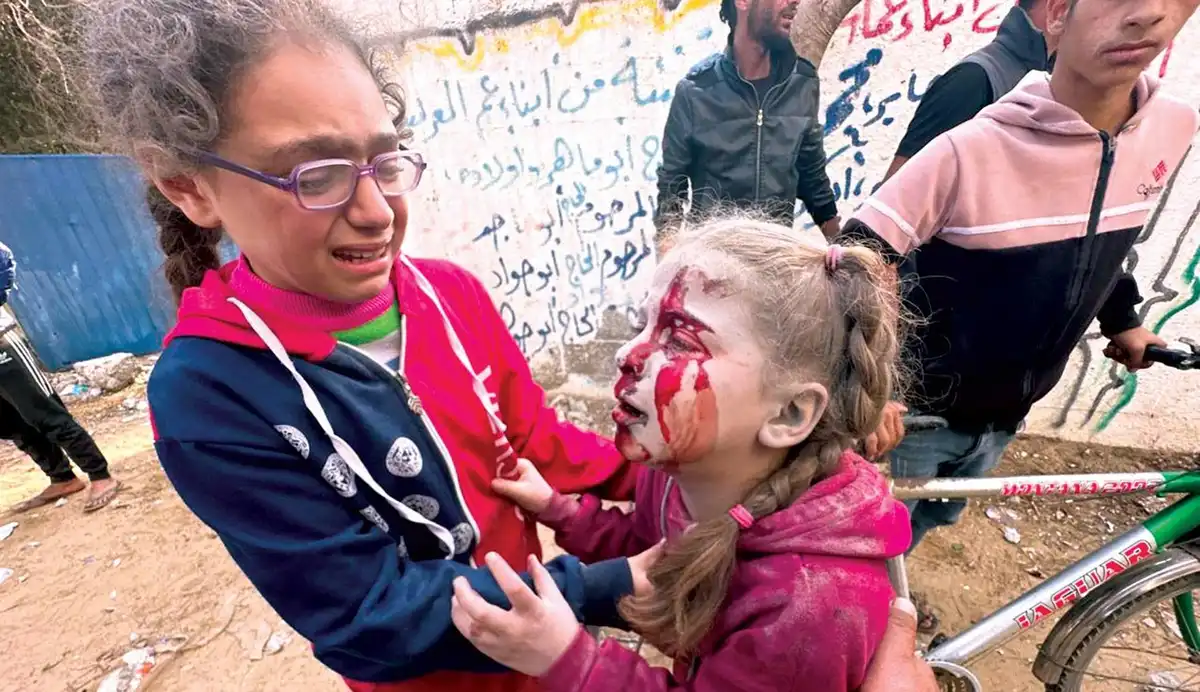

The article, written by British-Israeli journalist Jonathan Cook, said that the “desperate” smear campaign to defend Israel’s crimes highlights a mixture of “harmful lies” that have been the foundation of the liberal democratic system for decades.


The writer mentioned a British comic scene that took place during World War II, in which a Nazi officer near the front lines turns to a colleague, and in a sudden and comic moment of self-doubt, he asks: “Are we the bad guys?”


Cook said that we and many of us "felt as if we were living that same moment, which extended (for us) nearly 3 months, although there is nothing to laugh about." He added that Western leaders, in their statements and speeches, not only supported the genocidal war waged by Israel on the Gaza Strip, but also provided diplomatic cover, weapons and other military assistance.


The writer considered that the West is fully complicit in the "ethnic cleansing" of about two million Palestinians, in addition to killing more than 20,000 and wounding tens of thousands, the majority of whom are women and children.


Western politicians insist on "Israel's right to defend itself" even though it destroyed the infrastructure in Gaza, including government buildings, which led to the collapse of the health sector, and famine and diseases began to destroy the rest of the population.


Vile acts

According to the article, there is nowhere for the Palestinians of Gaza to flee to, and no hiding place to protect them from the bombs that the United States provides to Israel. If they are eventually allowed to flee, they will have no recourse other than neighboring Egypt, which will be their permanent “exile” after decades of displacement from their homeland.


While Western capitals try to justify what they call Israel's "despicable" actions by blaming the Islamic Resistance Movement (Hamas), Israeli leaders allow their soldiers and state-backed settler militias to invade the West Bank - "where Hamas does not exist" - to attack and kill Palestinians. .


Cook continues his frenetic attack, saying that Israel is waging an old-style "colonial war without shame" against the indigenous population, of the kind that preceded international humanitarian law, and Western leaders are applauding it. He wonders: Are we sure that we are not the bad guys?


He says that the Israeli attack on Gaza disgusts many people, and reveals what is “primitive and ugly” in the behavior of the West, which has been obscured for more than 70 years by deceptive manifestations of progress, by talking about the primacy of human rights, about developing international institutions and rules of war, and about claims of humanity.


Yes - Cook continues - these allegations have always been “false”, and nothing is more evident than the lies that promoted the wars in Vietnam, Kosovo, Afghanistan, Iraq, Libya and Ukraine.


The real goal of the United States and its NATO partners was to “plunder” other people’s resources, maintain Washington’s position as a world leader, and enrich Western elites.


But more importantly - in the opinion of the British-Israeli journalist - the “deception” was a comprehensive narrative that dragged many Westerners behind it, claiming that the wars were aimed at confronting the threat of Soviet communism, Islamic “terrorism,” or renewed Russian colonialism. It also aimed - ultimately - to liberate oppressed women, preserve human rights, and strengthen democracy.


Genocidal war

The writer believes that this narrative cover on the part of the West to justify its actions is of no use this time... “There is no humanity in bombing civilians trapped in Gaza, and turning their small prison into rubble, reminiscent of seismic disaster areas, but this time it is a man-made disaster alone.”


He denied that Hamas had the ability to send any type of warhead to Europe, adding that the Gaza Strip was never - even before its destruction - the heart of an Islamic empire preparing to attack the West and subject it to the provisions of Islamic Sharia. It is also almost impossible for Hamas, which consists of several thousand fighters stationed in Gaza, to pose a real threat to the way of life in the West.


According to the article, questioning Israel's right to exterminate the Palestinians in Gaza, chanting a slogan calling on the Palestinians to break free from the occupation and siege, and demanding equal rights for everyone in the region, are all things that the West and the Israelis view as anti-Semitism.


Cook pointed out that the British House of Representatives passed, by an overwhelming majority, a resolution equating anti-Zionism - which in this case applies to those who oppose the "genocidal war" launched by Israel against Gaza - with anti-Semitism.


He described the collective smear campaign in the West as “so unleashed” that the Western elites began on their own to curb freedom of expression and thought in the institutions in which they are supposed to enjoy strong protection.


He concluded that the Gaza Strip is not only a front line in the genocidal war waged by Israel against the Palestinian people, but also a front line in the Western elites’ war on “our ability to think critically in order to develop sustainable ways of living, and to demand that others be treated with the dignity and humanity that we expect for ourselves.” . Kokak concluded by saying: “Yes, the battle lines are drawn, and anyone who refuses to stand with the evil ones is the enemy.”


ARAB AND WORLD

Thu 28 Dec 2023 7:09 pm - Jerusalem Time

War on Gaza: Israel admits it killed dozens in Christmas 'massacre'

Army spokesperson says they 'regret' casualties sustained alongside intended target in a refugee camp on Sunday


The Israeli army admitted on Thursday that it killed dozens of Palestinians in an air strike on the Maghazi refugee camp in Gaza on Christmas Eve. 

An army spokesperson told Kan news that the military regretted that the attack, which killed 70 people, had harmed people adjacent to the intended target".

A preliminary investigation revealed that during the attack, additional buildings were damaged adjacent to the targets that were [meant to be] attacked," the spokesperson told Kan."[This] apparently resulted in harm to those not involved... The IDF regrets the harm to those not involved."

Israel has previously bombed the camp, but the attack on Sunday was described as one of the "deadliest" since the start of the conflict in early October.


The bombing of the camp started just before midnight on Christmas Eve and continued into Christmas Day. Hamas called the attack "a horrific massacre" and "a new war crime".


On Wednesday, the Palestinian Health Ministry said the death toll from Israel's operation had surpassed 21,000, most of them women and children.

Herzi Halevi, the head of the Israeli armed forces, said on Tuesday that the hostilities will continue for "many more months". At least 1.9 million Palestinians have been internally displaced since the beginning of the Gaza assault, according to UN estimates. Only limited amounts of aid have been allowed to enter Gaza since the beginning of the war as Israel has imposed a total blockade on the strip, including cutting off water and electricity supplies, causing severe shortages of water, fuel, food, and medicines.

The conflict in Gaza was triggered by the 7 October incursion by Hamas-led Palestinian fighters into southern Israel, which killed 1,140 people, mostly civilians, according to the Israeli army.


During the operation, around 250 people were taken to Gaza as captives, of whom 129 remain in Gaza after a series of prisoner exchanges.

PALESTINE

Thu 28 Dec 2023 7:05 pm - Jerusalem Time

West Bank: A young Palestinian was killed by Israeli forces west of Bethlehem

A young man died Thursday evening as a result of being hit by live bullets fired at him by the Israeli occupation army, west of Bethlehem.


The Ministry of Health announced thedeath of the young man, Muhammad Sayel Abdel Qader Al-Jundi (38 years old), from the town of Yatta, south of Hebron, after the occupation army shot him near the military tunnel checkpoint established on citizens’ lands west of Bethlehem.

OPINIONS

Thu 28 Dec 2023 6:54 pm - Jerusalem Time

War on Gaza: After Palestinians, Zionism's next victim is the Jewish faith

Middle East Eye

Middle East Eye

Opinion Writer

By Amanda Gelender


Israel's use of religious symbols in its genocide of Palestinians is an affront to Judaism and has robbed Jews of a faith practice divorced from nationalist barbarism


Israel has stolen and appropriated Jewish symbols we hold dear, politicizing them as markers for state-sponsored genocide. Palestinians continue to suffer for western empire's spoils, under the guise of safeguarding the Jewish people.


After Palestinians, Zionism's next victim is the Jewish faith.


Israel and Zionists around the world weaponize Jewish symbols to intimidate, humiliate and lay claim to that which they deem theirs. Israeli soldiers have branded the face of a Palestinian prisoner with the Star of David. Israeli forces notoriously make blindfolded kidnapped Palestinians wave or wear the Israeli flag - emblazoned with a blue Star of David - videotaping the humiliation to disseminate online for Zionists to join in the jeering. 

Israelis taunt Palestinians with cheers for a "Happy Hanukkah" while launching air strikes on communities dying of starvation and disease. 

How is this honoring the Jewish faith? How will Jewish people being inextricably tied to mass murder "protect Jewish people" globally?  


'Symbol of violence' 

As Jews around the world prepared for the start of Hanukkah this year, Israel murdered a beloved powerhouse intellectual, a Palestinian professor who represented the soaring voice of Gaza. The poet and educator Dr Refaat Alareer - and six members of his family - were "surgically targeted" and assassinated by Israel in his sister's home in Gaza City. 


Zionist soldiers marked the first night of Hanukkah by erecting a gigantic menorah in the rubble of decimated homes, where bodies remain trapped   


As I and many other Jews made arrangements for our annual festival of lights, Israel brutally assassinated Refaat as part of an ongoing campaign to snuff out the storytellers and journalists of Gaza. They claim to do this in our names. Near the site where Israel assassinated Refaat, Zionist soldiers marked the first night of Hanukkah by erecting a gigantic menorah in the rubble of decimated homes, where the unrecovered bodies of loved ones remain trapped. Instead of the menorah representing the hope and spirit of our people at this moment, it proclaims to the world a colonial military victory - a symbol of violent conquest in a place where a poet's passionate dissent was exterminated by Israel's death machine. 


In the legendary story we celebrate every Hanukkah, a tiny amount of oil miraculously provided the Maccabees eight nights of fuel to keep their temple lit. It has become a celebration of their faith and perseverance as Jewish freedom fighters facing down violent tyranny. Refaat and so many others martyred by Israel echo the resistance of these Jewish rebels - immortal symbols of light in the face of state terror and a reminder that the Palestinian spirit can never be extinguished. Zionism was once a fringe nationalist political movement within Judaism: only when its interests aligned with western imperialism did it receive the necessary backing to colonize Palestine. But so long as Zionist nationalism has existed, so have anti-Zionist Jews, rejecting the notion that our people should murder and displace Palestinians to build a western-backed settler-colony.

This genocide is a ceaseless nightmare with frightening echoes of the Holocaust. Zionist weaponization of the Star of David is reminiscent of jeering Nazis who wielded the (stolen and appropriated) swastika symbol to humiliate Jews before mowing them down in the streets.

I am continually struck by the glee with which Zionists abuse Palestinians and make a mockery of our sacred symbols and prayers. The Israeli occupation forces recently raided a mosque, detaining and abusing Palestinians while hijacking the mosque's speaker system to sing Hebrew prayers.

This is an affront to the Muslim Palestinians praying in their sacred place of worship and an insult to every single Jewish person of conscience who rejects the weaponization of our faith by Israeli fascists.


'Politicising Judaism'

Zionists drag Judaism through the mud by graffitiing and searing the Star of David to assert dominance over Palestinians while holding a literal knife to the neck of our Torah scrolls. But the symbolic death of the soul of Judaism pales in comparison to the material, ongoing devastation of the Palestinian genocide. 


Zionism is no longer a fringe ideology within Judaism: we grapple with genocide and occupation that the majority of our community supports

Israel has murdered more than 20,000 Palestinians and counting. It has displaced almost two million people more and intentionally destroyed homes, the ecosystem and infrastructure to render Gaza uninhabitable for those who manage to survive starvation, dehydration and carpet bombing.

So long as Israel massacres Palestine using the Jewish faith as a weapon of war, people will falsely conflate the global Jewish community with Israel. In politicizing Judaism, Zionists have robbed Jews of a faith practice divorced from nationalist barbarism. Antisemitic western countries are completely satisfied to have Jewish people act as moral cover and human shields for their imperialism. These are the same countries like the US that rejected entry for Jewish Holocaust refugees but without hesitation poured billions into Israel's military expansion project. 


Zionism is no longer a fringe ideology within Judaism: we grapple with genocide and occupation that the majority of our community supports. This is a result of ongoing Zionist indoctrination that dehumanizes and erases Palestinian life, teaches entitlement to Palestinian land, centers fear and Islamophobia, and sanitizes Israel's brutality.

Part of stepping into Jewish anti-Zionism is accepting the fact that our religion has been hijacked by fascists who commit ongoing genocide on behalf of colonial powers.

If Jewish people don't want to be incorrectly associated with Israel's tyranny, the answer is to be vocally anti-Zionist and work to dismantle both Zionism and Israel's settler-colony. As an anti-Zionist Jew, I eagerly embrace integrating Palestinian liberation into my faith practice.

Decoupling Zionism from my Judaic rituals isn't a burden: it fills my Judaism with the divine energy of Tikkun Olam - the Jewish moral imperative to repair the world. Disentangling Zionism from Judaism deepens my connection with my Jewish ancestors who, like Palestinians, fought with every dying breath to resist annihilation. Judaism will outlive violent Zionist nationalism and when Palestine frees itself, it will free us all.