PALESTINE

Mon 01 Jan 2024 4:01 pm - Jerusalem Time

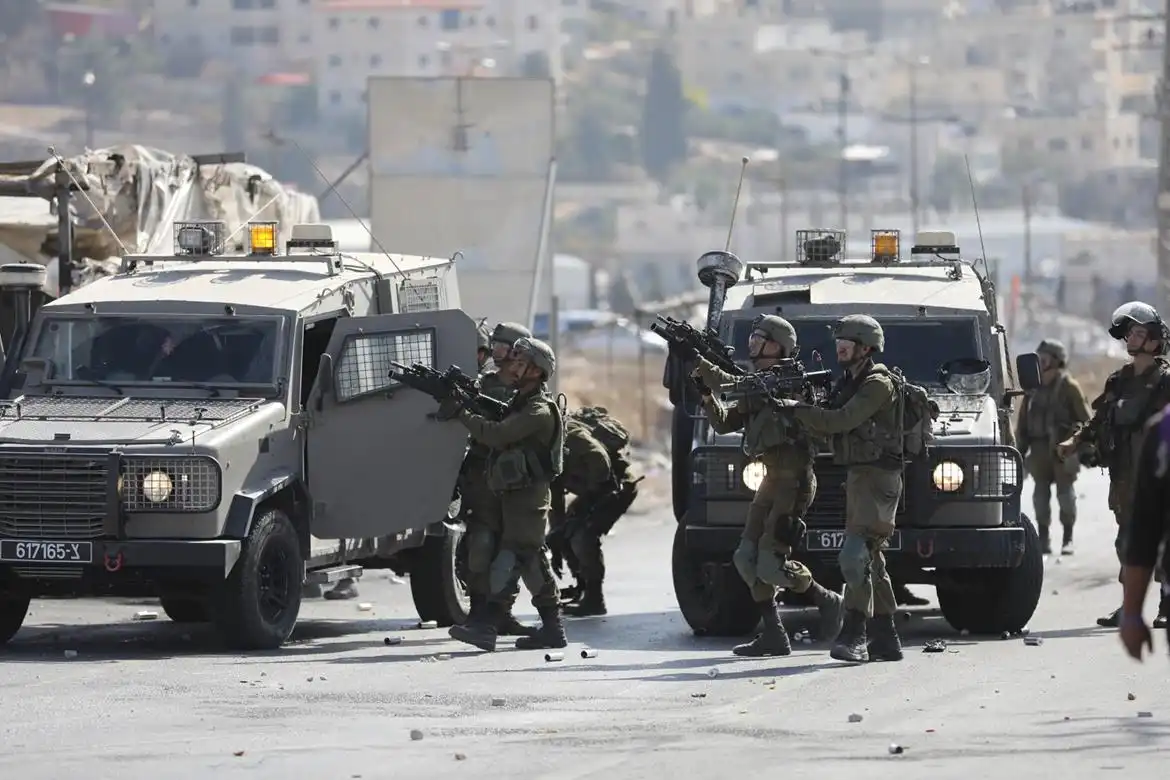
West Bank: Israeli forces storm villages in Jenin

On Monday evening, Israeli occupation forces stormed the villages of Nazlet Zeid and Jalboun in Jenin Governorate.


According to local sources, the occupation forces stormed the village southwest of Jenin, deployed an infantry squad, and raided its neighborhoods. The occupation soldiers directed insults and threats at the citizens.


In this context, these forces stormed the village of Jalboun, east of Jenin, raided the eastern neighborhood and the vicinity of the old cemetery, and launched a sweeping and searching campaign, in a provocative step, without any arrests being reported.

OPINIONS

Mon 01 Jan 2024 3:23 pm - Jerusalem Time

Israeli Opinion| The seriousness of the ambiguous reality in the Gaza Strip

Yedioth Ahronoth

Yedioth Ahronoth

Opinion Writer

By Michael Milstein

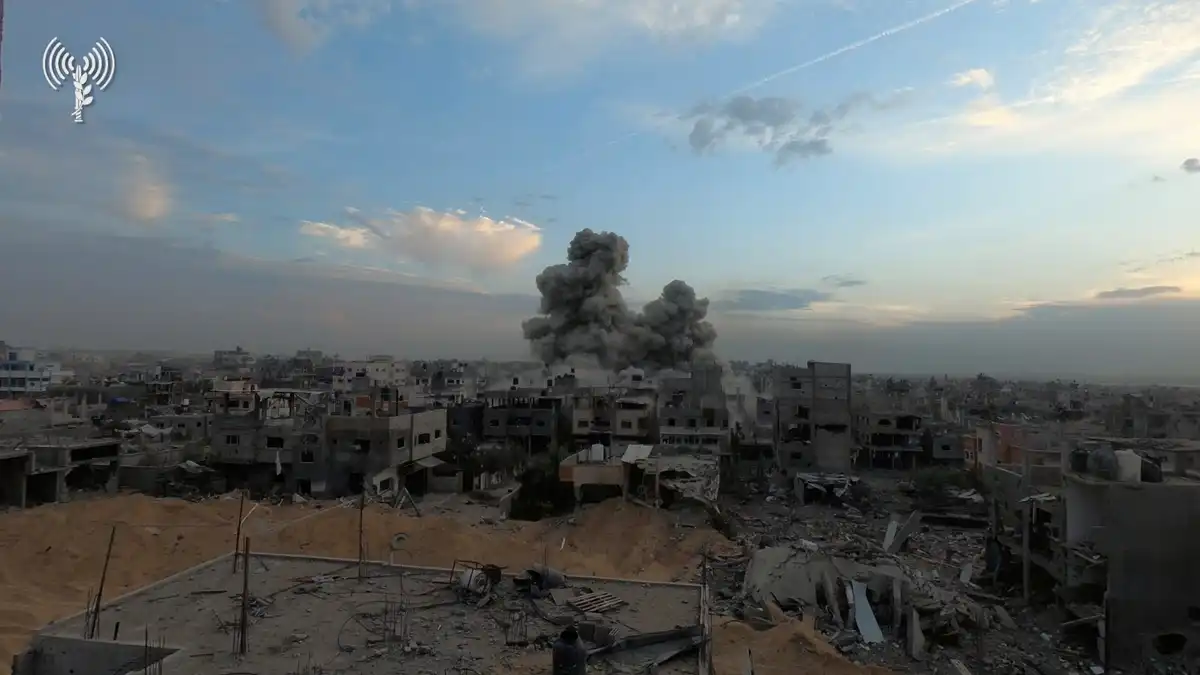
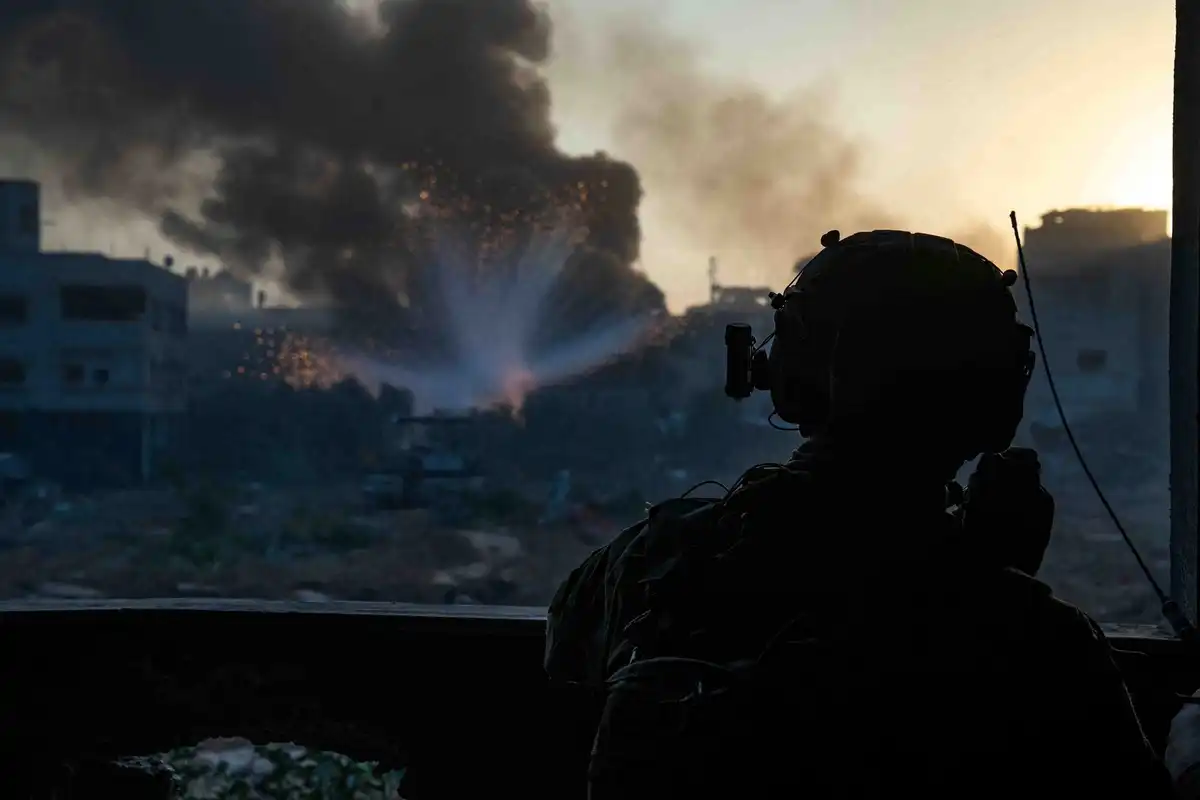
The heads of government and the army in Israel announce that it is expected to move soon to Phase C of the war in Gaza. After taking control of the northern Gaza Strip and focused operations in Khan Yunis, a phase is being planned in which the pattern of fighting will change, as its strength will diminish, and ground maneuvering will be replaced by focused operations, mainly ground incursions and air attacks, which are supposed to take a long time and lead to the collapse of Hamas’ rule.

But the above description is vague and highly complex, which is unacceptable in Middle Eastern discourse that relies on one-dimensional facts. The third phase could turn into an ongoing war of attrition, especially if Israel does not succeed in striking the Hamas leadership, or in achieving the collapse of the movement, which has proven, after 86 days of fighting, its ability to wage a fierce confrontation even if the Palestinians pay a heavy bloody price.

For Hamas, the third phase could represent an opportunity. It will allow it to claim that it has not conceded, even if it turns into a defeated entity controlling a small enclave. In its view, this matter can present an image of victory, despite the unprecedented killing and destruction that befell the Gaza Strip, and the fact that half of the Gaza Strip is occupied by the Israeli army, but the fact that it has stood firm and continues to fight inside and outside Gaza, fulfills the principle of steadfastness.

Moreover, this ambiguous situation could continue for a long time, and make it difficult for Israel to establish a different reality in Gaza. The continuation of fighting in the Gaza Strip will not allow the establishment of a positive model in the north, different from the south. Hamas will seek to undermine any attempt to establish stable civilian control mechanisms in the Gaza Strip, and the Palestinian public will avoid cooperating with it as long as fighting continues in the Gaza Strip (even in the northern part, Hamas will try to continue its movement), and foreign investors will refrain from offering projects to a region suffering from Permanent instability.

The ambiguous reality can be seen as a problem in the region, whether from Israel’s enemies or from its friends who will interpret the complex situation as an obstacle to its strategic goals, and on the other hand, the success of “Hamas” in achieving the “resistance doctrine,” that is, breaking the Israeli effort. By showing long breath and endless fighting ability; Of course, all of this will make it difficult for Israel to restore its image of deterrence, and could increase tensions on other fronts, especially in the north.

Israel must reconsider the third stage. The only way to achieve its strategic goals in the war, most importantly the elimination of the military and authoritarian capabilities of Hamas, is to control the entire Gaza Strip, despite the time and price required to achieve such a scenario. But this will make Israel sure that it has destroyed all of the movement’s military infrastructure, severely hit its leadership, and that another regime will emerge in the border area between Gaza and Egypt. Only after that, can we try to establish another regime in Gaza.

Within this framework, it is very important for Israel to conduct an in-depth dialogue with the United States, its strong strategic ally, which is pushing for a rapid transition to the third phase, in light of concerns about the accumulation of harm to the Gazan public. In this context, it is important to explain to Washington the challenges involved in this stage, the most prominent of which is the lack of a clear military solution. In addition to the harm that could befall Israel, this will reflect negatively on the United States as well, in light of what will be considered a new failure of its ally in its confrontation with the Iranian-led resistance camp, and a kind of continuation of the bitter experience of the United States in Iraq and Afghanistan.

The October 7 theory demonstrated the need to refrain from entering into situations involving contradictions and lack of clarity. Entering into a hybrid phase could eventually lead, after great frustration, to the situation that Israel is trying to prevent at this stage, namely, controlling the entire Strip.

OPINIONS

Mon 01 Jan 2024 3:18 pm - Jerusalem Time

Israeli Opinion| We are approaching a critical juncture: the next day is here

Maariv

Maariv

Opinion Writer

Tal Lev Ram

Today, with the beginning of the year 2024, talk in Israel about the next day must begin now. Currently, the IDF is about to move to the next phase of the fighting in the Gaza Strip, while there are still unresolved issues, in particular regarding the northern front facing Hezbollah. 

The army needs a set of decisions from the political level and goal setting, in order to allow it to plan in detail for the next stages of the war in Gaza and in the northern arena. Establishing a mechanism for the next day, which in many ways can be called “the present day,” is not only a political need, especially in the south, and with regard to the tripartite relations between Israel, the United States, and Egypt, but it is also, for the army, a deep practical need to establish The goal of the battle is in the Southern Command.

Regarding the interconnectedness between the different combat zones, the timeline for progress in the Khan Yunis area brings us closer to moving to the next phase of the war in the south, during which fewer IDF divisions are expected to operate simultaneously in the Strip. This stage brings the political level closer to making the required decisions in the northern arena in confronting Hezbollah.

Yesterday, Hezbollah Deputy Secretary-General Naim Qassem said that residents of the northern settlements can return to their homes only after Israel completely stops the war in Gaza. Although it is clear that the war in Gaza may last for many months. Hezbollah is hinting that even after Israel moves to the next phase of the war in southern Gaza, it plans to continue to maintain an effective battle front facing Israel, until a political solution is reached, which is not on the horizon at this stage.

For the political level in Israel, the point is that a critical turning point is approaching, such that it is not possible to continue to accept the security situation in the north of the country as a permanent situation for many months, and from here comes the possibility of a decision to be taken regarding significantly raising the degree and strength of the responses to Hezbollah, which will... It will lead to escalation and cause major unrest in the northern arena, which could turn into the central arena of war, as long as Hezbollah continues to fire on Israel, and as long as its forces do not withdraw back. They claim in the army that Hezbollah is paying prices, including the death of more than 130 fighters and damage to its military buildings, which are much greater than the damage it causes to Israel.

Even if there is some truth in this statement, it is not sufficient to change the strategic complexity that Hezbollah imposed on Israel, after the “terrorist” attack by Hamas on October 7.


Political criticism from the right and the opposition

We can understand the logic of the government’s decision-making, which calls for focusing on the war against Hamas, but on the other hand, it is clear that the situation emerging in the north as a result of the continuing fighting is an intolerable situation, even though, so far, between the use of force and Military, or using political means, there is no equation that can restore calm to the northern border with Lebanon, and at the same time, provide protection and a sense of security for the population. Hence, the distance of Radwan's forces from Hezbollah is a necessary condition.


Israel has made clear on several occasions that it prefers to try to resolve the situation politically, but when they talk about returning to Resolution 1701, this resolution includes future prices that Israel may have to pay. Also, making certain decisions could lead to political criticism of the Prime Minister from the right and the opposition, who will claim that Israel has submitted to Hezbollah’s blackmail.

So far, there is no immediate political solution on the horizon, and the method of using military force does not lead to restoring deterrence on the northern border. What is true now is that Hezbollah, at least in terms of statements, claims that it will not stop firing as long as the Israeli army continues its war. On Gaza. The IDF's transition to the next phase of the fighting in Gaza is taking place gradually, and is already having an impact on the ground. We advise all those who followed during the three months of fighting in the south, the maneuvering methods and the location of the Israeli army divisions in each stage, not to expect celebrations for the end of the second stage of fighting and the beginning of the third stage.

In the year 2024, which begins today, the coming months are expected to bring questions about the continuation of the war in Gaza, with a high possibility of deteriorating into war, or a major escalation in the confrontation with Hezbollah in the north. The central effort made by the Israeli army is in Khan Yunis, through the 98th Division, in which 7 brigades operate. This effort is what will lead to increased military pressure on senior Hamas officials above ground, especially underground, and an attempt to reach the movement's senior leaders. The intense military effort, according to the army's doctrine, is also supposed to lead to progress in releasing more kidnapped persons.


A buffer zone in the sector

In recent days, first signs have emerged, but it is too early to see more than that. In exchange for the army's central effort to continue to "cleanse" the northern Gaza Strip, with the exception of the Daraj al-Tuffah neighborhood, which has not been under operational control and is still witnessing battles. The increase in incidents in recent days against “saboteurs” in areas under the army’s control for a long time, such as Beit Lahia, or neighborhoods in the heart of Gaza City, is a good indication of the guerrilla warfare that the Israeli army is expected to face wherever its forces remain permanently.

The presence of fixed forces to protect the logistical supply axis that practically connects the north of the Strip to its south will continue in the next phase of the fighting, as will the plans related to the presence of forces securing the northern corridor, from the Erez area, passing through the beach, and up to the southernmost area in Gaza City. This presence in the field is what must provide flexibility for the army to carry out other operations in the coming months in the northern Gaza Strip...


Among the decisions that must be taken by the political level in the coming days are those related to the northern Gaza Strip in particular. Who will care for the civilian population remaining in Gaza City? Can people in the south return to the north? An issue that the Americans are expected to push to resolve, or should the current situation be maintained and pressure on Hamas from the Gazan population should be increased?


In addition to the central effort exerted by the army in Khan Yunis and in the center and south of the Gaza Strip, it is currently working to establish a buffer zone, hence the importance of the operations taking place in the Bureij, Al-Maghazi, Khirbet Khazaa and other camps.

In these areas adjacent to the border fence, and opposite the Israeli settlements, which were used as bases for the “terrorists” to launch their “terrorist” attack on October 7, the Israeli army is investing redoubled effort in demolishing the “terrorist” infrastructure, destroying the tunnels, and exposing the field towards A distance of one kilometer in order to allow the army to better control, monitor and improve the defensive capacity of the settlements.

In this style of fighting, the army advances, stage after stage, in dismantling the military capabilities of the enemy who does not want to surrender, even if the disaster it is causing in Gaza is clear in front of it, and even now, after 3 months of fighting, it is very difficult to see the end of the war.


What is certain is that without a political goal, it will be very difficult to continue the fight for a long time successfully, while the differences between the prime minister and other members of the cabinet are deepening, and political considerations are being favored, which today interfere in decision-making. All of these are discouraging indicators, in the face of... Months of long fighting lie ahead.

OPINIONS

Mon 01 Jan 2024 2:49 pm - Jerusalem Time

Why Gaza Matters? Since Antiquity, the Territory Has Shaped the Quest for Power in the Middle East

Foreign Affairs

Foreign Affairs

Opinion Writer

By Jean-Pierre Filiu

After nearly three months of Israel’s war on Gaza, one thing is beyond dispute: the long-isolated territory has returned to the center of the Israeli-Palestinian conflict. For much of the past two decades, as Israel imposed an air, sea, and land blockade on Gaza, international leaders and bodies seemed to assume that the dense enclave of 2.3 million Palestinians could be indefinitely excluded from the regional equation. Catching Israel and much of the wider world completely off guard, Hamas’s October 7 attack exposed the enormous flaws in that assumption. Indeed, the war has now reset the entire Palestinian question, putting Gaza and its people squarely at the center of any future Israeli-Palestinian negotiation. But Gaza’s sudden new prominence should hardly come as a surprise. Although little of it is remembered today, the territory’s 4,000-year history makes clear that the last 16 years were an anomaly; the Gaza Strip has almost always played a pivotal part in the region’s political dynamics, as well as its age-old struggles over religion and military power. Since the British Mandate period in the early twentieth century, the territory has also been at the heart of Palestinian nationalism. Therefore, any attempt at rebuilding Gaza after such a devastating war will be unlikely to succeed if it does not take account of the territory’s strategic position in the region. The demilitarization of this enclave can be achieved only by lifting the disastrous siege and putting forward a positive vision for its economic development. 

Rather than trying to cut off the territory or isolate it politically, international powers must work together to allow Gaza to reclaim its historic role as a flourishing oasis and a thriving crossroads, connecting the Mediterranean with North Africa and the Levant. The United States and its allies must recognize that Gaza will need to have a central part in any lasting solution to the Palestinian struggle.


THE JEWEL IN THE CROWN

In stark contrast to its present-day reality of impoverishment, extreme water shortages, and unending human misery, the oasis of Gaza, or Wadi Ghazza, was celebrated for centuries for the lushness of its vegetation and the coolness of its shade. As important, however, was its strategic value, for Gaza connects Egypt to the Levant. Its advantageous position has meant that the land has been contested since the seventeenth century BC, when the Hyksos invaded the Nile Delta from Gaza, only to be later defeated and repelled by a Theban-based dynasty of pharaohs. Eventually, the pharaohs had to abandon Gaza to the Sea Peoples—known as Philistines—who in the twelfth century BC established a five-city federation that included Gaza and the now Israeli cities of Ashkelon, Ashdod, Ekron, and Gath. 

Violent tensions erupted over access to the sea between the Philistines and the neighboring Jewish tribes and then kingdoms. Thus the biblical story of Samson, the legendary Israelite warrior who sets out to defeat the Philistines. As his formidable strength depends on his hair never being cut, he is rendered powerless when he falls under the spell of Delilah, who has his head shaved during his sleep, and winds up in a Gaza prison. While in captivity, however, his hair grows back, restoring his strength, and when he is finally dragged out of his cell to be ridiculed in a Philistine temple, he brings down the pillars of the building, killing himself along with his enemies. In a similar vein, it is after killing the Philistine Goliath that young David begins his effort to unify the kingdoms of Judah and Israel.

In later antiquity, Gaza’s coveted geography made it a crucial battleground between some of the epoch’s greatest hegemons. After passing through the hands of the Assyrians and the Babylonians, Gaza was captured by Cyrus the Great’s Persia in the mid-sixth century. But the real shock came two centuries later, in 332 BC, when Alexander the Great of Macedonia launched a devastating hundred-day siege of Gaza on his way to Egypt. During this gruesome war, both sides fortified their positions by digging numerous tunnels beneath Gaza’s loose soil—providing a historic antecedent to Hamas’s strategy against Israel today. In the end, Alexander’s forces came out on top, but at a high cost to all sides. Alexander was injured during the siege and took terrible revenge on the defeated Gazans: much of the male population was slaughtered, and the women and children reduced to slavery.

But Gaza’s importance extended beyond its military value. Having become a city-state during the Hellenistic period, it later became a major religious center in the early centuries of first Christianity and then Islam. In 407 AD, Porphyry, the Christian bishop of Gaza, managed to impose a church on the ruins of Gaza’s main pagan temple to Zeus. Even more famous was another local saint, Hilarion (291–371), who founded an important monastic community in Gaza and whose tomb became a hugely popular pilgrimage site. One of the prophet Muhammad’s great-grandfathers was a merchant from Mecca named Hashem ibn Abd Manaf, who died in Gaza around 525. As a result, after the territory was conquered by Muslim armies in the seventh century, Muslims respectfully referred to it as “Hashem’s Gaza.” (In the nineteenth century, the Ottomans built the Hashem Mosque in Gaza City to mark the site of Hashem’s mausoleum.)Any attempt at rebuilding Gaza will be unlikely to succeed if it does not take account of the territory’s strategic position.

Between the medieval period and the nineteenth century, Gaza continued to serve as a coveted prize in the region’s major power struggles. It seesawed between Christian crusaders and Muslim defenders in the twelfth century and Mamluk generals and Mongol invaders in the thirteenth. During two and a half centuries under the Mamluks—Turkic rulers who controlled medieval Egypt and Syria—Gaza entered a kind of golden age. The territory was endowed with numerous mosques, libraries, and palaces, and it prospered from the renewed coastal trade routes. In 1387, a fortified caravanseray or khan, a kind of trading and market hub, was established at the southern end of Gaza and soon grew into a city of its own, Khan Yunis.

Gaza was absorbed by the Ottoman Empire in 1517 and conquered, briefly, by Napoleon Bonaparte’s army, after it invaded Egypt in 1798. For much of this span, Gaza was renowned for its fruitful climate, congenial natives, and high quality of life. In 1659, one French traveler described it as “a very cheerful and agreeable place”; two centuries later, another, the French writer Pierre Loti, marveled at its “vast fields of barley all clothed in green.” When the border was drawn in 1906 to separate British-controlled Egypt from Ottoman Palestine, it ran through the city of Rafah to create a de facto free trade zone between the two empires. But during World War I, the border was fiercely contested by British and Ottoman forces; after three attempts, the British Army finally broke through Ottoman lines in 1917. General Edmund Allenby entered the devastated city of Gaza on November 9, the same day his government made public the Balfour Declaration and its commitment to “the establishment of a national home for the Jewish people in Palestine.” This endorsement of the Zionist program was later incorporated into the mandate that the League of Nations granted Britain to administer Palestine.


Although Gaza was one of the areas of Palestine least targeted by Zionist settlement, it became a stronghold of Palestinian nationalism, especially during the Great Arab Revolt of 1936–39, in which Palestinian Arabs rose up against the British and fought unsuccessfully for an independent Arab state. Instead, in November 1947, the United Nations endorsed a partition plan in which Palestine would be divided between an Arab state and a Jewish one—the original two-state solution—with Gaza joining the Arab state.


SEEDS OF STRUGGLE

Crucially, what became known as the Gaza Strip was shaped by the pivotal traumas of 1948. First came the failure of the UN’s partition plan, which, although welcomed by the Zionist leadership, was flatly rejected by Palestinian nationalists and the Arab states, setting off an armed conflict between Jews and Arabs. Soon, the first waves of Arab refugees, mainly from the Jaffa area, were arriving in Gaza; in a bitter anticipation of today’s international dilemma, the British suggested that the area would have better access to humanitarian relief overland from Cairo. Then, following the Zionist leader David Ben-Gurion’s proclamation of the state of Israel in May 1948, neighboring Arab states attacked, with 10,000 Egyptian soldiers moving into Gaza. But the Egyptians never made it farther than Ashdod, some 20 miles north of Gaza, where they were soon pushed back by a daring Israeli operation.

By January 1949, the Israelis had not only defeated the Arab armies but also driven some 750,000 Palestinians from their homes, in what became known as the nakba, or catastrophe. The armistice signed between Israel and Egypt under UN auspices in February of that year created the Gaza Strip, a territory under Egyptian administration and defined by the cease-fire lines in the north and east and by the 1906 border with Egypt in the south. After centuries as a strategic crossroads and vital commercial hub for regional trade, Gaza had been reduced to a “strip” of land, cornered by the desert, and cut off from what had been Palestine. On top of that, the local population of some 80,000 was now overwhelmed by some 200,000 refugees from all over Palestine who then described the Gaza Strip as their “Noah’s ark.”

There was no infrastructure to welcome these refugees, and during the first winter of 1948–49, the International Committee of the Red Cross estimated that ten children died every day from cold, hunger, or disease. The immensity of the Sinai Desert forced the survivors to remain in the enclave. Indeed, 25 percent of the Arab population of British Mandate Palestine was now confined in the Gaza Strip to just one percent of its former territory, with Israel absorbing 77 percent of that territory and the Hashemite Kingdom of Jordan another 22 percent, through its annexation of East Jerusalem and the West Bank.

Such was the magnitude of the nakba that the United Nations created a special body, the UN Relief for Palestinian Refugees (UNRPR), to deal with the humanitarian crisis. For Palestinians, the terrible upheaval also planted the seeds of a new struggle that would continue to the present day. In December 1948, the same UN General Assembly that had approved the failed partition plan a year earlier enshrined the Palestinian refugees’ “right of return”—whether by way of actual repatriation or mere monetary compensation—a concept that has been central to Palestinian aspirations ever since. It had special meaning in Gaza, given the extraordinary number of refugees there, and since Egypt had no territorial claim on the strip, the enclave became a natural incubator for Palestinian nationalism.


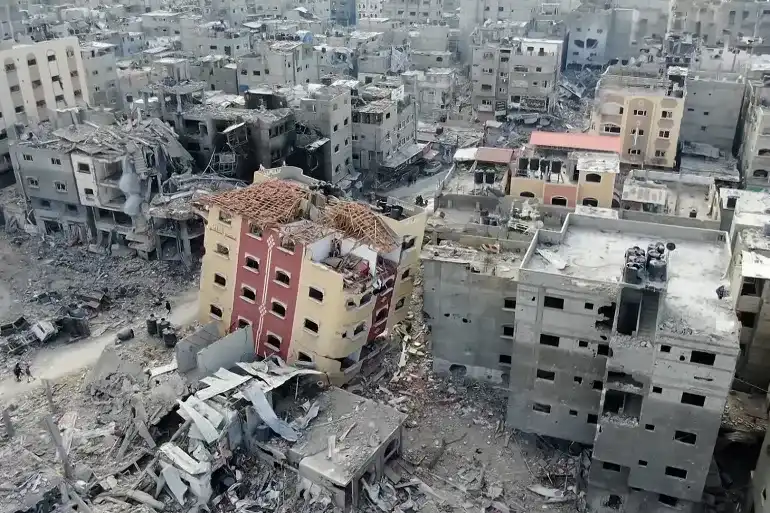
As Israel’s first leader, Ben-Gurion understood the long-term threat Gaza posed before almost any of his fellow Israelis. At the UN peace conference in Lausanne, in 1949, he proposed annexing the Gaza Strip and allowing 100,000 Palestinian refugees into their former homes in Israel. But the plan generated an uproar in both Israel, where there was enormous opposition to any return of Palestinians, and Egypt, where the defense of Gaza had become a national cause. As a result, the UN admitted its impotence to settle the Arab-Israeli dispute, terminating the Lausanne conference and establishing open-ended “interim” institutions instead. Thus, the UNRPR was turned into the United Nations Relief and Works Agency (UNRWA), which ever since has been the main employer and main provider of social services in Gaza. Eight refugee camps were founded in the enclave, the largest ones being Jabalya, in the far north, and the Beach Camp, on the shoreline of Gaza City—the same camps that have now been destroyed by the Israeli onslaught.


In fact, it took some years before Gazan refugees turned to militant activism. At first, both Israel and Egypt managed to tamp down on the so-called fedayeen—guerrilla fighters mainly drawn from the camps in Gaza who sought to infiltrate Israel. But by the mid-1950s, the Egyptian leader Gamal Abdel Nasser began using them for proxy raids against Israel, thus beginning the cycle of attacks and reprisals that is so closely associated with the territory today. In April 1956, the security officer of a kibbutz close to the Palestinian enclave was killed by infiltrators from Gaza, causing Moshe Dayan, the Israeli chief of staff, to warn Israelis of the unresolved grievances simmering in the territory: “Let us not, today, cast the blame on the murderers,” Dayan said. “For eight years now, they have sat in the refugee camps in Gaza, and before their eyes we have turned their lands and villages, where they and their fathers dwelt, into our home.”

Eradicating the fedayeen presence from Gaza became a top priority for Ben-Gurion and Dayan. In November 1956, the Israeli army took control of the strip as part of a coordinated offensive with France and the United Kingdom against Nasser’s Egypt. During four months of occupation, around a thousand Palestinians were killed by Israeli forces (including two massacres documented by UNRWA in which at least 275 were executed in Khan Yunis and 111 in Rafah). The trauma was so profound that when the Israelis withdrew under U.S. pressure, the Palestinian population called for the return of Egyptian rule instead of the UN trusteeship that had initially been envisioned. A historic opportunity to build a Palestinian entity that could evolve into a state had been lost. Meanwhile, the fedayeen fled to Kuwait, where they founded, in 1959, the Palestinian Liberation Movement, known as Fatah, with Yasser Arafat as its leader.

Israel’s second occupation of Gaza started in June 1967, after the Israeli triumph in the Six-Day War. Dayan, now minister of defense, with the future prime minister Yitzhak Rabin as his chief of staff, erased any trace of the border between Gaza and Israel, betting that the attraction of the Israeli labor market would dissolve Palestinian nationalism. But the local population nonetheless supported for four years a low-intensity guerrilla war, until Ariel Sharon, the Israeli commander for the region (also later prime minister), bulldozed parts of the refugee camps and broke the back of the insurgency. Today, the Israeli army is using the very same map that Sharon did to distinguish the so-called “safe areas” from the combat zones in the ongoing offensive.


MAKING A MONSTER

Israel’s more visionary leaders had long recognized that the Gaza refugee problem would not go away. In 1974—following Ben-Gurion—Sharon proposed resettling tens of thousands of Palestinian refugees in Israel to address Palestinian grievances, at least symbolically. But once again, the idea was rejected. Instead, Israel started to play off the Muslim Brothers in Gaza, led by Sheikh Yassin, against the now Fatah-controlled nationalists of the mainstream Palestinian Liberation Organization. Notably, the Israeli military governor attended the inauguration of Yassin’s mosque in Gaza in 1973, and six years later, Israel allowed the Islamists to receive foreign funds while repressing any established connection with the PLO.

For a time, this divide-and-conquer policy seemed to work well for Israel in Gaza, with clashes flaring between nationalists and Islamists in 1980. But by the late 1980s, an entire generation had grown up under the constant pressure of the Israeli settlers who, though numbering only in the low thousands, led the occupying army to exclude the already cramped Gazan population from one-fourth of the enclave. It was in Gaza’s Jabalya refugee camp that the first intifada began, in December 1987, from which it soon spread to the whole strip and then to the West Bank. Young Palestinians defied the Israeli military with their stones and slingshots but also forced Arafat and the PLO to endorse the two-state solution. In response, Yassin transformed his organization into Hamas (an acronym for the “Movement for Islamic Resistance”) accusing the PLO of having betrayed the “holy” duty to “liberate Palestine.” Once again, Israeli intelligence played on those tensions to weaken the intifada and waited until May 1989 to imprison Yassin. But the popular uprising went on until support for peace in Israel brought Rabin to office as prime minister, in July 1992.In opening secret talks with the PLO, Rabin’s priority was to disengage Israel from the Gaza Strip yet still protect the Israeli settlers there. The Oslo accords, signed in September 1993, created a Palestinian Authority to take charge of territories evacuated by Israel. Arafat moved into Gaza ten months later, believing he had himself liberated the territory, or at least the portion under Palestinian control, while the local population was convinced it had paid the hardest price for such a liberation. This misunderstanding, along with the rampant corruption of the PA, played directly into the hands of Hamas. In 1997, a botched Israeli intelligence operation against the Hamas leader Khalid Meshal in Jordan led to the arrest of Israeli agents. To secure their release, Prime Minister Benjamin Netanyahu was forced to hand over Yassin, who had been serving a life sentence in Israel and who returned triumphantly to Gaza.

Hamas’s growing aggressiveness and the crisis of the peace process led to the eruption of the second intifada in September 2000. The shocking wave of suicide attacks helped bring Sharon to power in a February 2001 landslide. After laying siege to Arafat in Ramallah and killing Yassin in Gaza, Sharon believed that his victory would be complete only after the Israeli evacuation of the Gaza Strip. Such a unilateral withdrawal was meant to secure a new Israeli defense line around the enclave and was carried out without any consultation with Mahmoud Abbas, who had succeeded Arafat as head of the PLO and the PA. But Sharon’s gamble ruined the ambitious $3 billion development plan for Gaza that James Wolfensohn, the special envoy of the Quartet for the Middle East (Russia, the United States, the European Union, and the United Nations) had designed.

Hamas naturally claimed the Israeli withdrawal as a victory and went on to win the internationally sponsored parliamentary elections a few months later, in January 2006. Embarrassed by the unforeseen outcome, the United States and the European Union decided to boycott Hamas until it recognized Israel and renounced violence. But by the following year, the unreformed Hamas, having killed hundreds of its rivals, had gained total control of the strip, which was then put under full Israeli blockade (with the cooperation of Egypt, which controls the Rafah crossing point in the south). In many ways, Israeli policies had brought Hamas to power in Gaza, a power that the blockade has only consolidated since then.


A PATH TO PEACE?

A legacy of the policies that have been followed since 2006, the current war between Israel and Hamas is also a result of the denial of Gaza’s rich historical identity. During the past 16 years, Israeli leaders thought they had found the optimal formula for sidelining Gaza entirely: more than two million Palestinians could be excluded from the demographic equation between the Jewish and Arab populations in Israel, East Jerusalem, and the West Bank; and the PA, blinded by its bitter feud with Hamas, resisted any effort to alleviate the blockade in Gaza, an approach that further undermined the PA’s already waning legitimacy. Meanwhile, the division of the Palestinian leadership doomed any effort to revive the peace process and allowed the Israeli settlements to steadily expand in the West Bank. From time to time, Israel engaged in what counterterrorism experts described as “lawn-mowing” wars on Gaza, with, from its point of view, a sustainable ratio of largely military casualties, although the Palestinian killed were mainly civilians. In 2009, 13 Israeli soldiers were killed, and 1,417 Palestinians. In 2012, the ratio was six Israelis to 166 Palestinians. In 2014 it was 72 Israelis to 2,251 Palestinians, and in 2021, 15 to 256. Meanwhile, the European Union and the Gulf states were always ready to foot the bill to reconstruct the ruins in the strip.

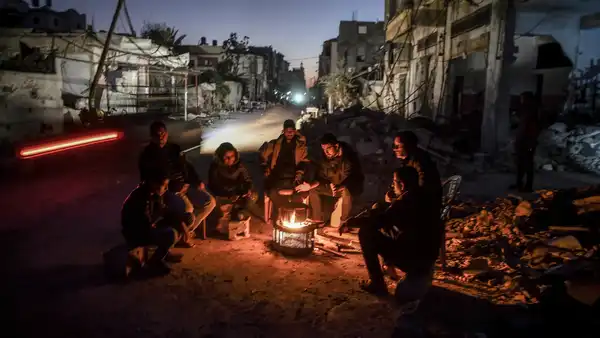
But the idea that the terrible human reality of Gaza could be simply ignored was a delusion. On October 7, 2023, the status quo collapsed in Hamas’s horrific killing spree. The unprecedented violence that Israel has been unleashing on Gaza ever since, in which more than 21,000 Palestinians have so far been killed—and, in a cruel replay of the memories of the nakba, an overwhelming majority of its 2.3 million inhabitants have been uprooted from their homes—has sent shock waves through the Middle East and beyond. Netanyahu’s declared war aim—the “eradication” of Hamas—echoes those of Ben-Gurion in 1956, only on a much larger scale and with the whole world watching. Even supposing such a goal can be accomplished, there will be no Nasser to bring order to the enclave after the Israeli withdrawal. So Israel seems destined to be haunted by the very “Gaza Strip” it created in 1948, with the continuing cycle of wars and occupation leading only to more radical Palestinian activism.

For the Israelis and the Palestinians to ultimately enjoy the peace and security they so deeply deserve, Gaza must once again return to its roots as the prosperous crossroads it was for centuries. To start with, the policy of siege and blockade must end, allowing the territory to finally reconnect with the rest of the region. At the same time, drawing on Gaza’s historic role as a major trading hub, a concerted strategy of redevelopment, echoing Wolfensohn’s 2005 plan, must be put in place to allow Gaza to move from international assistance to a self-generating economy. This is the key for the territory to be demilitarized under international supervision and in the framework of a two-state solution. Of course, it will be extremely difficult to make any of this happen, particularly after a ruthless war that threatens to spawn a new generation of Palestinian militancy. But there are no easy solutions left. This strategy might be the only way out of the current murderous spiral. As it has been for centuries, Gaza is once again at the center of a major war but also the key to peace and prosperity in the Middle East.


JEAN-PIERRE FILIU is Professor of Middle East Studies at Sciences Po in Paris and is the author of Gaza: A History and The Middle East.

OPINIONS

Mon 01 Jan 2024 2:15 pm - Jerusalem Time

Israel's war on Gaza encapsulates the entire history of European colonialism

Middle East Eye

Middle East Eye

Opinion Writer

By Hamid Dabashi


The reason Zionists have the full support of European and US leaders is because the genocidal drive to 'exterminate all the brutes' is embedded deep in their psyches


As millions of Palestinians trapped in Gaza were facing starvation and mass murder, Israel's invading army made sure to film themselves enjoying “rejuvenation complexes”, where they were lavished with “concerts, massage chairs, buffet, and more”. It is surreal to watch Israelis being pampered while slaughtering Palestinians in their own homeland. This is the genocidal practice of settler-colonialism, dating back at least as far as Bartolome de las Casas in his A Short Account of the Destruction of the Indies (1552). In it, he documented for posterity the vicious brutality of the Spanish, butchering “savage Indians” in an orgy of violence. Israelis are doing the same to the Palestinians.  In North and South America, Australia, Asia and Africa, European settler-colonialists have left behind the evidence of their psychotic genocidal practices.


The European transatlantic slave trade may have halved the population of Africa, some historians believe. The US, Canada, Australia, New Zealand and many African colonies were all built on the systematic extermination, displacement and internment of the original inhabitants.  Stay informed with MEE's newsletters


In the Israeli settler-colonialism now on violent display in Gaza and the rest of Palestine, European colonialism is living up to its murderous infamy and has returned to the global stage with a vengeance. For decades, scholars of European colonialism have been working hard to document, archive and connect these episodes of the premeditated mass murder of native people around the globe. 

But such painstaking scholarship has been unnecessary in Gaza and the West Bank. For there, the barbarity of the Israeli army and the settlers has been on full display on social media, and in the mainstream media in the global south, for anyone who cares to look for themselves. Israel has put the entire history of Euro-American settler-colonialism and its genocidal instincts on full global display. While the western media works tirelessly and shamelessly to whitewash Israel's murderous activities - offering “alternative facts”, demonizing Palestinians, valorizing Israelis, and sanitizing Zionism to assure the world that Israel is “the most moral army” the globe has ever seen - the world at large has been liberated from their pernicious journalism.


Settler colonialism and genocide

While Israel goes about its genocide against the Palestinians, US Congress has been busy persecuting those voicing opposition to Israel's actions and prosecuting imaginary threats to Jews, supported by billionaires frightening university presidents out of their wits.

For decades, critical thinking by leading anticolonial and postcolonial thinkers had been radically altering our perceptions of the savageries committed around the world by Europeans and Americans. In the US, critical race theorists and intersectional feminists have staged groundbreaking challenges against "established" world history.

Israel is a microcosm of that colonial history, all jammed inside a Zionist nutshell. “In a matter of weeks, a far greater number of children have been killed by Israeli military operations in Gaza than the total number of children killed during any individual year, by any party to a conflict since I have been secretary-general,” said UN Secretary-General Antonio Guterres on 30 November 2023.


How Israel's genocidal war against Palestinians is a colonial tradition

Read More »Yet Palestinians have been consistently dehumanized, their fate de-historicized, and Israelis cast as victims retaliating against an unprovoked attack. The entire history of the Zionist conquest of Palestine with the aid of their European and American benefactors is being consistently erased. Palestinians have no history, no humanity, no culture. Israelis have been in Palestine since the creation of heaven and earth. Evangelical Zionism was the paramount story of the world at large. What the Israelis are doing in Palestine is what the French did in Algeria, the British did in India, the Belgians in the Congo, the Americans in Vietnam, the Spaniards in Latin America, the Italians in Africa and the Germans in Namibia, another chapter of European genocidal history.


In his essay, Settler Colonialism and the Elimination of the Native (2006), Patrick Wolfe demonstrated how, “as practiced by Europeans, both genocide and settler colonialism have typically employed the organizing grammar of race”. Even more poignantly, the Martinique author and politician Aime Cesaire, in his 1950 seminal work Discourse on Colonialism, described the pernicious drive of colonists to enslave the natives and dehumanize them, while stealing their land, exploiting their labor and vandalizing their resources.  


Manifest destiny

How dare a people do this to another people - unless, of course, they think of themselves as destined by divinity. Zionism is the Jewish version of the racist US doctrine of “manifest destiny”, a belief in the racial superiority of white people and definitive to the American colonial conquest of the Native Americans and other groups they exterminated. 

Like the American version, Zionists believe Palestine was their promised land, that it was destined and promised to them by their God, and that the native inhabitants were a nuisance that must be brutally eliminated. What the Israeli army is doing in Gaza is the Zionist version of “the great replacement” theory, which holds that people of color are replacing white people and that the process must be reversed.

When such sentiments are uttered in the US, serious newspaper columnists ridicule it and dismiss it as a conspiracy theory. But when such views are expressed in Israel, they support, endorse and ideologically arm and weaponize them.  

A Christian zealotry was at the roots of the American manifest destiny ideology, which has now morphed into evangelical Zionism, with its drive to conquer “the Holy Land” and prepare for the second coming of their messiah. (This figure has nothing to do with the Palestinian Jesus Christ or Latin American liberation theology and is an entirely fictitious construct of America's imperialist imagination.) 


'Exterminate all the brutes'

In his classical 1893 essay, The Significance of the Frontier in American History, historian Frederick Jackson Turner theorized that American settler colonialists saw their destiny framed by the European civilization they had left behind and the barbarism they faced in the "new world".

Turner believed that the American character was shaped by those beliefs. Through evangelical Zionism, that frontier, that fight against "barbarism", is what drives the Israeli settler-colonial project against Palestinian resistance.


“Exterminate all the brutes,” whispers the character Kurtz, an ivory trader sent by a shadowy Belgian company into the heart of an unnamed place in Africa, believed to be the Congo Free State, in Joseph Conrad's 1899 novella Heart of Darkness.


Swedish author Sven Lindqvist borrowed that phrase for the title of his 1992 book, a moral meditation on the roots of European colonialism, racism and genocide in Africa.

When the Haitian documentary filmmaker Raoul Peck made his 2021 HBO miniseries Exterminate All the Brutes, in part based on Lindqvist’s book, he went around the globe documenting the barbarity of European colonialism, but dared not go near Palestine, except for a quick liberal Zionist cliche reference to how things there were “complicated”. Things are not complicated in Palestine.


In fact, things there are very simple: a pernicious European settler-colonial madness of conquest, colonization and genocide is unfolding right in front of our eyes. 


Zionists have the loyal and unreserved support of other settler colonists from Europe, the US, Canada and Australia behind them.


For that reason, the entire world, long brutalized historically by European savagery, has become Palestinian.

ARAB AND WORLD

Mon 01 Jan 2024 1:19 pm - Jerusalem Time

French academic: The fate of Europe in 2024 will be decided in Gaza

French academic and professor Jean-Pierre Filiu believes that Israeli Prime Minister Benjamin Netanyahu and Russian President Vladimir Putin, who are counting on the return of former US President Donald Trump to the White House, will do their utmost to prolong the war on Gaza, which will have disastrous effects on the European Union, whether In its relationship with the Middle East or in Ukraine.


It is worrying, as Filho sees it, that the war in Gaza has become accustomed to more quickly than the war in Ukraine, even though the casualties in Ukraine are mostly military, while the threshold for killing 1% of the population is about to be crossed in Gaza, which means compared to France 650,000 French people were killed, including 250,000 children, in addition to millions of wounded, orphans, maimed, and psychologically traumatized.


However, the professor says - in his column in Le Monde newspaper - that nothing foretells the end of this tragedy, because Netanyahu has a great interest in prolonging the war, with the possible re-election of Donald Trump.


In doing so, he is not only gambling on his political survival, but also on ensuring the preservation of immunity as head of government, and removing the judicial prosecutions opened against him since 2019 on charges of corruption, fraud, and breach of trust, which could drag him to prison.


Double bet

For this reason, as Filho, an expert on Middle East affairs, says, Netanyahu assigned his army a more rhetorical than military goal, which is to “eliminate” the Islamic Resistance Movement (Hamas), so that the continuation of hostilities becomes a goal in itself for him, not just to maintain power. But also to weaken US President Joe Biden, hoping for the return of Trump, who provided him unconditional support during his term.


Netanyahu is not the only one who relies on these calculations. There is also Putin who is convinced that Trump’s re-election will guarantee him victory over Ukraine, so that he will be the biggest winner from the war in Gaza, after Western democracies have proven their inability to defend in the Middle East the principles of law in whose name they supported Ukraine. A blatant embodiment of "double standards."


With the prospects of Russian success in Ukraine increasing with each day of the prolongation of the war in Gaza, Filiu believes that it is time for Europe to gather its strength to avoid such a disastrous scenario, and mobilize in favor of a permanent settlement of the Israeli-Palestinian conflict with the same energy it did in supporting Ukraine in 2022.


The writer concluded that the costs of Europe's marginalization of itself in light of the ongoing crisis in the Middle East may be high, which means the European Union must harness its short- and medium-term policy to achieve the "strategic goal" it has set for itself, which is a two-state solution.


According to Filho, this requires re-evaluating all forms of cooperation with Israel and suspending any project that promotes, even indirectly, settlement in the occupied territories of East Jerusalem and the West Bank.


In the end, the Union should not be satisfied with the role of financier for the reconstruction of the destroyed areas in Gaza, the role assigned to it by the United States and Israel, to exempt themselves from responsibility for such a disaster, which necessarily means that the fate of Europe in 2024 will be determined in Gaza, according to For Filio.


Source: Le Monde +Aljazeera

ARAB AND WORLD

Mon 01 Jan 2024 1:15 pm - Jerusalem Time

What does it mean to bring Israel to international justice?

South Africa has submitted a request to the United Nations International Court of Justice for a case against Israel, accompanied by a request for provisional measures against it for its potential failures to prevent the crime of genocide, to which the besieged and bombarded Palestinians in the Gaza Strip appear to be subjected.


The French news website Media Part alerted that this court - which is different from the International Criminal Court - has jurisdiction to adjudicate disputes between countries.


He pointed out that the powers of this court are limited due to the sovereignty of states, which are subject to their jurisdiction only from the moment they give their consent, or if they sign an optional clause related to compulsory jurisdiction, which is what only a third of the member states of the United Nations have done.


Because of the limitations of this jurisdiction - as the site says in a report by Antoine Perrault - South Africa took a third path, which is to resort to the court on the basis of an international treaty that includes a jurisdictional requirement, which is the Convention on the Prevention and Punishment of the Crime of Genocide, which was unanimously approved by the United Nations General Assembly on the ninth. From December 1948.


Therefore, Pretoria wants to condemn and prevent "genocide" in connection with Israel's war on the Islamic Resistance Movement (Hamas), which turned into a war on the Palestinian people, because this crime must be prevented or suppressed from the moment the intent that defines it is revealed, which is to commit Certain acts “with intent to destroy, in whole or in part, a national, ethnical, racial or religious group.”


The request submitted by South Africa on December 29 confirms that “Israel’s actions and omissions constitute genocide insofar as they are accompanied by the specific intent required to destroy the Palestinians in Gaza as part of the larger national and racist community.”


A specious argument

A request for an advisory opinion was submitted in The Hague this year to the International Court of Justice on “the legal consequences arising from Israel’s policies and practices in the occupied Palestinian territories, including East Jerusalem,” based on a resolution adopted by the United Nations General Assembly on December 30. /December 2022.


Israel's representative at the United Nations unsuccessfully opposed such a resolution, which "demonizes Israel - in his opinion - and absolves the Palestinians of any responsibility for the current situation."


The Israeli delegate added that referral to the institution “would eliminate any chance for reconciliation between Israel and the Palestinians,” which is the deceptive argument adopted by Washington, London, and Ottawa, in contrast to Paris.


In 2004, the International Court of Justice issued a clear advisory opinion against the “separation wall” built by Israel, which, according to the United Nations Foundation, constitutes an element of obstruction of the Palestinian people’s right to self-determination.


The advisory opinion recommended demolishing the wall, compensating for the damages, and preventing companies from continuing construction, but Israel found it difficult to tolerate such an interpretation of its systematic policy.


Since then, the Court has lost 15 of its wisest and most experienced international judges, according to one observer, and they were replaced in a single day by diplomats, experts in the art of division, motivated by the desire not to offend anyone.


He refused in disgust

Israeli Prime Minister Benjamin Netanyahu has just rejected with "disgust" South Africa's assertions, saying "we will continue our defensive war, which is unparalleled in justice and morality," adding that the army "is doing everything it can to avoid harming civilians, while Hamas is doing everything to avoid harming civilians." "In order to harm them and use them as human shields."


Israeli Foreign Ministry spokesman Lior Hayat had described the request as “defamation without a legal basis,” while stressing that his country “respects international law in its war against Hamas in Gaza.” However, the request submitted by Pretoria will leave traces that cannot but disturb those. They count on erasing it.


According to Filho, the path to achieving justice in this matter remains long and winding, so that the word of the strongest is no longer the first or the last, and until it becomes clear to those who rule us that no one is above the law.


Source: Aljazeera + Mediapart

OPINIONS

Mon 01 Jan 2024 1:02 pm - Jerusalem Time

The problem of comparing Ukraine and Gaza.. Did Lavrov put dots on the letters?

Dr. Salam Al-Obaidi

Dr. Salam Al-Obaidi

Opinion Writer

Ideas usually come to mind, which later become topic titles, and then you return to them after a while to write articles inspired by those titles. This is exactly what happened when I was preparing this article: I created a title that I forgot for a while, but Russian Foreign Minister Sergei Lavrov’s strange statements to the “Russia-1” channel on January 28 revived this title in my memory: “The problem of comparing Ukraine and Gaza.”


Lavrov’s statements in that interview conducted with him by Dmitry Kiselyov, Director General of the Russian international media agency “Russia Today” and presenter of the weekly news harvest on the first state channel of Russian television “Russia-1”, seem, to say the least, unsuccessful in terms of Presentation formula. But in reality, it was shocking and confusing in its content and significance. 

Rather, allow me to assume that it comes as a conclusion of Russia's position on the genocidal massacre committed by the barbaric and brutal Zionist entity against the Palestinian people in Gaza, and even in the West Bank, in a systematic manner over a period of about three months. Why can it be assumed that it is a summary of Russia's position? Because it is the last statement made by a senior official before the end of 2023.


What do we read in the statements of the head of Russian diplomacy and how do we understand them?


Lavrov described the “Al-Aqsa Flood” as a terrorist act, then crossed out his country’s position declared in the UN Security Council by Russia’s permanent representative to the United Nations, Vassily Nebenzia, who said that “Israel” does not have the right to self-defense as it is a state occupying the lands of others, which gives the people Those who are under occupation have the right to resist by all available means, in accordance with international legitimacy.


Lavrov called Hamas a “terrorist organization.” This contradicts Russia’s well-known position on the Islamic Resistance Movement, which raises the question: Has Russia changed its classification of Hamas? For what considerations?


Lavrov concluded from the statements of the Prime Minister of the Aggression, Benjamin Naten - Yahoo, that “Israel”, by seeking to destroy the military capabilities of Hamas, is implementing a “disarmament” process in Gaza, and that by trying to eliminate the resistance men, it is “uprooting the extremists.” According to the Russian Foreign Minister’s logic, “Israel” is doing something similar to what Russia is doing in Ukraine – disarming Ukraine and uprooting the Nazis from it.


Lavrov expressed his relief that the stinky Yahoo did not allow himself to utter harsh words towards Russia and its leadership, as many leaders did, whether in the West or in the Zionist entity itself, after the start of the special military operation.


Lavrov praised the “efforts” of the Zionist entity and Egypt in releasing the “Russian-Jews” detainees in Gaza, even though their release was a show of good faith on the part of Hamas towards friendly Russia!


Lavrov spoke about the common history and shared genetic code of both Russia and the Zionist entity, guided by the so-called Holocaust (“Holocaust”) of the Jews, many of whose details are questionable, during World War II.


Once again, we have to ask: Are Mr. Lavrov’s statements a slip of the tongue, or are they a reflection of the crystallization of the Russian position in its final form by the end of 2023? If it was a slip of the tongue, we must count at least six slips of the tongue, as we mentioned above. So the issue is much bigger than a slip of the tongue, taking into account the timing and the media platform that was chosen!

Here we must address the other part of the article’s title – the Ukrainian issue. Russia achieved some military successes a few days ago, including controlling the city of Mariinka, adjacent to the city of Donetsk - the capital of the so-called “Donetsk People’s Republic.” Recently, there has been an increase in the intensity of Russian aerial bombardment of Ukraine using missiles and drones. All of this is accompanied by talk, in public and behind the scenes, about the possibility of freezing the fronts and opening channels for negotiation between Moscow and Kiev. If this indicates anything, it indicates that certain communications are taking place and messages are being exchanged between the parties involved in the Ukrainian conflict (Russia - the United States and the West - Ukraine - mediators (?)). 

The “Al-Aqsa Flood” operation created a new reality in the world, which shows that without resolving chronic international issues, most notably the Palestinian issue, it is not possible to resolve emerging issues, such as the conflict in Ukraine, in order to move forward with the project of building a new world, which is intended to be pluralistic. Equal and respectful of diversity. On the one hand, we have the United States and its allies, who do not want to lose the West’s collective hegemony over international decisions, and on the other hand, another group that includes countries such as Russia, China, India, and Iran, that wants to break the unipolar equation. 

It has become clear to both parties that victory of one over the other is unlikely in the near future and that a truce must be concluded in order for each party to arrange its affairs in preparation for the next stage. Will Russia bite twice from the hole and be deceived by an Israeli mediating role with Washington? By the way, the truce concluded between the Soviet Union on the one hand and the Anglo-Saxon alliance on the other hand to eliminate Nazi Germany in World War II, resulted in the establishment of the United Nations and the adoption of the resolution to partition Palestine and the Nakba in 1948. 

From this angle, any truce is possible between Russia and the collective West. Regarding the conflict in Ukraine, it could once again be at the expense of the Palestinian people and what remains of their land. This is what we can conclude from Mr. Lavrov’s words, if he meant what he said!

What is blamed on the Russian Foreign Minister, who is a seasoned and veteran diplomat, is that his comparison between Ukraine and Gaza is completely unsuccessful: Russia claims that in Ukraine it is fighting the collective West and, essentially, the Anglo-Saxon alliance, which is the same opponent that supports the Zionist entity in its criminal war against the Palestinian people. Mr. Lavrov describes legitimate resistance to the occupation as terrorism. So he must acknowledge that the struggle of the Algerian people against French colonialism is terrorism, the war of Vietnamese fighters against the American invaders is terrorism, and the struggle of Nelson Mandela and the African National Congress against the racist oppressive regime in South Africa is terrorism. 


Rather, he must consider the guerrilla war waged by his Soviet ancestors against the Nazi invaders as terrorism. also. As for the shared genetic code of both Russia and the occupying state entity, we can only call on the holders of the shared genetic code among the Jews of Russia to return to their homeland from which they came and live in safety, peace and tranquility, instead of taking away the land of the Palestinians and settling it, and for the Russian authorities to stop Naturalizing Palestinian refugees from Gaza and settling them in the Caucasus republics.

We must tell the truth: The Soviet Union, which was succeeded by Russia, played a fundamental role in the Nakba of 1948, and contributed to deepening it by opening the door to Jewish immigration to occupied Palestine after its collapse in 1991. 


Therefore, Russia bears a historical, political and moral responsibility before the Palestinian people and must It is up to this responsibility today and clearly stands by Palestine, listening to the actual public opinion of the Russian people, and not to what the Zionist propaganda makers are promoting in the Russian media. We expect the honorable Mr. Lavrov to clarify his position, so that the peoples of the free world do not doubt Russia's credibility and justice.

Source: Sama News

ARAB AND WORLD

Mon 01 Jan 2024 1:01 pm - Jerusalem Time

Hebrew News Paper: Fears in Israel regarding genocide charges before the International Court of Justice

The Israeli newspaper Haaretz said that the security establishment and the Israeli Attorney General's Office fear that the International Court of Justice will attribute genocide crimes to Israel in Gaza.


One of the senior jurists dealing with the case warned the occupation army commanders of the danger of the International Court of Justice issuing an order for a ceasefire.

ARAB AND WORLD

Mon 01 Jan 2024 12:18 pm - Jerusalem Time

Iran and Britain discuss tension in the Red Sea

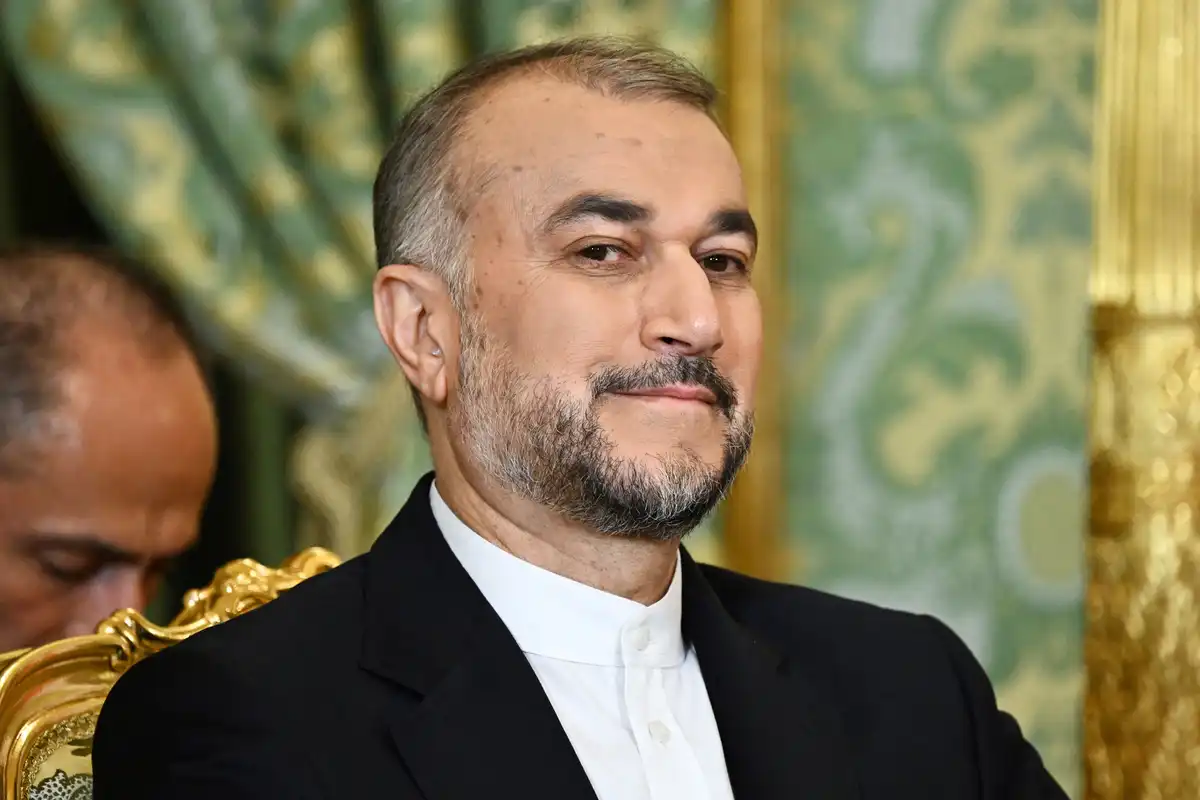
Iranian Foreign Minister Hossein Amir Abdollahian and his British counterpart David Cameron exchanged views on escalating tensions in the Red Sea as well as the conflict in Gaza.


During a phone conversation, Amir Abdollahian accused the United States and some Western countries of applying double standards, according to a statement issued by the Iranian Ministry of Foreign Affairs.


He said it was wrong to allow Israel to “kill women and children in Gaza” and “set fire to the region,” while “the arrest of an Israeli ship in the Red Sea is seen as endangering the security of the economic waterway.”


The Iranian diplomat also condemned the silence of some Western governments regarding the Israeli attacks on Gaza during the past 80 days.


Amir Abdullahian also urged Britain to adopt a "realistic and constructive" approach to regional developments and bilateral relations.
On the other hand, Cameron expressed his country's views regarding developments in Palestine and the Red Sea, and urged Iran to help prevent an escalation of the conflict between Israel and Hamas and ensure maritime security in the region, according to the Iranian statement.


In a post on the social media platform ((X)), Cameron stated that he spoke to Amir Abdullahian about the Houthi attacks in the Red Sea, which he said threatened the lives of innocent people and the global economy.


Cameron said he had made it clear that Iran shared the responsibility for preventing these attacks, given its long-standing support for the Houthis.
The Yemen-based Houthi group has claimed responsibility for several attacks on commercial ships in the Red Sea in recent weeks, saying they came in solidarity with the Palestinian people. American and British officials accused Iran of "being behind these attacks," which Iran strongly rejected.

PALESTINE

Mon 01 Jan 2024 11:38 am - Jerusalem Time

West Bank: Israeli forces arrest 13 Palestinians, including a woman, in Qatana, northwest of Jerusalem

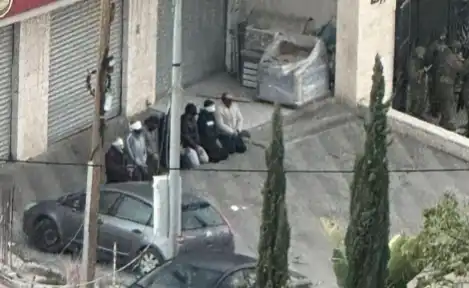
Today, Monday, the Israeli occupation forces arrested 13 citizens, including a woman, and summoned others, in the town of Qatana, northwest of occupied Jerusalem.


Local sources said that the occupation forces arrested: Lawyer Abdullah Hoshiyeh, Mustafa Tabanja, Imad Shamasneh, Mahmoud Shamasneh, Iyad Mohsen, Laith Al-Faqih, Muhammad Osama Dawoud Hassan, Youssef Hassan Al-Faqih, Jamal Joudah Hawsheba, Abdullah Hoshiyeh, and Jihad Jabr. Deacons, and Yaqoub Al-Faqih.


The same sources added that the occupation forces arrested Umm Assef Shamasneh, to pressure her children to surrender.


It indicated that these forces handed over reports to others to review their intelligence.


The occupation forces also set up a tent in the middle of the town, and began field investigations with dozens of citizens, after storming their homes.


ARAB AND WORLD

Mon 01 Jan 2024 10:53 am - Jerusalem Time

Blair denies to Al-Quds that he is preparing a plan to facilitate the displacement of Gazans

In a call with Al-Quds.com, former British Prime Minister Tony Blair denied what was reported by Israeli Channel 12 yesterday evening, that he would head a team working to convince European countries to receive refugees from the Gaza Strip.


Blair denied that he had discussed any such plan with Prime Minister Benjamin Netanyahu and War Council Minister Benny Gantz.


According to the channel, the goal of this visit is to be an envoy who will actually mediate between Israeli desires “the next day” after the war on the Gaza Strip, and between the moderate Arab countries, and to study the possibility of accepting refugees from Gaza in the countries of the world.


Later, Channel 12 reported that Tony Blair's spokesman denied what was contained in the channel's report and said: "The reports that Tony Blair has a connection to voluntary immigration are incorrect, and there was no such discussion and he does not intend to look into it either."


This comes as Israeli Finance Minister Bezalel Smotrich renewed his call on the Palestinians in Gaza to leave the Gaza Strip, “to make room for the Israelis who can transform the desert into prosperous valleys.”


Smotrich's statements seem to confirm widespread fears that Israel wants to expel the Palestinians from the lands on which they want to build their future state, in a repeat of the mass exodus of Palestinians that followed the declaration of Israel's establishment in 1948.


“What needs to be done in the Gaza Strip is to encourage immigration,” Smotrich told Army Radio. “If there were 100,000 or 200,000 Arabs in Gaza and not two million Arabs, the discussion for the next day would be completely different.”

He added that if Gaza's 2.3 million residents who "were raised with the ambition to destroy the State of Israel" left their land, Gaza would be viewed differently in Israel.

He continued: “Most members of Israeli society will say, ‘Why not, it is a beautiful place.’ Let us turn the desert into thriving valleys, and this does not come at the expense of anyone.”

Smotrich, whose far-right Religious Zionism party enjoys the support of the Israeli settler community, made similar statements in the past, entering into a dispute with the United States, Israel's most important ally.
The Palestinians accuse the occupying state of seeking a new “nakba,” similar to what happened following the 1948 war, when hundreds of thousands of Palestinians were forced to flee their homes when the establishment of Israel was declared.

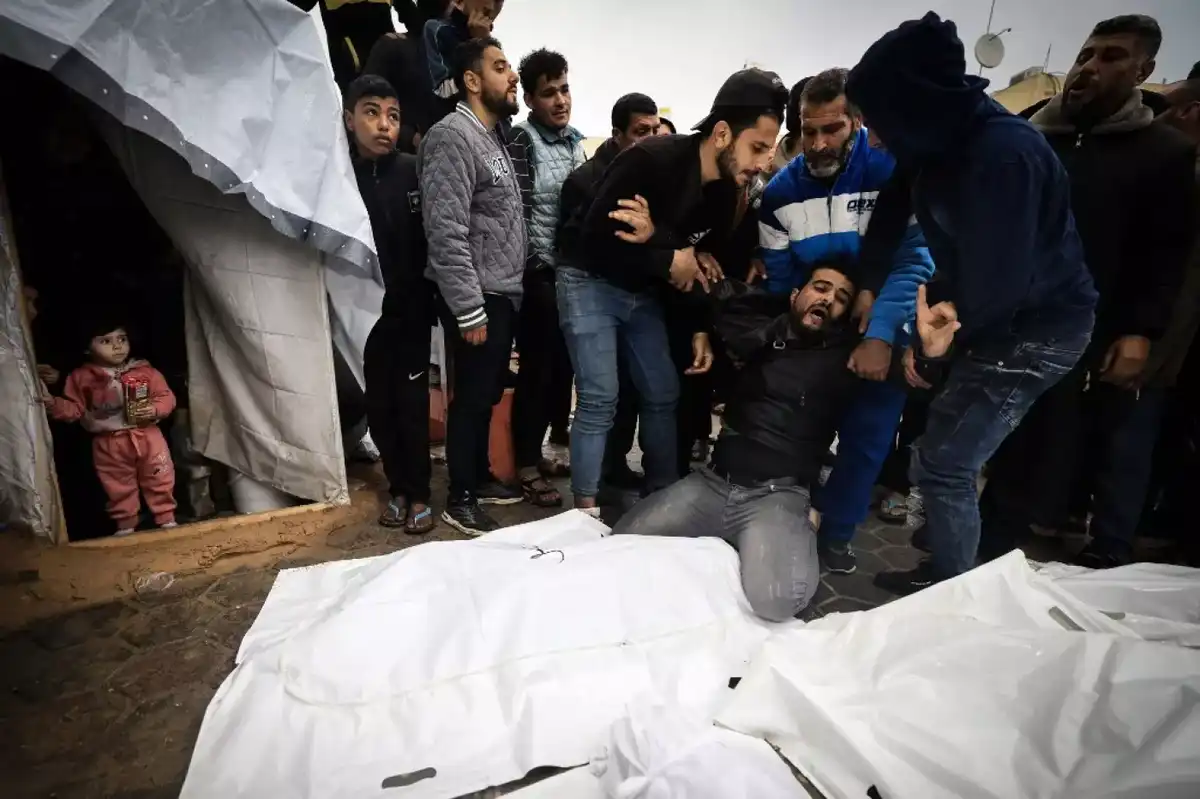
Since last October 7, the Israeli army has been waging a devastating war on Gaza, which as of Sunday left 21,822 dead, 56,451 wounded, massive infrastructure destruction and an unprecedented humanitarian catastrophe, according to the Gaza Strip authorities and the United Nations.

OPINIONS

Mon 01 Jan 2024 10:04 am - Jerusalem Time

War in Gaza. “Genocide constitutes the supreme crime”

L’Humanité

L’Humanité

Opinion Writer


Olivier Corten is professor of international law at the Free University of Brussels. The accusation of “genocide” brought against Israel before the International Court by South Africa could, according to him, change the situation in the conflict.


Elisabeth Fleury

“As early as October 19, several UN special rapporteurs warned of a “risk of genocide” before reiterating their warnings, based both on the systematic and massive nature of the attacks on Gaza, on the number significance of Palestinian victims and on certain particularly shocking statements by senior Israeli officials,” recalls Olivier Corten, professor of international law.


South Africa has just petitioned the International Court of Justice (ICJ) to condemn Israel for “genocide”. Does this surprise you?


No. This approach did not surprise me. It is open to any party to the “Convention for the Prevention and Punishment of Genocide” adopted in 1948, whether or not that party is directly affected by such a crime. This is not the first time that the ICJ has been contacted in this way. Its judges had to rule in the context of conflicts which pitted Bosnia against Yugoslavia and Croatia against Serbia in the 1990s. Two other requests are currently being examined: the first targets Russia, at the initiative of the 'Ukraine. The second, filed by Gambia, accuses Myanmar of genocide against the Rohingya.


Invoking the notion of genocide, in this case, is it relevant?


On the scale of international crimes, genocide constitutes the supreme crime. This notion is therefore not used lightly and refers to particularly demanding criteria. For there to be genocide, there must be an intention to destroy, “as such”, an ethnic or religious group. This was the case with regard to the Jews during the Second World War, the Shoah having directly inspired the development of the 1948 convention. This was also the case in July 1995, in Srebrenica, when nearly 8,000 men and Bosnian teenagers were liquidated by Serbian forces on the orders of General Mladic. In the present case, from October 19, several UN special rapporteurs warned of a “risk of genocide” before reiterating their warnings, based both on the systematic and massive nature of the attacks on Gaza. , on the significant number of Palestinian victims and on certain particularly shocking statements by senior Israeli officials. The hypothesis that a genocide is underway must therefore be taken very seriously.


And yet the United States continues to deliver weapons to Israel...


Yes. And this could be considered a violation of international law. Because the 1948 convention does not just prohibit genocide. It also obliges its States parties to try to prevent it from being committed. By continuing to deliver weapons to Israel, despite repeated warnings from observers, the United States is doing the opposite. They take the risk of being accused of having also violated the convention.


We must therefore closely follow what the ICJ will say…


Absolutely. His decision will be made in two stages. First, the emergency. The judges in The Hague will very quickly hear representatives of South Africa and Israel and, if they consider that there is indeed a risk of genocide, they will be able to decide on precautionary measures to put an end to it. Secondly, they will have to establish, on the merits, whether Israel has indeed failed in its obligation to prevent or repress genocide within the meaning of the convention. In this phase, the other States parties to the 1948 Convention could also intervene to explain their position regarding the interpretation of this convention. The judges' decision could take months, even years, especially since Israel could also increase the number of preliminary objections on which the Court would have to rule before addressing the merits.


And all the while, the number of civilian casualties continues to rise every day...


The State of Israel has repeatedly shown a flagrant lack of respect for the decisions taken by the competent United Nations bodies. Furthermore, the decisions of the ICJ, which are legally binding, are in principle guaranteed their application by the Security Council on which the United States sits. This provides two good reasons to believe that South Africa's approach will only have symbolic significance. But limiting ourselves to this reductive approach would be a mistake.


For what ?

Firstly because the judges of The Hague enjoy an excellent reputation. Their independence is unanimously recognized and most of their judgments are respected. Then, because South Africa’s initiative could gain momentum. Other states could indeed join in, and the unconditional support of the United States or others for Israel would then become increasingly problematic. However, it is difficult to predict which way the Court will rule. The judges are unlikely to unilaterally castigate Israel. They could demand more generally that all parties take all possible measures to prevent or repress acts of genocide. Regardless, if they admit that the Genocide Convention is relevant to judging the events taking place in Gaza, that could be a game-changer.


ARAB AND WORLD

Mon 01 Jan 2024 9:48 am - Jerusalem Time

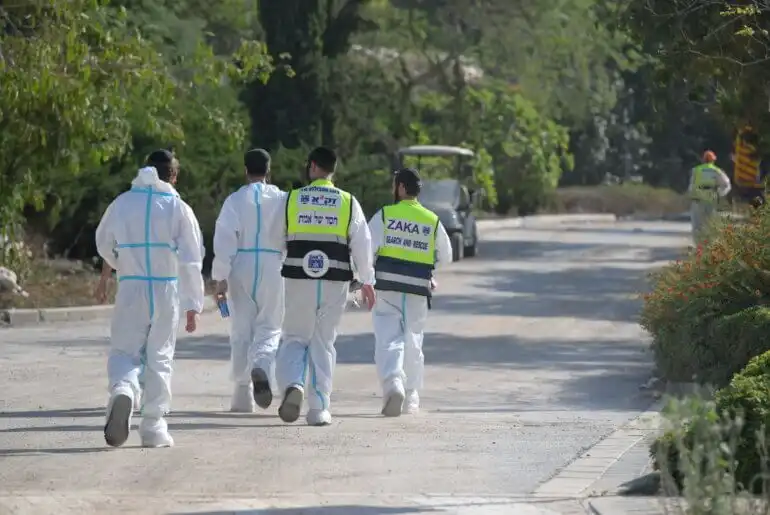
ZAKA is not a trustworthy source for allegations of sexual violence on October 7

ZAKA is one of the leading organizations alleging Hamas atrocities on October 7. But the organization’s volunteers have systematically given false testimonies, and continue repeating them to journalists on behalf of the Israeli government.


Many of the reports in Israeli and international media networks — including CNN, the BBC, the New York Times, and many others — that accuse Palestinians of committing systematic wide-scale gender-based violence against Israeli women on October 7, 2023, rely on testimonies by Israeli ZAKA volunteers.

ZAKA is a non-governmental religious Haredi organization specializing in collecting dead bodies and body parts from sites of “unnatural” deaths and transporting them to morgues according to strict Jewish religious laws. The organization was founded in the late 1990s by Yehuda Meshi-Zahav. Meshi-Zahav was previously the leader of “Keshet,” an ultra-Orthodox Jewish terrorist group that targeted forensic pathologists and used explosives against shops selling “secular newspapers.” Meshi-Zahav led ZAKA until 2021, when he attempted suicide after shocking revelations of dozens of rape and sexual assault cases committed by him. Since its inception, the organization — described as a “militia” by the highly esteemed Israeli journalist Yigal Sarna — has been subject to incessant criticism, investigations, and demands to dismantle it.


The testimonies provided by ZAKA’s members — all men, most of whom are volunteers — on sexual violence on October 7 are based on their interpretation of what they claim to have seen on bodies they collected after the attack. Not only do these men lack the professional qualifications to make such assessments (they are not medical experts), but their testimonies also lack details: no age, no location, and no time. Details and/or evidence have not even been given to journalists who have asked to see them while reporting on these testimonies. This means that it is impossible to either confirm or debunk them. In other words, the organization’s testimonies hold no value unless one blindly trusts what its men say.

Since October 7, ZAKA has been playing a key role in Israel’s orchestrated propaganda campaign, spreading fake news and vague information in the service of Israel’s genocidal war on Gaza. Looking closely into ZAKA reveals that the organization and its volunteers lack credibility. In fact, a significant part of their testimonies has been proven to be fabrications. “We need to buy time, which we also buy by turning to world leaders and to public opinion. You have an important role in influencing public opinion…[ZAKA testimonies] give us the maneuvering room. “Prime Minister Benjamin Netanyahu to ZAKA teams.

For those familiar with the organization, this is consistent with the organization’s questionable reputation. The organization has a troubled and problematic history that further undermines its legitimacy and credibility, from involvement in massive cases of sexual violence and silencing victims to financial corruption and the exploitation of tragic deaths to enhance its media appearance and grow its financial resources.

ZAKA’s reputation for spreading fake news has been known since its early years of activity. As the Israeli Army Radio correspondent in Jerusalem stated back in 2002, “ZAKA sends everything: what happened, what they think happened, and what didn’t happen as well. We verify everything, but they fulfill our need to know as quickly as possible…in the past, they sent numerous pieces of news that turned out to be lies.” 


Vital role in government propaganda


On November 12, 2023, the Israeli website Ynet published a report about how ZAKA was recruited to join Israel’s hasbara campaigns on the events of October 7, and conducted interviews with dozens of foreign journalists coordinated through the Government Press Office. Hasbara is the Israeli term for “public diplomacy” or government propaganda campaigns.

The director of the GPO, Nitzan Hein, stated, “It is difficult to imagine the Israeli hasbara with foreign correspondents without the remarkable, valuable, and effective role of ZAKA’s men. Their activity is extremely important in hasbara.” ZAKA also closely collaborates with the National Hasbara Headquarters in the Prime Minister’s office. One of the employees in the headquarters told Ynet how the state “worked on cementing the narrative that Hamas equals ISIS and enhancing the state’s legitimacy for a very forceful response…ZAKA’s men’s testimonies have shocked and exposed, in front of the correspondents, the kind of human monsters we are dealing with.”


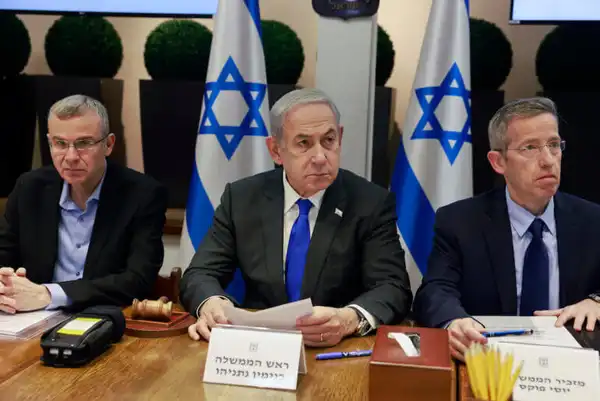
On November 23, 2023, Prime Minister Benjamin Netanyahu met with the organization’s teams. The meeting revolved around their role in Israeli propaganda. The Prime Minister heard from the volunteers “about their public diplomacy activity in Israel and the world” and urged them to intensify their efforts, as they are important for legitimizing and extending the timeframe of the war: “But we need to buy time, which we also buy by turning to world leaders and to public opinion. You have an important role in influencing public opinion, which also influences leaders. We are in a war; it will continue. The war is not only to take care of the 1,400 people…but also to give us the maneuvering room.”“


Non-governmental” organization


ZAKA utilizes its official designation as a “non-governmental” body to present itself as credible, and it is this supposedly independent status and ostensible lack of politicization that gives it particular legitimacy — by the organization’s own admission. For instance, one spokesperson for ZAKA told Ynet, “Being a voluntary organization without a political agenda leads to openness and more receptiveness…our testimonies are fully accepted as if they are dealing with an international humanitarian volunteer or a doctor.” In practice, the status of ZAKA is more complex in terms of both function and legal status. This complexity makes disseminating fake news effective while allowing them to evade responsibility. ZAKA is technically a non-governmental organization, but it enjoys significant governmental funding, working in full coordination with security and rescue forces. Indeed, ZAKA is recognized by the state as the only entity responsible for dealing with dead bodies in “unnatural” deaths.

In terms of political agenda, ZAKA is open about operating from and being guided by Zionist ideological objectives.

According to Yehuda Meshi-Zahav, ZAKA is also “acting as an arm for the Ministry of Foreign Affairs,” and “Ideologically, we are a nationalist organization seeking to integrate the Haredi public within Zionism.” 

In 2015, the Israel Medicine Association issued guidelines regarding “mass casualty incidents” and how to prioritize the order of medical attention according to the injury severity following objective medical standards. In response, ZAKA’s “operation unit commander” stated that “he puts aside medical consideration and decisions are made on who deserves treatment based on whether they are Jewish.” This policy was dictated by the religious ruling by Rabbi Chaim Kanievsky, who said during the discussion: “If it’s clear he is an Arab, don’t save him.” A fake medical image and a track record of false testimonies

ZAKA’s men deceivingly draw on a false image of medical credibility, which is designed to make their testimonies trustworthy. However, the organization’s volunteers lack any medical or healthcare qualifications, and its members are not qualified to infer or confirm any medical or forensic assessment of the bodies. ZAKA men are solely trained to recover and collect dead bodies according to strict religious laws, to ensure the dignity of the deceased, and to prepare bodies for burial.

Most of the so-called witnesses who were interviewed by media work in industry and commerce. Furthermore, as an orthodox Haredi organization, it has a radical religious position against autopsies and forensic procedures. In fact, it is within the organization’s official mandate to work to prevent autopsies, and the organization takes legal action to prevent having to comply with the state’s requests for forensic autopsies.

This murky position between governmental and non-governmental, medical and non-medical, facilitates ZAKA’s ability to lie without bearing responsibility. In early December, when an investigation by Haaretz uncovered several lies propagated by the organization’s men since October 7, ZAKA’s official response was: “ZAKA volunteers are not medical experts and do not have the professional means to identify the deceased, ascertain their age, or declare the manner in which they were killed…due to the difficult condition of the bodies, it’s possible that volunteers misinterpreted what they saw.” Among ZAKA’s lies, Haaretz listed a falsehood about the “bodies of twenty children with severed heads,” “piles of burned children,” and a “pregnant woman’s stomach ripped open, and her fetus stabbed.” It is hard to conceive of all these false testimonies as accidental “misinterpretations.” 


Simcha Greiniman’s testimonies

In early December 2023, Israeli organizations held a session at the United Nations on the allegations of sexual assault on October 7. One of ZAKA’s men, Simcha Greiniman, spoke and was identified by some media outlets as the organization’s foreign media spokesperson. His testimony was featured in a position paper by Physicians for Human Rights Israel on gender-based violence on October 7. A settler from the illegal “Modi’in Illit” settlement on the lands of the Palestinian villages Bil’in, Ni’lin, and Saffa, Greiniman’s main profession is carpentry, but he takes pride in his media performance: “They say I do a good job. When I sit in front of a foreign journalist, even if he is anti-Israel, I can make him cry,” Greiniman told Ynet. This was evident in his testimony to the United Nations. His speech was emotionally intense. He delivered it very slowly, interrupted by sips of water, holding back tears, and struggling with speech. 

However, while the testimony focused on three different alleged cases, he gave zero concrete details that can be confirmed or disproven. While it is understandable that he did not mention the victims’ names, he omitted other details that could have been mentioned for credibility, such as their ages, the name of the town where he saw these bodies or the time of finding them. In one case, he couldn’t even discern if the victim was male or female.

One might assume that Greiniman accidentally omitted these details due to his intense emotions. However, this was a premeditated decision: the British news website iNews published an interview where he presented the same testimony. When asked about the name of the kibbutz from which he described one of the scenes, he refused to answer. Any possible reason? Previous false testimony exposed

Previously, Greiniman presented a horrifying story about two burnt bodies of children found under the rubble of a house in Kibbutz Be’eri. This story first appeared in a long interview with Greiniman on October 19, 2023, spanning two pages in a local Haredi newspaper. No further details about the incident were mentioned there.

Later, he repeated the story twice, but the story evolved in its details. On November 7, in an interview with the Haredi site “Kikar Shabbat,” he added that the age of the first child was 5 or 6 years old. As for the second child, whose age was not specified, he claimed the child was found with a large knife lodged in his face. The next day, former minister Ayelet Shaked posted a video of Greiniman stating that the second child was 3-4 years old.According to Israeli lists, the closest ages of the deceased children in Be’eri are either 12 years old or 10 months old, and there are no children matching the ages mentioned by Greiniman. Furthermore, in the case of Be’eri, several testimonies by survivors have confirmed intense battles, with survivor Yasmin Porat testifying that the 10-month-old infant was killed by a shell from an Israeli tank amid gunfire exchanges. However, in his testimony, Greiniman stated that when he entered Be’eri, he “did not find any signs of fighting whatsoever.”


Baseless data

Several pieces of strange information emerge in ZAKA interviews. For instance, Greiniman reiterated in one of his interviews that “85% of the bodies of women arriving at the morgue were naked.” Despite the hundreds of workers at the Shura Military Morgue, this detail has not been repeated anywhere. Some have spoken about the presence of “some” or “many” naked bodies, but no one came close to describing the quantity and proportion as Greiniman did.


Another official from ZAKA, Yossi Landau, claimed that “80% of the bodies showed signs of torture.” In another interview, the same official said, “70% of the bodies were shot from behind.” Later, he said that “80% were shot in the back.” None of the statistics above was ever officially stated or confirmed.

Another baseless claim is Greiniman’s testimony that they found in the pockets of Hamas fighters’ bodies foreign ID cards that prove “the fighters came from different countries.”Greiniman also claims to have seen a video in which Hamas fighters killed Gazan workers who worked with permits inside Israel. Greiniman assured the interviewer that the fighters “knew they were from Gaza” because “the car plate was Palestinian…and you cannot mistake a person from Gaza. Their appearance is different from Israelis, even from Israeli Arabs, the mentality is different.”

This is another baseless lie. Apart from the racist assessment that “their appearance is different, the mentality is different,” there is no video showing such an incident. Moreover, Gazan workers are not allowed to enter Israel with cars, and Palestinian car plate numbers are generally not permitted in Israel, except in very rare cases of businesspersons and VIP permits.

In the same interview and others, Greiniman asserts that he has photos proving everything he says. He challenges anyone in doubt to come to Israel to personally show them the photos. However, in his interview with the Times of Israel on November 9, 2023, he was asked about the photos and replied: “I don’t have one picture in my phone.” Times of Israel reports that Greiniman claims that “some emergency workers did photograph other scenes and sent pictures directly to official authorities.” They, however, add that: “The Times of Israel was not able to obtain images from various government sources.”


Yossi Landau, another source of fake news

The earliest mentions by ZAKA members of rape allegations appeared in the testimonies of Yossi Landau, a central figure in the organization who made multiple international media appearances. His testimony was also endorsed, without any verification of authenticity, by Physicians for Human Rights Israel in their report that accuses Palestinians of using sexual violence as a weapon of war. YOSSI LANDAU. (PHOTO: WIKIMEDIA COMMONS)Similar to Greiniman, Landau has also been discovered to have disseminated fake news. On December 3, 2023, Haaretz published a report detailing several false testimonies disseminated by Israeli entities, confirming Landau’s personal responsibility for propagating some of these fake stories.

Among Landau’s lies was the myth of “dozens of beheaded children,” a claim that was refuted. Another reported lie was about the piles of children’s bodies burned together, a narrative that he repeated time and again, likening it to the Holocaust.

Landau also claimed, while crying in front of foreign reporters, to have seen “a pregnant woman, her abdomen ripped open, with the fetus outside her womb tied by the umbilical cord, and the fetus itself stabbed with a knife.” This has also proven to be a fabrication. Haaretz refuted any knowledge of a similar known case and interviewed the residents of the kibbutz, who denied the existence of such a case or even of a pregnant woman among their neighbors. Landau’s lies shouldn’t come as a surprise. In a conversation with foreign journalists, he said, “When we go into a house, we use our imagination. The bodies were telling us stories that happened, that’s what happened.” Disturbingly, despite being proven to be a pathological liar, Landau’s testimonies are still cited in PHRI publications and are circulating in major international media networks, including The New York Times‘ latest report on “how Hamas weaponized sexual violence on Oct. 7”.In the Times article, 


Landau claims that ZAKA volunteers are not allowed to take pictures. Other volunteers, such as Haim Otmezgin and Simcha Greiniman, assured reporters that they have photos. The Times report also says that ZAKA volunteers “inadvertently” destroyed evidence. Sources in the Israeli army claimed this happened when ZAKA members changed the body bags to take photos of the bodies in bags bearing their logo.


Haim Otmezgin defending rape victims?

The head of ZAKA’s “special unit,” Haim Otmezgin, testified on November 30 in front of the “Women’s Affairs Committee” in the Israeli Parliament.

The Israeli press widely covered the testimony, which was endorsed by many Israeli women’s organizations. When he posted the video of his testimony in parliament on his Facebook page, he wrote: “The world needs to know in order to support us and enable us to accomplish the task.” Like other testimonies by ZAKA’s men, his testimony lacked information and repeated false stories (beheaded babies, again). Otmezgin claims to “possess photos” of “a naked woman with a sharp object stuck in her crotch.” Nearly two months into the propaganda campaign, not a single journalist reported seeing these pictures. This isn’t the first time he has claimed to have evidence unseen by anyone else.


Since we are left to believe Otmezign’s words with no evidence to back them up, we must question his credibility. Otmezgin is a reserve soldier in the Israeli army and the owner of a human resources company. His name appeared in the press earlier this year after his participation in the Israeli rescue team following the earthquake in Turkey. Upon his return, Turkish authorities opened an investigation against him, accusing him of stealing and smuggling from Turkey into Israel an antique manuscript from “the Book of Esther” found under the rubble. But when it comes to believing Otmezgin, one must consider his connection to ZAKA’s founder, Yehuda Meshi-Zahav.


ZAKA leaders and the silencing of rape victims

In 2021, two investigative reports shook Israel. The first appeared in Haaretz newspaper, followed by TV reportage by the investigative news program Uvda. Both presented testimonies from victims of sexual assaults committed by the ZAKA founder over decades against both males and females, including children from the age of 12 and adults. The victims confirmed that those sexual crimes were widely known in Meshi-Zahav’s surroundings, likely also to Otmezgin, who was one of his closest trusted friends and worked alongside him for over 25 years. Otmezgin publicly defended Meshi-Zahav, even after a series of testimonies emerged: “I recently spoke to him, asked how he’s facing the case, how he spends these days, supported him, and we talked about faith matters. Anyone who knows him knows he cannot harm any person.” But Haim Otmezgin wasn’t the sole supporter of Meshi-Zahav. The ZAKA leadership, which is still in power, provided full support for him as well. Meshi-Zahav, according to evidence, used the organization’s funds, volunteer cards, and other properties for his criminal acts. In one of the first testimonies that emerged in Haaretz, a woman recounted how Meshi-Zahav threatened her during the rape: “If you utter a word, a ZAKA truck will run you over.” Once the police investigation began, investigators announced they planned to interrogate the organization’s leadership on suspicions of silencing victims and concealing evidence. With Meshi-Zahav’s suicide, the file was closed. 


In June 2023, Channel 12 revealed that the ZAKA organization, using donation funds, hired a private investigation office to track and gather smearing information about Isaac Weinhaus, an Orthodox Jewish activist working to expose sexual violence in the community. Weinhaus was one of the figures who contributed to breaking the silence surrounding Meshi-Zahav.


The fact that women’s organizations are now endorsing the statements of ZAKA leadership and demanding the world to blindly believe Meshi-Zahav’s defenders when it comes to the events of October 7 is not only absurd and cynical but is indicative of how deep anti-Palestinian racism runs.




OPINIONS

Mon 01 Jan 2024 9:41 am - Jerusalem Time

Israel is provoking the U.S. into a conflict with Iran — but the media ignores the danger

Mondoweiss

Mondoweiss

Opinion Writer

In addition to killing thousands of Palestinians in Gaza, Israel has been routinely attacking at least four other nations in the region: Iran, Yemen, Syria, and Lebanon. Why does the U.S. media keeps the American public in the dark?


BY JAMES NORTH  


For years, this site has warned that Israel, especially Benjamin Netanyahu, have tried to instigate the U.S. into a wider war in the Mideast, particularly with Iran. We’ve also regularly indicted the U.S. mainstream media for ignoring this danger.

Today, the threat is greater than ever. And, true to form, the New York Times, National Public Radio, and the others continue to cover it up, instead treating Netanyahu as the embattled but honest leader of an Israel that is only trying to defend itself. For more than a decade, Netanyahu’s main aim was to destroy Iran’s alleged (and unproven) program to build nuclear weapons. He openly tried to sabotage the Obama administration’s successful nuclear deal in 2015, and then vigorously encouraged Donald Trump’s abrupt decision to end the agreement 3 years later. 
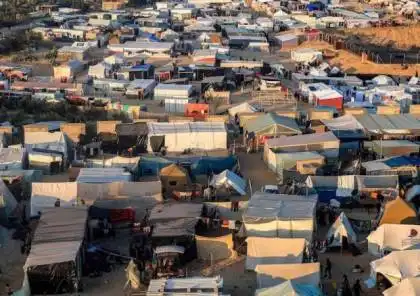
Secretly, Israel conducted a long campaign of sabotage against Iran, which included cyber warfare, and actual assassinations inside the country, including the November 2020 killing of an Iranian scientist, Mohsen Fakhrizadeh. Netanyahu wanted to provoke Iranian retaliation, which would draw in the U.S., and — he hoped — trigger an American attack that that would set back or even destroy Tehran’s nuclear program.

Since October 7, the stakes for Netanyahu are much higher. Israelis blame him for the Hamas attack, and the opinion polls show his popularity has never been lower. A number of Israeli commentators have called him the worst leader in the country’s history. If just a handful of members from his own coalition in the Knesset abandon him, his government will fall, and he will be trounced in new elections. Even worse, the pending court cases against him for corruption will then revive, and he could well end up in prison.

Luring the U.S. into a conflict with Iran will distract from his own troubles, and give him time to maneuver. So: On December 24, an Israeli air strike assassinated Iran’s top commander in Syria, Razi Mousavi. The always valuable Iranian/American expert Trita Parsi, asked: “Did Israel kill Iranian commander to provoke a wider war?” Also last week, a cyber attack “caused two-thirds of Iran’s gas stations to suddenly stop working,” yet another sabotage effort with Israel’s fingerprints all over it. No country will be able to endlessly ignore such provocations.(Netanyahu is not the only Israeli leader who wants the U.S. to attack Iran. Former prime minister Naftali Bennett just published an opinion article in the Wall Street Journal headlined: “The U.S. and Israel Need to Take Iran On Directly.” He disclosed 2 secret Israeli attacks inside Iran during his 2021-2022 tenure as prime minister: the destruction of a drone base and the killing of an Iranian military commander. After the article appeared, some Israeli officials criticized Bennett “for revealing classified information saying that he was potentially putting the country in danger.”)

The New York Times did run a brief report on the December 24 air strike that killed Ravi Mousavi in Syria. But the article was a model of dishonesty. The paper feigned ignorance in the report’s opening sentence: “Iran accused Israel on Monday of killing a high-level military figure in a missile strike in Syria at a time when concerns are growing that the war in Gaza could escalate into a regional conflict.” Nowhere do we learn that many observers, including some Israelis, believe that Netanyahu may actually want a wider conflict, as long as he can embroil the U.S. in it.

National Public Radio was even worse. In recent days, the network ran three on-air reports, including one from a correspondent in the region. The broadcasts were uniformly inept. They barely mentioned Israel’s provocative killing of Mousavi. In one, host Leila Fadel asked: “Does the U.S. or Iran really want this to become a regional war?” Somehow, she forgot to add Israel or Netanyahu to her question, although anyone who follows the story using a range of non-U.S. mainstream sources, even including some in Israel itself, would have known to broaden the inquiry. The Washington Post report has a single throwaway sentence about how an “airstrike” by an unnamed air force killed a “senior [Iranian] officer” in Syria. That was it.

Of course, the situation in the region is complicated. Ansar Allah, Iran’s allies (commonly referred to as the Houthis) who control much of Yemen, have been attacking shipping in the Red Sea, and Hezbollah, the political/military movement in southern Lebanon that is also allied with Iran, has been clashing with Israel across their mutual border. (This site’s estimable Mitchell Plitnick has explained at length how the Biden administration’s flawed response to the Red Sea shipping crisis could also trigger a broader conflict.) It is doubtful that even Benjamin Netanyahu would want to widen the conflict to bring in either of these other two actors.


But what makes Israel’s provocative killing of General Mousavi and its latest cyberattack even more dangerous that it also raises the risk of a lethal accident. Let’s go back to July 1988, when tensions in the region were similarly high. A U.S. Navy warship in the Strait of Hormuz accidentally shot down a civilian Iranian jetliner, killing all 290 people on board. Iran did show restraint, and so the conflict thankfully did not escalate further. 

Today, the danger is arguably even higher. Israel continues to murder thousands of Palestinian civilians in Gaza and attack at least four other nations in the region: Iran, Yemen, Syria, and Lebanon. Israel’s desperate leader is rolling the dice for his last time, and the Biden administration is letting him get away with it — while the U.S. media keeps the American public in the dark. The chances for a greater tragedy are high. 


OPINIONS

Mon 01 Jan 2024 9:27 am - Jerusalem Time

The Gaza War and the Palestine War!

Hazem Saghieh

Hazem Saghieh

Opinion Writer

In politics, preferring intentions over outcomes, and action - any kind of action - over thinking, and choosing the noisy and tumultuous over the calm or measured, are among the defining characteristics of a romantic mindset.

We thus see, for instance, that the call for establishing a "Palestinian state," which the Palestine Liberation Organization advocated after realizing that violent methods were a dead end, and which was later endorsed by Arab and international states and institutions, did not become a popular slogan that spoke to and stimulated the popular imagination. This slogan has always seemed insufficient for alleviating the masses’ accumulated frustrations. Moreover, it does not turn attention away from genuine concerns in the countries around Palestine, concerns that some regimes in our region were keen on turning attention away from. Consequently, the slogan of a "Palestinian state" is a "dwarf" compared to the "giant" that is "liberating Palestine from the river to the sea, annihilating Israel," or "liberating Al-Aqsa." That is part of a robust tradition of Arab political culture: even Gamal Abdel Nasser, who is not generally associated with workable strategies, could not make his famous yet modest slogan of "removing the effects of aggression" popular, unlike almost everything else associated with the Egyptian leader.

However, Benjamin Netanyahu, and his friends on the furthest end of the Israeli right, thought differently: they knew that the “giant” slogan did not scare them, and that, in the end, it was hot air that would vanish in the heat of the Arab streets. If it did scare them, they could dispel their fears through their military and technological superiority and their infinite capacity for killing Palestinians. When Iran became the region's largest giant slogan factory, the Israelis became more convinced that the real issue was not the slogans but the specter of Iran developing a nuclear weapon. As for the slogans, they are frail to an extent that has rendered them a game Tehran uses.

Netanyahu and his political school were and remain consistent on one matter: they are afraid of seeing this Palestinian state that has failed to capture our collective imagination come to light, as the emergence of such a state is feasible in principle. Moreover, the unequivocal justness of this demand undermines the narrative that Netanyahu and his allies have been using to blackmail the world: Israel’s existence is constantly questioned and threatened. On the other hand, such a state fulfills both Arab and international demands, paving the path for its legitimation.

This awareness led Netanyahu to bet on killing it, sometimes through procrastination and evasion, breeding despair among Palestinians and leaving the world disillusioned, and at others through direct violence, which began with the assassination of Yitzhak Rabin by an extremist right-winger (a move that found a partner in Arab and Iranian rejectionists, albeit from opposite position), and thirdly, by supporting Hamas. Since October 7, Israeli and international media outlets have been brimming with reports about the Israeli leader's facilitations to the Islamic movement, be it by allowing the entry of Qatari aid into the Gaza Strip or consistently giving Gazan workers preferential treatment. This support aimed to foster a distinct entity in Gaza that encouraged independence from the West Bank.

With a Palestinian state seemingly the only possible theoretical solution, Netanyahu's war on the Oslo Accords continues. He recently called it the founding father of the October 7 attack and took a hard line in opposing the return of the “Ramallah Authority” to Gaza.

The fact is that Israel can, as we are seeing today, retaliate to the Hamas attack with security and military operations, and by ratcheting up its genocidal brutality, which is helped by the fact that Hamas is a non-state actor. On the other hand, the attack helps strengthen the hateful ideology of the extreme right - the Likud's bloc also calls for a state “from the river to the sea,” as well as reinforcing accusations of anti-Semitism, which are brandished with or without reason to blackmail others. In addition, the October 7 attacks could be used as a pretext for bringing the global far-right together in backing a universal war against “ISIS terrorism,” as Netanyahu called it, and in the meantime getting away with paying the massive debt the Israelis owe the Palestinians. As for a legitimate Palestinian state, it is the only thing that could undermine this extreme right ideology and its raison d'etre, deny Netanyahu the talking points that Hamas provides him with, liberate the Palestinian cause from the clutches of Iranian-Israeli competition, and end wars instead of fanning their flames in perpetuity.

In this sense, two wars are being fought today: a destructive one, the Gaza war, and a political one, the Palestine war. While some have claimed that October 7 “put Palestine on the table,” the total opposite seems to be true, unless the Gaza war manages to find shade under the Palestine war and the forces of Gaza can stand behind the forces of Ramallah. That is perhaps precisely what is being engineered today in Cairo and Doha, and perhaps elsewhere as well.

However, the theoretical solution, the Palestinian state, will not emerge unless we see shifts in Palestine itself, as well as Israel. Besides the Israelis removing Netanyahu and his ilk and showing genuine readiness to resolve the settlement issue (there are 750,000 of them) in a way that paves the way for a Palestinian state, what is required, above all else, is sharpening a Palestinian political instrument and rendering it vigorous and dynamic, qualities that do not apply to the current Ramallah authority. Although bringing about this happy eventuality will not be simple, easy, or swift, its slow emergence late on certainly remains better than its non-occurrence.

Source: Alsharq Alawsat

ARAB AND WORLD

Mon 01 Jan 2024 9:17 am - Jerusalem Time

Will Netanyahu's government collapse while the war still continues? He is being blackmailed by his most extremist allies

Although the normal date for the Israeli elections is in 2026, after the Al-Aqsa Flood operation shook the Israelis’ confidence in Netanyahu, calls began to escalate to isolate him and dismiss the Israeli government, but this matter requires an internal coup in Likud or the collapse of the government coalition.


A report by the Israeli newspaper Maariv says that in terms of strategic value: Is it right and wise to hold elections simultaneously with war? What if the Knesset was dissolved and Yahya Sinwar bragged by saying that “Netanyahu threatened to bring my head, and in the end I brought his head”? How will Israel manage a military campaign in the north amid a political campaign? What if submitting elections harms the management of the front against Hassan Nasrallah?


The second question is tactical: Who will press the button? Who will break up the government coalition alliance? The answer to this dilemma is not the best; It is an answer that does not provide a solution. But after October 7, there are no comfortable answers; but it is more disturbing, according to the newspaper.


The newspaper says that the principle that grants immunity to the ruler and the government as long as the war is ongoing characterizes authoritarian regimes. Neville Chamberlain and Joseph Stalin made a mistake in analyzing Adolf Hitler's intentions, just as Benjamin Netanyahu made a mistake in analyzing Sinwar's intentions. The British dismissed Chamberlain eight months after the outbreak of World War II.


As for the Russians, they were unable to dismiss Stalin. He continued to abuse, starve, kill, exile, and send his people to hard labor in labor camps. Therefore, when some claim today that the overthrow of Netanyahu and the dissolution of the Israeli government or the Knesset, or both, is tantamount to offering a gift to Hamas, it is like someone saying that the overthrow of Chamberlain was a gift to Hitler.


The prevailing dynamics in Israeli society call for the overthrow of the government. Since Israel's situation is closer to that of Britain at the beginning of World War II than to the Soviet Union, the public's influence will inevitably be focused on the political system.


The Israeli newspaper Maariv says that the best outcome as long as Israel is still fighting under a state of mistrust is to form a broad unity government without dissolving the Knesset and heading to elections, as proposed by Yair Lapid and Avigdor Lieberman. But this step is impractical; Because it is unlikely that the Likud will include five rational men who support this step.


How will the Israeli government collapse?

Therefore, the practical question is: Who will take the initiative and call for early elections? The obvious answer at this moment is Itamar Ben Gvir. The leader of the Jewish Greatness Party has the ability to dismantle the government in two ways: by remaining or stepping down, and both measures seem to reinforce this step, with the possibility that his stay will be more influential than his resignation.


Bezalel Smotrich's hesitation regarding taxation of sugary drinks and disposable dishes, as well as the mismanagement of coalition funds, despite being publicly criticized, also indicate that the government's days are numbered.


Every moment in power is of great importance, hence the frustration of the ultra-Orthodox Jewish partners with Ben Gvir, who is accelerating the government's demise. His recent actions, such as announcing that the term of Israeli Prisons Commissioner Kathy Perry would not be extended (in violation of the plan to form a war government) indicate a trend in which only those who comply with him will retain their positions.


Netanyahu appeases Ben Gvir with state funds, and this may hasten the overthrow of the government

In the case of Ben Gvir, as in other cases, Netanyahu chose to manage the conflict by providing financial incentives from the Israeli state treasury to this provocative minister. Ben Gvir reached a clear conclusion that provocation is not only permissible, but necessary to fortify and expand his support base. With every statement Netanyahu issues, Ben Gvir escalates to another level of provocation.


Each rise increases popular opposition to the government and accelerates the possibility of the departure of Benny Gantz and Gideon Saar. When they step down, Ben Gvir will be ready to dismantle the government, after Netanyahu allows him to reach a position that only leads to elections.


Even if Ben Gvir wanted to stop at the last moment, he would face difficulties in curbing the dynamic he started.


The newspaper says that Netanyahu could have shown a little statesmanship by curbing this unruly minister; In any case, Ben Gvir would not have submitted his resignation during the war. Even if he chooses to resign, Gantz and Sa'ar will provide the government with the necessary majority until the end of the conflict. But what Netanyahu is doing is allowing Ben Gvir to cause problems that will worsen after six months of war.


When there is a clear majority in the public that does not trust the government, its days will be numbered. Whether because of Itamar Ben Gvir, or because of coalition actions in the wake of any future reservist protest, or for any other reason. And in 2024, someone is sure to push the button.

ARAB AND WORLD

Mon 01 Jan 2024 9:13 am - Jerusalem Time

US Congress Committee: Biden must pressure “to transfer the Authority’s funds and expect the West Bank to catch fire.”

Experts and observers in Washington estimate that the presence or emergence of a wing in the US Congress has begun to pressure the Biden administration to transfer the Palestinian Authority’s financial dues suspended by the Israeli Ministry of Finance, a step that once again indicates the isolation experienced in the United States by the extremist fundamentalist crew in Benjamin Netanyahu’s government.

A letter continues to be signed by members of the US Senate calling on President Joe Biden to pressure Israel to transfer Palestinian funds held by Israel, contrary, of course, to the direction of the entity’s Finance Minister Smotrich.

As of Friday evening, more than ten members had signed a document in this context to express their concerns about the deteriorating security situation in the West Bank, with a particular focus on the lack of tax revenue transfers from Israel to the Palestinian Authority since October 7.


“Israel must take steps to address the growing instability in the West Bank,” including settler violence and deteriorating economic conditions, which “threatens the lives of innocent Palestinians,” the senators said in their letter, whose signature collection is being led by Intelligence Committee Chairman Mark Warner. civilians and “risks opening an additional front to the conflict, at the great expense of Israeli and regional security.”

The letter said that after October, “economic conditions reduced the PA’s revenues by 80%, raising concerns about the PA’s continued ability to pay the salaries of members of the Palestinian security forces and public employees.”

The letter specifically raised concerns that the Israeli government's decision to withhold a significant portion of the tax revenues it collects on behalf of the Palestinian Authority and the PA's refusal to accept the reduced funding offered by Israel "significantly exacerbates economic volatility in the West Bank."

It “directly threatens the economic situation of the security services in the West Bank.”

The letter warned that gaps in the wages of these employees could lead to the withdrawal of security forces or allow armed groups to “financially coerce these services,” which could create the possibility of war on two fronts in Gaza and the West Bank.

“We urge you and senior members of your administration to continue to prioritize the resumption of these transfers in any talks with the Israeli government as well as Palestinian Authority officials,” the letter read.

  “Israel’s commitment to immediately transfer the full revenue allocations to the Palestinian Authority is vital to stave off a significant increase in instability, and will represent a decisive step by Israel toward de-escalating tensions in the West Bank,” she said.

PALESTINE

Mon 01 Jan 2024 9:01 am - Jerusalem Time

Palestine Statistics: 14 million and 630 thousand Palestinians in the world by the end of 2023

The Palestinian Central Bureau of Statistics said that the estimated number of Palestinians at the end of 2023 reached about 14 million and 630 thousand.


A statement by the agency stated that the estimated number of Palestinians at the end of 2023 was approximately 14.63 million Palestinians, 5.55 million in Palestine, more than a third of whom reside in the Gaza Strip, approximately 1.75 million Palestinians in the 1948 territories, approximately 6.56 million in Arab countries, and approximately 772 thousand in foreign countries. 


The statement stated that by the end of 2023, the percentage of individuals under 18 years old reached 44%, and 65% of the total population in Palestine under 30 years old, while the percentage of individuals aged 65 years and over reached 4%.


It pointed out that the year 2023 recorded the highest percentage of martyrs among Palestinians since the 1948 war.


ARAB AND WORLD

Mon 01 Jan 2024 8:58 am - Jerusalem Time

British newspaper: With high death toll in Gaza, “Israel” searches in vain for any sign of victory

The British newspaper “Observer” published in a report by its correspondent in Jerusalem, Emma Graham Harrison, that Israeli aircraft bombed refugee camps in Gaza yesterday, Saturday, as its forces expanded their ground operations and tens of thousands of Palestinians fled their homes, paving the way for a new year as bloody and destructive as the last three months of the year. 2023.


She spoke of broader signs of escalation in the region as well, “with the intensification of skirmishes on the northern border with Lebanon, while Israeli officials hinted that the ‘diplomatic hourglass’ was beginning to run out to reach a negotiated solution.”


She added that at the moment there appears to be little hope for a temporary halt to the attacks, even after Egypt hosted talks last week and pushed through plans for a gradual halt to the war.


She noted that a senior Hamas official told the Associated Press on Saturday that it was “steadfast in its position that there will be no release of hostages without a permanent ceasefire.” On the other hand, “Israel will not accept an end to a war that its leaders describe as an existential war without borders.”


She stated that Israeli Prime Minister Benjamin Netanyahu says, “Hamas must be destroyed after the brutal attacks that occurred on October 7.”


The writer emphasized that “the scale of death and suffering inside Gaza has isolated Israel internationally, so much so that allies such as the United Kingdom are now calling for a “sustainable ceasefire.” Health authorities in the Hamas-run Strip say that more than 21,600 people were killed in Gaza, the majority of them women and children, and thousands more were buried under the rubble.


The authorities said that the intense attacks that took place on Friday and Saturday, including on the refugee camps in Nuseirat and Bureij, killed 165 people within 24 hours.


The writer pointed out that Washington's consistent support helped Israeli leaders ignore international concerns about the humanitarian crisis and focus on the military campaign.


Last Friday, President Joe Biden's administration approved the sale of military equipment to Israel worth $150 million (£118 million), bypassing Congress to do so for the second time in one month. The US State Department pointed to “the urgent Israeli defense need.”


The report quoted Dalia Sheindlin, a political strategist and fellow at the Century Foundation for American Foreign Policy, as saying that there is widespread support in Israeli society for the war, despite widespread anger over the military and intelligence failures that left Israelis vulnerable on October 7.


She added, “The families of the hostages were strong critics of the government, and loud voices were calling for a ceasefire,” but even they “are not really calling for an end to the war.”


The report noted that US officials have called in recent weeks for more “targeted” attacks on Hamas leaders, amid daily warnings from the United Nations and other relief agencies about the devastating scale of human suffering.


The United Nations Relief and Works Agency for Palestine Refugees (UNRWA) said on Saturday, “Gaza is suffering from catastrophic hunger, and 40% of the population is now at risk of famine.” “Every day is a struggle for survival.”


The writer pointed out that almost all of Gaza's residents fled their homes, and that they gathered in tents and densely populated parts of the south and center of the Strip, which Israeli military officials say are safer, although they are still subject to regular bombing.


There is a shortage of food, clean water and medical supplies, after weeks of tight Israeli siege. And when supplies are allowed in, active fighting and logistical challenges in a war-torn region mean they do not reach many desperate residents.


Thomas White, UNRWA's director of Gaza affairs, said Israeli forces opened fire on UN staff who were on an aid mission on Friday.


White said on the “X” website: “Israeli soldiers opened fire on an aid convoy as it was returning from northern Gaza along the route specified by the Israeli army.”


He added: “The commander of our international convoy and his team were not injured, but one vehicle was damaged.”


The writer emphasized that military and diplomatic support is still flowing to Israel, but the end of unconditional American support looms on the horizon next year, which means that Israeli leaders have little incentive to curb their campaign now.


“America is pressuring the Israeli authorities to at least begin to envision the end of the intensive phase,” Scheindlin said.


Having sworn to destroy Hamas and eliminate its leadership, they still lack any tangible evidence that the war that has brought devastation to Gaza and claimed increasing numbers of Israeli soldiers has made the country safer.


The Israeli army has repeatedly claimed that it is closing in on the men behind the October 7 attacks. A spokesman said on Saturday that “forces destroyed a tunnel complex in a house used by Hamas leader in Gaza, Yahya Sinwar,” and posted photos of the site.


But they were unable to kill or arrest any of the senior Hamas leaders on the country's hit list, or provide details on how they believe they can take down an organization with political and ideological ties beyond Gaza.


Sheindlin described the war as “beginning as a concerted effort to stop an active attack, then turning into a campaign with a legitimate military objective, but fueled by anger and a desire for revenge, and now moving toward a stalemate.”

She stressed that “the unity that brought the country together in the shadow of grief and terror after the October 7 attacks launched by Hamas has begun to show cracks.”


According to the author, perhaps the most divisive question is how much priority the fate of hostages in war should receive: many families say they feel neglected by the government.


Now questions have resurfaced over Netanyahu's push for controversial judicial reforms, which have fueled violent political divisions and mass protests.


So too is the economy, she stressed, with reservists away from their jobs, tourism hit hard by the war, and spending falling at a bleak time for the nation.


However, the author emphasizes, “combined domestic and international pressure may not have the effect that those who want to stop or curb the attacks might hope for, simply because the government has no other plan.”


“Despite all the internal pressure that might make us believe that the government wants to end the war, I am not completely convinced,” Sheindlin said. She added: “They are acting completely steadfastly with their absolute incompetence in the first months (in power)... and they do not have any other plan, even if this plan does not succeed.”


ARAB AND WORLD

Mon 01 Jan 2024 8:55 am - Jerusalem Time

Hebrew News Paper: Aid to Gaza does not meet 10 percent of needs

On Sunday, the Israeli newspaper “Haaretz” called for an increase in humanitarian aid to civilians in the Gaza Strip, stressing that the aid entering the Strip does not meet 10 percent of its needs.


The newspaper said, in its editorial, that “increasing the amount of aid to civilians in the Gaza Strip is an urgent matter, as about half of Gaza’s population suffers from extreme and very severe hunger.”

It pointed out that “90 percent of the Gaza Strip’s population may spend an entire day without food.”


It explained that “the 190 aid trucks that Israel allows to enter the Gaza Strip daily do not meet 10 percent of the needs of the population there.”


The newspaper stressed that “the Israeli media conceals from its audience the extent of destruction, killing, and real humanitarian disasters in the Gaza Strip as a result of the ongoing war.”


It added, “Israelis’ support for the war and identification with its goals does not necessarily mean accepting the massive harm being caused to civilians in Gaza.”


The residents of Gaza are suffering from a catastrophic humanitarian and health situation, as about 1.4 million people out of 2.3 million have been displaced from their homes, and Israel has deprived them of supplies of food, water, medicine, and electricity, in light of intense bombardment.


Officials in the Gaza Strip have repeatedly stressed that the volume of aid entering Gaza is not in line with the needs of the population in light of the strict siege imposed by Israel on the Gaza Strip since 2006.


On October 26, a report by the United Nations Conference on Trade and Development (UNCTAD) revealed that the siege imposed on the Gaza Strip for 17 years has made 80 percent of its population dependent on international aid.


Since last October 7, the Israeli occupation army has been waging a devastating war on Gaza, which as of Sunday left 21,822 killed, 56,451 wounded, massive infrastructure destruction and an unprecedented humanitarian catastrophe, according to the Gaza Strip authorities and the United Nations.

ARAB AND WORLD

Mon 01 Jan 2024 8:50 am - Jerusalem Time

A British expert warns: A quarter of Gaza Strip population may die due to epidemics

Professor Devi Sridhar, head of the Department of Global Public Health at the University of Edinburgh, says that a quarter of the population of the Gaza Strip may die within a year due to disease outbreaks resulting from Israel's unprecedented war on the Strip.


In an article in the British Observer newspaper, Sridhar expressed the concern of public health organizations around the world, saying, “Not bullets or bombs. I have not seen these organizations as concerned about diseases as they are currently concerned about them in Gaza.”


World records

The writer said that this war set many world records, describing it to journalists as the bloodiest conflict in 30 years, and causing the largest individual loss of lives of United Nations employees in the organization’s history, adding that Gaza witnessed the worst number of attacks in the world on health care facilities. And its employees, and schools were destroyed, with 51% of educational facilities damaged.


She also pointed out that it is the deadliest conflict for children in recent times, “nearly 160 children were killed daily last November, according to the World Health Organization,” noting that the recent conflict in Syria recorded 3 deaths daily, two in Afghanistan, and in Ukraine. 0.7. She said that the number of children who had already been killed as of December 29 was more than 5,300, according to UNICEF.


It's just the beginning

Sridhar went on to say that these numbers will only be the beginning. By looking at similar conflicts around the world, public health experts know that we are likely to see more children die from preventable diseases than from bullets and bombs.


World Health Organization spokeswoman Dr. Margaret Harris was quoted as saying that in early November, diarrhea rates among children in camps in Gaza were more than 100 times normal levels.


Sridhar added that with no treatments available, children can become dehydrated and die quickly. Diarrheal diseases are the second leading cause of death in children under five years of age worldwide, and are caused by contaminated water and lack of access to oral rehydration fluids. Upper respiratory infections, chicken pox and painful skin diseases have increased, and there are fears that recent floods could lead to untreated sewage mixing with fresh water used for drinking and cooking, and causing a cholera outbreak.


Diseases played a major role in wars

Sridhar recalled that diseases played a major role in wars in past centuries. During the American Civil War, two-thirds of estimated soldier deaths were caused by pneumonia, typhoid, dysentery, and malaria. In 1994, cholera and dysentery, caused by unclean water and conflict zones, killed more than 12,000 Rwandan refugees in just 3 weeks in June 1994.


She explained that estimates indicate that 85% of the population of Gaza are already displaced, and experts who analyze previous refugee displacement cases in the British medical journal “The Lancet” estimate that the initial mortality rates (i.e. deaths per thousand people) were more than 60 times higher than they were. When each conflict started, on average.


Applying that equation to the current situation in Gaza, where the pre-conflict crude death rate was 3.82 in 2021 (relatively low due to the young demographic), death rates could reach 229.2 in 2024 if conflict and displacement continue at the current level of intensity, and continue to do so. Gazans lack access to sanitation, medical facilities and permanent housing.


Crude assessment

Ultimately, unless something changes, the author says, the world will face the possibility that nearly a quarter of Gaza's population of 2 million will die within a year. The causes of these deaths will largely be preventable health causes, as well as the collapse of the medical system. Sridhar commented that this is a crude estimate, but it is based on data, using the horrific true numbers of deaths in previous and comparable conflicts.


The author concluded her article by saying that she had never heard health and relief organizations as frank and concerned as they were about the level of suffering and deaths in Gaza. “It is an unprecedented, record-breaking, most tragic conflict, and while experts debate whether or not it is genocide, the reality is that we are witnessing the mass killing of populations, whether by bombs, bullets, hunger or disease.”


Source: Guardian


ARAB AND WORLD

Mon 01 Jan 2024 8:47 am - Jerusalem Time

Tony Blair in Tel Aviv.. Hebrew channel: He is preparing a plan to facilitate the displacement of the people of the Gaza Strip

Israeli Channel 12 said on Sunday, December 31, 2023, that former British Prime Minister Tony Blair will head a team working to persuade European countries to receive refugees from the Gaza Strip.


The channel indicated that Blair arrived in Tel Aviv last week, and met with both Prime Minister Benjamin Netanyahu and Minister in the War Council, Benny Gantz, in meetings that were not officially revealed.


According to the channel, the goal of this visit is to be an envoy who will actually mediate between Israeli desires “the next day” after the war on the Gaza Strip, and between the moderate Arab countries, and to study the possibility of accepting refugees from Gaza in the countries of the world.


Later, Channel 12 reported that Tony Blair's spokesman denied what was contained in the channel's report and said: "The reports that Tony Blair has anything to do with voluntary immigration are incorrect, and there was no such discussion and he does not intend to look into it either."


This comes as Israeli Finance Minister Bezalel Smotrich renewed his call on the Palestinians in Gaza to leave the Gaza Strip, “to make room for the Israelis who can transform the desert into prosperous valleys.”


Smotrich's statements seem to confirm widespread fears that Israel wants to expel the Palestinians from the lands on which they want to build their future state, in a repeat of the mass exodus of Palestinians that followed the declaration of Israel's establishment in 1948.


“What needs to be done in the Gaza Strip is to encourage immigration,” Smotrich told Army Radio. “If there were 100,000 or 200,000 Arabs in Gaza and not two million Arabs, the discussion for the next day would be completely different.”


He added that if Gaza's 2.3 million residents who "were raised with the ambition to destroy the State of Israel" left their land, Gaza would be viewed differently in Israel.


He continued: “Most members of Israeli society will say, ‘Why not, it is a beautiful place.’ Let us turn the desert into thriving valleys, and this does not come at the expense of anyone.”


Smotrich, whose far-right Religious Zionism party enjoys the support of the Israeli settler community, made similar statements in the past, entering into a dispute with the United States, Israel's most important ally.


The Palestinians accuse the occupying state of seeking a new catastrophe “Nakba,” similar to what happened following the 1948 war, when hundreds of thousands of Palestinians were forced to flee their homes when the establishment of Israel was declared.


Since last October 7, the Israeli army has been waging a devastating war on Gaza, which as of Sunday left 21,822 martyrs, 56,451 wounded, massive infrastructure destruction and an unprecedented humanitarian catastrophe, according to the Gaza Strip authorities and the United Nations.


PALESTINE

Mon 01 Jan 2024 8:03 am - Jerusalem Time

Human rights activists: Very difficult conditions for female prisoners in Israeli prisons

The Commission for the Affairs of Prisoners and Ex-Prisoners revealed the conditions of female prisoners in Damoun Prison. The Commission explained that “the number of female prisoners in the prison has risen to 76, including 43 female prisoners from Gaza, 18 from the West Bank, and the rest from Jerusalem and the occupied interior.”


It stressed that "the female prisoners face very difficult circumstances, as the prisoners' rooms are raided on an almost daily basis, and the most basic necessities of life are confiscated from them."


The authority noted that “all female prisoners suffer from abdominal and kidney pain, due to the chlorine content in drinking water, and they face deliberate medical neglect by the prison administration, in addition to being provided with bad food and confiscating all of their clothes and personal belongings.”


It is noteworthy that the number of prisoners in the Israeli occupation prisons reached about 7,800 prisoners by the end of November 2023, including 76 female prisoners and 260 children, and the number of administrative detainees reached 2,870 detainees, according to data issued by the Commission.


PALESTINE

Mon 01 Jan 2024 8:03 am - Jerusalem Time

War on Gaza: Israel continuous deadly raids on Gaza Strip leaves dozens of dead and wounded

At dawn on Monday, the Israeli occupation forces continued to bomb several areas in the Gaza Strip, especially Khan Yunis, which led to the death of a number of citizens and the injury of dozens.


On the 87th day of the Israeli aggression on the Gaza Strip, Israeli air and artillery bombardment continued, targeting the central region of the Gaza Strip and the vicinity of Abu Dawood Mosque in Camp 2 in Nuseirat, while artillery bombardment continued on the vicinity of the areas of Jabalia al-Balad, north of the Gaza Strip, and the Al-Tuffah neighborhood, east of Gaza City.


The east and north of Khan Yunis witnessed artillery shelling on various areas of the city, where one citizen was murdered, and others were injured in the bombing of the Abu Hatab family home near Bilal Mosque, west of Khan Yunis.


In addition, violent explosions rocked the central region of the Gaza Strip, in intense bombardment by aircraft and artillery.


Late yesterday evening, medical sources reported that a number of citizens were killed and others were injured, after the occupation warplanes bombed a group of citizens near the Dawla roundabout in the Al-Zaytoun neighborhood, east of Gaza.


A number of citizens, the majority of whom were children, were also injured after an occupation drone bombed a house in the Maghazi camp in the central Gaza Strip, while a number of injuries arrived at Al-Aqsa Martyrs Hospital as a result of the occupation forces targeting homes in the Nuseirat camp.


The Israeli occupation continues its aggression against the Gaza Strip for the 87th day, which led to the death of 21,822 citizens, and the injury of 56,451 others, most of them children and women, in addition to thousands of missing people, an infinite toll.


ARAB AND WORLD

Sun 31 Dec 2023 9:58 pm - Jerusalem Time

Israeli media: A fleeting visit by an Egyptian delegation to Tel Aviv...this is its content

An Egyptian intelligence delegation visited Tel Aviv late last week to discuss ways of complete Israeli withdrawal from the Gaza Strip, according to what Yedioth Ahronoth newspaper published on Sunday.


The newspaper reported that the Egyptian delegation met with the Israelis to get to know their point of view regarding the complete military withdrawal from the Gaza Strip, within the framework of a comprehensive post-war agreement that has been ongoing since October 7. The delegation was informed that the matter would be raised in the Israeli Council of Ministers, but, according to the newspaper, the Israeli Prime Minister Benjamin Netanyahu is preventing a possible agreement from being reached now, and he seems interested in extending the war as much as possible.


Palestinian factions’ discussions

On the other hand, Yedioth Ahronoth said that Cairo summoned the Gaza factions for an additional round of talks in Cairo after January 7. The Egyptians are working through more than one channel to reach a unified Palestinian position regarding a unified government responsible for Gaza.


So far, discussions between the factions about concluding a new deal regarding the Israeli hostages held in Gaza have not resulted in an agreement, as Hamas needs a commitment from the countries participating in the mediation not to resume fighting under any circumstances, according to the newspaper’s report. It explained that the head of the intelligence service the Israeli Mossad's David Barnea informed the military cabinet that Qatar said that Hamas is ready to negotiate the release of between 40 to 50 hostages, including women, the elderly, and sick prisoners, in exchange for a ceasefire for 20 to 30 days, and the release of Palestinian prisoners. While the rest of the hostages would be released under a comprehensive agreement that guarantees a complete ceasefire.


Once again, the newspaper pointed out that while the offer is being studied in Israel, Netanyahu is obstructing any deal that would lead to a ceasefire. A short humanitarian truce between Hamas and Israel, which took effect from November 24 until the morning of December 1, witnessed a deal to release 105 hostages from Gaza including 80 Israelis, in exchange for Israel releasing 240 Palestinian prisoners.


Israel believes that about 137 hostages remained with Hamas after this deal, while Netanyahu faces intense pressure from their families and inside Israel to release them, even through negotiation.


Philadelphia Axis

Palestinian political analyst, Nadhar Jabr, comments, “There is no doubt that Egypt plays a major role in mediation, and its initiative is the most logical, but I expect that the visit of the intelligence delegation to Israel carries a much greater message than mediation efforts.”


Jabr explained that this message “I believe it has something to do with the Philadelphia border axis with Egypt, and Netanyahu’s statements that Israel must control it.” However, according to the agreements signed regarding this axis, this buffer zone is supposed to be unarmed, and I believe that Egypt will insist on that.” .


As for the truce talk, he says, “There will also be talk about a ceasefire truce, as Egypt is a reliable mediator for both sides, and the details of the truce will not inevitably deviate from the initiatives put forward by Egypt.”


Netanyahu said in a press conference on Saturday that Israel must take complete control of the Philadelphia axis to ensure demilitarization in the region, in reference to an attempt to close the door to weapons reaching Gaza factions from abroad.


Netanyahu is concerned about stopping the war

In the opinion of the researcher specializing in Israeli affairs, Abdel Ati Ismail, Netanyahu’s talk about the Philadelphia axis “may be a provocation against Egypt, as it is the country that most pressures Israel to end the war.”


At the same time, the Israeli Prime Minister, Ismail continues, does not seem to accept stopping the war now. “Israel wants to achieve a military victory over Hamas, because so far it is considered defeated, as it has not implemented any goal of its war on the Gaza Strip, and internal public opinion is angry.” 


Ismail inferred this, in his interview with Sky News Arabia, by saying, “If Netanyahu now leaves Gaza, his fate will be imprisonment, and this is not an expectation, but he will be subjected to a special trial for security negligence on October 7 and the failure of his war on Hamas.”


What is the focus of Philadelphia?

The name Philadelphia Axis or Salah al-Din Axis is given to a strip extending on the border between Egypt and the Gaza Strip.


It is located within buffer zone D, according to the peace agreement signed by Egypt and Israel in 1979.


The axis extends from the Mediterranean Sea in the north to the Kerem Shalom crossing in the south, with a length of about 14 kilometers.


The peace agreement between Egypt and Israel imposes numerical and qualitative restrictions on the deployment of forces on both sides of the border, including the Egyptian side of the axis.


Israel controlled the Philadelphia axis within its control over Area D, to which it belongs, until it withdrew from Gaza and handed it over to the Palestinian Authority in 2005.


In the same year, a new agreement was signed to regulate the presence of forces in the Axis region, and allowed for Egyptian-Israeli security coordination.


Egypt deploys a limited number of forces on its side of the axis, to prevent infiltration and smuggling operations.

PALESTINE

Sun 31 Dec 2023 9:54 pm - Jerusalem Time

UNRWA: Israel killed 300 people in 180 of our facilities in Gaza

The United Nations Relief and Works Agency for Palestine Refugees (UNRWA) announced on Sunday that more than 300 people were killed in Israeli bombing operations that targeted 180 of its facilities in the Gaza Strip, some of them with direct strikes.


This came in an interview conducted by the British Broadcasting Corporation (BBC) with Juliette Touma, Director of Media and Communications at the UN agency, and the latter published its content on the “X” platform.


Touma added, "About 1.4 million Palestinians who were displaced due to Israeli raids live in UNRWA facilities throughout Gaza."


“Our facilities have become completely full, so people have started sleeping rough,” she stressed.


In a separate blog post, the UN agency said: “While the world is crowded with New Year’s celebrations, the streets of the southern Gaza Strip are crowded with displaced people.”


Since October 7, the Israeli army has been waging a devastating war on Gaza, which as of Sunday left 21,822 dead, 56,451 wounded, massive infrastructure destruction and an unprecedented humanitarian catastrophe, according to the Gaza Strip authorities and the United Nations.

PALESTINE

Sun 31 Dec 2023 9:48 pm - Jerusalem Time

War on Gaza.. 1825 Israeli massacre and the occupation withdraws 5 combat brigades

The Israeli aggression against Gaza continues for the 86th day in a row, with intense air and artillery bombardment of several areas in the Strip, especially its center and south, in light of the continuing fierce clashes between the resistance factions and the occupation army.


The Government Information Office in Gaza said that it recorded 1,825 Israeli massacres, and 28,822 dead and missing persons, including 9,100 children, during the 86 days of the Israeli aggression on the Gaza Strip.


The office added - in a statement - that the number of wounded people rose to 56,451 infected people, while the number of displaced people reached 1.8 million people.


The Times of Israel newspaper reported that the five brigades that were demobilized from the Gaza Strip will return to help revive the Israeli economy.


In turn, the Israeli "Wala" website said that according to developments in the fighting in the Gaza Strip, additional forces are expected to be demobilized during the next week.

PALESTINE

Sun 31 Dec 2023 8:36 pm - Jerusalem Time

West Bank: Israeli settlers attack Palestinian citizens in Masafer Yatta

Israeli extremist settlers attacked citizens in Masafer Yatta, south of Hebron.


The head of the Musafer Yatta village council, Nidal Younis, said that settlers wearing the uniform of the Israeli occupation army attacked the citizen Mahmoud Issa Ahmed Muhammad while he was herding sheep, and the citizen Malik Maher Ahmed Muhammad in Khirbet Janbah, and took them to a center after handcuffing and blindfolding them, and subjected them to investigation.


He added that the occupation forces forced the citizen, Muhammad Al-Jabareen, to remove the tin from his home in the Shaab Al-Butm area, and his brick home was demolished several times by settlers.


In the same context, settlers pursued citizens while they were grazing their sheep in Wadi al-Jawaya and Khallet al-Adra, while an armed settler pursued citizens’ sheep in Khirbet al-Tuba.


Younis said that the settlers escalated their attacks on citizens and their property in Masafer, including arrests, demolition of homes, and damage to projects and water wells, with the aim of controlling more lands for the benefit of colonialism. He pointed out that all communities in Masafer Yatta formed guard committees, in light of the escalation of settler attacks. , which is carried out under the protection of the occupation forces.

ARAB AND WORLD

Sun 31 Dec 2023 8:23 pm - Jerusalem Time

Hebrew media: An Israeli thief impersonated a military person and stole weapons in Gaza

A Hebrew newspaper revealed, on Sunday, that an Israeli impersonated a military man, stole weapons and ammunition from the combat zones in the Gaza Strip, and took pictures with Israeli Prime Minister Benjamin Netanyahu and Defense Minister Yoav Galant on the borders of the Gaza Strip.


Yedioth Ahronoth said that the Public Prosecution filed an indictment today (Sunday) against Roi Yifrah (35 years old) from Tel Aviv, and asked the District Court in the same city to “extend his detention until the end of the procedures.”


According to the indictment, “Yifarah” arrived, on October 7, to the combat zone in the south, and falsely presented himself in various positions, including as an explosives expert, a fighter in the “Yamam” special police unit, and an officer in the Public Security Service (Shin Bet).


According to the indictment, “on the basis of his impersonation of these characters and his remaining in the combat zone, Lefareh was allowed access to weapons, ammunition, military equipment, and police equipment.”


During the period between the outbreak of the war and his arrest on December 17, “Yifarah” stole weapons and ammunition in large quantities, including hand grenades, cartridges, bullets, and others.


In addition, the accused stole a lot of military and police equipment, such as uniforms, a walkie-talkie, a drone, etc. He transported some weapons and ammunition in his car to different places, and during his arrest, he was carrying weapons, ammunition and equipment in his car, his apartment, and his mother’s apartment, according to Indictment.


Also found in his possession was an M4 assault rifle, three explosive devices with Arabic inscriptions (confiscated by the Israeli army from the Gaza Strip), 14 stun grenades, two smoke grenades, an M203 shell, a 5.56 mm ammunition box, a 9 mm pistol ammunition box, and an army tablet. 


Yedioth Ahronoth, which described the incident as a "security breach," said that "Yifarah" appeared in photos taken with Netanyahu and Gallant, during their visit to Israeli army soldiers on the Gaza border.


Since last October 7, the Israeli army has been waging a devastating war on Gaza, which as of Sunday left 21,822 dead, 56,451 wounded, massive infrastructure destruction and an unprecedented humanitarian catastrophe, according to the Gaza Strip authorities and the United Nations.


Source: Anatolia