ARAB AND WORLD

Wed 17 Jan 2024 5:43 pm - Jerusalem Time

“Even the dead were not spared in Gaza!” Israel digs up graves in Khan Yunis and steals dead bodies

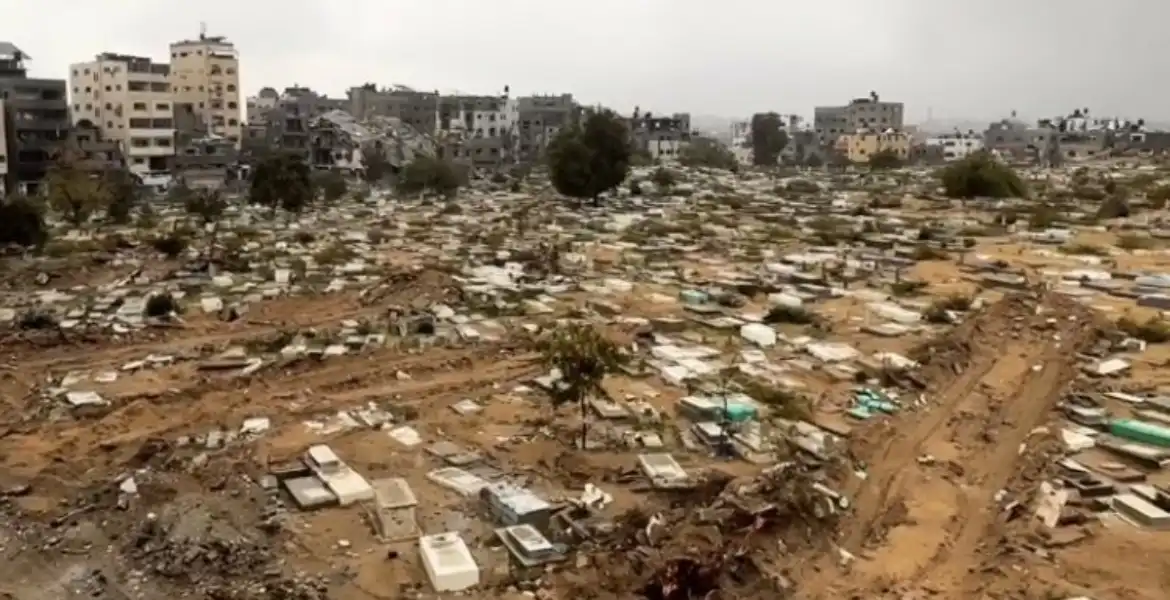
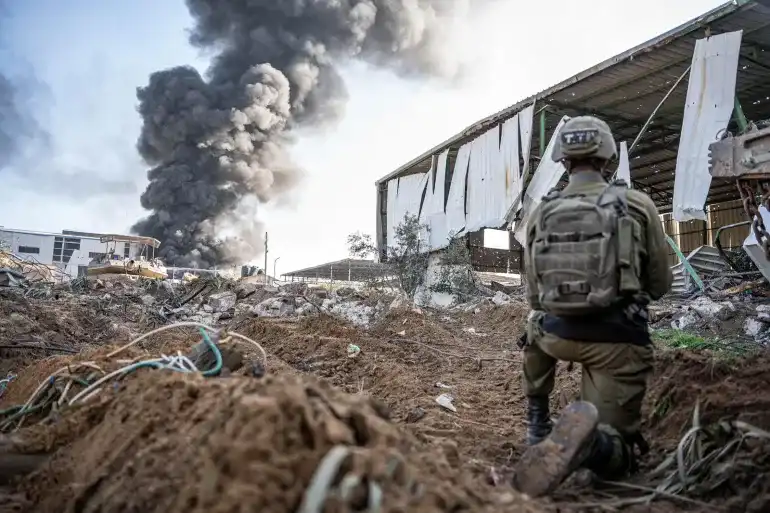
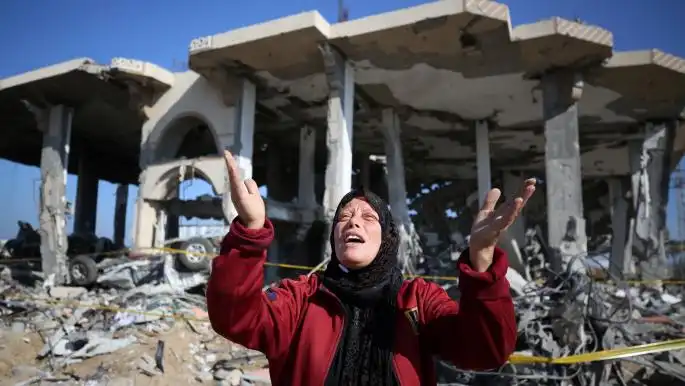
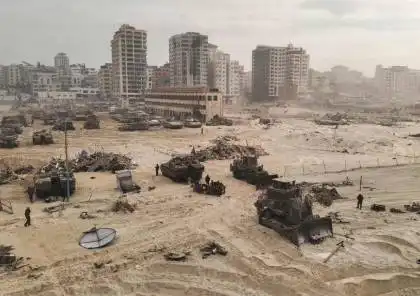
On Wednesday, January 17, 2024, the Israeli army destroyed a cemetery in the Austrian neighborhood, in Khan Yunis, in the southern Gaza Strip, before its vehicles withdrew from it.


Local sources confirmed the withdrawal of the Israeli forces penetrating the vicinity of the Nasser Medical Complex, after bulldozing and sabotage operations in the Al-Nasmawi cemetery.


Video clips on social media showed scenes of the Israeli army exhuming the cemetery in the Austrian neighborhood, west of Khan Yunis, and stealing a number of bodies.


This is not the first incident by theIsraeli forces, as this was preceded by the exhumation of graves and the theft of bodies in Gaza City and its north, during the ongoing aggression against the Gaza Strip, since October 7, 2023.


On January 8, 2024, a video clip was circulated documenting the Israeli forces’ destruction of the Al-Zalal Mosque, which is located next to the Bani Suhaila cemetery. The clip also shows the major demolition operations that the cemetery was subjected to.


On January 6, 2024, the Israeli army exhumed approximately 1,100 graves in the Al-Tuffah neighborhood cemetery, east of Gaza, and stole 150 bodies from them.

The Israeli mechanisms also trampled the bodies of the dead, and insulted their dignity, without any regard for the sanctity of the dead or the graves, according to what the Government Information Office in Gaza reported.


On December 27, 2023, the occupation returned the bodies of about 80 Palestinians to the Gaza Strip, and the government media office said in a statement: “After examining the bodies, it became clear that the features of the dead had changed greatly, in a clear indication that Israel had stolen vital organs from the bodies of these martyrs.” 


“The occupation also handed over unidentified bodies, refused to specify the names of these dead, and refused to specify the places from which they had stolen them,” according to the statement.


According to a previous analysis by the New York Times of satellite images and videos, Israel destroyed or damaged at least 6 cemeteries during its advance into the northern Gaza Strip.


ARAB AND WORLD

Wed 17 Jan 2024 5:29 pm - Jerusalem Time

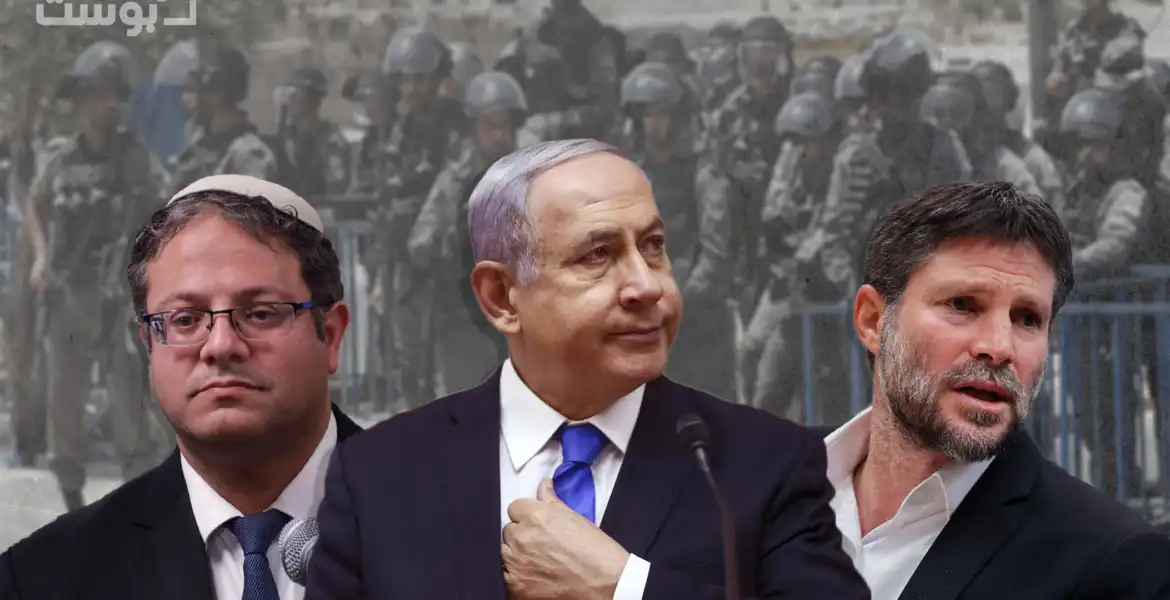
Israeli Channel 13: Netanyahu evades formulating a post-war strategy for fear of the wrath of his extremist ministers

Israeli officials and analysts said that Prime Minister Benjamin Netanyahu is avoiding formulating a strategy for the aftermath of the war on Gaza, due to political matters, and for fear of the Ministers of National Security, Itamar Ben Gvir, and Finance Minister, Bezalel Smotrich, according to what was reported by the Hebrew Channel 13, on the evening of Tuesday, January 16. Second 2024.

The officials, who were not named by the channel, added that “the Prime Minister’s actions and the lack of a political strategy harm the war’s achievements,” as they put it, while the channel indicated that “it is expected that the Mini Ministerial Council for Security and Political Affairs (Cabinet) will hold deliberations at the end of this week regarding the day next to the war.


It is noteworthy that the survival of the far-right "Jewish Power" party headed by Ben Gvir, and the far-right "Religious Zionism" party headed by Smotrich, is necessary for the continuation of Netanyahu's government.


"Erosion of achievements"

Channel 13 reported on Tuesday that “Army Chief of Staff Herzi Halevy warned the government that its refusal to develop a post-war strategy for Gaza could lead to the army being drawn into new operations in areas where fighting has already ended.”


It added: “This warning mainly concerns northern Gaza, where Hamas has once again shown some signs of governance since the IDF reduced its forces there".


According to the channel, Halevy said during the closed meeting: “We are facing an erosion of the achievements we have achieved so far in the war, because no strategy has been developed for the next day” of the war, adding: “We may have to return and work in the areas where we have already ended the fighting.” In reference to the northern Gaza Strip.


It is noteworthy that in recent weeks, Ben Gvir and Smotrich have repeatedly called for the reoccupation of the Gaza Strip and the construction of settlements there.

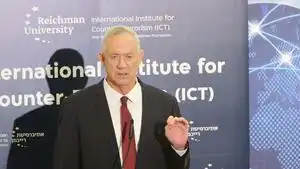
On Monday, the 15th of this month, the Minister of Defense of the Occupation Army, Yoav Galant, said during a press conference, referring to the course of the ground war that began on October 27, 2023, that “in the northern region of the Gaza Strip, this stage will end and in southern Gaza, we will arrive.” This achievement will be completed soon.”


The Israeli minister did not reveal whether the ground operation north of the Gaza Strip had actually achieved its goals of eliminating the Hamas movement, as the Netanyahu government claimed at the beginning of the war on Gaza.


Massive frustration in the upper ranks of the army

For his part, Amos Harel, a military analyst in the Israeli newspaper Haaretz, wrote on Wednesday: “There is tremendous frustration brewing in the upper ranks of the Israeli army and the Shin Bet security service, and their fear is that Netanyahu’s political considerations are already leading to the erosion of what has been achieved.” Until now".


He added: “Netanyahu strongly refuses to say the three words that the American administration wants to hear: ‘A renewed Palestinian Authority.’ This is the renewed Palestinian Authority that Washington wants to run Gaza in the future, if Hamas’ power can be further reduced.”


Netanyahu has repeatedly announced in recent weeks his rejection of the return of the Palestinian Authority to the Gaza Strip after the war, while the United States has announced on more than one occasion during the past weeks its rejection of Israel’s reoccupation of the Gaza Strip or building settlements there.


Harel added: "But it is natural for Netanyahu to reject (the renewed Palestinian Authority), as he is under pressure from his coalition members Ben Gvir and Smotrich, and he wants to unite his right-wing base behind his claim that he is the only one capable of preventing the establishment of a Palestinian state."


He added: "It is also clear that Netanyahu wants continued friction with the US administration, assuming that he will be able to blame the Americans for the failure to achieve the war goals while waiting for Donald Trump to win the presidential elections next November."

Since October 7, 2023, the Israeli occupation army has been waging a devastating war on Gaza, which, as of Wednesday, left 24,448 dead and 61,504 injured, and caused the displacement of more than 85% (about 1.9 million people) of the Strip’s population, according to the Palestinian authorities and the United Nations.

ARAB AND WORLD

Wed 17 Jan 2024 5:20 pm - Jerusalem Time

Israeli writer: If we had connected a lie detector to our lawyer in The Hague, the electricity grid would have collapsed

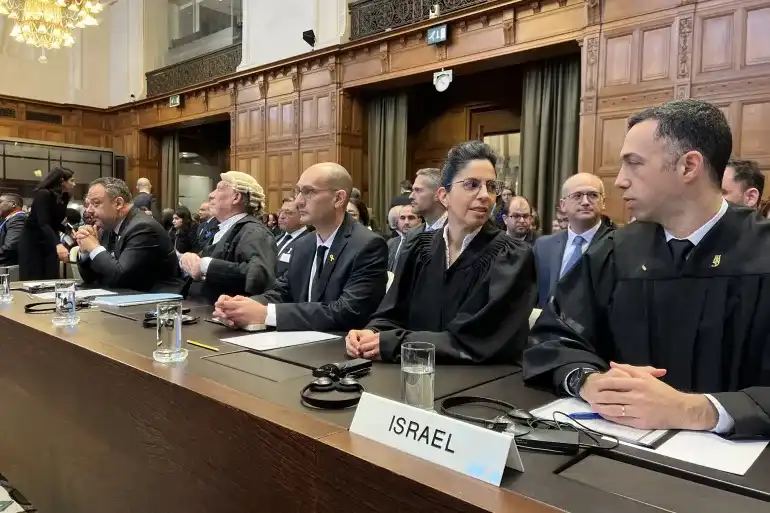
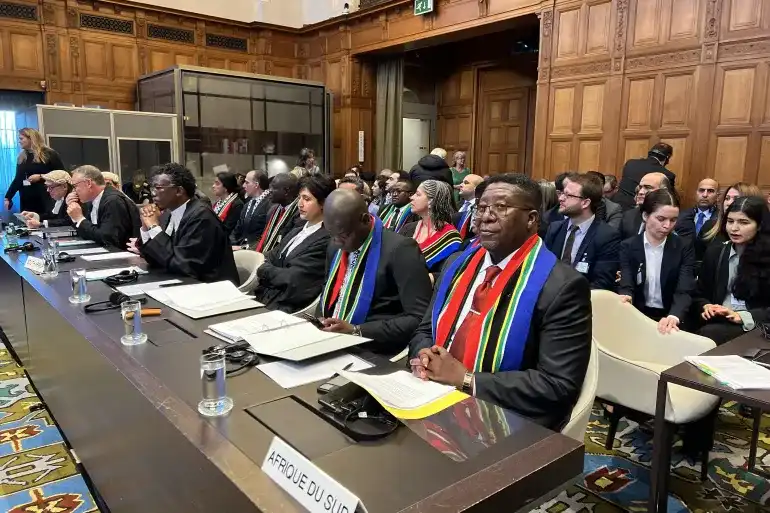
South Africa may have chosen to file a case against Israel for “Gaza genocide”, although this is difficult to prove, because that is the only way to force it to appear urgently before the International Court of Justice, in the hope that it will issue some meaningful interim orders against it.


This is what writer B. Michael sees in his column in Haaretz, where he explained that Israel saw this charge as its opportunity to focus on an attempt to refute it, and thus divert the discussion from all the other atrocities it is committing in the Gaza Strip.


This is exactly what happened, when Israeli lawyers broke all possible records regarding the plea of alleged innocence, as the Israeli writer says sarcastically.


He added, "We only shot at the terrorists... We warned the residents with leaflets. We indicated for them exactly where they should go. We destroyed the neighborhoods so that they could be cleared and rebuilt, as if the terrorists were dwarves hiding behind children, or effeminate people hiding behind women, or osteoporosis people hiding behind the elderly, the sick, doctors, journalists and people with disabilities.”


To illustrate the enormous level of lying and deception by the Israeli defense team, Michael says that if an Israeli lawyer had been connected to a lie detector during his speeches, the electricity grid in The Hague would have collapsed, and the city would have remained in darkness to this day.


One nation, one occupier

Fortunately for Israel as well - the writer is sarcastic - South Africa chose for an unclear reason to focus almost entirely on what is happening in Gaza instead of talking about what is happening in all the occupied territories, Gaza, the West Bank and Jerusalem, because the matter is related to one nation whose members are being trampled under the shoes of the same occupier.


One of the signs of malice and evil is that Israel denied for years the existence of the Palestinian people, and made persistent efforts to deny their existence in public consciousness and discourse, and issued laws to legalize the theft of all their property, until it made the theft of their lands a sacred act. In fact, their lives became a fair game, to the point that any child could carry a gun and can shoot a Palestinian whenever he wants. It is enough for him to say, “I felt threatened,” for him to enjoy immunity.


Michael: If South Africa had added the situation in the West Bank and East Jerusalem to its plea, its speech would have gained additional weight, and it would have made clear an important fact, which is that no one here will enjoy peace unless each of us gets his own land.


As for the freedom of the Palestinians and their freedom of movement and expression, such as their right to self-determination and self-defense, all of this has been trampled on, and is still being trampled on every day. Almost half of the people are in a cage, and the other half is rotting under a military dictatorship and living conditions that seem as if they were specially designed to burden their lives and push them into hiding out of sight.


If South Africa had argued in this way, its speech would have gained additional weight and would have made clear an important truth: that no one here will have peace unless each of us gets our own land. But the show is not over yet. On February 19, the court will meet again to discuss Israel, as the UN General Assembly has asked it for advice regarding “the legal consequences arising from Israel’s policies and practices in the occupied Palestinian territory, including East Jerusalem.”


Source: Haaretz

OPINIONS

Wed 17 Jan 2024 5:13 pm - Jerusalem Time

Israeli writer: “Israel started the war while it was defeated...”

Antoine Shalhat

Antoine Shalhat

Opinion Writer

According to Israeli army data, thousands of Hamas members were eliminated in these areas, and thousands of them remained alive. This means that the moment the Israeli army leaves those areas, they will return to them and begin to restore their capabilities.


As the Israeli war against the Gaza Strip passed its hundredth day, a phase of free conclusions began based on pre-programmed ideas and ideology in most of the analyzes of Israeli political and security commentators, and at its core emerged the recognition of the intractability and even impossibility of eliminating the Palestinian resistance, primarily the Hamas movement. Most of them were preoccupied with explaining the Israeli government’s withdrawal, at the urging of its Prime Minister Benjamin Netanyahu, from making decisions regarding the political outcomes that the battles should lead to, towards insisting only on the continuation of the war.

According to what a former general indicated, this insistence, from a political standpoint, is the safest path for the current government coalition, and any deviation from it would threaten this coalition with a resounding fall and the end of Netanyahu’s era and perhaps the Israeli extreme right. According to this general, the former head of the Military Intelligence Division (Aman) and the current director general of the National Security Research Institute, Tamir Hayman, this path does not lead to any stable final situation, nor does it guarantee the achievement of the war goals that Israel aspires to, nor a radical change in National security balance.


Such certainty applies to some analyzes of Netanyahu’s mouthpiece newspaper, “Israel Hayom,” whose military analyst, Yoav Limor, wrote a text that could be considered parallel to the official Israeli narrative. He began by saying that from the point of view of the professional military analyst, it is necessary to pronounce the fact that Israel is still far away from achieving the goals it set for itself, and it is not clear whether it can achieve them in light of the new circumstances.


In his opinion, it is true that the Israeli army announced that it took control of the northern Gaza Strip, but what is gradually becoming clear is that the existing reality is more complex than what the military establishment is promoting. According to the Israeli army, thousands of Hamas members were eliminated in these areas, and thousands of them remained alive. This means that the moment the Israeli army leaves those areas, they will return to them and begin to restore their capabilities. The indication of this is that the threat in the northern Gaza Strip has not been removed, as was pledged when the war was declared.


The political and security leadership has made many promises since October 7, and is facing great difficulties in fulfilling them. Hamas is moving further and further away from defeat, and the return of the kidnapped persons detained in Gaza does not appear to be on the horizon, and there is no evidence that military pressure has advanced their cause, as political and military leaders claim. There is no alternative way for Israel to release the kidnapped people other than reaching an exchange deal that also includes a political settlement, for the first time in the history of such deals that were now being implemented without any political conditions. Limor asserted that Israel began the war with defeat, but despite that, it remained too boastful to the point of not admitting this at an early stage, which led to lowering expectations.


Regarding the question of defeat and victory, there are Israeli texts that are equal to, if not superior to, what was stated above, as in the text of the commentator in the newspaper “Yedioth Ahronoth”, Nahum Barnea, who affirmed that after a hundred days of failure and devastation, one should not escape from reality as it is: That Israel is the losing party. Likewise, historian Ofri Ilani wrote in the Haaretz newspaper, who saw that the failure of October 7 could lead Israel towards profound renewal and radical reforms, but this remains subject to an indispensable and unfulfilled condition, which is that Israel acknowledges that it has been defeated. It has not been achieved for several reasons, the first of which is that those responsible for the failure, led by Netanyahu, are still in power, and the second is that Israel has decided to wage a war with no end in sight. Instead of admitting failure, it was drawn into an aggression that did not limit itself to any limits and did not involve any self-restraint.


ARAB AND WORLD

Wed 17 Jan 2024 4:57 pm - Jerusalem Time

Israeli Analysis: “Israel is like a gambler who loses all the time and hopes for a reversal of luck.”

“It quickly became clear that the possibility of rescuing them by force was very small, given Hamas’ extreme preparations to deal with any rescue attempt. In many cases at least, the ground incursion did not improve the situation of the kidnapped, but rather killed them.”

Today, Wednesday, security analysts refuted the claim of Israeli officials that increasing military pressure through ground maneuvers on the Gaza Strip would lead to the release of the hostages, but rather it led to the killing of some of them, following the refusal of the Israeli Prime Minister, Benjamin Netanyahu, to reach a prisoner exchange deal. With Hamas.

An Israeli official with knowledge of the war plans and the hostage issue described “the State of Israel, its security apparatus, the Israeli army, the Mossad, the Shin Bet, the Ministry of Security and those around the prime minister,” as being like “a casino patron, or just a person overwhelmed with his self-confidence, who entered the gambling structure and went off.” He puts money in the slot machine,” according to what was quoted by Ronen Bergman, intelligence analyst at Yedioth Ahronoth newspaper.


The same official added, "The State of Israel, with its soldiers and intelligence agencies, stands before the machine of fortune, even though it loses time after time and, at best, wins a small amount of money, but in the end it is in a state of enormous loss, and continues to carry out exactly the same thing, and hopes and believes that it will come." The moment for luck to turn around, and the big profit comes, but by insisting on victory, she allows life to pass in front of her, and she does not notice that she loses all the money, and she does not realize that the casino is always the winner in the end.”


Bergman pointed out that Israel “succeeded in liberating one kidnapped woman over the course of 100 days, and freed the rest of the eighty kidnapped persons with a deal that the Qatari mediators said was on the table before the start of the ground maneuver. And throughout the 100 days, the entire establishment, political and security, claimed that the primary goal of the military operation was to dismantle Hamas’ capabilities.” He is the one who will pay and allow the second goal to be achieved, the liberation of the kidnapped people.”

He added, "Any official is asked how it happens that whenever military pressure intensifies, and the Israeli army's bulldozers dig their claws, as the Minister of Defense explained, a short distance from Sinwar, the latter tightens his conditions" for a deal.


Bergman stated that the Israeli army and intelligence services have been talking in whispers, for 100 days, about the possibility that what everyone feared all the time had happened many times, and that kidnapped persons were killed (by Israeli bombing) or at the hands of Hamas in circumstances directly related to that ground maneuver that was supposed to save them. .


He added that regardless of the circumstances of the killing of hostages, “they are now whispering, for the first time, about the necessity of rethinking the whole issue, and that perhaps there is no real possibility of a major victory in this machine, and that continuing is like banging one’s head against the wall, but the talk is not about "Money, but about people, and they may pay with their lives."

He continued, "It quickly became clear that the possibility of rescuing them by force was very small, following Hamas' extreme preparations to deal with any rescue attempt."


Bergman pointed out that "the issue of the kidnapped persons was not initially at the top of the leadership's list of preferences. Nor was it written as a war goal. Only on October 16, after intense public pressure and after the families of the kidnapped had organized themselves, did the war cabinet secretly add the issue of the kidnapped as a second target of the war.”


Bergman repeated the statements of other analysts, saying, “The two goals of the war cannot be achieved together, as they contradict each other. There was no one in the security apparatus to stop this race and say that this will not succeed. In many cases at least, the ground incursion did not improve the situation of the kidnapped, but rather killed them.” .


He pointed out that "there are those who claim that the Israeli army has high-quality intelligence information regarding the death of quite a few kidnapped people, some of them by Israeli army fire on the first day of the war, within the framework of the Hannibal procedure that was officially used," which means that the army must kill its soldiers who were captured, and this system was used, on October 7, against Israeli citizens, not soldiers.

Bergman said, “The problem is that if the war does not stop, and (Security Minister Yoav) Gallant continues to lead the military operation that includes the occupation of at least parts of the Gaza Strip, no one can guarantee that it will end with the achievement of the goals. In practice, the Israeli army says that this "The operation will continue for a year or two, without ever explaining what will happen to the kidnapped during this period. The two goals are contradictory."


For his part, the military analyst in the newspaper "Haaretz", Amos Harel, repeated that "Netanyahu repeats the empty refrain that 'We will fight until victory,' but for him this stems mainly from considerations of his political survival. Netanyahu knows that despite the growing public support for a deal that includes difficult concessions. Such a step will disintegrate his government from within, because his far-right partners will withdraw from it.”


He added, "Not only are the two goals of the war colliding with each other at this stage, but they are not specific to their timetable," and reported that after the Hamas attack on October 7, "the Israeli army planned a war in four stages."


This week, Galant announced that the Israeli army has moved into a third phase of the war, which includes reducing its forces in the Gaza Strip. According to Harel, “the army is talking about many more months of fighting in a more reduced manner, before the situation in the Gaza Strip stabilizes and the military threat from Hamas is removed, following the dismantling of a large part of its systems.”


He pointed out, "This timetable does not match the real, increasing danger to the lives of the kidnapped. The army has so far announced that more than 20 kidnapped people died in captivity or were killed on October 7 and their bodies were kidnapped. The real number may be higher. The Israeli army's operations do not lead to the liberation of "Kidnapped, now. Their families fear that these operations will unintentionally lead to their death."


Harel continued, “The war cabinet is torn apart over this issue. Opposite to Netanyahu, Gallant, and the Minister of Strategic Affairs, Ron Dermer, who oppose a sustained ceasefire and the comprehensive liberation of thousands of Palestinian prisoners, there are the ministers of the National Union, Benny Gantz and Gadi Eisenkot, as well as the observer member from the Shas party, Aryeh Deri, and they appear to be seeking a deal, so as to make it possible to stop the fighting. Their claim relates to the state’s moral debt towards the kidnapped people, the majority of whom are civilians, who were abandoned to face their fate in the wake of a massive security and strategic failure.”


He pointed out that there is "tremendous frustration at the high levels of the Israeli army and Shin Bet. The fear is that the prime minister's political considerations lead to the erosion of the achievements that have been accumulated so far."


Yesterday, Channel 13 reported that the Chief of Staff of the Israeli Army, Herzi Halevy, warned the political echelon that refusing to hold deliberations about the “next day” after the war would push the Israeli army to return to areas where it had ended the fighting, especially in the northern Gaza Strip. Meanwhile, Hamas has returned to showing signs of its rule there.”


ARAB AND WORLD

Wed 17 Jan 2024 4:52 pm - Jerusalem Time

Netanyahu: The war on Gaza will continue in 2025

Netanyahu's statements came during his meeting with the heads of local authorities in the "Gaza envelope", and he claimed that they were based on estimates of the current situation, and he supported the residents of the "Gaza envelope" not returning to their homes before the summer vacation.


Israeli Prime Minister Benjamin Netanyahu said during his meeting with the heads of local authorities in the “Gaza envelope” yesterday, Tuesday, that according to estimates of the current situation, the war on Gaza will continue in the year 2025 as well, according to what Channel 12 reported today, Wednesday.


The military analyst in the newspaper "Haaretz", Amos Harel, pointed out today, "Netanyahu repeats the empty refrain that 'We will fight until victory,' but for him this stems mainly from considerations of his political survival. Netanyahu knows that despite the growing public support for a Prisoners exchange deal (with Hamas) include difficult concessions. Such a step will disintegrate his government from within, because his partners from the extreme right will withdraw from it.”


He called on the heads of local authorities to stop the procedures for returning residents of the “Gaza envelope” to their homes, provided that such a return begins during the summer vacation, and before the start of the next school year.


The heads of local authorities also called for continuing to grant these residents grants to stay in hotels until they return to their homes. Netanyahu said that he supports their position of postponing the return of residents by half a year, according to Channel 12.


Netanyahu added that he instructed the development of a plan in this regard, and pledged to the heads of local authorities to provide a response to their demands later.


A statement issued by the mayor of Sderot, Alon Davidi, to the town’s residents said, “The Prime Minister instructed the professional teams to consider continuing to fund stay in the shelter centers and to continue paying the housing grant until the beginning of July to any citizen who agrees to finish the current academic year in the center.” He resides there and extends the gift of adaptation to any citizen who chooses to return to his home.”


ARAB AND WORLD

Wed 17 Jan 2024 4:48 pm - Jerusalem Time

Blinken: The suffering in Gaza is heartbreaking and there must be a reformed Palestinian authority

US Secretary of State Anthony Blinken said that what is happening in the Gaza Strip is “shocking,” but stressed the need to ensure that “Israelis live in peace.”


Blinken spoke today, Wednesday, at the World Economic Forum in Davos, Switzerland, saying, “What we see in Gaza is shocking, and the suffering breaks my heart, and the question is: What should be done?”


Blinken stressed the necessity of “ensuring that Israelis live in peace,” saying that “what happened on October 7 cannot be repeated,” referring to the Al-Aqsa Flood operation carried out by the Palestinian resistance in the settlements surrounding the Gaza Strip.


He added, "The challenge now is the extent of Israeli society's willingness to cooperate to achieve a new vision with the region and its people," adding that "there will be no integration without recognition of a Palestinian state," while emphasizing the necessity of "developing a Palestinian authority capable of taking care of its people."


In this context, the US Secretary of State said that "any Palestinian authority that does not find support from Israel will not be able to provide what is required for the partnership between the two parties," noting that "there must be a Palestinian authority subject to reform."


Regarding the issue of normalization with Arab countries, Blinken said that there is a great opportunity for normalization with Israel in the Middle East, and that the challenge lies in exploiting it.


He pointed out that "there are Arab and Islamic countries that are expressing their willingness to normalize relations with Israel for the first time and recognize it."


Regarding the Iranian file, Blinken said, “Ending the Iranian nuclear agreement was a big mistake, and we are now in a situation that we did not want in this regard.”


He added, "Iran is isolated with its partners in the region, and there are important decisions capable of achieving a new vision."

PALESTINE

Wed 17 Jan 2024 4:48 pm - Jerusalem Time

West Bank: 4 Palestinians killed in a drone bombing in Tulkarm camp

4 Palestinian citizens were killed today, Wednesday, in the bombing by an Israeli drone, Haret al-Tammam in the Tulkarm camp.


This is the second assassination from the air in the West Bank in the Tulkarm camp, after the Israeli aircraft carried out the assassination of 5 young Palestinian men in Nablus at dawn today.


It is noteworthy that 5 young men were killed in an Israeli drone bombing, at dawn on Wednesday, of a vehicle near Balata camp, east of Nablus.

OPINIONS

Wed 17 Jan 2024 11:42 am - Jerusalem Time

A bet on time

op-ed Al Quds dot com

op-ed Al Quds dot com

Opinion Writer

After the Israeli war on Gaza entered its fourth month and the withdrawal of divisions and brigades of the Israeli army from the northern Gaza Strip began, the displaced are still at great distance from their homes, which they dream of returning to, even though the vast majority were destroyed by the occupation with its brutal aggression.

There is no doubt that the issue of the right of return, the permanent, established and immutable right of the Palestinians, is very similar to the equation of the situation in Gaza today. The right of citizens to return to their homes is a sacred right after the occupation deprived them of all their life and livelihood rights. Even the bags of flour around which a number of displaced people who had no shelter, food or clothing gathered, the occupation insisted on dampening their joy with its arrival, so they opened fire on them, preventing the flour of life that the women of Gaza prepares from the remaining firewood from igniting a flame and placing the bread within the reach of the children.


The Palestinians are betting on a firm hope of returning to their homes. Even if the time factor is long or deceptive. They see their return as a revival of their heritage, customs and traditions, and a nostalgia for all the things they lost. No matter how long it takes, the Palestinian will not forget his history in the land of his fathers and grandfathers.

Palestinian suffering still dominates all images and scenes of life in the Gaza Strip. It will go through long paths of fear, sadness, panic, and pain, after experiencing the bitterness of displacement, murder, and isolation. The Gazans will be very determined to return to telling parents the most vibrant stories to their children.


At a time when there is a lot of talk about the day after the war and who will rule the Gaza Strip, the Palestinian people are the true standard for any ruling authority, as Norwegian Foreign Minister Espen Barth Ede said in an interview in Davos yesterday, Tuesday. He stated that Norway believes that the unified Palestinian territories should be administered by the Palestinian Authority, but “it must be what the Palestinians want before anything.”


What the Palestinians want is national unity in its finest form. But above all, they want the occupation that is sitting on their chests to leave, out of their belief in the truth and the inevitable coming victory. They want to see Gaza put on the clothes of revival from its stumble, to put the foundations of construction back into the long wheel of life and to overcome tragedies and disasters with will, resolve and determination.

Betting on time is an important factor. Through it, the people of Gaza increase their steadfastness and their sacrifices for the sake of a decent life after about 103 days of war of destruction, which will not prevent the Palestinian people from reaching their goals and realizing their dreams and ambitions.

PALESTINE

Wed 17 Jan 2024 11:36 am - Jerusalem Time

West Bank: Israel arrests 84 Palestinians

Last night and at dawn on Wednesday, the Israeli occupation forces arrested 84 citizens from the West Bank, including 40 workers from the Gaza Strip.


OPINIONS

Wed 17 Jan 2024 11:31 am - Jerusalem Time

The management of the aftermath of war, is more important than managing the war itself

Nabil Amr

Nabil Amr

Opinion Writer

What is certain so far is that the Gaza war moved the Palestinian issue from a secondary position among the emerging regional and international issues, to a central position, such that it was established as a primary issue that attracted the world’s attention.


Never before has talk of a two-state solution become so widely circulated as a way out of the state of wars that are devastating the Middle East and severely damaging the interests of the world therein.

This is one of the most important gains that have been achieved since the first day of the outbreak of the war until the present day, and whatever its results will not detract from this gain.


On the balance of profit and loss, another gain can be recorded, which is reviving the morale of the Palestinian people, who have long stood on the brink of despair, and see their cause, which was classified as central, has declined greatly to the point where it has been absent from regional and international agendas.


As for the solutions that were being discussed before the war, they were very far from the solution he sought, as the real state on the ground was replaced with an imaginary state on paper, and the inalienable rights that the world described as inalienable were replaced with a package of facilities that is much less than what any other people obtained, even in the form of Autonomy.


As for the Holy of Holies, which the Palestinians embraced as their eternal capital, it was reduced to the village of Abu Dis, with a closed corridor used for prayer only.


As for the remaining elements of the larger issue, they have been forgotten. In this case, who is talking about refugees and their return?

This was the situation of the Palestinians before this war, except that what happened and we hope will continue has revived in the hearts of the Palestinians confidence and hope for a political solution that the world will adopt and talk about at a greater pace, with a clearer promise that the world will work on it as an inevitability from the first day of the end of the war.


However, these qualitative and important gains are not without caveats surrounding them, and there is no guarantee that they will not turn into the opposite, if the results of the Gaza war are as the Israelis want and design them.


What is known about the day following the cessation of the war are the urgent needs that cannot be postponed even for one day, which is the emergency work that precedes the larger process of “reconstruction.” The urgent and urgent relief is for hundreds of thousands of people to find shelter with the minimum conditions for living in it, even if it is tents that protect from the cold and rain, and for school students who were prevented from obtaining their education to find shelter for months, and no one knows how long it will be when it is agreed that the war has actually ended. Not to mention providing food, medicine and clothing for millions who will have to start their lives from scratch, which is required before the reconstruction process can begin.


This is a process that requires collecting double-digit billions to begin immediately, starting with removing the rubble and throwing it into the sea, then providing the supplies to rebuild hundreds of thousands of destroyed homes. The issue in this case is not an earthquake that destroyed a city as much as it is an earthquake that destroyed a country.


The question, the answer to which is not yet known, is where Israel will be in those days following the end of the war. Will it be in all of Gaza, or in some of its areas, or will it maintain a siege that is more horrific and harsher than it was before the war?


In this regard, there is talk about the third stage, which is the product of old American theory, which was not taken into account, and it means that the war will continue, but with less blood and destruction. This also means that Israel will remain in Gaza, directly or by controlling it with siege and fire.


Questions to which it is too early to find an accurate answer because their affairs are in the hands of many overlapping and conflicting forces with their own agendas.


In this preliminary analysis, I did not address the time factor, the extent of which no one knows, in the event of fighting or its reduction or transition from it to the final conclusions, and then what will be the condition of the Palestinians the next day? Will they respond to urgent calls to reform the state of power? Will Hamas be part of the temporary and final Palestinian composition?


The Palestinian gains were mentioned at the beginning of this article, but as for the losses, if it is possible to quantify the material aspect of them, their final conclusions are still very ambiguous. As Palestinians, we must improve the management of the aftermath of the war, because it is much more important than managing the war itself, because the Palestinian fate is not decided by one war or several wars, but rather by a political achievement made by an organized and qualified people who are able not only to withstand but also to advance.

OPINIONS

Wed 17 Jan 2024 11:24 am - Jerusalem Time

Israel’s war on Gaza and the West’s credibility crisis

Aljazeera

Aljazeera

Opinion Writer

Hina Rabbani Khar

Over the past decade and a half, I have attended many meetings and conferences, and met many people in Western governments, think tanks and academia who have been concerned about the rise of autocracies across the world. Many of them believe that authoritarian tendencies are the biggest threat to the liberal world order and rules-based system.

But I beg to differ. I believe the biggest threat to the liberal world order comes from liberal democracies and not their autocratic nemeses. That is because there is a widening chasm between the values Western governments proclaim to uphold and their actual conduct. That has triggered a credibility crisis that threatens to unravel the liberal world order.


What we say about our value system and how we project our foreign policy objectives in our statements is important, but even more important is what we do afterwards. People have eyes and ears, and when what they see is the opposite of what they hear, they lose trust. This is what is happening now with Western rhetoric and actions in relation to Israel and Palestine. This mismatch between what is said and what is being done is, of course, nothing new.

I come from a region where we have suffered immensely as a result of the great liberal promise of the West; our neighbor Afghanistan faced disaster not once, but twice because of it. As we moved from one war to another after the 9/11 attacks in the US, the Western-made liberal order started to lose its credibility faster than the West had time to realise. It left behind a debris of chaos, bloodshed and broken promises of “democratization” and “emancipation”. The “others” started questioning the Western narrative and its legitimacy.

Wars leave behind devastation that persists long after the fighting and funding for “reconstruction” end and long after the media spotlight, the fervent hashtags and impassioned posts move on, as the world’s collective conscience loses interest. The aftershocks are felt in the geography where the wars are conducted for generations, as people continue to experience a conflict’s intended and unintended consequences.

I was in office when the Russian war on Ukraine started and I experienced firsthand how the US, the EU, the UK and other Western countries tried to convince many in the developing world that they must not stand on the side of aggression, that they must not be “on the wrong side of history”.

As the UN Security Council could not pass any resolution because of Russia’s veto, the West expended a great deal of political capital to bring resolution after resolution in the General Assembly in support of Ukraine. It aimed to show the world that Russia was using its veto power against the global consensus and was in fact isolated on the world stage.

And then came the war in Gaza. I watched with incredulity when pleas echoed from Gaza in the form of resolutions brought forward to the UN Security Council urging an end to the bloodshed and asking for a humanitarian ceasefire only to be vetoed by the US.As the UN pleaded for action – calling Gaza a “graveyard for children” and reporting that more UN aid workers had died in the last few months in Gaza than in any other conflict – the West, which had historically been a champion of multilateralism, did nothing. In fact, it came in the way of those who were trying to stop the indiscriminate killing of civilians.


This forced UN Secretary-General Antonio Guterres to invoke in early December Article 99 – used only at times when international peace and security are threatened. Even then, the West took no action; the US vetoed a subsequent resolution for a humanitarian ceasefire at the UNSC and then voted against a nonbinding resolution at the General Assembly supported by 153 countries. The UK abstained in both votes. Let that sink in.

What makes this more unpalatable than Russia’s veto at the Security Council is that unlike Russia, the US and UK sanction people and countries on human rights violations and call for interventions on human rights grounds. How can the rest of the world have trust in the West’s self-declared “value-based leadership” when countries like the US and UK abdicate their responsibility and side with the aggressor?

This obvious hypocrisy is reminiscent of the tale of the emperor’s new clothes: Everyone can see Western rhetoric is naked. The West talks about commitment to human rights and democratic values, while at the same time offering full diplomatic cover to the state of Israel and ensuring its impunity in massacring as many Palestinians as it desires in the pursuit of its official, declared goal of complete extermination of the Palestinian people.

In supporting Israel and enabling it to kill tens of thousands of civilians, the majority of them women and children in the name of “self-defense”, Western countries are putting themselves at the opposite end of the values and principles of multilateralism and respect for human rights they have put mammoth effort in promoting in the past. They are going against the very fundamentals on which the United Nations was built.

I believe in the commonality of our values, I believe that the West has much to celebrate in its human rights and development records, but I also know that the West has shown glaring disregard for these principles outside of its own geography.

Anyone concerned with the US’s global leadership or retention of its status as the leader of “the free world” should certainly be asking themselves why it has decided to isolate itself on the world stage and why it is willing to pay such a high diplomatic price that will have reputational and credibility repercussions for decades.


Washington’s stance today would not only undermine efforts to promote it as the only reliable world power, but would also sabotage its ability to play the role of a peace builder in the future. If the US wants to save its global reputation, it should first and foremost stop standing in the way of Security Council resolutions demanding a humanitarian ceasefire in Gaza. It should also stop opposing General Assembly resolutions that commit to a two-state solution and condemn Israeli settlements; both of these elements are already part of US-stated policy. Finally, it needs to respond to the appeals of UN institutions and stop obstructing its actions.

Those who claim the UN has failed in the wake of this crisis are grotesquely wrong. The UN continues to unambiguously report what is happening on the ground and call for global action. Whether it is the UNGA, the voice of the collective conscience of the world, or the secretary-general, or the WHO chief or the UNICEF chief – they have all made incredible efforts to get the world to act and stop the violence.

I have served in government long enough to know that as officials, we often make the mistake of thinking our job is to maintain positions on certain issues that our countries have historically held. But this is the wrong way to go about building policy. Our job should be to hold principles not positions. Leadership requires strength to stand on the side of what is right not on the side of historical positions

OPINIONS

Wed 17 Jan 2024 11:10 am - Jerusalem Time

Hebrew Opinion| The attack in Tel Aviv indicates a real danger of a wave of "terrorism" in the West Bank

Haaretz

Haaretz

Opinion Writer

By Amos Harel

The stabbing and car-ramming attack that took place in Raanana yesterday, which led to the death of a 79-year-old woman and the wounding of 17 citizens, was not surprising. Since the beginning of the war in the Gaza Strip, numerous attempts have been recorded to carry out attacks inside the Green Line, carried out by “saboteurs” from the West Bank. 

This happened with the encouragement of Hamas, without the need for direct guidance from it. 


The atmosphere in the West Bank is stormy, and there is no real need for a firearm to carry out independent plans for attacks. In most of these cases, attacks were curbed in the West Bank, also due to large arrest operations carried out by the Israeli army in Palestinian cities and camps.

The two "terrorists" who were arrested by security forces after their killing are relatives of a family from Hebron who lives in Israel illegally. One of them worked at a car wash station in Raanana, and carried a fake card stating that he was a resident of Rahat in the Negev. The two were prohibited from entering Israel for security reasons, namely entering Israel without permission.

This attack will provide a broad platform for discussions regarding the entry of Palestinian workers from the West Bank to work in Israel. In the right wing of the government coalition, there is strong opposition to the entry of workers during the war, for fear of attacks. But this argument is also the lesson needed from the “massacre” of October 7, when it became clear that workers from the Strip had been used to gather intelligence for a Hamas attack on the “Gaza envelope” settlements (as Haaretz reported last month). In the past, this fear did not prevent the heads of settlement councils from requesting and obtaining limited permissions from the security establishment for the entry of Palestinian workers to work for them, especially in industrial areas.

In fact, the "terrorists" from the West Bank who participated in attacks in recent years were, for the most part, present in Israel without permission. 

Moreover, now also, security sources claim, for the most part, that despite the difficult circumstances of the war, the entry of Palestinian workers from the West Bank should be allowed again, at least in a limited amount. Their argument is that the economic situation in the West Bank is getting worse and threatens the stability of the Palestinian Authority’s rule. In addition to cuts in the salaries of Palestinian Authority employees and Israel's freeze on transferring tax funds, under pressure from Finance Minister Bezalel Smotrich.

The warning issued by the Shin Bet and the army to the political level is clear. While Gaza is burning, and in the absence of any effort to alleviate the economic crisis in power, there is a real danger that the West Bank will soon catch fire in a much greater way than we have seen since the beginning of the war. Despite everything that is happening in the Gaza Strip, the Authority still maintains security coordination with Israel, and from time to time, it stops activists from Hamas and Islamic Jihad on its territory. 


Under these circumstances, such a situation cannot continue for long, and may lead to an explosion that sweeps away armed activists from Fatah and the Palestinian security services. Now, especially after yesterday's attack, it is more difficult to see how the Prime Minister will respond to this warning, and whether he will risk agreeing to limited entry for Palestinian workers.

In the face of the increasing volume of attacks and warnings of attacks in and from the West Bank, the reserve forces that were called in more than 3 months ago, with the assistance of border guard units, stand up. Last month, a regular unit of the elite forces, the Musta'rab unit (Duvdovan), which had been withdrawn from the Gaza Strip for this purpose, was returned to the West Bank. This change in missions indicates the Central Region leadership’s fear of losing control of the situation in Gaza.

ARAB AND WORLD

Wed 17 Jan 2024 11:08 am - Jerusalem Time

The White House: Israel has moved to a less severe stage in Gaza

Strategic Communications Coordinator for the National Security Council at the White House, John Kirby, said that Israel has now moved to a less intense phase in its military operations in the Gaza Strip, and that Washington is working to determine the appropriate conditions for the return of people to the northern Strip.


Kirby stated that the Islamic Resistance Movement (Hamas) continues to pose an "active threat" to Israel and threatens to launch attacks similar to the October 7 attack.


But he added that the United States hopes that withdrawing Israeli forces from the northern Gaza Strip will ease the pressure and allow the population to return to that area, noting that his country is preparing to increase humanitarian aid to Gaza.


The Israeli army withdrew its forces from several areas in the northern Gaza Strip after weeks of war during which it suffered heavy losses, but it claimed to dismantle the capabilities of the Palestinian factions in those areas.


Yesterday, Monday, Israel announced the withdrawal of an entire military division out of the 4 divisions participating in the attack on Gaza, which is the 36th division that was attacking the camps area in the middle of the Strip.


On the other hand, Kirby said that American officials are holding “serious discussions in Qatar in order to reach another agreement to release the hostages,” and added that Washington hopes that these efforts will bear fruit soon.


Source: Al Jazeera

ARAB AND WORLD

Wed 17 Jan 2024 11:02 am - Jerusalem Time

Haaretz: The Gaza war ignites tensions between blacks and Jews in America

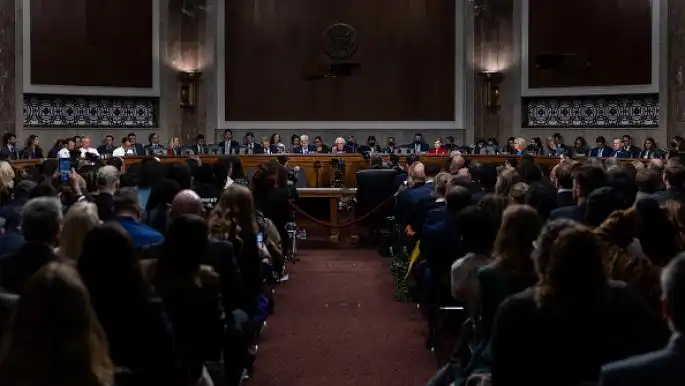
Haaretz said that the downfall of Harvard University President Claudine Gay earlier this month, following a congressional hearing on anti-Semitism, is the most visible incident in a disturbing pattern since October 7, 2023 and the beginning of the Gaza war, which sparked... The fire of tension between the black and Jewish communities in the United States.


The Israeli newspaper indicated - in a report written by Judy Maltz - that Gay did not explicitly blame wealthy Jewish donors for her departure, but they played a major role in her downfall, and they were likely on her mind when she wrote, “Those who campaigned relentlessly to overthrow me often... "They trade in lies and personal insults. They have recycled tired racist stereotypes about black talent and temperament. They have falsely advocated apathy and incompetence."


Indeed, Bill Ackman, the Jewish hedge fund billionaire and Harvard graduate, has been relentlessly pursuing Gay since the October 7 Palestinian operation - as the writer says - and he has called from the beginning for her ouster because of her weak response to the attack by the Islamic Resistance Movement (Hamas), which resulted in About 1,200 Israelis were killed. When that didn't work, he used social media to amplify allegations that she had been using plagiarism in her books.


Sad and predictable

At a later stage, Ackman claimed to have inside information that she was appointed because of her race, not her professional qualifications. “I learned from someone with knowledge of the matter that the committee will not consider a candidate who does not meet the standards of the Office of Diversity, Equity, and Inclusion,” he said, referring to the initiative. Which angered many conservatives and was criticized for excluding Jews.


However, Ackman was not the only wealthy Jew who turned against the first black president of Harvard University because of her handling of the events of October 7. Rather, a large group of Jewish alumni announced the cessation of all donations to the university, except for a symbolic amount of one dollar annually.


Gay may have preferred not to consider what happened to her as a confrontation between Jews and blacks, especially since among her main defenders were Jews, but Cornel West, a former leftist university professor - according to a Haaretz report - has no problem with that, as he wrote, “How sad and expected at the same time.” The figures and forces that support ethnic cleansing and genocidal attacks against the Palestinians in Gaza expelled the first black woman president of Harvard University.


West: When big money dictates university policy and brute power dictates foreign policy, the moral bankruptcy of American education and democracy looms large.


“This racism against Palestinians and blacks alike is despicable and undeniable,” West added. “I have faced similar attacks from the same forces in academia. When big money dictates university policy and brute force dictates foreign policy, the moral bankruptcy of American education and democracy looms large.” 


The writer warned that looking at the Jews as if they were organizing a campaign to remove the first black president of one of the best American universities from her job does not bode well for relations between blacks and Jews, even if she was not the only university president who was subjected to pressure to resign because of her performance in a congressional hearing under the title “Antisemitism on Campus.”


Jewish Americans should take notice

Unfortunately, says Harvard University professor Cornell Brooks and former president of the National Association for the Advancement of Colored People, what many observers will take away from this ordeal is that for Jews to be safe, blacks must be curbed. “The way Gay was treated, and the use of the word ‘nigger’ ) on her, and describing her employment as not the result of her competence, was a campaign of intimidation and humiliation.”


In this context, Jeremy Burton, CEO of the Jewish Community Relations Council of Greater Boston, described Brooks as a “strong ally” to the Jewish community and “a moral compass in everything.” “When someone of his caliber, a respected national figure in the civil rights movement, blames Guy’s ouster on racism, Jewish Americans should take notice,” he said.


Amy Spitalnick, CEO of the Jewish Council for Public Affairs, is concerned that the wedge driven between blacks and Jews in America due to the events at Harvard University serves the agenda of right-wing extremists.


"There are two things that could be true at the same time," she says. "One is that Harvard University and its president made a mistake in paying attention to signs of anti-Semitism, and the other is that right-wing extremists used Jewish pain and fear as a weapon to achieve their own agenda."


As for a black Jew like Ilana Kaufman, CEO of the Jews of Color Initiative, the matter presented unprecedented challenges, “I have no idea what it means to be president of Harvard University, but when I watched Gay, I felt complete sympathy for her as a black woman, and at the same time I felt disappointed.” Great response.”


Source: Haaretz

ARAB AND WORLD

Wed 17 Jan 2024 10:57 am - Jerusalem Time

British Lawyers reveal evidence implicating British officials in war crimes in Gaza

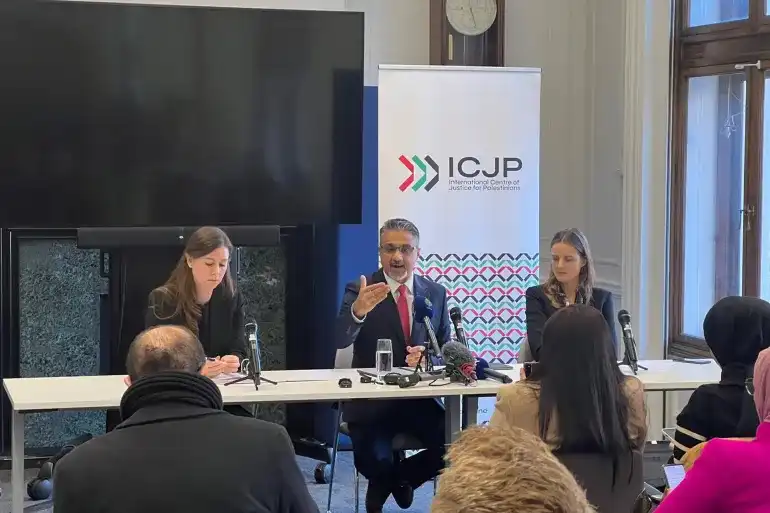
It was announced in London that the International Center for Justice for Palestine will present evidence about the involvement of Israeli and British officials in war crimes and crimes against humanity in Gaza at the International Criminal Court for Justice, and will present the evidence to the court and the Metropolitan Police “Scotland Yard” in the United Kingdom. This was during a press conference held by the center on Tuesday morning, January 16.


The press conference witnessed clarifications from the Director of the International Center for Justice, the Head of the International Law Department at Bindmans Law, Tayyab Ali, and Heidi Dijkstall, Head of International Law at Before Row Chambers, about the prosecution process.


Heidi Dixtal, senior advisor at the International Justice Center for Palestine, confirmed that the center continues to support the confidentiality of investigations by Scotland Yard, and revealed in an interview with Al Jazeera Net that the director of the center, Tayyeb Ali, went to Parliament to learn more about the evidence provided, support Scotland Yard, and ensure that it has the opportunity to conduct investigations. Completely freely without any pressure or interference.


Dixtal explained that it is not possible to predict when the names of those involved will be announced at this stage of the investigation.


Involvement of prominent politicians

The complaint included eyewitness accounts and photographic evidence of crimes including attacks on civilians, civilian property, and infrastructure, including hospitals and property protected under international law, in addition to starvation, the use of collective punishment, and attacks on humanitarian aid.


The file also includes photographic evidence that supports the claim that Israeli army forces used white phosphorus against civilians in Gaza, in contravention of international law.


The International Center for Justice for Palestine in Britain submitted a referral to the Metropolitan Police that included a file of 70 papers related to the involvement of 9 British citizens fighting with the Israeli army in Gaza, and at least 4 prominent politicians in war crimes, including government ministers.


At the end of last week, the International Center for Justice for Palestine held a secret meeting with Scotland Yard, which witnessed the court’s investigative unit handing over hard drives and evidence files to Scotland Yard’s war crimes unit, with the aim of analyzing information in response to a request from the Metropolitan Police for evidence of war crimes in Israel and Gaza.


This news comes after the International Center for Justice for Palestine announced last October that it had issued a notice of intention to prosecute British politicians, including government ministers, for their complicity in war crimes in Gaza.


Ban on arms export

Lawyer Alice Hardy, responsible for the legal challenge filed against the British Department of Trade and Business, which is responsible for allowing the license to continue arms exports to Israel, said: “The lawsuit would seek to stop the export of weapons to Israel under British law, which requires stopping the export if there is a breach of international laws.” Or the possibility of committing crimes against humanity and war crimes.”


Hardy explained to Al Jazeera Net that they submitted a mandatory official letter to the government before submitting the request to the court, demanding that the export of weapons to Israel be stopped in accordance with British law, adding, “We have already received a response from the government denying the existence of any danger of using weapons in violation of international law, and therefore we will take the next step forward.” “I urgently request the court to decide on this matter and stop the export of weapons.”


The case of prosecuting the British government over arms exports to Israel is being handled by the Global Legal Action Network (GLAN), in cooperation with the Palestinian Al-Haq Foundation.


Hardy considered that the Palestinian Al-Haq Organization or any party outside the Kingdom has the right to file a lawsuit against the British government as long as the matter is related to a violation of British law, noting that the lawsuit will be decided in the United Kingdom as a separate lawsuit from the lawsuits related to war crimes in the International Court of Justice, and it will be decided. Demanding a halt to granting arms export licenses to Israel.


She added, "Although there is no clear time line for the lawsuit, the defense team is working to submit an urgent petition to the court."


Heidi Dictsal, Senior Advisor to the International Center for Justice for Palestine, during the conference. Source: International Center for Justice for Palestine


Scotland Yard is investigating

Britain's Counter Terrorism Police War Crimes Team, hosted by the Metropolitan Police's Counter Terrorism Command, received a referral on 12 January relating to allegations linked to the Israeli war on Gaza.


The official spokesman for the Metropolitan Police explained to Al Jazeera Net that the information contained in the referral will now be evaluated by specialized employees, and whether any further action or official investigation will be carried out.

The spokesman also added that this will be done in accordance with the joint guidelines between the police and the Criminal Police Department regarding war crimes and crimes against humanity.


British law enables the Counter Terrorism Command to investigate war crimes committed outside the United Kingdom, if they breach the international Geneva Convention, if the suspect, who can be identified, is not a British citizen, or if he is resident in the United Kingdom as defined in the Court's law. International Criminal Code Act 2001 as amended by the Investigative Judges and Justices Act 2009.


The law in the United Kingdom also enables the extradition of criminals to justice and the prosecution of British citizens involved in war crimes or crimes against humanity.


UK Counter-Terrorism Commander Dominic Murphy told Al Jazeera Net, “The ongoing conflict in the Middle East continues to impact communities in the United Kingdom and internationally, and we recognize the strength of feelings on all sides, and we remain focused on supporting victims and witnesses who report crimes.” Essential international support, as well as support for UK families who were directly affected by the terrorist attacks that took place in Israel on October 7 last year.”


"I also want to reassure the public that we have a very clear set of guidelines that we use when evaluating all war crimes referrals made to us, and we will ensure they are followed here," Murphy added. The unit shared a link on its official website to receive reports about testimonies or evidence related to the commission of war crimes.


Source: Al Jazeera

PALESTINE

Wed 17 Jan 2024 10:42 am - Jerusalem Time

West Bank: 5 killed in Israeli drone bombing near Balata camp, east of Nablus

Five young men were killed in an Israeli drone bombing, at dawn on Wednesday, of a vehicle near Balata refugee camp, east of Nablus.


The Hebrew media reported on the assassination of the persecuted Abdullah Abu Shalal and a number of his cell members by bombing the vehicle in which they were traveling near Balata camp.


The Israeli army claims that the assassinated cell "was on its way to carry out an operation."


According to the Israeli army's account, the Israeli army tried to arrest him several times. Last August, the house of Abu Shalal, affiliated with the Al-Aqsa Martyrs Brigades, was bombed and destroyed in order to pressure him to surrender himself.


Security sources reported that a drone bombed a vehicle near the Barada Junction near Balata camp, causing it to explode and catch fire, preventing medical teams from reaching the place.


The killed are: the two brothers Saif and Yazan Al-Najmi, Muhammad Qatawi, and Abdullah Abu Shalal.


OPINIONS

Wed 17 Jan 2024 10:35 am - Jerusalem Time

Türkiye faces an American-Israeli “coup attempt”?

Assas Media

Assas Media

Opinion Writer

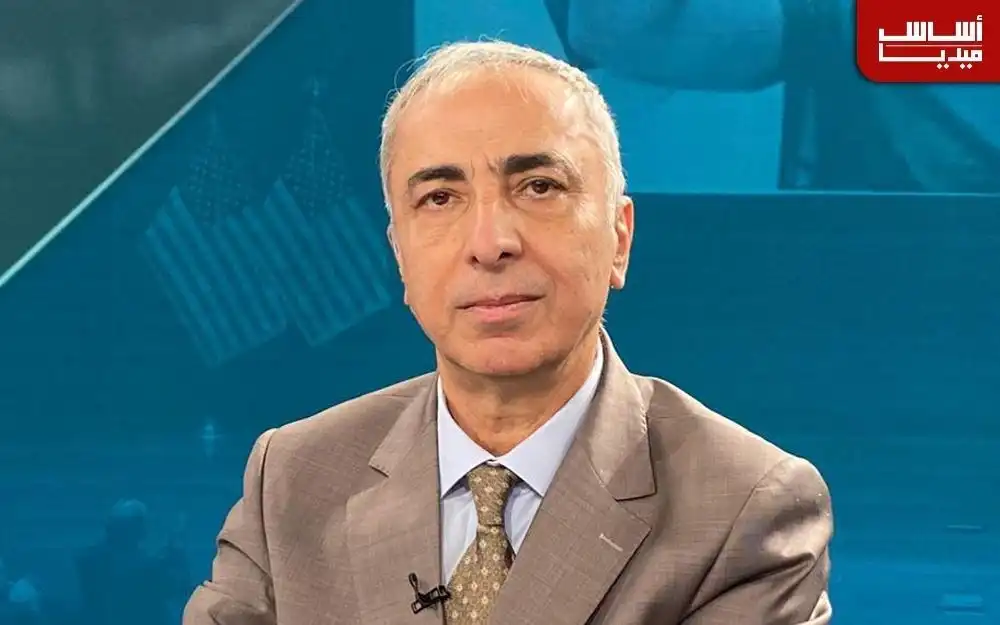
By Dr. Samir Salha


Washington wants Turkey to give it everything it wants, and when it does not achieve that, it directs all its tools against Ankara. What does all this American weapons sent to the east of the Euphrates mean? And all these American military bases in Greece, Cyprus, Syria and Iraq? Is it a coincidence that all this movement is taking place in a circle surrounding Turkey from all sides?


Ankara once again directed its arrows at Washington, holding it responsible for the partnership in targeting Turkish soldiers a few days ago in northern Iraq. It is the second attack of its kind, and the result is 21 Turkish soldiers killed within 20 days in infiltration operations and surprise attacks by members of the Kurdistan Workers’ Party in the “Claw - Al-Qafl” area in northern Iraq. To date, Turkish military operations on the northern Iraq-Syria line have not stopped, and there are no indications that they will stop soon.


Washington wants Turkey to give it everything it wants, and when it does not achieve that, it directs all its tools against Ankara


American "coup attempt"?

The well-known Turkish journalist Talat Atilla talks about the US administration's plans, which are preparing "a new coup attempt in Turkey through some strategic moves, as some inside Turkey see." We have previously followed similar positions that held Washington directly responsible for an attempted coup in 2016. But talk about America’s adherence to a goal of this kind at this time is a surprise to everyone, while US President Joe Biden’s work team praises the Turkish partnership and its importance for the two countries in the region.


The atmosphere of 7 years ago in the course of Turkish-American relations has not changed much. Washington is disturbed by the way Ankara deals with bilateral and regional issues that concern them, and the Turkish side criticizes America’s Syrian, Iraqi, and Middle Eastern policies on a daily basis and what it is trying to do in the Black Sea region. But for matters to come to an accusation of this kind on the lips of one of the Turkish pens in the midst of an atmosphere of popular and official anger regarding what the PKK and SDF groups are doing in northern Syria and Iraq, this means that protecting “Muawiyah’s hair” will be difficult for the two countries.


Turkish opposition journalist Fatih Burtuqal also speaks in the same direction, saying: “What happened in northern Iraq over the course of 3 weeks cannot be a coincidence.” America is waiting for an appropriate moment of emptiness and chaos inside Turkey to pounce.


Like Burtuqal and Attila, Islamic writer Latif Şimşak says, “Attempts to mobilize terrorist cells to carry out suicide operations will not work. The jinn has left the lantern and does not want to return to it before it takes what it wants.” A fourth Turkish writer, Ismet Ozcelik, repeats, “The message is clear. America brought down the Turkish march, mobilized ISIS and Workers’ Party groups, targeted Yemen, and moved Mossad cells in Turkey. These are all simultaneous issues with one goal. Washington is in a difficult regional situation and therefore is trying to threaten Turkey.” All of this is in addition to the confessions of cadres in the Workers’ Party who were interrogated and spoke about the logistical support provided on the Qamishli-Sulaymaniyah line.


What more does the Biden administration want to hear from Turkish President Erdogan than his saying: “They want to turn the Red Sea into a lake of blood”?


What is being said inside Turkey today brings us back to the starting line with Washington, and goes beyond holding it responsible for targeting Turkish soldiers in Hakurk and Matina, Iraq, in two successive operations within 3 weeks.


Is Israel a partner in the plan?


Yes, according to many Turks. There are a group of signals that cannot be skipped, the most important of which are:


- The declared state of alert among the ranks of the Turkish security and intelligence services and the activation of their operations at home and abroad against the Mossad and its activities against Turkey, and the waves of arrest and detention of dozens of spies and agents after monitoring and follow-up operations that lasted many weeks reflect the fact that Zero Hour is an American-Israeli one with a single decision and from a joint operations room. Moving the Kurdish card in the region is what may serve Washington and Tel Aviv in these difficult circumstances they are going through.


The Turkish air and ground forces, in coordination with the intelligence service, continue to target sites of the Kurdistan Workers’ Party and Kurdish Protection Units groups in northern Syria and Iraq, in retaliation for two infiltration and attack operations against Turkish military centers near the Iraqi city of Matina, which led to deaths and injuries among Turkish soldiers.


There is once again talk inside Turkey about broader ground and air operations on the Qamishli-Hasakah-Qandil-Matina line.


Baghdad and Damascus decided to remain silent and wait, waiting to know the limits of the Turkish military movement and where it will stop.


- Tehran did not miss an opportunity of this kind, so it moved to target Erbil under the pretext of the latter opening its doors to Mossad agents who attack its leaders in Iraq.


The mystery is the following: Will the Turkish operations reach the heart of Sulaymaniyah, the stronghold of Bafel Talabani, an ally of the SDF, the Labor Party, America and Iran at the same time, who facilitates the movement of the Labor Party groups on the Syria-Iraq line with the knowledge and support of the American forces present there?


We will not accept terrorism on our borders


US Secretary of State Anthony Blinken is coming to Turkey to discuss more than one file and to talk "about the role that Turkey can play in the next day in Gaza." From there, he continues his shuttle trip to Athens, as if to say that Washington is moving on the Turkish-Greek rapprochement, amid an atmosphere of Turkish optimism about the occurrence of trade-offs in the outstanding issues, including the F-16 deal and Sweden’s Atlantic membership. However, days after his departure, PKK groups moved to attack Turkish forces in Matina. Who orders her to move so quickly and why?


Washington must help answer, otherwise it will find the Turkish fireball in its lap very soon.

Turkish Interior Minister Ali Yerlikaya announces that “our operations continue resolutely until the last terrorist is neutralized.” Turkish intelligence service teams are active by air and land in targeting military installations and infrastructure of the SDF and hunting down cadres and leaders of the Workers’ Party and their collaborators.


The Turkish Presidency’s Communications Department transmits a statement issued by a security meeting in Istanbul, chaired by Recep Tayyip Erdogan and with the participation of senior security and political leaders, in which it said: “The more the noose is tightened on the terrorist PKK organization in Syria and Iraq, the more attempts to re-empower and revitalize it gain momentum... Turkey will absolutely not allow the establishment of terrorism on its southern borders, no matter the sacrifices.”


Washington prefers not to comment on what is happening so as not to anger Ankara further in Syria, Iraq, and the Red Sea.


Were we unfair to the White House two weeks ago when we wrote, “America is fighting Turkey... in northern Iraq?”, on the Asas website on January 4 of this year. Were we wrong when we came to conclusions that said: “We are at war with America. Are members of the Kurdistan Workers’ Party soldiers in the American army?”


The answer came to us just a few days ago. What is being said inside Turkey today brings us back to the starting line with Washington, and goes beyond holding it responsible for targeting Turkish soldiers in Hakurk and Matina, Iraq, in two successive operations within 3 weeks. The Turks are convinced that there is someone who shares the sheep with the wolf and cries with the shepherd. The limits of the Turkish military and political response are not yet clear... but the coming days will say a lot.


ARAB AND WORLD

Wed 17 Jan 2024 10:28 am - Jerusalem Time

Growing tension in the Israeli war cabinet: Gantz made requests to Netanyahu

The Israeli Channel 12 revealed a list of demands sent by the Minister in the Israeli War Council, Benny Gantz, to Prime Minister Benjamin Netanyahu, in which he touched on a number of issues crucial to the continuation of the war.


According to the channel, Gantz asked to discuss the issue of the Rafah crossing and the Salah al-Din Corridor (Philadelphia) and the mechanism that will be put forward to prevent the continuation of arms smuggling, in addition to talks with Egypt in this regard.


Gantz also asked to discuss the issue of the day after the war in Gaza, and asked whether it was necessary to redefine the goals of the war, especially with regard to the return of Israeli detainees, the introduction of humanitarian aid into the Strip, and the return of the residents of the Gaza Strip to their homes.


Gantz called for setting a time limit for diplomatic negotiations regarding the situation on the border with Lebanon.


Since the formation of the War Council - which is headed by Netanyahu and includes Gantz and Defense Minister Yoav Gallant - Israeli media have reported on more than one occasion that there are disagreements between Netanyahu and Gallant on the one hand and Netanyahu and Gantz on the other hand regarding the management of the war and the file of Israeli prisoners in the Gaza Strip.


The Islamic Resistance Movement (Hamas) surprised Israel on October 7 with a large-scale attack on the settlements surrounding the Gaza Strip, killing about 1,200 Israelis and capturing dozens.


According to the Israeli army, 168 officers and soldiers were killed in Gaza since the start of the ground operation on October 27, while the total number of deaths since the 7th of the same month reached 502 officers and soldiers.

OPINIONS

Wed 17 Jan 2024 9:05 am - Jerusalem Time

One hundred days and difficult decisions

Gershon Baskin

Gershon Baskin

Opinion Writer

Someone has to tell the truth, no matter how hard it is. I have said since the first week of this damned war that the only way to return all the kidnapped people alive is through a deal with Hamas - “all for all” - all the kidnapped people for all the Palestinian prisoners. That's the deal. Now, 100 days into the war, it is difficult to digest that there are still 136 hostages being held by Hamas somewhere in Gaza. 

After all the killing and destruction that lasted for a hundred days - both in Israel and in Gaza, Hamas, which at the beginning of the war demanded "all for all", is now also demanding an end to the war and Israel's withdrawal to the international border... and without Israel agreeing to these demands, there will be no agreement. 

From my experience in negotiations with Hamas, as well as from the messages I received from Qatar, from Egypt, and from Hamas men themselves - this is the deal. According to Israel, today at least 20 of the kidnapped are no longer alive (including Oron Shaul and Hadar Goldin), and it is not known how many of the kidnapped will survive until their release - every day in captivity puts their lives in danger.

There are Israelis, including heads of state and the army, who believe that if Israel succeeds in eliminating the leaders of Hamas - the Sinwar brothers, Muhammad Daf, Marwan Issa and others - all the kidnapped people will be released. I do not believe that eliminating Hamas leaders will automatically lead to the release of all the kidnapped people. Like many others, I assume that the Hamas leaders surrounded themselves with hostages as human shields, and if Israel found them, in the battle between them, many of the hostages would be killed along with the Hamas leaders.

There will be no victory for Israel if the kidnapped people do not return home alive. Too many of them have been killed there already, and we have no idea how many more will be killed. 

The return of the kidnapped people must be the most important task even before the death of Hamas. This is Israel's moral responsibility to return them after it abandoned them in their homes, bases, and at the Nova Festival. 

Military victory over Hamas can wait, but the kidnapped cannot wait. Much of what is said to the families of the kidnapped and what the public tells us, takes me back to the days of Gilad Shalit's residency. “We are turning over every stone,” they tell us, “and hundreds of people are working 24/7 to bring back the kidnapped people.” I do not know whether this is true or not, but it seems that the goals of the war since the first round of hostage release are now the defeat of Hamas and not the return of the hostages. 

Perhaps the reason for this is that the price demanded by Hamas is incomparably higher than the Israeli government's willingness to pay. If this is true, it seems that Israel has already decided not to conduct negotiations in good faith, or to conduct negotiations for an indefinite period and rely solely on military operations to rescue them from captivity. 

There is no doubt that a successful search and rescue operation is the best outcome for Israel. But 100 days later, the IDF succeeded in rescuing one of the kidnappers alive, and 136 Israelis remained captive in real and increasing danger to their lives.

The truth is that the price demanded by Hamas is very high, and even dangerous. There are approximately 8,000 Palestinian prisoners in Israeli prisons, of whom 559 are serving life sentences for killing Israelis. There are also about 130 Hamas terrorists captured in Israel after the October 7 massacre, and hundreds of Hamas fighters who have been transferred from Gaza to Israel since the beginning of the war. Israel continues to arrest hundreds of Palestinians from the West Bank every week.

In discussions among security personnel about the conditions for releasing prisoners if an agreement is reached, there are those who call for the most dangerous killers to be deported abroad, including those who killed hundreds of Israelis. Some support sending all prisoners to Gaza, but there they may join Hamas forces later in the war. In my opinion, they should all be released to the West Bank, where there is greater possibility of following them up and monitoring their actions. 

As in previous deals, all prisoners will have to sign a pledge not to return to terrorism. Obviously their obligation should not be relied upon, but this may provide a legal basis for their re-arrest if they breach this obligation. Prisoners to be released will be easier to hold in the West Bank than in Gaza or abroad. This is a large number of released prisoners, which will require a large number of people to supervise them. For this task, it will be possible to recruit people from among Shin Beit employees who will be unemployed after the prisons are emptied of prisoners. 

From past experience, many released prisoners do not return to terrorist activity. Many of them prefer to spend the rest of their lives with family members - spouse, children and grandchildren - or invest their time and energy in work and developing a new career. Not all of them are dangerous, and those who are can be treated after the kidnappers return. The most dangerous prisoners, if they return to terrorist activity, can be eliminated before they can cause any harm.

There is no doubt that the deal will constitute a landslide victory for Hamas, and this will have local and regional consequences. Therefore, this victory must be short-lived, and the war may resume after the kidnappers return. There is nothing sacred or binding in the agreement between Israel and Hamas. Both Hamas and Israel have proven this in the past. Hamas has violated the agreement for the first round of hostage release. Israel violated the Shalit deal by arresting about 70 of its editors in 2014. Hamas's popularity will skyrocket after the release of about 8,000 prisoners, both in Palestine and throughout the Arab world. 

Israel will be free to renew the war until it ends by eliminating Hamas' ability to control Gaza and dismantling the military apparatus that threatens Israel's citizens. 

In order to deal with Hamas' growing popularity, the international community, including Israel's neighbors, must put intense pressure on Israel to end the occupation and form a Palestinian government controlling the West Bank and Gaza Strip. 

The Palestinians must reform their political home, unite their forces in favor of peace with Israel, eliminate corruption, and gain legitimacy in the eyes of the Palestinian people. Talk about the establishment and actual existence of a Palestinian state should be removed from the negotiating table, and Israel should be stripped of its veto power in this regard. At the same time, the international community, including the OECD countries led by the United States of America, must recognize the State of Palestine and allow its admission into the United Nations as a member state. 

These steps will give victory to the Palestinians who understand that they must live in peace with Israel. The only way the Palestinians will win elections and respect is only if Israel provides security.

It took five years until about 80% of the public in Israel were willing to support the Shalit deal. Today, our abductees have only five years to wait for this support. The government must make difficult decisions now. Members of the government must approve the deal despite all the risks it entails. After the citizens of Israel lost confidence in the state’s protection of them when needed, after it abandoned them on October 7, failure to return the kidnapped people safely to their homeland will cause irreparable harm to Israeli society for many generations. 

The Israeli government has a paramount duty to return all abductees immediately, without any delay. 

According to the messages I received from Qatar, Egypt, and Hamas, this is the deal that will bring them home. The decision regarding it is one of the most difficult decisions that the State of Israel has faced, but I see no other option but to accept it.

OPINIONS

Wed 17 Jan 2024 8:48 am - Jerusalem Time

The Houthis sink an arrow into the West’s Achilles’ heel

The Washington Post

The Washington Post

Opinion Writer

By David Ignatius

The White House has officially designated April as “Supply Chain Integrity Month.” Houthi rebels in Yemen and a dozen other players that can wreak havoc on global logistics don’t seem to have gotten the message.The Houthis are a tribal militia in a faraway country that many Americans couldn’t identify on a map. But they have the ability to disrupt world markets. For three months, they have been sending missiles and drones toward commercial cargo ships in the Red Sea — and, in the process, altering global shipping flows and insurance rates. Reuters reported on Tuesday that just in the past week, risk premiums for ships traveling the area had increased by more than 40 percent.

The Houthis have what might be called bottleneck power. They command the narrow passageway into the Red Sea, which allows them to sabotage a vulnerable point in the global supply chain. This ability to exploit chokepoints is an increasingly important but little-discussed weakness in the global economy — one that the United States, which boasts of its role as guarantor of freedom of navigation, seems almost powerless to prevent.

U.S. military threats didn’t deter the Houthis, who began firing missiles at cargo ships in November in a supposed protest against the war in Gaza. A U.S.-led coalition of more than 20 countries, hubristically called Prosperity Guardian, didn’t stop the attacks, either. Maersk and Hapag-Lloyd, two of the biggest global shipping companies, announced on Jan. 2 they would stop using the Red Sea route because of the Houthi missiles.


The United States and Britain finally took military action on Jan. 11, striking more than 60 Houthi targets with more than 100 precision bombs, and U.S. forces attacked again the next day. Even that didn’t stop the Houthis, who struck a U.S-owned cargo ship on Monday, drawing a retaliatory U.S. assault Tuesday against a Houthi missile-launching site.

The Houthis are masters of modern guerrilla war, exploiting the weak points of stronger powers. Saudi Arabia and the United Arab Emirates fought a war against them starting in 2014. The UAE gave up in 2020, and the Saudis agreed to a peace deal last year, which only seemed to embolden the Houthis. They are tough, patient fighters — supplied with weapons, training and intelligence by Iran — and they sit atop one of the world’s most strategic waterways.

Houthi leaders seem to understand that the deeper they draw the United States into conflict, the greater impact they have on the global economy. That’s the lesson of this undeclared war: The United States has overwhelming economic power. But perhaps because it is dependent on global trade and financial flows, it is especially vulnerable to economic attack by such seeming lightweights as the Houthis.

We’ve seen other bottleneck vulnerabilities during the past few years. A giant Panamanian-flagged cargo ship called the Ever Given got stuck in the Suez Canal for six days in March 2021, obstructing more than 350 ships. The delicate thread of global commerce was beginning to unravel when the ship was finally refloated.

The war in Ukraine has been, in part, a battle to control access points and skew commerce. Russian control of the Black Sea allowed it, for a time, to halt Ukrainian grain shipments and spike global food prices — adding to inflation and, worse, threatening famine. Russia’s enemies, identity still unknown, sabotaged the Nord Stream pipeline in September 2022. Ukraine at least twice has attacked the Kerch Strait bridge that links Russia to occupied Crimea.

Paradoxically, the more dominant the United States has become economically, the more vulnerable it is to supply-chain attack. An early demonstration of that dependence was the 1974 Arab oil embargo, whose destabilizing effects persisted for much of the next decade. Today’s most precious resource is information, and the United States keeps leaping forward with new digital tools. But as cyber technology advances, so do the weapons of cyberwar.

A disturbing example of a U.S. strength that could become a weakness is our dominance of cloud computing — and growing reliance on it. A study to be published Wednesday by the Carnegie Endowment for International Peace focuses on the risk that the theoretically invulnerable cloud could be disrupted by natural disasters, technology failure, human error or other unanticipated factors.

The study cites an estimate by two giant reinsurance companies that potential insurance losses in a cloud-dependent world could be 100 times those before cloud adoption.

The Carnegie study, outlined for me this week by Ariel Levite, one of its three authors, proposes that cloud providers and their clients should agree on “a framework to enhance resilience and trust.” Like giant financial institutions, cloud providers should face regular “stress tests” to see how they would cope with unexpected disasters, Levite explained.

The Biden administration, which took office amid the covid-19 pandemic, recognized the need to protect global supply chains. And the administration’s actions have reduced the United States’ vulnerability to outside disruptions.

But the bizarre little war off the coast of Yemen — and its big potential effect on global commerce — is a reminder of how fragile the logistical network remains. The grandees of the world economy who are gathering this week in Davos, Switzerland, for their annual celebration of globalization should keep an eye on the distant bottleneck at the Bab el-Mandeb, where the system seems very weak indeed.


PALESTINE

Wed 17 Jan 2024 8:37 am - Jerusalem Time

West Bank: Israeli authorities hand over the body of the killed child, Ruqaya Abu Dahuk

On Tuesday evening, the Israeli authorities handed over the body of the killed child, Ruqaya Abu Dahuk (4 years old), after detaining it for 9 days.


The body of the child, Abu Dahuk, a resident of Beit Iksa, northwest of occupied Jerusalem, was transferred to the Palestine Medical Complex in Ramallah.


The Israeli forces had opened fire on two vehicles as they passed through the Beit Iksa checkpoint, on the 7th of January of this month, which led to the death of the young man, Muhammad Mazid Abu Eid, from the town of Biddu, and his wife, Duha Nabih Abu Eid, who was with him in the same vehicle, and the death of the child, Abu Dahok, who was with her family in another vehicle.

PALESTINE

Wed 17 Jan 2024 8:10 am - Jerusalem Time

West Bank: Confrontations with Israeli forces after storming towns and arresting 50 Palestinians

The Israeli forces continued their raids into cities and towns in the occupied West Bank, and confrontations broke out with Palestinian youth in a number of them, while Israeli forces arrested dozens.


The Israeli occupation forces stormed the town of Anata (east of occupied Jerusalem) and the villages of Nahalin and Husan (west of Bethlehem).


A local source reported that confrontations broke out between Palestinian youth and Israeli forces, as the occupation soldiers fired live bullets and tear gas bombs at the protesting youth. They also closed shops and searched a number of homes after storming them.


The Red Crescent announced that a young man was injured by occupation bullets during confrontations in the village of Madama, south of Nablus, and the occupation forces also stormed the town of Asira al-Qibliya, south of the same city.


Local sources said that the Israeli forces stormed the Ain Sultan refugee camp, north of the city of Jericho in the West Bank.


The sources added that the Israeli forces surrounded a house amid heavy firing of stun grenades and tear gas, and arrested a young man, claiming that he was wanted by their security services, before they withdrew.

The  Israeli forces set up a number of barriers at the entrances to the towns of Qalqilya Governorate and the main entrance to the city, and arrested a young man in front of the entrance to the town of Nabi Elias, east of the city.


The people of the city of Dura (south of Hebron) mourned the bodies of Muhammad Abu Sebaa and Ahed Mtair, who were martyred yesterday, Monday, at the hands of the  Israeli forces. The funeral coincided with a city-wide strike to mourn the two martyrs.


The  Israeli forces had previously withdrawn from the home of the prisoner, doctor Ayser Barghouti, in the Batn al-Hawa neighborhood in the city of Ramallah, after storming the city at dawn on Tuesday. They raided the apartment of Barghouti, who was arrested by the occupation forces 9 days ago on charges of carrying out an attack north of the city of Ramallah on the 7th of Ramallah. current month.


Arrests

The Palestinian Prisoners' Club said that the  Israeli forces arrested 50 Palestinians last night from the West Bank, including children and freed prisoners.


The Palestinian News and Information Agency (Wafa) reported on Tuesday that the arrests included 16 citizens from Hebron, 10 from Ramallah, 6 from Jenin, and 3 from Qalqilya and Nablus.


The Prisoners' Club and the Prisoners' Affairs Authority reported - last Sunday - that "the number of arrests rose after the seventh of last October to about 5,875 people, and it includes those who were arrested from homes, through military checkpoints, and those who were forced to surrender themselves under pressure." And those who were held hostage."


On the verge of explosion

Since the resistance launched the Battle of Al-Aqsa Flood on October 7, the pace of Israeli attacks in the West Bank has escalated, and has since resulted in the martyrdom of more than 350 Palestinians and the arrest of more than 5,000 others.


The Israeli army continues its raids, while the Haaretz newspaper quoted security officials as saying that the situation in the West Bank is on the verge of explosion. Security officials warned that if the political level does not make decisions about the economic future of the Palestinians there, the risk of conflict will increase. The newspaper said. The Israeli army transferred the Duvdevan unit from Gaza to the West Bank in anticipation of the escalation of the situation there.

OPINIONS

Wed 17 Jan 2024 8:01 am - Jerusalem Time

War on Gaza: Western racism laid the foundations for this genocide

Middle East Eye

Middle East Eye

Opinion Writer

By Jonathan Cook

 South Africa and Israel bear the trauma of Europe’s long history of racial supremacism, but each has drawn precisely opposite lessons

It should surprise no one that the prize-match fight for the rule of international law has pitted Israel and South Africa against each other at the International Court of Justice at The Hague.


The world is split between those who have crafted a self-serving global and regional order that guarantees them impunity whatever their crimes, and those who pay the price for that arrangement. 

Now the long-time victims are fighting back at the so-called World Court.

Last week, each side presented its arguments for and against whether Israel has implemented a genocidal policy in Gaza over the past three months. 


South Africa’s case should be open and shut. So far Israel has killed or seriously wounded close to 100,000 Palestinians in Gaza, almost one in every 20 inhabitants. It has damaged or destroyed more than 60 percent of the population’s homes. It has bombed the tiny “safe zones” to which it has ordered some two million Palestinians to flee. It has exposed them to starvation and lethal disease by cutting off aid and water. 


Bottom of Form

Meanwhile, senior Israeli political and military officials have openly and repeatedly expressed genocidal intent, as South Africa’s submission so carefully documents.

Back in September, before Hamas’ break-out from the Gaza prison on 7 October, Israeli Prime Minister Benjamin Netanyahu had shown the United Nations a map of his aspiration for what he termed “the New Middle East”. The Palestinian territories of Gaza and the West Bank were gone, replaced by Israel.

Despite the mass of evidence against Israel, it could take years for the International Court of Justice (ICJ) to reach a definitive verdict - by which time, if things carry on as they are, there may be no meaningful Palestinian population left to protect. 

South Africa has therefore also urgently requested an interim order effectively requiring Israel to stop its attack.


Opposing corners

The peoples of Israel and South Africa still carry the wounds of the crimes of systematic European racism: in Israel’s case, the Holocaust in which the Nazis and their collaborators exterminated six million Jews; and in South Africa’s, the white apartheid regime that was imposed on the black population for decades by a colonizing white minority.

They are in opposite corners because each drew a different lesson from their respective traumatic historical legacies.

Israel raised its citizens to believe that Jews must join the racist, oppressor nations, adopting a “might makes right” approach to neighboring states. A self-declared Jewish state sees the region as a zero-sum battleground in which domination and brutality win the day. 

It was inevitable that Israel would eventually spawn, in Hamas and groups like Hezbollah in Lebanon, armed opponents who view their conflict with Israel in a similar light.

South Africa, by contrast, has aspired to carry the mantel of “moral beacon” nation, that western states so readily ascribe to their top-dog, nuclear-armed Middle Eastern client state, Israel. 


South Africa’s first post-apartheid president, Nelson Mandela, famously observed in 1997: “We know too well that our freedom is incomplete without the freedom of the Palestinians.”


Israel and apartheid South Africa were close diplomatic and military allies until apartheid’s fall 30 years ago. Mandela understood that the ideological foundations of Zionism and apartheid were built on a similar racial supremacist logic.

He was once cast as a terrorist villain for opposing South Africa’s apartheid rulers, much as Palestinian leaders are by Israel today. 


Jackboot of colonialism

It should also not surprise us that lined up in Israel’s corner is most of the West - led by Washington and Germany, the country that instigated the Holocaust. Berlin asked last Friday to be considered a third party in Israel’s defense at The Hague.

Meanwhile, South Africa’s case is backed by much of what is called the “developing world”, which has long felt the jackboot of western colonialism - and racism - on its face.


Notably, Namibia was incensed by Germany’s support for Israel at the court, given that at the outset of the 20th century, the colonial German regime in south-west Africa herded many tens of thousands of Namibians into death camps, developing the blueprint for the genocide of Jews and Roma it would later refine in the Holocaust.

The Namibian president, Hage Geingob, stated: “Germany cannot morally express commitment to the United Nations Convention against genocide, including atonement for the genocide in Namibia, whilst supporting the equivalent of a holocaust and genocide in Gaza.”

The panel of judges - 17 of them in total - do not exist in some rarified bubble of legal abstraction. Intense political pressures in this polarized fight will bear down on them. 

As former UK ambassador Craig Murray, who attended the two days of hearings, observed: most of the judges looked as if they “really did not want to be in the court”.


‘Nobody will stop us’

The reality is that, whichever way the majority in the court swings in its decision, the crushing power of the West to get its way will shape what happens next.

If most of the judges find it plausible that there is a risk Israel is committing genocide and insist on some sort of interim ceasefire until it can make a definitive ruling, Washington will block enforcement through its veto at the UN Security Council. 

Expect the US, as well as Europe, to work harder than ever to undermine international law and its supporting institutions. Imputations of antisemitism on the part of the judges who back South Africa’s case - and the states to which they belong - will be liberally spread around.

Already Israel has accused South Africa of a “blood libel”, suggesting its motives at the ICJ are driven by antisemitism. In his address to the court, Tal Becker of the Israeli foreign ministry argued that South Africa was acting as a legal surrogate for Hamas.

The US has implied much the same by calling South Africa’s meticulous amassing of evidence “meritless”.

On Saturday, in a speech littered with deceptions, Netanyahu vowed to ignore the court’s ruling if it was not to Israel’s liking. “Nobody will stop us - not The Hague, not the axis of evil, and not anybody else,” he said.

On the other hand, if the ICJ rules at this stage anything less than that there is a plausible case for genocide, Israel and the Biden administration will seize on the verdict to mischaracterize Israel’s assault on Gaza as receiving a clean bill of health from the World Court.

That will be a lie. The judges are being asked only to rule on the matter of genocide, the gravest of the crimes against humanity, where the evidential bar is set very high indeed. 

In an international legal system in which nation-states are accorded far more rights than ordinary people, the priority is giving states the freedom to wage wars in which civilians are likely to pay the heaviest price. The gargantuan profits of the West’s military-industrial complex depend on this intentional lacuna in the so-called “rules of war”.

If the court finds - whether for political or legal reasons - that South Africa has failed to make a plausible case, it will not absolve Israel of war crimes and crimes against humanity. Indisputably, it is carrying out both.


Foot dragging

Nonetheless, any reticence on the part of the ICJ will be duly noted by the International Criminal Court (ICC), its heavily compromised sister court. Its job is not to adjudicate between states like the World Court but to gather evidence for the prosecution of individuals who order or carry out war crimes. 

It is currently gathering evidence to decide whether to investigate Israeli and Hamas officials over the events of the past three months.

But for years, the same court has been dragging its feet on prosecuting Israeli officials over war crimes that long predate the current assault on Gaza, such as Israel’s decades of building illegal Jewish settlements on Palestinian land, and Israel’s 17-year siege of Gaza - the rarely mentioned context for Hamas’ break-out on 7 October.

The ICC similarly baulked at prosecuting US and British officials over the war crimes their states carried out in invading and occupying Afghanistan and Iraq.

That followed an intimidation campaign from Washington, which imposed sanctions on the court’s two most senior officials, including freezing their US assets, blocking their international financial transactions and denying them and their families entry to the US.


Terror campaign

Israel’s central argument against genocide last week was that it is defending itself after it was attacked on 7 October, and that the real genocide is being carried out by Hamas against Israel. 

Such a claim should be roundly dismissed by the World Court. Israel has no right to defend its decades-long occupation and siege of Gaza, the background to the events of 7 October. And it cannot claim it is targeting a few thousand Hamas fighters when it is bombing, displacing and starving Gaza’s entire civilian population. 

Even if Israel’s military campaign is not intended to wipe out the Palestinians of Gaza, as all statements by the Israeli cabinet and military officials indicate, it is nonetheless still directed primarily at civilians. 

On the most charitable reading, given the facts, Palestinian civilians are being bombed and killed en masse to cause terror. They are being ethnically cleansed to depopulate Gaza. And they are being subjected to a horrifying form of collective punishment in Israel’s “complete siege” that denies them food, water and power - leading to starvation and exposure to lethal disease - to weaken their will to resist their occupation and seek liberation from absolute Israeli control.

If all of this is the only way Israel can “eradicate Hamas” - its stated goal - then it reveals something Israel and its western patrons would rather we all ignore: that Hamas is so deeply embedded in Gaza precisely because its implacable resistance looks like the only reasonable response to a Palestinian population ever more suffocated by the tightening chokehold of oppression Israel has inflicted on Gaza for decades.

Israel’s weeks of carpet bombing have left Gaza uninhabitable for the vast majority of the population, who have no homes to return to and little in the way of functioning infrastructure. Without massive and constant aid, which Israel is blocking, they will gradually die of dehydration, famine, cold and disease.

In these circumstances, Israel’s actual defense against genocide is an entirely conditional one: it is not committing genocide only if it has correctly estimated that sufficient pressure will mount on Egypt that it feels compelled - or bullied - into opening its border with Gaza and allowing the population to escape.

If Cairo refuses, and Israel does not change course, the people of Gaza are doomed. In a rightly ordered world, a claim of reckless indifference as to whether the Palestinians of Gaza die from conditions Israel has created should be no defense against genocide.


War business as usual

The difficulty for the World Court is that it is on trial as much as Israel - and will lose whichever way it rules. Legal facts and the court’s credibility are in direct conflict with western political priorities and war industry profits. 


The risk is the judges may feel the safest course is to “split the difference”. 

They may exonerate Israel of genocide based on a technicality, while insisting it do more of what it isn’t doing at all: protecting the “humanitarian needs” of Gaza’s people. 


Legal facts and the court’s credibility are in direct conflict with western political priorities and war industry profits


Israel dangled just such a technicality before the judges last week like a juicy carrot. Its lawyers argued that, because Israel had not responded to the genocide case made by South Africa at the time of its filing, there was no dispute between the two states. The World Court, Israel suggested, therefore lacked jurisdiction because its role is to settle such disputes.

If accepted, it would mean, as former ambassador Murray noted, that, absurdly, states could be exonerated of genocide simply by refusing to engage with their accusers.

Aeyal Gross, a professor of international law at Tel Aviv University, told the Haaretz newspaper he expected the court to reject any limitations on Israel’s military operations. It would focus instead on humanitarian measures to ease the plight of Gaza’s population.

He also noted that Israel would insist it was already complying - and carry on as before.

The one sticking point, Gross suggested, would be a demand from the World Court that Israel allow international investigators access to the enclave to assess whether war crimes had been committed.

It is precisely this kind of “war business as usual” that will discredit the court - and the international humanitarian law it is supposed to uphold. 


Vacuum of leadership

As ever, it is not the West that the world can look to for meaningful leadership on the gravest crises it faces or for efforts to de-escalate conflict.

The only actors showing any inclination to put into practice the moral obligation that should fall to states to intervene to stop genocide are the “terrorists”. 

Hezbollah in Lebanon is putting pressure on Israel by incrementally building a second front in the north, while the Houthis in Yemen are improvising their own form of economic sanctions on international shipping passing through the Red Sea. 

The US and Britain responded at the weekend with air strikes on Yemen, turning up the heat even higher and threatening to tip the region into a wider war. 


With its own investments in the Suez Canal threatened, China, unlike the West, seems desperate to cool things down. Beijing proposed this week an Israel-Palestine peace conference involving a much wider circle of states.


The goal is to loosen Washington’s malevolent stranglehold on pretend “peace-making” and bind all the parties to a commitment to create a Palestinian state. 

The West’s narrative is that anyone outside its club - from South Africa and China to Hezbollah and the Houthis - is the enemy, threatening Washington’s "rules-based order".

But it is that very order that looks increasingly self-serving and discredited - and the foundation for a genocide being inflicted on the Palestinians of Gaza in broad daylight. 

 

ARAB AND WORLD

Wed 17 Jan 2024 7:56 am - Jerusalem Time

Saudi Foreign Minister: We may recognize Israel if the Palestinian crisis is resolved

Saudi Foreign Minister Prince Faisal bin Farhan said on Tuesday that the Kingdom may recognize Israel if the Palestinian crisis is resolved, calling for a “first step” represented by a ceasefire in Gaza.


Ibn Farhan’s words came in an intervention, on Tuesday, during a discussion session at the Davos Forum held in Switzerland entitled: “Securing an Insecure World,” in which he responded to a question about whether the Kingdom could recognize Israel within the framework of a broader agreement after resolving the Palestinian conflict, where he said: "certainly".


Bin Farhan added that there is no evidence that the Israeli goals of its war on the Gaza Strip are close to being achieved, calling for making room for a path that empowers the Palestinian Authority and allows moving forward towards peace. He stressed that "our priority is to find a path to calm through real interaction in the region, and we must focus on reducing tensions through a ceasefire in Gaza."


While he expressed his pleasure "for international voices to join in calling for a ceasefire to put an end to the human suffering resulting from the war in Gaza," he considered that "the calls are insufficient" and demanded that "they be intensified and made more serious to achieve the demand to stop the war and suffering."


Regarding regional tensions in the context of the repercussions of the war on Gaza, Bin Farhan said: “We are concerned about regional security and freedom of navigation in the Red Sea, and the priority is calm and reducing escalation.”


The Saudi Foreign Minister stressed that "focus must be placed on the situation in Gaza because it affects the region and increases tension in the Red Sea."


He continued: "The priority must be to reduce the escalation in the Red Sea and the entire region," considering that "continuing suffering in Gaza will likely leave endless cycles of violence," according to his assessment.


In solidarity with the Gaza Strip, which is exposed to a devastating Israeli war, groups loyal to Iran, including Hezbollah in Lebanon, the Houthis in Yemen, and other groups in Iraq and Syria, launched attacks on Israeli and American targets.
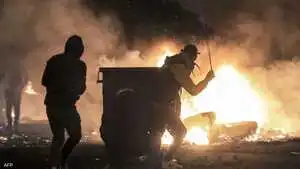

However, the most notable development was in Yemen, where the Houthis targeted, with missiles and drones, cargo ships in the Red Sea owned or operated by Israeli companies or transporting goods to and from Israel, which was met with international military action led by the United States under the name “Guardian of Prosperity.”


Since October 7, 2023, the Israeli occupation army has been waging a devastating war on Gaza with American support, which, as of Tuesday, left 24,285 dead and 61,154 injured, and caused the displacement of more than 85 percent (about 1.9 million people) of the Strip’s population, according to Palestinian authorities and the United Nations.


(Reuters, Anatolia)

ARAB AND WORLD

Wed 17 Jan 2024 7:51 am - Jerusalem Time

UN experts warn: Global human rights laws are collapsing

This month, independent UN experts concerned with the issue of human rights sounded a new alarm bell, warning of the decline in the situation of international human rights, which are based on international law, in an open letter to the member states of the United Nations Human Rights Council, based in Geneva.


International human rights laws are at risk

The experts, led by the UN Special Rapporteur on human rights in the occupied Palestinian territories, Francesca Albanese, called for all member states of the United Nations to stop and desist from providing political or moral support, or granting military and economic support, to actions by states or non-states, including violations of international humanitarian law and international human rights laws, some of which amount to serious violations of the Geneva Conventions signed in 1949 (relating to the protection of civilians in times of war), and to war crimes and crimes against humanity.


UN experts: Several events around the world threaten to undermine the possibility of universal application of basic international rules for the protection of civilians


The letter, which was also signed by 17 recent experts other than Albanese, who serve in several areas of investigation, monitoring and consultation commissioned by the UN Human Rights Council, and dated January 9, included a warning that several events are taking place around the world, which the letter did not enumerate or mention. Specifically mentioning any of them, as well as the response of active states to them, that constitute “international third parties” that threaten to fatally undermine the global application of basic international rules for the protection of civilians and their basic human rights, and with it the credibility of the mandates granted to these experts for research and investigation and work in several countries.


Increased violations since the “War on Terror”

In their letter, the experts speak of a worrying, gradual and continuing erosion and decline of international standards related to human rights, which have been observed in several conflicts around the world over the past two decades, especially since the declaration (of the United States and its allies) of the “War on Terrorism.”


But according to experts, a group of armed conflicts taking place in the recent period threatens to completely eliminate protection systems and standards that took many decades to implement.


The signatories stressed that they feel obliged to remind the member states of the international organization of the most important of these basic standards that “we must all respect and ensure that others respect them.”


In this context, the experts recalled that “collective punishment, indiscriminate attacks and targeting of civilians, medical facilities and staff, religious and residential centers, markets, and educational headquarters, as well as the evacuation of civilians and forced displacement, hostage-taking, sexual violence, theft, sabotage, and arbitrary arrest, And slavery are all practices prohibited by international law.” The letter also reminded, “In light of any emergency military operation, or an allegation that a specific area has had its civilian status violated, the burden of proving this falls on the party carrying out an attack and not on the attacked party, that is, civilians.”


Illegal practices include indiscriminate bombing of civilians, forcibly displacing them, and starving them


The letter, which was also signed by Richard Bennett, the UN Special Investigator for Human Rights in Afghanistan, and Pablo de Greiff, Commissioner of the Independent International Commission of Inquiry on Ukraine, also addressed “starving a people, or denying them access to clean water, shelter, or fuel, or medicine,” are also considered internationally prohibited practices, stressing that the parties to the conflict are obligated to allow the arrival of humanitarian and medical aid at the necessary levels to areas under military control, and for third parties to ensure that this is implemented. The experts also called on the member states of the United Nations to use the mechanisms to correct this imbalance and stop available human rights violations, forcefully and in an impartial manner.


It is noteworthy that also among the signatories are Shaheen Sardar Ali, a member of the international independent fact-finding mission in Iran, Hani Majli, Commissioner of the Independent International Commission of Inquiry on Syria, Carlos Castrezana Fernandez, Commissioner of the Human Rights Commission in South Sudan, and Isha Divan, the independent expert on the human rights situation. In Somalia, Mohammed Babiker, the UN Special Rapporteur on human rights in Eritrea, Vrinda Grover, Commissioner of the International Independent Fact-Finding Commission on Ukraine, Sarah Hussein, Member of the International Independent Fact-Finding Commission on Iran, and Milon Kothari, Member of the Commission of Inquiry mandated by the United Nations Human Rights Council. In the occupied Palestinian territories, including East Jerusalem, and the territories occupied in 1948.


(The New Arab)

ARAB AND WORLD

Wed 17 Jan 2024 7:35 am - Jerusalem Time

US Senate refuses a resolution demanding an investigation into Israel’s violations in Gaza

The US Senate rejected a draft resolution forcing the State Department to prepare a report within 30 days to verify whether Israel committed human rights violations in its war on the Gaza Strip.

54 out of 100 members of the US Senate voted to reject the draft resolution, which means that it cannot proceed with its approval. The vote was based on a move by Senator Bernie Sanders, an independent allied with members of the Democratic Party.


Although the draft resolution was rejected, it reflects the growing concern among some of President Joe Biden's Democratic colleagues, especially the left wing, about the supply of American weapons to Israel despite the heavy losses among Palestinian civilians.


Sanders said in a speech before the vote in which he urged support for the resolution: “We must ensure that American aid is used in accordance with human rights and our laws,” and expressed his regret at what he described as the US Senate’s failure to consider any measure to scrutinize the impact of the war on civilians.


The draft resolution, prepared by Sanders, was introduced under the Foreign Assistance Act, which allows Congress to direct the State Department to issue a report on human rights and other information about any country receiving US security assistance.


Had the resolution passed, it would have required the State Department to submit a report to Congress within 30 days. After receiving the report, Congress could consider another resolution proposing changes in security assistance to Israel.


The White House said it opposed the resolution, which could have paved the way for conditions on security aid to Israel.


The United States gives Israel $3.8 billion in such aid each year, ranging from combat aircraft to powerful bombs that can destroy Hamas tunnels, and Biden asked Congress to approve an additional $14 billion.


Early this month, Sanders called on Congress to freeze the financial aid allocated by the White House to the Israeli occupation, considering that the American taxpayer should not remain involved in the occupation’s aggression against Gaza, which left tens of thousands martyred and wounded.


(Reuters, Al-Arabi Al-Jadeed)

ARAB AND WORLD

Wed 17 Jan 2024 7:25 am - Jerusalem Time

Guardian article: Not just Israel. South Africa tests the West's claim to moral superiority

The British newspaper "The Guardian" published an article by columnist Nisreen Malik in which she talks about the broad implications of the "genocide" case that South Africa brought to the International Court of Justice against Israel, saying that it is not limited to accusing Israel only, but extends to testing the West's claim of moral and unjust superiority. 


Nisreen said that this issue gives legitimacy to supporters of Palestine whose position was described as marginal, and it also tests the limits of human rights.


The writer added that although the filed case dealt in detail with the Israeli attack on Gaza, its essence was about something broader, which is bridging the gap between the Palestinian reality and how the dominant political forces describe it.


In this regard, she pointed out that political leaders in the West ignored the widespread popular anger in Europe and the world and rejected it strongly and firmly, and the rejection of a ceasefire by the United States within the United Nations.


Showing the inability of the shocking international response

Nisreen Malik said in her article in The Guardian that the letter submitted to the International Court of Justice challenged the West’s portrayal of its support for the Palestinian cause in terms of appearance and content.


The writer emphasized that the final ruling that will be issued by the court is not more important than the importance of the case. It is possible for the court to agree or disagree on whether the claim is convincing in proving “genocide” legally. Rather, what is important is to recognize the seriousness of the events that may amount to “genocide,” and the impotence of the international response that has failed shockingly.


She said that the major challenge, among many challenges, is the challenge facing an international system that has made it difficult to verify the validity of Palestinian claims, and that this case before the International Court shows how Western logic is running out, and that its persuasive power is diminishing in a multipolar world.


Symbolism of South Africa

Nisreen Malik continued to say that filing the case by South Africa is very important, because it is the country that symbolizes the scourges of colonialism, settlement, and apartheid, and that this symbolism will not be lost on anyone. It is not surprising that the support expressed for South Africa comes entirely from the countries of the Global South.


The writer pointed out Namibia's refusal to support Germany for Israel in the International Court of Justice, because Germany committed "genocide" in Namibia, the first in the 20th century, and for which Germany has not yet completely atoned.


It also pointed to the widespread rejection of Western norms by not condemning African countries for Russia's invasion of Ukraine, and the outbreak of anti-European rhetoric following the coups in former French colonies on the continent.


Just empty nonsense

The Guardian writer said that what is happening in the countries of the South is an actual trend that questions, from within the same institutions created by the West, whether these human rights institutions are real, or merely a theater that serves an international class system.


She added that this issue will be strongly rejected by the United States, the United Kingdom, Canada, Germany and others, but there is a cost to rejecting the concepts and processes that support the legitimacy of these countries’ claim to moral authority, and it will completely undermine their credibility, and will make the language in which America and Britain appeal to the Houthis and the world to adhere to standards mere empty talk. 


She said that Western countries, by rejecting what South Africa is demanding before the International Court of Justice, are raising geopolitical winds that make agreeing to Western political agendas increasingly difficult, adding that the South African case showed that those who obstruct attempts to end the severe ordeal in Gaza are the ones who will occupy the marginal position.


Source: Guardian + Aljazeera

PALESTINE

Wed 17 Jan 2024 7:15 am - Jerusalem Time

War on Gaza: The "most violent" day in Khan Yunis...dozens of killed and wounded in Israeli raids

At least 13 citizens were killed and others were injured in the continuous Israeli occupation air and artillery bombardment on Khan Yunis, south of the Gaza Strip, bringing the number of dead in the governorate since this morning to 23 people, while violent clashes broke out, at dawn on Wednesday, between the Palestinian resistance and the Israeli forces trying to advance towards Nasser Hospital.


The Israeli warplanes launched raids on four houses inhabited by citizens west of Khan Yunis, in addition to violent bombardment targeting a number of residential buildings in the Al-Nasmawi neighborhood in the city, and artillery shelling in the “Batn Al-Sameen” area to the west, and the “New Abasan” area to the east.

The Israeli army also targeted, with raids and bombing, the vicinity of Nasser Medical Hospital and the vicinity of Al-Amal Hospital, affiliated with the Palestinian Red Crescent Society, which led to severe damage to the hospital and a state of panic and terror among the ranks of patients, wounded, medical staff, and displaced people.


Local sources reported that the Israeli forces destroyed and blew up dozens of homes and residential buildings in Khan Yunis Governorate, considering today the “most violent” day in Khan Yunis since the beginning of the Israeli aggression on October 7th.


Also at dawn today, 4 citizens, including two girls, were killed, and dozens were injured as a result of the Israeli bombing of a house in central Rafah, south of the Gaza Strip.

Earlier, a woman and her child were killed in an Israeli raid that targeted a group of citizens in the Hashashashin area, west of Rafah, in the south of the Gaza Strip.


At least 4 citizens were also killed in an Israeli bombing on the town of Jabalia, north of the Gaza Strip.


Local sources said that 4 citizens, including a child, were killed as a result of artillery shelling on Jabalia al-Balad, while the Israeli aircraft launched raids on the town of Beit Hanoun, north of the Gaza Strip.


In Gaza City, ambulance and rescue crews were able to recover the bodies of 20 dead, in addition to dozens of wounded, following violent raids launched by occupation aircraft on a number of homes in the “Tunnel” area, which led to their destruction along with the heads of their residents.


In an infinite toll, the number of killed in the Gaza Strip since the start of the Israeli aggression on the seventh of last October has risen to 24,285 people, in addition to 61,154 wounded, and thousands of people missing under the rubble.

ARAB AND WORLD

Wed 17 Jan 2024 7:03 am - Jerusalem Time

The Nation: Israel aims to make the Gaza Strip an unfit place to live in

The Nation magazine published an article by Joshua Frank in which he said that brutality for Israel is the goal of its campaign against Gaza. He emphasized in his article that Israel's goal in bombing the Gaza Strip was to make it an uninhabitable place by the end of its merciless military campaign.


  In the beautiful space of the beach in central Gaza, one mile away from the beach camp, which has now been razed to the ground, there were black pipes lying on the ground, placed by soldiers before they disappeared underground. This is a picture broadcast by the Israeli Ministry of Defense, and it shows numbers of soldiers placing the pipes and what appears to be Stations for pumping water from the Mediterranean Sea to underground tunnels. The plan, as reports indicate, is to flood the vast network of tunnels that Hamas is said to have built and is using in its operations.


The Chairman of the Joint Chiefs of Staff, General Herzl Halevy, said, “I do not want to talk about the details, but they include explosives for destruction and means to prevent Hamas activists from using the tunnels and harming the soldiers.” “Any means that gives us an advantage over the enemy [who uses the tunnels] and depriving him of this asset means that we are returning Evaluate this, and this is a good idea.”


This is not the first time that Hamas tunnels have been vandalized using water. In 2013, Egypt flooded the tunnels used by Hamas to smuggle goods and weapons between the two countries for more than two years. Egypt used Mediterranean water in the operation, causing devastation to the environment in Gaza. The groundwater became contaminated with salts, became saturated with mud and unstable, causing landslides and killing large numbers of people.


  When the soil becomes saturated with salt water and the drinking water is polluted, it becomes difficult for people to use it. Israel's strategy against Hamas will undoubtedly cause the same irreparable damage. Juliane Schillinger, a researcher at the University of Twente in the Netherlands, said: “It is important to keep in mind that we are not just talking about water saturated with salt. Seawater is polluted with waste that cannot be treated and flows into Gaza’s sewage system, which suffers from problems and malfunctions.”


The writer says that this, of course, seems to be part of Israel's goals, not only dismantling Hamas' military capabilities but also polluting groundwater that is already polluted from sewage leaking from corroded pipes.


  Israeli officials were clear that they would make sure Gaza was uninhabitable when they stopped their military operations. Defense Minister Yoav Galant said, “We are fighting human animals and we are acting accordingly,” and “We will erase everything and they will regret it.” If the destruction was not enough, as indiscriminate bombing destroyed 70% of Gaza's buildings, flooding the tunnels with salt water will cause structural damage to the remaining buildings in a way that makes repair impossible.


Abdul Rahman Al-Tamimi, director of the Palestinian Water Experts Group, says that flooding the tunnels with salt water will lead to salt accumulation and soil collapse, leading to the demolition of thousands of Palestinian homes. Its outcome will not be more shocking: “The Gaza Strip will become depopulated, and the environmental effects of the war will not be eliminated until after 100 years.”


In conclusion, Al-Tamimi says that Israel is destroying the environment in Gaza and has begun to destroy its olive fields. Every year, Gaza produced 5,000 tons of olive oil from 40,000 trees. Last year's olive season coincided with the beginning of the war, and it is a season that Palestinians await because it brings them hope, livelihood, and happiness. The percentage of olive oil in Gaza's economy last year was 10% of the total economy, or $30 million. Of course, last year, olives were left on their trees, and Israel destroyed agricultural lands, through a scorched earth policy.


Satellite images show that 22% of agricultural land in Gaza has become empty. Ahmed Odeh from Khuza’a says, “Our hearts are broken over the crop,” and “We cannot irrigate or care for the land, and after every devastating war we pay thousands of shekels to ensure the quality of our crop and the suitability of the land for agriculture.” The war it waged on Gaza left a devastating impact and left more than 23,000 dead, most of them women and children.


Since 1967, Israel has uprooted more than 800,000 trees to build settlements in the West Bank or for purposes it says are security or merely Zionist revenge. Harvesting olives has been a known custom in the Eastern region since ancient times, and hence the uprooting of its trees “is linked to irreversible climate changes, the eradication of the soil and the reduction of yields,” as the Yale Review magazine said in 2023. Uprooting olive trees is a destruction of the Palestinian environment, as olive trees are A refuge for several types of birds, such as the khussairi, the masked crow, and the sunbird. It is important for the environment, as Simon Awad Omar wrote in the 2017 issue of the Jordanian Journal of Natural History, “The olive fields of Palestine can be considered a cultural space designed as a global agricultural system due to the combination of biodiversity, culture, and economic values.” The ancient olive tree is a testimony to the Palestinians and their longing for freedom.


In addition to polluting the soil, Israel pollutes Gaza from the air, as Amnesty International and the Washington Post documented several cases of the use of white phosphorus. “The Gaza operation is one of the most intense punitive campaigns in history,” says Robert Pabb, a professor at the University of Chicago, and “it stands at the top of the bombing campaign box forever.” The writer believes that it has never happened in the history of wars that the perpetrators of a crime revealed their intentions, as was stated in the South African file submitted to the International Court of Justice in The Hague, as happened in Gaza. As Israeli President Isaac Herzog tried to put it, justifying the massacres against the Palestinians, “The entire nation there is responsible [for October 7] and all this rhetoric about civilians not knowing or not being involved, is absolutely untrue.”


“They could have risen up or fought the evil regime.”


We have not witnessed a military campaign supported by Joe Biden and the foreign policy team in which violence was committed and occurring in real time in the media and communication platforms. Gaza, its people and its land, have suffered from it over the centuries, but the latest campaign has polluted its land and turned it into an unlivable area, and its effects will appear on future generations.