ARAB AND WORLD

Tue 13 Feb 2024 8:24 am - Jerusalem Time

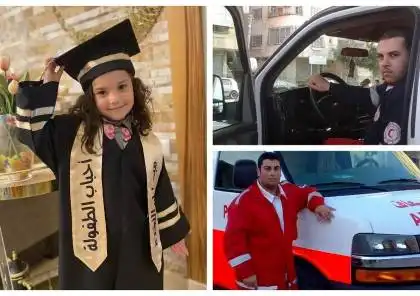
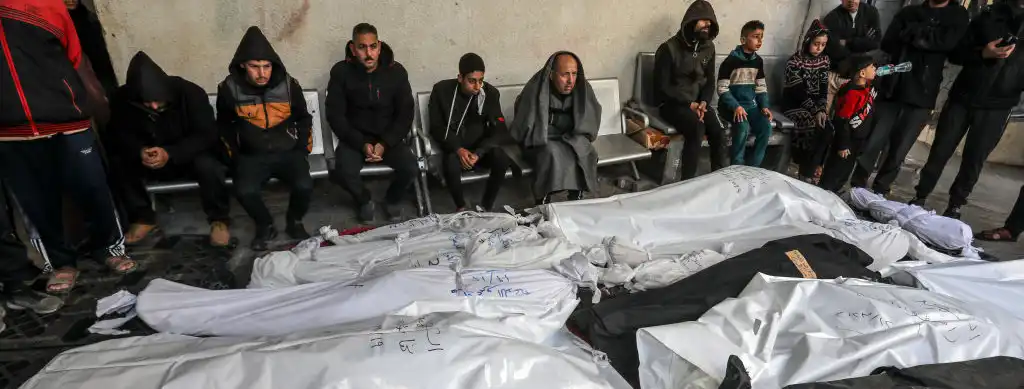
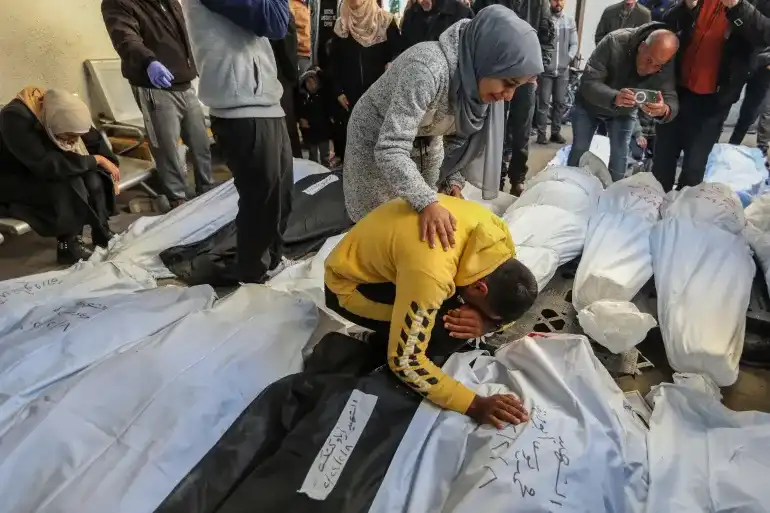
Euro-Med: The Israeli army committed two crimes against the child Hind and the ambulance crew

The Euro-Mediterranean Human Rights Monitor reported that preliminary investigations indicate that the child Hind Rajab and her relatives died as victims of a deliberate execution carried out by the Israeli army against them in Gaza City.

In an official statement, the Observatory reviewed the facts found at the scene of the incident, saying: “The child Hind and five members of her family were subjected to direct and repeated gunfire while they were riding in a civilian car in the Tal al-Hawa neighborhood, southwest of Gaza, on Monday, January 29, at approximately five o’clock.” evening


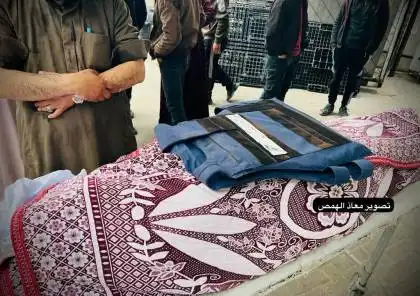
The statement indicated that "the child Hind was found on Saturday, February 10, and she died among the bodies of her relatives who were immediately martyred inside the car that was carrying them, 12 days after she issued the distress call. The Palestinian Red Crescent also found on the same day the bodies of the two paramedics, Yousef Zaino." and Ahmed Al-Madhoun, who went to rescue the girl, after coordination with the Israeli side.”


The statement pointed out that the car in which Hind was inside was found to be full of bullet holes, shattered glass, and heavy traces of bullets that were fired directly at her. The field examination also showed that traces of Israeli tanks were clearly visible on the road leading towards the car.


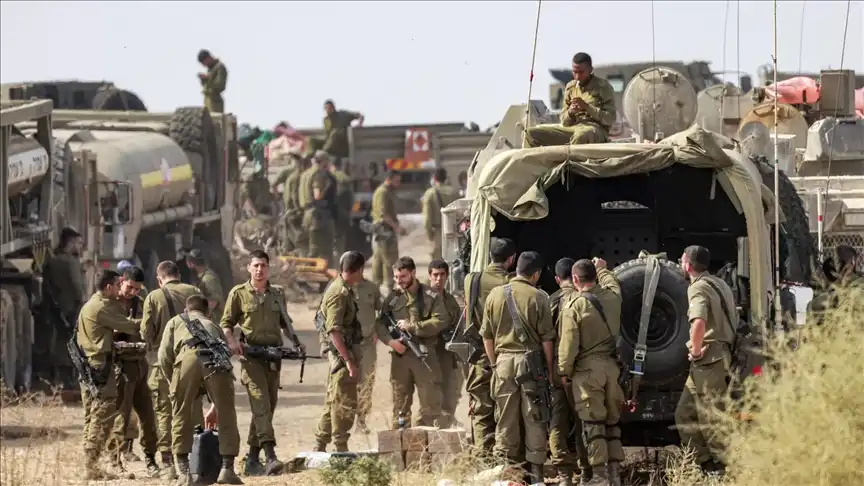
According to the statement, “satellite images hours before the crime showed that Israeli military vehicles were 200 meters away from the location of the car,” noting that the victims were subjected to intense fire and fragments of artillery shelling, and fragments of an American-made M830A1 HEAT shell were found in the area. A Red Crescent ambulance was targeted by the army.


The statement concluded, "All the facts indicate that both crimes occurred during the day and before dark, which means that the vision was clear in front of the Israeli army, and that they were able to identify and distinguish that those who were in the car were a group of civilians consisting of a family with its children."


On Saturday, the body of the child Hind Rajab (6 years old) and five members of her family (her uncle and his family) were found after their car, which they were traveling in, was surrounded 12 days ago, in the Tal Al-Hawa area, southwest of Gaza City.

PALESTINE

Mon 12 Feb 2024 9:07 pm - Jerusalem Time

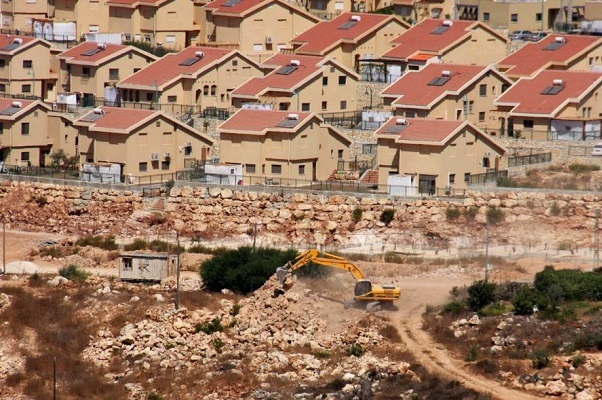
West Bank: Israeli Settlers shoot a young man and child south of Nablus

A young man and a child were injured by settlers’ bullets, Monday evening, during an attack on the village of Asira al-Qibliya, south of Nablus.


According to local sources, settlers from the "Yitzhar" settlement attacked the eastern area of the village, amid heavy gunfire, which led to a young man (20 years old) being injured by live bullets in his stomach and a child (16 years old) in his hand, after which they were taken to the hospital.


The sources added that the settlers burned a vehicle that was parked in front of a citizen's house, then targeted another citizen's house with Molotov cocktails, which led to it catching fire.

PALESTINE

Mon 12 Feb 2024 7:38 pm - Jerusalem Time

Hamas: 3 Israeli prisoners were killed after being injured in Israeli raids in Gaza

Abu Ubaida, spokesman for the Al-Qassam Brigades, the military wing of the Hamas movement, announced today, Monday, the killing of 3 Israeli prisoners held by the brigades, after they were injured earlier in occupation raids on the Gaza Strip.


Abu Ubaida explained in a brief statement on the “Telegram” platform that the three prisoners are among eight prisoners whom the Brigades announced yesterday, Monday, who were seriously injured in the raids on the Gaza Strip.


The Israeli army continued aggression against Gaza led to the death of 28,340 citizens and the injury of 67,984 people, in addition to the displacement of more than 85 percent (about 1.9 million people) of the Strip's population, according to the Strip's authorities and international bodies and organizations.


ARAB AND WORLD

Mon 12 Feb 2024 6:19 pm - Jerusalem Time

Axios: An Israeli delegation to Cairo to follow up on the exchange agreement negotiations

The American news site Axios, citing Israeli officials, reported that an Israeli delegation will head to Egypt tomorrow in an attempt to support negotiations regarding prisoners held by Palestinian resistance factions in the Gaza Strip.


The sources said that the Israeli delegation is expected to include the head of the Israeli Foreign Intelligence Service (Mossad), David Barnea, the director of the Internal Security Service (Shin Bet), Ronen Bar, and the Israeli army representative in the negotiations, General Nitzan Alon.


According to the same sources, the Director of the CIA, William Burns, the head of the Egyptian Intelligence Service, Abbas Kamel, and the Qatari mediator, are also expected to participate in the negotiations.


It is noteworthy that the Islamic Resistance Movement (Hamas) and Israel reached a temporary truce with Qatari-Egyptian-American mediation last November 24, which lasted for a week, during which prisoners were exchanged and limited humanitarian aid was brought into Gaza.


Efforts to reach a new deal were renewed late last month, as meetings were held in Paris that resulted in proposals for a ceasefire and prisoner exchange, which were handed over to Hamas for study.


Hamas responded

The movement responded to the proposal of the framework of the truce agreement, as it agreed to a framework that leads to reaching a complete and sustainable truce in 3 stages, each stage lasting 45 days, and including agreement on the exchange of prisoners and the bodies of the dead, ending the siege, and reconstruction.


It also demanded that the complete truce talks be completed before the start of the second phase, and that Israeli forces be ensured outside the borders of the Strip, and that the reconstruction process begin.


ARAB AND WORLD

Mon 12 Feb 2024 5:18 pm - Jerusalem Time

UN rights chief calls Israel's actions in Gaza Strip as 'disproportionate'

UN Human Rights Commissioner Volker Turk has strongly condemned Israel's actions in the Gaza Strip, calling them "disproportionate."

In a short interview with the Austrian public broadcaster ORF on Monday morning, Turk described the situation in Gaza as "terrible."


The UN has become a pawn in the conflict, he said.

Criticizing Western nations for suspending funds for the UN agency for Palestinian refugees (UNRWA), Turk said UNRWA is indispensable for the people in Gaza.


Turk will take part in an informal meeting of EU development ministers in Brussels on Monday. UNRWA head Philippe Lazzarini will also be present at the meeting.

As far as the situation of the Palestinian civilians in Gaza is concerned, "I can't really think of any more words", Turk told ORF.


In the meantime, 1.4 million Palestinians have sought refuge from the Israeli attacks but according to Turk, "without sufficient food, without sufficient humanitarian support."


Stating there was clear evidence of Israeli war crimes, he said 100,000 people were seriously affected and 27,000 killed, mostly  were women and children.

In addition, there are 60,000 to 70,000 injured, Turk said.

ARAB AND WORLD

Mon 12 Feb 2024 5:03 pm - Jerusalem Time

Eleven rights groups urge EU countries to publicly support ICJ provisional measures

The human rights organisations have penned a letter to 16 EU countries urging them to ensure that Israel complies with the International Court of Justice’s provisional measures against genocide.

“The EU and member states’ answer has been unsatisfactory. Not enough European states have declared their intention to adhere to the legal obligations instituted by the provisional measures or ensure that Israel applies them,” the organisations said.

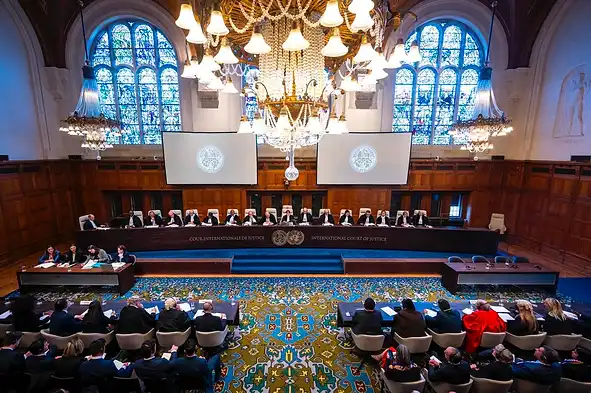
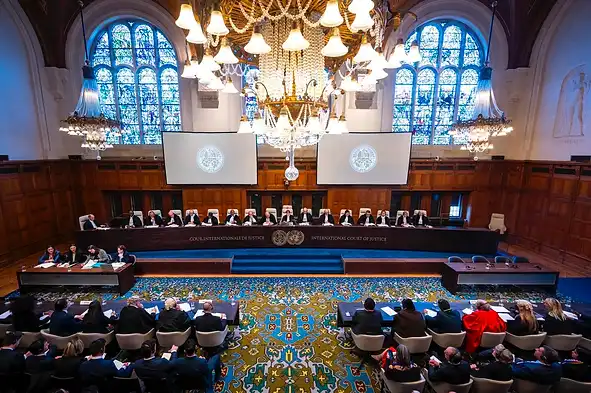
On January 26 the ICJ determined the plausibility that Israel is committing genocide against the Palestinian people in Gaza.

The provisional measures include that Israel will take measures to prevent genocidal acts, and ensure the provision of immediate humanitarian aid to Gaza. Additionally, Israel was ordered to report back to the Court within a month on its implementation of the provisional measures.

The groups further said: “The comparison with the wide support given by EU member states to the preliminary rulings of the ICJ in the context of the wars in Ukraine and in Myanmar have not escaped Palestinian eyes. The difference in treatment between Ukraine and Palestine has led many to note that Europe is operating with a clear double standard concerning the application of the Genocide Convention.”

OPINIONS

Mon 12 Feb 2024 4:55 pm - Jerusalem Time

Israeli Writer: Netanyahu is preparing the pretext to maintain Hamas' rule in the Gaza Strip as it is

Haaretz

Haaretz

Opinion Writer

By Amos Harel

In recent days, the statements of the Israeli leadership have become more severe regarding a possible operation carried out by the army in Rafah. This is happening despite many obstacles - the density of the Palestinian population in the city, the tension with Egypt, which opposes this move, American criticism, the fact that the army liberated the majority of the reserve army units that operated in the Gaza Strip, and the arrival of the month of Ramadan in about a month. It is true that the military operation is on the table, but there are suspicions that whoever is accelerating the discussion about it is doing so with different motives and agendas.

The first person to start talking about an expected attack on Rafah was Defense Minister Yoav Galant. Prime Minister Benjamin Netanyahu then quickly published a statement, in which he said that he had instructed the army to prepare the move (Chief of Staff Herzi Halevy said yesterday in the government session that the plan had been ready for a long time). Netanyahu has other calculations, more than the fact that without a military or non-military solution to the Rafah issue, the tunnels in Sinai could allow Hamas, in the future, to restore some of its military capabilities.

The threat of an operation in the southern Gaza Strip could be used as a pressure tool on Hamas, in the hope that this will allow negotiations to free the hostages. It also helps shift the media debate through which it appears that the negotiations are now suspended, not only because of Hamas' extremist demands, but also because Netanyahu does not show any willingness to rescue the vehicle stuck in the mud.

As is the case with many decisions taken by the prime minister in the war, this is also a policy that is researched through polls, and aims to serve the shrinking popular base, which would like to see Netanyahu clash with the American administration. Not only that, but it seems that there is preparation for something else. Netanyahu has been talking for weeks about achieving absolute victory over Hamas. Despite the tightening siege on the movement's leaders' hiding places, there are still no indications that Israel is close to this goal. But there is the possibility of accusing someone else of not fulfilling promises. They are the Americans who impose restrictions, for example, or the leftists who annoy us, or the generals who are unable to carry out the mission, and this will not be the first time that Netanyahu has acted in this way.

Over the weekend, conversations from the cabinet meeting were leaked, showing that Netanyahu was surprised that the army freed the majority of the reserve units that participated in the fighting in Gaza. Every operation in Rafah, especially if it is in parallel with the fighting in Khan Yunis, will require the reinforcement of forces again and the invitation of combat units from other places. Therefore, the army prefers to focus on the refugee camps in the center of the Strip, where there is still a Hamas battalion and a half that has not yet been defeated.

After two weeks of chaos at the Kerem Shalom crossing, the police and army yesterday began to impose order. The Chief of Staff spoke with the Commissioner General of Police, Kobi Shabtai, and asked him to intervene in order to stop the disturbance that prevents trucks from entering Gaza. In turn, Shabtai sent 500 policemen who evacuated about 40 right-wing demonstrators. This, of course, as expected, led to the anger of National Security Minister Itamar Ben Gvir, who demanded that Halevy not speak with Shabtai except through him.

Netanyahu strengthened his provocative approach, during his visit yesterday to the “Yalom” unit, where he stated there that “Israel will make the Strip demilitarized, through its security control over the west of the Jordan River, including the Gaza Strip. It seems that there is no alternative to this in the foreseeable future. This “What we say to the international community, and also to the president of the United States: there will always be our own security control, and if there is a need for our presence inside the sector, then, we will be there.”

In other words, not only is Netanyahu postponing any “day after” settlement in the Strip, but he also states that the army will remain there for the foreseeable future. If we deal with things as they are, this fundamentally contradicts American policy - and thus could close the door on normalization efforts with Saudi Arabia. The question is whether the Biden administration decides to act decisively this time. Yesterday, Netanyahu and Biden spoke by phone, and Biden asked him to ensure the evacuation of the civilian population from Rafah, as a condition for the army’s entry into the region.

These matters could become clearer in Cairo, where negotiations on a hostage exchange deal are supposed to be renewed tomorrow, with the participation of representatives from the United States, Qatar, and Egypt. The American delegation will be led by CIA Director William Burns. Until yesterday, Israel had not announced that it would send a delegation to the negotiations, after Netanyahu considered Hamas’ demands unacceptable.

Americans are shocked by what Israel is doing, and so are the mediators. It is true that Hamas's demands are extreme, as Netanyahu said, but this was not surprising to him. Moreover, the plan of the deal as agreed upon two weeks ago in Paris - the liberation of prisoners and hostages through three stages, in exchange for the liberation of a large number of Palestinian prisoners and a continuous ceasefire - took place on the Israeli initiative at a time when the mediators were pushing it forward, and in In the end, they discovered that Netanyahu was not interested, and he backed down.

Netanyahu's position on the deal is a direct continuation of his statements regarding continued control in the Gaza Strip and Rafah. On all issues, the Prime Minister leans towards the right and adopts an aggressive approach. According to his statements so far, he is not interested in a hostage-free deal that could expose his coalition to the risk of disintegration. His government will not withstand a ceasefire for a few months in the Strip, which will also include Hezbollah on the northern border, and raises difficult questions - Why did we not win? What really happened on October 7? The deal will not serve the political survival associated with far-right partners. The leaders of the "official camp", Benny Gantz and Gadi Eisenkot, will have to reconsider their steps soon.

They approach the Sinwar


The process of pursuing Hamas leader in the Gaza Strip, Yahya Sinwar, is not fake news. Apparently, there are many indications that Israel is close to arresting him, or killing whoever planned the “massacre” in “The Cover.” Al-Sinwar has been present in the tunnels and bunkers that Hamas has dug under Khan Yunis, since the war began, it seems, and considering that he surrounds himself with helpers, protection, and family members, and possibly also with some Israeli hostages, it is difficult to believe that he will move freely from his place of hiding to another place. Without leaving any evidence.

Over the past two weeks, contact with him has been cut off, and in his absence, it is difficult for the Hamas leadership abroad to formulate a position on the negotiations. This does not mean that he died, but rather it seems that he chose to adopt a more calm approach, in order to avoid harm. Currently, the army and Shin Bet are approaching him.

Recently, rooms and tunnels were found in which Al-Sinwar was present after the war began. Basically, a booklet written by him was found (the last note was written on January 14 this year). The army’s control over a technological infrastructure belonging to Hamas, and the major breach that took place in revealing the movement’s communications networks, exposed it more to Israeli intelligence. The army even systematically blew up the tunnels linking Khan Yunis to other sites.

Israel wants to reinforce the narrative that it is close to Sinwar. Over the weekend, Chief of Staff Herzi Halevy and Shin Bet head Ronen Bar visited the tunnels in Khan Yunis. When Bar talked about wanted people hiding underground, he meant the leader of Hamas. During the start of the ground maneuver in the Strip, the army activated a large force, accompanied by an air strike, which was described as a “mill.” Hamas was unable to withstand it, and it left great devastation in the northern Gaza Strip. The process now in Khan Yunis is more precise, and is based on working methods that have been developed over the past months.

Over time, serious damage could be done to Hamas' military and civilian capabilities. However, this plan suffers from a central weakness: it requires months of effort. And it's not just that the United States and Egypt don't have the time or patience for this - the hostages simply don't have much time either.

PALESTINE

Mon 12 Feb 2024 4:46 pm - Jerusalem Time

War on Gaza: Two Palestinian female journalists were killed in Israeli bombing of Rafah and Jabalia

The government media office in the Gaza Strip announced, on Monday, the death of two Palestinian journalists as a result of Israeli bombing on the city of Rafah and the town of Jabalia, south and north of the Strip, bringing the death toll of journalist martyrs to 126 since last October 7.


The office said in a statement: “The number of journalist killed has risen to 126 male and female journalists since the start of the genocidal war on the Gaza Strip, after the death of two female journalist colleagues: Alaa Hassan Al-Hams, a journalist at Sanad News Agency and other media sites, and Angham Ahmed Adwan, a journalist at the Libyan February Channel.”


The statement confirmed that the two journalists, Al-Hams and Adwan, “were killed as a result of the continuous bombing and targeting by the Israeli army of citizens’ homes in the Rafah and Jabalia areas.”

Palestinian and international media have repeatedly warned that the Israeli army is targeting media crews, and called for protection for them, while Israel ignores these calls.


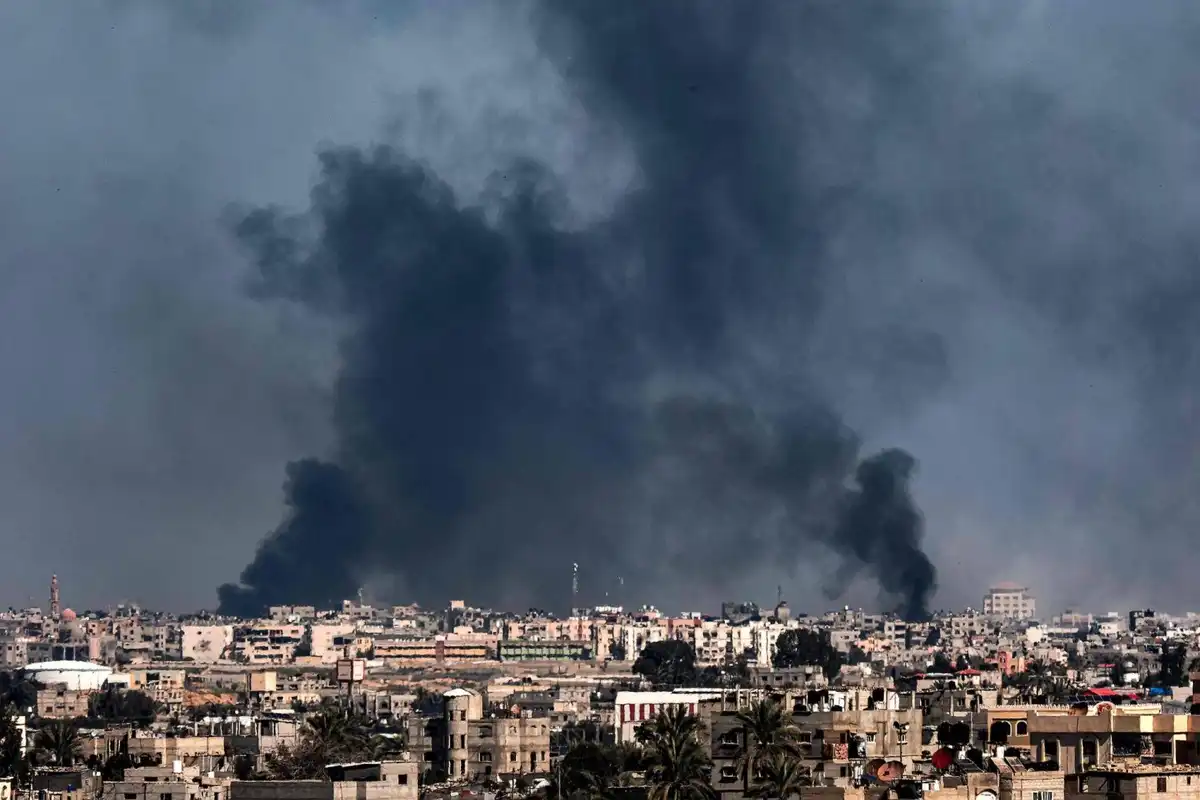
On Sunday evening and Monday morning, the Israeli army launched a series of violent raids on various areas in Rafah, which led to the death and injury of dozens of Palestinians, including children and women, in clear Israeli disregard for international warnings of the consequences of targeting the city, which is crowded with displaced people.


Rafah is the last refuge for the displaced in the stricken sector, and it includes more than 1,400,000 Palestinians, including 1,300,000 displaced people from other governorates.

Since the start of its ground operation in the Gaza Strip on October 27, the Israeli forces have been asking residents to go from the north and center of the Strip to the south, claiming that they are “safe areas,” but they were not spared from bombing homes, cars, and hospitals.


Following the ongoing military operation in the Gaza Strip since last October 7, which left tens of thousands of civilian casualties, Israel faces accusations of committing “genocide” before the International Court of Justice, for the first time in its history.

ARAB AND WORLD

Mon 12 Feb 2024 4:37 pm - Jerusalem Time

Britain also imposes sanctions on four settlers

Imposing British sanctions on settlers who "violently attacked Palestinians in the West Bank." British Foreign Secretary: “We will place responsibility on those who undermine the chances of peace.”


The British government announced today (Monday) that it will impose sanctions on four settlers for “practicing violence against Palestinians in the West Bank.”


The official announcement issued on behalf of British Foreign Secretary David Cameron stated that the sanctions include economic and travel restrictions, aimed at combating the ongoing settler violence that threatens stability in the West Bank.


The announcement also included the names of the four Israelis who will be subjected to sanctions, along with details of their “actions, such as threatening and harassing Palestinian shepherds and their women in the Jordan Valley region.”


In October 2023, a Palestinian group of 20 families fled, after one of the four punishers attacked the residents and told them they had five hours to evacuate.


While another of the four punished, “a settler who commands the Havat Zvi settlement outpost, has used violence since its establishment in 2018 and threats against local Palestinian residents, including threats with a gun, against young families who were on a picnic.” As for the third punisher, according to the British, “he was involved in a large number of incidents against Palestinian shepherds in the hills of the southern Hebron Hills,” and he was a soldier in the IDF who was injured by an RPG shell in Khan Yunis.


The last of them is the one on whom the United States previously imposed sanctions. The United Kingdom stated in the official announcement that the aforementioned “is the leader of a settlement outpost established in 2021, and the settlers who live there are using physical violence, sabotage, and destruction of property to displace Palestinian communities, including the gathering in Khirbet Zanuta in October 2023.”


British Foreign Secretary David Cameron said: “Today’s sanctions impose restrictions on those involved in some of the most horrific human rights violations. We must be clear about what is happening here. Extremist settlers are threatening Palestinians, sometimes with weapons, and forcibly expelling them from lands they legally own.” "This is illegal and unacceptable behavior."


In his words, Cameron addressed Israel and said that it must move more effectively to stop settler violence. “Too often we see that the commitments made and the tasks given are not fulfilled and are not implemented to the end. Extremist settlers who consider Palestinian citizens as targets and attack them undermine security and stability in the region, both for Israelis and for Palestinians,” the Foreign Minister said. British.


It is noteworthy that at the beginning of this month, US President Joe Biden signed a presidential order imposing sanctions on extremist settlers involved in acts of violence against Palestinians in the West Bank. In the first round, sanctions will be imposed on four settlers, who participated in actions that include setting fire to property that led to the death of a Palestinian, and violent threats to the Palestinian Bedouin population. Threatening them to leave their homes, and violent attacks on Palestinian farmers and Israeli peace activists.

OPINIONS

Mon 12 Feb 2024 4:20 pm - Jerusalem Time

South Africa/Israel: First lessons from a historic decision

YAANI.fr

YAANI.fr

Opinion Writer

By Johann Soufi, 

Fourteen key elements to understand the decision of the International Court of Justice in the case of South Africa against Israel.

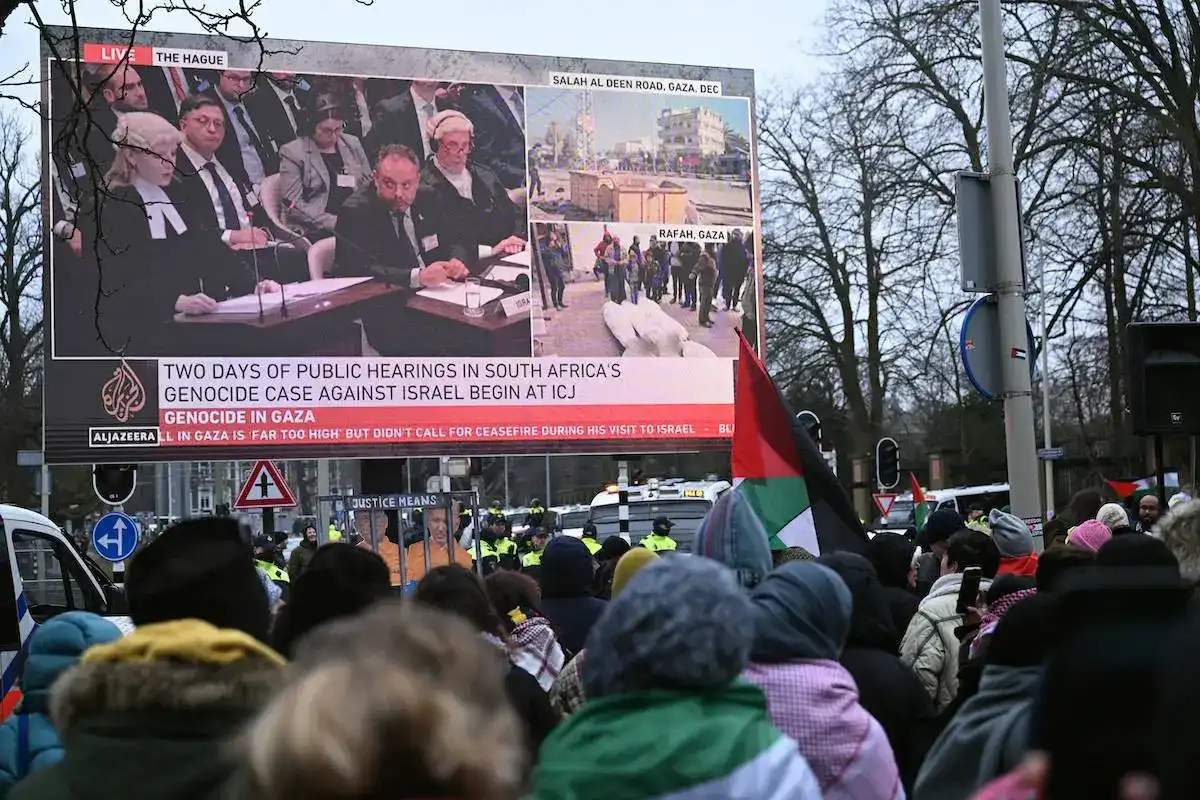
1. On January 26, 2024, the International Court of Justice (“The Court” or “the ICJ”) issued its Order pronouncing provisional measures in the case of South Africa v. Israel introduced by Pretoria under the 1948 Genocide Convention. Not since its creation in June 1945 has the principal judicial body of the United Nations attracted such attention. The hearings on January 11 and 12, broadcast live on social networks and certain television channels, aroused unprecedented interest in all four corners of the world. The order of January 26, 2024 was widely commented on in the media, with extremely variable precision and rigor. While many experts in international law have stressed the importance of this decision, other “toutologists” (previously self-proclaimed experts on Covid-19 and the war in Ukraine, and now on the Middle East and justice international) rushed onto television sets to distort its meaning or reduce its scope. This sudden enthusiasm of the media and the public for international justice, in the cemetery of international law represented by the Israeli-Palestinian conflict, nevertheless constitutes, undeniably, progress. It also carries significant risks of exploitation and politicization of international justice that is often misunderstood and criticized. In the current political and media tumult, this article aims to provide some analytical keys to understand a decision which, in many respects, is already historic.


Recognition of the risk of genocide: a legal victory for South Africa.


2. The order of January 26 undoubtedly constitutes a legal success for South Africa. While Israel, several of its allies (notably the United States and Germany) and certain political leaders, including French Foreign Minister Stéphane Séjourné, criticized the allegedly frivolous, even slanderous, nature of the South's action. African, the Court confirms its merits (paras. 19 to 32 of the order). In continuation of its jurisprudence in the Gambia v. Myanmar, the judges recognize in particular the capacity of Pretoria to act as erga omnes partes, that is to say its possibility of seizing the Court for the alleged violation by Israel of the Genocide Convention, even if the South African population is not directly threatened.


3. The Court's order also validates the relevance of the use of the terms "genocide" or "risk of genocide", used by South Africa, several States, and numerous human rights defenders (such as independent experts from the UN, or the former prosecutor of the International Criminal Court Luis Moreno Ocampo) and specialized organizations (such as the Lemkin Institute for Genocide Prevention, the International Commission of Jurists, or the FIDH) to describe the crimes perpetrated by Israel and the catastrophic humanitarian situation in Gaza. The judges in The Hague recognize the potentially genocidal nature of some of the Israeli acts in the Gaza Strip, in particular the intentional subjection of the Gazan population to conditions of existence likely to lead to their physical destruction (Article 6 c of the Statute of Rome). Drawing on reports from UNRWA, OCHA, and other United Nations agencies present on the ground, which have been warning for months about the disastrous humanitarian effects of the Israeli siege depriving water, food , medicine, and electricity to an exhausted, sick, and hungry population, the judges confirm the reliability of the testimonies of these humanitarian organizations in an area otherwise prohibited to journalists and international investigators (paras. 33 to 49, and 67 to 72 of the order). Israeli efforts to discredit UNRWA, immediately after the order was issued, must also be interpreted in this context.

4. In its order, the Court also recognizes the possibly genocidal intention of certain senior Israeli political and military officials, that is to say their desire to destroy, in whole or in part, the Palestinians of Gaza. Citing in particular the Minister of Defense Yoav Gallant, who claimed to fight "human animals", President Isaac Herzog who promised to "break the spine" of "Gaza terrorists", and the Minister of Infrastructure at the time , Israel Katz who wanted to deprive the inhabitants of Gaza of water and electricity "as long as they are in this world", (para. 52 of the order), the Court recognizes the "plausible" nature of the violation by Israel of the 1948 Genocide Convention, and the existence of a real and imminent risk of irreparable harm, which constitute the criteria for triggering provisional measures (paras. 54, 58, 61 and 74 of the order).


Partial, but significant, precautionary measures


5. The six provisional measures ordered in their vast majority (15 to 2 for the majority, and even 16 to 1 for two of the measures) by the judges of the Court have given rise to important debates, notably concerning the absence of cease -fire.


6. The absence, in the order, of a measure relating to the end of the fighting constitutes the main disappointment for the Palestinians and their supporters. The Court having not justified, in its decision, the reasons for the absence of such a measure, any analysis on this subject will therefore necessarily be speculative. Several elements can explain this decision. First, it is necessary to recall that the maintenance of international peace and security is primarily the responsibility of the Security Council and not of its judicial organ, the ICJ (Article 24 of the United Nations Charter). If the Court had indeed ordered a ceasefire in the Case between Ukraine and Russia in 2022, it should however be remembered that the context of this case was very different, Russia having invoked the 1948 Convention on genocide to justify its invasion of Ukraine in order to prevent a “risk of genocide in Donbass”. The Court having considered that this argument was a pretext for the Russian invasion, it naturally ordered the latter to “immediately suspend its military operations which began on February 24, 2022 on the territory of Ukraine” (ICJ , Russia v. Ukraine, Order of March 16, 2022 on precautionary measures). The reasons for launching the Israeli military operation in Gaza were different. Furthermore, it would have been difficult for the judges to order a ceasefire to only one of the belligerents (Israel), the other, Hamas, not being a State and therefore not a party to the procedure (see in this sense paragraph 16 of the separate opinion of Israeli judge Aharon Barak). It nevertheless remains obvious, for many jurists, diplomats and humanitarian actors, that stopping the fighting constitutes the only way to implement the precautionary measures ordered by the Court.


7. Despite the notable absence of a ceasefire, this decision constitutes a significant legal defeat for Israel. Not only did the judges recognize the plausibility of the genocide, but the precautionary measures taken against the Jewish state are strict. The Court orders Israel to take, without delay, all measures in its power to prevent the commission of any act falling under the 1948 Convention; to ensure, with immediate effect, that its army does not commit any potentially genocidal acts; to prevent and punish direct and public incitement to commit genocide; to adopt effective measures to enable the provision of basic services and emergency humanitarian assistance and to take effective measures to prevent the destruction and ensure the preservation of evidence. The Israeli government has one month to submit to the Court a report on all the measures taken to implement these provisional measures effectively. (paras. 83-86 of the order).


Important legal consequences


8. Although this decision does not concern the merits of the case, it already has important consequences for the Israelis, the Palestinians, and for the entire “international community”.

9. From a symbolic point of view first, the simple fact that the hypothesis of a new genocide in the 21st century is “plausible” should shake our human conscience. As Israeli judge Aharon Barak points out in his separate opinion, this accusation, however, acquires a particularly infamous symbolism for Israel, a state created to offer refuge to Jewish victims of genocide in Europe and centuries-old persecution (paras. 3-8 of the separate opinion of Israeli judge Aharon Barak). By being the subject of provisional measures from the ICJ under the Genocide Convention of 1948, the Jewish State finds itself in the history of international justice, alongside the Serbia of Milošević (April 1993) and the Burmese regime in Myanmar (January 2020), subsequently becoming pariahs of the international community. Whatever the outcome of this affair, this decision will also inevitably have a significant impact on Israeli politics. It will intensify criticism of Benjamin Netanyahu and his far-right allies, and strengthen protesters demanding a ceasefire in the country and elsewhere. It is also likely to strengthen the Israeli judiciary (target of numerous attacks by the Netanyahu government), which is asked to take measures against leaders suspected of inciting genocide. For Palestinians, this decision is a symbol of recognition of the “national, ethnic, and racial” group that constitutes the Palestinian people – protected by the 1948 Convention (para. 45 of the order; declaration by Chinese judge Xue, para. 2). This existence, sometimes denied by certain Israeli extremist leaders, such as Bezalel Smotrich in France in March 2023, can no longer be contested. To use the terms of the Court's advisory opinion on the legality of the wall in the West Bank in 2004, "the existence of this Palestinian people and the rights conferred on them, in particular their right to self-determination, are now indisputable" (para. 118 of the Advisory Opinion on the West Bank Wall, July 9, 2004). The Court's order also symbolizes recognition of the suffering of the Palestinian population and the forced displacement of which they are victims, which constitutes a war crime (Art. 2 a. iv and 2. A vii of the Rome Statute) and potentially a crime against humanity (Art. 7 d. of the Rome Statute) - (para. 46 of the order).

10. From a legal point of view then, as the Court recalled, the decision is obligatory for Israel (para. 83 of the order), which can no longer wage its war in Gaza as in the past and claim act in accordance with international law. The Court demands that the Jewish State immediately change its potentially genocidal behavior. For the rest of the international community, this decision also has important legal consequences. As the Court recalled in its judgment of February 26, 2007 in the case of Bosnia and Herzegovina v. Serbia and Montenegro, “States now have the obligation to implement all means that are reasonably at their disposal to prevent genocide”. (para. 430 of the Judgment of February 26, 2007). This obligation falls particularly on States which “have means likely to have a deterrent effect against persons suspected of preparing genocide, or who may reasonably be feared to harbor specific genocidal intent”. (para. 431 of the Judgment of February 26, 2007). It should also be recalled that, in this judgment, the Court considered that “the provision of means intended to enable or facilitate the commission of the crime” could constitute complicity in genocide (para. 419 of the judgment of February 26, 2007) . The decision of the United States and other Western states to continue their military support for Israel, or to suspend funding for UNRWA, could thus engage their international responsibility.


The future of the international order in question

11. The ICJ, like all international courts, does not have a constraint mechanism to impose its decisions. For this, it depends on the cooperation of States, in particular the permanent members of the UN Security Council. Although the Secretary-General of the United Nations quickly transmitted the Court's order to the Security Council for its implementation, it is likely, however, that the latter remains powerless, blocked by its internal divisions and by the American veto against any resolution perceived as excessively restrictive for Israel. Initial reactions from other Western nations also appear to reflect a reluctance to compel Israel to comply with its international obligations and the Court's order.

12. The most immediate consequence of Western powers' continued support for Israel will likely be continued Israeli hostilities and crimes in the Gaza Strip. While the population is starving in Gaza, the obstacles to humanitarian aid and the intensification of bombings on Khan Younis and Rafah are further increasing the suffering of a bruised and breathless Gazan population. The risk of regionalization of the conflict is increasing. The duplicity of the West, when it comes to respect for international law by Israel, also deeply undermines the rhetorical and legal edifice that it itself forged at the end of the Second World War. On the contrary, it strengthens the influence of authoritarian regimes and all those who attack human rights throughout the world.


An opportunity to seize: a new lease of life for international law

13. In this particularly dark context, this unprecedented crisis in the world order also reveals some glimmers of hope for the Israeli and Palestinian people, and for the rest of the “international community”. Never in the history of this historic conflict has the situation seemed so desperate. This dramatic situation is, however, the result of more than two decades of inertia during which the world gradually lost interest in a conflict whose main victim is the Palestinian people, colonized in the West Bank and walled in Gaza. The blood and tears shed by the two peoples since October 7 have tragically put the resolution of this conflict and the Palestinian question at the heart of international concerns. More and more voices are being raised, including among supporters of Israel, to finally recognize the Palestinians' right to a state and self-determination. Such a development will inevitably require a decolonization process, the only one capable of bringing peace and security to both peoples.


 14. The other source of hope lies in the symbolic significance of South Africa's action before the International Court of Justice. The fact that a southern democracy having defeated apartheid has generated such global enthusiasm for its judicial approach in favor of the Palestinian people underlines a deep global aspiration for greater justice and respect for universal values. In fact, criticism of the West's posture should not be seen as a questioning of the values it claims to defend. It constitutes, on the contrary, a vigorous call in favor of democracy, justice, and law on an international scale, without double standards. The profound deconstruction of the world that we are witnessing calls for a reconstruction, for a revolution: that of a true “global rule of law” based on universal values, on respect for international law and on greater equality between peoples. . The decision of January 26, 2024 could also constitute one of the first stones in the construction of this new world.


Johann Soufi, international lawyer, former head of the UNRWA Legal Office in Gaza and associate researcher at the Thucydides Center (Paris II Panthéon-Assas).



PALESTINE

Mon 12 Feb 2024 4:12 pm - Jerusalem Time

EXPLAINER| What’s happening in Gaza’s Rafah as Israel threatens to attack?

Over a million Palestinians are trapped at Gaza’s southernmost point, with the Israeli army preparing a ground attack.

Rafah, a looming Israeli ground “operation”, and the impact on more than a million trapped civilians are top headlines.

But what is Rafah and what are the details around this announced Israeli “operation”?

What is Rafah?

Rafah straddles the border between the Gaza Strip and Egypt.

On the Palestinian side, it is the name of Gaza’s southernmost governorate and its capital city, as well as of the crossing into Egypt’s Sinai. On the Egyptian side, it is a city in the North Sinai governorate.

Palestinian Rafah is 64sq km (25sq miles) and, as Israel assaulted Gaza these past four months, more and more people have been herded into it by Israeli forces who keep promising safety “further south” – which never materialised.

Approximately 1.4 million Palestinians have now been pushed into Rafah by relentless Israeli bombing that has killed nearly 30,000 Palestinians.

People are in dense clusters in the limited space not filled with debris or being bombed by Israel. Conditions are dire, with severe shortages.

INTERACTIVE - Israeli attacks on Rafah intensify-1707724888


What is the Israeli ‘operation’?

Tel Aviv claims four Hamas brigades are present within Rafah, using their presence there to justify the ongoing attacks by air as well as a planned land assault.

Israel also claims plans for the evacuation of the city – to where is unclear – are being prepared, leaving those sheltering in Rafah paralysed.

Why is Egypt involved?

Because the trapped civilians are pressed up against the border with Egypt, analysts say it seems likely Israel wants to push them into Sinai.

This raises concerns over Egypt’s internal security and the prospect of having more than a million traumatised Palestinians forced into its territory.

What has Egypt done so far?

Egypt has reportedly moved 40 tanks and armoured personnel carriers to the Gaza border to halt any potential spillover from an Israeli land assault.

Egypt has warned that any Israeli ground assault on Rafah would have “disastrous consequences” and that Israel’s aim to force the Palestinians out of their land would threaten the 40-year-old Camp David peace accord between the two countries.

Cairo has beefed up border security since October 7.

Why don’t Palestinians want to leave Gaza?

Palestinians have faced mass displacement in the not-too-distant past: the Nakba.

In 1948, some 750,000 Palestinians were ethnically cleansed from their homes and lands to make way for the establishment of the state of Israel.

Many in Gaza are the descendants of Nakba refugees and do not want to leave Palestine because they know it will be impossible to return – Israel won’t let them.

Arab countries, like Egypt, also object to any displacement as the Palestinian Right of Return has been a main demand since 1948.

So, is it safe in Rafah for now?

No.

Israel is already killing more than 100 people a day in air attacks on Rafah.

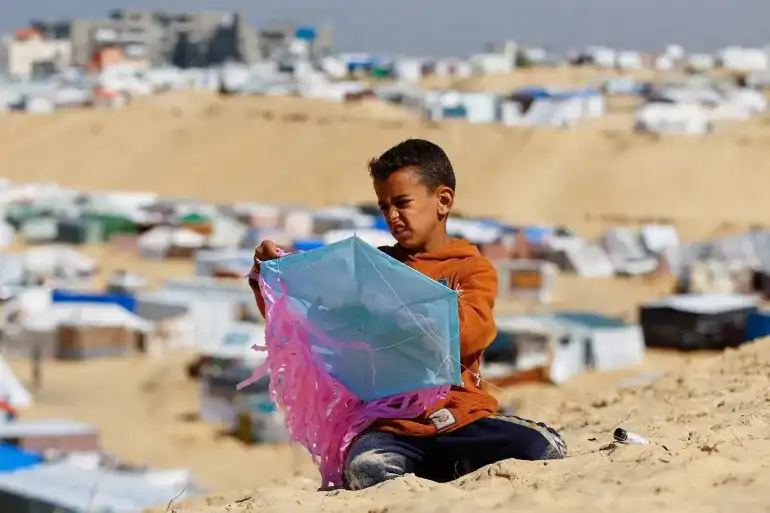
Those who survive the attacks live in unspeakable conditions in tents that fill with water whenever it rains, or under whatever scraps they find to make a shelter.

Many Palestinians in Rafah have been displaced many times over and say they will not move again, no matter what. Like Jihan al-Hawajri who told US broadcaster PBS that she would stay in her tent, come what may.

“There is nowhere left… to flee to,” said Angelita Caredda, Middle East and North Africa director for the Norwegian Refugee Council.

What are conditions like in Rafah now?

Satellite images obtained by Al Jazeera show an area already at breaking point. Some 22,000 people are crowded into each of Rafah’s 64sq km.


Before the war, 275,000 people lived in those 64sq km, making Rafah one of the most densely populated parts of Gaza, itself among the world’s most overcrowded parts.

The displaced crowd into UNRWA facilities, hoping the agency that was set up to help them would be able to. But nearly 150 of UNRWA’s staff were killed in Israeli attacks, aid is being stopped by Israel, and Western governments withdrew funding when Israel alleged – with no proof yet – that 12 UNRWA staff participated in the October 7 attack.

Overcrowding has resulted in the spread of disease, with health officials reporting an outbreak of hepatitis A – which flourishes in close contact.

With isolating patients impossible, there is little hope of stopping this outbreak or others, like scabies and lice, worsened by a lack of showers or hygienic toilets.

What does Israel want?

When the October 7 attack happened – killing 1,139 people in Israel – and Palestinian armed fighters took 240 people into Gaza as captives, Israel’s declared aims were to return the captives and “eradicate Hamas”.

Since then, the narrative has shifted back and forth.

First claiming to only be targeting armed fighters, Israel soon imposed a complete starvation siege on Gaza, killing civilians with every passing minute.

Then, it became apparent that when Israel said “avoiding civilian casualties”, it meant its secret calculus with an increased “acceptable loss margin”, or the number of people it felt it could kill to eliminate one target.


A massive attack on Jabalia refugee camp in October killed 50 people to eliminate one “Hamas commander”, a designation Israel has not presented proof of.

It also started targeting hospitals, with a horrifying attack on al-Shifa Hospital in Gaza City endangering more than 30 premature babies whose incubators stopped when Israel cut electricity. The declared aim to uncover “hidden Hamas command bunkers” under al-Shifa was never realised.

More followed as Israel surrounded one hospital after another, killing and starving people inside, to “unearth Hamas command centres”. None have been uncovered.

Will attacking Rafah help Israel achieve anything?

Not likely, as Israel’s claims about “dismantling terrorist battalions”, referring to armed Palestinian factions, appear as ephemeral as the claims of underground command centres.

It had declared Palestinian fighting factions “neutralised” in north Gaza, only to admit later that that was not the case.

Israeli Prime Minister Benjamin Netanyahu has been under pressure – including from the UK and the US – to call off the land assault but he insists this will be the operation to “dismantle Hamas”.

The US made its most pointed wartime criticism of Tel Aviv, saying Israel should “put civilians first and foremost”, but did not threaten to cut aid or support.

The EU and the UK have followed suit with the US.

 SOURCE: AL JAZEERA AND NEWS AGENCIES

OPINIONS

Mon 12 Feb 2024 4:09 pm - Jerusalem Time

Western narcissism and support for genocidal Israel go hand in hand

Aljazeera

Aljazeera

Opinion Writer

By Donald Earl Collins

Delusional beliefs of civilisational superiority help the West claim it is on the right side of history while supporting genocide in Gaza.

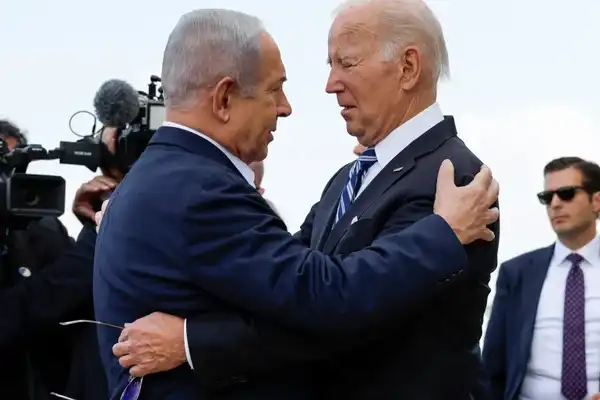
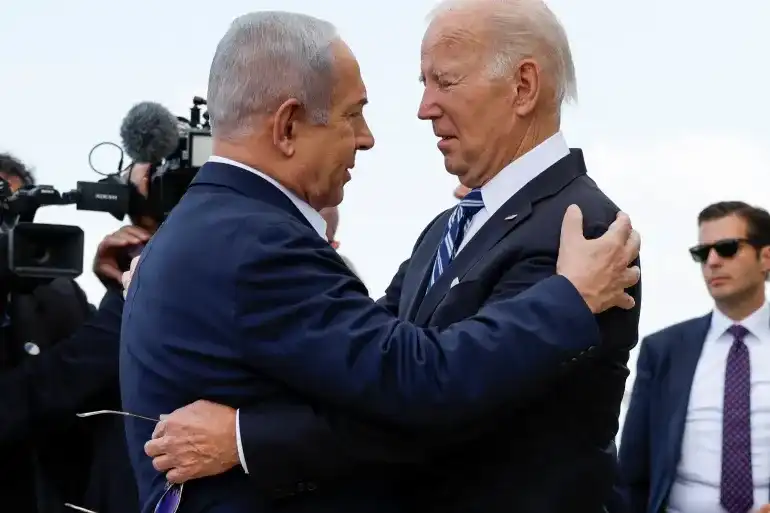
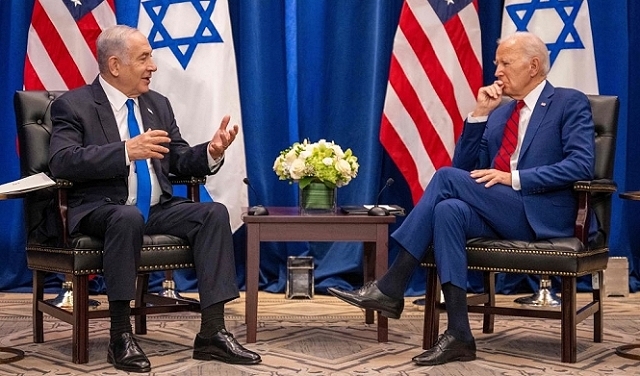
United States President Joe Biden is welcomed by Israeli Prime Minister Benjamin Netanyahu in Tel Aviv on October 18, 2023 [File: Reuters/Evelyn Hockstein]

For more than four months now, the United States, the United Kingdom, and other Western countries have been staunchly supporting Israel’s war on Gaza. As of now, the Israeli army has killed more than 28,000 Palestinians, including more than 12,000 children.

On January 26, the International Court of Justice ruled that “at least some of the acts and omissions alleged by South Africa to have been committed by Israel in Gaza appear to be capable of falling within the provisions of the [Genocide] Convention,” and that South Africa’s claim that Israel is committing genocidal acts is “plausible”. Nevertheless, the West continued to stand by Israel.

Then when Israel alleged that employees of the United Nations Relief and Works Agency for Palestine Refugees in the Near East (UNRWA) were linked to Hamas, the US, the UK, Germany, and more than a dozen other countries suspended their funding, as Palestinians in Gaza faced starvation.

Despite Western complicity in actions the world’s top court is recognising as genocidal, the West still assigns itself all manner of superiority in civilised societal behaviour. Western countries still honour themselves as “the good guys”.

“I got in trouble many times for saying you don’t have to be a Jew to be a Zionist, and I am a Zionist. I make no apologies for that. That’s a reality,” President Joe Biden said in a speech at a private campaign reception in Massachusetts in early December, when the death toll in Gaza already stood at 16,200. “We’ve [Americans] never thought anything is beyond our capacity, from curing cancer this time around to everything we’ve ever done. I really mean it,” he added.

It takes a special kind of narcissism for a world leader to declare himself a 50-year-long adherent to a white supremacist ideology that excuses apartheid, settler-colonialism, and genocide and then to turn to the greatness of the US and all its “possibilities”, as if the US has only been sprinkling pixie dust around the world and not intervening with brutal military and economic power over the past 130 years.

But the US president is not alone in his self-delusion. At the Conservative Friends of Israel gathering in London last month, UK Prime Minister Rishi Sunak showed unwavering support for Israeli attacks on Gaza and the West Bank. “There is a horrific irony in Israel, of all countries being accused of genocide,” Sunak said, labelling South Africa’s case against Israel “completely unjustified”.

The “horrific irony” is that Israel, as a Western ally, cannot be accused of genocide because it is one of “the good guys”. The “bad guys” can only be non-Western (really, non-white) nations, such as South Africa.

Biden, Sunak et al still believe that as the leaders of the developed world, they are making understandable rational choices when they are fighting wars and killing people in the name of self-defence or under the guise of fighting “terrorism”.

Despite the protest of tens of millions people around the world and the deaths of tens of thousands of Palestinians, the razing of Gaza and other crimes against humanity, the disregard for the ongoing war in Sudan and the conflict in the Democratic Republic of the Congo, Western leaders still believe Western capitalism and democratic institutions will save the world.

In his book The Clash of Civilizations (1996), the late political scientist Samuel Huntington warned about the dangers of the Western delusion that the rest of the world should embrace its purported values. “The survival of the West depends on Americans reaffirming their Western identity and Westerners accepting their civilization as unique not universal,” he wrote.

But what Huntington didn’t understand about the West’s quest for a one-world civilisation is that today’s resentments toward it didn’t start in the post-Cold War era of the 1990s. They are a response to the trail of death, destruction, and devouring of resources that Westerners have left behind ever since Christopher Columbus made his way to the Western Hemisphere and Vasco da Gama found a route around Africa to South Asia, both in the 1490s.

The rest of the world has been the West’s source of plunder, first through the pillage of gold, silver, and gems from newly invaded lands, then through the enslavement of millions of Indigenous, African, and Asian peoples, and finally through the conquest of the old empires of the East.

This belief in Western civilisation as superior and righteous because of its whiteness is so ingrained in its culture that young people in the West grow up without anyone in their lives ever questioning it. That is, until someone like me as a history professor comes along and confronts this fundamental belief.

In my many years of teaching history, my own students have often gotten into it with me over my supposition that “Western civilisation” is a contradictory term.

“But the Aztecs practiced human sacrifice!” one student yelped, while a calmer student, with a raised hand, said, “It’s unfortunate that atrocities happened to the natives, but it’s insulting to compare what the Spanish did to what happened to Rome.”

That was the strong pushback I received from a few students in one of my world history courses a few years back when I spoke of the barbarity of the Spanish conquests of the Aztecs and the Inca in the 16th century and the similarities between those invasions and the Vandal and Visigoth tribes who helped end the Western Roman Empire.

I pointed out the achievements of the civilisations destroyed and the conquistadors and the Spanish priests burning nearly all Mayan writings, desecrating Mexica, Mayan, and Inca temples, and forcing the population into slavery and Christianity.

I have also endured vitriol from students unwilling to even consider the possibility that the US and the West, having engaged in barbaric behaviour with their own populations and across the globe, might do so in the near future.

“It isn’t possible, because…no civilised society wants it happening to them,” one student said years ago. “Americans would never take up arms against the government, especially with our military, it isn’t rational. We wouldn’t be stupid enough to make this mistake again. Our military would crush any insurrection,” is what another student blurted out in the past year, despite evidence of the opposite with the insurrection at the US Capitol Building on January 6, 2021.

Some students were too deep in the belief of the West as a positive force to consider the apocalypse it visited upon 60 million Indigenous people, wiping out up to 90 percent of the population within 100 years of Columbus’s first contact.

We couldn’t even discuss the other genocides wrought in the name of empire, colonialism, and capitalism: the 165 million South Asians the British starved, murdered, or worked to death between 1880 and 1920; or the estimated 10 million Congolese who Belgians exterminated; or the genocide of up to 100,000 Herero and Nama people by German forces in Namibia between 1904 and 1908.

My students’ belief in Western rationality remained strong even when the carnage of World Wars I and II was brought up. In those conflicts, as many as 90 million civilians and service members were killed – among them more than 200,000 annihilated in the US nuclear bombing of Hiroshima and Nagasaki.

Western narcissism is exactly why my students have difficulty accepting that Western civilisation contradicts itself at every turn. As the late post-colonial scholar Edward Said wrote in Orientalism (1978), “It can be argued that the major component in European culture is precisely what made [Western civilisation] hegemonic both in and outside Europe: the idea of European identity as a superior one in comparison with all the non-European peoples and cultures.”

This belief in Western superiority means always being on the right side of history, even though there are plenty of examples of Western irrationality, barbarism, and brutality in its interventions in the Middle East and the rest of the world. Western narcissism means the US and West will only lift a finger to support the Palestinians if forced to by the world and by their own citizens.

That roughly half of Americans ages 18-29 believe that Israel is committing genocide in Gaza is encouraging, but by itself not enough to end US and Western complicity in Israel’s crimes.


PALESTINE

Mon 12 Feb 2024 4:05 pm - Jerusalem Time

Amnesty International: New evidence of Israeli raids causing mass killing of civilians in Gaza

Amnesty International said that new evidence it collected of deadly unlawful attacks in the Gaza Strip shows that the Israeli occupation forces continue to flout international humanitarian law and annihilate entire families with complete impunity.


Amnesty International explained in a press statement today, Monday, that it investigated four Israeli raids on Rafah Governorate, three of which were launched in December 2023, after the end of the humanitarian truce, and one in January 2024, which resulted in the death of at least 95. Civilians, including 42 children.


The organization added that Rafah Governorate, located in the far south of Gaza, is supposed to be the “safest” area in the Strip, but the occupation forces are currently preparing to carry out a ground operation there, and such an operation is likely to have serious consequences for more than a million people confined to an area. It is 63 square kilometers following successive waves of mass displacement.


Amnesty International confirmed that it did not find in the four raids any indication that the targeted residential buildings could be considered legitimate military targets or that people in the targeted buildings were military targets, which raises concerns that these raids were direct attacks on civilians or civilian objects, they should therefore be investigated as war crimes.


Amnesty continued: Even if the Israeli forces intended to target military targets in the vicinity of these buildings, these attacks failed to distinguish between military targets and civilian objects, and are therefore considered indiscriminate attacks, noting that indiscriminate attacks that kill and injure civilians are considered war crimes.


Amnesty International stated that the evidence it collected also indicates that the Israeli army failed to provide effective warning, or any form of warning, at least to people living in the sites that were bombed, before launching the attacks.


Entire families have been wiped out in Israeli attacks even after taking refuge in areas promoted as safe and without warning from the Israeli authorities, said Amnesty International's Director of Research, Advocacy and Policy, Erika Guevara-Rosas.


Amnesty added that these attacks demonstrate an ongoing pattern of flagrant violations of international law by the Israeli forces, which contradicts claims by the Israeli authorities that their forces are taking strict precautions to minimize harm to civilians.


Amnesty pointed out that among the victims in these illegal attacks was a baby girl who had not yet reached three weeks of age, a prominent 69-year-old retired doctor, a journalist who received displaced families in his home, and a mother who was lying in the same bed with her 23-year-old daughter.


Amnesty International visited the sites of the four attacks, took photos and videos of the devastation and interviewed a total of 18 people, including 14 survivors and four relatives who participated in the rescue operations. Amnesty International's Crisis Evidence Laboratory also analyzed satellite images, photos and videos to determine and verify the geographical location of the attacks and the resulting destruction. In addition, the organization reviewed the “War Diary” published by the official page of the Israeli army and found no reference to any of the strikes. quarter to.


Amnesty International said: “Following the important interim ruling of the International Court of Justice that the risk of genocide is real and imminent, the horrific details of these cases reinforce the urgent need for all states to press for an immediate and sustainable ceasefire, which is the most effective way to implement the interim measures ordered by the Court.” “It also stresses the importance of imposing a comprehensive embargo on the supply of weapons to all parties to the conflict.”

ARAB AND WORLD

Mon 12 Feb 2024 4:02 pm - Jerusalem Time

In Gaza, hope is a fantasy

  •          By Andrew Mitrovica

I wanted to be wrong, but it turns out that I was right. Since early October, I have been sure that Israeli Prime Minister Benjamin Netanyahu has had one aim all along: to erase Gaza.

Spurred on by a rabid cabinet that believes that Palestinians are worthless “vermin”, Netanyahu has done what I suspect he has always wanted to do: dispense with the incremental destruction of a people and a strip of land and, instead, engineer a genocide in Gaza with ruthless and oh so satisfying efficiency.

By now, this fact should be clear. That is the “victory” Netanyahu has and will continue to pursue until he has achieved it – to turn Gaza into dust and memory permanently.

There will be no “pause in fighting”, no “lasting” ceasefire, no truce, no end to the genocide because Netanyahu has no reason or incentive to stop.

And Netanyahu knows that no one inside or outside Israel is prepared, willing or able to stop him.

Hope has been extinguished.

Every day, Palestinians hope, in vain, that the horrors and outrages will end. Every day, we hope, in vain, for a faint sign that the murderous madness will end, that reason and diplomacy will prevail, that the captives – on both sides – will be reunited with their aching families.

Hope is a fantasy, snuffed out by men and forces who thrive on causing chaos and despair in their “killing rage”.

Netanyahu may be unpopular. Still, what he is doing and how he is going about doing it in defiance of proportionate scale, decency, and international law has the overwhelming support of Israelis who, apparently, would also be content to see Gaza reduced to dust and memory – permanently.

Polls show that most Israelis want Netanyahu to use more force, more “firepower” in Gaza and beyond. Damn decency, international law, and the mushrooming number of casualties day after dreadful day.

The pain and suffering of Palestinians is irrelevant. The right and duty of Israel to defend itself is the only thing that counts.

It’s hardly surprising then that polls show, as well, that despite the rampant hunger, disease, and desperate need, most Israelis want fellow Israelis to continue blocking trucks carrying food, water, and medicine from reaching Gaza until the Hamas-held captives are released.

Palestinians are expendable. Israelis are not.

As for the “future” of Gaza, 93 percent of Israelis reportedly agree with Netanyahu: the two-state “solution” is dead on arrival since all of the land between the Mediterranean Sea and the Jordan River belongs to them. The intent is to have Israeli settlers take the place of Palestinians in Gaza. Another Nakba is already afoot – literally.

I am convinced most of Israel’s confederates abroad – whether they admit it publicly or not – also embrace these egregious beliefs and subscribe, wholeheartedly, to Netanyahu’s modus operandi and definition of “victory”.

So, far from being “damaged” or “weakened”, Netanyahu has been emboldened as a “wartime” prime minister and by an “international community” that has encouraged him to do what he has done in Gaza and the occupied West Bank without remorse or restraint.

Netanyahu will survive as prime minister for as long as Israel goes about doing what it is doing in Gaza and perhaps longer. Ever the calculating Machiavellian, he has rebuffed predictions of his imminent political demise or forced exit by wishful-thinking columnists, “experts”, and former presidential candidates.

Again and again, the “international community” has said it is “concerned” by what their man in Tel Aviv is doing in Gaza and the occupied West Bank. Again and again, these expressions of “concern” have proven to be hollow bits of performative nonsense.

On reliable cue, US President Joe Biden described what Israel is doing in Gaza as being “over the top”.

“I’ve been pushing really hard, really hard, to get humanitarian assistance into Gaza. There are a lot of innocent people who are starving, a lot of innocent people who are in trouble and dying, and it’s gotta stop. Number one,” Biden told reporters earlier this week.

It won’t stop. How can it stop when Biden and his complicit allies in London, Paris, Berlin, and Ottawa keep arming Israel to the brim and refusing – even in the blatant face of Israel’s “over the top” onslaught and the deepening humanitarian catastrophe in Gaza – to demand an immediate ceasefire?

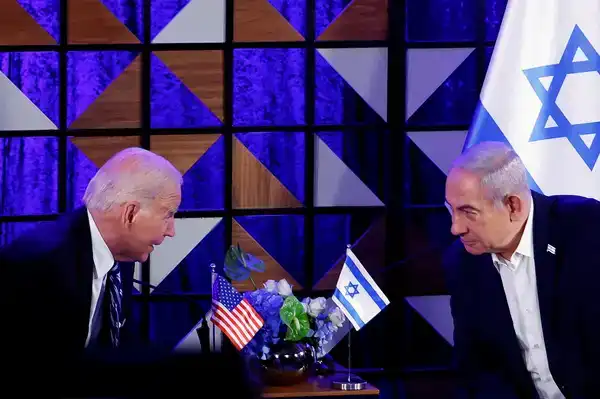
The calamitous course was set when Biden and the other presidents, chancellors, and prime ministers rushed to Tel Aviv in “solidarity” pilgrimages to “stand firmly” by Netanyahu’s side.

It’s too late to apply the stock, talking-point-ephemeral brake since Netanyahu isn’t listening.

He isn’t abiding by the International Court of Justice’s damning ruling which called on the Israeli government to stop what it is doing in Gaza after South African lawyers and diplomats made a persuasive and “plausible” case that Palestinians are victims of genocide and Israel is the perpetrator.

Rafah is in Netanyahu’s crosshairs. The so-called “safe haven” and the more than a million Palestinians who have taken refuge there in tents and makeshift “homes” will endure the inevitable lethal consequences of the major Western powers’ unconditional backing of Israel.

Exhausted and petrified Palestinians, including mothers, wives, and their sons and daughters, will not be spared Israel’s wrath. Their already precarious lives hang on the precipice of Netanyahu’s – for the moment and only for the moment – delayed designs.

Biden et al may claim, at least publicly, to ask Israel to stop the looming carnage. Netanyahu will not be deterred by their empty, delivered-behind-a-lectern “warnings”. He is calling the geopolitical shots, not Biden et al.

While America was preoccupied with a football game on Sunday night, Netanyahu gave Palestinians in Rafah a taste of the terror to come –  firing a shower of shells that killed and dismembered dozens of sleeping children, women and men.

Finally, a cocksure Netanyahu understands the value of patience. Biden looks and sounds like an old man who is poised to become yesterday’s man – gone, inconsequential and forgotten.

The November presidential election approaches just on the horizon. Another doddering old man, Donald Trump, has a better than even chance of returning to the Oval Office.

If that happens, Trump will enshrine Israel’s licence to commit genocide without his predecessor’s meaningless rhetorical “reservations”.

Either way, America has morphed, in effect, into Israel’s proxy. The dynamic has shifted.

Israel will decide what will happen in Gaza today and tomorrow and America will salute in approval and help pay for the pleasure of doing its captain’s bidding – happily, willingly, and enthusiastically.


ARAB AND WORLD

Mon 12 Feb 2024 3:44 pm - Jerusalem Time

Biden frustrated, describes Netanyahu as a “major obstacle” and a “fool”

Report: Biden spoke during meetings, some of which were with donors to his election campaign, about his frustration at his inability to persuade Israel to change its military tactics in the war on Gaza, during which he described his talks with Netanyahu as “hell.”


US President Joe Biden spoke during meetings, some of which were with donors to his election campaign, about his frustration with his inability to persuade Israel to change its military tactics in the war on Gaza, and his frustration with Israeli Prime Minister Benjamin Netanyahu, according to what ABC reported today, Monday, five. Informed sources.


The sources, who spoke on condition of anonymity, added that Biden is trying to persuade Israel to agree to a ceasefire, but Netanyahu is turning the conversation with him into “hell” and it is impossible to deal with him. One source said Biden feels the war “must stop.”


Informed sources indicated that Biden has spoken specifically about Netanyahu in recent weeks, with a frankness that surprised some of those receiving his comments. These people said that Biden's description of his dealings with Netanyahu is full of contemptuous references to the latter, calling him "that guy." Biden also called Netanyahu, at least three times, an “idiot,” according to three people with direct knowledge of his comments.


In response to a question about Biden's own statements regarding Netanyahu, a spokesman for the National Security Council said, "The president was clear about his disagreement with Prime Minister Netanyahu, but this has been a relationship that has been going on for decades and has been respected in public and in private," the network quoted him as saying.


However, the network added that as the war on Gaza continued, Biden became more frustrated due to the high number of civilian martyrs in Gaza, and Netanyahu’s refusal to reach a long-term peace agreement, and that the relationship between them could be approaching an inflection point.


Despite the disagreement between them over the issues of “the next day” and the future of the Gaza Strip after the war, which occupied a large part of their phone conversation yesterday, and Netanyahu’s insistence on launching an attack on the city of Rafah, which was carried out last night, Biden said that he believed it would be futile. To be very harsh with Netanyahu in public, according to people familiar with the matter.


These differences also did not lead to a change in the Biden administration’s policy towards Israel. Even as Biden steps up his rhetoric and talks about Israel's exaggeration of the war, he is not yet ready to make major policy changes, the people familiar with the matter said. He and his aides still believe his approach of unequivocally supporting Israel is the right one.


However, in perhaps some of his final private moments, Biden said Netanyahu wanted the war to continue so he could remain in power, three people familiar with his comments reported.


At a fundraising campaign attended by Biden in the past few weeks, he spoke about Israel and his frustrations with Netanyahu to a small group of donors. In response to his thanks for standing with Israel and against anti-Semitism, Biden said: “I am a Zionist.”


A person who was present and heard Biden's comments said: "He said that Bibi started out great, but lately he has been hurting me and causing damage" to Biden's election campaign.

ARAB AND WORLD

Mon 12 Feb 2024 12:43 pm - Jerusalem Time

Former General Yitzhak Brik: Egypt may become an unstoppable enemy of Israel

Retired Israeli General Yitzhak Brick said that Egypt has been building highways leading to Sinai for years, and Israel is the target, in an interview with the “FM 103” program about the progress of the fighting in the Gaza Strip and the weakening of the Islamic Resistance Movement (Hamas).

The Jerusalem Post newspaper reported part of what was discussed in the program, where the program presenter, Ariel Segal, said, after mentioning that the head of the Mossad is formulating the Israeli response to the mediators’ proposals, that the Israeli army’s ability to pursue Hamas is diminishing, the level of operational errors is increasing, and the pressure on the government from The detainees' families did not succeed.


In response, Yitzhak Brik said that Hamas still feels very strong, and it does not want to reach an agreement on the hostages, and it has time, because we are not close to weakening its capabilities, “Hamas will continue to exist.”


Regarding the fighting in the Philadelphia and Rafah corridor, Brik said that everyone knows that there is a crossing from Sinai under the corridor, and that the Israeli army did not want to remain along this corridor, and it had the ability to do so, but it would cause many casualties, so Israel hoped For the Egyptians to do that.


But today there is a very big problem with Egypt - as the former general says - they are not ready to do that, and they do not agree that we do it from this side of the aisle, and they threaten that if we start doing different things that will lead to the crossing of large numbers To Sinai, they will stop peace.


Isaac Brik concluded by saying that Egypt, “although it is a poor country, has the strongest army in the Middle East today with about 4,000 tanks... and hundreds of the most advanced aircraft, and a navy of the best that exists. They have also been building highways leading to Sinai for years. We The goal is: they are not building an army for any other party. This means that by making a decision to cancel peace, they become a hostile state, and we do not even have a brigade to stand against them,” he said.


Source: Israeli press

ARAB AND WORLD

Mon 12 Feb 2024 12:38 pm - Jerusalem Time

Israeli Intelligence Agency "Mossad" threatens South African Minister and her children!

By Tanupriya Singh 

South Africn Foreign Minister Naledi Pandor reveals threats to family in wake of ICJ case against Israel

Pandor has reported receiving threats against her and her children and has alleged involvement of Israeli intelligence


South Africa’s Minister of International Relations and Cooperation, Naledi Pandor, has stated that she and her family have been receiving threats in the aftermath of South Africa’s case against Israel accusing it of violating the Genocide Convention at the International Court of Justice (ICJ).
Speaking to reporters in Cape Town on February 9, Pandor, who has been outspoken and steadfast in her support of the Palestinian people, said that she had to increase her security and that she was worried about her family given that threats on social media had mentioned her children.

“The Israeli agents, intelligence services, this is how they behave, and they seek to intimidate you…we must not be intimidated. There is a cause that is underway,” she said.

“The people of the world and of Palestine didn’t draw back when the apartheid state was at its worst. They stood with the liberation movement so we can’t stand back now. We must be with them and one of the things we must not allow is a failure of courage.”

Not only did Israel call the South African government the “legal arm of Hamas” and spread bizarre misinformation that Iran had somehow funded its case at the ICJ, Pandor stated recently that Israel had also called her an ISIS supporter.

 “We will strive on. As long as the people of Palestine know we as South Africa are with them, we will strive on.”

In its initial ruling on January 26, the ICJ had upheld South Africa’s case against Israel, and granted the provisional measures sought by Pretoria, including ordering Israel to take “all measures within its power to prevent the commission of all acts within the scope of the Genocide Convention.” The acts defined included the killing of members of the group (the Palestinian people), causing them physical or mental harm, and imposing on them conditions of life calculated to bring about their physical destruction.

It was almost immediately apparent that Israel was violating the provisional measures, given that it had killed over 373 people within 48 hours of the ruling. “I can’t be dishonest. I believe the rulings of the court have been ignored.” Pandor had said at a press conference at the end of January.

“Hundreds of people have been killed in the last three or four days. And clearly Israeli believes it has license to do as it wishes”.

Nearly 28,000 Palestinians have been killed in Gaza as Israel continues its genocidal war on the besieged enclave. On February 8, the Zionist occupation rejected a ceasefire proposal presented by Hamas on behalf of the Palestinian resistance, a proposal which would have seen the return of all Israeli hostages, the freedom of Palestinian political prisoners, reconstruction, and negotiations towards a “sustainable peace.”

While Israel continues to blatantly flout international law under the diplomatic and military support provided by the United States and its allies, South Africa has also taken the matter to the International Criminal Court (ICC). 

Last November, South Africa was among a group of countries who filed a referral to the Court, which is established under the Rome Statute and has jurisdiction over crimes against humanity, war crimes, genocide, and crimes of aggression. The ICC is an independent entity that prosecutes individuals, as opposed to the ICJ, which is a UN institution that settles disputes between states.

However, despite having an open investigation into the situation in Palestine since 2021, Palestinian human rights organizations have accused the ICC’s incumbent chief prosecutor, Karim Khan, of delays and double standards in his handling of the case, particularly in light of the atrocities committed by Israeli forces, and sanctioned by its seniormost leadership, since October 7.

In its case before the Court, South Africa had appealed to the Court to issue an arrest warrant against Israeli Prime Minister Benjamin Netanyahu and to investigate the commission of war crimes, crimes against humanity, and genocide against the Palestinian people.

In the press conference on January 31, Pandor stated that a South African delegation had met with Khan and the ICC president, emphasizing Pretoria’s “concern at the slow pace of action on matters that we referred to them as urgent matters”.

She stated that the ICC prosecutor had assured the delegation that the matter was being looked at, however, “What I felt he didn’t answer me sufficiently on was– I asked him why he was able to issue an arrest warrant for Mr. Putin while he is unable to do so for the Prime Minister of Israel. He could not answer and did not answer that question.”

OPINIONS

Mon 12 Feb 2024 12:35 pm - Jerusalem Time

Looking at the ‘day after’ the Gaza genocide, the PA has an unpromising future

Middle East Monitor (MEMO)

Middle East Monitor (MEMO)

Opinion Writer

by Dr Ramzy Baroud

 In the first phase of Israel’s genocidal war against the Palestinians in Gaza, it was clear that the Palestinian Authority was caught off guard. Its leadership neither anticipated that the Gaza Resistance would carry out such an operation as Al-Aqsa Flood, nor did they expect that the Israeli war would reach the point of genocide within a matter of days.

This resulted in a dichotomy. While, early on, some PA officials criticised Israel strongly, others did so more guardedly. The likes of Mahmoud Al-Habbash, a close adviser to PA President Mahmoud Abbas, actually blamed Hamas for the 7 October operation, speaking bizarrely about the PA’s intention to hold the Resistance accountable, to the delight of Israeli media, of course.

These indecisive positions, however, became stronger over time, although certainly not to the extent where the PA outright supported the Resistance. But the events on the ground, the sheer number of Palestinians killed and wounded and the catastrophic destruction resulting from the Israeli offensive, gave the PA some political space to maneuver, and to present itself as the official and trusted Palestinian representative to the world.

The PA sprang into action, not to meet any kind of historical responsibility in defence of Gaza, but to fight back against Benjamin Netanyahu’s direct insinuation that the PA is no longer relevant. The Israeli prime minister and others within his government have insisted that the PA and its dominant Fatah party will have no future role in Gaza on the “day after” the genocide.


 “Gaza will be neither Hamastan nor Fatahstan,” said Netanyahu in December, resorting to his old school orientalist and condescending language. “After the great sacrifice of our civilians and our soldiers, I will not allow the entry into Gaza of those who educate for terrorism, support terrorism and finance terrorism.”

However, if the Fatah movement — which is, more or less, the PA — is “terrorist” according to Netanyahu’s own definition, why does he allow it to operate freely in the occupied West Bank?

Typically, of course, Netanyahu is lying.

In June last year, the Times of Israel reported that Netanyahu had told lawmakers that Israel “needs the Palestinian Authority”. The occupation state “has an interest in seeing that the PA continues to function” and is “prepared to assist it economically.” The article conveyed Netanyahu’s comments, citing the original report by the Kan public broadcaster.

“Where it’s operating successfully, it does our job for us,” Netanyahu was quoted as saying. Doing “our job for us” was a reference to the PA’s cracking down on Palestinian Resistance throughout the West Bank, part of its “sacred” — Abbas’s description — security collaboration with the Israeli occupation forces.

Thus, it makes little sense for the PA, from an Israeli viewpoint, to be trusted in fighting Palestinian Resistance in the West Bank while “supporting terrorism”, meaning legitimate Resistance to the military occupation, in Gaza.

Netanyahu, though, had other reasons to reach such a conclusion. For a start, Israel knows that if the entire Israeli army has failed to defeat, let alone “crush”, the Resistance in the Strip, PA leader Mahmoud Abbas and his band of poorly trained officers will be routed in a matter of days, if not hours.

The Fatah-Hamas fighting in the summer of 2007 was a perfect case in point. A much weaker Hamas defeated a large number of PA security cadres in the Strip faster than the latter’s ability to flee the area; some of them actually sought refuge at Israel’s Eretz military checkpoint.

Moreover, Netanyahu is unable to determine his “next step” in Gaza, and those who will supposedly run it, because he holds no cards. His military campaign has not only carried out a genocide, but has also been a total military and strategic failure.

The Israeli leader is heavily criticized by many for failing to talk about the “day after” the war scenario. But he ought not to be, because the question of “what do we do with Gaza?” is not a question he, or any other Israeli leader, is able to answer.

The question assumes that the Palestinians have no agency of their own. If 7 October was of any value, it at least proved that Palestinians are active participants in shaping the events that will determine their own future. In fact, that will also determine the future of Israel.

A more appropriate question should be, “What do we do with the Israeli occupation?” Another is, “What do we do with the Palestinian Authority, which is helping Israel manage its occupation?”

The PA is, after all, an authority with no authority. It is only relevant insofar as it carries out whatever task is allocated to it by Washington and permitted by Israel. This role, however, is likely to be even more marginal in the future, since the Palestinian Resistance remains strong, and a new resistance campaign is taking shape in the West Bank.

In the case of Israeli withdrawal from Gaza without achieving Netanyahu’s lofty goal of destroying or even dismantling the Resistance, Hamas and all others will emerge stronger, both in terms of their military weight and their political influence. Recent opinion polls have shown that support for Hamas among Palestinians in the West Bank has grown significantly, suggesting that the new Resistance model, starting in Jenin and Nablus, will most likely spread to the rest of the region in the coming months.

The Israeli occupation operates in the West Bank without the least degree of respect for the “authority” of the so-called Palestinian Authority. Even Palestinians in many parts of the West Bank are living and resisting with complete disregard for the PA. It is, therefore, difficult to imagine a workable scenario in which the PA can be fixed or reformed to fit the expectations of the Palestinian people.

Indeed, reform of the PA is not possible because the very political premise that established it was moulded by Washington and its western allies. After the Second Palestinian Uprising (2000-2005), the PA was “reformed” by US generals to fully facilitate and accommodate Israel’s “security”.


The PA is working for Israel, not against it

Since then, the PA has fulfilled its part of the deal and, as admitted by Netanyahu himself, it is working for Israel, not against it. This is why it continues to function.

Another reason why the PA cannot be expected to serve the role of a truly representative Palestinian political institution is that, throughout its history, it has fought every attempt at enacting any degree of democratic process.

Abbas thwarted the result of the “free and fair” 2006 democratic election; has prevented any return to the democratic process ever since; and has championed a truly repressive political system. His own mandate expired in 2009, and yet he continues to rule. He imprisons, tortures and kills his own people whenever it serves his personal interest to do so. His legacy is that of subservience to Israel, financial corruption and violence against Palestinians who resist Israel or question his behaviour.

For 30 years, the PA has learned to co-exist with the Israeli occupation and apartheid. However, it has also proven to be incapable of co-existing in a pluralistic and democratic Palestinian political space. Hence, the PA must be as worried about the outcome of the military offensive against the Palestinians in Gaza as Israel is, albeit for different reasons.

For Israel an end to the war without crushing the Resistance will be the dawn of a new era of the empowered and resisting Palestinians. For the PA, a victory for Hamas and the Resistance will be the end of an era as well. How the new era will be defined depends on the PA’s willingness to accept the new reality, and to simply let Palestinians manage their own lives, mould their own leadership and wage their own struggle. Anything less than this will mean that a clash will be inevitable. And that would be a tragedy.

OPINIONS

Mon 12 Feb 2024 12:26 pm - Jerusalem Time

Letter to a Jewish friend

Salam Kawakibi

Salam Kawakibi

Opinion Writer


I know that this time is trying for both of us, that it prevents us from freely exchanging and conducting our in-depth political dialogues on world affairs, because although we differ on a few points, we agree on many. others. I know that you share my strong criticism of the state of colonization and occupation, guilty of deprivation of rights, expulsion and murder of indigenous populations, all within the framework of a plan of ethnic cleansing implemented since 1948. I know that you face insults and threats of physical attack from Jewish extremists who unfairly project their racism and hatred onto the entire Jewish community. I know that, conscious from an early age and supported by your family which defends the rights of peoples, all peoples, you rejected the absurdities of the extremists of your faith, as I did with mine, and that you chose secularism as a compass for your life and your relationships with others, just like me. I know that, while being attached to your secularism, you are a believer, practicing the rituals of your religion, far from all fanaticism and extremism.

I know that you are engaged in awareness-raising initiatives related to the problems of the countries of the South, the same nations eroded by colonialism and continually exploited by the tyranny of profit. I also know that you are a member of numerous civil organizations that confront Israeli arrogance and Western blindness in the face of the crimes of the last colonial state in the world.

I know all this, my friend, and much more, which places you among those who are closest to my ideas and my convictions. I still remember all these beautiful stories that you told me about the coexistence between religions in Andalusia, because this historical period is at the heart of your research and you even made it the subject of your thesis. As for me, I have often told you my family's stories about an almost ideal coexistence between Jews, Muslims and Christians in the Jamiliyah district of our beautiful city of Aleppo. Your eyes filled with tears when I told you about my mother who went to her Jewish neighbors in the same neighborhood on Saturdays to help them with their forbidden tasks on this sacred day of Shabbat. And how much we laughed at the absurdities of this young Syrian poet who, in order to earn a few coins and promote his modest talent to the extremists of Western racism and supporters of the Zionist movement, falsely claimed that we had been raised from a very young age in hatred of Jews in Syria and other Arab countries.

Neither you nor I had ever considered that sacred texts hold title to land. We have always considered that the historical existence of a people in a given place does not confer, centuries later, legitimacy on their descendants to appropriate the lands of those who live there in the present. I have constantly witnessed the time, energy and money that you have invested in promoting the boycott of products from the colonies of the Occupied Territories, which has earned you insults, for example calling you " Self-hating Jew” and who have been the subject of calls for your social and professional ostracism. Your reading recommendations on the horror of the Holocaust remain vivid in my memory, as well as your clear and honest moral and principled distinction between this abominable genocide and the fallacious claim of the Zionists to occupy the lands of others, to kill them and move them.

You very quickly introduced me, my friend, to the work of the new Israeli historians who explicitly revealed the falsification of Zionist stories about the founding of the state and documented the massacres committed against the Palestinian people. Recently, we were shocked by the withdrawal by a major French publishing house of the 2008 book by prominent Israeli historian Ilan Pappé on the ethnic cleansing of Palestine. We also jointly condemned the cancellation by a French municipality of naming a public square in the name of Palestinian journalist Shireen Abu Akleh who was deliberately murdered by an Israeli soldier, before the eyes of the world.

You agreed with me when I pointed out that the Palestinians, whose rights are violated, refer to the Israeli occupiers when they speak of "Jews." And that the minority of extremists among Muslims, shouting loudly “Khaybar, Khaybar, oh Jews” during demonstrations denouncing the Israeli occupation, do not represent the majority who disavow them.

Today, faced with Western blindness regarding the situation of the Palestinian people, the complicit silence of Arab countries, the intimidation in the West towards those who dare to criticize Israel, labeled anti-Semitic, and the legislation of the American Congress equating anti-Zionism to anti-Semitism, to France following the same path, to the exclusion of sympathizers of the Palestinian cause, I really fear, my friend, that extremism in the Arab world is increasing. The accusation of anti-Semitism risks being misused, serving more as a diversion or means of repression than a real call for justice and understanding. I therefore fear, my friend, not only the rise of despicable anti-Semitism, but that it will become a news item in comparison with what awaits us in the not very distant future.


Salam Kawakibi

Politist, director of the Arab Center for Research and Political Studies in Paris

ARAB AND WORLD

Mon 12 Feb 2024 10:20 am - Jerusalem Time

Report: The Biden administration is considering redefining settlements as “violating international law”

The administration of US President Joe Biden is considering “defining” settlements as a violation of international law, in light of the escalation of calls in Benjamin Netanyahu’s government for settlement in the Gaza Strip, or the displacement of its people, according to what was reported by the Israeli Public Broadcasting Corporation (“Kan 11”). ), Sunday evening.


In 2019, former US Secretary of State Mike Pompeo abolished the policy followed by Washington, known as the “Hansel Document,” which determined for 40 years that the settlements were in violation of international law, as far as the United States was concerned. The broadcasting corporation noted that the US administration is currently looking into how to “reverse its decision (the decision taken in 2019).”


Kan 11 quoted an American source as saying, “The United States does not support the Israeli occupation of areas in Gaza, or the establishment of new settlements in the Gaza Strip.”


She noted that the US State Department “did not deny” this, and said in its response that “the expansion of settlements harms the two-state solution, causes tensions, and harms trust between the two sides.”


A press report in the Yedioth Ahronoth newspaper reported that extremist settler leaders in the West Bank were preparing a plan to return to settlement in the Gaza Strip. The plan was initiated by the head of the "Nihala" settlement movement, Daniela Weiss, who is leading the process of establishing random settlement outposts in the West Bank, along with the head of the "Samaria Council" of settlements in the northern West Bank, Yossi Dagan. The settlement plan in the Gaza Strip is being implemented by seeking to gain the support of parties and external parties for this plan, in addition to recruiting Israeli public opinion, and monitoring families who agree to move to settlement in the Strip.


In the meantime, before the end of the war on Gaza, the "Nahala" movement seeks to "normalize" the presence of settlements again in the Gaza Strip in Israeli public opinion. “While Dagan talks about settlement in the northern Gaza Strip only, Weiss stresses settlement in the entire Gaza Strip,” according to the newspaper.


The plan stipulates not transferring settlers from the West Bank to the Gaza Strip, but rather transferring residents from all parts of Israel, especially from its south, to settle in the Gaza Strip. To this end, meetings were held in Ashdod and Sderot, which included sailing boats off the shores of the Gaza Strip. Vice held "home circles" in a hotel in Jerusalem for residents evacuated from Sderot, at the beginning of the current war.


According to the plan, “the settlement cores are practically what bring this vision into effect. They must be prepared for the day of implementation and their members must arrive carrying their equipment and equipment to settle in the settlement points. A partisan, security or political event can push these families. Historical experience indicates that These things happen quickly, and sometimes very quickly, as happened in the case of the random settlement outpost of Eviatar,” according to the newspaper.


The Washington Post reported on Sunday that “Biden and his senior aides are closer to breaking with Netanyahu than at any time since the start of the war on Gaza.”


The newspaper quoted unnamed sources as saying, “The Biden administration no longer views Netanyahu as a partner who can be influenced, even in secret.”


OPINIONS

Mon 12 Feb 2024 8:59 am - Jerusalem Time

In waging war on the UN refugee agency, the West is openly siding with Israeli genocide

Jonathan Cook

Jonathan Cook

Opinion Writer

Israel has long plotted the downfall of UNRWA, aware that it is one of the biggest obstacles to eradicating the Palestinians as a people

There is an important background to the decision by the United States and other leading western states, the UK among them, to freeze funding to the United Nations’ Relief and Works Agency (UNRWA), the main channel by which the UN disseminates food and welfare services to the most desperate and destitute Palestinians.

The funding cut – which has been also adopted by Germany, France, Japan, Switzerland, Canada, Netherlands, Italy, Australia and Finland – was imposed even though the International Court of Justice (ICJ) ruled on Friday that Israel may be committing genocide in Gaza. The World Court judges quoted at length UN officials who warned that Israel’s actions had left almost all of the enclave’s 2.3 million inhabitants on the brink of a humanitarian catastrophe, including famine.

The West’s flimsy pretext for what amounts to a war on UNRWA is that Israel claims 12 local UN staff – out of 13,000 – are implicated in Hamas’ break-out from the open-air prison of Gaza on October 7. The sole evidence appears to be coerced confessions, likely extracted through torture, from Palestinian fighters captured by Israel that day.

The UN immediately sacked all the accused staff, seemingly without due process. We can assume that was because the refugee agency was afraid its already threadbare lifeline to the people of Gaza, as well as millions of other Palestinian refugees across the region – in the West Bank, Lebanon, Jordan and Syria – would be further threatened. It need not have worried. Western donor states cut their funding anyway, plunging Gaza deeper into calamity.

They did so without regard to the fact their decision amounts to collective punishment: some 2.3 million Palestinians in Gaza face starvation and the spread of lethal disease, while another 4 million Palestinian refugees across the region are at imminent risk of losing food, health care and schooling.

According to law professor Francis Boyle, who filed a genocide case for Bosnia at the World Court some two decades ago, that shifts most of these western states from their existing complicity with Israel’s genocide (by selling arms and providing aid and diplomatic cover) into direct and active participation in the genocide, by violating the 1948 Genocide Convention’s prohibition on “deliberately inflicting on the group [in this case, Palestinians] conditions of life calculated to bring about its physical destruction in whole or in part.”

The World Court is investigating Israel for genocide. But it could easily widen its investigation to include western states. The threat to UNRWA needs to be seen in that light.  Not only is Israel thumbing its nose at the World Court and international law, but states like the US and UK are doing so too, by cutting their funding to the refugee agency. They are slapping the court in the face, and indicating that they are four-square behind Israel’s crimes, even if they are shown to be genocidal in nature.

Israel’s creature

The following is the proper context for understanding what is really going on with this latest attack on UNRWA:

1. The agency was created in 1949 – decades before Israel’s current military slaughter in Gaza – to provide for the basic needs of Palestinian refugees, including essential food provision, health care and education. It has an outsize role in Gaza because most of the Palestinians living there lost, or are descended from families that lost, everything in 1948. That was when they were ethnically cleansed by the fledgling Israeli military from most of Palestine, in an event known to Palestinians as the Nakba, or Catastrophe. Their lands were turned into what Israel’s leaders described as an exclusively “Jewish state”. The Israeli army set about destroying the Palestinians’ towns and villages inside this new state so that they could never return.

2. UNRWA is separate from the UN’s main refugee agency, the UNHCR, and deals only with Palestinian refugees. Although Israel does not want you to know it, the reason for there being two UN refugee agencies is because Israel and its western backers insisted on the division back in 1948. Why? Because Israel was afraid of the Palestinians falling under the responsibility of the UNHCR’s forerunner, the International Refugee Organisation. The IRO was established in the immediate wake of the Second World War in large part to cope with the millions of European Jews fleeing Nazi atrocities.

Israel did not want the two cases treated as comparable, because it was pushing hard for Jewish refugees to be settled on lands from which it had just expelled Palestinians. Part of the IRO’s mission was to seek the repatriation of European Jews. Israel was worried that very principle might be used both to deny it the Jews it wanted to colonise Palestinian land and to force it to allow the Palestinian refugees to return to their former homes. So in a real sense, UNRWA is Israel’s creature: it was set up to keep the Palestinians a case apart, an anomaly.

Prison camp

3. Nonetheless, things did not go exactly to plan for Israel. Given its refusal to allow the refugees to return, and the reluctance of neighbouring Arab states to be complict in Israel’s original act of ethnic cleansing, the Palestinian population in UNRWA’s refugee camps ballooned. They became an especial problem in Gaza, where about two-thirds of the population are refugees or descended from refugees. The tiny coastal enclave did not have the land or resources to cope with the rapidly expanding numbers there. The fear in Israel was that, as the plight of the Palestinians of Gaza became more desperate, the international community would pressure Israel into a peace agreement, allowing for the refugees’ return to their former homes.

That had to be stopped at all costs. In the early 1990s, as the supposed Oslo “peace process” was being unveiled, Israel began penning the Palestinians of Gaza inside a steel cage, surrounded by gun towers. Some 17 years ago, Israel added a blockade that prevented the population’s movement in and out of Gaza, including via the strip’s coastal waters and its skies. The Palestinians became prisoners in a giant concentration camp, denied the most basic links to the outside world. Israel alone decided what was allowed in and out. An Israeli court later learnt that from 2008 onwards the Israeli military put Gaza on what amounted to a starvation diet by restricting food supplies.

There was a strategy here that involved making Gaza uninhabitable, something the UN started warning about in 2015. Israel’s game plan appears to have gone something like this:

By making Palestinians in Gaza ever more desperate, it was certain that militant groups like Hamas willing to fight to liberate the enclave would gain in popularity. In turn, that would provide Israel with the excuse both to further tighten restrictions on Gaza to deal with a “terrorism threat”, and to intermittently wreck Gaza in “retaliation” for those attacks – or what Israeli military commanders variously called “mowing the grass” and “returning Gaza to the Stone Age”. The assumption was that Gaza’s militant groups would exhaust their energies managing the constant “humanitarian crises” Israel had engineered.

At the same time, Israel could promote twin narratives. It could say publicly that it was impossible for it to take responsibility for the people of Gaza, given that they were so clearly invested both in Jew hatred and terrorism. Meanwhile, it would privately tell the international community that, given how uninhabitable Gaza was becoming, they urgently needed to find a solution that did not involve Israel. The hope was that Washington would be able to arm-twist or bribe neighbouring Egypt into taking most of Gaza’s destitute population.

Mask ripped off

4. On October 7, Hamas and other militant groups achieved what Israel had assumed was impossible. They broke out of their concentration camp. The Israeli leadership’s shock is not just over the bloody nature of the break-out. It is that on that day Hamas smashed Israel’s entire security concept – one designed to keep the Palestinians crushed, and Arab states and the region’s other resistance groups hopeless. Last week, in a knockout blow, the World Court agreed to put Israel on trial for genocide in Gaza, collapsing the moral case for an exclusive Jewish state built on the ruins of the Palestinians’ homeland.


The judges’ near-unanimous conclusion that South Africa has made a plausible case for Israel committing genocide should force a reassessment of everything that went before. Genocides don’t just emerge out of thin air. They happen after long periods in which the oppressor group dehumanises another group, incites against it and abuses it. The World Court has implicitly conceded that the Palestinians were right when they insisted that the Nakba – Israel’s mass dispossession and ethnic cleansing operation of 1948 – never ended. It just took on different forms. Israel became better at concealing those crimes, until the mask was ripped off after the October 7 break-out.

5. Israel’s efforts to get rid of UNRWA are not new. They date back many years. For a number of reasons, the UN refugee agency is a thorn in Israel’s side – and all the more so in Gaza. Not least, it has provided a lifeline to Palestinians there, keeping them fed and cared for, and providing jobs to many thousands of local people in a place where unemployment rates are among the highest in the world. It has invested in infrastructure like hospitals and schools that make life in Gaza more bearable, when Israel’s goal has long been to make the enclave uninhabitable. UNRWA’s well-run schools, staffed by local Palestinians, teach the children their own history, about where their grandparents once lived, and of Israel’s campaign of dispossession and ethnic cleansing against them. That runs directly counter to the infamous Zionist slogan about the Palestinians’ identity-less future: “The old will die and the young forget.”

Divide and rule

But UNRWA’s role is bigger than that. Uniquely, it is the sole agency unifying Palestinians wherever they live, even when they are separated by national borders and Israel’s fragmentation of the territory it controls. UNRWA brings Palestinians together even when their own political leaders have been manipulated into endless factionalism by Israel’s divide and rule policies: Hamas is nominally in charge in Gaza, while Mahmoud Abbas’ Fatah pretends to run the West Bank.

In addition, UNRWA keeps alive the moral case for a Palestinian right of return – a principle recognised in international law but long ago abandoned by western states.

Even before October 7, UNRWA had become an obstable that needed removing if Israel was ever to ethnically cleanse Gaza. That is why Israel has repeatedly lobbied to stop the biggest donors, especially the US, funding UNRWA. Back in 2018, for example, the refugee agency was plunged into an existential crisis when President Donald Trump acquiesced to Israeli pressure and cut all its funding. Even after the decision was reversed, the agency has been limping along financially.

6. Now Israel is in full attack mode against the World Court, and has even more to gain from destroying UNRWA than it did before. The freeze in funding, and the further weakening of the refugee agency, will undermine the support structures for Palestinians generally. But in Gaza’s case, the move will specifically accelerate famine and disease, making the enclave uninhabitable faster.

But it will do more. It will also serve as a stick with which to beat the World Court as Israel tries to fight off the genocide investigation. Israel’s barely veiled claim is that 15 of the International Court of Justice’s 17 judges fell for South Africa’s supposedly antisemitic argument that Israel is committing genocide. The court quoted extensively from UN officials, including the head of UNRWA, that Israel was actively engineering an unprecedented humanitarian crisis in Gaza. Now, as former UK ambassador Craig Murray notes, the coerced confessions against 12 UNRWA staff serve to “provide a propaganda counter-narrative to the ICJ judgment, and to reduce the credibility of UNRWA’s evidence before the court”.

ARAB AND WORLD

Mon 12 Feb 2024 8:51 am - Jerusalem Time

UNICEF wonders: How many children in Gaza will die before the nightmare ends?

The Executive Director of the United Nations Children's Fund (UNICEF), Catherine Russell, asked on Sunday: "How many children in the Gaza Strip will die before the nightmare ends?"


Russell's words came as she commented on the killing of the six-year-old girl, Hind Rajab, in Gaza City, located in the northern Gaza Strip.


UNICEF has confirmed, on more than one occasion, what it previously announced last November that the ongoing Israeli aggression against Gaza since October 7 is a “war on children.”


Russell wrote, in a blog post published on the UNICEF account, via the “X” platform, that there was “tragic news that the body of the little girl was found with her relatives and the two rescue workers who tried to return her safely to her mother.”


Yesterday, Saturday, the spokeswoman for the Palestinian Red Crescent Society, Nibal Farsakh, told Anadolu Agency: “Sources from the family informed us that they found the child Hind murdered inside a vehicle containing six bodies of her family members, including the child Layan, while several bodies were decomposing,” after 12 days have passed since everyone was lost.


In a related statement, the association announced that its ambulance, “which went out to rescue the child Hind 12 days ago, was found bombed in the Tal al-Hawa area (west of Gaza City) with the crew inside it killed.”


It is noteworthy that during the past two weeks, Israeli forces made a significant re-incursion into several areas of the Gaza Governorate in the north, and this coincided with the implementation of military operations and intense air and artillery bombardment, while ordering the evacuation of a number of residential neighborhoods.


Yesterday morning, Saturday, it withdrew from several areas west of Gaza City (in the Gaza Governorate), which allowed the fate of the child Hind and her family to be revealed, as well as the Palestinian Red Crescent paramedics Youssef Zeno and Ahmed Al-Madhoun, who had gone to rescue the little girl.


Today, Sunday, the government media office in Gaza published new statistics for the genocidal war waged by the Israeli occupation on the Strip since October 7, indicating 28,176 killed who arrived in hospitals, including 12,300 children and 8,400 women martyrs.


The people displaced from Gaza to Rafah must be protected

In another post she published on the “X” platform, Russell called for the protection of about 1.3 million Palestinians in Rafah, located in the far south of the Gaza Strip. She added that this border city with Egypt has turned into "one of the most densely populated places on Earth" amid the ongoing Israeli war on the Gaza Strip.


The Executive Director of UNICEF explained that “Rafah is full of children and families,” noting that “among them are those who have been displaced several times due to the war on Gaza.”


While Russell stressed that “1.3 million civilians have been pushed into a corner and are living on the streets or in shelters,” she stressed that “they must be protected.” She added that they do not have "a safe place to go."

It is noteworthy that since the first days of the war on the Gaza Strip, more than one official at the United Nations or in humanitarian and human rights organizations stated that “there is no safe place in Gaza,” as no area was spared from the bombing by the Israeli occupation forces, whether by air strikes, tank shells, or bullets. Sniping.

PALESTINE

Mon 12 Feb 2024 8:38 am - Jerusalem Time

Israeli army announces the killing of two soldiers in battles in southern Gaza

The Israeli Broadcasting Authority said on Monday morning that two Israeli army soldiers were killed in the battles taking place in the southern Gaza Strip.


The Israeli army said that two soldiers from the Magellan unit were killed yesterday during fighting in the southern Gaza Strip.


It added that the two dead were soldier Adi Eldor, 21 years old, a resident of Haifa, and soldier Alon Kleinman, also 21 years old, a resident of Tel Aviv.


This comes a few hours after the Israeli army announced the release of two detainees held by Hamas since October 7.


Yesterday, Sunday, the Israeli army announced that two officers and a soldier were wounded in battles in the southern Gaza Strip.


PALESTINE

Mon 12 Feb 2024 8:35 am - Jerusalem Time

War on Gaza: Nearly 100 killed...new massacres in Rafah

The Israeli  army continues its war of extermination on the Gaza Strip for the 129th day in a row, with the worsening humanitarian crisis in the Strip, which has become on the brink of famine and most of its hospitals are out of service amid a severe shortage of medicines and the continuation of the occupation’s war on medical institutions and personnel.


More than 100 Palestinians were killed and dozens were injured, most of them women and children, in a violent Israeli bombardment on homes and mosques in Rafah, south of the Gaza Strip. The Islamic Resistance Movement (Hamas) considered the attack a continuation of the genocidal war against the Palestinian people, and called for urgent international action to stop the aggression.


The remains of the killed were scattered in the targeted areas due to the intensity of the bombing, and clouds of thick smoke filled the air of the city, coinciding with an intense flight of reconnaissance planes and helicopters.


According to Al Jazeera, the raids destroyed the Al-Huda Mosque in the Yabna camp, the Al-Rahma Mosque in the Al-Shaboura camp, and 14 residential homes for the families of Al-Mughair, Al-Masry, Abu Jazar, Abu Al-Husayn, Abu Rizq and others in the areas of Yabna, Khirbet Al-Adas, Al-Shaboura, Tal Al-Sultan, Mirage, the Musabah area, and Badr camp.


The Hamas movement said, in a statement, that the Israeli army’s attack on the city of Rafah led to the death of more than 100 citizens, considering this attack “a continuation of the genocidal war and the forced displacement attempts it is waging against our Palestinian people.”


The statement considered that the attack "is a combined crime, a continuation of the genocidal war, and an expansion of the scope of massacres committed against our people, given the tragic conditions this city is experiencing due to the concentration of nearly 1.4 million citizens there."


The movement held the US administration and President Joe Biden "fully responsible with the Israeli government for this massacre, because of the green light they gave to Netanyahu yesterday, and the open support they provide him with money, weapons, and political cover to continue the war of genocide and massacres."


In its statement, Hamas called on the Arab League, the Organization of Islamic Cooperation and the UN Security Council to take “urgent and serious action to stop the Zionist aggression and the ongoing crimes of genocide against defenseless civilians in the Gaza Strip.”


PALESTINE

Mon 12 Feb 2024 8:32 am - Jerusalem Time

War on Gaza: Israeli army announced the release of two prisoners in a night operation in Rafah

The Israeli army announced the liberation of two Israeli prisoners held by the Palestinian resistance in Rafah - south of the Gaza Strip - in a night military operation, coinciding with a violent bombardment on the city that resulted in the death of at least 63 Palestinians, including a girl, and the injury of dozens of others.


Israeli Defense Minister Yoav Gallant said that the operation was carried out with the participation of the army, police special forces, and the General Security Service (Shin Bet), and with the follow-up of Prime Minister Benjamin Netanyahu, and succeeded in returning the two captives, Fernando Simon Marman (60 years old) and Louis Haar (70 years old).


Gallant confirmed that the two prisoners are in good health, and were transferred for a medical examination to Sheba Tel Hashomer Hospital.


For his part, Israeli army spokesman Daniel Hagari said that the forces carried out a complex operation inside a building, where clashes took place with Hamas fighters during the liberation operation.


At the same time, the Air Force launched an intense wave of raids targeting the Hamas Shaboura Brigade, in order to enable the force to move to the site. There has been no response yet from the Palestinian resistance to the Israeli announcement.


Hagari stressed that the army had prepared for the operation to liberate the two captives for a long time based on intelligence information, stressing that the executing forces arrived at the place under cover, and then received great support from other forces from the Air Force.


Yesterday, Monday, the Al-Qassam Brigades said that the continuous Israeli bombing of the Gaza Strip over the past four days claimed the lives of two Israeli prisoners in the Strip and led to the serious injury of 8 others.


The Al-Qassam Brigades explained that the conditions of the wounded are becoming more dangerous, in light of the inability to provide them with appropriate treatment.


The Al-Qassam Brigades held the Israeli army fully responsible for the lives of the injured prisoners, in light of the continued bombing and aggression.


ARAB AND WORLD

Mon 12 Feb 2024 7:18 am - Jerusalem Time

Biden: Israel Shouldn't Press Into Rafah Without 'Credible' Plan to Protect Civilians

Israel shouldn’t go ahead with a military operation in the densely populated Gaza border town of Rafah without a “credible” plan to protect civilians, President Joe Biden told Prime Minister Benjamin Netanyahu on Sunday, the White House said.

Biden's call with Netanyahu came days after the US leader told reporters that Israel's response in the Palestinian enclave of Gaza was "over the top."

The call also focused on ongoing efforts to secure the release of hostages taken by Hamas in its Oct. 7 attack on Israel, the White House said.

Aid agencies say an assault on Rafah would be catastrophic.

Over half of Gaza's population of 2.3 million have fled to Rafah to escape fighting in other areas, and they are packed into sprawling tent camps and UN-run shelters near the border.

Netanyahu told “Fox News Sunday” that there’s “plenty of room north of Rafah for them to go to” after Israel’s offensive elsewhere in Gaza, and said Israel would direct evacuees with “flyers, with cellphones and with safe corridors and other things.”


PALESTINE

Mon 12 Feb 2024 4:25 am - Jerusalem Time

War on Gaza: About 100 killed in an Israeli massacre in Rafah

Hundreds of citizens were killed and injured, at dawn on Monday, including a large number of children and women, in intense Israeli bombardment and fire belts targeting various areas of Rafah in the southern Gaza Strip, on the 129th day of the ongoing Israeli aggression on the Gaza Strip.


Health sources in Rafah reported that more than 100 citizens, including children and women, were killed and hundreds of others were injured. They arrived at Rafah hospitals following heavy Israeli raids on the city in the southern Gaza Strip.


The Palestinian Red Crescent said that the city of Rafah is witnessing violent Israeli raids concentrated in the center of the city, targeting inhabited homes opposite the headquarters of the Crescent Society.


Director of Kuwait Hospital, Suhaib Al-Hams, said: The hospital is full of wounded people in a very dangerous situation, and there is not enough medicine and serums.


Local sources added that warplanes launched a series of violent raids estimated at about 40 raids, targeting in particular many homes and mosques housing displaced people, in conjunction with intense artillery bombardment by warships on the city of Rafah.


The sources indicated that civilian vehicles carrying killed and wounded arrived at the Kuwaiti Hospital in Rafah, amid hundreds of people fleeing to the hospital to escape the bombing of the city.


Among the targeted mosques were the Al-Rahma mosques in Al-Shaboura and Al-Huda mosques in the Yabna camp, which shelter dozens of displaced people in Rafah, in addition to more than 14 inhabited homes.


Israeli bombing and raids also targeted areas close to the border with Egypt.

ARAB AND WORLD

Sun 11 Feb 2024 6:24 pm - Jerusalem Time

The conversation between Netanyahu and Biden is the first in 3 weeks

Israeli Prime Minister Benjamin Netanyahu spoke this evening, Sunday, with US President Joe Biden, in light of an imminent attack on Rafah in the southern Gaza Strip, where about 1.5 million residents of the Strip who were displaced from the north and center of the Strip are concentrated in this area.


This came in their first conversation about 3 weeks ago, when they spoke on January 19, after Biden described the Israeli military response in Gaza as “exaggerated.”


The Washington Post reported today that “Biden and his senior aides are closer to breaking with Netanyahu than at any time since the start of the war on Gaza.”


The newspaper quoted unnamed sources as saying, “The Biden administration no longer views Netanyahu as a partner who can be influenced, even in secret.”


A leadership source in Hamas warned today that “any attack by the occupation army on the city of Rafah means torpedoing the exchange negotiations.”


He stressed that "Netanyahu is trying to evade the entitlements of the exchange deal by committing genocide and a new humanitarian disaster in Rafah."


Earlier today, Netanyahu touched on Israel's expansion of its attack on Rafah, and claimed during an interview with the American network ABC, "Victory is imminent. We will reach the last Hamas brigades present in Rafah, and we will implement this order."


Regarding the international warnings about the consequences of the attack on Rafah, Netanyahu considered that, “Whoever tells us that under all circumstances we are prohibited from entering Rafah, is practically telling us to lose the war and keep Hamas there. We are about to reach the last Hamas brigades in Rafah, which constitute "The last stronghold."


Against the backdrop of American warnings against attacking Rafah due to the presence of the huge number of displaced people there, Netanyahu said: “I agree with them on that,” and claimed that Israel is “working on a detailed plan, through which we will ensure safe passage for the civilian population.”


The Israeli Broadcasting Authority (“Kan 11”) reported yesterday evening that the US administration sent a message to Israel during the past few days, warning it against launching a military operation in Rafah during the month of Ramadan, considering that this would not only lead to “escalation in Gaza” but To a comprehensive escalation in the region.


The channel indicated that Arab countries also issued similar warnings to Israel. This comes as the American CNN network reported, citing an unnamed Israeli official, that Netanyahu informed the “war cabinet” on Thursday that the Israeli forces’ operation in Rafah “must be completed by the beginning of the month of Ramadan on the tenth of next March.” ".


The Israeli government is preparing to send a high-level security delegation to the Egyptian capital, Cairo, next week, to participate in an American-Egyptian-Qatari meeting regarding deal negotiations between Hamas and Israel.


Israel conditions its participation in the American-Egyptian-Qatari meetings in Cairo on “softening” the position of the Hamas movement, in reference to its response to the Paris proposal that was held about two weeks ago.


Israeli officials said, “If Hamas does not express a softer position, Israel will not send a delegation to the talks” in Cairo, according to what Israeli Channel 13 reported on Friday evening, and made it clear that the cabinet had taken a decision in this regard.

ARAB AND WORLD

Sun 11 Feb 2024 6:07 pm - Jerusalem Time

Report: US Deputy National Security Advisor: I have no confidence in the current Israeli government regarding everything related to intentions to establish a Palestinian state.

The New York Times revealed last night that US Deputy National Security Advisor John Feiner confirmed that he has no confidence in the current Israeli government regarding intentions to take steps aimed at establishing a Palestinian state.


The newspaper reported that it quoted Viner's assertion from a recording of a meeting he had with Arab-American leaders in the city of Dearborn in the US state of Michigan, during his visit last Thursday to this city, which includes a large Arab-American community. Feiner visited the city, accompanied by other officials in the administration of President Joe Biden, including the former ambassador to the United Nations, Samantha Power, to support the president’s efforts to win a second term in the 2024 elections before an electoral district that is considered decisive, but which is angry with him because of his support for Israel during its war with the Hamas movement. In the Gaza Strip.


Michigan is a crucial state in the US presidential elections that will be held in November 2024. Arab Americans constitute about 2% of the state’s population. Dearborn, which has the highest percentage of Arab-American residents in the United States per capita, is represented in Congress by Representative Rashida Tlaib, the first Palestinian-American elected to this position, and she was at the forefront of those calling for a ceasefire in the Democratic Party.


According to the newspaper, Viner spoke to attendees during the meeting about the Biden administration’s efforts to end the war in Gaza and build diplomatic relations with the Kingdom of Saudi Arabia, which he said was a necessary step towards establishing a Palestinian state, and would require concessions from all parties.


The newspaper quoted Viner as saying: “We will have to do things to Saudi Arabia that will not be very popular in this country and in Congress. Will Israel be prepared to do the difficult thing required of it, which is meaningful steps for the Palestinians regarding the two-state issue? I do not know if the answer is "That is yes. I have no confidence in the current Israeli government."


Weiner also described some unnamed Israeli officials as abhorrent, and said the administration in Washington should have taken a stronger stance against those who likened Gaza Strip residents to animals.


“I have to say that out of our desire to focus more on solving the problem and not engage in rhetorical debate with people that I think we find, in many cases, to be somewhat obnoxious, we haven't communicated enough that we completely reject that kind of thing,” Feiner said. Of opinions and we do not agree with him.”


Viner also expressed his regret over mistakes made by the Biden administration in its handling of the war, especially regarding what is perceived as a lack of concern about civilian casualties, as the administration refused to support calls for a ceasefire.


“We are fully aware that we have made mistakes in dealing with this crisis since last October 7, and we have left a very harmful impression due to the failure of the president, the administration, and the country to attach the required value to the lives of Palestinians,” Viner said. He expressed his regret that Biden's speech on the occasion of the 100th day of the war did not mention the Palestinians who were killed in Gaza, and said: “There is no justification for that, and it should not have happened, and I believe it will not happen again. But we know that it caused a lot of damage.” "


Weiner declined the New York Times' request to comment on the report.

The Associated Press later said the White House National Security Council spokesman's office confirmed the veracity of the statements in the report, but sought to downplay their significance, saying the president and Viner were commenting on concerns the United States has had for some time. As the Israeli war continues, the loss of Palestinian lives and the need to limit harm to civilians will continue.

ARAB AND WORLD

Sun 11 Feb 2024 6:03 pm - Jerusalem Time

Israeli Writer: I beg you: do not enter Rafah

All that remains is for me to ask, plead, and scream: “Do not enter Rafah.” The Israeli invasion of Rafah will be an attack on the largest camp for displaced people in the world, and will push the Israeli army to commit a grave crime of genocide that it has previously committed. Rafah cannot be stormed today without committing a war crime, and if the Israeli army storms it, it will turn into a slaughterhouse.

About 1.4 million displaced people now live there, finding refuge in plastic tents. The American administration, the protector of Israeli law and conscience, stipulated an evacuation plan to storm Rafah, but there is no such plan, and it cannot be done, even if Israel finds some solution. It is not possible to move a million people who lack everything, most of whom are displaced, for the second or third time, from a “safe” place to another place that always turns into a killing field, and they cannot be transported like herds being led to the slaughterhouse, as even herds are not transported with such brutality, not to mention that there is not even Now there is a place for these people to move to, and in devastated Gaza there is nowhere to escape or take refuge. So, if the displaced people of Rafah are evacuated to Mawasi, as the Israeli army proposes in its humanitarian plan, Mawasi will turn into a humanitarian disaster the likes of which we have never seen in Gaza before.

Correspondents Yardan Michaeli and Avi Sharaf wrote that Gaza's entire population of 2.3 million people would be crammed into 16 square kilometers. Amira Hass estimated that if about a million people were evacuated to Mawasi, the population density there would reach 62,000 people per square meter. As is known, there is nothing in Al-Mawasi; No infrastructure, no water, no electricity, no homes, just sand and sand, blood, epidemics, and sewage. The mere thought of that not only freezes the blood in the veins, but also indicates the extent to which Israel's inhumanity has reached in its plans.

The bloodshed will continue in Mawasi, as happened in Rafah in recent days, which until now was the last resort proposed by Israel. The Shin Bet will find a Hamas policeman who will have to be eliminated with a one-ton bomb on the new plastic camps, and 20 passers-by will be killed, most of them children, and our military correspondents will talk about the excellent job the army did in assassinating the high-ranking chain of command in Hamas. Absolute victory is on the way, and Israel will be defeated again.

Public opinion in Israel and the American administration must wake up. These are emergency times the likes of which we have not witnessed in this war. The Americans must prevent the storming of Rafah by actions and not by words, as they alone are able to restrain Israel. The left wing of the Israeli public must find other sources of information for itself, other than our news channels. Look at the pictures of Rafah on all the world's channels. They are pictures you do not see in Israel, and you will understand why it is impossible to evacuate Rafah. When you imagine consoling two million displaced people, you will realize what war crime we are heading towards.

Yesterday, the body of Hind Hamada, a 5-year-old daughter, was found, whose photos spread throughout the world after the moments of terror her family experienced in a confrontation with an Israeli tank on January 29. These terrifying moments were recorded via a call to the Red Crescent, until Hind’s aunt’s screams of terror fell silent, and 7 family members were killed, and little Hind remained a survivor, and since then, her fate has been unknown.

Yesterday, Hind's body was found in her aunt's burned car at a gas station in Khan Yunis. She was wounded, and there were 7 bodies of her family members on top of her. She did not succeed in getting out of the car, and thus, she bled until she breathed her last. Hind and her family responded to Israel's "humanitarian" call to leave Khan Yunis. Who wants thousands of Indians to fall during the evacuation of Rafah to Al-Mawasi?