PALESTINE

Tue 21 Jan 2025 3:05 pm - Jerusalem Time

UN official: More than 630 aid trucks entered Gaza in one day

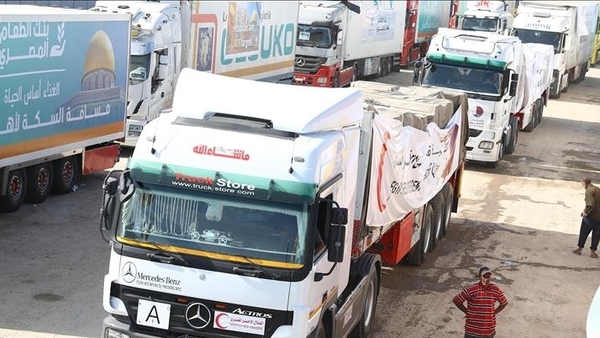
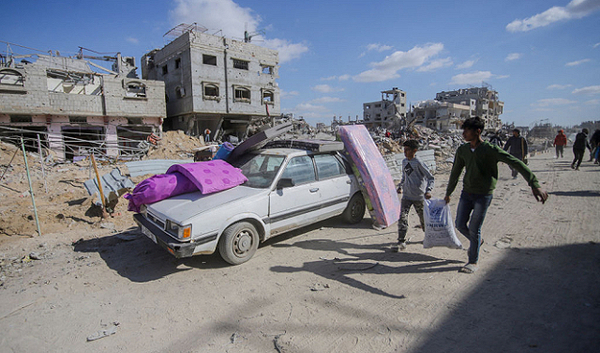
Jens Laerke, spokesman for the United Nations Office for the Coordination of Humanitarian Affairs (OCHA), said that more than 630 aid trucks entered the Gaza Strip on the first day of the ceasefire agreement.


Laerke told Anadolu Agency on Tuesday that this number is considered very large compared to the aid of the past months, expressing his hope that this momentum in daily aid will continue without stopping.


He said that the ceasefire brought happiness and relief to everyone, and that a glimmer of hope appeared among the Palestinians in Gaza.


The UN official added: "Even the Israelis are happy about the release of the three prisoners."


He pointed out that 600 aid trucks were allowed to enter Gaza daily in the first phase of the ceasefire, expressing his hope that trucks from the commercial sector would also enter.


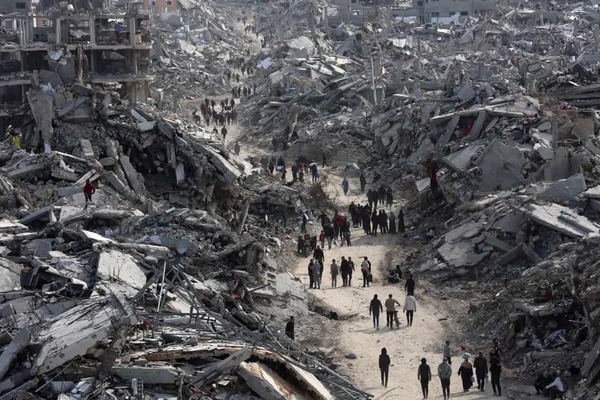
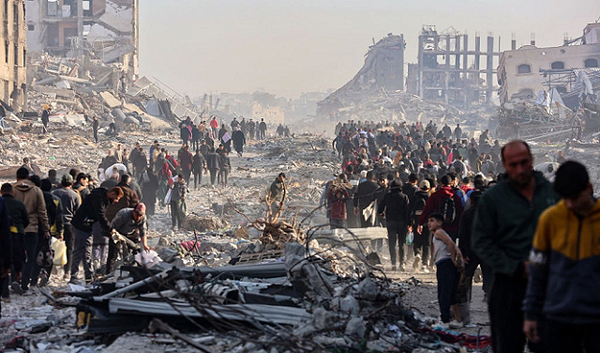
He pointed out that the situation in Gaza is very bad, there is complete destruction everywhere, the health sector has completely stopped and patients cannot receive treatment.


He stressed the need to provide long-term psychological care to Palestinians because the Israeli war has affected generations from children to adults.


The ceasefire went into effect on Sunday morning, and its first phase will last for 42 days, during which a second and third phase will be negotiated, mediated by Egypt, Qatar and the United States.


With American support, between October 7, 2023 and January 19, 2025, Israel committed genocide in the Gaza Strip, leaving more than 157,000 Palestinians dead and wounded, most of them children and women, and more than 11,000 missing.

PALESTINE

Tue 21 Jan 2025 3:03 pm - Jerusalem Time

Qatar announces date for discussing second phase of Gaza agreement

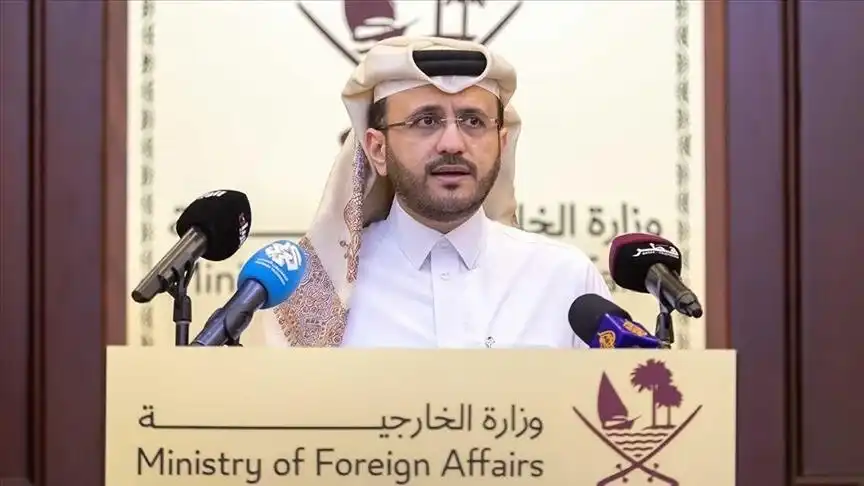
Qatar announced, on Tuesday, the start of work on preparing and drafting the second phase of the exchange agreement and ceasefire in the Gaza Strip, calling on the UN Security Council to play an active role in ensuring the implementation of the agreement and Israel's commitment to its terms.


Qatari Foreign Ministry spokesman Majed Al-Ansari said in a press conference that the parties will meet on the 16th day of the start of the implementation of the agreement to discuss the second phase, adding, "We are currently working on preparing and drafting the agreement on the second phase."


Al-Ansari declined to provide technical details regarding the implementation of the second exchange operation planned for next Saturday.


He also expressed Doha's appreciation for the involvement of US President Donald Trump's administration in the negotiations, adding, "We believe that the previous and current US administrations are seeking peace in Gaza."


He stressed that the main guarantee for the continuation of the agreement in Gaza is the commitment of both parties to implement its provisions, calling on international and regional partners to pressure to ensure the commitment of both parties to the agreement to implement it.


Invitation to the Security Council

In a related context, the Permanent Representative of the State of Qatar to the United Nations before the Security Council, Sheikha Alia Ahmed bin Saif Al Thani, called on the Security Council to assume its responsibility in playing an effective role in ensuring that the Gaza Agreement achieves the positive results expected from it.


This came in a statement read before the Security Council regarding developments in the Middle East, including the Palestinian issue, at the organization's headquarters in New York, according to a statement by the Qatari Foreign Ministry.


She stressed the need to reject any measures that undermine the sustainable solution to the Palestinian issue, including attempts to annex Palestinian lands and violate religious sanctities.


She stressed the importance of supporting Palestinian reconciliation in the next phase, noting that managing the Gaza Strip after the war is a purely Palestinian affair.


On January 19, a ceasefire went into effect, with its first phase lasting 42 days, during which a second and third phase will be negotiated, mediated by Egypt, Qatar, and the United States.

PALESTINE

Tue 21 Jan 2025 2:41 pm - Jerusalem Time

UNRWA: Reconstructing Gaza Strip is beyond our capabilities

The media advisor and spokesman for the United Nations Relief and Works Agency for Palestine Refugees (UNRWA), Adnan Abu Hasna, confirmed today, Tuesday, that the reconstruction process in the Gaza Strip exceeds the agency’s capabilities due to the severe damage and destruction that has affected all aspects of life in the Gaza Strip.


He added that the agency can contribute to rehabilitating the infrastructure in the camps, returning employees to work inside them, and operating their wells.


According to the organization's official website, Abu Hasna said that the agency's work has doubled over the past two days after more than a thousand aid trucks entered, with thousands of employees working at full capacity in the process of distributing food supplies. He pointed out that talking about the service infrastructure in the sector requires focusing on the basics, such as enabling municipalities to restore water and its lines and repair wells, as well as electricity companies that need wires, generators and high-voltage lines.


He explained that the search for the missing, whose number exceeds thousands of bodies under the rubble, requires planning and the work of special teams with experience, especially with regard to unexploded shells, the number of which has been estimated at tens of thousands according to UN estimates, expressing his concern about the Israeli practices and obstacles facing the agency and its employees, and the obstacles that will result from that.

PALESTINE

Tue 21 Jan 2025 12:51 pm - Jerusalem Time

Updated: 6 dead and more than 35 injuries in the occupation's operation on Jenin and its camp

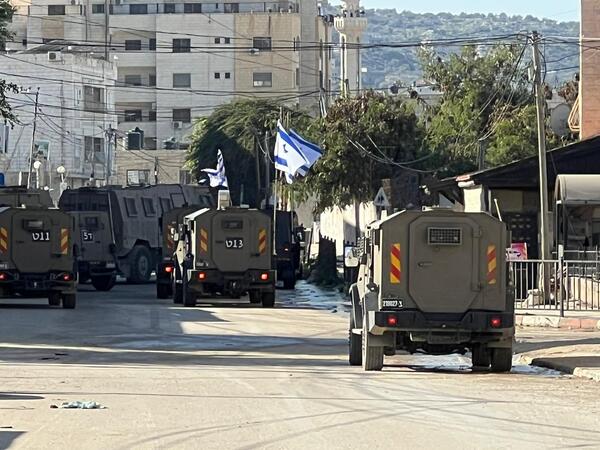
The Ministry of Health announced, on Tuesday afternoon, the martyrdom of 7 citizens and the injury of more than 35 others during the Israeli occupation's aggression on the city of Jenin and its camp.


The Israeli army announced today, Tuesday, that following a military investigation into the attacks by terrorist settlers on the area of the village of Al-Funduq in the occupied West Bank, it was found that dozens of settlers, some of them masked, carried out these attacks, and set fire to and damaged Palestinian property.


Local sources reported, quoting local sources, that the occupation forces, with military reinforcements, stormed the city of Jenin from the Jalameh military checkpoint, after a special Israeli force infiltrated the Al-Jabariyat neighborhood and was discovered.


The raid coincided with Israeli drones bombing an empty vehicle near Al-Zahraa School in the vicinity of Jenin camp, without any injuries being reported, while Apache helicopters fired into the skies of Jenin camp.


PALESTINE

Tue 21 Jan 2025 11:48 am - Jerusalem Time

Mossad and Shin Bet chiefs visit Cairo to discuss security arrangements on Philadelphi corridor

The heads of Mossad and Shin Bet, David Barnea and Ronen Bar, visited Cairo yesterday, Monday, and met with the director of Egyptian General Intelligence, Hassan Rashad, and discussed security arrangements in the Salah al-Din (Philadelphi) axis, the ceasefire management system, and the continuation of talks between Israel and mediators on implementing the ceasefire agreement and exchanging prisoners, according to the Ynet website today, Tuesday.


The Israeli army called on the displaced not to move from the south of the Gaza Strip to the north or towards the "Netzarim" axis, where the army's operations are still ongoing.


A post on the account of the Israeli army spokesman for the Arab media, Avichay Adraee, stated that "if Hamas adheres to all the details of the agreement, then starting next week, the residents of the Gaza Strip will be able to return to the northern part of the Strip, and directives will be issued in this regard."


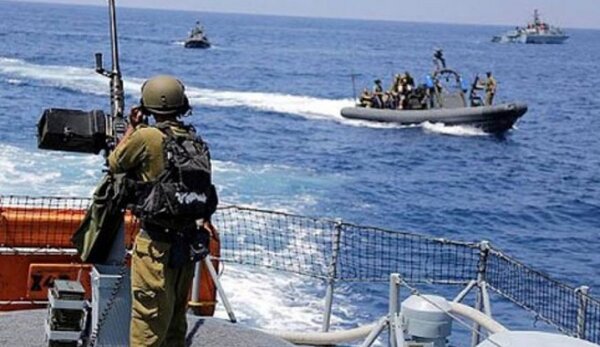
Adraee added that "it is dangerous to approach the Rafah crossing area, the Philadelphi Corridor area, and all areas where forces are concentrated," and that "in the maritime area along the Strip, there is a great danger in practicing fishing, swimming, and diving, and we warn against entering the sea in the coming days."


He continued, "It is forbidden to approach Israeli territory and the buffer zone. Approaching the buffer zone is extremely dangerous."

PALESTINE

Tue 21 Jan 2025 11:44 am - Jerusalem Time

Report: Biden and Trump pledge to Israel that resuming the war will not be considered a breach of the agreement

Netanyahu refuses to disclose the full text of the ceasefire and prisoner exchange agreement, and his office only published the text of the government decision, in order to refrain from withdrawing from the Philadelphi corridor and from implementing the second and third stages of the agreement


Israeli Prime Minister Benjamin Netanyahu refuses to disclose the full text of the ceasefire and prisoner exchange agreement with Hamas, exploiting what were described as "pledges" from the two American presidents, Joe Biden, whose term has expired, and Donald Trump, whose term began yesterday, according to Israeli media today, Tuesday.


Biden conveyed two pledges to Israel regarding the prisoner exchange, and Trump approved them, according to Israel's Channel 12. The first pledge stipulates that there will not be an automatic transition to the second stage of the prisoner exchange. According to the second pledge, if Israel decides that negotiations on the second stage do not lead to the results Israel wants, resuming the war will not be considered a breach of the agreement.


The channel added that in this case, Israel will be able to claim that Hamas did not agree to "certain matters," and therefore the withdrawal from the Salah al-Din (Philadelphi) axis will not be implemented. The agreement stipulates that the Israeli army will withdraw from the axis gradually between the 42nd and 50th days of the agreement, which went into effect the day before yesterday, Sunday.


Israel claims that the withdrawal from the Philadelphi is not legally binding, and that "the final withdrawal on the 50th day will not happen, because in Israel's view this (the clause in the agreement) was the way to get Hamas down from the tree," and that talk of withdrawal is "empty talk," according to the channel.


In the same context, the Israeli Prime Minister's Office refuses to disclose the full text of the agreement, and only publishes the text of the government's decision to ratify the agreement, which included details of some of the understandings in the full text, while the text of the government's decision does not include details about the humanitarian aid that will enter the Gaza Strip or Israel's commitment to withdraw from the Philadelphi axis on the 50th day of the ceasefire, according to Haaretz.


The newspaper quoted informed sources as saying that the ministers had reviewed the full text of the agreement before it was approved during the meetings of the political-security cabinet and the government last Friday, but not all ministers had reviewed the full documents in the agreement.


The newspaper noted that Netanyahu's office had refused its request to obtain a copy of the full agreement or to inspect it. It reported that the Israeli government had approved the previous ceasefire and prisoner exchange agreement in the same manner, in November 2023.


The text of the government decision on the current agreement was titled "Plan for the Release of Kidnapped Israelis", and mainly includes details of the dates for the release of Israeli and Palestinian prisoners in the first stage. Regarding the second and third stages of the agreement, the text of the government decision states that "the two sides will begin indirect negotiations in accordance with Appendix B", and the newspaper suggested that this appendix is the original full agreement kept in the government secretariat.


After the agreement was approved, a petition was filed with the Supreme Court, demanding that the government disclose the full text of the agreement to the public and inform the families of the Israeli prisoners of its details. In contrast, the government claims that the main reason for not disclosing the full text is a “security consideration.”


The petitioners say that the fact that the agreement was signed “even indirectly, in exchange for the enemy, Hamas,” and that Hamas knows its full details, makes it unreasonable for the agreement to include information that would harm state security if published.


Legal expert Professor Barak Madina, one of the petitioners, said that “the prime minister’s tendency to conceal the details of the agreement with Hamas and refrain from approving the entire agreement in the government raises suspicions that it is not based on considerations of state security, but rather an attempt to evade implementation of the second stage of the agreement, in which 64 kidnapped individuals are supposed to be released” along with thousands of Palestinian prisoners.

Source: arab48

OPINIONS

Tue 21 Jan 2025 11:20 am - Jerusalem Time

The Future of Hamas Between the Deal and Expected Challenges

Translation for "Al-Quds" dot com

Translation for "Al-Quds" dot com

Opinion Writer

Alaa Matar

Amad/ The Israeli war of extermination in the Gaza Strip is approaching its 470th consecutive day, while a state of widespread controversy is surfacing among the Gazans, about the “war of nothingness” that caused them to pay all this heavy price, starting with the number of martyrs approaching 50 thousand and the injuries approaching 120 thousand, passing through the destruction of the infrastructure of the Strip and making it an area unfit for life, and not ending with a huge and unknown number of prisoners in the occupation’s prisons and missing persons, after years of “erasure propaganda” that Hamas has been hurting our heads with, until we reached the most prominent topics currently being raised: the negotiations between Hamas and Israel, in light of allegations from senior Palestinian officials that Hamas’s refusal to accept a certain deal may put the movement’s future at stake.


This highlights the internal and external challenges facing Hamas in light of regional and international pressures, in addition to the impact of this on the Palestinian scene as a whole, in light of reports that the ongoing negotiations are related to a sensitive deal that touches on political and security issues that may have a fundamental impact on Hamas and its presence as a major force in the Palestinian arena.


With the lack of details announced in the media about the content of the deal, questions are raised about the extent of the concessions required from the movement, and whether it will take steps that may lead to a change in its strategy or structure.


The claim that the movement’s leaders may sign a “deletion” of Hamas, if they do not accept the deal, reflects the great pressures facing the movement’s political leadership. In light of this scenario, it seems that the deal is not just a passing agreement, but a turning point that could determine the movement’s future and its role in the Palestinian struggle.


According to the reports, Hamas leaders’ rejection of the deal could lead to disastrous consequences for the movement as a whole, most notably the tightening of the regional and international noose to weaken the movement’s influence, the escalation of direct military confrontation with Israel, and thirdly the erosion of popular support, because if the move is interpreted as harming major Palestinian interests, the movement could lose part of its popular base inside and outside the Gaza Strip. All of this is in addition to the worsening of the Palestinian division with the Palestinian Authority, which deepens the internal division and weakens the Palestinian position in the face of the Israeli occupation.


In light of these pressures, the movement faces a difficult dilemma that requires a delicate balance between preserving its basic principles and being open to solutions that may be necessary to ease the burdens on the Palestinian people, especially in the besieged Gaza Strip. If we assume that the movement accepted the deal, this would be a strategic step that could reshape its relationship with other parties. However, acceptance could be interpreted as a concession to some of its basic goals.


However, if the movement rejects the deal, it may show firmness in its positions, but it will face existential challenges as a result of the potential consequences.


Regional and international parties are currently playing an important role in shaping the course of these negotiations. While some countries are pushing for a political settlement that includes concessions from Hamas, other parties are seeking to exploit this circumstance to weaken the movement. The Israeli role here is central, as Tel Aviv seeks to undermine any future role for Hamas in the Palestinian arena, whether through political pressure or military operations.


Apart from Hamas as an organization, these talks reflect a delicate stage in the course of the Palestinian cause. The decision that Hamas will take will greatly affect the future of the Palestinian resistance and the chances of achieving national unity. Hence, the situation requires a great deal of wisdom and strategic planning to avoid scenarios that increase the suffering of the Palestinian people and weaken their position in the international arena.


Talk about eliminating Hamas as a result of its rejection of a certain deal reflects the complexity of the Palestinian political scene and its overlap with the interests of regional and international parties. At this stage, the choice that the movement’s leadership will make is a real test of their ability to balance political principles with the requirements of the changing reality. Whatever the decision, achieving Palestinian unity and confronting the Israeli occupation remains the ultimate goal that must unite all parties.

OPINIONS

Tue 21 Jan 2025 11:13 am - Jerusalem Time

Diplomacy Is All Hamas Has Left in the Arsenal

The Atlantic

The Atlantic

Opinion Writer

Hamas and Israel each abandoned long-standing demands in order to secure the cease-fire that takes effect today. Both parties were responding to internal and external pressures when Israel agreed to pull its forces back from almost all of Gaza, and Hamas accepted a temporary cessation of hostilities, but not the end to war it had sought.

In Israel’s case, one source of external pressure was President-Elect Donald Trump, who pushed Benjamin Netanyahu to accept conditions he’d long rejected. The Israeli prime minister was also swayed by intense public demands to retrieve the hostages. Netanyahu’s priorities and incentives are relatively visible and easy to apprehend. Hamas’s strategy is, in this instance, more opaque.


A major concession for Hamas was to accept that many of its key cadres will now stay indefinitely in Israeli prisons. In any case, the militant Islamist group is no longer the same organization that launched the October 7, 2023, massacre. Its battalions have been smashed; all that is left is a ragtag insurgency capable only of hit-and-run tactics. The group’s arsenal is greatly depleted; its fighters have fallen back on improvised explosive devices assembled from unexploded Israeli ordnance. The top tier of Hamas’s military leadership has been eliminated, leaving two relatively inexperienced and junior commanders—Ezz al-Din Hadad in the north and Mohamed Sinwar, younger brother of the October 7 attack’s mastermind, Yahya Sinwar, in the south.

As they planned the original 2023 assault, Sinwar and his lieutenants no doubt anticipated a devastating military response from Israel. They accepted the bargain of sacrificing all of the infrastructure and quasi-state apparatus that Hamas had built in Gaza since seizing power in 2007, in return for a “permanent” guerrilla war against Israel. According to the military wing’s theory of insurgency, after drawing the Israel Defense Forces into Gaza, Hamas fighters would inflict grinding attritional losses on Israeli troops. In a marginal way, that scenario seemed slightly plausible when Israel recently lost 15 soldiers in the northern town of Beit Hanoun within a week. After 15 months of fighting, the IDF’s losses are incommensurable with Hamas’s. But Israel’s generals need clarity from its civilian government about the political goals of the war and what they can call victory.

Read: Israel never defined its goals

Hamas, too, may finally have had a moment of clarity. Sinwar used to mock the Hamas politburo as “the hotel guys” because few of the political leaders ensconced in comfortable digs abroad had personal experience of armed struggle. For more than a decade, the Gaza gunmen became ascendant, while these formerly commanding, civilian Hamas figures in foreign capitals were reduced to soft-power roles as diplomats and TV talking heads. They had their uses as conduits for money and arms, but as Sinwar saw it, they had no hard-power value to the movement.

Recommended ReadingGraduate School Can Have Terrible Effects on People's Mental HealthAlia WongHow About Never?Anna HolmesWhat Apple Thought the iPhone Might Look Like in 1995Adrienne LaFrance

All of that has changed. Sinwar is dead; in Lebanon, the great ally Hezbollah has collapsed; in Syria, Israel’s longtime adversary Bashar al-Assad is gone; a humbled Iran has been kept at bay. So Hamas has had to change course. With the reemergence of Turkey and Qatar as regional power brokers, the deal-making diplomacy of the hotel guys is now the only game in town. If Hamas is to have any way of rebuilding power inside Gaza, the politburo must get its way.

Plenty of evidence suggests that the Sinwar-directed version of Hamas has not fared well in public opinion in Gaza, where 2.2 million Palestinians suffered serial displacement, hellish misery, and mass death. The military wing calculated that its adoption of a frontal position in the so-called Axis of Resistance of Iran-backed regional militias would shift Palestinian public opinion in its favor. But the backlash potential among Gaza’s civilian population, in what was surely imagined as a years-long insurgency, must have been obvious. Even the most implacable and belligerent Hamas leaders must operate within a Palestinian political context that demands significant support for a “people’s war.”

But the decisive factor in shifting Hamas at the negotiating table is the dramatic change in the wider geopolitical landscape. The Sinwar strategy of October 7 was to provoke a multifront war against Israel, in hopes of dragging into a regional conflict the ultimate adversaries, the United States and Iran. That call went unanswered. When Hezbollah made clear that it would intensify its long-standing border conflict with Israel but essentially sit out the war in Gaza, Hamas leaders complained at first, but eventually had to accept that the Lebanese cavalry was not on its way.

Even so, Hamas assumed broader backing from its regional sponsors. Yet the devastation that Israel inflicted on Hezbollah last year, the general degradation of Iran’s militia network, and the failure of Tehran’s strategy of using Arab fighters as a forward defense against Israel and the U.S. were decisive. The collapse of the resistance proved central to Hamas’s change of course.

With the end of the Assad regime in Syria, Iran now has no overland route to resupply Hezbollah in Lebanon, let alone Hamas in Gaza. The fall of Assad has helped shift power inside Hamas away from the Qassam Brigades, which advocated “permanent war” against Israel, and toward the civilian politicians who recently relocated from Qatar to Turkey. Many of those operatives were never really on board with the strategy of ditching governance in Gaza and turning to guerrilla combat. Hamas was careful to avoid open dissension, but signs of unease among politburo members were evident.

The victory in Syria of the Turkish-backed rebels fundamentally altered Hamas’s calculations. Turkey and its close ally Qatar are now emerging as key players in the Levant. For Hamas, whatever political links to Ankara and Doha it can leverage suddenly matter far more than any ties to Tehran. Unlike Iran’s leaders, the rulers of Turkey and Qatar have no interest in prolonging an open-ended conflict in Gaza. Both countries are largely aligned with the U.S. They have an overriding interest in regional stability, not in support for an endless insurgency on Israel’s doorstep.

If Hamas is to have any hope of getting back in the business of governing Gaza, and restoring a social contract with its more than 2 million Palestinian residents, Turkey and Qatar are most likely to supply the means. That would involve, first, political and diplomatic cover, and then financing for the territory’s reconstruction, especially its shattered health and education systems.

Trump’s threats of “hell to pay” if a hostage deal did not materialize before his inauguration probably meant little to Hamas. But even if the president-elect’s principal influence was on Netanyahu, Ankara and Doha certainly felt the Trump factor enough to lean on the politburo. The Qassam Brigade fighters surviving in Gaza’s tunnels still have their guns, and at some point they may decide they’ve had enough of the cease-fire; equally, Israel will show no hesitation in playing militant whack-a-mole, and Netanyahu might judge that resuming the conflict would advance his interests. But for the moment, the politburo members who want to pull back from endless warfare and try to rebuild political power in Gaza have the momentum and the leverage. That’s why there’s a cease-fire—and why it might just last.

PALESTINE

Tue 21 Jan 2025 10:54 am - Jerusalem Time

Two Palestinians injured Israeli occupation bullets in Gaza City

Two citizens were injured by the occupation forces' bullets in two separate operations, today, Tuesday, in the sea of Gaza City, and in the Sabra neighborhood, southwest of the city.


Local sources reported that a fisherman was seriously injured by Israeli gunboat fire in the sea of Gaza City, while another was injured by Israeli drone fire in the vicinity of the Abu Sharia office in the Sabra neighborhood, southwest of Gaza City.


In the same context, medical sources reported that rescue crews and citizens were able to retrieve the bodies of 66 dead from under the rubble of destroyed homes in the southern and northern Gaza Strip yesterday, Monday.


Health data indicates that more than 137 dead have been recovered from the city of Rafah, since the ceasefire agreement came into effect the day before yesterday, Sunday.


Since October 7, 2023, the occupation forces have launched an aggression on the Gaza Strip, which resulted in the death of 47,035 citizens, the majority of whom were children and women, and the injury of 111,091 others, while thousands of victims remain under the rubble.

PALESTINE

Tue 21 Jan 2025 10:46 am - Jerusalem Time

The Presidency condemns the settlers' attacks and the dismemberment of the West Bank

The Palestinian presidency condemned the ongoing Israeli aggression against our Palestinian people, the latest of which were the attacks by terrorist settlers under the protection of the occupation army on the villages of Al-Funduq, Jinsafut and Amatin in Qalqilya Governorate, accompanied by the occupation army placing many military checkpoints and iron gates at the entrances to cities and villages, with the aim of dismembering the West Bank.


The official spokesman for the presidency, Nabil Abu Rudeineh, said that these crimes committed by the terrorist settler militias and the occupation army come as part of the ongoing war of extermination waged by the Israeli occupation state against the Palestinian people, targeting their sanctities and properties.


He added that the far-right Israeli government is trying to drag the West Bank into a comprehensive confrontation through this silent war it is carrying out, with the aim of escalation and creating a climate of violence and tension, considering that the decision to lift sanctions on the settlers encourages them to commit more of these crimes.


Abu Rudeineh continued: We call on the new American administration to intervene to stop these crimes and Israeli policies that will not bring peace and security to anyone, stressing that the only way to achieve security and stability is to implement international legitimacy resolutions and the Arab Peace Initiative as a basis for resolving the Palestinian issue, and embodying the establishment of the Palestinian state, with East Jerusalem as its capital.

ARAB AND WORLD

Tue 21 Jan 2025 9:55 am - Jerusalem Time

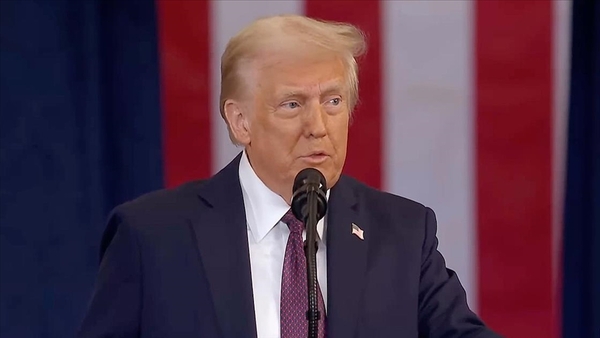
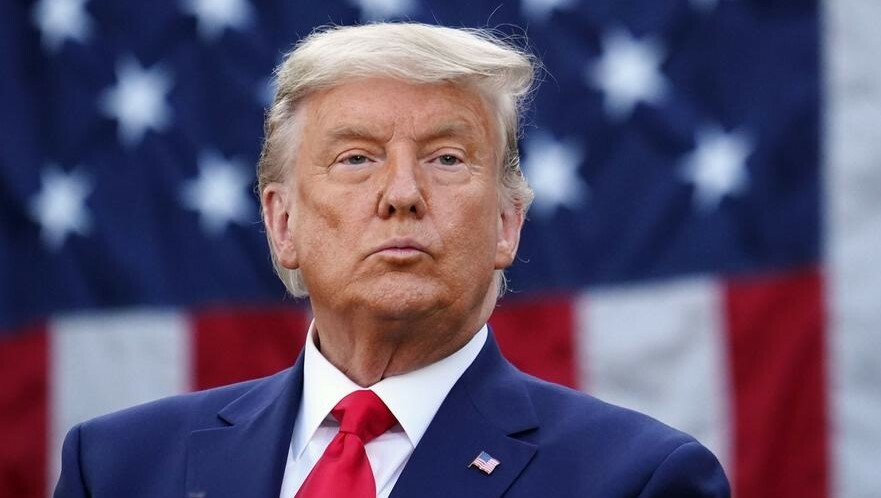
Trump: I'm not sure the Gaza ceasefire will last

US President Donald Trump said he was not sure whether the ceasefire agreement in the Palestinian Gaza Strip would last.


This came in a statement to reporters, after he signed a number of presidential decrees at the White House, Monday, after taking the constitutional oath to become the 47th President of the United States.


He added in this regard: "This is not our war. This is their war. I think the other side (Hamas) has become very weak."


"I looked at a picture of Gaza. Gaza is a massive destruction area. In fact, it has to be rebuilt in a different way," he added.


The US President indicated that he is able to provide assistance to rebuild the Gaza Strip.


"Gaza is an interesting place. It has a great location on the sea, and the atmosphere is great. There are many good things to do there," he continued.


On Sunday morning, a ceasefire between Israel and Hamas came into effect after a genocide committed by Israel with American support in Gaza since October 7, 2023, which left more than 157,000 Palestinians dead and wounded, most of them children and women, and more than 11,000 missing, amid massive destruction and famine that killed dozens of children and elderly people, in one of the worst humanitarian disasters in the world.

OPINIONS

Tue 21 Jan 2025 9:48 am - Jerusalem Time

Palestinian messages to Trump

op-ed - Al-Quds dot com

op-ed - Al-Quds dot com

Opinion Writer

On the eve of Donald Trump’s inauguration as the new President of the United States, in his long speech he addressed the exchange deal, and was content to say that the prisoners had returned to their homes in the Middle East one day before he arrived at the White House, without referring to the fundamental issues in our region, foremost among which is the need to stop the aggression against our Palestinian people in the West Bank and Gaza Strip, and to establish a Palestinian state.


Trump is excused if he does not realize the fact that there is a defenseless people who are still suffering from the occupation’s measures and oppressive practices over many years. However, if Trump really wants the world and history to remember him as a peacemaker, he must deal with the urgent Palestinian messages directed at him from under the rubble of Gaza, most notably the presence of more than 11,000 missing persons as a result of the devastating Israeli war, and that the Gaza Strip needs 600 trucks to enter daily to secure food and medicine for the population. Does Trump know that hundreds of thousands of families in the Strip are homeless, and that they immediately and urgently need more than 200,000 tents and 60,000 homes? Does Trump know that 800,000 male and female students are still deprived of education due to the destruction of educational bodies and institutions, most notably schools, institutes, colleges and universities? Does Trump know that Gaza has no mosques, minarets or churches to hold prayers?


Trump must acknowledge and admit that Israel has committed a genocidal war against the Palestinian people, resulting in more than 47,000 martyrs, thousands under the rubble, more than 11,000 injured citizens, and tens of thousands disabled, amputated, and in need of emergency operations.


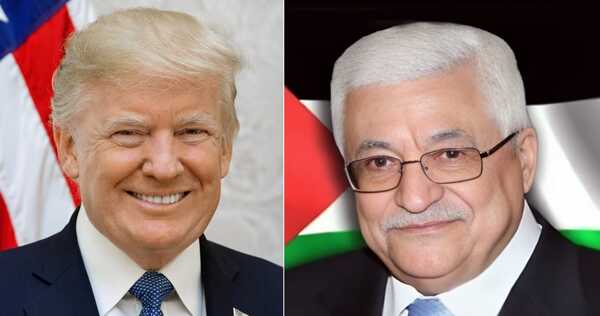
We will keep your statements, Mr. President, and keep them in the records, that you said yesterday that your strength will stop wars in the world forever, and that it will bring a new spirit of unity to a world that was angry, violent and completely unpredictable, and that you want your legacy to be that you are makers of peace and unity, and on this basis we say to you, here is Mr. President Mahmoud Abbas, the President of our State, our Authority and our Organization, which is considered the sole legitimate representative of our Palestinian people, and on behalf of our people, he was one of the first presidents in the world to send you warm congratulations on assuming your duties, addressing you with readiness to work with you to achieve peace during your term, according to the two-state solution based on international legitimacy, the State of Palestine and the State of Israel to live side by side in security and peace, and to achieve security and stability in our region and the world.


Our Palestinian messages to Trump are messages to the core. The national, humanitarian and moral duty requires that they be presented based on the values, customs and traditions of our people who love justice, peace, security and reassurance. We hope that the elected American president will keep his promises and that the crises, wars and problems in our region will end forever.

OPINIONS

Tue 21 Jan 2025 9:46 am - Jerusalem Time

The controversy of victory and defeat

Hani Al Masry

Hani Al Masry

Opinion Writer

Our people have the right to celebrate the cessation of suffering and the cessation of the war of extermination, and what was stated in the Doha ceasefire agreement - despite its many shortcomings - of an Israeli commitment to withdrawal, relief, reconstruction, the return of the displaced, and the release of prisoners, including most of those sentenced to life imprisonment and those with long sentences. Israel must be pursued to hold it accountable and hold it responsible for crimes that do not expire with the passage of time, especially the war of extermination and comprehensive destruction.

The ceasefire agreement reached in the formula that was in May was a surprise. The Netanyahu government had rejected this formula and insisted on continuing the war to achieve the declared and undeclared goals. It agreed to it without achieving its goals, even though what it did exceeded all expectations. This is due to the following reasons:


The first reason: US President-elect Donald Trump insists on completing the deal upon taking office, and it is said that his envoy threatened Israeli Prime Minister Benjamin Netanyahu that he would lose his position if he did not pass it.


The second reason: A shift occurred in Israel, as there is now an Israeli majority demanding an end to the war, after the great political, military, human, economic and moral losses, and after it became impossible to release the Israeli prisoners due to military pressure.


The third reason: The resistance’s steadfastness and bravery, its continued infliction of tangible losses on the occupation forces, and its ability to foil the generals’ plan.


The fourth reason: It is related to the gifts that Trump promised to give to Israel, which are related to the following: First, normalization with Saudi Arabia and other Arab and Islamic countries and their integration into the region. Second, addressing the situation in Iran, especially the nuclear file, whether through maximum pressure, siege and negotiation, or by directing a strong military strike against Iran if the carrot and stick policy does not succeed. Third, giving a green light to Israeli policies and measures in the West Bank. Fourth, removing some restrictions on the supply of American weapons and ammunition to Israel.


The question that arises is: Will the agreement be implemented in its three stages? The answer is not easy, and it could be yes as long as the reasons that led to it still exist. If we go deeper, the first stage will almost certainly be implemented. As for the second and third stages, they will be implemented, but with a risk of non-implementation that could grow or shrink according to events and the behavior of the players; that is, with postponement, tension, small and large violations, and things may even reach the point of resuming the war, albeit in new forms.


Whether the agreement is implemented or not, it is a battle and a new round in a long conflict that began more than a hundred years ago, and will continue no matter how long it takes until rights are returned to their owners.


Accordingly, the Netanyahu government or any future Israeli government, if the current government falls or its coalition changes, will continue to work to achieve the goals that were not achieved, whether by resuming the war later, after the first stage or later, or by using the human suffering and the need for reconstruction and continuing the aggression, under the pretext that Hamas still controls the Gaza Strip.


This title (Hamas control over the Gaza Strip) will be used by the Israeli government to continue assassinations, arrests, demolition and destruction, especially since the agreement does not include any clause that talks about the next day, and who will rule the Gaza Strip. We will be facing the possibility of deepening the Palestinian division, and perhaps turning it into Palestinian fighting despite the Israeli rejection of the return of the Palestinian Authority to the Gaza Strip for fear that it will embody the national identity and unity of the West Bank and the Gaza Strip, which keeps the establishment of the Palestinian state open. The matter becomes more complicated in light of the failure of the Palestinian leadership and forces to reach an agreement on a unified formula, whether by returning the current government to the Gaza Strip, or after amending it, or forming a national consensus government, according to what was stipulated in the Beijing Declaration (and this is the best formula), or forming a community support committee according to the American, Egyptian and Emirati proposals.


There is a heated debate among the Palestinian, Israeli, and Arab ranks, and across the world, about assessing what happened, and whether it constitutes a victory or a defeat, or somewhere in between, because the war has not been completed and has not been decided with a knockout blow in favor of this or that party, and the assessment of the war will not be decided until the war ends and the three stages are implemented, and then we will see whether it stopped without achieving its Israeli goals, without diminishing the importance of what it achieved or somewhere in between, although what Israel did not complete achieving during 470 days is difficult for it to achieve now or in the near future at least, after the resistance was able to benefit from the repercussions of the agreement on the Israeli, Palestinian, Arab, and international levels.


There are those who consider what happened a crushing defeat for the resistance, as evidenced by the fact that Netanyahu’s government was able to make a comprehensive change in the Middle East region, especially in light of what happened in Syria, and it has become closer to imposing its hegemony over the region, and by virtue of the genocide and turning most of the Gaza Strip into an area uninhabitable for humans, and not achieving most of the goals set by the commander-in-chief of the Qassam Brigades on the day the Al-Aqsa Flood began.


There are those who saw what happened as a clear victory for the resistance, as evidenced by the failure of the occupying state to achieve the goals it declared, and the losses it incurred on various levels, including the weakening of Israel’s strategic position and its functional role and its moral downfall, and in light of the well-known rule in history that the weak wins when it stands firm, and the strong party is not enabled to achieve its goals, and vice versa.


There is a third opinion, which sees the legendary steadfastness, valiant resistance and unparalleled courage embodied by our people and their resistance, and the occupation’s failure to achieve its declared and undeclared goals, as an important step on the road to victory, and can be considered a form of victory. It also sees the qualitative change that could happen in the Middle East, especially with regard to Israel’s integration into the region, as well as the humanitarian catastrophe and the heavy losses suffered by our people in the Gaza Strip, which the resistance incurred, and which made it demand a ceasefire, without achieving most of the resistance’s goals. The best that could happen is for the resistance to remain and for things to return to what they were before October 7, with its strategic significance not being a victory, but rather the victory of the weak over the strong; meaning that it is not able to achieve its goals, which is the fruit of legendary steadfastness and valiant resistance.


The mere survival of the resistance, and even its continued control of the Strip, despite its importance, is not considered a victory and is not the goal. Rather, the goal was and will remain the liberation of the land, because it is a return to what existed, especially since in light of the current circumstances, its survival and rule will be used as a pretext to continue the aggression and prevent relief and the return of life to the Strip through reconstruction, lifting the siege, and stopping the aggression. This will serve to perpetuate the division and prevent the establishment of a Palestinian state. If this happens, the Gaza Strip will become a repellent area, not an attractive one for its residents.


If what happened was not a victory, was it a defeat? Of course not, but rather an Israeli failure with the taste of defeat. Whoever does not believe will see the anger, sadness, crying and disparity in Israel between those who consider what happened a victory and those who consider it a defeat, because the decisive criterion for victory is achieving the set goals, and they have come a long way on the road to achieving them, but they did not complete achieving them due to the reasons mentioned at the beginning of the article.


What happened is not a defeat for the resistance, because the resistance was determined and preserved itself under compelling circumstances, and did not acknowledge or act as if it was defeated, and this is the decisive factor, as defeat becomes so if it is acknowledged and if it leads to surrender.


It is not consistent to talk about a Palestinian victory in light of the horrific suffering, heavy losses and genocide, but the occupying state and with it the entire global colonialism did not break the will of the people and the resistance, and did not lead to the recognition of defeat and the raising of the white flag. Rather, according to the enemy and the US Secretary of State, the resistance fought until the last moment, and is able to continue fighting, and reorganized its ranks, and was able to recruit thousands of new resistance fighters.


If the resistance was not defeated and did not win in the literal sense of victory, that is, liberating the occupied land and raising the Palestinian flag on the minarets and churches of Jerusalem, then this is in the immediate term, but in the medium and long term, the Al-Aqsa flood and its repercussions will be one of the reasons for the future victory of the resistance. The legendary steadfastness, valiant resistance and unparalleled courage that took place from October 7 until the ceasefire agreement came into effect on January 19, 2025, will be just as the Paris Commune was a prelude to the victory of French wealth.


What to do?


In order not to waste the valiant heroism and the precious and great sacrifices, there must be a Palestinian initiative that is up to the challenges and risks and is able to exploit the available opportunity. This is possible, either through - and this is better, faster and less costly - the leadership taking the initiative or responding to numerous initiatives by calling for a comprehensive national dialogue that results in:


First: An irreversible decision to implement what was stated in the Beijing Declaration, whether by forming a national unity government with a national reference, activating the temporary leadership framework of the PLO, and preparing for comprehensive elections at all levels, where we achieve the unity of the institution, leadership, and decision-making in peace and resistance, and thus we remove the pretexts from the hands of the occupation and its partners to continue the aggression even through new forms, such as assassinations and concentrated and continuous bombing operations that prevent stability, relief, and reconstruction and push financiers and investors to flee.


Second: Continuing the dialogue to formulate a comprehensive vision and strategies capable of achieving direct national goals, foremost of which is the right to self-determination and ending the occupation as a condition for achieving the independence of the State of Palestine on the 1967 borders, considering this a step on the path to achieving the full national goals.


In the event that the leadership does not respond to the call for unity, as is the case so far, the forces and figures who agree on common denominators should take the initiative to form a national meeting or a national front aimed at pressuring the leadership to respond to the national interest and the decisions of the national consensus to achieve unity and a true partnership, as a national priority and necessity, unity that preserves and develops pluralism, provided that this front presents models of unity in words and through joint actions that prevent the emergence of a vacuum that enables the occupying state to achieve its goals, or facilitates the era of guardianship, containment, and Arab and international alternatives.


If we look at the experiences of the Palestinian national movement since the birth of the Palestinian cause until now, we will find that the Palestinian struggles, sacrifices and heroism, despite their enormity, did not achieve achievements commensurate with them. Rather, the gains were much less. Moreover, the Palestinian resistance was able, on several occasions and at historical stages, to achieve achievements in the struggle and military battles (for example, but not limited to: the 1936-1939 revolution and the first intifada). However, the political leadership lost these achievements either because of its division, or as a result of rushing to reap the political fruits for fear of losing the opportunity, or refraining from investing with flimsy pretexts such as achieving the goals all at once, or as a result of submission to Arab, regional and international parties and interventions, or because of giving priority to individual and factional interests over national interests.


We must remember that we concluded the Oslo Accords after the first Intifada, and despite some of its achievements and positives, it was ultimately a disaster in every sense of the word. We must not forget that after the glorious second Intifada, the Palestinian political ceiling fell below Oslo, to the level of unilateral commitment to the Oslo commitments, in addition to the occurrence of political, geographical and institutional division.


Despite the challenges and existential risks that it entailed, the Battle of the Flood of Al-Aqsa and its repercussions brought the Palestinian cause back to the forefront, to the point that various parties became convinced of the futility and possibility of bypassing the issue and skipping over it, which provides an opportunity to reach a solution that could be national or liquidationist, accumulating on what happened or aborting it.


Therefore, the path must be changed and a new national democratic path must be adopted that gives priority to unity of struggle so that the political ceiling is not repeatedly lowered and a bad formula such as the Trump deal is not accepted, which could be proposed in the comprehensive deal that he is expected to propose, where normalization and the integration of Israel into the region are in exchange for a “serious and reliable” path that leads to a state without the components of states and 30% of it is deducted as stated in the deal of the century.


Without unity based on a national, democratic, and combative foundation and true partnership, we will be faced with the loss of what was achieved after the legendary steadfastness and valiant heroism, the deepening and generalization of division, and the loss of Palestinian rights and the unity of Palestinian representation. In order to defeat this, we must adhere to a realistic national program far from indolence and recklessness; a program that preserves rights and is capable of achieving goals and soaring regionally and internationally. Will we learn a lesson before it is too late?

OPINIONS

Tue 21 Jan 2025 9:43 am - Jerusalem Time

Gaza sea..

Mutawakel  Taha

Mutawakel Taha

Opinion Writer

He walks ..

His wrinkled cloak is loose and transparent. He rushes towards the bombed-out houses, rolls his sleeves back over his shoulders, lifts up the rubble, and pulls the baked goods under the tottering buildings.


He carries a huge machete and stands at the entrances to the city, as if he were its guard.


He is the one who blew the cement walls with his finger, and carried the fighters, the martyrs with suspended sentences, to return the land to its owners, and to inflict heavy death on the officers of death. He is the one who drove them in vehicles, at dawn, to destroy the fiery towers erected towards the fearful borders. He is the one who swept away with his braid the remaining soldiers at the entrances, until the miracle was achieved that surprised the terrified occupiers, who were led in panic and humiliation towards the chains.


He walks through the camps and towns, greeting the people.


He stands on a solid rock and says: The killers target children, women and innocent markets! Are these people? Or is it their booby-trapped travels that provide them with the pretext to burn tender meat, birds, infants and milky down? How can they establish “peace” with them, which only leads to destruction, racism, madness, genocide and graphic atrocities? What is left in them to love peace, and for us to believe that they are descendants of Adam?


They have seen him, but they do not know his name, exactly. However, the simpletons know, with the intuition of bright insight, that this sheikh is aware of the hypocrisy of the West, which justifies our annihilation and our removal from the lists of life! So they ask him: Have the Crusades ended, Sheikh, or is the entity of killing what represents the last Latin kingdom on our shores? And that is why they support it.. at the expense of our pure blood!


And after every hundred mass funerals, they hear him say to a man running toward the graves: How can some of our “brothers” embrace these monsters? And open their capitals to his reprehensible voices? And side with him, with their defeated statements or their despicable silence, in shooting children and windows of basil?


After the bombing, which is renewed every minute, he stands leaning on a building that the shells have not yet reached, and counts on his fingers the bombs that have fallen, and the martyrs... He stutters, and tries again, but stops, because the martyrs have exceeded the numbers..!


The sheikh looked into the goblet of fire; there is someone smiling at the bottom of it, he said! And the flames glistened on his lips; he will be born here, after the wreckage and the fragments, and he will have a magical throne, and his chariots will reach the migrating serpents of the coasts.


In His presence you excel yourselves, and if He looks at you, the miracle will be completed, and time will laugh at you!


His horses will be countless; their hides will be water, their wings will be mysterious, and his trees will seem like an antidote to hearts.


She carried him in her womb to avenge her, but he went beyond the ashes, and became skilled in knowledge and wildness, until he broke the neck of superstition.

-No glory without suffering-


The Sheikh cried until his beard was wet! Then he shouted: Victory! The Great! Wait for it..


His mother cries in labor pains. His enemies shall dine in hell, and there shall be no sun in the sky; he shall be the sun of the lands. He shall cover the earth with their blood, and pursue them to the last gasp. His masts shall rise, and he shall send down rain where he wills, and he shall pluck out the eyes of the falcons and the battleships. The hawks shall thank him, and he shall wipe out the vanishing cock's comb, and the images of his enemies shall vanish like the air. The trumpets shall burn, and metal shall melt with the screaming.


The valleys, pits and trenches will overflow with rot, worms and iron clothes, until the chicks belch, then fire and purity will creep in, and the summer clouds will rain, seven days and nights.


Perhaps his mother did not give birth to him, but he came out of the cauldron of wailing and oppression.


The dew will dry on his shirt, and peel off on the streams of sweat under the noonday sun.

He will enter the rebellious city, as they entered the cities of legends.

The lion will play the violin.

The wanderers will bring their boxes to him, and rejoice in his pardon.

The scent of the flower with the charcoal locks will bite his heart.

He is neither weak nor a prophet, but he forgets, as is the habit of humans, that there are traitors in the house.


He will reach the unknown and the distant, and the lost in the regions will talk about him, and they will weave around him the auras they want.

The gazelles will dance for him in the clouds, the belly of the stream will torment him, and he will dream of jasmine milk.


They will scatter rice as a decoration under its walls, and it will shine with white ink, and forests and dreams will swim on its walls.


When he reaches the summit, he will see a rugged terrain that only the gods can reach or cross, so he will be forced to take the path of the sea and the hearths.


He will tremble and shiver, this strong and stubborn one, and will not bow, for he is far from shame and the lust of wood. Nor will he be arrogant like a foolish colt.


His body will not let him down, nor will the days dare to attack him. He will remain a simple, ascetic worshipper...and a hero until his grandchildren grow old and carry the map of the soul to the soul of the soul.


Because slander is weakness, and vision is good news, there is no harm in laughing, you savages, because you will not even find tears, after a while.


It seems that his brilliance lies in the fact that he saved us from ourselves.


He is a heavenly fighter, and I see him; in the abundance of pomegranates, and on the soft shores of cunning, and in the saliva of the lamp, and in the cup of fire.

The Sheikh shouted: I see him... I see him!

What do you see, Sheikh?

He said: It is the beginning of the end, it is the end of the beginning.

Get ready, people!


Then he continued walking north and south, as if he was checking the situation. They often saw him wiping red tears from his eyes, gathering them in his hands, and pouring them out onto the thirsty fields.


His mouth was salty, his eyes were a deep blue, and his hair was strands of silver, almost as long as the horizon.

The shop owner said to him: I know you, Sheikh..!


He smiled and said, “I know your great-great-great-great grandfather. He used to play with me on the beach, and I attended his father’s wedding.”

He carries the wounded and the scattered remains in the markets, even if there are a hundred of them, on his arms, and rushes with them to the only remaining hospital.


He removes the rubble of the neighborhoods, reopens the road, and sprinkles water on the dirt.

His clothes were covered in blood stains, due to the many shrapnel and bombs that hit his body, so as not to hit the houses.

They see him sitting at the heads of the murdered children, crying, stroking their gaping heads.

He traces the ground with his finger, and a large, long furrow opens, to bury the victims. He remains by their graves, muttering over the fire and the spray.

He is an old man from the water, who lives near the houses on the Gaza coast.

He is the one who sneaks in from under the doors, to return to a woman who lost all her children.. He ties mint to her heart, and kisses her feet.

He is the one who throws the rubble away until he reaches the cotton toy, picks it up and returns it to that wounded, crying child.

With his fingers, he picks out the pieces of the demolished walls, the broken ceilings, walls and trees, and throws them into the sky... far away, and she gasps at the scattered light.

He is the one who restored the minaret, which they had split, to its original condition, and covered it with his shine so that it would remain standing... like an obelisk and a call.

He mounts his thundering horse and ascends to the heavens, to cry at the gates of the throne for mercy on Gaza.

He is the one who dug a stream with his fingernail to direct the exploding wastewater to the distant estuary, so that the fields and neighborhoods would not be flooded.


He is the one who runs like clouds at night, carrying bags on his shoulder... distributing them to the slaughtered and those gathered in the darkness.


He opens his artery for the anemones to flow, for the thirsty orchards to be quenched, and for its lands to explode with anemones and the flowers of the anemone.

After each bomb, the roads are washed, and what remains of the buildings and streets appears polished with a sharp, gleaming polish.

And I see him, squatting, his face to the east, his hands stuck like two pickaxes into the bottom of the southern border and the northern border, trying to carry Gaza by its roots, carry it to the balcony of his tall house, place it there, and surround it with his arms.

It's the sea.

OPINIONS

Tue 21 Jan 2025 9:42 am - Jerusalem Time

Gaza.. disaster and heroism!

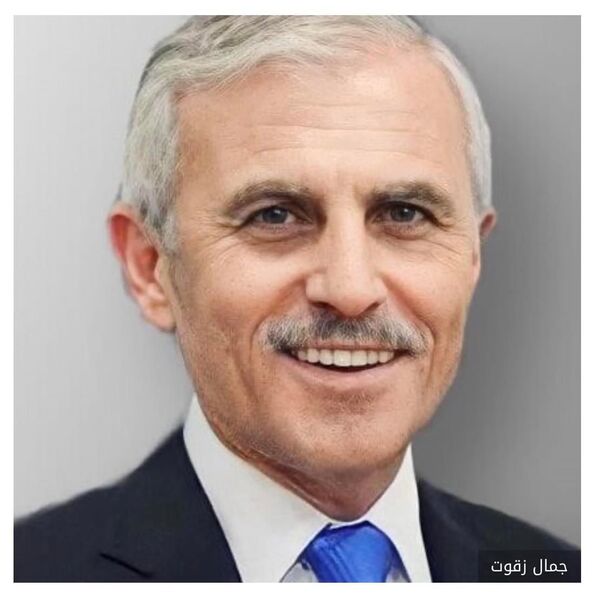
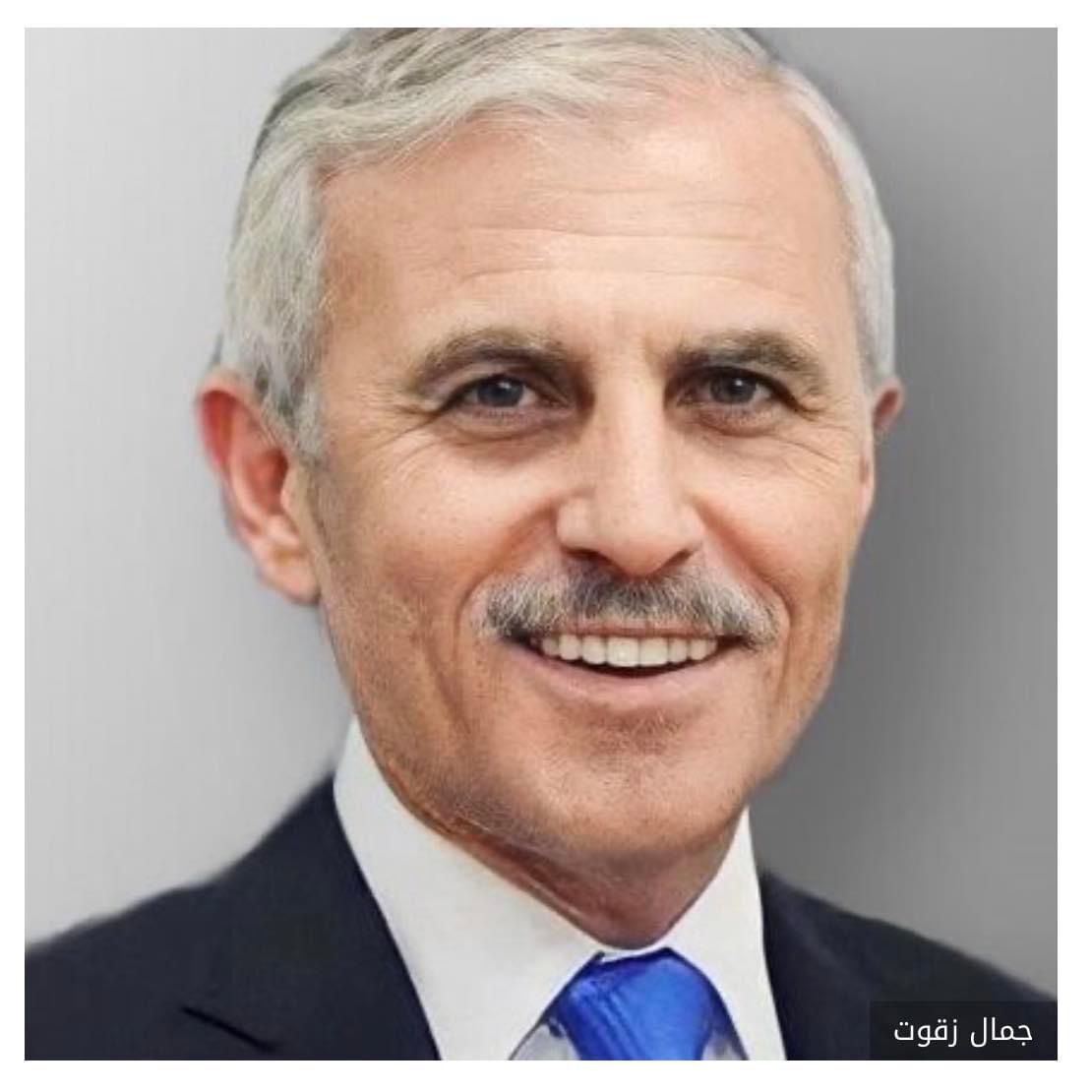
Jamal Zaqout

Jamal Zaqout

Opinion Writer

With a spontaneity that pulsates with a sense of humanity that overflows across the universe, the Gazans, both men and women, began congratulating each other on surviving a genocide that targeted their lives for 471 days with a brutality that contemporary history has not witnessed. Tears mingled between feelings of joy at surviving and tears of sadness over the tragedy of losing their loved ones, and perhaps their deep-seated feeling of betrayal, including by some of their own people.


Their tears streamed down on the rubble of all aspects of their lives that they built with their sweat throughout the history of their cities, towns and camps, which the invaders could never conquer. Gaza, which has tasted death and destruction, does not know defeat, as it is a term outside the dictionary of its origins since time immemorial. Its sons and daughters grew up among the golden sands and the striking blue undulating sea waters, filled with a love of honest life, even if it was characterized by the roughness of sailors as they struggle for a clean livelihood soaked in their sweat and the dignity of their ancestors. Mahmoud Darwish’s vision came true in his poem Silence for Gaza, as if he were living today in its destroyed alleys and lanes:


“Gaza is not the most beautiful city. Its beach is not bluer than the beaches of Arab cities, and its oranges are not the most beautiful oranges on the Mediterranean. Gaza is not the richest city.

It is not the most upscale city, nor is it the largest city.

But it is equivalent to the history of a nation.

Because it is more ugly in the eyes of the enemies, and more poor, miserable and fierce.


Because she is the most capable of spoiling the mood and comfort of the enemy, because she is his nightmare, because she is a mined orange, children without childhood and old men without old age, and women without desires, because she is like that, she is the most beautiful, purest, richest and most worthy of love.

... "We do Gaza an injustice when we turn it into a myth, because we will hate it when we discover that it is nothing more than a small, poor city resisting...


And when we ask: What made it a legend?


We will break all our mirrors and cry if we have any dignity, or curse it if we refuse to revolt against ourselves.

We would be doing Gaza an injustice if we glorified it, because our fascination with it would lead us to wait, and Gaza will not come to us, Gaza will not liberate us.


The fascists, while sinking their racist fangs into its belly, tried to hold its people responsible for the bitter taste of its flesh, and some slipped into the traps of their narrative. However, the pride of its people, the beauty of its children’s eyes, and the tears of its women have re-corrected the narrative of history, so that the peoples of the world are once again aligned with the right side of it. The tragedy of Gaza and all of Palestine did not begin 471 days ago of catastrophe and heroism.


It is true that Gaza has paid a heavy price beyond its capacity, due to the excess arrogance of power supported by killing tools in a retaliatory aggression to break its position as a historical lever of national dignity, but it knows how to make the blood and remains of its loved ones a thorn in the throat of its enemies.


Gaza, which paid the price of division and the heavy price of being left alone to face the annihilation of Zionist fascism, cannot bear to remain drowning in the rubble of its people’s homes. It also cannot bear to remain a victim of the absurdity of the conflicts over the future of its ability to transform its instinctive steadfastness and these heavy prices it paid to restore its position in renewing identity, narrative and national future on the path to freedom, return and the wresting of our people’s right to self-determination.


Gaza has once again placed the national movement and the remnants of the political system with all its components before a golden opportunity for a massive renaissance, albeit one filled with pain and thorns. The birth of hope from the womb of lean years of division and the fascism of racist occupation forces everyone to heed the voice of those who sacrificed their lives so that Gaza would not be broken. Its collapse would have brought nothing but loss and defeat in the face of the racism of the Zionist project and its expansionist ambitions, especially in what it plans to annex the West Bank, especially Jerusalem, which the occupation seeks to complete swallowing up and liquidating the Palestinian cause in its entirety.


Gaza calls on everyone that there is no time for bickering and the continuation of the struggle over representation and the legitimacy of restoring what Israel wanted from rubble that drowns us all in its mire, so that it can monopolize the fate of the land, identity and cause. The steadfastness of the people of Gaza in the face of the enemy’s fascism forced all parties to agree on a unified word. The Beijing Declaration was made to restore unity capable of returning Palestine to the geography of history. It, Gaza, cannot tolerate manipulation of what cost it precious blood and unbearable pain. If there is a victory that Gaza can achieve to restore its status, it lies only in starting the wheel of the train of comprehensive national institutions. There is no legitimacy outside of consensus until we reach together the station of the legitimacy of the ballot box, where we can knock on the doors of freedom and the end of the occupation. There is no place for continued hesitation and narrow factional calculations, and no place for exclusion, exclusivity and domination. This is the lesson of Gaza’s steadfastness and its great sacrifices.


Thank you to Gaza that has showered us with its love, and with it and this love filled with blood and tears. We have a responsibility to break the dullness of politicians and their narrow calculations. In this way, we will defeat the racism of the last occupation in this era of history. Palestine is greater than everyone, and the doors of its freedom are just around the corner.

OPINIONS

Tue 21 Jan 2025 9:40 am - Jerusalem Time

Pos and Cons

Hamada Faraana

Hamada Faraana

Opinion Writer

Hamas military spokesman - Qassam Forces Abu Obeida says: The sacrifices of the Palestinian people will not be in vain, and this is true in the horizon and in the long term, but the truth is that the sacrifices of the Palestinian people will go to the benefit of Hamas first, as the indirect negotiations that took place between the colony and Hamas strengthen the position of Hamas, just as they consolidate, strengthen and feed the Palestinian division, and this was done by an effective act, a prior decision and a deliberate direction, and instead of the participation of the PLO and its national authority, they were isolated, as if they did not exist, and they were removed from the negotiation equation, on the path to eliminating their political role, their legitimate status, and gradually canceling their role, according to the plan of the colony according to the convictions, work and directions of Netanyahu's coalition government based on: 1- That united Jerusalem is the capital of the Israeli colony, and it is being isolated, Israelized, Judaized and Hebraized, 2- That the Palestinian West Bank is not Palestinian, not Arab and not occupied, but rather it is Judea and Samaria as part of the map of the Israeli colony, and thus working to weaken the authority, distort its reputation and status and deal with it as if it is Absent and non-existent, on the path to reducing its role and dissipating its status.


Abu Obeida and other Hamas leaders view the Battle of the Flood of Al-Aqsa as the beginning of Palestinian action, and that it changed the balances, priorities and political data, and opened the gate to Palestinian victory, and that its sacrifices in the martyrdom of Haniyeh, Al-Arouri and Al-Sinwar are the price they paid in order to strengthen Hamas’s return to its sole, unilateral administration of the Gaza Strip.


In Hamas's unprecedented and courageous operation, the movement set the following goals:

1- Stopping the storming of Al-Aqsa Mosque.

2- Lifting the siege on the Gaza Strip.


3- Liberating all Palestinian prisoners from Israeli prisons. These are legitimate and realistic goals and a program that reflects Palestinian understanding and national interests. However, these goals were not fully achieved due to the Israeli military superiority and capability, despite the colony’s failure to achieve its goals in the following two issues: 1- Releasing Israeli prisoners without exchange operations, and 2- Uprooting Hamas and ending its role and authority. The results were disappointing to the Israelis’ goals and aspirations. Rather, they were forced to negotiate with Hamas and reach a truce agreement with it.


Regardless of the assessment of the physical facts of the battle on the ground and in the field, the political results will remain shaky, because the results of the battle are not decided in favor of one party at the expense of the other, because the Israelis failed but were not defeated, and the Palestinians held out but were not victorious.


The political battle began even before the military battle stopped, and both sides are working to exploit the practical results on the ground to their advantage, and this is what we will see and follow during the weeks of implementing the truce deal and beyond.

OPINIONS

Tue 21 Jan 2025 9:39 am - Jerusalem Time

Regional settlement and the Palestinian issue in light of the upcoming American vision

Marwan Emil Toubasi

Marwan Emil Toubasi

Opinion Writer

In our current era, the world is experiencing a state of great confusion resulting from the collapse of the major "progress" projects that prevailed in the twentieth century. On the one hand, "Soviet-style socialism" has ended, and on the other hand, the Western capitalist model faces fateful challenges, with the erosion of the "consumer capitalism" system and the decline of the welfare state model. These major transformations have reshaped the rules of global conflict and the international system, albeit slowly, towards the end of the unipolar international system with the emergence of multiple poles, which may later contribute positively to changing the equations related to our Palestinian national cause, as the tools of economic and political control have now become more complex, and part of the components of the Islamic State, ISIS and Al-Nusra organizations have become part of the tools that are employed to achieve the goals of hegemony in the Middle East, according to the exchanges of roles in Afghanistan, Sudan and Syria, and as is the case with the support of a number of Gulf Arab states and their roles in addition to America's allies and the poles of neoliberalism.


Despite these major transformations that the world has been witnessing for some time, the Palestinian issue remains central to international calculations, especially with the continuation of American attempts to arrange the region in a way that serves its strategic interests, taking advantage of these transformations in light of Russia’s preoccupation with the proxy war in Ukraine and China’s preoccupation with the economic war and the crises in the China Sea and Taiwan, in addition to protecting its colonial project in the region represented by Israel, and ensuring its hegemony and superiority. With the return of talk about Donald Trump and his project to resolve regional conflicts, the features of a vision based on imposing new facts on the ground appear, far from any just settlement that meets the legitimate and inalienable rights of our Palestinian people.


During Trump’s first term, the “Deal of the Century” shaped the features of his vision for the region, as it sought to rearrange the cards in a way that would serve Israel first and last and his leadership in the region. The deal focused on Arab-Israeli normalization and the abolition of the political rights of the Palestinians or even the Arab Peace Initiative project, in an attempt to transform the Palestinian issue into a humanitarian and economic issue instead of being an issue of national liberation and political rights.


Despite the deal’s failure, its approach has not ended. Similar arrangements have emerged elsewhere in the region, such as in Lebanon, Syria, and before that in Iraq and other countries, according to the repercussions of the first phase (the so-called Arab Spring) of implementing the New Middle East vision, the second phase of which is being implemented today. American interventions there, especially after the ceasefire in Lebanon, the fragile stability arrangements there, and the arrangements that took place in Syria, have guaranteed its interests and Israel’s interests by creating new facts aimed at keeping these countries in a state of weakness and internal division that prevents the formation of a future strategic threat.


On another note, despite the declared relations between Trump and Israeli Prime Minister Benjamin Netanyahu, some sources indicate that there is hidden tension between the two sides. Trump has sent troubling messages to Netanyahu, which raises questions about the future of their relationship and its impact on Israeli domestic policies, especially in light of the challenges facing the current Israeli government, which is likely to witness changes in order to facilitate the implementation of Trump’s vision for the region.


In addition, today's eyes are turning to the West Bank more dangerously than before, as a number of reports and leaks indicate that Trump may support Netanyahu's plans to annex parts of the West Bank and expand settlements, which may lead to the creation of isolated Palestinian cantons, which threatens to undermine the project of an independent Palestinian state with sovereignty and geographical contiguity over all the occupied territories and its capital, Jerusalem, which Trump had considered the capital of Israel and moved his embassy to.


Given these facts, it seems that Trump is seeking to reshape the political landscape in the Middle East in line with the interests of the United States, Israel, and the money empire, using a combination of pressure and threats to achieve his goals. This approach may lead to the imposition of new facts on the ground, as happened in Lebanon and Syria, where arrangements were reached that guarantee American and Israeli interests, which raises questions about the future of the region in light of these policies.


Therefore, the next stage requires regional actors, especially us Palestinians, to make an accurate assessment of the expected American policies, to benefit from the lessons of the past and to seriously and realistically review the policies, and to work on formulating strategies that are compatible with the new challenges, to guarantee our rights and national interests in light of the accelerating international and regional changes, even if we maintain reasonable optimism about the changes resulting from the Israeli aggression of genocide and uprooting, regarding which a ceasefire agreement was reached, a topic that I will address and its repercussions in the next article.


With Trump's return to the scene, the outlines of completing his vision for the region become clear, which is based on:

1. In the West Bank, after Trump’s previous approach of approving the Israeli annexation of Jerusalem, Trump promised Netanyahu during his first term to support annexation plans and settlement expansion. This reveals a larger goal of dismantling the West Bank into isolated cantons, linked to each other by roads under complete Israeli control. These cantons, which may be presented to us or offered to us as a political entity less than a state and more than an autonomous government, effectively preclude any chance of establishing a sovereign Palestinian state geographically contiguous with the Gaza Strip and implementing national rights.

This project not only aims to deprive our Palestinian people of their inalienable rights, but also seeks to establish the reality of occupation and settlement as an integral part of the geopolitical arrangements in the region.


2. In the Gaza Strip, Trump’s focus on long-term arrangements in Gaza, such as a ceasefire under American conditions imposed on Israeli policy and on Hamas through Egyptian, Qatari and Turkish mediators, reflects a strategic goal of keeping the Strip as a separate, besieged entity, completely isolated from the West Bank, under limited self-administration whose form is not yet known, which is what the West called “the day after,” subject to Israeli and American supervision. These arrangements guarantee the exclusion of Gaza from any comprehensive Palestinian national project, leading to the political and geographical division of the Palestinians, their land and their people.


3. Regional trade arrangements: According to his vision, Trump’s goal is not limited to political aspects only, but also seeks to strengthen regional trade and economic arrangements that ensure Israel’s integration into the region as a dominant economic power. By linking the interests of the Gulf states and Israel economically, Trump is establishing a new reality that makes Israel a major partner for these countries through major multinational companies, ensuring continued American and Israeli dominance over the region’s resources and markets, specifically the energy, transportation, technology, and agriculture sectors.

What is happening today is not just a political reordering of the region, but rather a comprehensive attempt to dismantle the Palestinian national liberation project. Therefore, there are a number of challenges that must be faced:


1. At the internal Palestinian level, ending the division and rebuilding broad national unity on the basis of democracy and participation, with an independent national decision away from external influences, to overcome the pressures related to the so-called “renewed authority”, renewing the construction and development of the Palestine Liberation Organization as a comprehensive house with its leadership role as the sole legitimate representative of the Palestinian people, and the owner of political and legal jurisdiction over Palestinian geography, which requires formulating a new political vision that restores consideration to the rights of our Palestinian people and to the national liberation cause its comprehensive status, and confronts attempts to liquidate the cause, through the rapid implementation of what was agreed upon in “Beijing” in a way that enables the management of Gaza’s affairs in accordance with what was stipulated in the terms of that agreement by forming a Palestinian national consensus government to be able to undertake reconstruction with a broad popular incubator for this government that enables it to work on the ground, and so that there are no loopholes that some regional and international parties are trying to exploit to impose their interference in national affairs and impose a non-national administration in Gaza. Then, the invitation was issued by President Abu Mazen in his official capacity for a broad Palestinian national meeting attended by all nationalists, not limited to factions only, until the membership of the Palestinian National Council is rectified and it convenes according to the rules, and the democratic entitlement of our people is implemented by holding general elections, considering that the people are the source of authority.


2. At the regional and international levels, enhancing work with popular movements, civil societies, and emerging political and economic blocs that have demonstrated their increasing support for the Palestinian cause, especially in light of the escalation of international solidarity against the occupation, its racist policies, and the crimes of genocide, ethnic uprooting, and holocausts that have been carried out in the Gaza Strip during the past period, as well as in the West Bank, especially in its camps.


3. Developing partnerships with international boycott movements to expand their influence on governments and companies involved in supporting the occupation, completing political diplomatic work in international forums in order to obtain full membership status in the United Nations, and working with emerging international alliances to confront US policies in providing immunity to Israel, and in order to isolate it internationally based on the charges it faces before international courts and the status of its racist entity.


Trump's upcoming vision, which combines threats, economic and political interests, and the empowerment of global financial empires to play a role in the region, shows that our Palestinian people are facing a decisive moment in their history. Either we can build a comprehensive, unified, and rational resistance strategy that takes into account the circumstances of our people and the changing situation in the world and the region, enabling us to achieve our national political rights, or attempts to dismantle our national liberation project by the enemies of our people will continue.


Despite all the pressures and threats, there remains hope in the steadfastness of our Palestinian people and their increasing international support, as was evident from the shifts in world public opinion, especially in Europe and the United States, as a result of the crimes and holocausts of the Israeli enemy in Gaza in particular, and the steadfastness and resistance of our people there despite the extent of the pain. The justice that the Palestinian people seek is not just a national demand, but rather a humanitarian issue that affects the conscience of the world and an international legal, political and moral responsibility, which requires everyone to confront the plans of hegemony and liquidation, and work to achieve a just peace that ends the occupation first and restores rights to their legitimate owners, foremost among which is our right to self-determination and national independence on the path to defeating the Zionist project, so that there is a place for justice, equality and dignity.

OPINIONS

Tue 21 Jan 2025 9:28 am - Jerusalem Time

A fragile agreement or is it the king and the kingdom?

Hamdy Farag

Hamdy Farag

Opinion Writer

The truce agreement between Israel and the resistance is not what many respected analysts tend to describe as "fragile", providing evidence of this with what happened on the first day of Hamas's delay in providing the names of the three female prisoners (British, Romanian and Israeli) for a few hours, during which Israel raised hell, Netanyahu threatened to resume the war, and announced that the ceasefire had not entered into force, even though Hamas explained the reasons for the delay as "security and field reasons". Despite our understanding of these reasons, along with many parties involved and not involved, no one wants to repeat this, except Netanyahu himself and some of his leaders who have resigned and those who are on their way to resigning.


It was very clear how much Hamas cared about implementing the agreement, through the image of the three female prisoners, in good health, good mentality, clean clothes, good treatment, and broad smiles that only indicated gratitude to the kidnappers, as if they were in a palace hospitality whose term had come to an end. It is true that Netanyahu said that they suffered hell, and this may be objectively true, as they and their kidnappers were under siege, surveillance, bombardment, spying, starvation, thirst, and women's needs for 471 days, in fear, anxiety, sadness, and pain. But all of this is because of Netanyahu, who killed fifty thousand people, more than half of whom were children and women. He could have ended all of this last May, as Biden says, that is, half the period of these girls' captivity, but he stubbornly and arrogantly refused to kill his captives, and he could have continued for months had Trump not arrived at the White House.


Did Hamas tell him that the real hell is your prisons, in whose basements you killed more than fifty detainees, the last of whom was the twenty-year-old Mohammed Yassin Jabr from the Deheishe camp, who had been administratively detained for a year, and was killed on the same day of the deal. Not to mention the widespread humiliation, deliberate starvation, and even rape.


Hamas, which appeared strong, sober, responsible, organized, confident, knowledgeable, and capable, did not say anything about delaying the release of the ninety Palestinian prisoners from Ofer until the early hours of yesterday morning, nor about bringing in 330 trucks instead of 600 according to the agreement.


It is clear that Hamas, along with the axis of resistance, realize that Ofer prison, where Israel has gathered the prisoners who are to be released, is nothing but a small prison, compared to the homeland that has been transformed into a large Ofer, where joy is forbidden.


It is not the agreement that is fragile, but rather the mentality of Netanyahu the king and his fascist government, which breathes from the lungs of the biblical kingdom, which is no longer hidden from anyone, and which has become wanted by the courts of extermination and purification at the international level.


Forty-five years ago, the IDF killed the Palestinian activist from the village of Battir, Taghreed al-Batma, on her way to university. At the time, the military spokesman justified the killing by saying that it was a stray bullet. At that time, the world believed them and disbelieved us, but the philosopher and thinker Abdul Latif Aql said: A stray bullet from a stray soldier in a stray state.

PALESTINE

Tue 21 Jan 2025 9:16 am - Jerusalem Time

Hamas confirms date of second batch of prisoners, 915 aid trucks enter Gaza

The Islamic Resistance Movement (Hamas) confirmed that the second batch of prisoner exchange with Israel will take place on the scheduled date next Saturday, according to the ceasefire agreement in Gaza. Meanwhile, the Washington Post quoted a senior Israeli official as saying that Tel Aviv agreed to release prisoners on Saturdays, "and this must be adhered to."


Media reports earlier on Monday said Hamas would release the next group of detainees in Gaza on Sunday, a day later than expected under a ceasefire agreement reached this month with Israel.


This comes amidst what Israeli Prime Minister Benjamin Netanyahu pledged - in a video message of thanks to US President Donald Trump - to "return the remaining hostages... and ensure that Gaza will never again pose a threat to Israel."


The American website Axios quoted the Israeli ambassador in Washington as saying that the Trump team obtained "concessions" from Israel to complete the deal, "and gave us things and will give more."


He stressed that "Trump's team played a major role in the Gaza negotiations and was determined to complete the deal."


Trump's leadership

In turn, Steve Witkoff, Trump's envoy to the Middle East, said in a speech at the inauguration ceremony of the new US president that Trump's policies have already achieved notable successes, such as the release of prisoners in Gaza, stressing that the agreement that was reached is "an achievement that demonstrates the strength of Trump's leadership and the respect he enjoys globally."


"Real progress requires tough conversations and bold decisions," he added.


feeling shocked

On the third day of the ceasefire agreement, the Israeli Broadcasting Corporation quoted Israeli officials as saying that they were "shocked when they saw the hostages (the three who were released on the first day of the agreement) walking out into a crowd with Hamas fighters in central Gaza."


The officials added that they "will inform the mediators that the scene of the hostages being released in the manner in which it was carried out is unacceptable."


Meanwhile, the United Nations Office for the Coordination of Humanitarian Affairs said that 915 aid trucks entered the Gaza Strip on Monday, the second day of the ceasefire between Israel and Hamas.


The office quoted in its statement information it received from the Israeli authorities and the guarantors of the ceasefire agreement.


The first stage


It is noteworthy that the ceasefire agreement entered into force last Sunday morning, and its first phase will end within 42 days, during which 33 Israeli detainees are supposed to be released in exchange for 1,900 Palestinian prisoners. It is accompanied by a cessation of hostilities in the Gaza Strip.


On the seventh day of the agreement, the occupation forces will withdraw from Rashid Street eastward to Salah al-Din Street, and operations will begin to dismantle all sites in this area, so that the displaced can begin to return to their residential areas, while ensuring freedom of movement for residents throughout the sector.


Vehicles will also be allowed to return north of the Netzarim axis after being inspected by a private company determined by mediators with the Israeli side, based on an agreed-upon mechanism.


On the 22nd day of the implementation of the agreement, the Israeli occupation forces will withdraw from the center of the Strip, especially from the “Netzarim Axis” and the “Kuwait Roundabout,” to an area close to the border, and the military installations will be completely dismantled, with the continued return of the displaced to their places of residence, and the residents will be granted freedom of movement in all areas of the Strip.


With American support, Israel has committed genocide in Gaza since October 7, 2023, leaving more than 157,000 Palestinian martyrs and wounded, most of them children and women, and more than 11,000 missing, amid massive destruction and famine that killed dozens of children and the elderly, in one of the worst humanitarian disasters in the world.


PALESTINE

Tue 21 Jan 2025 9:08 am - Jerusalem Time

When the prisoner triumphs over the jailer

Abdullah Al-Zaghari: The deal restored hope to the old prisoners after years of political deadlock due to the Israeli far-right governments

Issam Bakr: The exchange deal breaks one of the most important restrictions imposed by the extremist occupation government, especially after the events of October 7

Hilmi Al-Araj: Defeat of the occupation’s attempts to break the will of the prisoner movement through policies of abuse, starvation, enforced disappearance, medical crimes and isolation

Sari Samour: What happened confirms that the release of prisoners, especially those with life sentences and long sentences, can only be achieved through exchange deals.

Yasser Manna: The return of prisoners in light of Ben Gvir’s resignation is a strong message to the occupying state that the policies of oppression will not succeed in achieving its goals

Samer Anabtawi: The deal gave a great morale boost to the Palestinian people and proved that the prisoner will be released despite the jailer, no matter how harsh the circumstances are.


The prisoner exchange deal between the resistance in the Gaza Strip and the Israeli occupation state restores hope to the families of the prisoners and to the prisoner movement, which is considered a victory for them and for the steadfastness of the people of Gaza, over the Israeli occupation government and especially the Israeli Minister of National Security Itamar Ben Gvir, who personally supervised the torture of prisoners and freed prisoners in prisons.


Officials, writers, political analysts and specialists, in separate interviews with “I”, believe that this deal, which came under international sponsorship, not only stopped the genocide that the Gaza Strip was subjected to, but also broke the policies of repression and abuse followed by the Israeli far-right government, especially the policies of Itamar Ben-Gvir, the former Minister of National Security, who resigned following the conclusion of the deal.


They stress that the return of prisoners, including those serving life sentences and old prisoners, is a turning point in the Palestinian struggle, as it restores hope in the possibility of achieving freedom despite the great challenges. This deal was not just an exchange, but rather a defeat for the occupation policies that tried to break the will of the prisoner movement through torture, starvation and enforced disappearance.


They see that the prisoners who came out of the depths of prisons, with their heads held high, embrace freedom after long years of suffering, which reflects a legendary steadfastness that inspires peoples struggling for their freedom.


They point out that this deal has had a profound positive impact on Palestinian society. After a long period of suffering and anxiety over the fate of prisoners, their families began to feel reassured and hopeful for a better future. The deal also reminds us that the Palestinian struggle still holds within it the ability to achieve victories, no matter how violent the policies of oppression and tyranny are.


A great victory for the prisoner movement and the Palestinian people


The head of the Prisoners Club, Abdullah Al-Zaghari, confirms that the release of the first batch of the first stages of the exchange deal, which led to the liberation of a number of prisoners from Israeli occupation prisons, is a great victory for the prisoner movement and the Palestinian people.


He points out that this deal prompted Itamar Ben-Gvir, the founder of the "maximum pressure" theory, to resign, reflecting the failure of his repressive policies to break the will of Palestinian prisoners.


Al-Zaghari stressed that the release of prisoners in this batch is a historic event welcomed by the Palestinian people, who consider the issue of prisoners to be one of the central issues in their struggle for freedom and justice.


Al-Zaghari points out that this deal came to restore hope to the prisoners who were deprived of freedom for many years, in light of Ben Gvir’s policies that turned the prisoners’ lives into hell.


Al-Zaghari points out that Ben Gvir was one of the most enthusiastic supporters of the policies of repression against prisoners, as he tried to pass projects related to executing prisoners, and confiscated all their human rights that were achieved with great sacrifices, as the prisoners made great sacrifices of their lives and bodies in order to live a dignified life inside the prisons, despite all the violations they were subjected to, and Ben Gvir's resignation came to confirm his failure in the face of their steadfastness.


Al-Zaghari asserts that what the prisons witnessed under Ben Gvir’s rule and under the Israeli aggression is beyond human reason, as the prisoners were subjected to crimes of starvation, medical crimes, and continuous assaults, including cases of rape and harassment, pointing to the testimonies given by the prisoners during the past months, which reveal unimaginable atrocities.


It is believed that this deal represents a qualitative shift in the process of liberating prisoners, as it constituted a victory over Ben Gvir’s liquidation projects against the prisoner movement.


Al-Zaghari points out that the liberation of prisoners during the time of genocide is a victory over the policies of repression and abuse pursued by Ben Gvir.


Al-Zaghari confirms that this deal restored hope to the families of prisoners, especially those with long sentences, who were deprived of freedom by the occupation and denied the agreements previously concluded between the Palestine Liberation Organization and the occupation government, especially with regard to the fourth batch of prisoners who were detained before the signing of the Oslo Accords.


Al-Zaghari confirms that the cessation of negotiations since that time led to a state of despair among the prisoners and their families, but this deal restored hope in the possibility of achieving freedom.


Al-Zaghari points out that this deal restored hope to the old prisoners after years of political deadlock due to the far-right Israeli governments, which are no longer partners for peace.


Al-Zaghari asserts that this deal is the beginning of the liberation of more prisoners, especially in light of the ongoing Palestinian struggle for freedom and justice. This deal is also a victory for the Palestinian people, and reflects the steadfastness of the prisoners and their invincible will.


The deal restores the Palestinian collective consciousness


Issam Bakr, Secretary of Foreign Relations and Media at the Supreme Commission for Prisoners and Freed Prisoners, confirms that the release of the first batch of male and female prisoners within the framework of the recent exchange deal represents a break in one of the most important restrictions imposed by the far-right Israeli government, especially after the events of October 7, 2023.


Bakr points out that this government has worked to create multiple forms of physical and psychological abuse of prisoners, in addition to a series of procedures and practices that violate human dignity.


Bakr asserts that the release of the prisoners represents a great victory for the prisoner movement, as the Israeli standards that used to classify prisoners under the name of “blood-stained hands” and “terrorism” have been broken, in an attempt to brand the Palestinian struggle as terrorism.


Bakr stresses that the prisoners are a result of the conflict and not a cause of it, stressing the need to stop practices that violate their human dignity.


Bakr explains that the current deal confirms the possibility of achieving freedom, as a number of prisoners have been released, including life prisoners, old prisoners, and the elderly, who have spent many years of their lives behind bars.


He points out that the exchange deal restores the collective consciousness of the Palestinian people, stressing that the will of the prisoners remains unbreakable, and that they represent a model to be emulated by peoples struggling for their freedom and independence.


Bakr confirms that Ben Gvir's resignation carries great implications that have shattered his dreams, as he used to enjoy torturing Palestinian prisoners, as he personally supervised torture operations in several Israeli prisons.


Bakr believes that Ben Gvir's resignation marks the end of a symbol of extremism and racism, who posed a danger not only to the Palestinians, but also to the occupying state itself.


Bakr confirms that Ben Gvir left humiliated in the face of the steadfastness of the Palestinian prisoner movement, which remains steadfast and unbreakable.


Bakr believes that Ben Gvir's resignation is an implicit admission of the failure of his policies of repression and torture, noting that the prisoner movement will remain at the forefront of the Palestinian struggle for freedom and independence.


Bakr points out that the release of prisoners came after a heavy price paid by the Palestinian people, as the Israeli aggression on the Gaza Strip left behind massive destruction and great human suffering, stressing that the legendary steadfastness of the people of Gaza was a major factor in achieving this deal, which is an important step towards restoring Palestinian rights.


Bakr stresses that the prisoner movement will remain a symbol of struggle and steadfastness, and that the will of the Palestinian people will remain stronger than all attempts at oppression and humiliation.


Bakr believes that the current deal is only the beginning of the liberation of more prisoners, calling on the international community to assume its responsibilities in protecting the rights of prisoners and ending their suffering.


The deal is a practical response to Ben Gvir's policy


Director of the Center for the Defense of Liberties and Civil Rights "Hurriyat" Helmi Al-Araj confirms that the exchange deal and the announcement of the ceasefire are a real victory for the Palestinian people, who fought a fierce battle over the course of 15 months, during which they were subjected to the crime of genocide by the brutal Israeli aggression on the Gaza Strip.


Al-Araj points out that reaching this agreement under international sponsorship means stopping the crime of genocide, which in itself is a great victory for the Palestinian people.


Al-Araj stresses that this victory is also embodied in the liberation of prisoners, including those serving life sentences, old prisoners, and prisoners of the Wafa al-Ahrar (Shalit) deal.


Al-Araj stresses that this deal is a defeat for the Israeli occupation’s attempts to break the will of the prisoner movement through policies of abuse, starvation, enforced disappearance, medical crimes, and comprehensive isolation.


Al-Araj explains that the moment of freedom has come for the prisoner movement, which has triumphed with its will over the will of the jailer, pointing out that this victory also includes the bodies of the martyred prisoners and the rest of the martyrs detained in the numbered graves or refrigerators, who were detained by the occupation authorities in an unparalleled, heinous war crime.


Al-Araj stresses that the Palestinian people and the families of the prisoners feel great joy, especially after the long suffering they have been subjected to due to the violations and crimes committed by the occupation authorities against the prisoners.


Al-Araj points out that this deal is a practical response to Ben Gvir's policy, which imposed a starvation policy to terrorize prisoners and their families, and attempted to terrorize the Palestinian people through slow killings.


Al-Araj stresses that this deal is a defeat for the racist and oppressive policies pursued by the Israeli occupation, pointing out that as long as the occupation exists, the prisoners will continue to exist, but this deal is a step on the right path towards the freedom of male and female prisoners and the freedom of the Palestinian people.


Al-Araj confirms that the deal has great positive effects on the Palestinian people, as everyone was living in a state of anxiety about their sons and daughters in Israeli prisons.


Al-Araj points out that the number of martyred prisoners since the beginning of the Israeli aggression on October 7, 2023 has reached 56 martyrs, as a result of systematic torture, in addition to the presence of other prisoners in a state of enforced disappearance, especially from the people of the Gaza Strip.


Al-Araj confirms that the entire Palestinian society was living in a state of anxiety for its sons and daughters in light of the policies of enforced disappearance, comprehensive isolation, torture and abuse.


Al-Araj points out that the starvation policy followed by the occupation was clear in the thin bodies of the prisoners, as some of them lost more than 30 kilograms of their weight.


Al-Araj confirms that this deal has begun to reassure the families of the prisoners, as the stages of their release began on Sunday, and that the anxiety has begun to gradually dissipate, not only by improving the conditions of detention, but also by achieving the freedom that those who have been in prison for 45 years or those who have life sentences have been waiting for.


Al-Araj confirms that this deal is a historic turning point, as the prisoners are freed from the depths of prisons and from the heart of the stone graves that the occupation wanted for them.


Al-Araj points out that the prisoners left with their heads held high, embracing freedom after long years of isolation, torture, abuse, and medical crimes.


The release of prisoners is a central and sensitive issue for the Palestinian people.


Writer and political analyst Sari Samour asserts that the return of prisoners to their families and their release from captivity is a central and sensitive issue for the Palestinian people, as it is linked to deep feelings in which emotion is mixed with a sense of victory, and its importance deepens with their release in the exchange deal.


Samour points out that the issue of prisoners is of great interest to Palestinians, as there is hardly a home without a prisoner, whether a relative, friend or neighbor, which makes it an issue that affects every individual in society.


Samour explains that the feelings of joy experienced by the Palestinian people on the occasion of the return of the prisoners are mixed with pain and sadness over the great sacrifices they have made, especially in the Gaza Strip, which paid a heavy price during the recent Israeli aggression. However, everyone hopes that the people of Gaza will live a dignified life and that the long-lasting siege will be lifted.


Samour points out that Ben Gvir's resignation constitutes a moral victory for the Palestinian people, noting that what happened confirms that the release of prisoners, especially those with life sentences, can only be achieved through exchange deals with the Palestinian resistance, which narrows the political options for releasing prisoners from prisons.


Samour believes that this deal confirms that resistance is the only way to liberate the prisoners, especially in light of the failure of Israeli policies to break the will of the Palestinian people, stressing that the return of the prisoners is a strong message that the Palestinian struggle will continue until freedom and justice are achieved.


Psychologically and morally, Samour asserts that the return of prisoners has a profound positive impact on Palestinian society.


Samour points out that the feelings of joy experienced by the Palestinian people are mixed with pain over the loss of loved ones, as many of the released prisoners will find that their sons or fathers have passed away.


Samour stresses that despite these sacrifices, the general feeling is one of optimism and hope, as the exchange deal restores hope that the prisoners will be released and break the prison bars, stressing that this return boosts the morale of the Palestinian people and restores their faith in their ability to achieve victories.


Samour points out that the Israeli occupation tried to curb the joy of the Palestinian people by releasing the female and young prisoners late after midnight, and yet these attempts did not succeed in hiding the great joy that the Palestinian people are experiencing on the occasion of the return of the prisoners.


Samour stresses that the return of the prisoners is a moral victory that restores hope to the Palestinian people, and confirms that the struggle for freedom and justice will continue until the major goals are achieved.


The return of prisoners is a pivotal moment in the Palestinian struggle


Writer and expert on Israeli affairs Yasser Manna asserts that the return of Palestinian prisoners to freedom, in light of the resignation of Itamar Ben Gvir, the founder of the "maximum pressure" theory, carries deep implications and meanings that are reflected on the political, psychological and social levels.


Manaa points out that this return of the prisoners represents a symbolic victory for the will of the Palestinian people and their steadfastness in the face of the oppressive policies of the occupation, and confirms the failure of attempts to subjugate the prisoners and break their resolve.


Manaa explains that the return of prisoners is a pivotal moment in the Palestinian struggle, as it strengthens the national spirit and collective morale, stressing that this return shows the Palestinians’ ability to achieve gains despite major challenges, which restores hope in the possibility of liberation from the restrictions of occupation.


Manna’ stresses that this moment is uniting Palestinian society around a central issue that embodies their shared suffering: the issue of prisoners, who are a symbol of struggle and steadfastness. Manna’ points out that the return of prisoners also demonstrates the Palestinians’ ability to negotiate from a position of strength, making it a reminder of the importance of national unity and continued resistance.


Manaa stresses that this return is a strong message to the occupying state that policies of oppression and pressure will not succeed in breaking the will of the Palestinian people.


Psychologically and morally, Manna’ asserts that the return of the prisoners has a profound positive impact on Palestinian society. This moment contributes to strengthening collective morale and reviving hope for freedom and liberation. The return of the prisoners also represents an end to a long period of suffering from anxiety and longing for their families, which restores their sense of security and stability.


Manaa stresses that seeing the released prisoners inspires Palestinian youth and deepens their belief in the struggle for legitimate rights.


Manna points out that this moment is a reminder that the Palestinian struggle still has the ability to achieve victories, no matter how violent the policies of oppression and tyranny are.


Regarding the resignation of Itamar Ben-Gvir, the founder of the “maximum pressure” theory, Manna describes it as reflecting the failure of these policies to achieve their goals.


Manaa points out that Ben Gvir relied on oppressive and violent policies in dealing with Palestinian prisoners, including torture, abuse, and medical neglect, stressing that his resignation is an implicit admission of the failure of these policies, which did not succeed in breaking the will of the prisoners or subjugating them.


Manaa stresses that the return of the prisoners in light of Ben Gvir's resignation is a strong message to the occupying state that the policies of repression will not succeed in achieving its goals, and that the Palestinian people will remain steadfast in the face of all attempts at subjugation.


Manaa stresses that the return of prisoners is not just a symbolic event, but rather brings about extended transformations on multiple levels.


Manaa points out that this return strengthens belief in the ability of the Palestinian struggle to achieve victories, and restores hope in the possibility of liberation from the shackles of occupation, stressing that this moment is a reminder that the Palestinian struggle still carries within it the ability to achieve victories, no matter how violent the policies of oppression and tyranny are.


Great lessons for the occupying state and the entire world


Writer and political analyst Samer Anabtawi confirms that the war that the Gaza Strip has witnessed over the past 15 months has taught great lessons to the occupying Israeli state and to the entire world.


Anbatawi points out that the Israeli far-right government, which dealt with arrogance, tyranny and force, failed to force surrender on an entire people, despite the massive destruction that befell Gaza.


Anbatawi explains that the Israeli aggression on the Gaza Strip was bloody by all standards, as tens of thousands were killed and more than 100,000 were injured, in addition to the destruction of infrastructure, buildings and daily life in the Strip. However, the legendary steadfastness of the Palestinian people and the resistance surprised the occupying state and the world, as Gaza thwarted the goals announced by the extremist occupation government.


Anbatawi points out that the current agreement, although it does not meet all the aspirations of the Palestinian people, is an important step, as those with long sentences and life sentences were released, in addition to the return of women and children as part of a major exchange deal.


Anbatawi asserts that this deal gave a strong boost to the resistance and the Palestinian people, while it represented a setback for the occupying state and its settlement dreams.


Anbatawi points out how the Israeli female prisoners were handed over, as the resistance dealt with them in a highly ethical manner, unlike the occupation’s treatment of the Palestinian prisoners.


Anbatawi points out that Ben Gvir's appointment as Minister of National Security has exacerbated the suffering of prisoners, as they have been tortured, starved, and deprived of the most basic necessities of life, including medical neglect and the spread of diseases in prisons.


Anbatawi points out that these repressive measures have become a major concern for the Palestinian people, who see prisoners as a symbol of struggle and steadfastness.


Anbatawi confirms that the deal and the release of prisoners gave a great moral boost to the Palestinian people, as it proved that the prisoner will be released despite the jailer, no matter how harsh the circumstances.


Anbatawi confirms that what happened in Gaza gives new hope to the prisoners that they will be released from the occupation's prisons.


Anbatawi points out that the deal confirms the continuation of resistance and steadfastness, which sends a strong message that the Palestinian struggle is legitimate and ongoing, and that the Palestinian people will not stop demanding their rights and freedom.


Anbatawi stresses that the lessons learned from this war will remain a milestone in the history of the Palestinian-Israeli conflict, as the Palestinian people have proven once again that their will is stronger than all attempts at oppression and humiliation.


PALESTINE

Tue 21 Jan 2025 9:05 am - Jerusalem Time

A year in which people are rescued!

The four hundred and seventy-one days of the war of extermination passed without respite, as if they had been years, during which the Gazans suffered the embers of hell, which left hundreds of thousands of victims, including martyrs, wounded, hungry, and sick people, who were haunted by the specter of death, even while they were in their beds in hospitals that had been taken out of service, after they had become one of the targets of the raging war.


During the fifteen lean months, homes were destroyed, churches, mosques where the name of God was mentioned were demolished, roads were bulldozed, hospitals were besieged, and water and electricity stations and communication lines were taken out of service.


During the difficult months, the crops died, the udders dried up, the crops and the offspring were destroyed, and stray dogs gnawed at the bodies scattered in the streets. The remains of loved ones remained under the rubble of the houses, until the ceasefire agreement came into effect, when the families began to search arduously on the path of Calvary for the remains of their loved ones, whom they could not save and bury with the dignity they deserved.


In the war of extermination, the supplicants prayed, the supplicants pleaded, the Takbirs of the Takbirs rose, the oppressed pleaded, and people thought ill of God, before relief came and the slaughter stopped, and only those of strong resolve were able to bear its burdens and be patient with its horrors.


During nearly a year and a half, innocent souls were buried, great dreams were lost, the land became barren and desolate, the water dried up, and people lived in a shortage of lives, money, and fruits.


Now, after all the suffering that has passed, the day has come when people will be relieved and will be pressed.

PALESTINE

Tue 21 Jan 2025 8:58 am - Jerusalem Time

Trump cancels sanctions on settlers, freezes aid to Palestinians

The new US President, Donald Trump, signed several executive orders that would cancel more than 80 executive orders and laws of former President Joe Biden, including canceling sanctions imposed by former President Joe Biden on extremist Israeli settlers who use violence against Palestinian citizens, withdrawing from the World Health Organization, the Paris Climate Agreement, and banning drilling in places considered to be environmental reserves, among others.


Trump also signed an executive order targeting “foreign nationals participating in anti-Israel protests that have swept across the country since October 7, 2023, under the guise of protecting the United States from foreign terrorists and other threats to national security and public order,” and stating that the government must be “vigilant” in issuing visas to foreign nationals and ensure that those approved “do not intend to harm Americans or our national interests.”


It requires the U.S. government to ensure that foreign nationals “do not harbor hostile attitudes toward its citizens, culture, government, institutions, or founding principles, and do not advocate for, aid, or support designated foreign terrorists and other threats to our national security.”


Trump campaigned on a promise to crack down on anti-Israel protests, especially those on college campuses, but it's not clear exactly how he'll do that, given U.S. free speech laws.


Trump said in his first press conference after his election at the White House on the sidelines of those signings that he was affected by the extent of the destruction that befell Gaza during the Israeli war since October 7, 2023, and said that he would consider rebuilding Gaza "especially since Gaza is located in an attractive area on the Mediterranean coast" and could become an attractive tourist resort due to its location.


President Trump also issued an order suspending foreign development assistance for 90 days pending an assessment of efficiency and consistency with his foreign policy.


“All heads of departments and agencies responsible for U.S. foreign development assistance programs must immediately halt new commitments and disbursements of development assistance funds,” the new order says.


It was not immediately clear how broad the move would be and which programs, countries, NGOs and international organizations would be affected. It is also unclear what funding could be cut since Congress sets the federal government budget, but the move would likely affect U.S. aid to the Palestinians, which Trump cut during his first term.


The executive order reflects a return to the approach adopted by Trump during his first term between 2017 and 2021.


In his press conference, Trump reiterated what he had said in his inauguration speech about making America a great nation and ending the American collapse. He pledged to restore America to its rightful place as “the greatest, most powerful, most respected nation on Earth,” and he pledged to restore fair justice.


Trump reiterated his previous statements in which he promised to restore the Panama Canal, saying that the United States spent a lot of money and many Americans lost their lives while building the Panama Canal. He also pledged to change the name of the Gulf of Mexico to the Gulf of America.

PALESTINE

Tue 21 Jan 2025 8:48 am - Jerusalem Time

Israeli occupation forces launch a large-scale arrest campaign in the West Bank

This morning, Tuesday, the Israeli occupation forces launched a large-scale arrest campaign in the West Bank.


In Bethlehem, the occupation forces arrested Idris Suleiman Abayat (26 years old) and Rami Yasser Rawad (21 years old) after raiding and searching their parents’ homes.


Meanwhile, the occupation forces raided Yasser Rawad's house and stole a sum of money and gold jewelry.


In Qalqilya, the occupation forces arrested: Amin Hamed, Muhammad Abu Asab, Iyad Aweinat, Ahmad Titan, and Mazen Nazzal, after raiding and searching their homes.


The Israeli occupation forces also obstructed the movement of citizens, as they set up a military checkpoint at the eastern entrance to the city of Qalqilya, stopped vehicles, searched them, and checked the identities of their passengers, which caused a traffic crisis in the area.


In Nablus, the occupation forces stormed the town of Beit Furik since the early hours of the morning, and the storming is still ongoing until this news was prepared. They arrested more than 13 citizens, raided more than 15 homes, and wreaked havoc in them.


In addition, the occupation forces tightened their military measures at the checkpoints surrounding the city of Nablus, and imposed strict inspections on them, which led to a stifling traffic crisis.


In Jericho, the occupation forces continued to close all entrances and exits of Jericho, obstructing the exit from it, and stormed Aqabat Jaber camp and raided the home of citizen Rami Jamal and severely beat him, where he was transferred to Jericho Governmental Hospital to receive treatment.


Settlers also stormed the town of Al-Auja in the north and tried to steal a Palestinian vehicle, according to eyewitnesses.


In Hebron, the occupation forces stormed neighborhoods in the town of Beit Idhna, including: Wadi Risha, Al-Dhakhra, and Khallet Al-Ghazal, and searched a number of homes, and arrested: the brothers Moaz, Mutawakkil, Mujahid, Asid and Muhammad Mutlaq Abu Juhaisha, Muhammad Hussam Al-Jiyawi, Mahdi Jibril Abu Zalta, Ayas Muhammad Bashir Salimiya, Zaher Musa Abu Juhaisha and his son Malik, and Adnan Salimiya and his son Muhammad, after raiding and searching their homes.


The occupation forces have continued to storm the town of Idhna since yesterday, in addition to continuing its siege by closing its main entrance with an iron gate, as well as the side and dirt roads.


In Tulkarm, the occupation forces arrested: Adi Abu Aisha, Wassim Maher, Majd Sakr, Ahmed Ghassan Jaber, Muhammad Mahdawi, and Qasim Ghanem, after raiding and searching their homes. Meanwhile, the occupation forces stormed the towns of Allar and Saida, north of Tulkarm, and deployed in their streets and neighborhoods. They also patrolled the main streets of the Shaarawiya area leading to its villages and towns, obstructed the passage of vehicles, stopped a number of them, and subjected them to inspection.
PALESTINE

Mon 20 Jan 2025 9:13 pm - Jerusalem Time

The President congratulates Trump on taking the oath of office

President of the State of Palestine Mahmoud Abbas congratulated President Donald Trump on the occasion of his swearing-in as President of the United States of America.


The President stressed, "We are ready to work with you to achieve peace during your era, according to the two-state solution based on international legitimacy, with the State of Palestine and the State of Israel living side by side in security and peace, and to achieve security and stability in our region and the world."

ARAB AND WORLD

Mon 20 Jan 2025 8:04 pm - Jerusalem Time

Trump takes oath as 47th US president, boasts of Gaza deal


US President-elect Donald Trump and Vice President J.D. Vance were sworn in on Monday at the US Capitol, where the inauguration ceremony for the 47th US president took place.


Before Chief Justice John Roberts, Trump said: “I, Trump, do solemnly swear that I will faithfully execute the Office of President of the United States, and will to the best of my ability, preserve, protect and defend the Constitution of the United States, so help me God.”


Trump then headed to his family and vice president, where he was warmly shaken hands, amid applause from those present, including the outgoing president, Joe Biden, who stood next to him.


Before Trump, Vance took the oath of office before Supreme Court Justice Brett Kavanaugh, saying, "I, Trump, do solemnly swear that I will faithfully execute the office of President of the United States, and will to the best of my ability, preserve, protect, and defend the Constitution of the United States, and I pray God that he may help me."


Trump said his proudest legacy would be “peacemaker and unifier; and I am pleased to say that as of yesterday, the day before I take office, the hostages in the Middle East are coming home to their families,” drawing a standing ovation from the crowd.


“As in 2017, we will once again build the most powerful military the world has ever seen,” he said. “And we will measure our success not just by the battles we win, but also by the wars we end, and perhaps most importantly, the wars we never enter.”


“Our strength will stop all wars and bring a new spirit of unity to a world that has been angry, violent and completely unpredictable,” he said at the end of his speech.


The official inauguration ceremony opened with the introduction of outgoing President Joe Biden and Vice President Kamala Harris to the podium, amid applause from those present in appreciation of her four years of service.


In her remarks before the inauguration, Democratic Senator Amy Klobuchar, chair of the Joint Congressional Committee on Inauguration Ceremonies, stressed the importance of a peaceful transfer of power.


“Welcome to the 60th presidential inauguration,” Klobuchar said. “Today, President-elect Trump and Vice President-elect Vance will take the oath of office. We will witness a peaceful transfer of power at the heart of our democracy.”


Invited guests flocked to the Capitol Rotunda for the ceremony, where former President George W. Bush and his wife, Laura, President Bill Clinton and his wife, Hillary, were seen, as was former President Barack Obama, who attended without his wife, Michelle, who has been at odds with Trump.

Sources close to Michelle told People magazine that the former first lady did not attend Trump's inauguration because she "is not the type to put on a friendly face for the sake of protocol."


In addition to the Trump family, the CEOs of major tech companies were in attendance, including Jeff Bezos, founder of Amazon, Mark Zuckerberg, CEO of Meta, and Elon Musk, CEO of Tesla and SpaceX.


The inauguration in Washington, DC, will make Trump the first president to serve two non-consecutive terms since Democrat Grover Cleveland, the only president before Trump to reach the White House in the same way, having won the presidency in 1885, then been defeated in 1889, then nominated by his party again to win in 1893.


Trump's inauguration also marks a triumphant return for a president who has twice survived impeachment proceedings, two assassination attempts and an accusation of trying to overturn his 2020 election loss.


Unlike his former presidential rival, Kamala Harris, who had the backing of former Democratic presidents Barack Obama and Bill Clinton, Trump has not had such support from his Republican predecessors. The only living former Republican president, George W. Bush, has not declared his support for him, but is expected to attend his inauguration.

PALESTINE

Mon 20 Jan 2025 7:09 pm - Jerusalem Time

Israeli occupation tightens the siege on Jericho and continues to close it

This evening, Monday, the Israeli occupation forces tightened their siege on the city of Jericho and its two camps, and the villages of Ad-Duyuk and Nuweimah, and closed the side roads and dirt roads leading to them.


Local sources reported that the occupation forces closed all side roads along Road 90 leading to the city of Jericho with earth and military barriers, checked citizens' vehicles and forced them to turn back.


The occupation forces had closed the checkpoints and military gates erected at the entrances to Jericho since yesterday, Sunday, and prevented exit through them.

PALESTINE

Mon 20 Jan 2025 7:07 pm - Jerusalem Time

Two dead shot by Israeli occupation snipers in Rafah, south of the Gaza Strip

Two citizens, one of them a boy, were killed on Monday evening by Israeli occupation forces in the city of Rafah, south of the Gaza Strip.


Local sources said that two citizens, one of whom was a boy, were killed by Israeli snipers in the central and southern areas of Rafah city, south of the Gaza Strip.


Eight citizens, including children, were injured today by Israeli occupation forces' bullets in the city of Rafah, south of the Gaza Strip.


The ceasefire in the Gaza Strip went into effect yesterday, Sunday, at exactly 11:15 am.

ARAB AND WORLD

Mon 20 Jan 2025 6:49 pm - Jerusalem Time

Trump's Middle East envoy considers visiting Gaza Strip


President-elect Donald Trump's Middle East envoy, Steve Witkoff, is considering visiting the war-ravaged Gaza Strip as part of his efforts to keep a cease-fire between Israel and Hamas on track, according to an official from Trump's transition team who says he has direct knowledge of the cease-fire process, NBC News reported.


Underscoring the fragility of the ceasefire agreement that is due to go into effect on Sunday, the official said, “Wittkoff also plans to be a near-constant presence in the area over the coming weeks and months to resolve problems on the ground that he believes could unravel the agreement and halt the release of the hostages held by Hamas at any moment.”


"You have to be on top of it, and ready to put out the problem if it happens," the official said.


At the same time, Witkoff is working to achieve long-term stability for Israelis and two million displaced Palestinians, a path that runs through the three stages of the agreement reached last week.


The first phase, which began on Sunday, is scheduled to last about six weeks and includes the release of hostages held by Hamas and Palestinian prisoners in Israeli jails. The second phase will be negotiated during the first phase and is supposed to result in the release of additional hostages and the withdrawal of Israeli forces from Gaza. The goal of the final phase, which also remains to be negotiated, is to end the war and begin rebuilding Gaza.


It is noteworthy that during the "Al-Aqsa Flood" operation launched by Hamas against Israel on October 7, 2023, Israel says that 1,200 people were killed, including 311 soldiers, and about 250 hostages were kidnapped. The surprise attack shocked Israel and the world, especially since Hamas fighters had light weapons, while Israel has the most powerful military force in the region and the world if you take into account the unlimited American support for Israel.


For now, Trump's envoy's main concern is the inevitable daily interactions between Israelis and Palestinians on the ground in and near Gaza, even with a ceasefire agreement.


"Remember, there are a lot of people, extremists, fanatics, not just on the Hamas side, but the Israeli side, who have absolute incentives to blow up this whole deal," the official told the network.


The official said a visit to Gaza would allow Witkov to see the dynamics there for himself, rather than take Israel or the Palestinians at their word, adding: “You have to see it, you have to feel it.”


As Trump and his team manage the current phase of the deal and negotiate the next one, they are also competing with longer-term solutions.


"If we don't help the people of Gaza, if we don't make their lives better, if we don't give them a sense of hope, there will be a rebellion," the transition official told NBC.


Jerusalem has learned that some of Trump's advisers are assessing whether it is possible to resettle Gazans elsewhere in the world, as well as where large numbers of Palestinians could be resettled in different parts of the world. According to NBC News, the transition official said that Indonesia, for example, is among the locations being discussed where some of them could go.


But the question of whether Gazans are willing to move is rejected by the overwhelming majority of Palestinians, who believe that Israel's ultimate goal is to expel Palestinians from their land.


It should be noted that at present, the issue of getting aid into Gaza required in the first phase of the ceasefire agreement remains a challenge. Israel claims that Hamas takes a cut of any aid allowed into Gaza, at a time when the humanitarian crisis is dire. Hunger and disease are widespread and conditions continue to deteriorate.


Israel’s 15-month war of annihilation in Gaza has killed more than 47,000 people in Gaza, most of them women and children, according to Palestinian health officials. The relentless Israeli bombardment has also shattered the territory’s health system and forced people to leave their homes and live in squalid tent camps.


Witkoff, a real estate developer who has known Trump for decades, entered negotiations for a deal — joining President Joe Biden’s team he had been working on for more than a year — with Trump’s singular directive: “Bring the hostages home, and if you don’t, come back and explain why,” the transition official said.


The window for reaching a deal was narrower than ever. Not only had Trump set a deadline, Jan. 20, when he would be sworn in, but several additional hostages had died in recent weeks as temperatures in the region dropped and conditions continued to deteriorate, the transition official said.


Trump's close alliance with Israeli Prime Minister Benjamin Netanyahu, as well as the threat that he would not stop Israel from continuing to bomb Gaza if no deal was reached, also had an impact on the process.


The United States provided Israel with $22 billion in military aid last year.


According to the leak, Witkoff used Trump’s history with Israel and his dynamic with Netanyahu to pressure the Israelis. In one instance, he went to meet the prime minister on Saturday for a candid exchange. Witkoff privately told people that his comments to Netanyahu were not a threat, and that one of Netanyahu’s closest aides, Ron Dermer, had invited him to the prime minister’s residence.


The transition official said Witkoff was looking for a realistic benchmark from Netanyahu about what he was willing to do, and told him bluntly what was required to reach an agreement, including that Israel send a senior representative to the negotiations in Doha who could make decisions in real time. He essentially conveyed to the Israeli prime minister, “If you’re not going to make a deal, tell me, and I’ll get on the plane and fly back to the United States.”


In discussions with Israeli officials, he also did not hesitate to point out everything Trump has done for Israel, according to the network.


Trump moved the US embassy from Tel Aviv to Jerusalem, recognized the Golan Heights as Israeli territory and cut US aid to the Palestinians in his first term. At times in his discussions with Israeli officials, he also indicated that Trump was willing to endure political pressure to reach a deal, and urged the Israelis to do the same.


To Hamas, the message conveyed through the Qataris was: Why don't you see this as the deal that could ultimately lead to an end to the war?

ARAB AND WORLD

Mon 20 Jan 2025 6:45 pm - Jerusalem Time

Karim Khan says 'Israel not making real effort' to investigate Gaza war crimes allegations


International Criminal Court prosecutor Karim Khan has defended his decision to bring war crimes charges against Israel's prime minister, saying Israel has made "no real effort" to investigate the allegations themselves.


In an interview with Reuters, he stood by his decision on the arrest warrant despite the U.S. House of Representatives voting last week to impose sanctions on the ICC in protest, a move he described as "unwelcome and undesirable."


ICC judges issued arrest warrants for Israeli Prime Minister Benjamin Netanyahu, former Israeli Defense Chief Yoav Galant and Hamas leader Ibrahim al-Masri (known as Mohammed Deif) last November on charges of war crimes and crimes against humanity during the Gaza war.


Reuters said the Israeli prime minister's office did not immediately respond to a request for comment on the statements.


Israel rejects the jurisdiction of the Hague-based court and denies committing war crimes. The United States, Israel's main ally, is also not a member of the ICC, and Washington has criticized the arrest warrants against Netanyahu and Galant.


"We are here as a court of last resort... As we speak now, we have not seen any real effort by the state of Israel to take action that would satisfy the established jurisprudence, which is investigations into the same suspects for the same conduct," Khan told Reuters.


"This can change and I hope it will," he said in an interview on Thursday, a day after Israel and the Palestinian Hamas movement reached a ceasefire in Gaza.


The Israeli investigation could have led to the case being returned to Israeli courts under so-called complementary principles. He said Israel could still demonstrate its willingness to investigate, even after arrest warrants were issued.


The International Criminal Court, which has 125 member states, is the world's permanent court for prosecuting individuals for war crimes, crimes against humanity, genocide and aggression.
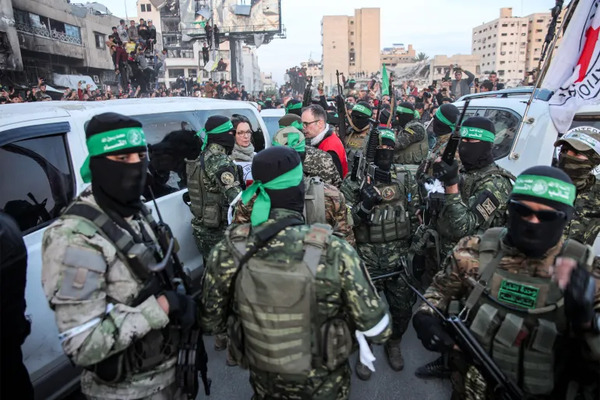

Khan said Israel has very good legal expertise.

But he said, "The question is, were these judges used, were these prosecutors used, were these legal tools used to properly scrutinize the allegations that we saw in the occupied Palestinian territories, in the State of Palestine? And I think the answer to that was 'no.'"


The passage of the “Anti-Illegitimate Court Act” by the US House of Representatives on January 9 confirmed the strong support for the Israeli government among President-elect Donald Trump’s Republican colleagues.


The International Criminal Court said it noted the bill with concern and warned that it could deprive victims of atrocities of justice and hope.


The first Trump administration imposed sanctions on the ICC in 2020 over its investigations into war crimes in Afghanistan, including allegations of torture by US citizens. Those sanctions were lifted under Joe Biden’s presidency.


It is noteworthy that in 2020, the credit cards and bank accounts of then-ICC prosecutor Fatou Bensouda and other staff were frozen and travel to the United States was blocked. Any further US sanctions under Trump are widely expected to be more severe and widespread.


The International Criminal Court, established in 1998, was intended to take over the work of the temporary tribunals that conducted war crimes trials based on legal principles established during the Nuremberg trials against the Nazis after World War II.


“It is of course undesirable and unwelcome that an institution that is the daughter of Nuremberg... is threatened with sanctions,” Khan said in his interview. “People should be aware of that because this court is not owned by the prosecutor or the judges. We have 125 countries.”


"It is a matter that should concern all people of conscience," he said, declining to discuss further what the sanctions might mean for the court.

PALESTINE

Mon 20 Jan 2025 2:33 pm - Jerusalem Time

Gaza Health: 122 dead bodies and 341 injuries arrived at hospitals within 24 hours

The Ministry of Health in Gaza announced today, Monday, that the death toll in the Gaza Strip has risen to 47,035, the majority of whom are children and women, since the start of the Israeli occupation aggression on October 7, 2023.


It added that the number of injuries has risen to 111,091 since the start of the aggression, while thousands of victims are still under the rubble.


It pointed out that 122 dead, 62 of whom had their bodies recovered, and 341 injured arrived at hospitals in the Gaza Strip, as a result of the Israeli aggression on the Gaza Strip during the past 24 hours.