PALESTINE

Sat 22 Feb 2025 1:29 pm - Jerusalem Time

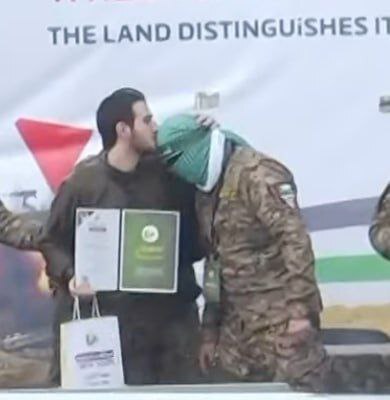
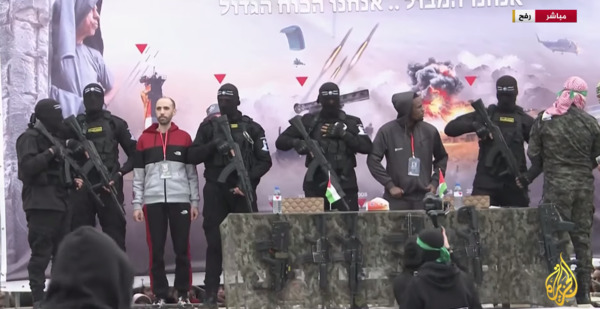
Released Israeli detainee kisses head of Qassam fighter

One of the released Israeli prisoners kissed the head of fighters from the Qassam Brigades, the military wing of Hamas, on Saturday.


The Palestinian Information Center reported that this came during the handover ceremony to the International Red Cross team in the Nuseirat camp in the central Gaza Strip.


On Saturday, Hamas handed over 3 Israeli prisoners to the Red Cross in Nuseirat, central Gaza Strip.


Hamas handed over the Israeli hostages Elijah Cohen, Omer Shem Tov and Omer Finkert to the Red Cross in the Nuseirat camp in Gaza.

The Palestinian Information Center stated that the process of handing over the hostages to the Red Cross came after the arrival of the Shadow Unit convoy, the security forces of the Qassam Brigades, and the Red Cross crews to the handover point to receive the Israelis.


PALESTINE

Sat 22 Feb 2025 12:27 pm - Jerusalem Time

"Al-Qassam" decides to release prisoner Hisham Al-Sayed without a ceremony for this reason

After Hamas announced the names of the hostages scheduled to be released at the end of the first flight of the Gaza agreement, Hisham al-Sayed's name emerged among the six names, and many wondered if there was an Arab name among the names.


A source in Al-Qassam revealed that "the Israeli prisoner Hisham Al-Sayed will be handed over in Gaza City without ceremony, out of respect for the Palestinians inside."


According to the i24 News website, Hamas detained Hisham Shaaban al-Sayed in April 2015, as he independently crossed the border with the Gaza Strip through the orchards of Kibbutz Erez.


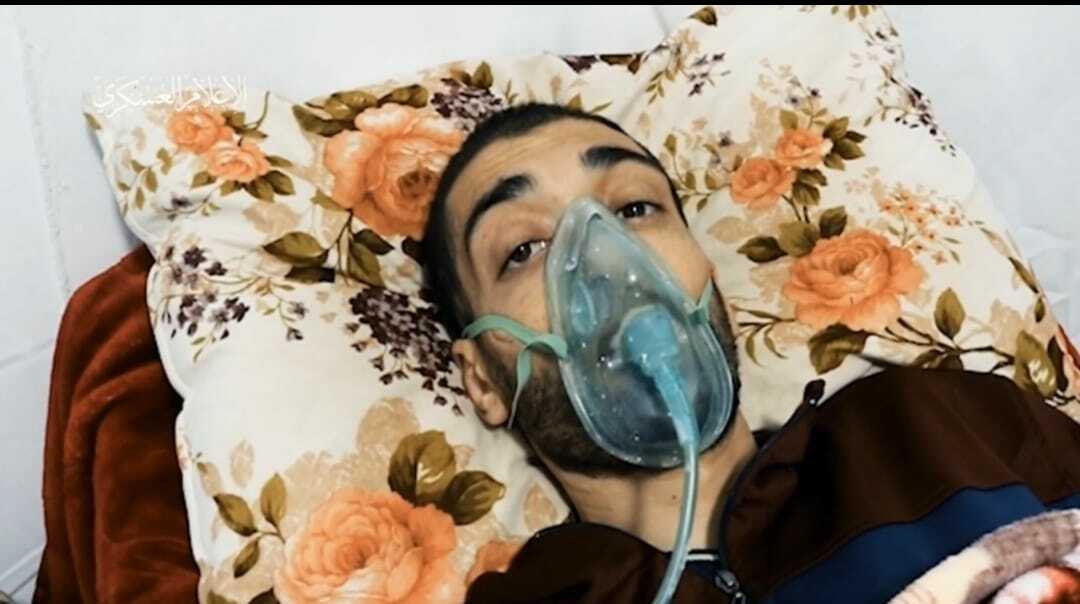
Hisham Al-Sayed (36 years old), an Arab citizen born in the Negev, is reported by his family to suffer from schizophrenia.


At first, he was declared missing and his family did not know what happened to him, until surveillance cameras on the separation fence showed him sneaking into the Gaza Strip.


During 2022, Hamas announced the deterioration of Hisham al-Sayed's health, and published a video documenting his condition.


His family did not try to exert public pressure over the past years to release him. Over the past ten years, all efforts to conclude a deal to release him in exchange for Palestinian prisoners in the occupation’s prisons failed, and his name was included under the title of forgotten prisoners in the Gaza Strip.


Press reports said that Mr. Sayed is an Arab of 1948 who lives in Israel and volunteered in the Israeli army in 2008.


PALESTINE

Sat 22 Feb 2025 11:45 am - Jerusalem Time

UN expresses its concern over the continued Israeli aggression on the West Bank

The United Nations expressed its concern over the continued Israeli aggression on the cities of the West Bank, especially in the north, for the second month in a row.

The official spokesman for the Secretary-General of the United Nations, Stephane Dujarric, said during a press conference tonight that the Office for the Coordination of Humanitarian Affairs continues to monitor the situation in the occupied West Bank.

He stressed that the UN office "remains concerned about the ongoing operations carried out by Israeli forces in the northern part of the West Bank, that Israel is carrying out its longest attacks since the early 2000s."

He pointed out that "the attacks of Israeli settlers who are usurping Palestinian lands are still ongoing."

The UN spokesman revealed that an average of 5 "violent attacks by settlers" were documented daily in the West Bank during the last week.

He pointed out that these attacks "caused damage to Palestinian property, and the settlers cut off agricultural water pipes, which negatively affected the livelihoods of dozens of Palestinian farmers."

"The United Nations Office for the Coordination of Humanitarian Affairs has documented the displacement of some 2,300 Palestinians, including 1,100 children, across the West Bank since last year, due to settler attacks and restrictions imposed by Israel," Dujarric added.

OPINIONS

Sat 22 Feb 2025 10:23 am - Jerusalem Time

AI's Opinion on the Migration Plan

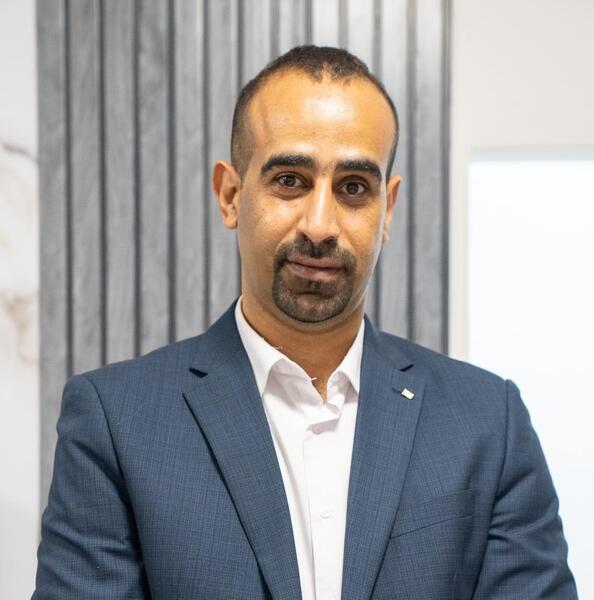
Written by Abdul Rahman Al-Khatib - Artificial Intelligence Specialist

Written by Abdul Rahman Al-Khatib - Artificial Intelligence Specialist

Opinion Writer


We have heard a lot about the subject of displacement recently, between a plan or a deal or other, the media talked about it and politicians dealt with it with a lot of analysis and detail until it became the subject of people’s talk because of its impact on their Palestinian existence and entity in Gaza or even in the West Bank, and here several questions arise about the seriousness of these proposals, especially in light of the association of the name of the American President Trump with it, so I asked artificial intelligence about this plan or deal, and here I present to you the opinion of artificial intelligence on it as it answered:


AI analysis of the feasibility of migration


A. Political and international obstacles

1. Absolute Palestinian rejection: The Palestinians, whether in Gaza or the West Bank, reject any attempt to uproot them from their land, and they realize that displacement does not represent a solution but rather the liquidation of their national cause.

2. The Arab position: Egypt has repeatedly rejected the idea of resettling Palestinians in Sinai, as have Jordan, Saudi Arabia, and other Arab countries, in the belief that the Palestinian Arab people have the right to establish their independent state on their land in accordance with historical rights and international legitimacy resolutions.

3. International Community: Although some major powers are biased towards Israel, carrying out a mass displacement of Palestinians would be considered ethnic cleansing, which could lead to widespread condemnation, possible sanctions, and diplomatic tensions.


B. Logistical and demographic obstacles

- Gaza has a population of more than 2.3 million people, making their displacement a nearly logistically impossible task.

- No country has expressed its willingness to receive this huge number of refugees, and the previous experience of Palestinian refugees confirms that any new displacement will not be acceptable or sustainable.

- The Gaza Strip has been under siege for years, which means that any attempt to forcibly displace the population would require massive transfers, which is unrealistic under the current circumstances.


C. Security and strategic implications

Any attempt to impose displacement by force will lead to an unprecedented military escalation, and perhaps ignite a regional conflict that extends to other countries.

This move will strengthen the resistance groups, which could lead to more attacks against Israel and American interests in the region.

Historically, forced displacement has not led to lasting stability, but has created humanitarian crises and protracted conflicts.


AI's opinion on this plan


Based on an analysis of political, historical, and legal data, AI can conclude that the idea of displacing Palestinians from Gaza, whether supported by the Trump administration or any other party, is not a realistic option. Political, international, and logistical obstacles make the implementation of this plan nearly impossible, even if it is raised in some political circles.


Looking to the Future: What's Next?


Rather than focusing on forced displacement scenarios, AI believes that sustainable solutions should focus on:

1. Improving the economic conditions in Gaza, because displacement is often the result of economic and social pressures.

2. Supporting a just political solution that guarantees the rights of the Palestinians, instead of perpetuating conflicts and attempts to impose solutions by force.

3. Pressure to end the blockade, which will enable the people of Gaza to develop their economy and remain in their homeland instead of thinking about forced or voluntary migration.


Finally


In politics, unrealistic or immoral ideas may be put forward, but their implementation depends on their ability to overcome political, humanitarian, and logistical obstacles. The plan to displace Palestinians from Gaza, whether attributed to Trump or anyone else, faces challenges that make it unworkable on the ground. If the real goal is to achieve peace and stability, the solution does not lie in displacing the population, but in ensuring their legitimate rights within a just and sustainable framework.


PALESTINE

Sat 22 Feb 2025 9:19 am - Jerusalem Time

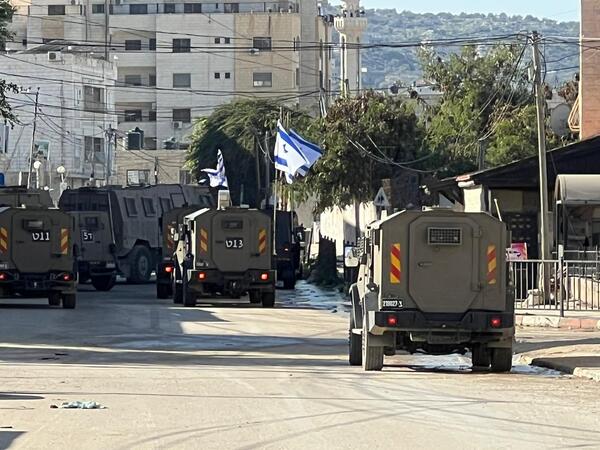
Nablus: Israeli occupation forces besiege a house in Yasid and target it with an Energa shell

This morning, Saturday, the Israeli occupation forces targeted a house with an Energa shell in the town of Yasid, north of Nablus.


Security sources reported that the occupation forces stormed the town, surrounded a house, targeted it with an Energa shell, raided several other houses, and conducted field investigations with citizens.

PALESTINE

Sat 22 Feb 2025 9:18 am - Jerusalem Time

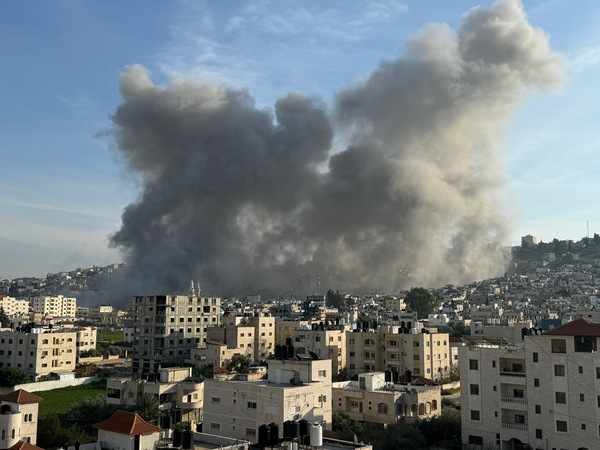
On the 33rd day of Israeli occupation's aggression: extensive destruction and displacement of more than 3,000 families from Jenin camp

The Israeli occupation army continues its aggression on the city of Jenin and its camp for the 33rd consecutive day, leaving 27 dead, and dozens of injuries and arrests.


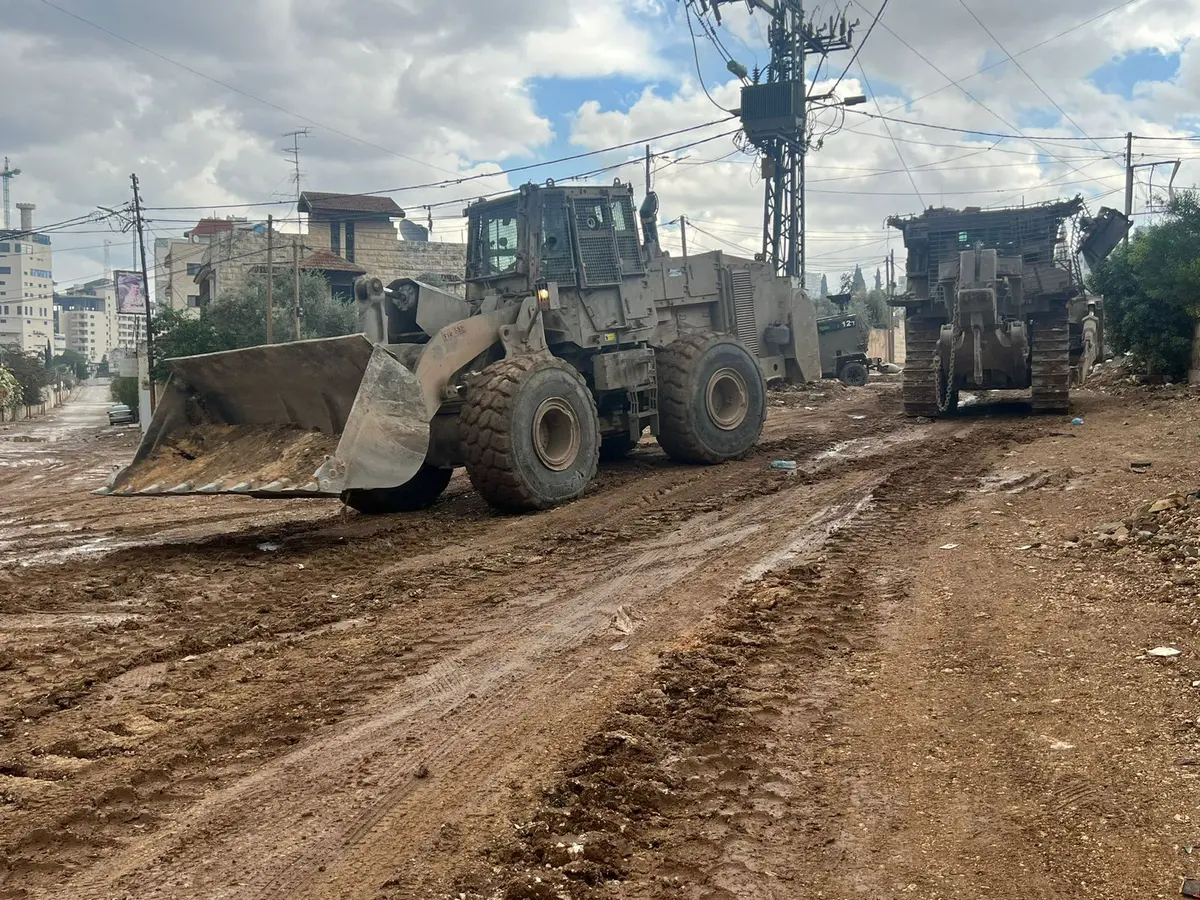
The occupation sent military reinforcements accompanied by bulldozers to the city of Jenin and the entrances to its camp, as well as water tanks and fortified military rooms used for internal military communications.


The occupation bulldozers left behind widespread destruction inside the camp’s neighborhoods, and in the citizens’ homes and properties, which greatly changed its features and geography, while infantry squads were deployed in several areas inside it near the Shireen Abu Akleh roundabout, Talat al-Ghabz, and the new camp.


According to the WAFA news agency, the Israeli occupation caused the displacement of about 3,000 families from Jenin camp, and destroyed their homes and properties.

The occupation continues to seize a number of citizens' homes and turn them into military barracks since the beginning of the aggression, especially in the buildings near and overlooking Jenin camp, while citizens, homes and buildings near them face difficulties in entering, exiting and moving due to the constant presence of snipers, which puts their lives at risk.


Yesterday, the occupation forces arrested a citizen from inside his vehicle while he was on Arrana Street east of Jenin, and stormed the towns of Ya'bad, Araba, and Bir al-Basha in the south, without reporting any arrests.

The ongoing aggression on the city of Jenin and its camp has left 27 dead the latest of whom was the child Rimas Al-Amouri (13 years old), who was martyred yesterday after the Israeli occupation soldiers opened direct fire on her while she was in front of her house in the Al-Jabariyat neighborhood, around the Jenin camp. She was hit by a bullet in the back that exited from the abdomen, and was transferred to the hospital before the doctors announced her death, in addition to dozens of injuries and arrests.

PALESTINE

Sat 22 Feb 2025 9:17 am - Jerusalem Time

Closure of educational institutions in the Holy City...UNRWA under the guillotine


Adnan Al-Husseini: Israel turned its back on international institutions, forgetting that it gained its legitimacy from these institutions.

Hatim Abdel Qader: Israeli violations against UNRWA are a blatant attempt to shed international responsibility for the refugee issue

Sami Mshasha: UNRWA does not have any real plan to confront the plot to liquidate it, but rather has begun to adapt to international pressures

Ratiba al-Natsheh: The right-wing government has launched an open war on the fundamental and fateful issues of the Palestinian people, including the refugee issue.

Ziad Al-Hamouri: There is an intensive campaign to try to end the refugee issue.. and "UNRWA" is the main symbol of Palestinian refugees

Fadel Tahboub: The Authority is required to assume its responsibilities to ensure the continuation of the educational process and not allow the occupation to impose a new reality


Three weeks after the Israeli occupation authorities’ decision to ban the work of the International Relief Agency (UNRWA) in areas under Israeli “sovereignty” came into effect, occupation police forces stormed a number of UNRWA schools in Jerusalem last Tuesday and ordered their closure. This measure affected 250 children in 3 schools in the city, and 350 students in the Qalandia Training Center.

“Israeli forces and Jerusalem Municipality staff stormed UNRWA’s Qalandia Training Centre and ordered its immediate evacuation,” UNRWA Commissioner-General Philippe Lazzarini said in a statement on the X platform, describing the incident as a denial of the right of children and youth in East Jerusalem to education in UNRWA schools.

Lazzarini considered what happened to be a "violation of the fundamental right to education, as well as a violation of the privileges and immunities of the United Nations," stressing the need to preserve the right of children to access education, and to protect and respect United Nations facilities at all times and in all places.

Politicians, writers and analysts who spoke to “I” considered that the right-wing government in Israel has embarked on an open war on all the essential and fateful issues of the Palestinian people, including the refugee issue, and that these Israeli violations against “UNRWA” are a blatant attempt to drop international responsibility for the refugee issue.

One analyst pointed out that UNRWA does not have any real plan to confront the plot to liquidate it, but rather has begun to adapt to international pressures, while another called on the Palestinian Authority to assume its responsibilities to ensure the continuation of the educational process and not allow the occupation to impose a new reality.


Dire consequences of the occupation's decision to close UNRWA


Engineer Adnan Al-Husseini, member of the Executive Committee of the Palestine Liberation Organization and head of the Jerusalem Department, said that the Israeli occupation authorities are defying the world and ignoring all international laws and conventions.

He added: "At a time when Israel has turned its back on international institutions, it has forgotten that it gained its legitimacy from these institutions."

Al-Husseini explained that the unjust Israeli decision to close the offices of the United Nations Relief and Works Agency for Palestine Refugees (UNRWA) in the occupied Palestinian territories comes in the context of the aggressive war waged by the occupying state against the Arab Palestinian people, and the quest to pass suspicious plans to eliminate them and liquidate their just cause, at the forefront of which is the refugee issue.

Al-Husseini warned of the dire consequences of the decision of the occupying state, which he considered an insult and contempt for the international community, its institutions and decisions, and the disasters expected to occur as a result of obstructing and stopping the efforts and services provided by UNRWA, especially humanitarian aid, in light of what the Israeli machine of destruction leaves behind in its aggression on the occupied Palestinian territories in the Gaza Strip and the West Bank.

Al-Husseini called on the international community to assume its responsibilities, deal with the occupying state as a racist state outside the law, work to strip it of its international legitimacy, and provide full support to UNRWA, in order to ensure the continuation of its services.


A flagrant violation of international law


For his part, Hatem Abdel Qader, Secretary-General of the Islamic Christian Authority for the Support of Jerusalem and the Holy Sites, and member of the Revolutionary Council of the Fatah Movement, condemned the Israeli occupation’s targeting of UNRWA schools and institutions in the city of Jerusalem as part of the incitement campaign launched by Israeli officials against UNRWA.

Abdul Qader added: "These violations against the agency are a blatant attempt to drop international responsibility for the Palestinian refugee issue, which threatens to liquidate the right of return and compensation stipulated in international resolutions.

"These violations constitute a flagrant violation of international law and a direct threat to the rights of Palestinian refugees," Abdel Qader said.

Abdul Qader called on the United Nations and the international community to assume their responsibilities in protecting UNRWA and ensuring its continued provision of vital services to the Palestinian people.


Lack of a clear and effective action plan to confront the ban on UNRWA


Sami Mshasha, a follower of UNRWA affairs and its former official spokesman, believes that the absence of a clear and effective plan of action to confront the ban on UNRWA’s work in Jerusalem and its expulsion from it constitutes a direct threat to the fate of Palestinian refugees in the city.

Mshasha explained that this absence includes the lack of specific instructions for the families of students in UNRWA schools, and hundreds of students at the prestigious Qalandia Institute who received evacuation notices, in addition to the intimidation of students in schools and the absence of any plan to protect the agency’s employees, whose job security is now threatened.

Mshasha added: "There is also a lack of any vision about the fate of poor families classified as "cases of extreme hardship", as well as the follow-up of patients, especially the elderly and those with chronic diseases, stressing that these issues cannot be addressed through hollow statements and declarations about the steadfastness of "UNRWA."

Mish'sha' criticized the absence of any realistic plan by UNRWA and the United Nations to confront the campaign targeting the agency, pointing out that this shortcoming was clearly evident during the last war, when UNRWA evacuated its headquarters and left the displaced and its employees to their fate in northern Gaza.

He also referred to the intensive attack that targeted UNRWA for more than a year, with the aim of expelling it from Jerusalem and reducing its role in Gaza after the war, without the agency taking any serious steps to protect its workers or ensure their job security.

In a related context, Mshasha questioned the usefulness of the UN Commissioner-General’s attendance at the Munich Security Conference, considering that his presence at such events reflects a dangerous shift in the role of UNRWA, as if the Palestinian refugee is now viewed as a security threat.

He also criticized his attendance at the meetings of the "International Alliance for a Two-State Solution," noting that his statements there deviate from UNRWA's mandate and link the fate of refugees to a political solution that does not guarantee the right of return, but rather seeks to create a distorted Palestinian entity.


Statements by the UN Commissioner-General


Mshasha explained that the Commissioner-General stated during the Munich conference that “the long-term goal is to enable Palestinian institutions to assume the basic services provided by UNRWA,” wondering who gave him the right to speak on behalf of the refugees and the mandate to change the agency’s clear and explicit mandate.

He also condemned his statement during the Cairo meeting about "gradually ending UNRWA's mandate," stressing that these statements are in line with plans to end the agency and turn it into a political tool that serves projects to liquidate the Palestinian cause.

At the end of his speech, Mshasha stressed that UNRWA does not have any real plan to confront the plot aimed at liquidating it, but rather has begun to adapt to international pressures, which makes it an indirect partner in implementing the policy of deportation and settlement.

He also pointed out the absence of a Palestinian national plan to confront this scheme, warning that the continuation of division and dispersion of positions will lead to the loss of Palestinian rights, most notably the right of return. He concluded his speech by calling for the development of a clear and specific plan of action that guarantees the protection of Palestinian refugees and the continuation of UNRWA's role in providing its services away from political calculations.


The only international witness to the refugee issue


In turn, political and community activist Ratiba Al-Natsheh said that UNRWA represents the only international witness to the issue of Palestinian refugees, and embodies dozens of international resolutions related to their rights.

She added: "It is no secret that the Palestinians' adherence to the refugee issue and their right to return to the lands from which they were displaced constituted an obsession for Israeli leaders, who considered it a national threat to the existence of their state, and even an implicit rejection by the Palestinians of the defeat of 1948 and the establishment of the State of Israel."

She pointed out that the previous Israeli government, during Trump's first term, sought to issue a decision that would limit the right of return to the original refugees who were displaced from their cities and villages in 1948, without this right being passed on by inheritance to their children who were born outside Palestine.

She added: "This government also worked to dry up UNRWA's resources and restrict it with American assistance, through a committee appointed by the United Nations under American leadership, to investigate the records of employees and refugees registered as beneficiaries of the agency's services in the Palestinian territories, and to set new standards for neutrality and rejection of "terrorism."


Lifting UNRWA's diplomatic immunity


Al-Natsheh stressed that the current government led by Netanyahu, which called itself the “decisive government,” has launched an open war on all the essential and fateful issues of the Palestinian people, including the refugee issue, fighting UNRWA, inciting against it, and drying up its resources.

Al-Natsheh considered that the majority vote in the Israeli Knesset to declare UNRWA an undesirable institution, lift its diplomatic immunity, and demand that it end its services before the end of January 2025, is a translation of the Israeli desire to end the refugee issue as one of the decisive factors to end the Palestinian issue and any international evidence of it. It also represents a clear challenge to international law and the United Nations institutions, which Israel has not respected any of its previous decisions.

“The decision of the Prime Minister of the occupation government, in the last cabinet meeting a few days ago, to implement the decision related to banning UNRWA “decisively and without hesitation or delay,” is further evidence that ending the refugee issue and declaring war on this international institution constitutes a top priority, no less important than imposing control over the West Bank and Gaza Strip. It is also a clear indication that Israel has received a green light from the White House to move forward on the issues of resolving the conflict in the Middle East, including the Palestinian issue at all levels,” she added.


Storming UNRWA educational institutions


Al-Natsheh pointed out that the educational institutions affiliated with UNRWA were stormed, their employees were interrogated, and orders were given to evacuate them, in implementation of the Prime Minister’s decision, starting with the education sector, as it is one of the arms of the war that the occupation municipality has been waging for many years in an attempt to completely control education in Jerusalem.

She added: This was followed by statements by the Israeli Minister of Health regarding ending cooperation in the health field with UNRWA and stopping its health services, which was translated in the field by removing the sign from the Indian Corner Clinic in the Old City, in preparation for ending its services or incorporating it into the Israeli health system.

She stressed that the threat to seize UNRWA properties in Jerusalem existed even before the Knesset voted to ban UNRWA. She said that the Israeli authorities informed UNRWA schools in the Shuafat camp of their intention to seize their buildings, and had previously taken their measurements. They also issued a decision to evacuate UNRWA headquarters in the Sheikh Jarrah neighborhood, on the pretext that it was built on land belonging to the Israel Land Authority, and planned to build 1,440 settlement units on it, in addition to imposing heavy taxes on the organization in an attempt to dry up its financial resources.

Al-Natsheh concluded by saying: “Despite the Israeli plans and the weak international and UN response so far to these violations and the blatant challenge to international law, the will of the Palestinian people, and more than 150,000 Jerusalemites who benefit from the agency’s educational and health services, still constitutes an obstacle to achieving the plan to end UNRWA’s services, and also provides a window of time for international action to save the refugee issue.”


The occupation is moving towards closing most of the agency's institutions


For his part, the Director of the Jerusalem Center for Social and Economic Rights, Ziad Hamouri, said that the occupation authorities continue their escalation against the institutions of the United Nations Relief and Works Agency for Palestine Refugees (UNRWA), as part of a plan targeting the issue of Palestinian refugees.

He said: "What happened a few days ago in Jerusalem is that a delegation from the Israeli Ministry of Education visited the schools in an attempt to find out the numbers of male and female students, but some directors refused to cooperate with them, while others referred them to the agency's general administration."

He confirmed that one of the school principals decided, in order to ensure the safety of the students, to allow them to leave, without this being an official closure decision. As for the issue of schools in general, it has been postponed until the summer, and no steps will be taken before the end of the school year.

Al-Hamouri pointed out that the occupation is moving towards closing most of the agency’s institutions, as its forces stormed the agency’s clinic in Bab al-Zahra and changed its name as part of a policy aimed at obliterating the Palestinian identity in the city.


Attacks on refugee camps in the West Bank


In a related context, Al-Hamouri stressed that the attacks on refugee camps in the West Bank, such as Jenin, Nablus and Tulkarm, come within a comprehensive plan aimed at liquidating the refugee issue and undermining the existence of UNRWA.

He explained that the occupation has already displaced 90% of the residents of Tulkarm camp, and 70% of the residents of Jenin camp, without any solutions on the horizon to house them.

He stressed that there is an intensive campaign to try to end the refugee issue, and the agency is the main symbol of Palestinian refugees. Therefore, these steps represent an attempt to eliminate this symbol, which reflects a systematic policy that has no limits.

Al-Hamouri added: "The current occupation government is pursuing racist and extremist policies targeting education, health, and vital facilities, in the absence of an effective Arab or Palestinian plan to confront these plans."

Al-Hamouri warned that these Israeli measures represent a real danger to the future of Palestinian refugees, calling for urgent action to stop the Israeli escalation and protect UNRWA institutions, which are a symbol of the Palestinian refugee issue.

Attack on UNRWA is targeting the United Nations


In turn, political analyst Fadel Tahboub said that the Israeli attacks on the institutions of the United Nations Relief and Works Agency for Palestine Refugees (UNRWA) do not only target the Palestinians, but also represent an attack on the United Nations, considering that UNRWA is an international institution.

Tahboub pointed out that Israel is acting as if it is above the law, exploiting American support, which reflects an American-Israeli attempt to impose complete control over the West Bank.

He explained that UNRWA supervises about a third of school students in Jerusalem, and that ending its role would require the Palestinian National Authority or any Arab party to assume responsibility for managing these schools and bear their operating costs, including teachers’ salaries and students’ educational needs.

He added: "Leaving students without schools is unacceptable," stressing that the National Authority is required to assume its responsibilities to ensure the continuation of the educational process and not allow the occupation to impose a new reality.

Tahboub also pointed out that Israel is working to prevent funding for UNRWA and prevent its employees from performing their work, which is a clear challenge to the international position, as Israel seeks to systematically end the agency’s existence.

Tahboub concluded by stressing the need to assume national responsibility for managing the Agency’s schools and health institutions, to ensure the continuation of the basic services needed by the Palestinian people.


OPINIONS

Sat 22 Feb 2025 9:16 am - Jerusalem Time

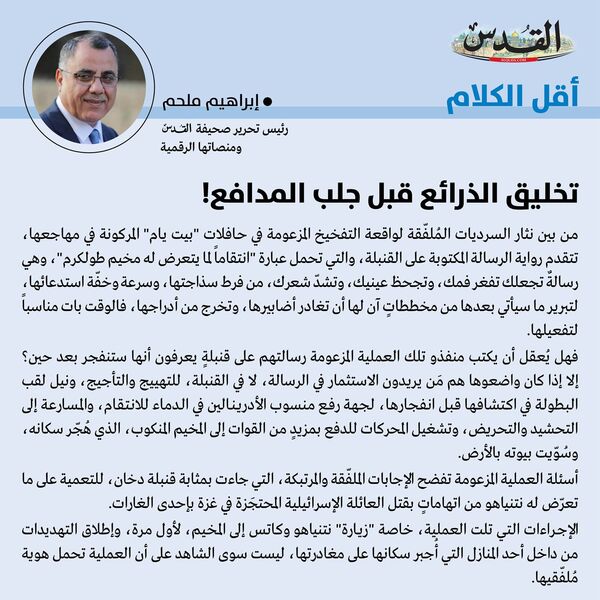
Create excuses before bringing in the guns!

Ibrahim Melhem

Ibrahim Melhem

Opinion Writer


Among the fabricated narratives of the alleged bombing of the Beit Yam buses parked in their dormitories, the story of the message written on the bomb stands out, bearing the phrase “in revenge for what Tulkarm camp is being subjected to.” It is a message that makes you open your mouth, bulge your eyes, and pull your hair, due to its extreme naivety and the speed and lightness of its summoning, to justify the plans that will come after it, which it is time for them to leave their files and come out of their drawers, as the time has come to activate them.

Is it reasonable that the perpetrators of this alleged operation would write their message on a bomb that they knew would explode after a while? Unless its authors are the ones who want to invest in the message, not the bomb, to incite and inflame, and to win the title of hero in discovering it before it explodes, in terms of raising the level of adrenaline in the blood for revenge, and rushing to mobilize and incite, and operating the engines to push more forces to the stricken camp, whose residents have been displaced and whose homes have been razed to the ground.

The alleged operation questions expose the fabricated and confused answers, which came as a smoke bomb, to cover up the accusations that Netanyahu was exposed to in killing the Israeli family held captive in Gaza in one of the raids.

The actions that followed the operation, especially Netanyahu and Katz’s “visit” to the camp for the first time, and the threats issued from inside one of the houses whose residents were forced to leave, are nothing but evidence that the operation bears the identity of its fabricators.

PALESTINE

Sat 22 Feb 2025 7:57 am - Jerusalem Time

The seventh batch of Israeli prisoners in Gaza has begun to be handed over

Today, Saturday, preparations began in the Gaza Strip to hand over 6 Israeli prisoners in the seventh batch of exchange operations within the first phase of the ceasefire agreement.

The Al-Qassam Brigades handed over the prisoners Avra Mengistu and Tal Shoham to the International Red Cross in Rafah, in the southern Gaza Strip, and later handed over 4 other prisoners in the Nuseirat camp (center).

Shortly after the Red Cross signed their receipt, Mengistu and Shoham, who were soldiers, were transferred to vehicles belonging to the international organization after they climbed onto a platform erected in Al-Mashrou’ Square, east of Rafah city.

Several formations of the Qassam Brigades, including the Shadow Unit responsible for prisoners, are participating in the handover ceremonies in Rafah and Nuseirat.

A large number of Al-Qassam Brigades fighters were deployed in Rafah (southern Gaza Strip) and in the Nuseirat camp (central Gaza Strip) in preparation for handing over the six prisoners to the International Red Cross. The ceremony is also taking place in the presence of the people.

It is expected that 3 prisoners will be handed over in Rafah and 3 others in Nuseirat.

In return, 602 Palestinian prisoners are expected to be released from the occupation prisons today, including 50 prisoners sentenced to life imprisonment, 60 with long sentences, in addition to 47 prisoners released in the Wafa al-Ahrar deal who were re-arrested by the occupation.

445 prisoners from the Gaza Strip who were arrested after October 7, 2023 will also be released.

Several formations of the Qassam Brigades are participating in the handover ceremony, including the shadow unit responsible for the prisoners.

Abu Obeida, the military spokesman for the Qassam Brigades, announced yesterday evening that the prisoners who will be released are: Ilya Cohen, Omer Shev Tov, Omer Finkert, Tal Shoham, Avra Mengistu, and Hisham al-Sayed.

Israeli Prime Minister Benjamin Netanyahu's office said it had received a list of the names of the six prisoners and had notified their families.

On the delivery platforms in Rafah and Nuseirat, the Qassam Brigades displayed weapons that the resistance fighters had seized during the battles with the Israeli occupation forces, and pictures of the resistance leaders who were martyred in the last war on the Palestinian Strip were also raised.

PALESTINE

Fri 21 Feb 2025 10:29 pm - Jerusalem Time

Hamas announces handing over the body of Israeli hostage Sheri Bibas

Ò

ARAB AND WORLD

Fri 21 Feb 2025 10:28 pm - Jerusalem Time

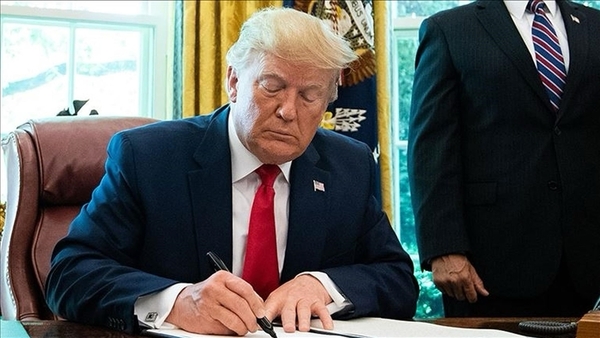
Trump: I support any decision Israel makes - continue the truce or resume the war


US President Donald Trump said Friday he supports any decision Israel makes on whether to continue with the second phase of the Gaza hostage deal or resume the war.


In an interview with Fox News, Trump was asked about Prime Minister Benjamin Netanyahu's position, and he said: "He's actually not confused; I mean, you know where he stands, he would love to go and go in, and he's very angry, and he should be. If he's not angry, there's something wrong with him, frankly."


"He's very angry; he's a very angry man about what happened, especially what happened yesterday with those children," Trump added, referring to the return of the slain child hostages Ariel and Kfir Bibas. "It's very barbaric. You wouldn't think that would happen in modern times, but it did."


Asked whether Israel needed to choose between seeking more hostages in a second phase or resuming the war, and whether he was okay with either option, Trump replied: “I do. I really do. You know, when you see what’s going on over there… you just wonder what the state of the hostages they have. They got a really bad group that came in, it looked like a concentration camp in Germany.” He added: “Sometimes you have to make a decision… It’s a tough decision.”

PALESTINE

Fri 21 Feb 2025 7:21 pm - Jerusalem Time

IOM: 90% of homes in Gaza Strip destroyed

ك

ARAB AND WORLD

Fri 21 Feb 2025 7:17 pm - Jerusalem Time

Trump: I will not impose the Gaza plan.. and I was surprised by the rejection of Egypt and Jordan

US President Donald Trump said on Friday that his plan to rebuild the Gaza Strip was "successful", but he would not impose it, indicating that he would only make recommendations.

“The plan is really working, but I’m not going to impose it,” Trump said in an interview with Fox News Radio. “I’m going to sit down and recommend it, and then the United States will be in charge of the site.” Trump said he was surprised that Jordan and Egypt rejected the reconstruction plan, despite the American aid the two countries receive, adding: “We pay billions of dollars a year to Jordan and Egypt. I was a little surprised that they didn’t accept my plan.”


The US President stressed that his plan does not include Hamas, noting that the goal is to develop and completely rebuild the Strip: "There will be no Hamas, Gaza will be developed, and then we will start again in a clean place."


Trump suggested that Gazans might prefer to live in a developed and stable environment, saying: "If the people of Gaza were given a choice between that and living in a beautiful society, I think I know which choice they would make."

PALESTINE

Fri 21 Feb 2025 5:54 pm - Jerusalem Time

Bibas family blames Netanyahu for 'abandoning' Sheri and her children

The Bebas family on Friday accused Israeli Prime Minister Benjamin Netanyahu of "abandoning" their family members during the October 7, 2023 attack and failing to return them safely to their families.


"We will not forgive abandoning them on October 7, and we will not forgive abandoning them in captivity. Prime Minister Benjamin Netanyahu, we did not receive an apology from you at this painful moment," Ofri Bibas said in a statement on behalf of the family.


She stressed that the family is awaiting the "fate" of Sherry, her brother's wife, and "is not seeking revenge at the present time."


Israeli Prime Minister Benjamin Netanyahu said on Friday that Israel would make Hamas pay the price for not handing over Sheri Bibas' body as agreed.

"We will act with determination to bring Sheri home with all our hostages, living and dead, and ensure that Hamas pays the full price for this cruel and vicious violation of the agreement," he added in a video statement.

The statement came after Israeli experts said that one of the four bodies handed over by Hamas on Thursday was that of an unidentified woman and not that of Sheri Bibas, whose sons Kfir and Ariel were handed over and whose identities were confirmed.

PALESTINE

Fri 21 Feb 2025 5:50 pm - Jerusalem Time

Netanyahu from Tulkarm camp: I issued orders to reinforce forces in the West Bank

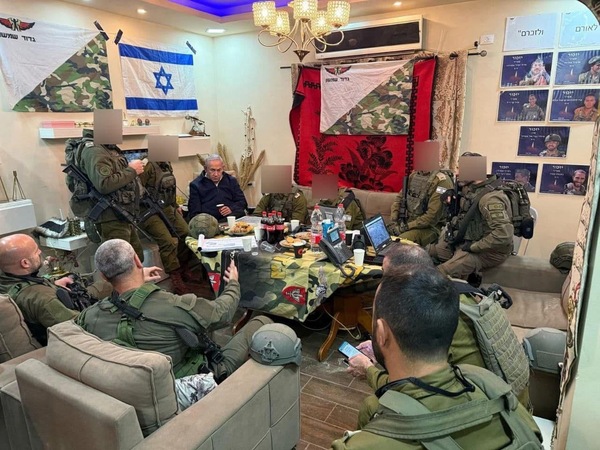
Israeli Prime Minister Benjamin Netanyahu visited Tulkarm camp in the northern West Bank on Friday.


Netanyahu said in a video posted on his account on the "X" platform: "I ordered the launch of an additional military operation in the West Bank in response to the series of explosions on buses yesterday, and we have greatly intensified our operations and are entering the strongholds of "terrorism" and razing entire streets to the ground."


"Before Saturday, I came to the refugee camp in Tulkarm to be with our heroic soldiers. They are doing great work. In the past year, we have greatly increased our activity: we have entered terrorist strongholds, we have leveled entire streets used by terrorists, their homes, we have eliminated terrorists and leaders," he continued.


“We are doing very important work against the plans of Hamas and other terrorist elements to harm us. And these plans have not stopped. What we saw yesterday – the attempt to carry out mass serial attacks – is very serious,” Netanyahu said. “In response, and on my instructions and the instructions of the defense minister, we increased the forces in the West Bank, and I also ordered another military operation against terrorist centers. I know that our heroic soldiers know how to do this job well.”


On Thursday, Netanyahu and Defense Minister Yisrael Katz vowed to launch larger military operations in the occupied West Bank, following the bus bombings that took place in Tel Aviv on Thursday night.


The Prime Minister's Office said Netanyahu had ordered the army to carry out an intensive operation in the West Bank against what he called "terror hotbeds." Explosions occurred on Thursday evening, with three explosive devices detonating on buses in the city of Bat Yam, while another device was found in Holon before it exploded. No injuries were reported.


Israeli media reported that an explosive device was found at the scene with the words "Revenge for Tulkarm camp" written on it. However, the message written on the device could not be clearly verified.

PALESTINE

Fri 21 Feb 2025 5:46 pm - Jerusalem Time

Updated | Two Palestinian children killed in Jenin and Hebron

A child was killed by Israeli occupation forces today, Friday, in the city of Jenin.


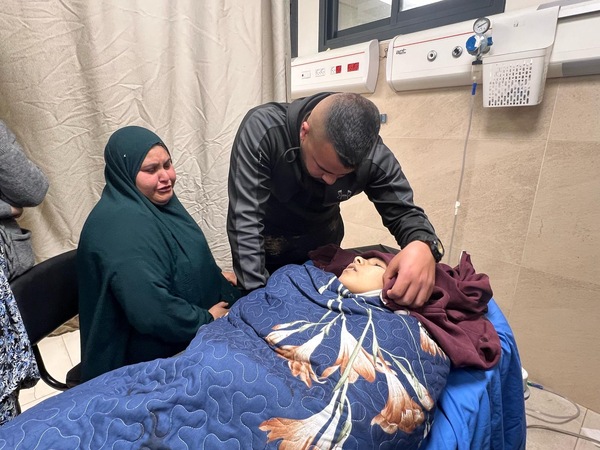
The Ministry of Health said that the child, Rimas Al-Amouri (13 years old), was killed after being critically wounded by the occupation forces’ bullets in the abdomen and out of the back. She was then transferred to Jenin Governmental Hospital, before her death was announced.

With the death of the child Al-Amouri, the number of dead in Jenin Governorate rises to 27, as the occupation's aggression against it enters its second month.


In Hebron, a 13-year-old child died of his wounds after being shot by the Israeli occupation forces, today, Friday, in the city of Hebron.


Local sources reported that the occupation forces fired live bullets at the child Ayman Nassar Al-Haimouni (13 years old), while he was visiting his relatives in the Jabal Jawhar area south of Hebron, which resulted in him being injured in the chest. He was transferred by Red Crescent crews to the Muhammad Ali Al-Muhtaseb Hospital, where his death was announced.

PALESTINE

Fri 21 Feb 2025 3:36 pm - Jerusalem Time

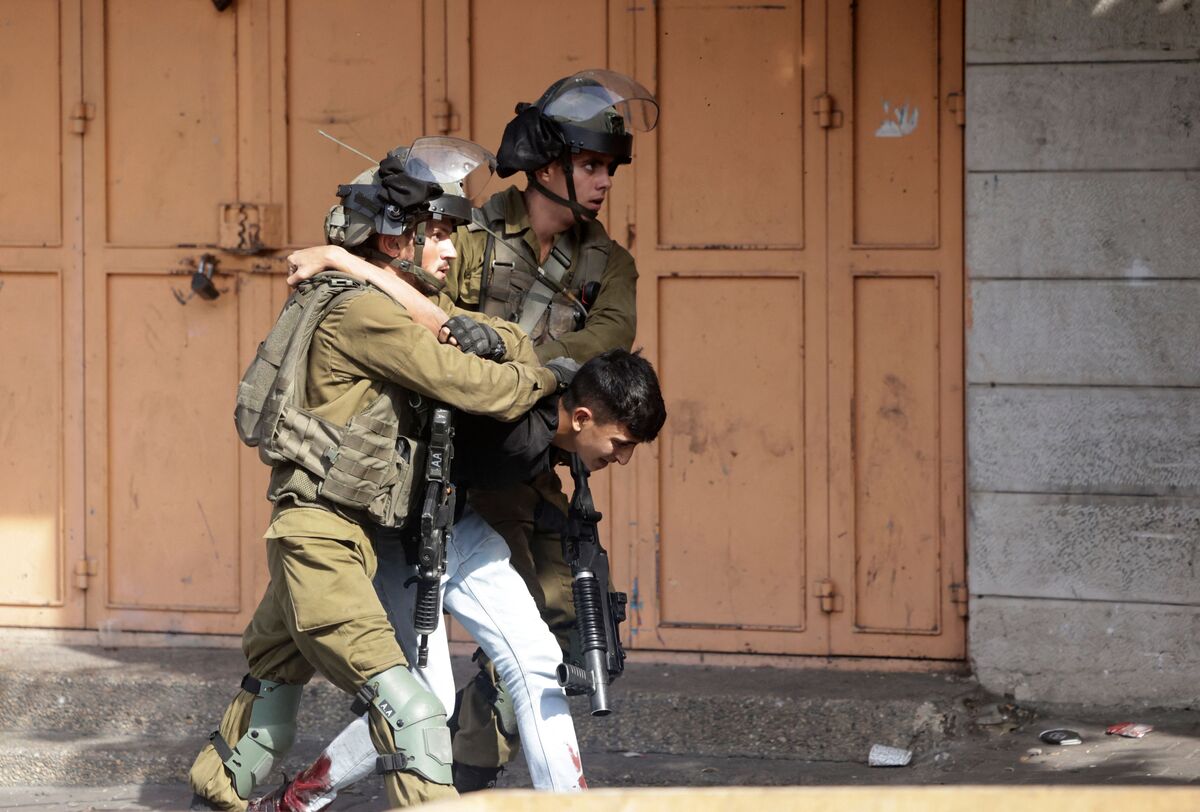
Israeli forces arrest a young man while grazing his livestock in the northern Jordan Valley

Today, Friday, the Israeli occupation forces arrested a young man while he was herding his livestock in the northern Jordan Valley.


Local sources reported that the occupation forces arrested the young man, Hussein Yousef Basharat, while he was herding his livestock near his father’s tents in Khallet Makhul in the northern Jordan Valley.

PALESTINE

Fri 21 Feb 2025 2:34 pm - Jerusalem Time

West Bank: Israeli Settlers burn a vehicle and an agricultural room and write racist slogans

Today, Friday, settlers burned an agricultural room and attacked citizens' property in the village of Kafr Qaddum, east of Qalqilya.


Local sources reported that settlers burned an agricultural room in the northern part of the village, near the "Qedumim" settlement outpost, belonging to citizen Aqaba Obeid. They also attacked agricultural land planted with olive trees and tampered with equipment belonging to citizen Musa Obeid.


In Hebron, settlers burned a vehicle today, Friday, and attacked citizens’ property, and wrote racist anti-Arab slogans east of Yatta.


According to local sources, settlers infiltrated the home of Majed Al-Dabbaseh on Friday night in the Abu Shaban area, east of Yatta, burned his vehicle and wrote inflammatory and racist slogans against Palestinians and Arabs.

PALESTINE

Fri 21 Feb 2025 2:31 pm - Jerusalem Time

602 Palestinian prisoners to be released on Saturday, Israel confirms receiving list of hostages

The Prisoners' Information Office announced today, Friday, that 602 Palestinian prisoners are scheduled to be released tomorrow, Saturday, as part of the prisoner exchange agreement, while the office of Israeli Prime Minister Benjamin Netanyahu announced that Israel has officially received a list of its prisoners who will be released on the same day.


This comes shortly after Hamas confirmed that it had received from mediators the occupation’s allegations regarding a body that Israel said was not that of a hostage it was supposed to receive among the bodies of the four dead Israelis who were handed over yesterday, Thursday. It also indicated that it would seriously examine the matter and announce the results.


The spokesman for the Qassam Brigades, Abu Obeida, confirmed that the Qassam Brigades will release 6 prisoners tomorrow, Saturday, and announced their identities.


The Prisoners' Media Office said, "After the Palestinian resistance hands over the names of the Zionist prisoners, 50 prisoners sentenced to life imprisonment and 60 prisoners with long sentences will be released tomorrow, Saturday, as part of the first phase of the exchange deal."


He added that "47 Wafaa al-Ahrar prisoners who were re-arrested, and 445 prisoners from the Gaza Strip who were arrested after October 7, will also be released."


Netanyahu's office said that "Israel received a list of the names of the hostages who are scheduled to be released tomorrow as part of the agreement," noting that their families had been informed of this.


Yesterday, Thursday, the Palestinian factions handed over to Israel the bodies of four of what they said were Israeli detainees, in exchange for the release of about 50 Palestinian prisoners. Palestinian resistance elements were deployed in the town of Bani Suhaila, east of Khan Yunis, during the handing over of the bodies of the detainees.


Commenting on the handover of the bodies of the Israeli prisoners, Hamas stressed that the prisoner exchange is the only way to return the Israeli detainees to their families alive, and that any attempt to retrieve them by military force or return to war will only result in more losses among the prisoners.


Hamas said it was prepared to release all hostages still being held in the Gaza Strip "in one go," not in successive batches, during the second phase of the truce agreement, which is supposed to begin on March 2.

PALESTINE

Fri 21 Feb 2025 2:17 pm - Jerusalem Time

Nablus: Suffocation cases during Israeli occupation forces’ storming of the town of Beita and the villages of Qaryut and Tal

Citizens suffered from suffocation on Friday after inhaling toxic gas fired by the Israeli occupation forces during their raid on the village of Tal, southwest of Nablus, and the town of Beita and the village of Qaryut, south of Nablus.


Local sources reported that the occupation forces fired live bullets, sound bombs and tear gas during their raid on Beita, Qaryut and Tal, which led to a number of citizens suffering from suffocation, and they were treated in the field.

ARAB AND WORLD

Fri 21 Feb 2025 12:26 pm - Jerusalem Time

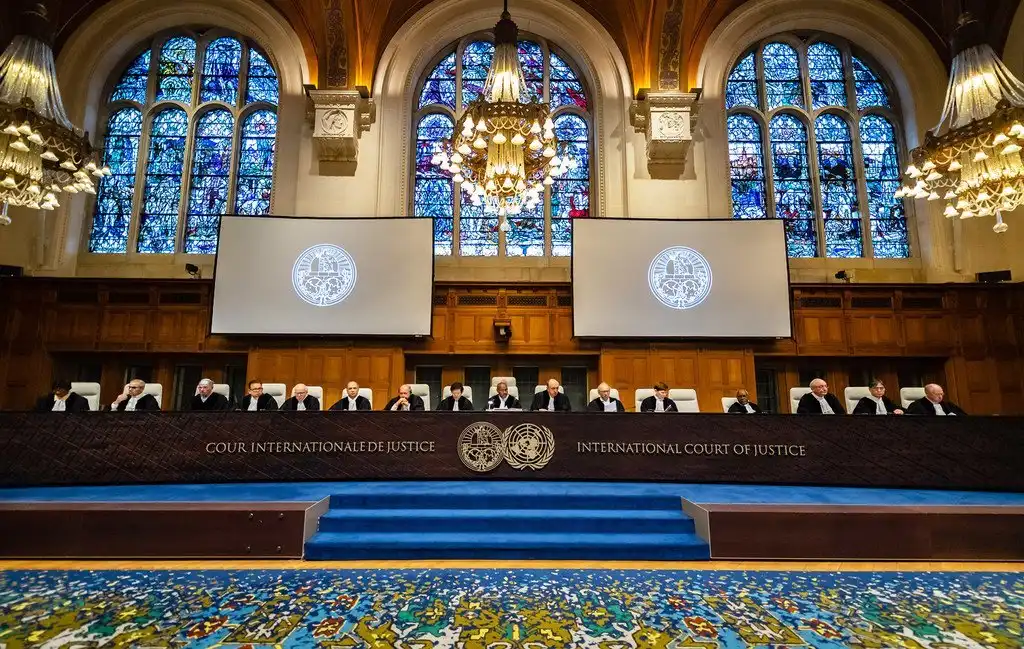
ICJ allows African Union to participate in advisory proceedings on Israel's obligations in the Palestinian territories

The International Court of Justice last night authorized the African Union, at its request, to participate in advisory proceedings on Israel's obligations regarding attendance at activities of the United Nations, other international organizations and third States in the occupied Palestinian territory.


According to a statement from the Court, and based on Article (66) of the Statute of the Court, the Acting President of the Court, Judge Julia Sebutinde, decided that the African Union is likely to be able to provide information on the question submitted to the Court by the General Assembly and therefore “the African Union may submit a written statement on this matter within the time limit set by the President’s order, i.e. by 28 February.”


On 19 December 2017, the United Nations General Assembly adopted a resolution requesting an advisory opinion from the International Court of Justice on the following question: What are the obligations of Israel, as the occupying Power and a Member of the United Nations, with regard to the presence and activities of the United Nations, including its agencies and bodies, other international organizations and third States, in and in relation to the Occupied Palestinian Territory, for the purposes, inter alia, of ensuring and facilitating the delivery of supplies essential to the survival of the Palestinian civilian population, basic services, humanitarian and development assistance, for the benefit of the Palestinian civilian population and in support of the right of the Palestinian people to self-determination?


The decision came after the Israeli Knesset issued decisions that hindered the work of UNRWA in Palestine, especially in occupied Jerusalem.


It is noteworthy that the court had also authorized the Organization of Islamic Cooperation and the League of Arab States to participate in the advisory procedures.

PALESTINE

Fri 21 Feb 2025 11:26 am - Jerusalem Time

A Palestinian woman was killed by the occupation forces in the southern Gaza Strip

A female citizen was killed today, Friday, by Israeli occupation forces’ bullets in the Al-Janina neighborhood, east of Rafah city, south of the Gaza Strip.


Local sources reported that the occupation forces fired live bullets at citizens in the Al-Janina neighborhood, which led to the death of a female citizen.


It added that the occupation military vehicles opened fire with their machine guns east and northeast of Al-Bureij camp, and east of Al-Shuja'iyya neighborhood east of Gaza City.


Since October 7, 2023, the Israeli occupation has launched a war of genocide on the Gaza Strip, resulting in the martyrdom of 48,319 citizens, the majority of whom are children and women, and the injury of 111,749 others, in an incomplete toll, as a number of victims are still under the rubble, and ambulance and civil defense crews cannot reach them.


It is noteworthy that the ceasefire in the Gaza Strip entered into force on January 19, and since it came into effect, a number of citizens have been killed and injured in various parts of the Strip.

PALESTINE

Fri 21 Feb 2025 10:56 am - Jerusalem Time

"Gaza Government Office" denies entry of mobile homes for shelter into the Strip

The government media office in Gaza denied on Friday that mobile homes had entered the Strip for the purpose of shelter, and stressed that a very limited number of them had entered and were allocated to international institutions or field hospitals.


"No mobile homes (caravans) were brought in for shelter at all," said Ismail Thawabta, director general of the government media office, in a statement.


He added, "The number of caravans entering is very limited and is allocated to international institutions or field hospitals, as was previously the case for the Red Crescent Society's field hospital a few days ago."


In this context, Rafah Mayor Ahmed Al-Sufi said that Israel allowed 15 mobile homes to enter the Strip on Thursday through the Rafah land crossing, where they were directed to international and UN institutions to use them as headquarters.


Al-Sufi called on the countries sponsoring and guarantor of the ceasefire agreement to exert pressure on the Israeli occupation to allow the entry of mobile homes, tents and reconstruction materials to shelter the Palestinians.


"We need to open the Rafah crossing around the clock and bring in hundreds of thousands of temporary housing units and building materials, as well as allow specialized companies to enter to start the rubble removal and recycling operations," he said.


Al-Sufi pointed out that delaying the reconstruction process exacerbates the suffering of the Palestinians in Gaza, noting that the reconstruction process must begin immediately by providing suitable housing for those affected, and bringing in the equipment and companies necessary to remove the rubble and rebuild vital facilities.


On January 19, the first phase of the ceasefire and prisoner exchange agreement began, divided into three phases, each lasting 42 days, with the condition that the next phase be negotiated before the current phase is completed.


According to the government media office in the Gaza Strip, nearly 1.5 million people have become homeless after their homes were destroyed, while all 2.4 million residents of the Strip suffer from the lack of the most basic life services and the absence of infrastructure.


Israel is refusing to allow the entry of necessary humanitarian aid into the Strip, especially 200,000 tents and 60,000 mobile homes (caravans) to provide urgent shelter for the affected Palestinians, thus violating the ceasefire agreement, according to the government office.


More than once, Hamas has asked mediators to pressure Israel to allow the entry of mobile homes and heavy equipment needed to remove the rubble and recover the bodies of Palestinian martyrs.

PALESTINE

Fri 21 Feb 2025 10:55 am - Jerusalem Time

The 32nd day of Israeli occupation's aggression on the city and camp of Jenin

Today, Friday, the Israeli occupation continues its aggression on the city of Jenin and its camp for the 32nd consecutive day, leaving 26 martyrs and dozens of injuries.


Local sources reported that the occupation forces are still besieging Jenin Governmental Hospital, where dozens of military vehicles are stationed around the hospital and Al-Amal Hospital, checking citizens’ identities and interrogating them as they move around the area.


The city's hospitals are suffering from a severe water shortage, after the occupation targeted and destroyed water lines, with nearly 35% of the city's residents suffering from a lack of water.


It added that the occupation forces have been using buildings near Jenin camp as military barracks since the beginning of the first days of the aggression.


The occupation also sent military reinforcements accompanied by a bulldozer to the Al-Basatin neighborhood in the city of Jenin, after bringing in fuel tanks, water tanks, and small fortified rooms used for internal military communications for soldiers.


It pointed out that according to current data, the Israeli occupation forced about 3,000 families from Jenin camp to be forcibly displaced from their homes, and completely demolished more than 120 homes, amid widespread destruction of the infrastructure.


In a related context, the occupation forces arrested a child from the town of Yamoun, while he was outside his home, and last night they stormed the town of Ya'bad in the south, without any arrests being reported.


The unprecedented Israeli occupation aggression on the city and camp of Jenin left 26 dead and dozens of injuries.

ARAB AND WORLD

Fri 21 Feb 2025 10:05 am - Jerusalem Time

Israeli bombing targets sites between Syria and Lebanon in the western countryside of Homs

The Israeli occupation army launched an air attack tonight, targeting sites between Syria and Lebanon.


The Syrian Observatory for Human Rights said that the occupation warplanes bombed the crossings between Syria and Lebanon, in Wadi Khaled and the western countryside of Homs.


This comes within the framework of the ongoing Israeli attacks on sites in Syria, and the occupation's continued violation of the ceasefire in Lebanon.

ARAB AND WORLD

Fri 21 Feb 2025 9:57 am - Jerusalem Time

Witkoff, Kushner discuss Gaza reconstruction

Steve Witkoff, President Donald Trump's Middle East envoy, said Thursday that he and Jared Kushner, the president's son-in-law, are discussing bringing together real estate executives to come up with a plan to rebuild Gaza.


“We’re talking about bringing people together from all over the world, master planners, developers, architects, talking about ideas and so on,” Witkoff said on stage in conversation with Kushner at the F11 II Priority conference in Miami, a gathering of business executives sponsored by Saudi Arabia’s sovereign wealth fund.


Earlier this month, Trump said that “the United States will take over the Gaza Strip” and turn it into the “Riviera of the Middle East.” Trump said that Gazans could be transferred to neighboring Arab countries and that they should leave Gaza and never return. Most of the world has rejected Trump’s idea, and his comments have drawn condemnation from the Middle East and Europe, which have said that the displacement of Palestinians from Gaza amounts to ethnic cleansing and is illegal under international law.


According to the Wall Street Journal, citing a person familiar with the matter, Witkoff has been working on a possible plan for a White House summit that would bring together real estate developers and other business leaders to jump-start reconstruction efforts in Gaza. The plan for such a summit is still in its early stages, and would be the first effort to answer some of the biggest outstanding questions, such as where construction will begin and how the debris will be cleared with more than 2 million Palestinians living in the territory.


The summit will include a public display, possibly with large cranes and other flashy pieces of equipment, the person said. Companies will likely be asked how to handle logistical, technical and explosive issues, including how to detect bombs, deal with underground tunnels used by Hamas fighters and deal with people who don’t want to leave the area.


From the stage at the conference, Witkoff repeated the idea that Gaza is not a suitable place to live.


"You have to see the destruction that's happening there today in Gaza. There are 30,000 unexploded shells everywhere there. The conditions are horrific, I don't know why anyone would want to live there today. It doesn't make sense to me," he said.


Kushner, Trump’s son-in-law in the past, has called the Gaza waterfront property “very valuable” and said the best approach would be to “get people out and then clean it up.” Kushner has previously said he will not be involved in any Trump administration policymaking. He has said he continues to advise the Trump team from his private sector position.


During their conversation, Witkoff said he decided to step away from his real estate development work and take on the role of Middle East envoy because Kushner convinced him to do so.


Trump and many of his closest allies, including Witkoff and Kushner, were real estate developers before entering politics, and many of the onstage conversations highlighted that experience.


For example, Witkoff said that in the ceasefire negotiations between Hamas and Israel, it seemed like a real estate deal made more difficult because neither side would sit at the same table to negotiate.


While the original ceasefire agreement included a three- to five-year plan to rebuild Gaza, Witkoff does not believe it is possible to achieve that within that time frame.


“This is not something that can be done in five years. It’s not really possible,” Witkoff said on stage at the conference. “You can’t build an apartment building in Manhattan in five years.”


As Witkoff said Thursday, President Donald Trump's plan for Gaza does not aim to displace Palestinians, and that the conversation about the future of Gaza is shifting to how to create a better future for the Palestinians.


It is noteworthy that in a press conference on Wednesday, Egyptian Prime Minister Mostafa Madbouly said that Egypt is working on developing a framework for a Gaza reconstruction plan in partnership with Egyptian universities and consulting companies, and that the country has the capacity to rebuild the Gaza Strip within three years while allowing Gaza residents to remain there.


A report released this week by the United Nations, the European Union and the World Bank indicates that the costs of rebuilding Gaza will exceed $50 billion over the next decade.

OPINIONS

Fri 21 Feb 2025 9:56 am - Jerusalem Time

Return in coffins.. an Israeli decision

op-ed "AlQuds" dot com

op-ed "AlQuds" dot com

Opinion Writer

It would have been better for Israel to have its prisoners returned alive, rather than some of them returning as corpses in coffins, as happened yesterday, when Israel recovered four bodies. The reason for this is the ruling issued by Israeli Prime Minister Benjamin Netanyahu, who repeatedly refused to reach an agreement and release the Israeli detainees, giving priority to the interests of his ruling coalition and his remaining in power, despite the great pressure exerted by the families of the detainees and their numerous appeals. The agreement came late, which led to the death of a number of detainees.


It was clear that the Israeli army was the one who killed its prisoners, by bombing their detention centers, and the Israeli government alone bears responsibility for its stubbornness and insistence on continuing the war and aggression, knowing that the resistance preserved the lives of the occupation prisoners as much as possible, and provided everything it could, and treated them humanely, but the army killed them along with their captors, in its criminal campaign during which it killed about 18 thousand children, and this particular part was narrated by the resistance to respond to the occupation’s claims and its deception of world public opinion, by promoting the narrative of Hamas killing children, while Israel is the one who committed the massacres and continues to do so against the innocent of our people, especially our children.


Yesterday, during the ceremony of handing over the bodies of the Israeli prisoners, the resistance was keen to respect the sanctity of the dead and the feelings of their families. They were handed over to the International Red Cross in closed coffins and in a decent manner. The process was carried out smoothly and calmly, at a time when Israel is returning the bodies of Palestinian martyrs in plastic bags and in unsanitary vehicles, without taking their sanctity into consideration.


What is strange in yesterday’s statements was what was issued by the UN High Commissioner for Human Rights, where he claimed that displaying corpses is abhorrent and cruel, and is considered a slap in the face to international law. The answers to these statements: Where was this Commissioner, his voice, and even his whisper when the bodies of Palestinian martyrs were being delivered in garbage bags? What is his position on the hundreds of bodies of Palestinian martyrs that are still being held in Israel’s “cemeteries of numbers”?


Gaza sent many messages yesterday, most notably the delivery of the bodies of Israeli prisoners at a point near the eastern cemetery in Bani Suhaila, where the Israeli army worked and exhumed Palestinian bodies from graves, claiming the need to identify them to determine whether they belonged to detained Israelis, in a blatant violation of all international conventions and norms, at a time when slogans of Palestinian national and Islamic action factions appeared, as an important signal to the American administration and the Israeli government that the decision of who rules the Gaza Strip is a decision that goes back to Palestinian consensus only, and does not allow it to be outside of this consensus.


Netanyahu's failures continue, as he leads Israel to the abyss. The senior Israeli journalist in Maariv (Ben Caspit) described him as a terrible person, for attacking the head of the Shin Bet and the army leaders, and attributing the successes to himself, while in fact he is responsible for all the failures.


The Israeli street can only blame Netanyahu, because he is the one who decided to return some prisoners in coffins as a result of his stubborn policies.

OPINIONS

Fri 21 Feb 2025 9:54 am - Jerusalem Time

In reforming the Palestine Liberation Organization

Jihad Harb

Jihad Harb

Opinion Writer

The Palestinian debate over demands to reform the Palestine Liberation Organization, following the convening of the "Palestinian National Conference in the Qatari capital, Doha", is not a new matter in Palestinian history, as it sometimes took on escalating violent curves, sometimes closed-room discussions, and at other times with a demand curve that was popular in the media and in the form of protests and other things.

In my opinion, the problem is not in the demands, or in the conferences, or in the response and counter-response, but in the transformation of the organization from a means (i.e. a national front for liberation and the establishment of the state) to a goal. The Palestinians’ concept of reforming the Palestine Liberation Organization is based on quotas, “partnership,” and elections “which will not be achieved due to subjective and objective factors,” according to the documents of the reconciliation agreements between the Palestinian factions over the past twenty years, as two central elements.

The Declaration of Independence document shows that the goal of the Palestinian struggle is to establish a democratic state on the borders of June 4, 1967, which includes all Palestinians without detracting from the affiliation or the umbilical cord of the eternal relationship with the homeland and the legal bond with the state, while the Palestine Liberation Organization (PLO), the “instrument,” remains a moral homeland for all Palestinians and its function is transformed from a political one concerned with political representation, which remains today, to the link or connection between the Palestinians in the diaspora and the state and its institutions. In this context, the National Council announced its decision in 1988 that the Executive Committee would temporarily carry out the duties of the government of the State of Palestine until its formation, and it is deposited as a document in the General Secretariat of the United Nations pursuant to a letter submitted by the representative of the PLO at the time, Zuhdi Tarazi.

The greatest transformation among the Palestinians occurred following the elevation of Palestine’s status to observer state in the United Nations by virtue of UN General Assembly Resolution 67/19 issued on 26 November 2012. A number of steps were taken to embody the process of transition from the “means” organization to the “target” state over the past thirteen years, namely:

* Replacing the name “Palestinian National Authority” with the State of Palestine in official Palestinian institutions, and then deleting the word “President of the National Authority” from the President’s signature on decisions, laws, decrees and presidential decisions and adding to them the words “President of the State of Palestine” and “President of the Executive Committee of the Palestine Liberation Organization.”

• Issuing Decree-Law No. (1) of 2021 amending Decree-Law No. (1) of 2007 regarding general elections, which stipulated the election of the President of the State of Palestine by the Palestinian people, as Article 3 of the amended decision of 2021 stipulates “amending Article (2) of the original law, to become as follows: The President of the State of Palestine, Chairman of the Executive Committee of the Palestine Liberation Organization, the sole legitimate representative of the Palestinian people, shall issue a presidential decree, within a period of no less than three months before the date of the end of his term or the term of the Legislative Council, calling for presidential and legislative elections, or either of them, in the State of Palestine, and specifying the date of the vote, and this decree shall be published in the Official Gazette, and announced in local newspapers.”

• The decision of the Central Council at its thirty-first session held on February 6-8, 2022, stipulating “the necessity of continuing work to adapt the legal status of the institutions of the Palestinian state and its international relations in implementation of General Assembly Resolution No. 19/67 of 2012” regarding raising the status of Palestine to an observer state in the United Nations, and the necessity for the Central Council to exercise its constitutional powers and supervisory authority over the executive bodies of the organization, its agencies and institutions, and over the Palestinian National Authority and the work of unions, syndicates and associations in accordance with the laws regulating their work.

• The Palestinian President’s decision dated 4/11/2022, stipulating “placing the General Secretariat of the Legislative Council, its components, and all its facilities under the responsibility of the President of the National Council.”

• The Presidential Decree regarding the President of the State of Palestine and members of the Palestinian leadership’s visit to the Gaza Strip, issued on 8/21/2024, which tasked the committee formed pursuant to the decree in Clause Five of Article Three of the Decree with “developing mechanisms for tangible steps towards the embodiment of the State of Palestine, the Constitutional Declaration, and the Transitional Council.”

In my opinion, talking about reforming the vehicle in the presence of a state recognized by 140 countries, becomes like talking about reforming an old, dilapidated vehicle that is no longer important when a modern vehicle is present. In the best of cases, the reform is done in the direction of changing its method of operation or its tasks as a complementary tool that helps in the matter of the home “homeland”. The cost of reform here is greater than bringing about the required change represented by declaring the government of the State of Palestine in accordance with the decision of the National Council in 1988, and with the political will represented by the transformation from the institutions of the Palestinian Authority “the tool of the PLO in managing the government in the Palestinian territories occupied in 1967 according to the Oslo Agreement” to the institutions of the state.

This does not eliminate some people’s fears of this transition, for reasons related to the status of the Palestine Liberation Organization, which the Israeli government recognized in letters of recognition in August 1993 as representing the Palestinian people. However, this recognition no longer has any meaning after Israel destroyed all existing commitments in the signed agreements.

OPINIONS

Fri 21 Feb 2025 9:51 am - Jerusalem Time

Washington and the Arab Plan for Gaza... between reconstruction and political rearrangement

Marwan Emil Toubasi

Marwan Emil Toubasi

Opinion Writer

Riyadh witnessed rounds of Russian-American negotiations, which addressed several issues in the region, including the situation in Gaza, and the Palestinian issue in general, according to press sources. These negotiations came at a sensitive time, as Russia seeks to strengthen its influence in the Middle East, and send specific messages to the United States about reorganizing the region. Despite the divergent positions of the major powers, these meetings may have a direct impact on how Washington deals with the Arab proposals regarding Gaza, and open the way for new negotiating opportunities that may take into account the interests of the various parties in the region.


Despite the EU’s public and verbal support for the two-state solution, its positions often lack practical action on this issue, given the ongoing Association Council with Israel. Regarding Trump’s plan for Gaza, the EU has not shown any serious action against it, but rather has been hesitant to support the Arab plan, reflecting its diminished role due to Trump’s attempts to marginalize it, as was evident at the recent Munich conference.


Although the PLO will participate in the Arab summit in Cairo next week, it will be absent from a mini-Arab summit with the participation of eight countries, which will be held on Friday, in a move aimed at reorganizing the political scene in Gaza, before the Arab summit in Cairo next week. This initiative comes within the framework of reconstruction attempts, but at the same time it carries strategic dimensions that should not intersect with American and Israeli interests, which raises fundamental questions about the extent to which Washington will accept this plan in the event of Arab agreement on it, which requires challenging American dictates, and the extent to which the Americans are prepared to abandon their declared vision for Gaza, which includes brutal scenarios such as displacing the population.


Although it is unusual for the Palestine Liberation Organization or the Palestinian Authority to be excluded from such meetings, especially when it comes to discussing fateful issues such as the Trump plan, the absence in Riyadh may be the result of differing positions with some of the participating Arab countries, or perhaps due to the lack of internal consensus on how to deal with international and regional pressures, which is reflected in the Palestinian side’s ability to influence such forums under these circumstances.


However, in light of the current international reality, the American position can be inferred by comparing it to the way Washington dealt with other files, such as Ukraine and Zelensky, where the United States played a dual role represented by intensive military and political support accompanied by imposing a special vision for how to manage the crisis in a way that serves its interests, a principle that depends on exhausting those who cooperated with Washington throughout the history of its relations with them until they are exhausted. The question here is, will Washington adopt a similar approach in Gaza, so that it supports the Arab plan, provided that it remains under its direct supervision and serves its interests, or will it work to empty it of its content, as it did with many previous political initiatives?


Since the Trump administration presented its Middle East plan, the forced displacement of Gazans has been among the scenarios promoted as part of the implementation of the New Middle East Vision. Despite the change of administrations in Washington, the US approach to the Palestinian issue has not changed much, as it continues to seek to impose a reality that serves Israel, whether by supporting Tel Aviv militarily, politically and economically, or by obstructing any efforts that might lead to the unification of Gaza and the West Bank under a sovereign Palestinian leadership represented by the PLO, and lead to the embodiment of a continuous and sovereign Palestinian state. Therefore, even if Washington does not explicitly reject the Arab proposal, it is likely to work to modify it to become a tool for implementing Israeli policies.


The main challenge facing the Arab countries is to achieve a delicate balance between their desire to rebuild in order to prevent displacement to their lands and ensure their national security, and to prevent Gaza from turning into a new arena of conflict on the one hand, and American and Israeli pressures seeking to keep the Strip in a state of chronic weakness on the other hand, or to renew the war on it according to Netanyahu’s desires to ensure his survival in his position, unless the United States pushes for a change in the form of the occupation government.


Given previous experiences, any Arab initiative that does not have American support will be subject to abortion or distortion because the Arabs have previously agreed to follow a path of non-confrontation. The success of the plan also depends on the acceptance of the Palestine Liberation Organization, which may not be guaranteed, especially if a Palestinian committee independent of the Palestinian Authority government is imposed, reflecting the desire of some Arab countries to reduce the influence of the current leadership of the Authority, in order to serve the attempt to impose their vision of a “renewed authority” that will be acceptable to the United States.


As for Israel, it is unlikely to support any formula that restores Palestinian political and geographical unity.


If the United States has treated Zelensky as a functional card in Ukraine, it may do the same with some Palestinian parties that will be used to manage Gaza, without giving them any real margin for independent decision-making.

This raises questions about the independence of the proposed Palestinian committee, and whether it will turn into another functional entity that serves external agendas instead of being an expression of the Palestinian will with reference to the PLO and the independence of its national decision.


In this context, the ongoing negotiations between Israel and Hamas on the second phase of the ceasefire agreement, mediated by Egypt and Qatar, may play a pivotal role in determining the future of Gaza. If understandings are reached on the ceasefire and post-war management, this may affect the extent to which the various parties accept the Arab plan. However, if the negotiations continue to falter, any political initiative will remain hostage to the reality on the ground.


With the continuation of the annexation and settlement expansion policies adopted by Israel in the West Bank, including Jerusalem, with American support, this expansion does not stop at the borders of displacing Palestinians from Gaza, but rather includes its plans to target Palestinian camps in various occupied territories, which poses a major challenge to our Palestinian people in preserving their identity and existence on their land, in the face of what seriously threatens the unity of the Palestinian land and people through attempts to embody the Greater Israel settlement project.


The continuation of these policies makes broad Palestinian national unity more important than ever, as efforts must be intensified between the various Palestinian factions, independents, and civil society to ensure that these schemes are confronted. By strengthening the unity of the Palestinian national ranks, clear vision, programs, and tools that must be characterized by development, change, and non-stagnation, and understanding the nature of the necessities of correct political positioning in light of the ongoing transformations in international relations and enabling our people to stand firm and confront, we can stand up to the major challenges surrounding the Palestinian cause, and begin to achieve our national independence, justice, and freedom for our people.

ARAB AND WORLD

Fri 21 Feb 2025 9:37 am - Jerusalem Time

Netanyahu's crises within his government: Installing a new regime in Gaza is a story of declared failure

The position of the administration of US President Donald Trump differs from that of the government of Benjamin Netanyahu regarding progress towards the second phase of the ceasefire and prisoner exchange agreement. The Trump administration is putting pressure on Netanyahu to reach and implement the second phase, while Netanyahu is trying to obstruct or delay reaching it.


In this context, the Israeli media portrays Netanyahu as having to submit to threats from the head of the Religious Zionism Party and Finance Minister, Bezalel Smotrich, who sees the implementation of the second stage as the end of the war on Gaza, which he rejects, and threatens that in this case he will withdraw from the government, which threatens its collapse, because the remaining parties in the government, namely Likud and the Haredim, will not form a majority in the Knesset, after the Otzma Yehudit party headed by Itamar Ben Gvir withdrew from the government last month.


But this scenario is not necessarily realistic. Netanyahu has repeatedly stated that the war on Gaza will resume after the current first stage of the agreement is over. And if Netanyahu decides to end the war, he will show that he has failed to achieve its stated goals: eliminating Hamas militarily and politically, and returning all Israeli prisoners held in the Gaza Strip.


In addition, Ben-Gvir's party did not join the opposition in the Knesset after withdrawing from the government, and Smotrich's party is not expected to join the opposition either, if he withdraws from the government. Ben-Gvir declared that "we will not bring down the right-wing government."


Netanyahu's government seems to be safe in this case. But there are two crises coming: a law exempting the ultra-Orthodox from military conscription, demanded by the ultra-Orthodox parties, and the state budget law for the current year, which the government must enact by the end of March, or the government will automatically fall. The ultra-Orthodox parties are threatening not to support the state budget if the law exempting the ultra-Orthodox from military conscription is not enacted before then.
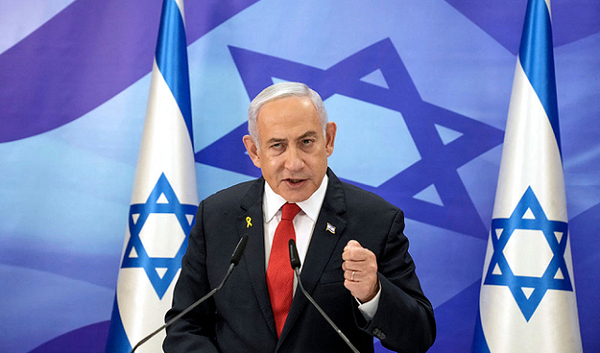

In contrast, Smotrich and Ben-Gvir’s parties support mandatory conscription for the Haredim, as their voters enlist in the army at high rates compared to other population groups performing military service. Therefore, it is expected that they will oppose a law exempting the Haredim from conscription, especially since the Israeli army announces that it is facing a shortage of its personnel due to the war, and demands the conscription of the Haredim.


It is not clear how Netanyahu will resolve these crises in his government, but some estimates indicate that if he decides to implement the second stage of the ceasefire, prisoner exchange, and cessation of the war, he will provide “compensation” to Smotrich, in the form of implementing a plan to annex areas in the West Bank to Israel, although this will not be an easy step to implement, due to widespread international opposition to it, with the possible exception of the Trump administration, and in light of expectations of a deterioration in the security situation in the West Bank leading to a massive uprising. The most prominent thing in this scenario, the essence of which is to stop the war, is that Netanyahu declares his failure to achieve the goals of the war.


However, Netanyahu decided to resort to procrastination, and raised the possibility of extending the first stage. He excluded the head of the Mossad, David Barnea, and the head of the Shin Bet, Ronen Bar, from the negotiating delegation, and appointed Minister Ron Dermer, who is considered his closest advisor, as head of the negotiating delegation.


The change comes as a prelude to ending the Shin Bet chief’s term in office, either by forcing him to resign, as was done with the IDF Chief of Staff, Herzi Halevi, or by dismissing him. This is expected to happen by the end of this month, when the Shin Bet is due to submit its investigation into its failure on October 7, 2023. Israeli reports indicate that Netanyahu will appoint someone loyal to him as head of the Shin Bet.


Dermer's appointment aims to obstruct or delay the negotiations on the second phase, as Dermer will conduct these negotiations with Trump's special envoy to the Middle East, Steve Witkoff, and not with the Qatari and Egyptian mediators, under the pretext of taking the reins of the negotiations away from Qatar. Since the negotiations are between Israel and Hamas, and not with the mediators, it is not clear how Hamas will be communicated with, which has no direct contact with the Americans, but it is likely that Qatar will continue its efforts to end the war, as it is the closest to Hamas, whose leadership is based in Doha.


Installing a new system in Gaza

In the past week, there has been increasing talk in Israel about the displacement of Gazans, after Trump gave it legitimacy, when he spoke about “transferring” Gazans to other countries, including Egypt and Jordan, and Netanyahu mentioned that Saudi Arabia is also among these countries, in return for rebuilding the destroyed Gaza Strip. The Palestinians, the Arab countries and the entire world oppose this plan, except for the Trump administration.


Reports in the past week have indicated Israeli plans to displace Gazans during a war on Gaza, not during a ceasefire. This means that these plans indicate the possibility of resuming the war after the implementation of the second stage, and not implementing the third stage, which, according to the agreement, requires the complete withdrawal of the Israeli army from the Strip and the beginning of reconstruction that is not linked to what Trump announced.


The Israeli displacement plans include details about “transferring” Gazans abroad by air, sea and land, while the Israeli army launches heavy-handed military operations against Hamas throughout the Strip. Israel imagines that this will eliminate Hamas’s military and governmental presence, after it has recovered its prisoners.


However, the success of the plan to displace the Gazans is not expected. All of Israel's attempts to displace the Gazans have failed, since the Nakba of 1948, and during the tripartite aggression against Egypt in 1956, during which Israel occupied the Gaza Strip and Sinai for a few months and was forced to withdraw from them, and also after occupying the Strip in 1967.


Although Netanyahu was aware of this historical fact, he was the first to propose, in the current war, implementing such a displacement. At the end of December 2023, he announced during a meeting of the Likud party faction in the Knesset that he was working on implementing a “voluntary migration” of the residents of the Gaza Strip to other countries, and considered that “our problem is (finding) countries willing to receive them, and we are working on this matter.” At the time, former Foreign Minister Eli Cohen formed a team whose mission was to try to make contacts with African countries that might agree to receive displaced people from Gaza, including Congo and Rwanda.


Netanyahu declares that at the end of the war Hamas will not be in power, and that he rejects the return of the Palestinian Authority to Gaza. According to Trump's plan to "own" Gaza and turn it into a huge resort, Israel will not be in Gaza either. Netanyahu welcomed and praised this plan. This means that in Netanyahu's view, someone will be installed to lead Gaza.


The issue of installing a ruler or regime in an area occupied, besieged or controlled by Israel in any way is a complex one for the Israelis, and by their own admission, due to its failure. In the West Bank, Israel failed to install Palestinian groups loyal to it, such as the “Village Leagues,” in the late 1970s, to serve as an alternative to the Palestinian national forces and prevent the establishment of a Palestinian state. During the Israeli invasion of Lebanon and the siege of Beirut in 1982, it failed to install the leader of the Phalangists, Bashir Gemayel, as president of Lebanon, and he was assassinated in the Phalangists’ stronghold three weeks later.


In both cases of inauguration, there were no local armed movements in the West Bank or Lebanon on the scale of the resistance in Gaza, which recorded great steadfastness in the face of the massive Israeli war machine, despite the horrific crimes of genocide and massive destruction in the Strip. Therefore, it is expected that the issue of inauguration in Gaza, regardless of who is the party that will inaugurate it, whether American, international or Arab, will be a story of declared failure.