PALESTINE

Sun 23 Feb 2025 11:58 am - Jerusalem Time

Israeli occupation threatens to demolish a house west of Salfit

Today, Sunday, the Israeli occupation forces notified the demolition of a house in the town of Kafr ad-Dik, west of Salfit.


Local sources reported that the occupation forces stormed the town and raided the home of citizen Mahmoud Nabil and notified him to evacuate the house permanently in preparation for its demolition at any moment.


It is noteworthy that this is the second time that the occupation has notified the home of citizen Mahmoud Nabil to evacuate the house within 10 days.


The occupation forces carried out the demolition of the house of citizen Hammam Tawfiq Ali Ahmed from the town of Kafr al-Dik last Tuesday.

PALESTINE

Sun 23 Feb 2025 11:48 am - Jerusalem Time

Katz announces preventing the return of residents of camps in the northern West Bank "for at least a year"

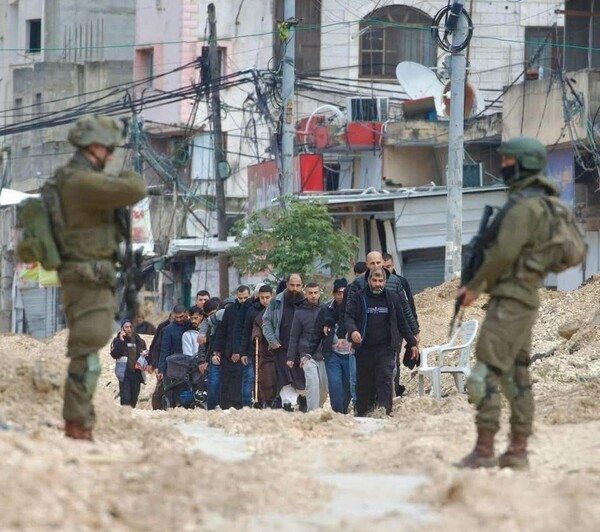
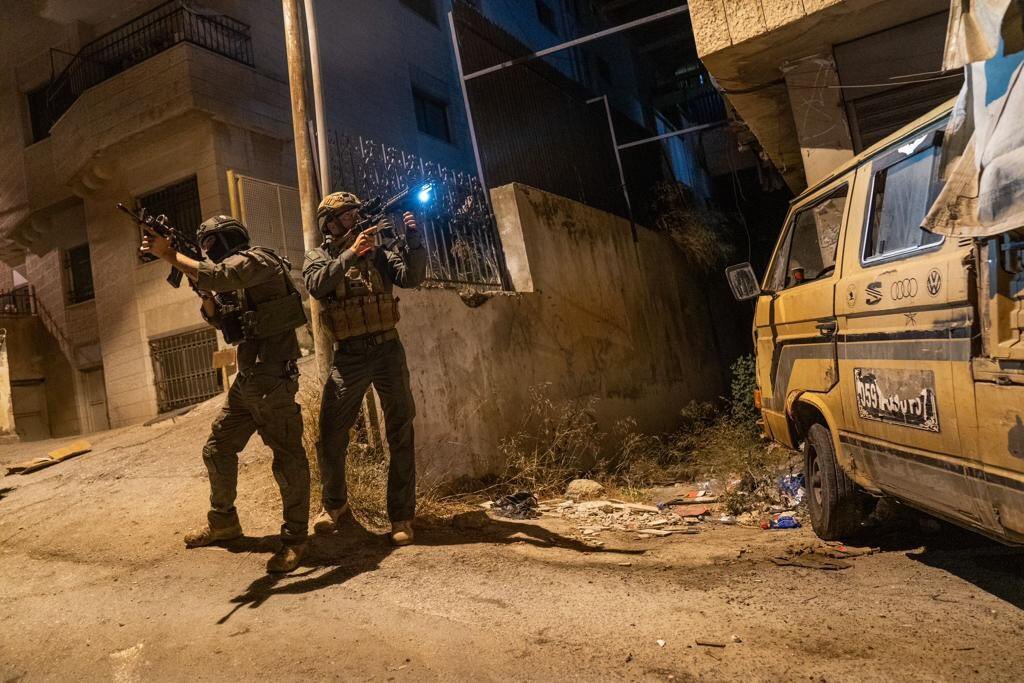
Israeli Security Minister Yisrael Katz announced today, Sunday, the expansion of Israeli military operations in the northern West Bank, where the occupation army began carrying out operations in the town of Qabatiya, in conjunction with the reinforcement of Israeli forces with armored units and additional forces.


Katz confirmed that 40,000 Palestinians were forced to leave the Jenin, Tulkarm and Nur Shams refugee camps, which are now "completely empty of residents," as he put it. He also pointed to the disruption of the work of the United Nations Relief and Works Agency for Palestine Refugees (UNRWA) inside these camps.


The Israeli Minister of Security added that the army will remain in these areas for at least a year to prevent the return of the residents, stressing that the occupation forces "will not allow the return of the residents and the return of terrorism to grow," referring to the infrastructure of the Palestinian resistance.


Katz stressed that military operations will continue to include other Palestinian camps and centers, as part of a strategy aimed at dismantling the resistance battalions and destroying their military infrastructure, noting that these measures come within what he described as the "war on extremist Islamic terrorism."


Katz stressed that Israel will continue what he described as "cleansing" the refugee camps and what he described as "other centers of terrorism," with the aim of "dismantling the battalions and terrorist infrastructure of radical Islam that were built, armed, financed and trained by the evil Iranian axis."


He claimed that this comes "in an attempt to establish an eastern terrorist front against the settlements in Samaria (the biblical name for the northern occupied West Bank), the seam line and the major population centers in Israel."


Katz concluded his statement by stressing that the occupation "will not return to the status quo ante," and that military operations will continue until "terrorism is completely eliminated," in reference to the continuation of the policy of displacement and the consolidation of the Israeli military presence in the northern West Bank.


In a statement issued earlier today, the Israeli army announced the expansion of its military operations in the northern West Bank, where forces from the Nahal Brigade, the Duvdevan Unit and a tank platoon began operating in additional villages around Jenin.


The occupation army said that a tank platoon is operating inside Jenin as part of the offensive operation, as part of the ongoing military escalation. Israeli forces, with the participation of units from the Shin Bet and the "Border Guard", continue to carry out operations in Jenin and Tulkarm.

OPINIONS

Sun 23 Feb 2025 11:35 am - Jerusalem Time

Thomas Friedman: This is the most terrifying thing about Trump's Gaza rant

Translation for "Alquds" dot com

Translation for "Alquds" dot com

Opinion Writer

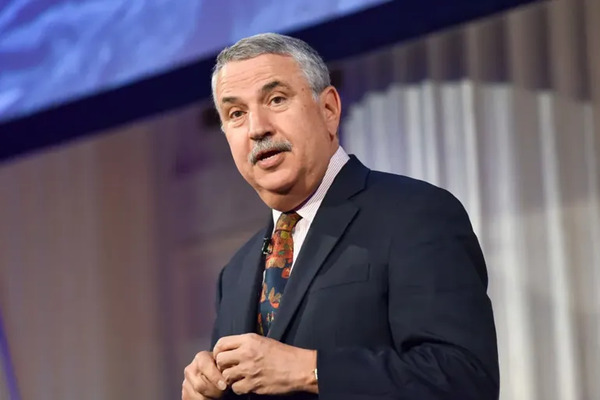
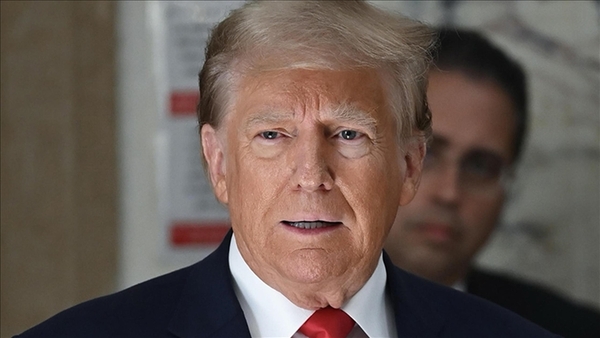
Prominent American writer Thomas Friedman warned that President Donald Trump's plan to displace Palestinians from the Gaza Strip is the most foolish and dangerous in history, and considered it a recipe for chaos inside and outside the United States.

Trump's plan to seize Gaza, expel two million Palestinians and turn the coastal desert strip into a resort town proves one thing only: how short the distance is between "thinking outside the box and thinking outside the mind," Friedman wrote in his weekly column in The New York Times.

He went further, saying, "I can state with confidence that Trump's proposal is the most dangerous and foolish 'peace' initiative ever proposed by an American president."


But he seemed uncertain when he spoke about what scared him most about the US president’s proposal for Gaza: the fact that it seemed to change day by day, or the speed with which his aides and cabinet members agreed to the idea? “Almost none of them were briefed on the plan in advance,” he said, describing them as “a bunch of puppets that kept nodding their heads.”

He said the plan was not just about the Middle East, but a microcosm of what the United States now faces as a country. Trump was surrounded in his first term by aides, cabinet ministers and generals who often deflected and reined in his worst impulses, he added.

Trump was surrounded in his first term by aides, cabinet ministers and generals who often countered and curbed his worst impulses.

Now, according to Friedman’s article, the president is surrounded by aides, cabinet members, and senators and representatives who tremble in fear of his wrath or of being attacked by the “mob” on the Internet that his billionaire ally Elon Musk unleashes if they stray from the path and act inappropriately.


The writer considered this combination of Trump and Musk giving free rein to the world, and many government agencies and business circles living in fear, a recipe for chaos at home and abroad.

Trump has been described as more of a godfather than a president, as evidenced by his demands to annex the Danish island of Greenland and the Panama Canal, and to seize the Gaza Strip and displace its population to Egypt and Jordan.

Trump is more like a godfather than a president, as evidenced by his demands to annex the Danish island of Greenland and the Panama Canal, and to seize the Gaza Strip and displace its population to Egypt and Jordan.

He mocked Trump's recent ideas, saying that while they may work in the movies, his administration's attempt - in practice - to force Jordan, Egypt or any other Arab country to accept Palestinians living in Gaza and have the Israeli army arrest them and hand them over to those countries, will upset the demographic balance in Jordan between the East Bankers and the Palestinians, and undermine the stability of both Egypt and Israel.

Friedman expected that Trump's plan would provoke violent responses against US embassies and interests in the Arab and Islamic world, warning that Muslims in Europe, the Middle East and Asia would take to the streets to resist the displacement of Palestinians from their land, as Trump vowed to take over the Gaza Strip and that the Palestinians would not have the right to return to it.

He noted that this would be the “greatest gift” Trump could give Iran to return to the Middle East by embarrassing all the Sunni regimes loyal to America, and American companies - such as McDonald's and Starbucks - that have already faced a boycott as a result of America arming Israel in the war on the Gaza Strip would be dealt a major blow.

But Friedman, an American Jewish writer, believes that Trump is right in considering the Islamic Resistance Movement (Hamas) a “sick and deviant” organization, and that Gaza has now become hell as a result of its actions.

However, he believes that resuming any kind of peace process will not be easy, but to say that ethnic cleansing is the only option left, after trying all alternatives, is a misconception.

One of the biggest problems with the Trump team is that it views the Middle East through the lens of the Israeli far right and evangelical Christians.

One of the biggest problems with the Trump team, he believes, is that it views the Middle East through the lens of the Israeli far right and evangelical Christians, and that all it knows about the Arab world is through the Gulf Arab investor community. Perhaps for this reason, Friedman says, they are “absolutely in love” with Israeli Prime Minister Benjamin Netanyahu.


The author goes on to say that if Trump really wants to make a radical shift and take advantage of some of the fear he is instilling in people, it will not be through this “childish” proposal in Gaza, but by calling on all parties publicly to challenge each other to actually do, in good faith, the hard things required to get out of this hell.

Friedman offered an alternative proposal: reform the Palestinian Authority, appoint a new, uncorrupt leader and prime minister—such as Salam Fayyad—form a technocratic government that would invite an Arab peacekeeping force to take over the Gaza Strip from Israel, complete the “eviction” of the Hamas leadership, and seek the international assistance needed to rebuild Gaza.3:12

He added that the Arab force would have to commit to training Palestinian Authority security personnel, and divide the Gaza Strip into areas A and B, with the Palestinian Authority and the Arab peacekeeping force controlling all population centers in the first area, while the Israeli army could remain in the entire perimeter of the second area.

After that, Friedman continues to explain his proposal, the Palestinians would engage in organizing elections in the West Bank and Gaza Strip, and negotiating a two-state solution with Israel in both areas. As for the plan to transfer the people of Gaza, it would destabilize Egypt, Jordan, and Israel, in his opinion.


Source: New York Times


OPINIONS

Sun 23 Feb 2025 11:31 am - Jerusalem Time

America Has a Historic Opportunity in the Middle East. Trump Has Leverage, but He Must Use It Wisely

Foreign Affairs

Foreign Affairs

Opinion Writer

Philip H. Gordon

For decades, the Middle East has been the region where diplomatic aspirations go to die. At least since U.S. President George H. W. Bush left office on the heels of the Gulf War, successive U.S. presidents have, often after fleeting periods of hope, ended up leaving the region in a more perilous state than they found it.

Bill Clinton had high hopes for a historic Israeli-Palestinian peace agreement; he got the parties close at Camp David in 2000, only to see his presidency end with the collapse of talks and the beginning of the deadly second intifada. After the 9/11 attacks on the United States, George W. Bush successfully toppled Saddam Hussein’s regime in Iraq in the name of “transforming” the region, only to see that project become a quagmire that killed thousands of Americans and empowered Iran. Barack Obama sought to seize the opportunity of the Arab Spring, in 2011; although he negotiated a nuclear deal with Iran, his aspirations for democratization and regional cooperation were undermined by a bloody coup in Egypt, the rise of the Islamic State in Iraq, and the outbreak of a devastating civil war in Syria. In his first term, Donald Trump hoped that pulling out of Obama’s nuclear deal and killing Iran’s terrorist leader Qasem Soleimani would reduce the Iranian threat, but when he left office, in 2017, Iran was expanding its nuclear program and using proxies to attack U.S. troops, as well as its own neighbors. And most recently, Joe Biden, with past failures in mind, eschewed grand aspirations and focused on delivering stability to the region, only to see his final year in office consumed with the aftermath of the October 7, 2023, terrorist attacks on Israel and the horrors of the war in Gaza that followed.

With such a history, it might seem foolish to imagine that the Middle East today could prove to be anything other than a source of trouble for a new U.S. president. If anything, the past 30 years have proved that the Middle East is impossible to ignore, never fails to surprise, and that however bad the situation seems, it can always get worse. Yet for all the region’s real troubles and risks, Trump is in fact inheriting a series of opportunities. And in some ways, he may be well situated to take advantage of them—something I acknowledge even as a harsh Trump critic and former national security adviser to U.S. Vice President Kamala Harris. Along with the new strategic landscape he inherited, Trump’s unpredictable nature could give him leverage with Iran, Israel, and the Gulf states, among others. And he could potentially sell policies to Congress—such as a nuclear deal with Iran—that a Democratic president never could.

Trump is, of course, also uniquely capable of exacerbating the region’s problems, and he has already done so by deciding to cut vital U.S. assistance to the region and by calling for the United States to depopulate and take over Gaza. The fate of the Middle East over the next four years will depend in large part on whether Trump manages to take advantage of these strategic opportunities or instead squanders them with his reckless impulses.

A NEW DEAL

The first opportunity Trump has inherited is with Iran, which has for decades been at the heart of the Middle East’s problems. Today, Tehran is weaker, and likely more susceptible to leverage, than it has been since the Iranian Revolution, in 1979. Two of the country’s main terrorist proxies—Hezbollah in Lebanon and Hamas in Gaza—have been decimated militarily. Its ballistic missile fleet, long a second line of deterrence alongside those proxies, has proved ineffective against Israeli air defenses that are backed by U.S. and other regional forces. Syria, Iran’s main regional partner, is now run not by Iranian ally Bashar al-Assad but by an anti-Iranian coalition that has deprived Tehran of its land bridge to Lebanon. Iran’s own air defenses proved so inefficient against Israeli airstrikes in the fall of 2024 that Iran felt too vulnerable to even try to respond. And the Iranian economy, wrecked by years of mismanagement, U.S. and international sanctions, and a period of low oil prices, is under tremendous strain—hardly the basis for addressing new gaps in its deterrence and defense capabilities.

Under these new circumstances, it is not surprising that Iranian leaders have begun to signal openness to a new nuclear deal, because the alternatives to such a deal for Iran are worse than ever. President Masoud Pezeshkian was elected in 2024 on a platform of improving the economy, and the only conceivable way of achieving that objective is striking a diplomatic deal with the United States and gaining sanctions relief. Although Supreme Leader Ali Khamenei, a hard-liner and longtime skeptic of talks, remains the final decision-maker, even he knows that Iran’s ability to deter military strikes on its nuclear program or energy infrastructure—which relies on proxies, ballistic missile strikes against Israel, and domestic air defense—has been dramatically reduced. The leaders also know that the willingness of the United States and Israel to undertake offensive strikes has increased under an emboldened Israeli Prime Minister Benjamin Netanyahu and an unpredictable Trump.

Trump has signaled his own interest in a deal, and the new strategic landscape could lead Iran to put far more on the table than previously imagined. Concessions that were never realistic in the past but might be today include strict caps on levels of nuclear enrichment, conditions without expiration dates, limits on ballistic missiles, and even limits on Iranian regional interference (since Iran’s proxies have been so weakened anyway). A new deal could even prevent a domestic Iranian uranium-enrichment program by allowing Iran to access an international fuel bank; such a setup would allow Tehran to claim to have preserved its right to benefit from civil nuclear-energy production and also permit Trump and the Israeli government to say that they denied Iran control over enrichment.

Even amid the new strategic circumstances, there will be limits on Iran’s concessions, and Trump could easily overreach—or even pursue regime change in Tehran. But the attraction of a deal that verifiably prevents Iran from developing a nuclear weapon and limits its regional influence should be obvious, and the combination of Iran’s vulnerability and the United States’ increasingly credible threat of the use of force makes it more realistic than ever before. If Trump managed to negotiate such an agreement, he could gloat about getting a “better deal” than Obama and sell that deal to Congress.

WAR AND PEACE

Trump’s second opportunity in the region is to end the war in Gaza—the greatest setback to peace and stability in the region since the Iraq war—and to start the long process of stabilizing the “day after.” Since Hamas’s horrific attack on Israel on October 7, 2023, and Israel’s subsequent response, the situation in Gaza has been an unfathomable tragedy. But the cease-fire and hostage deal reached between Hamas and Israel on January 15, after many months of failed efforts and with assistance from the incoming Trump team, provides a potential path to finally end the war. After 15 months of unprecedented devastation and suffering, Israel suspended major military operations, Hamas began to release hostages, and Gazans began to return to their neighborhoods.

The first phase of the cease-fire is limited in time and scope, and it is far from guaranteed that it will last. Getting to a second phase will require even more difficult decisions on hostage releases (including Israeli soldiers), Israeli prisoner releases (including more terrorists), and ultimately on the fate of Hamas. At the same time, the images of the emaciated Israeli hostages released on February 8 were a stark reminder to Israel of the urgency of an agreement on the second phase, before more hostages die. Hamas must likewise realize that the end of the agreement would not end well for the organization. Trump has threatened Hamas with “hell” if it rejects a deal, and the group knows that its “cavalry,” Hezbollah and Iran, will not arrive—a main reason it agreed to the cease-fire and hostage deal in the first place.

If Trump can help extend the deal between Hamas and Israel, or even prevent renewed fighting, he will have an opportunity to begin putting in place the building blocks for at least a modicum of stability in Gaza and the West Bank and, in the long run, for his long-coveted “normalization” agreement between Israel and Saudi Arabia, the extension of the Abraham Accords that he negotiated in his first term. That historic vision would require not just an end to the war in Gaza but also an Israeli commitment to a pathway to a Palestinian state. Such a commitment is certainly hard to imagine under the current Israeli government, but it is perhaps not inconceivable under pressure from Trump, who would be uniquely well placed to influence Israel, especially if he saw doing so as a path to a Nobel Peace Prize.

There are also more realistic, limited goals that Trump should be well placed to advance if he is willing: demanding genuine reform of the Palestinian Authority as the 89-year-old President Mahmoud Abbas leaves the scene; persuading Israel to accept a role for the PA in Gaza’s postwar governance, which the remnants of Hamas might tolerate as an alternative to further decimation; and persuading Arab Gulf states, which are keen to stay on good terms with the administration, to provide political support, reconstruction funds, and potentially security forces to support a peace agreement. The problems and challenges would remain enormous even with such progress, but they would pale in comparison with the destruction, divisions, and suffering that preceded the cease-fire deal. And Trump would get, and deserve, credit.

LOOKING TO LEBANON

Trump has also inherited opportunities in Lebanon, whose prospects seemed grim even before the Israel-Hamas war but got manifestly worse when Israel turned its forces on Hezbollah, leading to thousands of casualties and tens of thousands of displaced civilians. Lebanon has for decades suffered under the grip of Hezbollah and, since 2011, has been flooded with over a million refugees from the war in Syria. But with Hezbollah’s weakening, the country finally has a chance to free itself from Iran’s grip and to establish a more functional and sovereign state.

That chance stems from the tremendous losses Hezbollah has suffered since it made the mistake of going to war with Israel following the October 7 attacks. Although some in Israel advocated launching a major military operation against Hezbollah from the start, Netanyahu initially held off, in part because of pressure from the Biden administration to avoid regional escalation. But as continued Hezbollah attacks in northern Israel prevented tens of thousands of Israeli evacuees from returning to their homes, Israel lost patience. In the last months of 2024, escalating Israeli military strikes on Hezbollah—including pager attacks that disabled thousands of fighters; assassinations of Hezbollah’s officials, including its top leader, Hassan Nasrallah; and relentless airstrikes against Hezbollah military infrastructure—gradually decimated the organization politically and militarily. By November 2024, fearing further losses and seeing that Iran was in no position to come to its defense, Hezbollah agreed to a cease-fire with Israel that omitted its previous precondition to end the war in Gaza, required the group to withdraw its forces to north of the Litani River, and allowed thousands of Lebanese armed forces to deploy to a buffer zone in the south. The deal also paved the way for a breakthrough in Lebanese politics, with the selection of a new president, the former army commander Joseph Aoun, and prime minister, the respected jurist Nawaf Salam, both of whom are committed to improving governance and ensuring the independence of the Lebanese state.

Hezbollah will still exert significant influence over Lebanese politics, but its influence has been greatly reduced. The Lebanese people are fed up with the results of Hezbollah’s leadership. Iran’s ability to resupply Hezbollah has been severely set back by its loss of Syria, and the new Lebanese government could win the international political, economic, and military support it needs to succeed—including from the United States. If Trump can overcome his instincts against foreign assistance, he has an opportunity to help provide the Lebanese government and military with the means and confidence to further sideline Hezbollah and reduce the influence of Iran.

A NEW SYRIA

Finally, and most stunningly, comes an opportunity in Syria, which has been perhaps the most destabilized and destabilizing region of the Middle East for the past 15 years. After years of trying to isolate and even oust Syrian dictator Bashar al-Assad, by 2020 the United States and many of its Arab and European allies had mostly moved on, accepting the grim reality of Assad’s enduring rule. But with the world’s attention rightly focused on the situation in Gaza, and with Iran and Russia weakened by their respective conflicts with Israel and Ukraine, Assad’s opposition, led by the rebel group Hayat Tahrir al-Sham, seized the opportunity to act. It was not a coincidence that HTS and its allies launched their military offensive immediately after Hezbollah’s cease-fire agreement with Israel, which ensured the Lebanese group would not come to Assad’s rescue as it did in 2011, when he had last been on the ropes.

Perhaps equally surprisingly, HTS, which is still designated as a terrorist organization by the United States, professed and even began to act on a commitment to ensure human rights and respect for minorities and to distance itself from its terrorist past. Suddenly, the Syrian regime that had been Iran’s main ally in the Middle East, a conduit for arms to Hezbollah, the host to Russian military forces and naval bases, a major exporter of narcotics, and a supporter of Islamist terrorism was gone, and an opportunity to shape new Syria took its place. The new president, Ahmed al-Shara, will still have to prove his commitment to that better Syria, but as recently as three months ago, the idea that Trump would inherit the opportunity to support such a Syria would have sounded like nothing but a dream.

U.S. policy will not be the main variable that determines success or failure in Syria, but Washington can make a difference. Trump could, for example, lift U.S. terrorist designations in exchange for good governance and cooperation on counterterrorism objectives, including a negotiated U.S. military presence in the northeast to help prevent an Islamic State resurgence. He could also lift broader sanctions and provide economic assistance if Syria agreed to deny Russian access to naval bases, and he could help the country find supplies of grain and oil to replace lost Russian and Iranian sources. Trump could also use U.S. leverage with Turkey and with Washington’s Syrian-Kurdish partners to ultimately broker a political agreement among them and the new regime in Damascus. These are opportunities that the United States has not had in decades, and Trump should seize them.

SEIZING THE MOMENT

No one should underestimate the challenges and risks that continue to loom throughout the Middle East. Weak and ineffective governments; deep religious, ethnic, and interstate rivalries; and a multiplicity of bad actors—on top of the consequences of a terrible war in Gaza that may well not be over yet—will continue to conspire against progress toward peace and stability. At the same time, it would be a tragic mistake to ignore the historic opportunities the new strategic landscape presents, all of which would have seemed far-fetched only a year or even a few months ago.

Trump would no doubt like nothing more than to succeed where so many of his predecessors have failed. Anyone who cares about the region should hope that he does.

OPINIONS

Sun 23 Feb 2025 11:26 am - Jerusalem Time

Netanyahu's Ambiguity on the Gaza Deal Serves Israel and Hamas – but the Hostages Don't Have Time

Haaretz

Haaretz

Opinion Writer

By Ravit Hecht


Under U.S. pressure to continue the cease-fire, Israel is conditioning the end of the war on exiling senior Hamas leaders from Gaza. And while Hamas has agreed to transfer Gaza's civilian administration to the PA, this demand is unlikely to be met


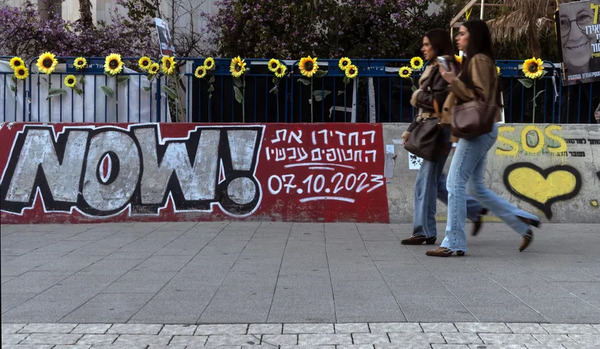
With the accelerated conclusion of the first stage of the hostage release deal – a stage that, had it not been for the opposition of the Religious Zionism party, which opposed it, would never have really been in danger – next comes the main course, along with bones that will be difficult to handle. That's the second stage, which includes the rescue of the remaining hostages, including most importantly 24 live hostages, some in serious medical condition, as the recent returning hostages have reported.

In the face of focused and determined American pressure to continue to the second stage and to conclude the hostage saga as quickly as possible, at this time, Israel is making a demand that conditions the end of the war and the withdrawal of the Israeli army from Gaza on the exiling of those among the senior Hamas leadership that remain in the Strip. 

At this stage at least, the prospects that such a demand will be addressed aren't high. Granted that Hamas has agreed to transfer civilian control of the Strip to other entities such as the Palestinian Authority, but it's refusing to give up its military control or to reduce it. That's a demand that Netanyahu would find very difficult to accept and get approval for – and not only for political reasons. (Another demand, which is a kind of deal-breaker for Israel, is the release of Hamas' Nukhba terrorists who committed the crimes of October 7).

The challenge for Netanyahu, who like President Trump isn't interested in renewing the war in Gaza, is to maneuver through these binary constraints, which don't allow the two sides' demands or conditions to be bridged. Netanyahu is trying as best he can to extend the twilight zone between the first and second stages and in the process to attempt to free several more living hostages, possibly in exchange for various humanitarian benefits, such as providing work tools and mechanical equipment, thanks to which the release of hostages in the coming days was expedited.


"The effort at the moment will be to find a vague formula that Hamas can also live with and that would permit a cease-fire that is not of set duration without declaring an end to the war," one cabinet source said. "This, while promising [Finance Minister Bezalel] Smotrich a return to the fighting at some time, until a solution is found to remove Hamas from power."

It's hard to see how this circle can be squared, but the efforts aren't ceasing. According to the source, in light of this, the heavyweight Gaza population transfer demand that Trump interjected, should apparently also be seen as a pressure tactic on Egypt and Jordan in connection with the Gaza issue only to be later be abandoned for their benefit or for the Saudis.

Such vague wording sounds like a meaningless idea, but in practice, it might serve the interests of both sides. Netanyahu wouldn't pay with his government for a temporary cease-fire and might even manage to bring about the release of more hostages. Hamas would remain around the table as a relevant party. This certainly isn't a fundamental, long-term solution, but it buys both sides time and that, apparently, is the most necessary ingredient in the region. The only ones who don't have time are the hostages and their families, who are being relegated in the coming weeks to uncertainty and major anguish.

And when it comes the "day after" that everyone has been wracking their brains over, a much more realistic possibility than an American occupation of Gaza or turning the Strip into a real estate gem – or other suggestions that have been thrown around without consideration in recent days – is an Arab coalition of the kind that is being put together at this time aimed at purportedly responding to Trump's population transfer idea but that is actually aimed at a pro-Arab and pro-Palestinian proposal as a solution to the distress in Gaza.

It would be reasonable for the Palestinian Authority to have a senior role in such a coalition. And Hamas would also take part in it through the back door. (Burying the identity of the problematic members in it would enable both sides to get the coalition down their throats.) That's the only possible escape hatch that would avoid a resumption of the war, a step that none of the major players are interested in.


OPINIONS

Sun 23 Feb 2025 11:21 am - Jerusalem Time

Three-quarters of U.S. Jews Fear for Their Safety Because of Israel-Hamas War, Poll Shows

Haaretz

Haaretz

Opinion Writer

Judy Maltz

In a poll conducted for the Jewish Federations of North America, two-thirds of Jewish Americans describe the climate in their communities as either tense, uncomfortable or scary

An overwhelming majority of Jewish Americans are concerned about their personal safety and believe antisemitism is on the rise, according to a poll published Thursday by the Jewish Federations of North America.

The poll, the first in-depth look at the effects of Israel's war in Gaza on Jewish Americans, shows that nearly a third of Jewish Americans (29 percent) are aware of physical acts of violence committed against members of their respective communities since the start of the war on October 7.

The poll shows that Americans in general believe Jews are facing growing hostility in the United States, but not to the same extent that Jews themselves do.

Among the Jewish respondents, 86 percent said they believed there was more antisemitism in the United States today than there was five years ago. Among the general population, nearly two-thirds of the respondents were of that opinion.


Jews who wore “distinctive Jewish” items such as kippas, according to the poll, were twice as likely as other Jews to report being concerned for their safety “all the time,” according to the poll.

The poll was carried out by Benenson Strategy Group between October 29 and November 1 through text messaging. It included a random sample of 3,777 respondents, including 2,199 respondents who identified as Jewish.

Nearly three out of four Jewish respondents said they believed there was “a lot” of antisemitism in the United States today, while more than 20 percent said there was “some.” Only 2 percent said there was “not much” antisemitism, and not one Jewish respondent said there was “none at all.”

Among the general population, more than three-quarters of the respondents said there was “a lot” or “some” antisemitism in the United States today.

Looking back at the past few weeks, nearly three out of four (72 percent) of Jewish respondents said antisemitism in their local communities was increasing, and a clear majority (58 percent) anticipated that this trend would continue.

Three out of four Jewish respondents said they were either “very concerned” or “somewhat concerned” that the war between Israel and Hamas would cause safety and security issues in their local communities.


When asked how they would describe the climate in their respective communities since the outbreak of the war, nearly one in three of the Jewish respondents said “tense”; one in five said “uncomfortable”; and one in 10 said “scary.”

More than 40 percent of the Jewish respondents said that in the past month they were worried “very much” or “all the time” about their personal safety because of their religious identity.

Among the Jewish respondents, 82 percent said they were following the war in Gaza “very closely,” compared with just over half the respondents in the general population group. Nearly 70 percent of the Jewish respondents said they approved of the way U.S. President Joe Biden was handling the situation – as opposed to less than half (44 percent) of the respondents in the general population group.

Among the Jewish respondents, an overwhelming 87 percent believed it was important for the U.S. government to provide military aid to Israel.

The poll was timed for publication before next week’s big march on Washington in solidarity with Israel. JFNA is one of the march’s main sponsors.

“This polling demonstrates precisely why our community feels it is so important to mobilize and come to Washington, so that we can tell our nation’s leaders directly about the need to both stand up against the rampant antisemitism in our country and remain steadfast in their incredible support for Israel,” said Eric Fingerhut, JFNA president and CEO.

“We know that large majorities of Americans support Israel in its fight against terror, and it’s important not to let a vocal minority color that view,” he added.


PALESTINE

Sun 23 Feb 2025 11:15 am - Jerusalem Time

Israeli occupation arrests citizens from the West Bank in Beit Hanina, Jerusalem

Last night, the Israeli occupation forces arrested two citizens from the West Bank, in the town of Beit Hanina, north of occupied Jerusalem.


Local sources reported that the occupation forces arrested two citizens - whose identities are not yet known - while they were in the town of Beit Hanina.

OPINIONS

Sun 23 Feb 2025 11:04 am - Jerusalem Time

Between Gaza Syndrome and Tel Aviv Syndrome

Bahaa Rahal

Bahaa Rahal

Opinion Writer

"Stockholm syndrome is a psychological phenomenon that occurs when a hostage sympathizes with, or cooperates with, his enemy, or someone who has wronged him in some way, or shows some signs of loyalty to him, such as when the kidnapped person sympathizes with the kidnapper. It is also called the bond of captivity or kidnapping, and it became famous in 1973, where the hostage shows sympathy, harmony, and positive feelings towards the kidnapper or captor, to the point of defending him and showing solidarity with him" (from Wikipedia).


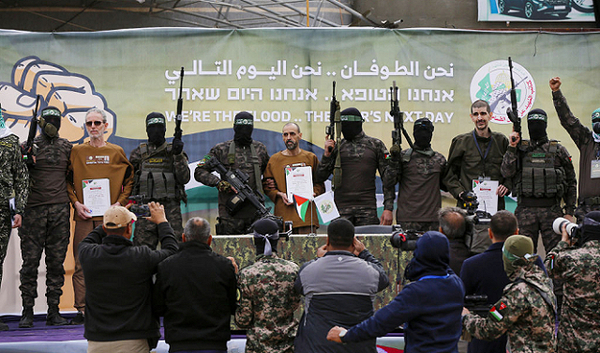
Yesterday, live on air, the Israeli prisoner's kiss on the handover platform to one of the resistance members came in the spontaneous manner that we saw, and he was not forced to do it, which further clarifies and explains the Stockholm Syndrome in showing positive feelings towards the kidnapper. At the same time, it shows the extent of the relationship that existed throughout the period of captivity, and the nature of the care and attention between the captor and the prisoner.


Another syndrome that appeared in contrast to the Gaza syndrome is the Tel Aviv syndrome, where we saw prisoners being forced to wear clothes with slogans written on them threatening and threatening the released Palestinians with revenge, killing and eliminating them, in addition to what we saw of abuse, severe beatings, solitary confinement, and the spread of diseases without treatment or respect for international and humanitarian law, with unprecedented brutality. This is the syndrome of hatred, animosity and savagery that the occupation soldiers send, making the Tel Aviv syndrome the opposite of the Gaza syndrome.


What the camera documented this Saturday, and every Saturday, makes the extremist government wish the deal had been done all at once and not in stages and weeks, so it releases a picture every Saturday to make Netanyahu and his government depressed.


Between two contradictory syndromes, one calling for brutality and killing, and the other calling for life and coexistence, and with a kiss between the prisoner and his captor, the curtain falls on the first stage of the deal, and a stage of the truce ends, so that the discussion returns again about the second stage of the deal, and opinions circulate between supporters and opponents, and between those who want to return to war and those who want to continue stopping it according to the vision of reconstruction and building and rehabilitating everything that the war machine destroyed.

PALESTINE

Sun 23 Feb 2025 10:07 am - Jerusalem Time

Two injured by Israeli occupation bullets in southern Gaza Strip

Two citizens were injured, Sunday morning, by Israeli occupation bullets in the city of Rafah, south of the Gaza Strip.

The Civil Defense in Gaza reported that its crews rescued two citizens from the Tal al-Sultan area, west of Rafah.

OPINIONS

Sun 23 Feb 2025 9:23 am - Jerusalem Time

A kiss on the forehead of the resistance under the shade of the flag

op-ed "AlQuds" dot com

op-ed "AlQuds" dot com

Opinion Writer

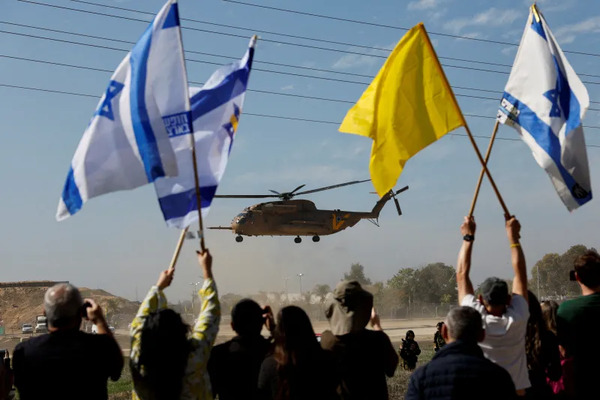
The seventh batch of prisoner exchange in the first phase reflected the Palestinian resistance’s ability to present more surprises to the Israeli side, through the organization and skillful management of the release of Israeli detainees, amid great confidence that astonished everyone. Despite Israel’s delay in the release of Palestinian prisoners in light of Netanyahu’s policies and his extremist ministers to embitter the families of prisoners and tighten the noose on them, this negative practice by Israel, which has been repeated more than once, reflects one fact, which is that Hamas humiliated Israel, and after inflicting a military defeat on it and proving its ability to control Gaza on the ground, it forced it to sign a swap deal to release thousands of prisoners, including hundreds of those sentenced to life imprisonment, which aroused the anger, resentment and resentment of ministers such as Smotrich, the resigned Ben Gvir and others.


Yesterday, the resistance in the Gaza Strip scored many goals against the Israeli goal, starting with the good treatment of the Israeli prisoners, and dealing with them based on the instructions of the true Islamic religion. There is no doubt that the message that the resistance succeeded in conveying to the entire world came from Israel itself when the Israeli prisoner Omer Shem-Tov kissed the heads of two members of the Qassam Brigades, imprinting a kiss on the forehead of the resistance, to ignite social media networks and all international channels, through his return of the favor to those who captured him and treated him with kindness and respect, while the Israeli prison administration excels in oppressing and torturing our prisoners and spoiling their joy of freedom until the last moments of their release.


The scenes of raising the Palestinian flag on a specially prepared flagpole, and the playing of the national anthem with its patriotic expressions that exude pride and loftiness, by virtue of the oath and under the shade of the flag, warmed the hearts of everyone in a scene that inspires pride, which reached its peak with an expressive and unifying message when the resistance decided to release the Bedouin prisoner Hisham al-Sayyed, away from the ceremonies and television broadcasts out of respect for the feelings of the Arab Palestinians of the interior, so the Palestinian interior received it with pride and honor as an expression of the unity of destiny.


The solid Palestinian will was evident and the failure of the occupation to achieve its goals and break the steadfastness of our people was entrenched, through the message of the resistance that came in all the exchange batches, from Rafah, the Middle, Khan Yunis and Gaza, to confirm that it is stronger and more determined to continue on its path of struggle, in addition to the characteristic of the ability to accomplish a complete secret operation, which Israel, with all its security systems that rely on the latest monitoring devices, weapons and radars, did not succeed in uncovering or spoiling, and this point in particular is attributed to the cunning and intelligence of the resistance, militarily and administratively, in addition to the dazzling and successful media aspect.


It is natural in light of these scenes that Netanyahu appears trying to evade the agreement, and threatening to resume the war, but he knows very well that the only way to return his living and dead prisoners is to negotiate and adhere to the terms of what was agreed upon, while stressing the readiness and preparedness of the resistance to begin negotiations on the second stage, despite Israel’s deliberate delay, as it has not started until this moment, due to pressure from the United States, which also realizes and knows very well that the plans of its president Trump will not pass by the citizens in Gaza in particular, and the Palestinian people in general, who will defeat them forever.

OPINIONS

Sun 23 Feb 2025 9:22 am - Jerusalem Time

Riyadh Summit and the Fate of the Palestinian Cause

Dalal Saeb Erekat

Dalal Saeb Erekat

Opinion Writer

The Riyadh Summit is a pivotal moment in testing the seriousness of the Arab position on the Palestinian issue, and the extent of its ability to translate its rejection of displacement into actual and binding steps. However, the absence of Palestinian representation from the meeting raises fundamental questions about how decisions are made regarding the future of the Palestinian issue, in light of the absence of its owners from the discussion table. This absence does not only reflect political marginalization, but also raises the possibility of arrangements being formulated outside the traditional Palestinian framework.


Since the 1970s and the Arab League's recognition of the Palestine Liberation Organization as the legitimate representative of the Palestinian people, the Arab brothers have never met to discuss the fate of the Palestinian issue without the representation of the PLO.


It seems that the Arab countries are trying, through this summit, to find a formula that balances their position of rejecting displacement, and their efforts to avoid a direct clash with the US administration. With the increasing pressures, whether from Israel or Donald Trump, the Arab countries find themselves facing a difficult equation between maintaining their rhetoric in support of the Palestinians, and adapting to the political reality imposed by Washington. The absence of the Palestinians from the summit indicates the possibility that there are arrangements being discussed regarding the “day after” phase in Gaza, without the participation of the Palestinian Authority or the active forces on the ground, which could lead to reshaping the Palestinian situation according to external agendas.


Among the issues likely to be discussed in this context is the issue of not integrating Hamas into any future framework for governing Gaza, and whether a community support committee from Gaza will be formed to assume alternative administrative tasks. There is also the question of who will finance these arrangements, and what guarantees can be provided, especially in light of previous experiences in Gaza and the repeated Israeli attacks that have thwarted many initiatives. In addition to discussing the security file and the possibility of a European-Emirati entity maintaining security in coordination with the Palestinian Authority. These sensitive issues require clarity of vision and a real commitment to ensure that unsustainable solutions are not imposed.


Saudi Arabia is leading efforts to bring Arab positions closer together, to dispel fears that these developments will lead to the adoption of solutions that bypass the Palestinians, whether by imposing new security arrangements that include Arab or international forces, or by presenting proposals based on an American-Israeli vision aimed at restructuring the administration in Gaza and the West Bank, which may amount to separating Gaza administratively in the form of the State of Gaza. In this context, the question remains as to whether the Arab countries are prepared to take an independent and firm position towards the Trump administration, which has long employed “coercive diplomacy” to pressure the Palestinians and Arabs, with the aim of pushing them towards making political concessions in preparation for ending the Palestinian issue according to an Israeli perspective based on procrastination and buying time to complete the colonial project.


Arab positions have succeeded in reducing the risk of forced displacement against Palestinians, but gradual displacement operations are still ongoing, which requires taking practical and sustainable measures to confront them, especially in what is happening in the West Bank, and trying to impose a new reality, represented by expanding Israeli settlements, destroying infrastructure, and creating harsh living conditions that push Palestinians to undeclared forced migration. This requires moving from positions rejecting displacement to practical and binding policies that go beyond political statements to clear executive steps that prevent the reproduction of displacement scenarios.


Arab countries are trying to present an alternative vision to the US administration, which includes a comprehensive plan for the "day after" phase in Gaza, which ensures avoiding the risks of displacement and annexation, and thwarting the "Greater Israel" project, which threatens the Palestinians' right to self-determination. Therefore, the Palestinians must cooperate and coordinate with Arab countries to respond to Trump's statements, by proposing a comprehensive initiative that ensures the completion of the prisoner exchange and the sustainability of the ceasefire deal, by adopting a clear political framework that includes the establishment of an independent Palestinian state and the Palestinians' right to self-determination. The absence of such an alternative will impose a fait accompli of occupation and apartheid, which the Netanyahu government is translating on the ground.


The responsibility of the Palestinian leadership at this stage requires a re-evaluation of the strength of its representation and its effectiveness in moving the Palestinians from the stage of occupation to independence. This requires a frank national dialogue that presents a practical and tangible proposal that reflects a comprehensive political vision, based on the current situation represented by the separation of Gaza on the one hand and by settlement, annexation and the redeployment of the occupation army in areas (C), (B) and (A).

OPINIONS

Sun 23 Feb 2025 9:21 am - Jerusalem Time

The controversy of victory and defeat

Nabhan Khreisha

Nabhan Khreisha

Opinion Writer

As soon as the ceasefire agreement was announced in Gaza on January 15, 2025, the pages of the Palestinians on social media sites were ablaze with the debate of victory and defeat, between those who believe that Hamas had triumphed over Israel by its steadfastness and thwarting its plans by not enabling it to achieve its goals, and those who believe that Hamas had been defeated, and the criterion for its defeat is the large human losses among Palestinian civilians, and the massive destruction inflicted by the occupation army’s bombing of homes, educational and health facilities, and infrastructure in the Gaza Strip, which made it an area unfit for living.


During the wars between Hamas and Israel in the Gaza Strip from 2008 to 2025, the question that was always present among Palestinians was "Did Hamas achieve victory or not?" It is true that Hamas achieved some demands in previous wars with Israel, but the matter in the recent "Israeli revenge" war is different, as Israel turned the Strip into piles of rubble, and killed and wounded tens of thousands of civilians in a way that had not happened in all the Arab-Israeli wars since 1948, which prompted Hamas to try to overcome this, as its fighters came out of the tunnels and into the streets in military parades after the ceasefire was declared, and organized shows during the operations to hand over the Israeli hostages to the Red Cross, carrying and carrying a message confirming its presence, and the inability to bypass it in any arrangements after the end of the war. But the truth is that Hamas did not achieve a decisive victory, nor was it completely defeated, but rather maintained its survival... but it is a survival that is very expensive.


During the prisoner exchanges in the first phase of the ceasefire agreement, Hamas sent many messages to the Palestinians, the Israelis, and the world in general, indicating that Israel was unable to eliminate it, that it was capable of restoring its military capabilities, and perhaps most importantly, that it still ruled Gaza. On every Saturday of the prisoner exchanges, Hamas broadcast scenes of the Israeli hostages waving their hands on platforms set up in various locations in the Gaza Strip, with Hamas fighters standing next to them, some wearing Israeli military uniforms, and others carrying Israeli weapons captured in the October 7 attack, in addition to the banners hung at the exchange sites bearing phrases affirming its victory.


The scenes of hundreds of thousands of displaced people returning from the south of the Gaza Strip to its north also carried messages that the occupation army had failed, after more than 100 days of destructive military operations, to force the Palestinians to evacuate the north of the Gaza Strip, to implement the generals’ plan to create a buffer zone between the Gaza Strip and Israel, and that they were returning to their areas despite knowing that their homes, farms, schools, mosques and public facilities had been completely destroyed. The scenes of the large numbers of Palestinian prisoners who had been released from Israeli prisons, waving the victory sign, and the celebrations welcoming them in Ramallah and other cities in the West Bank, also served the image of Hamas’ victory.


Just as there is a debate about victory and defeat among the Palestinians, the Israeli arena is witnessing a similar debate. The Israeli government, through its statements and the declarations of its officials, has stated and continues to state that it has achieved victory over Hamas by being able to eliminate its military capabilities, liquidate the first rank of its military and political leaders, paralyze its ability to continue ruling the Gaza Strip, and prevent its smuggling of weapons by controlling the Salah al-Din (Philadelphi) axis and the Rafah crossing with Egypt. In addition, it has worked and is working to release the Israeli detainees. However, Israeli analysts and media outlets see the opposite. For example, Haaretz newspaper said, “The sight of hundreds of thousands of Gazans returning to their areas in the northern Gaza Strip, and the sight of prisoner exchanges organized by Hamas, shatters the illusions of complete victory promoted by Benjamin Netanyahu.” Or, in the words of Amos Harel, the most prominent military analyst, in an article in the same newspaper, “With the return of Palestinian residents to northern Gaza and the rise of military and political challenges, it seems that Netanyahu’s victory is nothing more than an illusion, while the region approaches a new phase that may be more complicated than ever before.”


Because war is a violent form of politics, the issue of victory or defeat is related to the goals achieved during it. For example, imposing conditions is considered a victory, and failure to do so is considered a defeat, especially if the failure entails strategic and existential risks for the party waging the war. This is what happened to Israel, because its government failed to achieve its declared "military" goals, and because Benjamin Netanyahu refused to define a clear, achievable strategy for the post-war period, to achieve a victory that Israel did not achieve, but which he seeks to achieve to "ensure his survival" in power!! .. But if Israel's standard for victory is wallowing in the blood of innocent Palestinian civilians, and destroying the material and moral foundations of their lives, then it has indeed won.


Because many wars in the world did not achieve a decisive victory, it was replaced by the term "relative or partial victory", which the two warring parties claim, to convince local and foreign public opinion that achieving some goals is a victory in itself, despite the material, human and moral costs paid for those partial goals achieved. But when delving into the debate of who is the victor, the question must be answered: How is victory achieved and what are its criteria and implications? There are a set of explicit criteria and implications that indicate the achievement of victory, such as one party's admission of defeat, or signing an agreement or peace treaty that approves the results of the war in favor of one of the parties, or declaring surrender. In order for the result to be decisive, the achieved victory must be permanent and not temporary. Otherwise, the concept of victory becomes an assessment or opinion, and the outcome of the war remains open to interpretations.

ARAB AND WORLD

Sun 23 Feb 2025 9:17 am - Jerusalem Time

Trump vows to release all Israeli prisoners, Rubio threatens Hamas with destruction

US President Donald Trump said in a speech on Saturday evening about Gaza and Ukraine that the United States will not stop working until all detainees in Gaza are released, and he expected an agreement with Kiev on rare minerals and an end to the Russian-Ukrainian war to be imminent.


Trump told a gathering of conservatives in National Harbor, Maryland, outside Washington, that he did not like to talk about the Gaza issue because there were negotiations, but he stressed that America would not stop working until all the prisoners returned home.


For his part, US Secretary of State Marco Rubio said on Saturday that Hamas would be "destroyed" if it did not release all remaining prisoners in Gaza, and he also condemned the killing of three members of an Israeli family who were being held in the Strip.


“Hamas’ treatment of captives, including their brutal murder of the Bibas family, further demonstrates their barbarity and is yet another reason why we say these terrorists must release all hostages immediately or they will be destroyed,” Rubio claimed via XN.


On Saturday evening, Trump's US envoy to the Middle East, Steve Witkoff, met with Israeli Minister of Strategic Affairs Ron Dermer, whom Netanyahu had appointed to head the Israeli negotiating team, instead of Mossad chief Barnea and Shin Bet chief Bar, to discuss continuing negotiations on the second phase of the prisoner exchange deal. This was their second meeting in the past two days.


Neither President Trump, Secretary of State Rubio nor his Middle East envoy have commented on Israel’s reneging on its commitment to release 602 Palestinian prisoners who had boarded buses to be taken out of captivity and were then returned to captivity, despite this blatant violation of the agreement that the United States helped to draft.


Israeli Prime Minister Benjamin Netanyahu announced early Sunday that the release of Palestinian prisoners under the Gaza ceasefire agreement would be delayed until Hamas ends the "humiliating ceremony" it holds during the handover of Israeli hostages.


Netanyahu said in a statement that "it was decided to postpone the release of the terrorists that was planned for yesterday (Saturday) until the release of the next hostages is guaranteed, without humiliating ceremonies" and "until the next batch of Israeli hostages in the Gaza Strip is handed over."


Netanyahu also said, following a security meeting that began late Saturday night/Sunday, that the release of Palestinian prisoners had been delayed due to "repeated Hamas violations."


These statements came hours after the handover of the Israeli hostages on Saturday, while it was expected that Israel would release more than 600 Palestinian prisoners that it had agreed to release in exchange for its hostages.


"Once these consultations are over, a decision will be made on the next stages" of the ceasefire agreement with Hamas, an Israeli official said on condition of anonymity.


According to the first and seventh stage, the bodies of only 4 Israelis remain to be handed over within this stage, which includes a total of 33 prisoners, 25 of whom are alive and 8 dead.


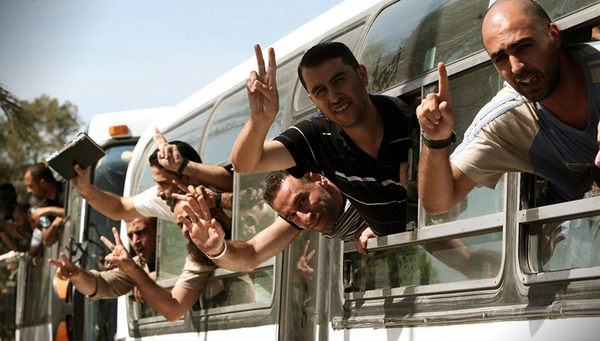
The seventh batch of the Saturday deal was supposed to bring the total number of Palestinian prisoners released to 1,755, including dozens who had been sentenced to life imprisonment.


Tel Aviv estimates that there are 63 Israeli prisoners in Gaza (living and dead), and it detains thousands of Palestinians in its prisons and commits torture, starvation, and medical neglect against them, which has led to the deaths of many of them, according to Palestinian and Israeli media and human rights reports.

PALESTINE

Sun 23 Feb 2025 9:01 am - Jerusalem Time

Israeli occupation continues its aggression on the West Bank and intends to send tanks

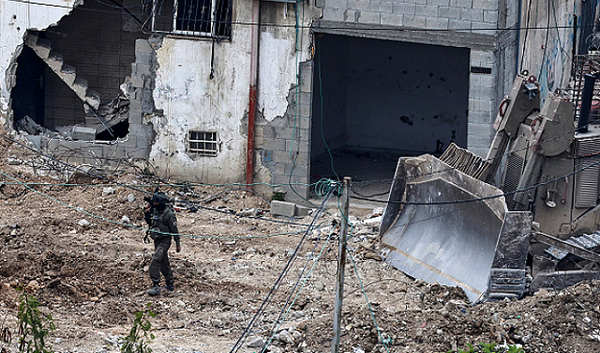
The Israeli occupation army continues its military aggression on the occupied West Bank, for the second month in a row, while the occupation forces continued their raids on towns and camps in the West Bank as part of their ongoing military operations, especially in the governorates of Tulkarm and Jenin.


As the military operation "Iron Wall" enters its 33rd day on Sunday in the city of Jenin and its camp, the Israeli occupation army intends to deploy tanks in the battles in the northern West Bank, for the first time since Operation "Defensive Shield" in 2002, according to what Israeli Channel 14 reported.


Channel 14 Israel quoted an unnamed informed Israeli security source as saying that the deployment of tanks in the northern West Bank aims to enhance military operations in the region, adding that the decision came "after pressure from the political leadership."


Regarding the date of the actual use of tanks, the security source explained that they "may enter the northern West Bank in the near future if necessary, as part of expanding the scope of military operations," without mentioning a specific time.


In Tulkarm, the Israeli occupation forces continue their aggression on the city of Tulkarm and its camp for the 28th consecutive day, and on the Nour Shams camp for the 15th day, amid military reinforcements, coinciding with raids on homes and turning them into military barracks.


Local sources reported that the occupation forces, in the late hours of last night, sent military reinforcements of heavy machinery and bulldozers to the city of Tulkarm from the direction of the "Nitzani Oz" military checkpoint west of the city, and headed towards Nablus Street opposite the northern entrance to Tulkarm camp.


She added that the occupation forces have intensified their military presence along Nablus Street, which connects the Tulkarm and Nour Shams camps, and around the buildings they are seizing, while imposing a tight siege on them.


The infantry soldiers were deployed in large numbers around Tulkarm camp and its inner neighborhoods, including the agency neighborhood towards the airport neighborhood. They raided the empty houses and destroyed their contents. They re-seized a number of them and turned them into military barracks and deployed snipers inside them, amidst the sounds of intense live ammunition being heard.

PALESTINE

Sun 23 Feb 2025 8:58 am - Jerusalem Time

Disruption in the last quarter of an hour!

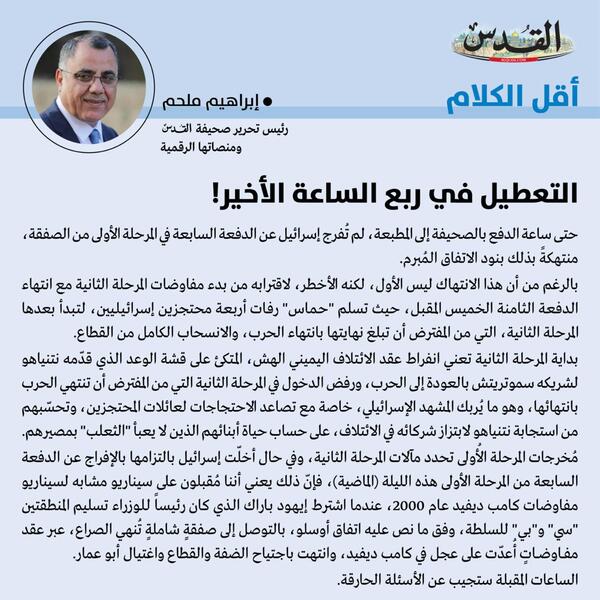
By the time the newspaper was sent to press, Israel had not released the seventh installment in the first phase of the deal, thus violating the terms of the agreement.


Although this violation is not the first, it is the most serious, as it approaches the start of the second phase negotiations with the end of the eighth batch next Thursday, when Hamas will hand over the remains of four Israeli detainees, after which the second phase will begin, which is supposed to end with the end of the war and the complete withdrawal from the Strip.


The beginning of the second stage means the disintegration of the fragile right-wing coalition, which is leaning on the straw of the promise that Netanyahu made to his partner Smotrich to return to war, and the refusal to enter the second stage, which is supposed to end the war with its end, which confuses the Israeli scene, especially with the escalation of protests by the families of the detainees, and their apprehension of Netanyahu’s response to the blackmail of his coalition partners, at the expense of the lives of their children, whose fate the “fox” does not care about.


The outcomes of the first phase determine the outcomes of the second phase. If Israel fails to fulfill its commitment to release the seventh batch of the first phase tonight (last night), this means that we are heading towards a scenario similar to the Camp David negotiations scenario in 2000, when Ehud Barak, who was Prime Minister, stipulated that Areas C and B be handed over to the Authority, as stipulated in the Oslo Accords, on reaching a comprehensive deal that would end the conflict, through negotiations that were hastily prepared at Camp David, and which ended with the invasion of the West Bank and Gaza and the assassination of Abu Ammar.

The coming hours will answer the burning questions.


PALESTINE

Sun 23 Feb 2025 8:53 am - Jerusalem Time

Closure of educational institutions in the Holy City... UNRWA under the guillotine

Adnan Al-Husseini: Israel turned its back on international institutions, forgetting that it gained its legitimacy from these institutions.

Hatim Abdel Qader: Israeli violations against UNRWA are a blatant attempt to shed international responsibility for the refugee issue

Sami Mshasha: UNRWA does not have any real plan to confront the plot to liquidate it, but rather has begun to adapt to international pressures

Ratiba al-Natsheh: The right-wing government has launched an open war on the fundamental and fateful issues of the Palestinian people, including the refugee issue.

Ziad Al-Hamouri: There is an intensive campaign to try to end the refugee issue.. and "UNRWA" is the main symbol of Palestinian refugees

Fadel Tahboub: The Authority is required to assume its responsibilities to ensure the continuation of the educational process and not allow the occupation to impose a new reality


Three weeks after the Israeli occupation authorities’ decision to ban the work of the International Relief Agency (UNRWA) in areas under Israeli “sovereignty” came into effect, occupation police forces stormed a number of UNRWA schools in Jerusalem last Tuesday and ordered their closure. This measure affected 250 children in 3 schools in the city, and 350 students in the Qalandia Training Center.


“Israeli forces and Jerusalem Municipality staff stormed UNRWA’s Qalandia Training Centre and ordered its immediate evacuation,” UNRWA Commissioner-General Philippe Lazzarini said in a statement on the X platform, describing the incident as a denial of the right of children and youth in East Jerusalem to education in UNRWA schools.


Lazzarini considered what happened to be a "violation of the fundamental right to education, as well as a violation of the privileges and immunities of the United Nations," stressing the need to preserve the right of children to access education, and to protect and respect United Nations facilities at all times and in all places.


Politicians, writers and analysts who spoke to “I” considered that the right-wing government in Israel has embarked on an open war on all the essential and fateful issues of the Palestinian people, including the refugee issue, and that these Israeli violations against “UNRWA” are a blatant attempt to drop international responsibility for the refugee issue.


One analyst pointed out that UNRWA does not have any real plan to confront the plot to liquidate it, but rather has begun to adapt to international pressures, while another called on the Palestinian Authority to assume its responsibilities to ensure the continuation of the educational process and not allow the occupation to impose a new reality.


Dire consequences of the occupation's decision to close UNRWA


Engineer Adnan Al-Husseini, member of the Executive Committee of the Palestine Liberation Organization and head of the Jerusalem Department, said that the Israeli occupation authorities are defying the world and ignoring all international laws and conventions.


He added: "At a time when Israel has turned its back on international institutions, it has forgotten that it gained its legitimacy from these institutions."


Al-Husseini explained that the unjust Israeli decision to close the offices of the United Nations Relief and Works Agency for Palestine Refugees (UNRWA) in the occupied Palestinian territories comes in the context of the aggressive war waged by the occupying state against the Arab Palestinian people, and the quest to pass suspicious plans to eliminate them and liquidate their just cause, at the forefront of which is the refugee issue.


Al-Husseini warned of the dire consequences of the decision of the occupying state, which he considered an insult and contempt for the international community, its institutions and decisions, and the disasters expected to occur as a result of obstructing and stopping the efforts and services provided by UNRWA, especially humanitarian aid, in light of what the Israeli machine of destruction leaves behind in its aggression on the occupied Palestinian territories in the Gaza Strip and the West Bank.


Al-Husseini called on the international community to assume its responsibilities, deal with the occupying state as a racist state outside the law, work to strip it of its international legitimacy, and provide full support to UNRWA, in order to ensure the continuation of its services.


A flagrant violation of international law


For his part, Hatem Abdel Qader, Secretary-General of the Islamic Christian Authority for the Support of Jerusalem and the Holy Sites, and member of the Revolutionary Council of the Fatah Movement, condemned the Israeli occupation’s targeting of UNRWA schools and institutions in the city of Jerusalem as part of the incitement campaign launched by Israeli officials against UNRWA.


Abdul Qader added: "These violations against the agency are a blatant attempt to drop international responsibility for the Palestinian refugee issue, which threatens to liquidate the right of return and compensation stipulated in international resolutions.


"These violations constitute a flagrant violation of international law and a direct threat to the rights of Palestinian refugees," Abdel Qader said.


Abdul Qader called on the United Nations and the international community to assume their responsibilities in protecting UNRWA and ensuring its continued provision of vital services to the Palestinian people.


Lack of a clear and effective action plan to confront the ban on UNRWA


Sami Mshasha, a follower of UNRWA affairs and its former official spokesman, believes that the absence of a clear and effective plan of action to confront the ban on UNRWA’s work in Jerusalem and its expulsion from it constitutes a direct threat to the fate of Palestinian refugees in the city.


Mshasha explained that this absence includes the lack of specific instructions for the families of students in UNRWA schools, and hundreds of students at the prestigious Qalandia Institute who received evacuation notices, in addition to the intimidation of students in schools and the absence of any plan to protect the agency’s employees, whose job security is now threatened.


Mshasha added: "There is also a lack of any vision about the fate of poor families classified as "cases of extreme hardship", as well as the follow-up of patients, especially the elderly and those with chronic diseases, stressing that these issues cannot be addressed through hollow statements and declarations about the steadfastness of "UNRWA."


Mish'sha' criticized the absence of any realistic plan by UNRWA and the United Nations to confront the campaign targeting the agency, pointing out that this shortcoming was clearly evident during the last war, when UNRWA evacuated its headquarters and left the displaced and its employees to their fate in northern Gaza.


He also referred to the intensive attack that targeted UNRWA for more than a year, with the aim of expelling it from Jerusalem and reducing its role in Gaza after the war, without the agency taking any serious steps to protect its workers or ensure their job security.


In a related context, Mshasha questioned the usefulness of the UN Commissioner-General’s attendance at the Munich Security Conference, considering that his presence at such events reflects a dangerous shift in the role of UNRWA, as if the Palestinian refugee is now viewed as a security threat.


He also criticized his attendance at the meetings of the "International Alliance for a Two-State Solution," noting that his statements there deviate from UNRWA's mandate and link the fate of refugees to a political solution that does not guarantee the right of return, but rather seeks to create a distorted Palestinian entity.


Statements by the UN Commissioner-General


Mshasha explained that the Commissioner-General stated during the Munich conference that “the long-term goal is to enable Palestinian institutions to assume the basic services provided by UNRWA,” wondering who gave him the right to speak on behalf of the refugees and the mandate to change the agency’s clear and explicit mandate.


He also condemned his statement during the Cairo meeting about "gradually ending UNRWA's mandate," stressing that these statements are in line with plans to end the agency and turn it into a political tool that serves projects to liquidate the Palestinian cause.


At the end of his speech, Mshasha stressed that UNRWA does not have any real plan to confront the plot aimed at liquidating it, but rather has begun to adapt to international pressures, which makes it an indirect partner in implementing the policy of deportation and settlement.


He also pointed out the absence of a Palestinian national plan to confront this scheme, warning that the continuation of division and dispersion of positions will lead to the loss of Palestinian rights, most notably the right of return. He concluded his speech by calling for the development of a clear and specific plan of action that guarantees the protection of Palestinian refugees and the continuation of UNRWA's role in providing its services away from political calculations.


The only international witness to the refugee issue


In turn, political and community activist Ratiba Al-Natsheh said that UNRWA represents the only international witness to the issue of Palestinian refugees, and embodies dozens of international resolutions related to their rights.


She added: "It is no secret that the Palestinians' adherence to the refugee issue and their right to return to the lands from which they were displaced constituted an obsession for Israeli leaders, who considered it a national threat to the existence of their state, and even an implicit rejection by the Palestinians of the defeat of 1948 and the establishment of the State of Israel."


She pointed out that the previous Israeli government, during Trump's first term, sought to issue a decision that would limit the right of return to the original refugees who were displaced from their cities and villages in 1948, without this right being passed on by inheritance to their children who were born outside Palestine.


She added: "This government also worked to dry up UNRWA's resources and restrict it with American assistance, through a committee appointed by the United Nations under American leadership, to investigate the records of employees and refugees registered as beneficiaries of the agency's services in the Palestinian territories, and to set new standards for neutrality and rejection of "terrorism."


Lifting UNRWA's diplomatic immunity


Al-Natsheh stressed that the current government led by Netanyahu, which called itself the “decisive government,” has launched an open war on all the essential and fateful issues of the Palestinian people, including the refugee issue, fighting UNRWA, inciting against it, and drying up its resources.


Al-Natsheh considered that the majority vote in the Israeli Knesset to declare UNRWA an undesirable institution, lift its diplomatic immunity, and demand that it end its services before the end of January 2025, is a translation of the Israeli desire to end the refugee issue as one of the decisive factors to end the Palestinian issue and any international evidence of it. It also represents a clear challenge to international law and the United Nations institutions, which Israel has not respected any of its previous decisions.


“The decision of the Prime Minister of the occupation government, in the last cabinet meeting a few days ago, to implement the decision related to banning UNRWA “decisively and without hesitation or delay,” is further evidence that ending the refugee issue and declaring war on this international institution constitutes a top priority, no less important than imposing control over the West Bank and Gaza Strip. It is also a clear indication that Israel has received a green light from the White House to move forward on the issues of resolving the conflict in the Middle East, including the Palestinian issue at all levels,” she added.


Storming UNRWA educational institutions


Al-Natsheh pointed out that the educational institutions affiliated with UNRWA were stormed, their employees were interrogated, and orders were given to evacuate them, in implementation of the Prime Minister’s decision, starting with the education sector, as it is one of the arms of the war that the occupation municipality has been waging for many years in an attempt to completely control education in Jerusalem.


She added: This was followed by statements by the Israeli Minister of Health regarding ending cooperation in the health field with UNRWA and stopping its health services, which was translated in the field by removing the sign from the Indian Corner Clinic in the Old City, in preparation for ending its services or incorporating it into the Israeli health system.


She stressed that the threat to seize UNRWA properties in Jerusalem existed even before the Knesset voted to ban UNRWA. She said that the Israeli authorities informed UNRWA schools in the Shuafat camp of their intention to seize their buildings, and had previously taken their measurements. They also issued a decision to evacuate UNRWA headquarters in the Sheikh Jarrah neighborhood, on the pretext that it was built on land belonging to the Israel Land Authority, and planned to build 1,440 settlement units on it, in addition to imposing heavy taxes on the organization in an attempt to dry up its financial resources.


Al-Natsheh concluded by saying: “Despite the Israeli plans and the weak international and UN response so far to these violations and the blatant challenge to international law, the will of the Palestinian people, and more than 150,000 Jerusalemites who benefit from the agency’s educational and health services, still constitutes an obstacle to achieving the plan to end UNRWA’s services, and also provides a window of time for international action to save the refugee issue.”


The occupation is moving towards closing most of the agency's institutions


For his part, the Director of the Jerusalem Center for Social and Economic Rights, Ziad Hamouri, said that the occupation authorities continue their escalation against the institutions of the United Nations Relief and Works Agency for Palestine Refugees (UNRWA), as part of a plan targeting the issue of Palestinian refugees.


He said: "What happened a few days ago in Jerusalem is that a delegation from the Israeli Ministry of Education visited the schools in an attempt to find out the numbers of male and female students, but some directors refused to cooperate with them, while others referred them to the agency's general administration."


He confirmed that one of the school principals decided, in order to ensure the safety of the students, to allow them to leave, without this being an official closure decision. As for the issue of schools in general, it has been postponed until the summer, and no steps will be taken before the end of the school year.


Al-Hamouri pointed out that the occupation is moving towards closing most of the agency’s institutions, as its forces stormed the agency’s clinic in Bab al-Zahra and changed its name as part of a policy aimed at obliterating the Palestinian identity in the city.


Attacks on refugee camps in the West Bank


In a related context, Al-Hamouri stressed that the attacks on refugee camps in the West Bank, such as Jenin, Nablus and Tulkarm, come within a comprehensive plan aimed at liquidating the refugee issue and undermining the existence of UNRWA.


He explained that the occupation has already displaced 90% of the residents of Tulkarm camp, and 70% of the residents of Jenin camp, without any solutions on the horizon to house them.


He stressed that there is an intensive campaign to try to end the refugee issue, and the agency is the main symbol of Palestinian refugees.


Therefore, these steps represent an attempt to eliminate this symbol, reflecting a systematic policy that has no limits.


Al-Hamouri added: "The current occupation government is pursuing racist and extremist policies targeting education, health, and vital facilities, in the absence of an effective Arab or Palestinian plan to confront these plans."


Al-Hamouri warned that these Israeli measures represent a real danger to the future of Palestinian refugees, calling for urgent action to stop the Israeli escalation and protect UNRWA institutions, which are a symbol of the Palestinian refugee issue.


Attack on UNRWA is targeting the United Nations


In turn, political analyst Fadel Tahboub said that the Israeli attacks on the institutions of the United Nations Relief and Works Agency for Palestine Refugees (UNRWA) do not only target the Palestinians, but also represent an attack on the United Nations, considering that UNRWA is an international institution.


Tahboub pointed out that Israel is acting as if it is above the law, exploiting American support, which reflects an American-Israeli attempt to impose complete control over the West Bank.


He explained that UNRWA supervises about a third of school students in Jerusalem, and that ending its role would require the Palestinian National Authority or any Arab party to assume responsibility for managing these schools and bear their operating costs, including teachers’ salaries and students’ educational needs.


He added: "Leaving students without schools is unacceptable," stressing that the National Authority is required to assume its responsibilities to ensure the continuation of the educational process and not allow the occupation to impose a new reality.


Tahboub also pointed out that Israel is working to prevent funding for UNRWA and prevent its employees from performing their work, which is a clear challenge to the international position, as Israel seeks to systematically end the agency’s existence.


Tahboub concluded by stressing the need to assume national responsibility for managing the Agency’s schools and health institutions, to ensure the continuation of the basic services needed by the Palestinian people.


PALESTINE

Sun 23 Feb 2025 8:40 am - Jerusalem Time

Israeli occupation forces arrest 7 citizens in Nablus

The Israeli occupation forces arrested, at dawn today, Sunday, seven citizens from Nablus Governorate.


Security and local sources reported that the occupation forces stormed several neighborhoods west of the city, searched a number of vehicles as they passed through Tunis Street, raided a house at the Zawata intersection to the west, searched it and tampered with its contents, and arrested the young man, Raed Sanobar.


The same sources added that the occupation forces stormed Hawash Street in the city, raided a house there and searched it, without any arrests being reported.


In the same context, the occupation forces arrested six citizens from the village of Deir al-Hatab, east of Nablus, namely: Rakez Kassab and his two sons Tamer and Nour, Muhannad Kassab and his son Mahab, and Baha Kassab.

PALESTINE

Sun 23 Feb 2025 8:34 am - Jerusalem Time

"Israel" delays the release of Palestinian prisoners, and "Hamas" responds

The Israeli Prime Minister's Office said on Sunday, "We have decided to suspend the release of Palestinian prisoners until we guarantee the release of the next kidnapped without provocative ceremonies."


The Israeli Prime Minister's Office accused Hamas of repeatedly violating the agreement through several means, including provocative ceremonies and using the kidnapped soldiers for propaganda, according to its statement.

In turn, Hamas leader Izzat al-Rishq strongly condemned the occupation's decision to postpone the release of Palestinian prisoners, stressing that the occupation's claim that the prisoner handover ceremony is humiliating is a false claim and a flimsy pretext aimed at evading the agreement's obligations.


He said: "The prisoner handover ceremony does not include any insult to them, but rather reflects the noble humane treatment of them," noting that the real insult is what our prisoners are subjected to during the release process, from torture, beatings and deliberate humiliation until the last moments.


Al-Rashq called on mediators and the international community to pressure the occupation to implement the agreement and release the prisoners without delay.


In turn, the Commission of Prisoners' Affairs and the Palestinian Prisoners' Club said last night that the Israeli occupation authorities had postponed the celebrations of the seventh batch of detainees until further notice.


The occupation authorities were scheduled to release the seventh batch of detainees yesterday, Saturday, as part of the ceasefire agreement.


The seventh batch includes 402 prisoners, including 50 detainees sentenced to life, 60 with long sentences, 47 prisoners who were re-arrested in the Shalit deal, and 445 prisoners from the Gaza Strip, who were arrested by the occupation forces during their aggression on the Strip after October 7, 2023.


Hundreds of citizens and relatives of the detainees had gathered since the morning hours of yesterday, in the very cold weather, in front of the Ramallah Cultural Palace and the Mahmoud Darwish Museum Square in the city of Ramallah, to receive the detainees.

PALESTINE

Sat 22 Feb 2025 10:30 pm - Jerusalem Time

Israeli occupation forces stormed Araba, south of Jenin

The Israeli occupation forces stormed the town of Araba, south of Jenin, on Saturday evening.


Local sources reported that the occupation forces stormed the town, without any arrests being reported.


It is noteworthy that the occupation forces storm the towns and villages of Jenin Governorate on a daily basis, and launch a wide-scale arrest campaign since the beginning of their ongoing aggression on the city of Jenin and its camp for the 33rd consecutive day.

ARAB AND WORLD

Sat 22 Feb 2025 9:53 pm - Jerusalem Time

Trump: What happened during the handover of detainees in Gaza is a "shameful thing"

US President Donald Trump has criticised the handover of detainees in Gaza, describing it as "shameful", without giving specific details about the incident.


Trump noted that the six detainees who were handed over were "not in good shape," but added: "We have seen detainees in worse conditions."


Commenting on the general situation of the hostages in Gaza, Trump said: "What a terrible situation for the people being held there."


PALESTINE

Sat 22 Feb 2025 8:51 pm - Jerusalem Time

"Our eyes are on you".. Israeli occupation messages on Ramallah buildings

Palestinian media reported on Saturday that Israeli occupation forces lit up buildings surrounding Ofer prison, west of Ramallah in the West Bank, with the phrase "Our eyes are on you."


Earlier today, the head of the Higher Committee for Monitoring the Affairs of Palestinian Prisoners and Freed Prisoners, Amin Shoman, said that the Red Cross informed them that the Israeli occupation had postponed the release of the seventh batch of prisoners as part of the exchange deal until 8 pm Jerusalem time.


After the announcement of the postponement of the release, the families of the prisoners who were scheduled to be released left the Ramallah Cultural Palace, where they were supposed to be received.


Israel announced today, Saturday, the release of 602 Palestinian prisoners as part of the seventh batch of the exchange deal, including 445 from the Gaza Strip who were arrested after October 7, 2023, 50 with life sentences, 60 with long sentences, and 47 prisoners from the "Wafa al-Ahrar" prisoners who were re-arrested.


The names of the Palestinian prisoners released today also include 3 journalists: Khader Abdel Aal, Baha El-Din Al-Ghoul, and Muhammad Qaoud Hamza Radwan.


The first phase of the three-stage ceasefire agreement between Israel and Hamas, which went into effect on January 19, included the release of prisoners who had been freed in 2011 under the Gilad Shalit deal, known as the “Wafa al-Ahrar deal,” before Israel re-arrested them after 2014.

ARAB AND WORLD

Sat 22 Feb 2025 7:39 pm - Jerusalem Time

A complete American reversal in its position on it, and the chances of a solution are equal to its continuation

Three years ago, no one could have imagined the possibility of a devastating war breaking out in Europe, recalling the history of its countries’ conflicts, which claimed millions of lives during two world wars and destroyed the infrastructure of most of its major cities. But the Ukrainian-Russian war reminded everyone that bloody wars and some people’s efforts to show strength or restore past glories are still possible.
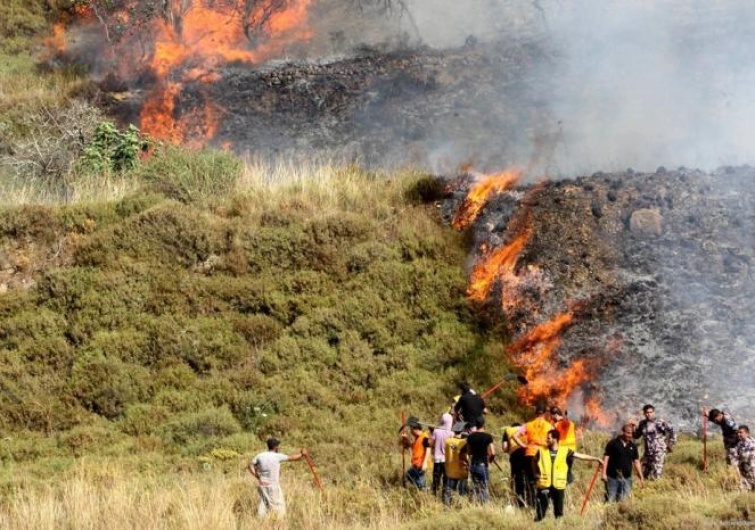

Over three bloody years, hundreds of thousands of Russians and Ukrainians were killed in the fighting, many more were wounded, millions of Ukrainians were displaced and entire cities were reduced to rubble or torn apart by trenches, in a shocking reminder of World War I.


American position reversal

Today, on the third anniversary of this war, positions on it have been turned upside down. The United States has changed its alignment, Europe is outside the discussions, Ukraine is looking for bitter options, and the sponsors of mediation and its location have changed from Helsinki to Riyadh. US President Trump, who promised to end the war, has begun communicating with Moscow and sent his negotiators to meet with the Russians.


In theory, the talks should resolve the conflict this year. But in practice, there is no sign yet that this will happen. Ukraine is effectively out of the negotiations amid an unprecedented escalation of political and personal attacks with Washington. Europeans are angry and disappointed by the “preliminary concessions” that Russian President Vladimir Putin made before the negotiations even began, without offering anything in return. He has even reiterated his demands, which he has raised since the first day of his “special military operation”: disarming and subjugating Ukraine, “defeating the neo-Nazis” there, and preventing it from joining NATO.


Trump sticks to his vision

With Trump clinging to his vision of resolving the conflict without the “guarantees” that Ukraine is demanding, especially in the security field for its future, the result may lead to him discovering the complexities of this conflict, which may at least prevent the expectation of quick solutions, or ultimately lead to his withdrawal from the negotiations, whether he wants to resume support for Kiev, in response to Putin’s insistence on his demands, or he chooses “neutrality” that may serve Moscow, even if indirectly.


Some believe that Kiev, despite realizing the importance of American support, cannot bear the idea of defeat after all the sacrifices it has made. If Trump sticks to his vision of imposing a solution, it may find itself forced to continue fighting. The Europeans are also convinced that Moscow will not stop its attempts to subjugate not only Ukraine, but also to rebalance the continent as a whole, and that Putin will continue to try to seize or destroy as much of Ukraine as possible before any peace agreement, and they point to the Russian troop buildup in Belarus as evidence of his readiness to threaten other European countries.
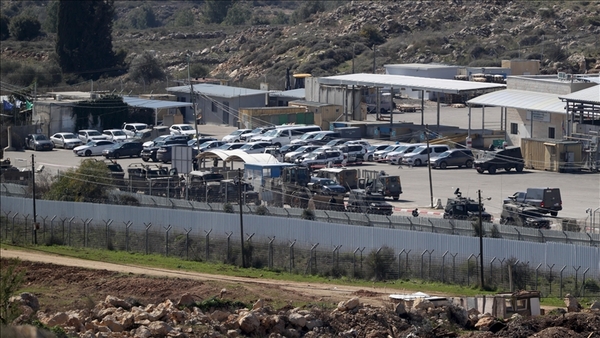
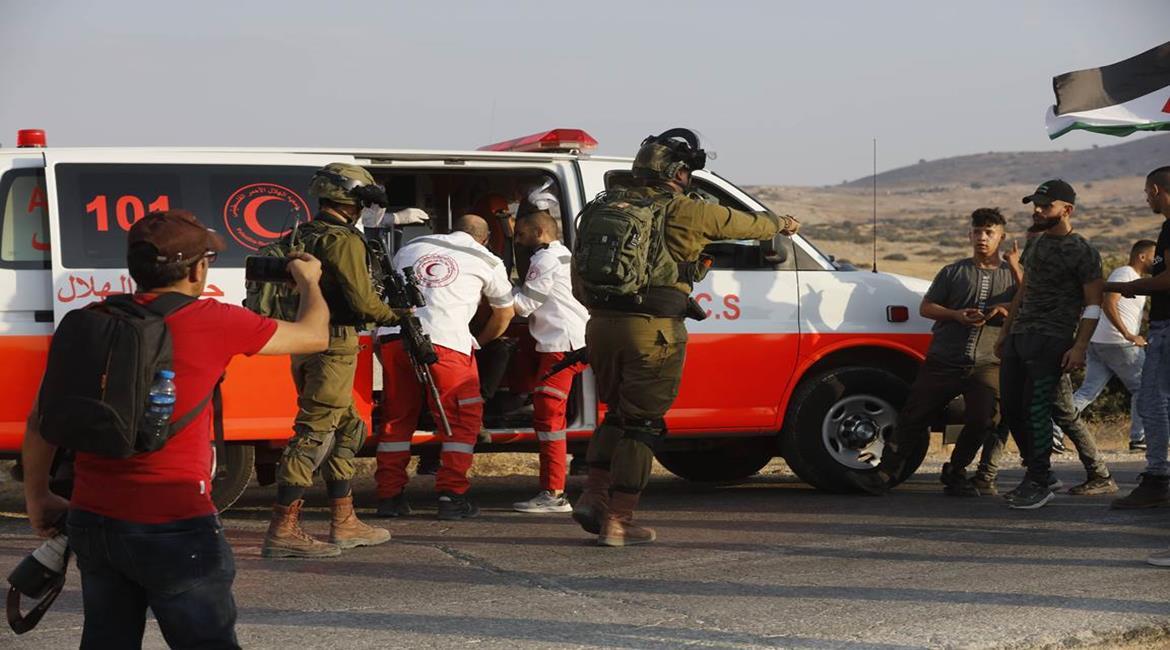

Stagnation of fronts

In reality, however, the war in Ukraine had reached a clear stagnation, since before the change in the international scene, after the return of US President Donald Trump to power. Although the United States initially sided with its European allies against Russia, their behavior together did not suggest their readiness to quickly resolve the war in Ukraine’s favor. Instead, it became clear that prolonging the war was aimed at exhausting Russia for a long time, without allowing Ukraine to become a strong player on the European stage, in light of the approaches and reservations that the Europeans have always expressed about the role that Kiev could play. This was translated into gradualism, hesitation, and “trickle-down” in providing American and Western weapons or in allowing their use. As Russia continued to seize Ukrainian territory, albeit at a slow and costly pace in terms of human and economic costs that could no longer be tolerated, in contrast to Ukraine’s steadfastness, which was also costly, the two countries achieved parity only in directing their long-range strikes, and succeeded in transforming into two countries fully mobilized for war.


Changing nature of international conflict

But regardless of the outcome of the negotiations, the war in Ukraine has already changed the nature of conflict around the world, and the new US position on it poses more radical challenges, given its outlook on international conflicts and its priorities of achieving “America First” and achieving “peace through strength.”


Trump summarizes his justifications for his position on the war in Ukraine in several points. He says that Washington has provided more than $300 billion in aid to it. But the benefits it has achieved are disproportionate to this spending, and came at the expense of American taxpayers. With his slogan of cutting spending and streamlining the federal administration, and to compensate for this aid, he seeks to obtain an agreement to exploit precious metals in exchange for weapons and other aid that Kiev has received. It seemed that the negotiations initiated by his Treasury Secretary, and continued by his special envoy, Keith Kellogg, and the pressure he is exerting, may lead to its submission and the signing of an agreement soon that would satisfy Trump first and foremost.


US aid

But his numbers do not match the report of the US Department of Defense Inspector General, which revealed that the total financial aid allocated by Congress to Ukraine since the start of the Russian-Ukrainian war three years ago has reached $183 billion, provided by several federal agencies, including the Pentagon, the State Department, and the US Agency for International Development. He explained that about three-quarters of the financial allocations, equivalent to $132 billion, were spent to meet military needs, with more than $45 billion of that allocated to the Pentagon to replace equipment sent to Kiev.


According to an investigation conducted by the Russian news agency Novosti, the value of non-military Western financial aid to Ukraine over the course of 3 years amounted to $238.5 billion, while the value of military aid amounted to $132.5 billion.


Europe out of protection

Trump says that the relationship with Europe and NATO has always been at America’s expense. While his country bears the responsibility of protecting the continent and the majority of the alliance’s military spending, Europe has been building a “welfare” state, abandoning its role in protecting itself. Today, with the change in American strategy and its focus on competing with China, he has called on the alliance countries to increase their military spending to 2, 3, and even 5 percent, because protecting Europe is no longer Washington’s priority, and it must protect itself from any Russian attack, as stated explicitly by US Defense Secretary Pete Hegseth in Germany recently.


With Hegseth announcing cuts to the Pentagon budget, which will include the US European Command, the African Command, and the Central Command in the Middle East, Europeans fear that the continent is facing a US withdrawal similar to the withdrawal from Afghanistan. Their warnings to take Trump’s threats seriously have escalated, after it seemed that the train of US-Russian negotiations would not stop at the stations they preferred. Some have come to believe that the United States may not remain an automatic ally of Europe, and will hardly be a partner unless it turns into an adversary.

PALESTINE

Sat 22 Feb 2025 7:29 pm - Jerusalem Time

The death toll in the Gaza Strip has risen to 48,329

Medical sources announced, on Saturday evening, that the death toll in the Gaza Strip has risen to 48,329 dead, since the start of the Israeli aggression on October 7, 2023.


The same sources added that the number of injuries has risen to 111,753 since the beginning of the aggression, while a number of victims are still under the rubble and on the roads, and ambulance and rescue crews cannot reach them.

PALESTINE

Sat 22 Feb 2025 6:52 pm - Jerusalem Time

Netanyahu announces the return of 192 kidnapped

Israeli Prime Minister Benjamin Netanyahu said, "So far we have recovered 192 kidnapped people, including 147 alive and 45 dead."


"There are still 63 kidnapped people in Hamas's hands," he added.


Netanyahu noted that "the government is committed to continuing to work to return all the living kidnapped to their families and the dead to be buried with dignity."


The newspaper "Israel Hayom" quoted the Israeli Prison Service today, Saturday, as saying that "the political leadership has not yet issued instructions to release Palestinian detainees as part of the seventh batch of the exchange deal."


The official Israeli Broadcasting Authority said, "Israel has postponed the release of Palestinian detainees in the seventh batch of the exchange deal until the end of security consultations, which Prime Minister Benjamin Netanyahu will hold this evening, Saturday, regarding negotiations for the second phase of the Gaza agreement."


This comes as the private newspaper "Israel Hayom" quoted the Israeli Prison Service as saying that the political leadership has not yet issued instructions to release Palestinian detainees in the current batch.

ARAB AND WORLD

Sat 22 Feb 2025 6:14 pm - Jerusalem Time

Senator Fetterman's staff resigns amid frustration over 'working only for Israel all the time'

The staff exodus from Sen. John Fetterman's office, D-Pa., continued Thursday with the departure of two new staffers.


The departure of the veterans reflects deep disappointment in Fetterman's office, known for its close ties to the Israeli lobby organization AIPAC, over his rejection of the progressive policies of the Democratic Party, his shift to the right in his openness to working with US President Donald Trump and his embrace of positions in support of Israeli extremists.


The “major staffing shift” at the office, a veteran of Fetterman’s team told The Intercept, comes amid a tough hiring environment for Democratic staffers in Washington.


“I don’t find this surprising,” said a former staffer on Fetterman’s last campaign, who asked to remain anonymous to protect his livelihood. “I think the staffers probably feel frustrated that working for Fetterman means you’re working for Israel all the time.”


“This is a guy who came out to talk about being a champion for working people and he didn’t talk about it,” they said. “This is a guy who, since Trump won, has basically become a useful idiot for Republicans. He supports things that are completely antithetical to Democratic political values, which gives them cover to say, ‘Look, he’s bipartisan, we got Fetterman.’”


The latest departures from Fetterman’s office are two of six due to his pro-Israel hardline stance, especially after October 7, 2023. Three of Fetterman’s top communications staffers left his office last spring after he claimed he was not progressive amid criticism from left-leaning colleagues for his aggressive pro-Israel stances.


After that round of resignations, Fetterman hired a new communications director, Carrie Adams. Adams left the office last month. Fetterman posted a job opening for a new communications director on Wednesday.


Al-Quds learned that the latest employees to leave the office are Charlie Hills, communications director in Fetterman's office, whose last day was Friday (2/21/2025), and legislative director Trey Easton, whose departure date is not yet clear.


The former campaign staffer said the staffers’ resignations were a sign that people in Fetterman’s office were tired of him abandoning campaign promises to make the economy easier on the working class; to be an advocate for the poor, immigrants and LGBT people; and to push for criminal justice reform in the Senate, and instead being a staunch defender of Israel and its policies.


Fetterman campaigned as a progressive and positioned himself as the only logical choice for Pennsylvania voters to fight Trump's influence in the 2022 Senate race. But shortly after taking office, Fetterman shed the mantle of progressivism.


Fetterman’s recent positions are a far cry from his 2022 campaign, which included a focus on cutting taxes for workers and celebrating immigrants, but since the October 7, 2023, attack, Fetterman’s office has ignored most of the issues he campaigned on, instead devoting all of its focus to working to support Israel, according to people familiar with his office’s work.


Since Trump took office last month, Fetterman has become a staunch ally of Republicans, especially in their positions that are fully supportive of Israel.

PALESTINE

Sat 22 Feb 2025 5:53 pm - Jerusalem Time

Israeli Settlers attack Bedouin communities in the plains of Jaba town, east of Jerusalem

This evening, Saturday, settlers burned down a house belonging to a family in the Bedouin community east of the village of Jaba’, north of Jerusalem. They also burned a vehicle owned by one of the community’s residents and fired heavy gunfire at the citizens.


Hassan Malihat, General Supervisor of the Al-Baidar Organization for the Defense of Bedouin Rights and Targeted Villages, stated in a press statement that a terrorist group from the “price tag” gangs burned a house and a vehicle belonging to citizen Daoud Muhammad Musa Kaabneh, a resident of the community, and fired heavy bullets at the citizens, and attacked property.


On February 11, the occupation government announced its intention to appoint a settlement official under its supervision to organize the terrorist acts carried out by the Hilltop Youth gang in the occupied West Bank, “in order to protect them and not distract the occupation army forces with security developments that would cause them to lose focus.”


Recent years have witnessed a significant increase in the number of members of the "Hilltop Youth" gang and those who carry its ideology, according to previous Israeli reports. This gang, like all settlers, lives in a state of great comfort under a government that promotes settlement and supports targeting Palestinians and expelling them from their lands.


The "hilltop youth" are a group of very extremist Jewish youth who live in settlements, outposts, farms and isolated settlement units. Despite being called "youths", most of them are in their twenties and older, and a large number of them are often involved in attacks on Palestinians.


PALESTINE

Sat 22 Feb 2025 5:17 pm - Jerusalem Time

Israel delays release of Palestinian prisoners until security consultations end tonight

The official Israeli Broadcasting Authority said that Israel postponed the release of Palestinian prisoners as part of the seventh batch of the exchange deal until the end of security consultations held by Prime Minister Benjamin Netanyahu on Saturday evening regarding negotiations for the second phase of the Gaza agreement.


This comes as the private Hebrew newspaper "Israel Hayom" quoted the Israeli Prison Service as saying that the political leadership has not yet issued instructions to release Palestinian detainees in the current batch.


As part of the seventh batch of the exchange deal, Hamas handed over 6 living prisoners to the Israeli side earlier today, and before that, it released 4 bodies of other prisoners on Thursday.


In return, Israel is supposed to release 620 Palestinian prisoners, including 50 sentenced to life imprisonment, 97 to be deported abroad, and 23 children arrested by the Israeli army from Gaza after October 7, 2023.

PALESTINE

Sat 22 Feb 2025 5:00 pm - Jerusalem Time

Suffocation injuries during Israeli occupation's storming of the town of Qusra, south of Nablus

Today, Saturday, a number of citizens suffered from suffocation, during the Israeli occupation forces’ storming of the town of Qusra, south of Nablus.


According to local sources, the occupation forces stormed Qusra amid heavy gunfire and tear gas bombs, which led to a number of citizens suffering from suffocation.

PALESTINE

Sat 22 Feb 2025 3:40 pm - Jerusalem Time

Death of a released prisoner after falling from a height in Issawiya

A freed prisoner from the town of Issawiya in occupied Jerusalem died this evening, Saturday.


Local sources reported that the freed prisoner, Nael Salama Obeid, was killed after falling from the roof of his house in the town of Issawiya, northeast of occupied Jerusalem.


Prisoner Obaid was released last week as part of the sixth batch of the ceasefire, noting that he had spent 21 years in the occupation prisons.

PALESTINE

Sat 22 Feb 2025 1:34 pm - Jerusalem Time

Hamas hands over the seventh and final batch of prisoners in the first phase of the exchange deal

On Saturday, the Al-Qassam Brigades handed over the seventh and final batch of prisoners as part of the first phase of the prisoner exchange deal.


The handover of the two prisoners, Tal Shoham and Avraham Mengistu, took place in Rafah. Mengistu had been captured 11 years ago, and Israel had previously refused to negotiate over him, while Tal Shoham had been captured in the October 7 operation.


The Qassam Brigades displayed destroyed Israeli weapons on the platform for handing over the prisoners in Rafah, after its fighters had seized these weapons in the Rafah battles during the ground war on Gaza.


The platform in Rafah carried the slogan "We are the flood...we are the great might", in addition to the verse "For red freedom there is a door that every blood-stained hand knocks on", which is the verse that Yahya Sinwar had appeared reciting in scenes broadcast by the Qassam Brigades of Sinwar in Rafah during the war.

The platform also carried a picture of the captive soldier Hadar Goldin, who was captured in the 2014 war, and the occupation announced his death, while Hamas refused to comment on his fate before conducting real negotiations to release him along with the three other captives it had in its possession at the time, namely: Abraham Mengistu and Hisham al-Sayed, who are being released in the seventh batch today, and Shaul Oron, whose body the occupation recovered after the ceasefire.


The Qassam Brigades handed over three other prisoners in Nuseirat in the central Gaza Strip: Ilya Maimon Yitzhak Cohen, Omar Shem Tov, and Omer Finkert. As for the sixth prisoner, Hisham al-Sayed, he was handed over in Gaza without any ceremony. Media outlets quoted a source in the Qassam Brigades as saying that the decision was made "as an honor to our people in the occupied interior," considering that Hisham al-Sayed is a Palestinian from 1948, and he is "among the exceptional cases of those who enlist in the occupation army, which is rejected by all Palestinians," according to the Qassam source.

On the handover platform, the Al-Qassam Brigades raised a banner that read, “The land knows its people... from the foreigners with dual citizenship.” The handover process was opened with the Palestinian national anthem.


In return, 151 prisoners serving life sentences and long sentences will be released today, as well as 445 prisoners from the Gaza Strip who were arrested during the war, in addition to women and children arrested from Gaza during the war; who were decided to be released in exchange for the four bodies that were released last Thursday.

Hamas spokesman Abdul Latif Al-Qanou said that 33 days have passed since the first phase without the occupation completing the implementation of all the terms of the agreement, stressing that the guarantee for completing the upcoming exchange operations is the occupation’s commitment to the remaining terms of the agreement and implementing the humanitarian protocol.

Al-Qanou added, in press statements coinciding with the handover of the two prisoners in Rafah, that the situation in Gaza is catastrophic, "which requires mediators to pressure the occupation to implement the humanitarian protocol and provide our people with shelter and relief supplies."

Al-Qanou reiterated the resistance's readiness to complete a "broad and complete one-package" exchange process based on a final cessation of war, the withdrawal of the occupation, and the reconstruction of the Gaza Strip. He continued: "We informed the mediators that the next day in Gaza is a purely Palestinian affair."

It is noteworthy that this batch is the last of the living prisoners who were agreed to be released in the first phase of the ceasefire and prisoner exchange agreement, while the release of 4 detained bodies is expected in the coming days.