PALESTINE

Sun 04 May 2025 4:36 pm - Jerusalem Time

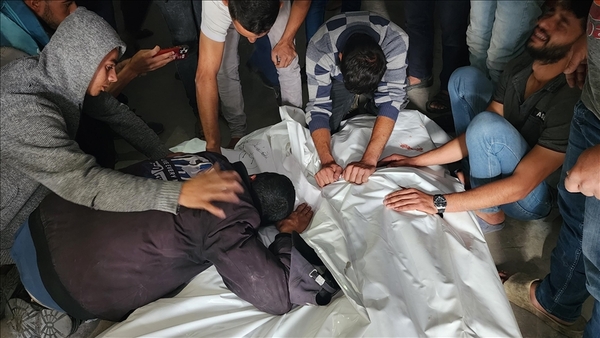
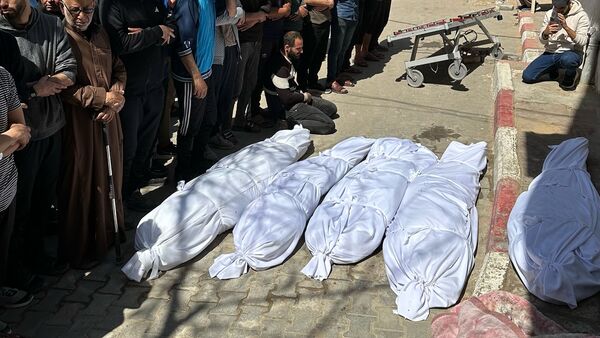
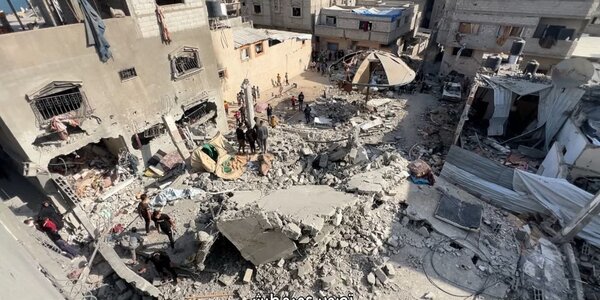
23 dead are the result of Israeli raids on the Gaza Strip since dawn today.

The death toll from Israeli airstrikes on the Gaza Strip since dawn on Sunday has risen to 23, including 19 in the southern Gaza Strip.


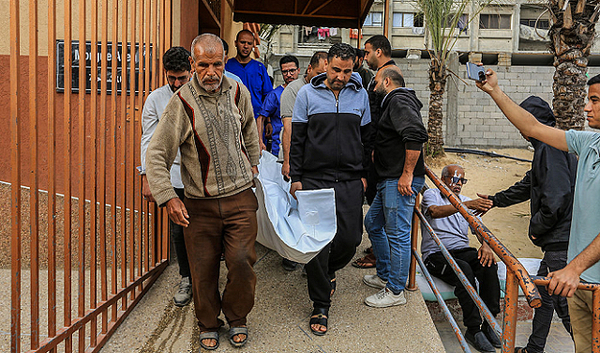
In Khan Yunis, south of the Gaza Strip, citizen Nisreen al-Abd Qassem was killed and others were injured when the Israeli occupation bombed the home of journalist Rami Abu Shamala in the al-Amal neighborhood of Khan Yunis.


Four members of the Qanan family were also killed in a bombing that targeted an apartment in the Al-Mawasi area, west of the city.


Ibrahim Bassem al-Najjar was killed and others were injured in an Israeli airstrike that targeted a tent housing displaced persons in the Wadi Saber area, south of the town of Abasan al-Kabira, east of Khan Yunis. Meanwhile, Salem al-Jabour and Bayan Naji Hussein al-Najjar died of wounds sustained in a previous airstrike on the city.


Earlier, ten civilians, including seven women and a child, were killed in an attack targeting a tent for displaced people in the Al-Mawasi area, west of Khan Yunis.


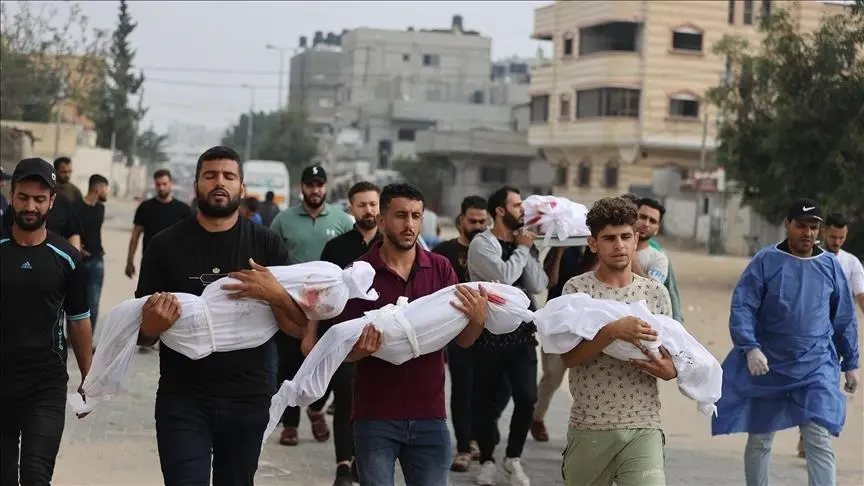
The body of the child Saif Abdel Rahman Al-Sinwar was also recovered, following yesterday's bombing of the Al-Bayram family home in Khan Yunis camp.


In the central Gaza Strip, citizen Fatima Raed Ahmed Abu Huwaishel was killed and eight others were injured in a bombing that targeted the Abu Huwaishel family home in the Nuseirat refugee camp.


In Gaza City, citizen Mohammed Habib (33 years old) was martyred, and his wife was injured, when occupation aircraft targeted the Al-Tuffah neighborhood east of the city.


In the northern Gaza Strip, citizen Hassan Zakaria al-Za'anin died of serious wounds he sustained in an Israeli bombardment of the town of Beit Hanoun a few days ago.


In the same context, rescue crews reported finding the body of martyr Khaled Ahmed Al-Kafarneh on the roof of Al-Shawa School in the town of Beit Hanoun.

PALESTINE

Sun 04 May 2025 4:05 pm - Jerusalem Time

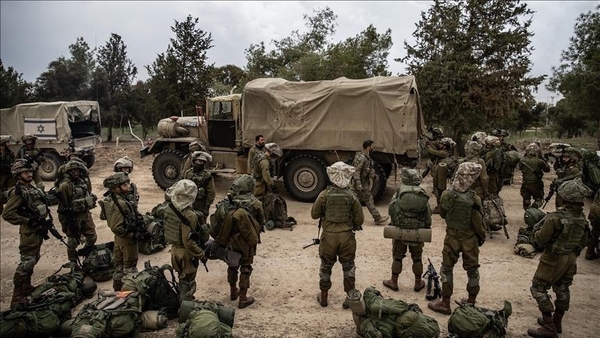
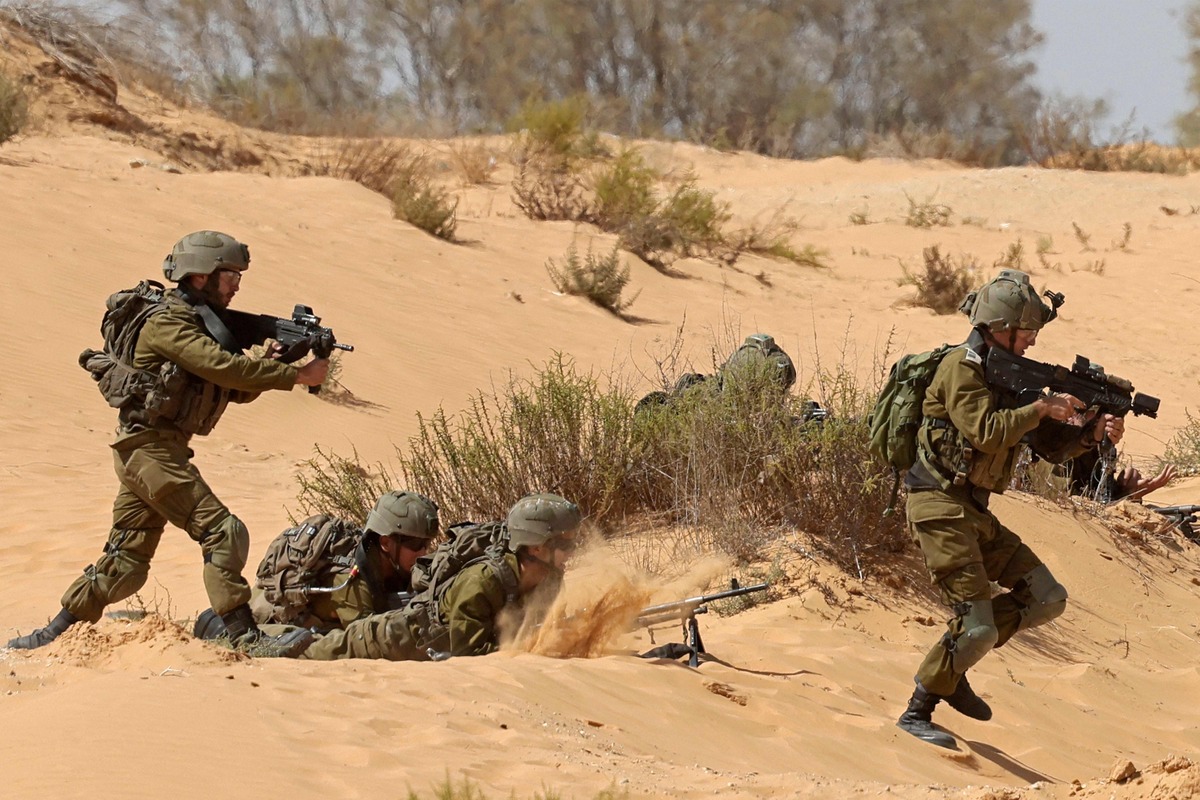
The Israeli occupation orders the recruitment of tens of thousands of reserve soldiers to expand the Gaza war.

Hebrew media reported on Sunday that tens of thousands of Israeli reserve soldiers received draft orders in preparation for an expanded war of extermination in the Gaza Strip, while many declared their intention to refrain from serving due to exhaustion.


Yedioth Ahronoth reported that "the security cabinet is expected to approve plans to escalate the fighting in Gaza today (Sunday), which will also require a large-scale mobilization of reserve forces."


According to the newspaper: "Over the past few days, tens of thousands of reserve soldiers have received notifications from their commanders, asking them to prepare for this."


For its part, Haaretz newspaper reported: "The Israeli occupation army began sending conscription orders to tens of thousands of reserve soldiers last night in preparation for expanding the scope of the fighting in Gaza."


The Israeli army was quoted as claiming that Hamas "continues to oppose the proposals presented in the negotiations."


Hamas said on Friday that it had presented a vision based on a comprehensive, simultaneous, five-year ceasefire agreement, which Netanyahu rejected and insisted on fragmenting the issues.


According to Haaretz, the army reiterated its position that "the declared goals of the war - foremost among them the return of the abducted (prisoners) - have not changed."


Tel Aviv estimates that there are 59 Israeli prisoners in the Gaza Strip, 24 of whom are still alive. Meanwhile, more than 9,900 Palestinians are languishing in its prisons, suffering torture, starvation, and medical neglect, many of whom have died, according to Palestinian and Israeli human rights and media reports.


The newspaper also quoted unnamed Israeli military sources as saying, "It is still unclear how long reserve service will continue under the new orders."


The same sources added, "The majority of the reserve personnel will be recruited to replace regular soldiers on the northern border and in the West Bank, with the aim of redeploying additional regular units to expand the fighting in the Gaza Strip."


The newspaper said: "With this, the Israeli army deviates from the planned framework of operational activity presented to reserve soldiers over the next 12 months."


She revealed that "even before the recruitment orders were sent out, many commanders and fighters announced that they did not intend to join the next round of combat, citing fatigue."


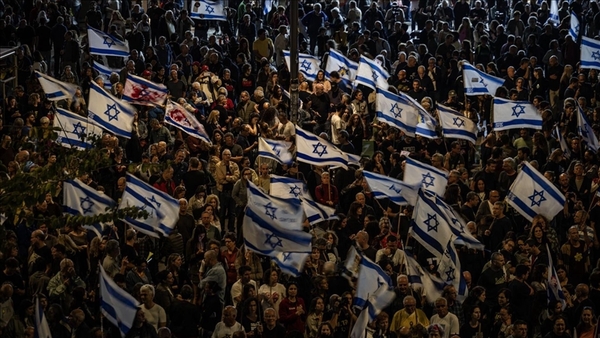
On Saturday, thousands of Israelis demonstrated in central Tel Aviv to protest the government's decision to expand the war of extermination in the Gaza Strip, believing it would kill living prisoners in the Strip and wipe out their bodies.


On Friday, Israeli Prime Minister Benjamin Netanyahu decided, during security consultations attended by Defense Minister Yisrael Katz and Chief of Staff Eyal Zamir, to expand the genocide in Gaza, including the call-up of thousands of reserve soldiers, according to Yedioth Ahronoth.


In early March, the first phase of a ceasefire and prisoner exchange agreement between Hamas and Israel, which went into effect on January 19, 2025, concluded with Egyptian and Qatari mediation and US support, and which the Palestinian movement adhered to.


However, Netanyahu, who is wanted by the International Criminal Court, evaded the start of the second phase and resumed the genocide in Gaza on March 18, in deference to the most extreme faction within his right-wing government, to further his own political interests, according to Hebrew media.


Since October 7, 2023, and with full American support, Israel has been committing systematic genocide in the Gaza Strip, leaving more than 170,000 Palestinians dead or wounded, most of them children and women, and more than 11,000 missing.

PALESTINE

Sun 04 May 2025 1:17 pm - Jerusalem Time

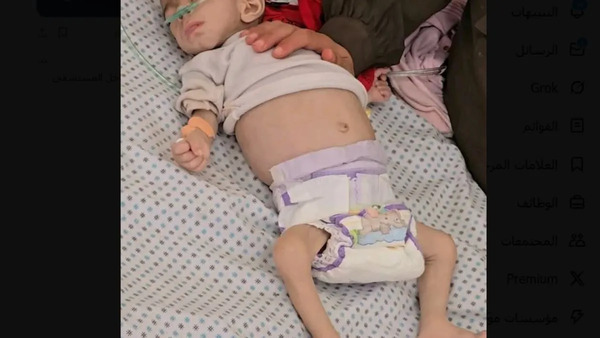
Janan died of starvation along with 57 other children and elderly people.

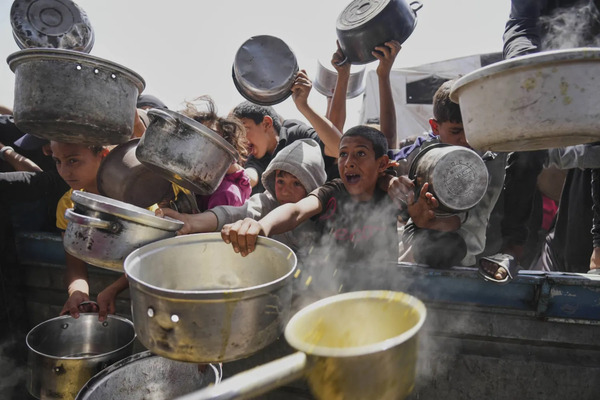
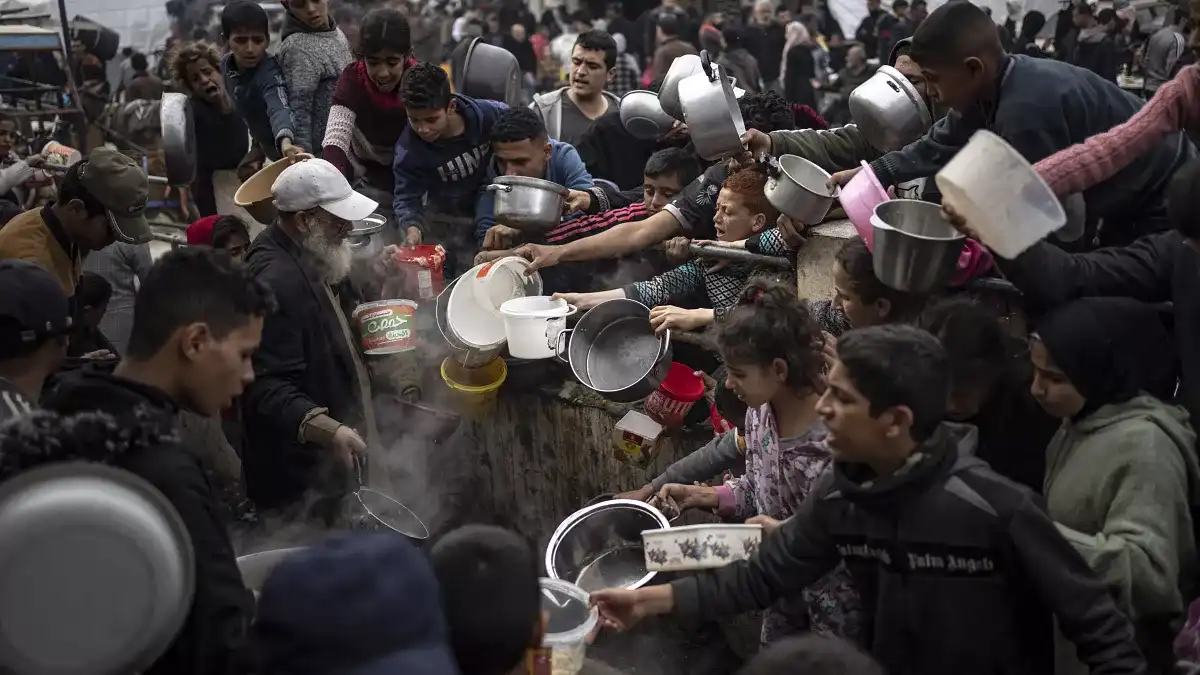
Yesterday morning, Saturday, infant Janan Saleh Al-Skafi died at Al-Rantisi Hospital west of Gaza City due to malnutrition resulting from the famine in the Strip, bringing the number of malnutrition victims in the Gaza Strip to approximately 57.

The infant, Al-Skafi, a resident of Gaza City, was receiving treatment and medical attention at Al-Rantisi Hospital, which had been rehabilitated after being bombed during the war.

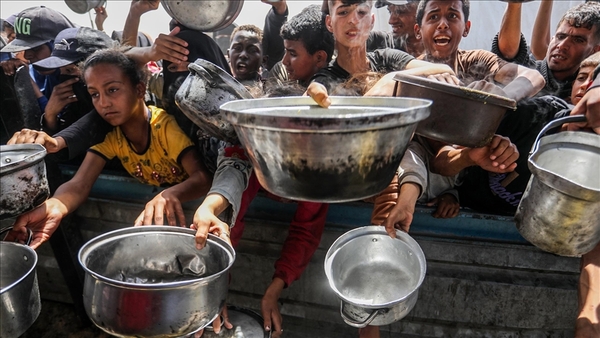
Medical sources reported that approximately 60,000 children are suffering from malnutrition due to the Israeli occupation's strict blockade of the Gaza Strip, its closure of all crossings, and its prevention of the entry of essential supplies and humanitarian aid, including food, water, medicine, and even fuel, for approximately 64 days.

UNICEF warned that more than 96% of women and children in Gaza are unable to meet their basic food needs. A United Nations report indicated that 1.95 million Palestinians out of a population of 2.2 million are suffering from critical levels of food insecurity.

Since the first hours of the devastating Israeli war on the Gaza Strip, starvation, particularly in northern Gaza, has been a weapon of mass destruction, genocide, murder, siege, and destruction.

The Government Media Office in the Gaza Strip said in a statement that the number of victims of starvation and severe malnutrition has risen to 57 since the start of the war, the vast majority of whom are children, but also include the sick and elderly.

The office condemned in the strongest terms "the Israeli occupation's continued use of food as a weapon of war and its imposition of a stifling siege on more than 2.4 million people in the Gaza Strip by completely closing the crossings for the 63rd consecutive day."

He added that the number of martyrs due to starvation is likely to increase "in light of the ongoing crime of completely closing the crossings and preventing the entry of humanitarian aid, baby formula, nutritional supplements, and dozens of types of medicine."

The Government Media Office called on the international community and humanitarian and human rights organizations to take immediate and effective action to open the crossings and allow the entry of food and medicine "before it is too late."

Meanwhile, aid organizations in Gaza stressed that food, water, and fuel are running out and that the prices of the remaining scarce supplies are unaffordable, according to the Associated Press.

Oxfam in Gaza said that mothers in the Strip are feeding their children only one meal a day amid a stifling hunger crisis.

The Palestinian NGO Network warned that 70 community kitchens in Gaza will close within a week if the blockade continues and aid is prevented from entering.

For its part, the Norwegian Refugee Council noted that food production in Gaza is almost impossible due to Israeli airstrikes on the agricultural sector, adding that the Israeli navy is targeting fishermen in the Gaza Strip.

The council announced that no relief organization in Gaza had any tents left to distribute to the displaced, saying, "If Israel continues its blockade of Gaza, thousands will die and the system will completely collapse."

He added that Israel has created a situation in which Palestinians in Gaza cannot grow their own food or fish.


medicine shortage

Meanwhile, the Kuwait Specialized Hospital in Rafah, south of the Gaza Strip, warned of a severe shortage of most essential medicines and foods for patients.

He stated that the Gaza Strip is suffering from a severe shortage of more than 75% of essential medicines, noting that the ability to continue providing medical services is at stake, given that stocks of medicines and medical supplies are insufficient for more than a week.

He stressed that most medical services would cease without urgent and immediate intervention.

Since March 2, Israel has closed the Gaza Strip's crossings to the entry of food, relief, medical aid, and goods, causing a significant deterioration in the humanitarian situation for Palestinians, according to government, human rights, and international reports.

OPINIONS

Sun 04 May 2025 12:35 pm - Jerusalem Time

The fall of regimes and the reality of sectarian fighting in the Arab East: Where are we headed?


Christine Hanna Nasr

The aftermath of the Arab Spring has had repercussions, particularly on the regimes that fell, particularly in Iraq, and also in Syria, specifically after the fall of the ruling Baath regime, which was represented by the Baath Party and a single party. After the fall of the former Assad regime and the assumption of power during the transitional period by the new Syrian President, Ahmad al-Sharaa, we note an increase in the problems accumulated as a result of the Assad family’s rule, which lasted for more than 55 years. Here, we note that it is a regime that left a legacy of devastation in Syrian society, represented by ethnic and sectarian divisions, especially when Syrian society was divided into several sections, including a section supported by Iran and Hezbollah, which supports the ruling minority with its Alawite component, and the other section of the Syrian Sunni component supported by Turkey and represented by the Syrian National Army, which supported and armed the Syrian National Army. Unfortunately, this created a major rift between the two components in one country, especially in light of the exclusion of other components by the ruling component, which monopolized power and controlled the country’s resources at the expense of marginalizing other components.

Unfortunately, after the fall of Bashar al-Assad’s regime and until now, everyone expected that Syria would enter a new phase of state-building, i.e., the new Syria, and what I can call the best phase for healing old wounds after years of revolution, with the aim of reaching a new phase of building a pluralistic, democratic, secure and stable state. Unfortunately, the alternative, especially in this transitional phase of governance, was to enter the scene of the Syrian state, which can be described as difficult and crisis-ridden, i.e., the phase of division and sectarian fighting, the pace of which has increased day after day, until we began to see scenes of sectarian fighting that would explode and destroy the fabric of Syrian society, and dismantle the national unity between the components of the single state. For example, what happened in the sectarian fighting in the areas of the Syrian coast with an Alawite majority, which ruled Assad’s Syria, as well as the sectarian massacres in Tartus and Latakia, where we witnessed a state of clear rift and psychological, political and social destruction, and an increase in sectarian fighting and the spread of sectarian manifestations in the state. Unfortunately, it is undoubtedly a remnant of the defunct regime, as Syria is now entering a phase of fighting. Sectarianism, including a bloody reality between the components of a single nation, is based on differences in religion, belief, and ancient inherited blood feuds. These massacres, committed against the Alawite component on the Syrian coast, have clearly been characterized by collective revenge against the Alawite component associated with the defunct Assad regime.

Damascus and its suburbs also witnessed an outbreak of bloody clashes, specifically in the Druze-majority suburb of Jaramana, and the town of Ashrafieh Sahnaya, administratively affiliated with the Damascus countryside. The number of victims in these areas increased due to the manifestations of sectarian fighting and clashes. Unfortunately, the conflict now in Syria is not a military or political conflict, but rather an existential sectarian conflict, the predominant feature of which is the accusation of treason against the different other, and an increase in the psychology and motives for revenge and murder among the various components of the same homeland. Here we find that society, instead of being cohesive, is losing its cohesion, and the respect for pluralism in one country is fading. Peace and coexistence are also absent, and flimsy, empty pretexts are used for sectarian fighting. Unfortunately, all of this is a remnant of the defunct Assad regime, which played a role in deepening the principle of exclusion and discrimination between the various components of society, and the regime’s monopolization of exclusionary rule that brutalizes others.

Here we find that Syria is now embroiled in a conflict that has deepened the increasingly abhorrent sectarianism, rather than calming the situation for this Syrian society, already exhausted by the war, which has lasted for more than 14 years and has left the people financially, economically, socially, security-wise, and politically exhausted.

Unfortunately, one of the factors deepening sectarian strife is the presence of armed foreign militias coming from neighboring countries. It seems that their goal is to prevent the new transitional government from succeeding in establishing security, but rather to distract it from establishing security and stopping internal fighting, instead of devoting itself to building the new Syrian state. Therefore, the factions and foreign fighters must be removed from Syrian territory. Now in Syria, it is clear that there is no national reconciliation between the components of a single nation, as we are witnessing the concept of a narrow state, meaning the loss of the feeling of the principle of tolerance between its various ethnic components. The state must be a strong state with its various cohesive components, dominated by the character of strong national unity.

The question here is, when will homelands be built in the countries of the Arab East, which are witnessing wars? When will the sectarian structure of these countries and societies disintegrate? When will a strong national structure take root in its place and will just civil rule be imposed on all the various components of the state? In other words, when will we face a model of a strong, secure, and diverse state that is not based on sectarianism, revenge, and infighting between the various components of the people? When will a social contract be built whose goal is citizenship, not sectarian infighting or narrow, supremacist ideas? When will society succeed in establishing comprehensive national dialogues to unify them and achieve their unified demands, along with succeeding in fortifying society against factors of collapse, along with achieving success in spreading civil peace and preventing internal collapse.

The answer is that there is no exploitation by any country with external influence and through a loyal army linked to it, which it unfortunately exploits to inflame the internal situation and create a state of sectarian strife, in order to achieve its external goals, which it will achieve by creating a state of internal chaos in countries, in order to achieve gains for external forces that do not care about the citizen and the homeland, but rather its primary goal is to weaken countries and societies in order to dominate them, occupy them, control the capabilities of the homeland and divide it socially and geographically.

PALESTINE

Sun 04 May 2025 12:28 pm - Jerusalem Time

13 Palestinians dead including a child and 8 women, and wounded in the occupation's bombing of various parts of the Gaza Strip.

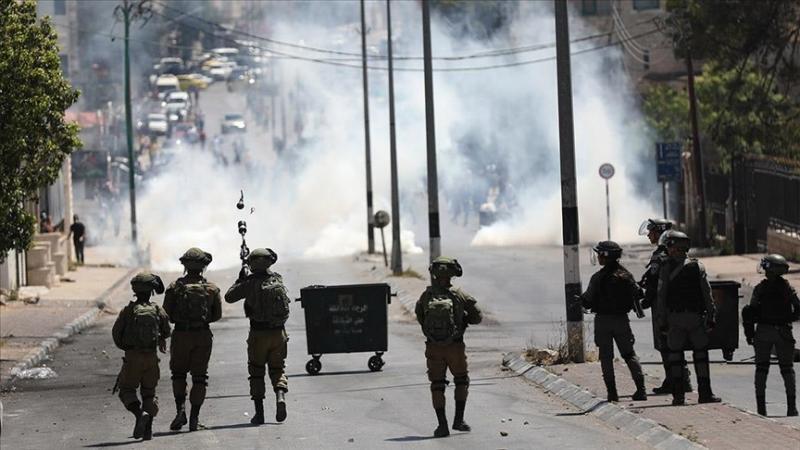
Thirteen civilians, including a child and eight women, were killed Sunday morning in Israeli shelling of various parts of the Gaza Strip.


Local sources, citing medical sources, reported that two civilians, including a woman, were killed and others were injured when the occupation forces bombed a home belonging to the Abu Huwaishel family in the Nuseirat refugee camp.


The same sources added that 10 citizens, including seven women and a child, were killed when the occupation forces bombed a tent housing displaced persons in the Al-Mawasi area, west of Khan Yunis.


It noted that two citizens died of their wounds as a result of the occupation's bombing of Khan Yunis and Beit Hanoun.


Separately, medical sources in Gaza said that the occupation authorities are preventing international and UN organizations from accessing fuel storage sites designated for hospitals, claiming that they are located in red zones.

The same sources explained that the occupation is obstructing fuel supplies from reaching hospitals, threatening to shut them down, as they rely on generators to power vital departments.

It noted that the available fuel supplies in hospitals are sufficient for only three days.

Since October 7, 2023, the Israeli occupation forces have launched an aggression against the Gaza Strip, resulting in the deaths of 52,495 citizens, the majority of whom were children and women, and the injury of 118,366 others. This is a preliminary toll, with a number of victims still under the rubble and on the streets, unable to be reached by ambulances and rescue teams.

PALESTINE

Sun 04 May 2025 11:51 am - Jerusalem Time

The Palestinian Government Communication Center monitors the most important interventions implemented by the government during the past week.

The Government Communication Center issued a report outlining the most important developmental and reform interventions implemented by the Palestinian government during the past week (April 27, 2025 - May 3, 2025), as follows:

The report explained that Prime Minister and Foreign Minister Mohamed Mustafa held discussions in London last Monday with his British counterpart, Keir Starmer, and Foreign Secretary David Lammy regarding the Israeli aggression on Gaza and the West Bank, including Jerusalem. They emphasized the need for a ceasefire and the entry of humanitarian aid.

It was agreed to upgrade relations to a strategic partnership, sign a memorandum of understanding to enhance cooperation in various fields, and affirm commitment to the two-state solution and ending the occupation as the only path to achieving a just peace.

Britain also expressed its intention to recognize the State of Palestine and the Palestinian people's right to self-determination, and announced a £101 million support package to strengthen the Palestinian economy, governance, and institutional reform.

The Palestinian Energy and Natural Resources Authority signed a $655,000 agreement to supply medium and low-voltage cables to the Gaza Strip.

- A government-funded project was also completed to install 200 kilowatt solar cells in the Solomon's Pools area of Bethlehem, with the aim of supplying service buildings with sustainable energy and reducing reliance on external sources.

The Water Authority in the Gaza Strip is carrying out maintenance work on 25 wells and distributing desalinated water at a rate of 1,300 cubic meters per day, in cooperation with UNICEF. It also signed an agreement with the German government to implement a sustainable management program for non-conventional water, with the aim of improving wastewater management and sustainable reuse. The Authority is also continuing to study the site of the Malaki Dam as part of a project that includes a treatment plant in Tulkarm and the transfer of water from Nablus to the Jordan Valley for use in agriculture and renewable energy generation.

The Ministry of Agriculture launched a unique project to support the resilience of farmers in the Jerusalem Governorate, in cooperation with the Bayt Mal Al-Quds Agency in Rabat, through an urgent aid package to provide production inputs.

The Minister also discussed with the Shuyukh Municipality the needs of farmers and the development of the Martyr Khalil Al-Wazir Nature Reserve. The Ministry opened agricultural offices in Kafr Thulth and Al-Funduq/Qalqilya to enhance services, and implemented three training courses in Nablus as part of the "Relap" project, benefiting 79 farmers. Within the framework of the same project, 27 small grant agreements were signed with Jenin farmers. The Ministry received the first phase of the Samou Station for Animal Breed Improvement, funded by the European Union. This phase included a laboratory, a training hall, and other facilities.

The Ministry distributed 790 olive seedlings to 12 farmers in Salfit as part of the "Greening Palestine" project, and 130 5-cubic-liter water tanks to 35 Bedouin communities in Jerusalem, with funding from the FAO.

Three training days were also held for 60 female farmers in Bethlehem on milk production, a field day at Al-Ummah School in Al-Ram to plant a garden, and an organic fertilizer production workshop for female farmers in Al-Auja in the Jordan Valley.

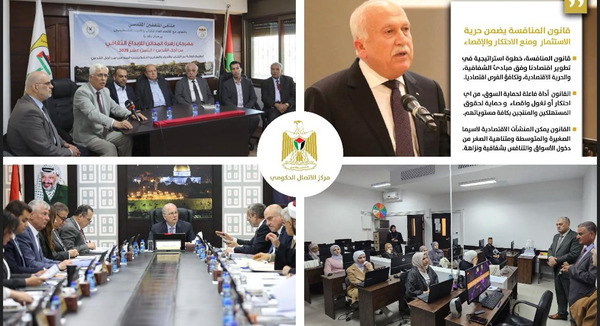
The President issued a decree-law on competition to foster a fair investment environment and prevent monopolies, building on the Ministry of National Economy's efforts to promote competition and prevent monopolies. The Ministry also announced the opening of import applications for goods within the 2025 quota, referred five violators to the Public Prosecution, issued 29 notices, seized 19.5 tons of non-compliant goods, conducted 94 inspection tours, and collected 15 samples for testing.

The Ministries of Local Government and Finance completed settlement and clearing procedures for three new local authorities. The Minister of Local Government also conducted an inspection visit to Jenin Governorate to review relief efforts for displaced persons and the needs of local authorities.

This week, the Ministry completed several street rehabilitation projects in Beitunia, Zeita, Marka, and Dura, in addition to delivering a waste truck to the Halhul Municipality through the Municipalities Fund.

The Wall and Settlement Resistance Commission supported the steadfastness of the residents of Sinjil and Anata in the face of settler attacks, by distributing tents and building materials such as wooden planks, zinc sheets, and water tanks.

The Ministry of Jerusalem Affairs participated in the 18th "Flower of Cities" Festival, affirming its continued support for culture despite the expulsion of its minister from the West Bank. The festival honored writers from Palestine, Jordan, and Egypt, in the presence of national and cultural figures.

The Ministry of Foreign Affairs and Expatriates continues to direct Palestinian embassies around the world to enhance diplomatic and humanitarian efforts and expose the crimes of the occupation.

The Minister of State for Foreign Affairs also participated in the 163rd session of the Council of the League of Arab States, stressing the importance of supporting the wounded in Gaza and the Palestinians in Egypt. She also presented a comprehensive briefing to the Arab Ministerial Committee on Jerusalem, calling for confronting attempts to displace our people.

The Ministry of Culture launched 37 cultural projects, including 11 to support the resilience of creative individuals in Jerusalem. The Minister of Culture also launched the Jerusalem Award for Arab Women in Literary Creativity and met with cultural and youth figures in the Tubas Governorate to promote the role of culture.

Palestine participated in an international meeting to protect heritage, while the Ministry organized numerous cultural events in the governorates, including literary and educational workshops, theatrical performances, seminars, evenings, youth gatherings, and folk tales. The events aimed to support national identity, empower women, and enhance the presence of culture in marginalized areas threatened by settlement expansion.

The Ministry of Public Works has completed the rehabilitation of the alternative road between Masha and Az-Zawiya in Salfit, carried out maintenance work on roads damaged by low-pressure systems in Hebron, and paved and leveled the connecting and ring roads in Qalqilya in cooperation with the municipality.

The Environmental Quality Authority followed up on 17 complaints, conducted 51 inspection tours of industrial facilities, and monitored the effects of a fire at a random landfill northwest of Ramallah. It issued a report documenting Israeli environmental violations during the first quarter of 2025, and organized awareness-raising activities and planted medicinal seedlings in areas threatened with seizure, with local community participation.

In its 58th session, the Cabinet approved recommendations for preparing the 2025 legislative agenda. The Minister of Justice also discussed with a delegation from the UNDP and Sawasya the "Business and Human Rights Frameworks" initiative, aimed at enhancing integration between the justice and economic sectors and developing alternative means of dispute resolution.

The Ministry of Tourism and Antiquities launched the first phase of the General Inventory of Tangible Cultural Heritage in Palestine project, and a cultural tourism trail in the Old City of Al-Bireh to raise awareness of heritage and support local products. It also concluded the "Know Your Country" program, in cooperation with the Ministry of Education and the Jericho Municipality, to introduce students to archaeological sites.

The Ministry of Awqaf and Religious Affairs implemented a series of religious, educational, and social activities, most notably honoring hundreds of male and female Quran memorizers in Jenin, Hebron, and Ramallah. The Ministry also launched specialized courses in inheritance law and Quran memorization as part of the "Distinguished Memorizer" program in Tulkarm. Women's training courses in Nablus aimed at empowering women economically were also held, as were awareness-raising workshops in Jenin and Dura, and a lecture on cyber-extortion in Hebron.

The Ministry of Social Development continued its relief efforts over the past week. The minister conducted a field visit to Jenin to monitor the conditions of displaced persons, announcing the collection of 1.5 million shekels and the distribution of 426,000 shekels across the directorates. She also inspected shelters hosting 600 displaced families.

In Tubas, the Ministry of Development provided aid worth NIS 60,000. In Tulkarm, it distributed 500 mattresses and 500 hygiene kits worth NIS 127,000. The Ministry's directorate in Qalqilya also sent aid worth NIS 12,250 to Tulkarm. Various interventions were also implemented in Nablus, Yatta, Jerusalem, Jericho, and Bethlehem, including psychological support, protection files, health insurance, economic empowerment, and honoring 29 active organizations.

The Ministry of Education and Higher Education held a series of meetings to follow up on the implementation of a joint Jordanian-Palestinian initiative to support students from Gaza who are expected to graduate. This initiative allows them to complete their courses through free self-study. With the participation of the Minister of Education and Higher Education, Birzeit University launched the Graduate Student Research Forum for the 2024-2025 academic year. The Minister also discussed with the French Development Agency (AFD) support for Nablus University's vocational and technical education. The Ministry also organized an introductory workshop on the Horizon Europe program, with the participation of European experts.

Palestine achieved an exceptional accomplishment by taking the top three places in the Quantum Computing and Artificial Intelligence Hackathon, held in Abu Dhabi from April 24 to 28, 2025, with the participation of international teams. This achievement came after Palestinian teams qualified through the Palestine Quantum Computing Hackathon, organized by the Ministry of Telecommunications and Digital Economy in cooperation with the Palestinian Computing Hackathon Committee.

The Minister of Labor signed an agreement with the Gift of the Givers Foundation to provide urgent in-kind assistance to affected workers in camps in the northern West Bank. She also called on donors to support Palestine's accession to the International Labor Organization as an observer, and to promote initiatives in entrepreneurship, telework, occupational safety, and vocational education and training.

In support of citizens' steadfastness in areas threatened with confiscation, the Ministry of Transportation continues to facilitate the licensing of tractors and the updating of drivers' licenses on the spot, without the need to visit the directorates. Approximately 100 licenses have been granted in the south and east of Ramallah.

The Ministry is also working to strengthen infrastructure in Tulkarm and Jenin, in cooperation with municipalities.

ARAB AND WORLD

Sun 04 May 2025 10:58 am - Jerusalem Time

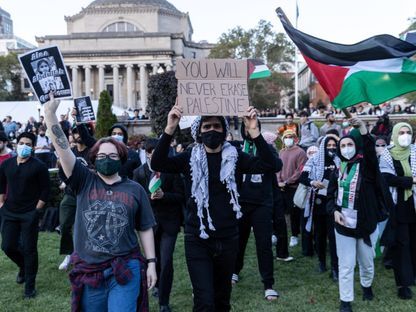
Columbia University Protesters' Investigation Orders Concern the Justice Department

The New York Times revealed that informed sources told the newspaper that a senior Justice Department official appointed by Trump ordered an extensive investigation into the Columbia University student protesters over the past few months, sparking anger and concern among prosecutors and investigators who viewed the request as politically motivated and lacking legal basis.


The sources added to the newspaper that the request to investigate students who protested Israel's conduct in the Gaza conflict also drew opposition from a federal judge, who deemed some of the steps sought by the official, Emil Bove III, unjustified and potentially violating the First Amendment to the US Constitution.


The scope of the investigation, conducted by the Justice Department's Civil Rights Division, has not been previously reported. The ensuing dispute highlights the tensions gripping the department as administration officials seek to implement President Trump's agenda. This proposal involves redirecting the Civil Rights Division away from its traditional approach of protecting minority rights to a new mission: fulfilling a campaign promise to crack down on student protesters amid allegations of rampant anti-Semitism on campus.


According to current and former officials, these demands from political appointees at the Justice Department are part of the reason for the exodus of lawyers from the department in recent weeks.


The federal investigation into the student protests at Columbia University appears to have stalled for now, but it represents one of the most contentious episodes so far within the Justice Department during Trump's second term. The people told the newspaper that the dispute has created ongoing ill will within the department, as well as in the courts and the FBI.


When asked for comment, Deputy Attorney General Todd Blanche said, "This is a false story concocted by a group of people who have allowed anti-Semitism and support for Hamas terrorists to fester for years, standing by and doing nothing."


The Trump administration has pledged to address the university protests against Israel's military campaign in the Gaza Strip, saying they reflect anti-Semitism that warrants punishment. These efforts target both college administrators, whom Trump officials say should have done more to curb campus protests, and the student activists themselves, some of whom have been detained by immigration officials. The activists, in turn, accuse authorities of conflating criticism of Israeli and US policies with anti-Semitism.


The investigation began shortly after masked protesters stormed Milbank Hall, a building at Columbia University's Barnard College, on February 26 to demonstrate against the expulsion of students accused of disrupting a Modern Israel History lecture. Video footage shows students shoving a security guard and occupying a hallway. School officials said the guard was assaulted and hospitalized with minor injuries. Boff, a senior Justice Department official, ordered an immediate investigation, primarily into one specific student group, Columbia University Against Apartheid, according to three people familiar with the matter who spoke on the condition of anonymity to discuss details meant to remain confidential.


At Pough's urging, prosecutors in the Civil Rights Division were asked to obtain a list of the group's members. However, investigators rejected this instruction because they were skeptical that such a list existed, given the opaque nature of online forums. Even if it did exist, vetting people's memberships seemed like a potential violation of their First Amendment rights, according to these individuals.


One of the Justice Department lawyers assigned to the case was Samantha Tribble, a seasoned civil rights prosecutor who secured a federal conviction against Derek Chauvin, the Minneapolis police officer who killed George Floyd in 2020, the people said. The people said prosecutors told them that Poff was seeking a list so the information could be shared with immigration agents. The people said prosecutors within the Civil Rights Division feared their criminal investigation could be used to facilitate a Trump administration campaign of intimidation and deportation against student protesters. They added that prosecutors refused to compile such a list that could be provided to Immigration and Customs Enforcement agents. The people said Poff then shifted his focus to obtaining a search warrant for the group's Instagram account. They said they instructed prosecutors to request a search warrant for non-public data associated with the account.


These people said that prosecutors' superiors informed them that Poff was seeking a list so that the information could be shared with immigration agents. These people said that prosecutors within the Civil Rights Division had become concerned that their criminal investigation was being used to facilitate a campaign of intimidation and deportation by the Trump administration against student protesters. They said that prosecutors refused to compile such a list that could be provided to Immigration and Customs Enforcement agents. They added that Poff then shifted his focus to obtaining a search warrant for the group's Instagram account. They said they instructed prosecutors to request a search warrant for non-public data associated with the account. They said the premise of the request was also controversial within the department. Poff insisted that the Instagram account in question had been used to issue a threat, while prosecutors argued that the statement did not meet the legal definition of a threat. In late March, the social media company suspended the group's account for failing to meet its "community standards."


Blanch added in his statement that the search warrant request, which focused on Columbia University's campaign against apartheid, "included an image from CUAD's social media accounts showing the inverted triangle symbol used by Hamas to identify targets of violence, spray-painted on Columbia University property with red paint designed to look like blood."


He said the investigation was "ongoing," apparently referring to a related criminal investigation by federal authorities, which "included an independent judge finding good cause to believe there was evidence of land at Columbia University housing and concealing illegal immigrants."


Before Trump addressed the Justice Department on March 14, Blanch told the audience that the department was investigating whether anyone involved in the Columbia University campus protests violated civil rights and anti-terrorism laws.


Blanche expressed his firm belief in the wisdom of conducting such an investigation. But behind the scenes, the professional lawyers harbored deep doubts about the merits of the case they had been assigned to, and deep fears about the potential consequences of their refusal.


Bove's demands angered staffers in the Civil Rights Division, but many managers were afraid to respond, having watched Bove a month earlier press prosecutors in another division, the Public Integrity Division, to drop criminal charges against New York Mayor Eric Adams, according to the three people. That division, which once had about 30 lawyers, now has only a handful.


Bennett Gershman, a law professor at Pace University who specializes in prosecutorial ethics, told the newspaper that Mr. Bove's described behavior was "astonishing."


“He did something that prosecutors are absolutely prohibited from doing—using government law enforcement powers to attempt to intimidate these individuals or destroy their rights,” Gershman said. “This goes far beyond the bounds of prosecutorial professionalism and adherence to the principles of justice.” In his statement, Blanche said that “the unethical and inaccurate allegations made by deep state terrorist sympathizers, who have stood by as members of the Jewish faith, have been targeted across the country” and will not deter Attorney General Pam Bondi and the Department of Justice from “vigorously investigating criminal conduct and rooting out anti-Semitism.”


When federal prosecutors investigating the student protests applied for a search warrant, a New York magistrate judge denied the request, saying the government lacked sufficient cause, the people said.


In an unusual move, Poff insisted that the plaintiffs appeal the ruling to a district court judge, according to these people. After reviewing the request, Judge John J. Koeltl of the federal court for the Southern District of New York instructed Chief Magistrate Judge Sarah Netborn to reconsider the request, according to these people.


But the second time, the government lawyers' fate was even worse. Judge Netburn not only denied the search warrant request, but also ordered the government to abide by a special condition: If prosecutors try to refile such a request before another federal judge, they must include a transcript of the confidential discussions in her court, according to these people.


Part of the judge's skepticism stems from the absence of lawyers from the Manhattan federal prosecutor's office in the case, these people said. But prosecutors in the Southern District of New York were wary of signing on to the effort and had little role in it, according to these people. A spokesman for the U.S. Attorney's Office in Manhattan declined to comment.


While civil rights prosecutors conducted the investigation Bove requested, they often opposed specific steps he wanted to take, these people said, arguing that they were either not justified by the available facts or conflicted with the law and past practice, or both.


At one point, Bove instructed FBI agents on the New York Joint Terrorism Task Force to don their SWAT vests, go to the Columbia campus, and stand in formation near any protesters. These individuals said the instruction was viewed within the Civil Rights Division as completely inappropriate and a blatant attempt to intimidate students. The FBI agents did not demonstrate any such show of force.


By early April, the investigation appeared to be largely over, but nothing prevented Bove or others from reviving it. But in the aftermath, people familiar with the case said it only exacerbated ill will and mistrust between political appointees at the Justice Department's headquarters in Washington and the New York attorney general's office, as well as between those political appointees and veterans of the Civil Rights Division.

ARAB AND WORLD

Sun 04 May 2025 10:00 am - Jerusalem Time

Qatar rejects Netanyahu's statements, stressing its lack of "the lowest levels of moral responsibility."

Qatar has rejected Israeli Prime Minister Benjamin Netanyahu's accusations, describing his statements as inflammatory and irresponsible.

Qatari Foreign Ministry spokesman Majed Al-Ansari said in a post on the X platform on Sunday that the State of Qatar "categorically rejects the inflammatory statements issued by the Israeli Prime Minister's Office, which lack the minimum levels of political and moral responsibility."

Al-Ansari considered that "portraying the continued aggression against Gaza as a defense of 'civilization' brings to mind the rhetoric of regimes throughout history that have used false slogans to justify their crimes against innocent civilians."

He added that since the outbreak of the war on the Gaza Strip, the State of Qatar, in coordination with its partners, has worked to support mediation efforts aimed at stopping the war, protecting civilians, and ensuring the release of hostages.

He said, "A legitimate question must be raised here: Were at least 138 hostages released through military operations described as 'justice,' or through mediation, which is being criticized and unjustly targeted today?"

Al-Ansari continued, "On the other hand, the Palestinian people in Gaza are experiencing one of the worst humanitarian disasters of the modern era, from a stifling blockade and systematic starvation, to deprivation of medicine and shelter, to the use of humanitarian aid as a weapon of political pressure and blackmail. Is this the 'civilization' they are trying to market?"


The Qatari Foreign Ministry spokesperson emphasized that "Qatar's principled foreign policy does not conflict with its role as an honest and reliable mediator. Disinformation campaigns and political pressure will not deter it from standing with oppressed peoples, defending the rights of civilians regardless of their backgrounds, and advocating for international law without fragmentation or selectivity."

He also stressed that "the State of Qatar continues its close work with both the Arab Republic of Egypt and the United States of America to achieve an immediate ceasefire, ensure the flow of humanitarian aid, and advance a just and lasting peace based on the values of justice and humanity, not violence and double standards."

He concluded by saying, "The State of Qatar reaffirms its firm belief that true peace can only be achieved through a just and comprehensive settlement based on international legitimacy resolutions, ending the occupation, and guaranteeing the legitimate rights of the Palestinian people, foremost among which is the establishment of an independent state on the 1967 borders, with East Jerusalem as its capital."


Al-Ansari's remarks came in response to inflammatory statements issued by Netanyahu's office attacking Qatar for demanding that Israel, before the International Court of Justice, halt the genocide in the Gaza Strip and allow the entry of food and medical aid into the territory.

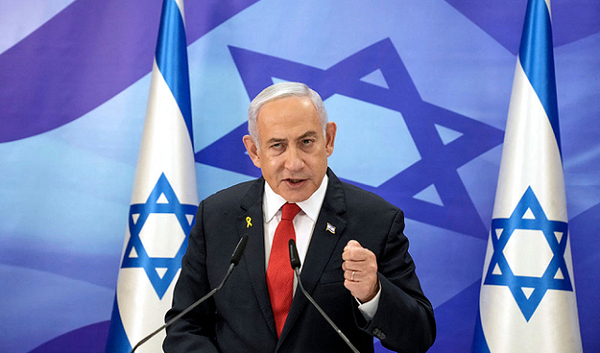
Netanyahu said, according to what was reported by his office, that "it is time for Qatar to stop manipulating opinions with its double standards and to decide whether it will stand with civilization or with the barbarism of (the Islamic Resistance Movement) Hamas," as he put it.

OPINIONS

Sun 04 May 2025 8:54 am - Jerusalem Time

The cruel departure

Hamada Faraana

Netanyahu was unable to achieve his goals in response to the October 7 operation. He failed despite occupying the entire Gaza Strip. He was unable to locate the Israeli prisoners and release them without a prisoner exchange. He failed to end and eliminate the resistance. Because he possesses the power, armament, and superiority, he chose the path of death for the Palestinians.

Not a single woman raised the white flag, and all of them who appeared said with truth and faith: We will not leave, we will remain above the rubble, the ruins, and the destruction, we will not leave here, we will stay, we will not leave, and the bombing and death will come to them.

Death is the harsh choice. It sweeps away the Palestinians there, and sweeps away friends here. The engineered unionist friend, Qaher Safa, departed too soon. The force of life did not defeat him, not in Yemen, not in Syria, not in Jordan. Death defeated him, and we lost him, because of his inability to continue protesting.

All those who lost him, disagreed with him, with his stubbornness, with his strength, with his belief in his refined and gentle Jordanian citizenship, and his steadfast Palestinian identity. He was an elected unionist who disagreed with the "Muslim Brotherhood" and confronted them, and allied with the leftists and nationalists and clashed with them. He was not just a number, but a unique kind of man. A unionist, a patriot, a professional, a nationalist, possessed of stubbornness, without any trace of hatred, possessed of giving and rejected rottenness, a heritage that was progressive, as well as conservative, a mixture of life's givens.

I don't think that the disease defeated him or overcame him, despite its damnable assault on him and his body, because I am certain from my knowledge of him, that he passed away because of his inability to protest sufficiently. The Israeli invasion of the Gaza Strip: killed him, the Israeli invasion of the Gaza Strip accompanied by death and killing, coincided with the disease, so he passed away rejecting what was happening to the people of Gaza, to his people who spent the details of his life pleading for his desire for freedom and to return to Palestine.

Protest and rejection are the title of Qaher Safa, its substance. He was not compromising even on the simplest requirements of life and his right to it, and for this reason he lost his rights to stability, reassurance, and equal citizenship like the rest of humanity.

He was unable to return, and died outside Palestine, along with his membership in the Palestinian National Council. The consolation for him is that Jordan, its people, and its soil remained warm with him. This is confirmed by the fact that the pure Jordanian soil embraced him and will continue to preserve it until he returns as part of what he had, through his family and friends, who will carry his trace and return with him towards the river, spreading his breath there after they cross the bridge, before they reach Jericho and Kafr Malik.

We mourn the loss of a friend, and we are deeply saddened by the destruction, killing, starvation, thirst, and deprivation of the right to life that is happening to the Palestinian people in Gaza.

This is how the people of Karak, Ma'an, Tafilah, Salt, Madaba, Jerash, Irbid and Ramtha, Bani Hassan and Bani Sakhr are, all those who love Jordan, adore it, owe it loyalty and dignity, live their daily lives in solidarity, and their noble human interaction with their people and their extension in Gaza, and even to the rest of Palestine. The pain is one, the dream is one, and Jordan's security, stability, progress, democracy and pluralism are the title of the Jordanian lever for the freedom and independence of Palestine. This is why we miss Qaher Safa, with whom we believed in the credibility of our Jordanian citizenship, and "our Palestinianness to the marrow of the bone", as I have said everywhere, and I say it and repeat it, and I will not back down from it. Loyalty to Jordan, as is loyalty to Palestine.

Qaher Safa has departed. May God forgive him and offer our condolences to his family. We will follow him, and we have no choice but to continue on the path he walked for a better future for all our people in Jordan and Palestine.

OPINIONS

Sun 04 May 2025 8:38 am - Jerusalem Time

An army that fears its image!

Amin Al-Hajj


As the occupation celebrates the 77th anniversary of the declaration of its state, in a scene that raised questions, the occupation army decided to conceal the faces of 120 of its soldiers during the annual ceremony to "honor" them. They were merely shown in a manner that concealed their features, without publishing their names. This decision may seem like a small detail in a security protocol, but in reality, it reflects profound implications that expose the contradictions in the discourse of "military pride" that it constantly boasts about. What does it mean to honor a soldier without a face? In essence, honoring is a celebratory act that shows appreciation and public recognition for someone who has performed a "heroic" act. But when a soldier is prevented from appearing publicly, or his face is hidden, the equation of honor turns into a state of fear. Is it honoring or concealment? Pride or denial?

Hiding soldiers' faces implicitly means that he is either unable to protect them, unable to bear the consequences of their actions, due to their involvement in violations that could lead to legal accountability, or simply fears that their identities will be known and they will be targeted. Here, the soldier is transformed from a "symbol of courage" into a ghost in a system that fears accountability.

But concealment doesn't just reflect an escape from accountability, but also an evasion of the self, as psychoanalysts have argued. What isn't perceived internally manifests externally in the form of "fate." Thus, the outside world becomes a stage for internal conflict. When a state is embarrassed to display its combat symbols, it declares—consciously or unconsciously—a loss of confidence in its moral narrative. What's hidden isn't just the face of a soldier, but rather a mirror of lost legitimacy, one that it fears confronting because it reveals what it seeks to deny. Concealment here isn't just a means of protection; it's a collective defense mechanism to protect a fractured narrative from collapsing in the face of a simple moral question: What have we done? Consequently, concealment here is no longer an option, but an existential necessity for a system that has come to recognize itself as morally and legally exposed.

The soldier's image is not merely a visual identity; it is a political narrative. Hiding faces in the age of the image is an implicit admission that the image has become damning evidence that incriminates, not exonerates. After a series of clips documenting his crimes against civilians—from killing and starving children and women to destroying homes—he realized that the image could transform him from a claimant to legitimacy into an accused war criminal.

In an unequal battle, the image may defeat the bullet, and awareness may prevail over force. Military superiority does not guarantee victory when the executioner is defeated in the media arena, the camera becomes a court, and the image becomes a weapon that moves the streets and tightens the noose on the machine of oppression. Although its influence is still limited, it is expanding day by day.

An army that cannot display photos of its soldiers is not worthy of being proud of. How can it be presented as the "most moral army," as its leaders claim, while concealing those it claims are "role models"? How can a society be proud of its army while keeping its "heroes" anonymous, for fear of international law or a public opinion that no longer believes the old lies?

What's worse is that this concealment exposes the depth of the moral dilemma it is experiencing. It knows that what it is committing on the ground, in Gaza, the West Bank, the displaced villages, and throughout the region, cannot be publicly defended or marketed as "national pride," even if it could temporarily. Therefore, in this context, the soldier is no longer a symbol of heroism, but rather a moral burden hidden from view, so that the world does not see the true face of the occupation. Thus, the occupation does not appear as it claims, but as it is: fearing its image, ashamed of its soldiers, and hiding behind false masks. The hero is not the one whose face is hidden, but the one who reveals it to the public to tell the story of the truth.


.........


An army that cannot display photos of its soldiers is not worthy of being proud of. How can it be presented as the "most moral army," as its leaders claim, while concealing those it claims are "role models"? How can a society be proud of its army while keeping its "heroes" anonymous, for fear of international law?


PALESTINE

Sun 04 May 2025 8:34 am - Jerusalem Time

The US and Israel are close to agreeing on a "new mechanism" to deliver aid to Gaza.

The United States, Israel, and representatives of a new international organization are close to reaching an agreement on how to resume the delivery of humanitarian aid to Palestinians in Gaza without Hamas controlling it, Axios reported, citing Israeli officials and a US source.

Israel suspended all humanitarian aid, including food, water, and medicine, to the Gaza Strip after the collapse of the ceasefire agreement in Gaza two months ago, exacerbating the humanitarian crisis.

UN relief agencies say food supplies in Gaza will run out within days, while Israeli officials claim the stock will be completely depleted within three to four weeks.

Axios reported that an internationally managed foundation supported by countries and charitable organizations will deliver aid to Gaza. It will be led by humanitarian figures and an advisory board of prominent international figures.

Israeli officials said that according to the plan, "several compounds will be established in part of Gaza, and Palestinian civilians will be allowed to go to them once a week to receive one aid package per family, sufficient for seven days."

A source familiar with the plan stated that "Israel has committed to funding and implementing the engineering work necessary to build the infrastructure for safe aid distribution sites," adding that the parties to the agreement are in advanced discussions with donor countries that will fund the organization's operations, including the purchase of humanitarian aid.

He continued, "A private American company will be responsible for delivering aid logistically and providing security inside and around the complexes."

Israeli officials stated that Israeli military forces will not participate in the distribution of aid and will not be present inside the compounds, but will provide security in the surrounding areas, according to Axios.

The website added that American and Israeli officials want the new mechanism up and running when US President Donald Trump visits the region in two weeks.

Trump is expected to visit Saudi Arabia on May 13, then travel from there to Qatar and the UAE.

Israeli officials said they want the mechanism up and running before Israel also expands its ground operation in Gaza, expected later this month if the stalemate in prisoner swap and ceasefire negotiations continues, according to Axios.

An informed source told the US website that the new mechanism will meet Trump's goal of allowing humanitarian aid into Gaza, while adhering to Israeli government directives that no aid reach Hamas.

A US State Department official added, "We understand that the mechanism will deliver aid to those in need, with guarantees that it will not be misused or abused by groups like Hamas and Islamic Jihad."

"President Trump and Secretary Rubio expect all UN agencies and international aid to work within the framework of the mechanism to ensure that these vital resources do not reach Hamas," the official continued, according to Axios.

Israeli officials say the new aid distribution system will weaken Hamas "because it will deprive it of revenue and reduce the population's dependence on it," Axios reported.


PALESTINE

Sun 04 May 2025 8:32 am - Jerusalem Time

Bombing of homes and tents, and marches pursuing gatherings of hungry people in front of the takayas and water wells.

39 martyrs, most of them children, in horrific massacres

11 martyrs from the Al-Bayram family were killed when their home in Khan Yunis camp was bombed.

10 martyrs in the occupation's bombing of the Ghattas family home in Shuja'iyya

A fisherman was killed and three others were injured by Israeli fire in the northern Gaza Strip.

Three civilians were killed and others injured after the bombing of the Al-Gharabli building on Salah al-Din Street.

4 martyrs in bombing of Al-Daraj neighborhood


The Israeli occupation forces continue their aggression against the Gaza Strip for the 46th consecutive day, resuming their genocidal war. This comes amidst the tragic humanitarian conditions facing the population, amid severe food and medicine shortages and a near-total collapse of basic services.


Since dawn yesterday, Saturday, 39 citizens, including children, have been killed as a result of the occupation's bombing of several sites in the Gaza Strip.

The death toll from the genocidal war on the Gaza Strip has risen to 52,495 martyrs and 118,366 wounded since October 7, 2023.

The Ministry of Health in Gaza reported that the death toll includes 2,396 martyrs and 6,325 injuries since March 18, when the occupation resumed its aggression on the Gaza Strip following the ceasefire agreement.

Over the past 24 hours, 77 martyrs arrived at Gaza Strip hospitals, including 7 who were recovered. 275 others were injured, and a number of others remain buried under the rubble and debris, as well as on the streets, unable to be reached by ambulances and civil defense teams.


In detail, the occupation committed new massacres by bombing the homes and tents of the displaced in Khan Yunis, which resulted in the martyrdom of 19 citizens, as the occupation aircraft bombed the home of the Al-Bayram family in Khan Yunis camp, which led to the martyrdom of 11 citizens, among whom were identified: Ayman Ahmed Al-Bayram (57 years old), Abeer Ayman Al-Bayram (23 years old), the child Muhammad Ayman Al-Bayram (11 years old), the infant Alma Yasser Khaled Awad (one year old), An’am Muhammad Al-Bayram (44 years old), Hiba Zidan Asaf (19 years old), the infant Saif Abdul Rahman Al-Sinwar (one year old), and the infant Yahya Abdul Rahman Al-Sinwar (one month old).

A martyr arrived at Nasser Medical Complex after his tent was targeted in the complex street, and his name is Bassem Al-Qudra. His wife and two sons were injured, while a citizen was killed and others were injured in the bombing of a tent sheltering displaced people in the Al-Mahta area. In addition, the child Hassan Abdul Tuman (4 months) was killed as a result of the bombing that targeted a tent for displaced people in the Asdaa area to the north.

In this context, ten citizens were killed and others were injured, after the occupation bombed a house east of Gaza City.

Local sources reported that civil defense and rescue teams recovered ten bodies killed when Israeli warplanes bombed the Ghattas family home on Nazir Street in the Shuja'iyya neighborhood.

Meanwhile, a drone targeted a group of civilians in the Daraj neighborhood of Gaza City, killing four and wounding others.

A number of citizens were killed and others injured on Saturday evening when Israeli warplanes bombed a residential building in Gaza City.

A correspondent for the official Palestinian news agency, WAFA, reported that at least three civilians were killed and others were injured after an Israeli warplane bombed the Al-Gharabli building on Salah al-Din Street, east of Gaza City.

In the same context, a number of civilians were injured after an Israeli drone dropped bombs near the Baptist Hospital in Gaza.

Two sisters were also killed yesterday evening when Israeli aircraft bombed a house in the town of Al-Fakhari, southeast of Khan Yunis, in the southern Gaza Strip.

A fisherman was killed and three others were injured by Israeli naval fire in the sea north of Gaza City.

The Israeli occupation artillery also shelled the Qizan al-Najjar area, south of Khan Yunis, in the southern Gaza Strip.

Meanwhile, a number of citizens were martyred after an Israeli drone bombed a group of civilians, killing several of them, including children, and wounding others, in the Al-Mawasi area west of Rafah.

A female citizen was killed and five others were injured after Israeli aircraft bombed a tent housing displaced persons in the Al-Barakah area of Deir al-Balah, central Gaza Strip.

A child was also injured when an Israeli quadcopter drone fired bullets at the Al-Huda camp for displaced persons in the Al-Zeitoun neighborhood, southeast of Gaza City.

The occupation forces also bombed land in the Al-Rahma camp for displaced persons in the Al-Maslakh area, west of Khan Yunis, in the southern Gaza Strip.


PALESTINE

Sun 04 May 2025 8:23 am - Jerusalem Time

The aid distribution mechanism: a dubious plan fraught with security and political suspicions.

Dr. Saeed Shaheen: The plan to distribute aid through an international mechanism is "necessary and dubious," and Israel is exploiting it politically and for security purposes.

Talal Okal: This mechanism is extremely dangerous due to its humanitarian and political repercussions, and will keep the people of Gaza "permanent hostages" at the mercy of this aid.

Yasser Manna: This mechanism is not a "humanitarian rescue plan," but rather an attempt to redesign the occupation and transform the disaster into a manageable, not accountable, or solvable, situation.

Samah Khalifa: This plan, which is being promoted as a humanitarian initiative, may be a cover for strengthening Israeli control over the Gaza Strip and serving future projects.

Imad Moussa: An unprecedented step in the history of conflicts, it aims to advance the genocide project through "humanitarian hands" that serve Israel and evade international accountability.

Muhammad Joda: The new mechanism is not a humanitarian step, but rather a political one aimed at redrawing the map of influence in Gaza using both soft and hard tools.

Amid an unprecedented humanitarian catastrophe in the Gaza Strip, widespread questions are being raised about a new mechanism being promoted for distributing humanitarian aid, under the supervision of donor countries and international institutions, and with direct Israeli oversight.

In separate interviews with Al-Quds, writers, political analysts, experts, and university professors say that while the plan appears to be an urgent need to save the lives of Gaza's residents, concerns are growing that it conceals political and security objectives behind the guise of humanitarian action.

They point out that this plan could become a tool for controlling and dominating the people of the Gaza Strip, particularly given the reported involvement of private security companies and Israeli military oversight of distribution points.

They warn that this initiative could be used to whitewash Israel's international image, while it continues to pursue its relentless military and aggressive policies. They point out that what appears to be an attempt to alleviate hunger is in reality "crisis management, not a solution," at a time when there is no real prospect of halting the aggression or reaching a just political settlement.

An important step, but...

Dr. Saeed Shaheen, a professor of political media at Hebron University, warns of the potential security and political dimensions of the mechanism for distributing humanitarian aid to the population of the Gaza Strip, which is reportedly being implemented through an international organization run by donor countries and charitable organizations, under direct Israeli supervision.

At the same time, Shaheen stresses the importance of this step in saving millions of lives amid the unprecedented humanitarian catastrophe facing the Gaza Strip. It is necessary but questionable, as Israel could exploit it politically and for security reasons.

Shaheen explains that the new aid distribution mechanism is being promoted as requiring Palestinian civilians in Gaza to receive "one aid package per week, sufficient for seven days," under direct Israeli security supervision.

Shaheen says, "Although this plan carries 'extreme danger and sensitive security implications,' it represents a 'top priority' at the present time, given the hunger ravaging the bodies of nearly two million Palestinians in the besieged Gaza Strip, a result of a systematic Israeli policy aimed at 'bringing Palestinians to their knees through starvation and thirst.'"

Shaheen points out that there are legitimate concerns that these aid distribution points could become "security centers under humanitarian cover," used to track Palestinian resistance fighters. He emphasizes that Israel does not take any step without careful consideration and planning.

Shaheen adds, "Everything Israel does is governed by careful calculations to reap political, security, and military gains. Today, it seeks to undermine Hamas's authority through this move, as part of a long-term strategy."

Shaheen considers this plan, despite its ambiguity and danger, "a positive step at this time," given the urgent need to save the lives of civilians who have become hostages to hunger and siege, amid a war of extermination that has been ongoing for more than 17 months.

The priority is to stop the daily killing and genocide.

Shaheen stresses that the priority remains to stop the daily killing and genocide that Israel continues to commit against women, children, and men.

Shaheen believes that through this mechanism, Israel "achieves double benefits." On the one hand, it appears responsive to international pressure, which alleviates political and diplomatic pressure. On the other hand, it continues its military operations without interruption, exploiting the world's preoccupation with other crises in the region.

Shaheen explains that Israel is working to divert international attention from its crimes in Gaza by "fabricating regional security and political crises," such as its repeated strikes in Syria, its threats to strike Iranian nuclear facilities, and its continued aggression against Lebanon and Yemen, all with direct American support and backing.

"Israel believes this mechanism serves its interests entirely," Shaheen says, "and can halt it whenever it wants, as long as part of the international community shares its crime, while the other part is unable even to demand that it comply with international humanitarian law."

Famine in the Gaza Strip has reached catastrophic levels.

For his part, writer and political analyst Talal Okal believes that Israel's resort to a new mechanism for distributing humanitarian aid in the Gaza Strip, implemented under the supervision of donor countries, international cover, and Israeli oversight, is essentially aimed at easing mounting international pressure on it. The famine in the Gaza Strip has reached catastrophic levels, and images of hunger and disease have become clearly visible to global public opinion.

Awkal explains that this plan is inseparable from Israel's attempt to escalate pressure on Hamas and its popular base by deepening the chaos and division within Gazan society and demonstrating the inability of the movement's administrative institutions to meet the population's basic needs.

Okal points out that Israel seeks, through this mechanism, to implement a precise separation between those it classifies as "civilians not affiliated with resistance factions" and those it considers legitimate targets for its policy of strangulation and starvation. According to Okal, implementing this policy requires a "complex security database" that enables it to determine who is eligible to receive aid and who is not, according to Israeli standards. This constitutes direct interference in the social and demographic fabric of the Gaza Strip.

Humanitarian and political repercussions

Awkal describes this mechanism as "extremely dangerous," given its humanitarian and political repercussions. He asserts that it will keep Gaza's residents "permanent hostages" at the mercy of this aid, subjecting them to ongoing review processes aimed at examining their compliance with the standards set by Israel.

Okal believes that US support for this mechanism reflects the complexity of the political landscape and indicates the difficulty of reaching a ceasefire agreement in the near term. He asserts that these measures aim to force Hamas to submit to Israeli conditions without offering any guarantees that the aggression will cease, casting doubt on the movement's ability to yield to such pressure.

Israeli strategy for crisis management

In turn, writer and researcher on Israeli affairs, Yasser Manna, says that the new mechanism being promoted for distributing humanitarian aid in the Gaza Strip falls within the context of an Israeli strategy aimed at managing the crisis, not resolving it, and controlling the Palestinian population under a semblance of humanitarianism that conceals deeper political and security objectives.

Manaa explains that this mechanism, which will be implemented through an international organization under the supervision of donor countries and a private American security company, and in direct coordination with the Israeli military, which will secure the perimeters of the distribution points, represents a dangerous shift in the nature of dealing with the humanitarian disaster in Gaza.

Manaa says, "What appears to be a humanitarian step in form is, in reality, a war-making operation using civilian tools, excluding Palestinian actors and subjecting the population to the logic of humanitarian management under security control."

Manaa points out that the new mechanism is inseparable from the logic of the occupation, which seeks indirect control over the population of the Gaza Strip. He emphasizes that transforming aid into an external institutional project, entirely managed from outside the local environment, reinforces an Israeli vision that views the Gazans as a mere "logistical file" to be temporarily contained, rather than as a people who must be saved and empowered to exercise their rights.

Perpetuating the state of human collapse

Manaa asserts that this move aims to contain the famine in Gaza without halting the aggression or reaching a genuine political settlement, as part of a broader Israeli strategy that seeks to "perpetuate the state of humanitarian collapse" and prevent a popular explosion or escalation of international pressure by providing "domesticated humanitarian housing" that is completely subject to Israeli political and military oversight.

Manaa explains that the goal of the United States' support for this mechanism is not limited to the apparent mitigation of the disaster, but rather falls within an attempt to restore the morally collapsed American role in the eyes of international public opinion, by presenting an institutional model that appears "neutral," while actually serving the existing Israeli strategy.

Manaa warns that any potential success of this plan would be "technical only," noting that the regularity of shipments, the clarity of distribution points, and the coordination of operations do not negate the fact that they are taking place within a colonial system that continues to conduct bombing, control border crossings, and prevent reconstruction. This makes talk of a "humanitarian success" an attempt to normalize the disaster and prolong the war.

Manaa asserts that this mechanism "is not a humanitarian rescue plan, but rather an attempt to redesign the occupation and transform the disaster into a manageable situation, not amenable to accountability or resolution." He emphasizes that what is happening is "managing hunger, not ending it; controlling the population, not protecting it; and perpetuating the war, not stopping it."

The plan conceals political and strategic objectives.

For her part, writer and political analyst Samah Khalifa asserts that the pressure exerted by US President Donald Trump on Israeli Prime Minister Benjamin Netanyahu to adopt a plan to distribute humanitarian aid to the Gaza Strip conceals political and strategic objectives aimed at improving the international image of both Trump and Israel, while violations against Palestinian civilians continue.

Khalifa points out that this plan, which is being promoted as a humanitarian initiative, may be a cover for strengthening Israeli control over the Strip and serving future projects.

According to Khalifa, the Israeli military continues to target civilians in Gaza, claiming they are Hamas members, without providing convincing evidence.

Khalifa cites incidents such as the targeting of a group of unarmed young men while they were drinking tea, asserting that Israel no longer cares about justifying its killings, raising questions about how it can ensure the protection of civilians during aid distribution.

Khalifa asks, "How many people will be killed on suspicion of belonging to Hamas while traveling to receive aid?" Especially given that many Palestinians have lost their identity documents as a result of the war.

Khalifa criticizes the proposed aid distribution plan, noting that Israel may use extensive back-and-forth inspections of civilians to ensure "that aid is not duplicated" or to ensure the absence of Hamas members, which would exacerbate the suffering of the population.

Khalifa points out that Israel's insistence on preventing aid from reaching Hamas means depriving Israeli prisoners held by the movement of food and medical care, potentially leading to their death from starvation.

Khalifa asserts that this situation contradicts Hamas's goal of preserving the lives of prisoners for use in prisoner exchange negotiations, which could lead the movement to abandon them to their inevitable fate.

Fear of placing tracking devices inside aid

Khalifa warns that Israel's commitment to funding engineering work to build infrastructure for aid distribution could be a step toward preparing the Strip for complete control, paving the way for future settlement or economic projects.

Khalifa points to the possibility that Israel is using tracking devices in aid to monitor civilians and detect Hamas locations, raising doubts about the plan's true intentions.

Khalifa believes that Trump, through this plan, is seeking to polish his image as a "man of peace" with his voters, despite his failure to fulfill his previous promises to stop wars and support oppressed peoples.

Khalifa asserts that Israel is exploiting this media initiative to portray itself as a humanitarian state fighting "terrorism," while ignoring the tragic situation in Gaza, where famine and disease are spreading due to the lack of medical care.

Khalifa warns that the health and environmental situation in the Gaza Strip portends a catastrophe, noting that Israel's goal is not to save civilians, but rather to prevent the international community from becoming angry.

"Israel wants civilians to die quietly without causing environmental problems," Khalifa says, emphasizing that starvation will not eliminate Hamas, which does not rely on such aid, and that international cooperation in establishing distribution points may be part of a broader plan to strengthen Israeli control over Gaza.

Israel seeks to polish its humanitarian image

Writer and political analyst Imad Musa says that the Israeli occupation government, headed by Benjamin Netanyahu, continues its genocidal crimes in the Gaza Strip, while ostensibly seeking to polish its humanitarian image through alleged aid distribution plans.

Musa believes that the aid distribution move is unprecedented in the history of conflicts, aiming to advance the genocide project through "humanitarian hands," while achieving strategic goals that serve Israel and avoid international accountability.

According to Musa, Israel is pursuing a deliberate strategy with three main objectives: prolonging the starvation of Gaza's population by controlling the flow of aid, thus exacerbating the humanitarian crisis; holding the international community or Palestinian parties responsible for any delays in funding or disruptions in aid delivery, thus portraying Israel as a party seeking humanitarian solutions; and absolving itself of moral and legal responsibility for violations through a "victim-blaming" strategy.

Musa warns that Israel may fabricate incidents that it blames on the Palestinians, such as accusing Palestinian parties of responsibility for casualties, to appear to be adhering to the laws of war and avoid international accountability.

Musa describes this plan as a "miserable attempt" to conceal the genocide project, noting that it is the product of an internal debate among members of Netanyahu's government to find a way out that preserves Israel's strategic objectives from the war.

Excluding Egypt from any effective role in managing the crisis

Moussa asserts that the plan's success or failure depends on the international stance, particularly Egypt's, as Israel seeks to exclude Egypt from any effective role in managing the crisis, with the goal of monopolizing the Gaza Strip and strengthening its control over it.

Moussa calls on Egypt to counter this plan by exerting pressure to ensure unfettered access to aid and exposing the true intentions behind Israel's actions, to prevent it from achieving its political and military objectives under the guise of humanitarian action.

Musa asserts that this move reflects a recurring Israeli approach to the conflict, which relies on manipulating the media narrative to portray Israel as a humanitarian state while continuing its aggressive policies.

Musa points out that Israel's continued obstruction of aid and restrictions on civilian movement exposes the falsity of humanitarian claims, warning that the primary goal is to prepare the Gaza Strip for future projects that serve the occupation's agenda.

Reengineering control of the sector

For his part, writer and political analyst Mohammed Joda warns against the new mechanism for distributing humanitarian aid in the Gaza Strip, which comes amid an unprecedented humanitarian catastrophe. Hunger has reached dangerous levels, threatening the lives of hundreds of thousands of residents, he notes, noting that there are numerous caveats to address.

Joudeh believes that this mechanism, despite its humanitarian appearance, raises serious doubts about its true objectives, warning that it may be part of a broader strategy to reengineer control of the Gaza Strip under a humanitarian guise.

Joudeh explains that the proposed mechanism, which includes indirect Israeli oversight and the participation of a private American security company, appears on the surface to be a response to urgent humanitarian needs.

Joudeh warns that this framework could turn aid distribution points into tools for surveillance and control, and potentially exploit humanitarian needs to achieve political and security objectives.

Joudeh points out that allocating a single aid package per week does not match the scale of the humanitarian disaster, as the Strip suffers from a complete collapse of infrastructure and the absence of a health system, exacerbating famine and threatening the lives of the population.

Joudeh asserts that the mechanism's stated goal is to regulate aid distribution and ensure its delivery to civilians, but the reality reveals deeper objectives.

A systematic campaign to undermine UNRWA's role

Joudeh believes this move comes within the context of a systematic campaign to undermine the role of the United Nations Relief and Works Agency for Palestine Refugees (UNRWA) and local organizations, following repeated accusations that UNRWA cooperates with Hamas.

Joudeh believes that this new mechanism aims to impose new facts on the ground that diminish the role of the Palestinian resistance and deepen the political and geographic divisions in the Gaza Strip, while Israel and the United States seek to portray themselves as "saviors" to the international community.

Joda points out that the success of this mechanism depends on several factors, including Gaza residents' acceptance of it, the effectiveness of distribution, and continued funding.

Joudeh believes that the loss of trust in Israel and private security companies makes it unlikely that the mechanism will achieve sustainable success or constitute a real solution to the crisis.

Joudeh points out that the Israeli-American move does not come in a vacuum, but rather falls within a strategy aimed at "privatizing" humanitarian aid and linking it to a security and political vision, rather than a neutral humanitarian approach.

Joudeh explains that the political objectives of this mechanism go beyond simply delivering aid. It seeks to reshape humanitarian governance in Gaza away from Hamas and UNRWA, weakening any manifestations of local sovereignty or national representation. It also aims to normalize an indirect security presence through an American company, potentially paving the way for international or partial administration of the Strip.

The chances of success of this mechanism seem weak.

Joudeh points out that this mechanism also seeks to ease international pressure on Israel by demonstrating "seriousness" in delivering aid, while maintaining control on the ground and politically.

Joudeh warns that the chances of this mechanism's success in the medium and long term appear slim for several reasons, most notably the lack of popular trust in the parties overseeing it, particularly given that it is being overseen by Israel, the country responsible for the blockade and destruction.

Joudah points to the potential for escalating security tensions around distribution points if aid is linked to monitoring or selection procedures.

Joudeh believes that the complexities of financing and operation, along with potential opposition from international and UN bodies, could hinder the plan's implementation. He noted that Palestinian parties, led by Hamas, will not accept this mechanism as a fait accompli, given its sovereign dimension.

Joudeh asserts that the new mechanism is not merely a humanitarian step, but rather a political one par excellence, aiming to redraw the map of influence in Gaza using both soft and hard tools.

Despite potential international support and funding, Joudeh believes that popular and national rejection could thwart this plan or render it meaningless unless it is part of a comprehensive and just political solution that ends the occupation and addresses the roots of the crisis rather than merely treating its symptoms.


ARAB AND WORLD

Sat 03 May 2025 10:15 pm - Jerusalem Time

UN official calls for independent investigation into attack on Gaza aid ship off Malta

The UN High Commissioner for Human Rights called on Saturday for an "independent, impartial, and effective investigation" into the drone attack on a Freedom Flotilla ship, which was en route to the Gaza Strip to deliver humanitarian aid to Palestinians, in international waters off the coast of Malta.


This was stated by Commission spokesperson Thamin Al-Khitan in a statement, in response to a question from an Anadolu Agency correspondent regarding the attack on a ship belonging to the Freedom Flotilla coalition.


The UN spokesman said they had seen "disturbing reports" about the incident, but added that they "cannot be independently verified."


He stressed that it is absolutely necessary for the competent authorities to conduct an "independent, impartial and effective investigation" into the incident.


He pointed out the need to ensure accountability as a result of the independent investigation.


The aid ship, part of the Freedom Flotilla Coalition, which was created with the participation of international initiatives and campaigns from around the world to stop Israel's attacks on the Gaza Strip, was attacked by drones yesterday, Friday, at 00:23 Malta time (+2 GMT), amid secret security measures taken to confront potential risks.


The attack caused a hole in the ship's hull and a fire in its bow, according to coalition sources.


• The Israeli siege of Gaza

The UN spokesman pointed out that Gaza has been subject to an Israeli blockade for years, and that this blockade significantly restricts the entry and delivery of humanitarian aid into the Strip.


Al-Khaitan considered the siege imposed on Gaza a "collective punishment" against the Palestinians in the Strip.


He continued, "The blockade has been tightened in recent months, and since March 2, 2025, Israel has banned the entry of all goods into the Gaza Strip, exacerbating the already deteriorating humanitarian situation."


He pointed out that collective punishment is prohibited under international humanitarian law and is considered a war crime.


Since March 2, Israel has closed the Gaza Strip's crossings to the entry of food, relief, medical aid, and goods, causing a significant deterioration in the humanitarian situation for Palestinians, according to government, human rights, and international reports.


Palestinians in Gaza are entirely dependent on such aid after Israel's ongoing genocide over the past 19 months rendered them impoverished, according to World Bank data.

PALESTINE

Sat 03 May 2025 10:07 pm - Jerusalem Time

Hebrew media: The army calls up 60,000 reserve soldiers and prepares for a large-scale ground escalation.

Hebrew media reported Saturday evening that the Israeli occupation army began implementing the first phase of its plan to expand its ground operations in the Gaza Strip, by issuing summonses to approximately 60,000 reserve soldiers, in preparation for an expected military escalation in the coming days.


The Hebrew newspaper Haaretz reported, citing military sources in the occupation entity, that the call-up process will begin gradually tonight, as part of a plan developed by Chief of Staff Eyal Zamir, which was recently presented to both Prime Minister Benjamin Netanyahu and Defense Minister Yisrael Katz during an official meeting.


According to the Israeli Channel 10, the plan includes evacuating residents from Gaza City and the northern and central areas of the Strip, in a manner similar to what happened in Rafah. It also includes imposing military control over specific areas, combing them, and remaining there for an extended period.


The plan, dubbed "Little Gaza," aims to reduce the geographical size of the Gaza Strip, given the faltering negotiations over the detainees, according to Hebrew sources.


The plan also includes the establishment of temporary humanitarian complexes for distributing aid, similar to the existing complex in the southern Gaza Strip between the Morag and Philadelphia roads, with strict security measures imposed around them.


For its part, Channel 14 reported that the occupation army has begun moving regular forces from the West Bank and the north to the Gaza front, as part of field preparations to expand the ground offensive, pending final approval from the security cabinet.


Hebrew reports indicate that the next phase will witness a significant escalation in military pressure on Hamas, with the expansion decision linked to developments in the detainee issue in the Gaza Strip.

ARAB AND WORLD

Sat 03 May 2025 8:56 pm - Jerusalem Time

Netanyahu denies secret coordination with Trump's ousted adviser on Iran

Israeli Prime Minister Benjamin Netanyahu denied on Saturday any coordination between him and former US National Security Advisor Mike Waltz regarding a potential Israeli attack on Tehran, which an American newspaper reported was one of the reasons for Waltz's dismissal.


Last Thursday, US President Donald Trump announced the dismissal of Waltz, less than four months after assuming the position, and immediately appointed him as Washington's ambassador to the United Nations, a move awaiting Senate confirmation.


Trump did not disclose the reason for the dismissal, but US press reports linked it to a scandal involving Waltz last March, when he accidentally added a reporter to a Signal conversation with Trump's top national security aides regarding the US bombing campaign against the Houthi group in Yemen.


The Washington Post reported today, citing two informed sources, that one of the reasons for Waltz's dismissal was that he "had upset Trump after Netanyahu's visit to the Oval Office in early February, when the national security adviser appeared to share the Israeli prime minister's belief that the time had come to strike Iran."


The two sources said that Waltz "appeared to be engaged in intense secret coordination with Netanyahu regarding military options against Iran ahead of an Oval Office meeting between the Israeli prime minister and Trump."


One of them noted that "Waltz wanted to take US policy in a direction that Trump was uncomfortable with, because the United States did not attempt to reach a diplomatic solution."


"It got to Trump, and the president wasn't happy about it," he added.


In response, Netanyahu's office said in a statement, "The Washington Post report about secret coordination between Netanyahu and Waltz regarding Iran is incorrect."


The statement claimed that "Netanyahu did not have any contact or meeting with Waltz regarding Iran," noting that the only encounter between them was a "friendly meeting" last February at Blair House (a guest house across from the White House), prior to Netanyahu's meeting with President Trump, with the participation of US Special Envoy Steve Witkoff.


The statement continued, "Waltz also participated in another meeting between Netanyahu and US Vice President J.D. Vance, before the Israeli Prime Minister left Washington."


The office explained that "since then, there has been only one phone call between Netanyahu and Witkov, and it did not address the Iranian issue," it claimed.

PALESTINE

Sat 03 May 2025 8:47 pm - Jerusalem Time

Dead and injuries in the occupation's bombing of a residential building in Gaza City

A number of citizens were killed and others injured on Saturday evening when Israeli warplanes bombed a residential building in Gaza City.


According to local sources, at least three civilians were killed and several others were injured after an Israeli warplane bombed the Al-Gharabli building on Salah al-Din Street, east of Gaza City.


In the same context, a number of civilians were injured after an Israeli drone dropped bombs near the Baptist Hospital in Gaza.

PALESTINE

Sat 03 May 2025 7:48 pm - Jerusalem Time

Gaza notables: The Strip is experiencing a complete famine, and we demand that the world stop the genocide.


Palestinian dignitaries and clans in Gaza issued an urgent appeal on Saturday to the world and US President Donald Trump to halt the ongoing Israeli genocide in the besieged Strip.


In a statement, they stressed that the Gaza Strip is experiencing a "state of complete famine" due to the ongoing Israeli blockade and the closure of crossings to the entry of aid and goods since March 2.


Earlier on Saturday, the government media office in Gaza announced that the death toll from Israel's starvation policy had risen to 57 Palestinians since October 7, 2023, warning of a further increase due to Tel Aviv's closure of the crossings and its prevention of the entry of relief aid for two months.


The dignitaries and clans said, "We are urgently appealing to the world that the Gaza Strip is experiencing a real famine, as the Israeli occupation uses starvation as a weapon against civilians."


The statement added: "The people of Gaza have no access to clean drinking water, food, or aid. Thousands of families are living in catastrophic and unprecedented humanitarian conditions."


He continued, "We are dying of hunger. Children and the sick are threatened with death every day, as the occupation uses the blockade as a destructive weapon against the people of the Gaza Strip, amid shameful international silence."


The dignitaries and clans in Gaza called for "the immediate opening of the crossings and the permission for the entry of humanitarian aid."


They called on Egyptian President Abdel Fattah el-Sisi to intervene "urgently" to open the Rafah crossing and save lives, stressing that the continued closure of the crossings "deepens the humanitarian catastrophe" in Gaza.


They also called on the US president to "correct Washington's sin and restore its humanity" by pressuring Israel to halt the genocide in Gaza. They also called on the free people of the world to "take urgent action and pressure to open the crossings."


In early March 2025, the first phase of a ceasefire and prisoner exchange agreement between Hamas and Israel, which had been in effect since January 19, 2025, concluded. However, Israel reneged on the agreement and resumed its genocide on the 18th of the same month.


Since March 2, Israel has closed the Gaza Strip's crossings to the entry of food, relief, medical aid, and goods, causing a significant deterioration in the humanitarian situation for Palestinians, according to government, human rights, and international reports.


Palestinians in Gaza are entirely dependent on such aid after Israel's ongoing genocide over the past 19 months rendered them impoverished, according to World Bank data.


Since October 7, 2023, with full American support, Israel has been committing systematic genocide in the Gaza Strip, leaving more than 170,000 Palestinians dead or wounded, most of them children and women, and more than 11,000 missing.

PALESTINE

Sat 03 May 2025 7:31 pm - Jerusalem Time

Netanyahu's office denies holding extensive talks with former US national security adviser on Iran

The office of Israeli Prime Minister Benjamin Netanyahu denied a Washington Post report alleging he held "intensive talks" on Iran with Mike Waltz, the former US National Security Advisor who was fired by President Donald Trump.


"Contrary to the Washington Post report, Prime Minister Netanyahu did not hold extensive talks with Mike Waltz on the Iranian issue," Netanyahu's office said in a statement released Saturday.


The statement explained that Netanyahu's meeting with Waltz and Steve Witkoff, President Trump's special envoy to the Middle East, took place at the guest house in February, prior to his upcoming meeting with President Trump at the White House.


PALESTINE

Sat 03 May 2025 6:52 pm - Jerusalem Time

Families of Israeli prisoners in Gaza: Escalation of fighting will kill them

The families of Israeli prisoners in Gaza said on Saturday that the escalation of fighting in the Strip will not only lead to the deaths of their loved ones, but also "the obliteration of the bodies of those killed."


This came during a joint press conference organized by the families of the Israeli prisoners in front of the Ministry of Defense headquarters in Tel Aviv, broadcast by the private Israeli Channel 12.


A relative of one of the prisoners said during the conference: "The escalation of the fighting will not only kill the detainees, but will also wipe out the bodies of the dead."


He added, "The war that (Prime Minister Benjamin) Netanyahu claims is a war of peace, is a war of killing detainees, and we must stand against it."


Another relative of one of the prisoners stated that "calling up reserve soldiers to expand the military operation in Gaza will only result in the deaths of the kidnapped soldiers."


PALESTINE

Sat 03 May 2025 6:33 pm - Jerusalem Time

Israeli aircraft target towns in southern Lebanon

Israeli occupation aircraft launched two raids on Saturday evening, targeting several towns in southern Lebanon.


A drone bombed a civilian vehicle in the town of Khartoum, Sidon District, while a drone launched an airstrike targeting the area between the towns of Markaba and Tallousa in southern Lebanon.

ARAB AND WORLD

Sat 03 May 2025 6:06 pm - Jerusalem Time

Cairo confirms to Washington its rejection of any Israeli interference in Syrian affairs.


Egyptian Foreign Minister Badr Abdel Aty affirmed on Saturday his country's commitment to respecting Syria's territorial integrity and sovereignty, and its rejection of any Israeli interference in its affairs under any pretext.


This came during a phone call with US Presidential Advisor for Arab and Middle East Affairs, Massad Boulos, in which Abdel Ati also stressed the need to implement the ceasefire agreement between Israel and Hezbollah in Lebanon.


Regarding developments in Syria, Abdel Aati affirmed "Egypt's commitment to supporting the brotherly Syrian people, respecting the sovereignty, unity, and territorial integrity of Syria, and ensuring that Syria remains a source of stability in the region," according to a statement from the Egyptian Foreign Ministry.


During the call, Abdel-Ati also expressed his "condemnation of the Israeli raid on the area adjacent to the presidential palace in Damascus," considering it "a violation of the 1974 disengagement agreement."


The Egyptian Foreign Minister affirmed his country's rejection of "any Israeli interference in Syrian affairs under any pretext."


He also stressed "the necessity of launching a comprehensive political process that includes all components and segments of Syrian society to overcome this critical phase."


Regarding Lebanon, the Egyptian minister indicated that his country will continue to "provide all forms of support to Lebanon, its government, and its national institutions to achieve security and stability."


He expressed "Egypt's rejection of any infringement on Lebanon's sovereignty and territorial integrity, and the necessity of implementing the cessation of hostilities agreement, the immediate and undiminished withdrawal of Israeli forces from southern Lebanon, and the implementation of Resolution 1701 by all parties without selectivity."


PALESTINE

Sat 03 May 2025 5:13 pm - Jerusalem Time

Clashes with Israeli occupation forces in Sebastia, north of Nablus

Clashes erupted on Saturday after Israeli occupation forces stormed the town of Sebastia, northwest of Nablus.


Sebastia Mayor Mohammed Azem said that Israeli forces stormed the town amid heavy gunfire and tear gas, sparking clashes.

ARAB AND WORLD

Sat 03 May 2025 4:39 pm - Jerusalem Time

Lebanon: Hamas pledges to hand over those launching rockets at Israel

Lebanon's official warning to Hamas against using its territory to carry out actions that threaten its national security and constitute a violation of its sovereignty effectively means that Lebanese-Palestinian relations are on the verge of entering a new phase that requires the annulment of the Cairo Agreement, which was abrogated by the government of Prime Minister Salim al-Hoss in 1987. The implementation of this abrogation remained ink on paper under pressure from the former Syrian regime, which embraced the forces of the Palestinian coalition in its war against Palestinian President Yasser Arafat.


The Cairo Agreement was signed in 1969 between the Lebanese government and the PLO under Egyptian auspices. It constituted a violation of Lebanese sovereignty, as it allowed Palestinian factions to possess all types of weapons. This later deepened the rift among the Lebanese, with Palestinian factions joining the "National Movement" against the Christian parties in the civil war that broke out in the spring of 1975.


But political circumstances changed with the conclusion of the Taif Agreement, sponsored by Saudi Arabia, which stipulated the confinement of arms to the legitimate authority as a culmination of the war's end. This was followed by a consensus among the political parties at the first National Dialogue Conference, held in the spring of 2006, at the invitation of Parliament Speaker Nabih Berri, to collect Palestinian weapons inside and outside the camps. The Syrian regime prevented this from being implemented.


The same position, regarding the collection of illegal weapons and their exclusive control over the state, applies to Resolution 1701 in all its provisions, and the necessity of its implementation in response to the agreement sponsored by the United States and France, to implement the ceasefire between Lebanon and Israel. This came in the wake of Hezbollah’s monopolization of support for Gaza, and the resulting unprecedented destruction resulting from its miscalculation of the Israeli response. In addition, the party demanded a withdrawal from south of the Litani River to make way for the deployment of the Lebanese Army with the support of the Interim International Emergency Force (UNIFIL) up to the international border, even though Israel obstructed its deployment by retaining a number of points.


Therefore, the opening of the Hamas file did not come out of nowhere, but rather came against the backdrop of its support for Gaza by violating Lebanese sovereignty, most recently by launching rockets from north of the Litani River towards the settlements of Metulla and Kiryat Shmona, and its involvement in the warehouse raided by Lebanese army units, which found quantities of rockets and platforms prepared for their launch.


The warning issued by the Lebanese government to Hamas, based on the recommendation issued by the Supreme Defense Council meeting chaired by President Joseph Aoun, and attended by his deputy, Prime Minister Nawaf Salam, is more like an ultimatum that applies to all Palestinian factions and groups without exception. It paves the way for the upcoming visit of Palestinian President Mahmoud Abbas (Abu Mazen) to Beirut on May 21. On the agenda is the collection of heavy and medium Palestinian weapons from inside the camps, because Hamas is no longer permitted to use southern territory to launch rockets, according to its own agenda that conflicts with the Lebanese insistence on ending the war to restore stability to the south.


In this context, Asharq Al-Awsat learned that the Director General of General Security, Major General Hassan Shuqair, summoned, in the presence of the Director of Military Intelligence, Brigadier General Tony Kahwaji, the Hamas official in Lebanon, Ahmed Abdel Hadi, who arrived with Ayman Shana'a to his office at the directorate. The official asked him to inform the Hamas leadership of the decisions issued by the Lebanese government, based on the recommendations of the Supreme Defense Council during its session on Friday.


Major General Shuqair's notification came as a warning to Hamas, represented by Abdel Hadi, based on an order from the Defense Council against engaging in any security or military activities from Lebanese territory that would undermine sovereignty and national security. The warning also required Hamas to adhere to the residency requirements for refugees, respect Lebanese laws, and hand over the four suspects who remain at large.


Abdul Hadi responded to the warning and expressed his willingness to hand over the four wanted individuals. He was quoted as saying that Hamas adheres to the Defense Council's recommendations, government decisions, and all agreements it concludes, referring to the ceasefire agreement, and refrains from engaging in actions that would undermine Lebanese national security.


He was also quoted as saying that the rocket fire was the result of individual action and not a central decision by Hamas. He added that their project was to live with dignity in Lebanon, have the right to return, abide by Lebanese laws, and refrain from any action that would undermine the country's security and stability. He emphasized that Hamas was informed of the rocket fire after the launchers were arrested.


Asharq Al-Awsat learned that the four wanted individuals being pursued are Palestinians, some of whom are reportedly hiding in the Ain al-Hilweh and Mieh Mieh refugee camps near Sidon. Meanwhile, investigations are ongoing into three detainees: two Palestinians and a third Lebanese man with a Palestinian mother.


The sources confirmed that the decision to collect weapons had been made and was irreversible. Security forces will confront any Palestinian attempt to break out of the camps, and will raid any location suspected of being used as a missile storage facility.


She revealed that camp security would be entrusted to Lebanese security forces, and that weapons no longer served any purpose other than to fuel internal fighting and undermine the security and stability of the neighborhood, especially after they lost their role in the region with the decline of the Iranian-led axis of resistance and its retreat into the interior.


The sources believed that the exclusivity of arms to the state, with regard to Hezbollah, was not raised in the Defense Council meeting, but those who believe that not discussing it means it is no longer a priority are mistaken. They pointed out that its inclusion in the Palestinian portfolio refutes Hezbollah's pretext for retaining its weapons. They said: "There is no link between the two weapons, and what is required of the party is to engage positively with President Aoun's insistence on arms exclusivity, as long as he agreed to evacuate south of the Litani River, supported the ceasefire and the implementation of Resolution 1701, and refrained from responding. This indicates his willingness to place his weapons on the negotiating table in support of the diplomatic option adopted by the state to compel Israel to withdraw. Therefore, the party's stubbornness in clinging to its weapons is misplaced now that it has lost the balance of terror card and the rules of engagement."

PALESTINE

Sat 03 May 2025 4:05 pm - Jerusalem Time

Gaza Health: 52,495 dead as a result of the Israeli genocide

The Ministry of Health in the Gaza Strip announced on Saturday that the death toll from the genocide perpetrated by the Israeli occupation against Palestinians has risen to 52,495 dead and 118,366 wounded since October 7, 2023.


The ministry said in its daily statistical report on the number of martyrs and wounded as a result of the Israeli aggression on the Gaza Strip: "77 dead (including 7 people who were pulled from under the rubble) and 275 injuries arrived at Gaza Strip hospitals during the past 48 hours."


She added that the death toll since Israel resumed its genocide on March 18 has reached "2,396 dead and 6,325 wounded."


Thus, the ministry announced that the death toll from the Israeli aggression has risen to 52,495 dead and 118,366 wounded since October 7, 2023.


The ministry noted that "a number of victims are still under the rubble and on the roads, and ambulance and civil defense crews are unable to reach them."


In early March, the first phase of a ceasefire and prisoner exchange agreement between Hamas and Israel concluded. The agreement, which went into effect on January 19, was brokered by Egypt and Qatar and supervised by the United States.


While Hamas has adhered to the terms of the first phase, Israeli Prime Minister Benjamin Netanyahu, who is wanted by the International Criminal Court, has reneged on the start of the second phase in deference to extremists in his ruling coalition, according to Hebrew media.


Since March 18, Israel has resumed its genocidal crimes by launching violent, large-scale airstrikes, most of which targeted civilians, including homes and tents housing displaced persons.


Since October 7, 2023, the Israeli occupation, with full American support, has been committing genocide against Palestinians in Gaza, coupled with a stifling blockade that has plunged the Strip into unprecedented humanitarian conditions.

PALESTINE

Sat 03 May 2025 3:04 pm - Jerusalem Time

Foreign Press Association (FPA): Israel's ban on foreign press entering Gaza is a disgrace

The Foreign Press Association (FPA) expressed its shock and sadness that, 18 months into its war on Hamas, Israel continues to impose an unprecedented ban on foreign journalists entering Gaza.


A statement issued by the board of directors of the association, which includes 380 journalists working for the foreign press in Israel and the Palestinian territories, on the occasion of World Press Freedom Day, which falls on May 3, stated that "unprecedented in the history of Israel, the government has imposed such sweeping restrictions on the media for such an extended period," considering it "a stain on a country that claims to be a beacon of democracy."


The statement added, "We salute our Palestinian journalist colleagues who continue to cover events despite great personal risks. However, Israeli restrictions have severely hampered independent reporting and deprived the world of a full picture of the situation in Gaza."


The statement continued, "Our repeated requests for dialogue and a solution that would allow journalists to enter the Gaza Strip have been rejected, while the Israeli government has repeatedly sought to delay referring our case to the Supreme Court."


The Foreign Press Association Board of Directors statement concluded, "We call on Israel to end the ongoing delays, uphold the basic principles of press freedom, and allow journalists unrestricted access to Gaza."

PALESTINE

Sat 03 May 2025 3:02 pm - Jerusalem Time

Report: Israeli occupation is paving colonial roads to connect outposts and pastoral farms in implementation of the annexation project.

A report prepared by the National Bureau for Defending Land and Resisting Settlements stated that the Israeli occupation forces are implementing a dangerous project that will change the features of the West Bank and push forward the imposition of actual Israeli "sovereignty" over Area C, at a minimum. This is taking advantage of the preoccupation with the brutal aggression on the Gaza Strip and the raids, raids, demolitions and destruction in the cities, towns and camps in the northern West Bank.

The report, released Saturday, added that over the past year, the occupation government allocated 3.1 billion shekels (equivalent to $838 million) to pave hundreds of kilometers of new internal roads between Palestinian areas, with the aim of linking Israeli settlements established in the West Bank with cities within the 1948 territories, which contributes to the implementation of the Israeli annexation project and creates a reality on the ground that is difficult to change.

It pointed out that, according to the occupation government's statements, the goal is to establish a million settlers in the West Bank and impose Israeli sovereignty over their settlements, despite the fact that these projects directly impact the lives of Palestinians by fragmenting their cities, towns, and villages and further isolating them from their surroundings.

In this context, an investigation by the Israeli website "Shmomrim," published last week, confirmed that the occupation authorities are continuing to expand the colonial road network by paving hundreds of kilometers of new roads to connect settlements and colonial outposts with government support, making it difficult for Palestinians to exercise their rights to their lands.

The investigation publishes a number of evidences of this, such as the road built east of the village of Mikhmas, northeast of Jerusalem, to connect the "Nahalat Zvi" colonial outpost, established in 2022, with a new extension of the colonial outposts that were recently established in the area. As a result of this road, landowners in the area are no longer able to access their land, and if they try to do so, they are subjected to attacks by settlers, after the settlers paved it in October of last year. This was despite contacts made by the residents of the area with the Coordination and Liaison Office and the occupation police, who did nothing to stop them, as they had previously destroyed the road paved by the people of Mikhmas.

The investigation reveals a significant increase in the construction and paving of unlicensed roads under the settler government led by Itamar Ben-Gvir and Smotrich, in addition to some roads approved by official authorities. These roads not only prevent Palestinians from accessing their agricultural lands but are also changing the face of the West Bank.

In addition to this road, which connects the colonial outposts to the pastoral farms in the area, the investigation also examines another road in the vicinity of the village of Maghayer al-Deir, near the town. The investigation reveals that residents were surprised to discover engineering tools used by the settlers on the northern side of their town, just meters from their homes. The tools were discovered with permission from the Binyamin Colonial Council, which allows them to carry out work to "protect state lands," they claim.

These roads facilitate the access of settlers from colonial pastoral farms to Palestinian villages, by tractor, car, and even on foot, as is the case in Khirbet Umm al-Marajim near the village of Duma, south of Nablus. They enable them to storm it, as happened with the "Gal Yosef" colonial farm, which was established last year, and burn its homes and vehicles, by quickly reaching the area via the road that heads from the colonial farm towards the south, directly next to the khirbet.

The Shmumrim investigation reveals multiple ways to finance unlicensed roads, directly through the budget of the Ministry of Colonization, which, in turn, supports the land patrol departments run by the colonial councils in the West Bank. These departments aim to monitor and prevent planning and construction in Area C, and may receive government support for "road construction and paving of dirt roads."

Documents from the Ministry of Colonial Affairs show that the Hebron Hills Settlement Council received 1.1 million shekels last year to support a road construction project in the Susya area. As part of this project, the Gush Etzion Settlement Council received 958,000 shekels "to improve existing roads to protect state lands in the hills," while the Binyamin Settlement Council received approximately 1.9 million shekels for six different road construction projects.

The National Bureau reported that the occupation authorities are covering up this by preventing the publication of information about the new roads. However, Israeli organizations are documenting the situation based on aerial photographs. Meanwhile, the Peace Now movement explains that between mid-2023 and mid-2024, 139 unlicensed roads were built in the West Bank, totaling 116 kilometers in length.

In its latest report on the issue, the movement explains that 25 roads have been paved to establish new colonial outposts, 31 roads to expand existing colonial outposts, eight roads between an existing outpost and the nearest colony, and 46 roads to allow access to areas where there is currently no permanent colonist presence. No construction plan has been prepared for any of these roads, and no legal permit has been issued for their operation.

In this regard, the author of the Peace Now report, Yoni Mizrahi, confirms that the construction of roads has become a major tool for seizing Palestinian land without the need for a colonial population density. He adds that in some colonial outposts, only one or two families may live, but with the help of roads, they seize vast areas. He adds that the last two years have witnessed an escalation in settler violence and an increase in the construction of outposts and farms, in addition to the expansion of the road network that strangles Palestinians and restricts their access to their lands.

The colonial leaders openly declare that the goal of building such roads is to contribute to the seizure of the largest possible area with the least number of colonists.

Finance Minister Bezalel Smotrich made this clear during a recent official ceremony in southern Hebron, where he and Colonization Minister Orit Struck handed over dozens of four-wheel drive vehicles to support these farms. Smotrich emphasized that the proliferation of sheep and goats on the land prevents Palestinians from accessing them.

The roads being built to the farms and settlement outposts play a vital role in this, as they not only facilitate the movement of settlers, but also contribute to consolidating their control over the land. Yotam Cohen, a volunteer with the Israeli human rights organization Torat Tzedek, confirms that these roads intensify attacks on Palestinians by enabling settlers to quickly access the lands via these roads in four-wheel drive vehicles.

The National Bureau stated in its report that the activities of these colonial outposts and unlicensed pastoral farms receive clear government support, in addition to multiple funding channels, such as the Colonization Department of the World Zionist Organization. Its Director-General, Hosea Harari, acknowledged at one of its conferences, held in June of last year, that in 2023, the department invested approximately 75 million shekels to support unlicensed colonial farms and outposts, including 7.7 million shekels allocated for road construction. This department also received an additional budget of 75 million shekels from the occupation government to "support security components" in the settlements, including guard posts and surveillance cameras.

He added that these pastoral farms receive generous financial support not only from the occupation government, but also from local authorities in the colonies, the Colonization Department of the World Zionist Organization, and from colonial organizations and associations, such as the Friends of Samaria, the Amana Association, and the Permanent Fund for Israel, known as the Keren Kayemet, which is considered a major supporter through its participation in various projects, and through devious and dangerous means to whitewash and expand the farms, and to provide them with roads to ensure communication between them.

The report noted that the terrorist Amana movement, which was sanctioned by the former US president's administration, plays a prominent role in providing support to the settlements and pastoral farms, including helping them pave roads to connect these outposts and farms to the nearby settlements. This effort is being spearheaded, according to Israeli sources, by Ze'ev Hever (Zambish), the man whose door is open to Netanyahu, many say.

He explains that some observers see Hafer as the “mastermind behind the project to control” Palestinian lands, and as the head of the “Amana” group, the main executive arm for establishing the colonial outposts. Haaretz newspaper quotes him in an interview with the magazine “Ndalani Yehosh” (Regional Real Estate) as saying: “Building connections between these outposts and the farms and preserving open land is Amana’s central mission,” and that the primary means we use are the farms. He added that “the area occupied by these farms amounts to 2.5 times the total area occupied by the hundreds of settlements combined.”

The report confirms that this "Amana" organization, led by Ze'ev Hever, a far-right terrorist in the Jewish underground movement in the early 1980s, was convicted in 1984 for his involvement in the attempted assassinations of mayors in the West Bank in 1980. In subsequent years, he became increasingly influential, and the occupying state awarded him its highest official award (the Israel Prize). He is now the secretary-general of the organization responsible for building most of the most violent colonial outposts in the West Bank.

Sources also report that it is considered a "powerful organization," with assets estimated at 600 million shekels (about $158 million currently).

In this context, Yossi Dagan, a prominent member of the Likud Party and head of the Northern West Bank Settlements Council, is constantly appearing. Some describe him as an "octopus in the service of colonialism." He has done much to achieve this goal, particularly securing the necessary approvals for the construction of the Hawara bypass road, the bus station at the eastern entrance to Ariel, connecting the settlements to high-speed internet, lighting intersections and streets, installing traffic signals at the entrances to the settlements, and licensing cemeteries.

Yossi Dagano has strong ties with prominent rabbis such as Rabbi Levanon, Daniela Weiss, head of the Nahala colonial movement, and the Amana Association.

He manages a broad network of external relations with regional and international entities he calls "Friends of Samaria," enabling him to raise funds not only to support colonialism, spread colonial outposts and terrorist pastoral farms, and connect them with internal roads, but also to arm the colonists.

The National Bureau reports that Israeli reports indicate that the Zionist Organization's Colonization Department and the Jewish Agency are involved in serious crimes, including the transfer of ownership and disposal of private Palestinian lands, their allocation to Jewish colonization, and their contribution to the displacement of Palestinians from their pastures and farms, with the support of the military and political echelons.

In recent years, according to the Peace Now movement, it has become clear that this department is deeply involved in illegal activities by allocating privately owned Palestinian lands to settlers, without the consent of their owners. This is despite the fact that the Government Comptroller's Office issued an advisory opinion in 2015 confirming that the powers and duties performed by the Settlement Department, a non-governmental body, fall within the core powers of government, and therefore the government may not delegate them to a non-governmental entity.

The opinion also prohibited the allocation of direct budgets to the department within the budget law or through direct financial transfers.

Instead of acting on this advisory opinion, in 2015 the Knesset enacted an amendment to the Law on the Status of the World Zionist Organization and the Jewish Agency for the Land of Israel, which aimed to enable the government to continue its activities in the West Bank through the Colonization Department.

With the passage of this law, the status quo was formally established, allowing this department to freely dispose of the lands transferred to it by the state, without any obligation to report or be transparent.

The National Bureau for Defending Land documented the following weekly violations in the West Bank governorates during the reporting period:

Jerusalem

Israeli occupation forces forced Jerusalemite Sufyan al-Lawzi to demolish his home in the town of Kafr Aqab. He was given only half an hour to demolish his two-room home, claiming it was built without a permit. He was also fined a hefty sum if he did not comply with the self-demolition order immediately. He was also forced to remove the rubble from his home to preserve nature.

In Beit Anan, settlers attacked guards and employees at the solid waste landfill, seizing a digger and a motorcycle. They assaulted the guards and employees while they were on duty, seriously injuring several of them and causing fractures. They also forcibly seized a "bagger" used for dumping waste, in addition to a motorcycle belonging to one of the guards.

Hebron

Settlers uprooted a number of olive saplings and vandalized a fence surrounding land owned by the Al-Hathalin family in Khirbet Umm al-Khair in Masafer Yatta.

The settlers also released their livestock into large areas of agricultural crops in Wadi Al-Jawaya, owned by the Al-Shawahin family.

In the Fateh Sidra area, settlers released their livestock around Farid Al-Hamamdeh's home, provoked the family, and erected occupation flags on citizens' lands in the area.

On the Wadi Sa'ir road, a citizen, his wife and his son were injured in an attack by settlers, which resulted in him suffering bruises and wounds in various parts of his body. His wife (50 years old) was also attacked, resulting in her suffering a broken hand, and his son suffering head injuries. They were taken to the hospital.

In the village of Al-Zuwaydin, occupation forces suppressed a protest in the village denouncing the settlers' attempt to seize their lands.

In the village of Umm al-Khair, the occupation authorities notified Musa al-Hadhlin of the demolition of three homes, each covering an area of 150 square meters, and a home in the Hamida area, each covering an area of 120 square meters, belonging to Nayef Suleiman al-Najada. Five homes were also demolished in the town of Idhna, west of Hebron, on the pretext of lacking a permit.

The occupation army and settlers in military uniform raided the home of Akif Salem Harizat in the village of Manizil in the Masafer Yatta area, destroying the contents of the house and its furniture, and stealing an amount of money worth six thousand shekels.

Bethlehem

The occupation forces notified the demolition of a car wash in the village of Husan, located in the "Al-Shurafa" area at the eastern entrance to the village, on the pretext of lacking a license. It is worth noting that the facility has been demolished previously.

The occupation forces also demolished a 100-square-meter house, built of iron and galvanized sheet metal, in the Al-Khamar area, southeast of Bethlehem, on the pretext of lacking a permit.

In the lands of the village of Artas, the occupation forces began paving a colonial road through the village lands adjacent to the tourist pools of Solomon, reaching the eastern part of Al-Abyat. This will lead to the possibility of separating the areas of Abu Zeid and Khallet al-Nahla from Artas, and the possibility of bypassing the Khalayel al-Loz area and separating it from its lands, with the aim of expanding the "Efrat" settlement.

Ramallah

Citizens Adnan Hassan Rashid and Musa Shalalda were injured and bruised in an attack by armed settlers on the town of Kobar. They also kidnapped two young men, Adnan Abdul Rashid and Muhammad Bassam, after tying them up, assaulting them, and torturing them.

In the town of Sinjil, dozens of settlers renewed their incursion into the hill area, raising Israeli flags there. Meanwhile, the occupation forces began building a separation wall around the town, extending 1,500 meters in length. This prevents residents from moving, contributes to the settlers' seizure of the town's lands, and transforms it into a prison, suffocating and isolating it from the homes located behind Route 60.

In the village of Qibya, occupation bulldozers demolished two inhabited homes belonging to Rajih al-Tahir and Faraj Abu Zahra. The demolitions were carried out under the pretext of building in Area C.

Nablus

Citizens confronted an attack by settlers in the town of Beita, south of Nablus, where they attacked a number of participants in an anti-colonial march near Jabal Sabih. The residents confronted the settlers.

It's worth noting that the residents of Beita have been organizing a weekly march to protest the Israeli occupation forces' seizure of their lands in Jabal Sabih for the "Avitar" settlement outpost.

In the village of Qusra, the occupation forces continued bulldozing the village's lands as part of a policy aimed at seizing more agricultural land for colonial expansion.

The occupation forces delivered a notice to stop work on the Burqa Park, which is being built in the archaeological area of Al-Masoudiya, on the pretext that it is located in Area C. The park is funded by the Palestinian Union of Local Authorities at a cost of 130,000 shekels, and work on preparing it began ten days ago, with the aim of providing entertainment for the residents of the area and making it a breathing space for families, in light of the siege and colonial attacks.

Salfit

Thousands of settlers stormed religious sites in the town of Kafr Haris, amid a heavy deployment of occupation forces that provided protection.

The occupation authorities closed the town's entrances and imposed strict military measures, including prohibiting Palestinian movement and forcing shops to close, a common occurrence during Jewish holidays.

The raid came in response to calls by colonialist groups to organize noisy Talmudic prayers and celebrations, including scenes of dancing and singing near Islamic shrines, in an ongoing attempt to impose a new reality and Judaize these sites.

The occupation forces halted work on the road paving project between the towns of Bidya and Mas'ha. Soldiers stormed the site, halted work on the project, and issued orders to the workers to halt the work.

In Wadi Qana, the occupation authorities served notices to remove a fence and uproot olive trees over an area of 100 square meters, and to uproot 12 olive trees under the pretext that they are a nature reserve.

The Israeli occupation forces also uprooted more than 1,200 olive trees from citizens' lands in the village of Haris, covering an area exceeding 63 dunams, in preparation for seizing them for colonial expansion in the area.

Jordan Valley

Settlers stormed Khirbet Samra in the northern Jordan Valley, roamed among residents' homes, and placed occupation flags nearby.

Others began fencing and cultivating land in the Wadi al-Faw area in the northern Jordan Valley, despite the fact that it is owned by citizens by land title.

In the Al-Farisiya area, settlers attacked a shepherd and attempted to steal his livestock. Others cut water lines in the Al-Auja Waterfall community and carried out provocative car tours among residents' homes. They then cut off water pipes extending from the Al-Auja Spring, which supply residents with drinking water.

In the Ein el-Hilweh settlement, settlers stormed the settlement and placed occupation flags on citizens' property in repeated provocative acts. They also placed cement blocks around some springs in Khirbet el-Deir, an additional step to impose their seizure and prevent Palestinian citizens from exploiting them.

PALESTINE

Sat 03 May 2025 12:57 pm - Jerusalem Time

A newlywed Palestinian couple was killed hours after their wedding in Gaza.

A Palestinian newlywed was killed hours after their wedding in an Israeli airstrike on the Gaza Strip.

The Palestinian Information Center reported that "Alaa Abu Al-Ainain and Hala Za'rab were killed in an Israeli airstrike that targeted their home at dawn on Saturday."

He pointed out that they "got married yesterday and ascended to heaven this morning."


On March 18, Israel resumed its military operations in the Gaza Strip, following the end of the first phase of a ceasefire agreement brokered by Egypt, Qatar and the United States on January 19, amid stalled understandings regarding the start of the second phase or the extension of the truce. Israel launched a large-scale war on the Gaza Strip on October 7, 2023, following an unprecedented attack launched by Hamas on Israel, which, according to Israeli authorities, resulted in the deaths of more than 1,200 people and the capture of a number of hostages. The war led to the martyrdom of more than 52,000 Palestinians in the Gaza Strip, according to data from the local Ministry of Health. (DPA)


PALESTINE

Sat 03 May 2025 12:55 pm - Jerusalem Time

Due to famine: A child dies in Gaza City

Medical sources announced on Saturday the death of a child due to starvation and dehydration in Gaza City, bringing the number of malnutrition victims in the Gaza Strip to approximately 53.

The same sources said that the child, Janan Saleh Al-Skafi, died in Al-Rantisi Hospital, west of Gaza City, due to malnutrition resulting from the famine in the Strip.

She added that approximately 60,000 children are suffering from malnutrition due to the occupation's tight blockade of the Gaza Strip, its closure of all crossings, and its prevention of the entry of essential supplies and humanitarian aid, including food, water, medicine, and even fuel, for approximately 64 days.

UNICEF warned that more than 96% of women and children in Gaza are unable to meet their basic food needs. A United Nations report indicated that 1.95 million Palestinians out of a population of 2.2 million are suffering from critical levels of food insecurity.

Since the first hours of the devastating Israeli war on the Gaza Strip, starvation, particularly in northern Gaza, has been a weapon of mass destruction, genocide, murder, siege, and destruction.

PALESTINE

Sat 03 May 2025 12:54 pm - Jerusalem Time

52,495 dead and 118,366 wounded as a result of the occupation's aggression on Gaza

The death toll from the genocidal war and aggression waged by the Israeli occupation forces on the Gaza Strip has risen to 52,495 dead and 118,366 wounded since October 7, 2023.

Medical sources reported that the death toll includes 2,396 dead and 6,325 injuries since March 18, when the occupation resumed its aggression on the Gaza Strip following the ceasefire agreement.

Over the past 24 hours, 77 dead arrived at Gaza Strip hospitals, including seven who were recovered. Another 275 were injured, and a number of victims remain trapped under the rubble and debris, as well as on the streets, unable to be reached by ambulances and civil defense teams.