PALESTINE

Thu 28 May 2026 9:00 am - Jerusalem Time

Under the Buzz of Planes.. Thousands of Gazans Perform Eid Prayer Over Khan Yunis Rubble

Thousands of Palestinian worshippers performed the blessed Eid al-Adha prayer this morning over the ruins of homes and mosques destroyed by the war machine in the city of Khan Yunis, south of the Gaza Strip. Worshippers lined up in streets completely leveled to the ground, trying to revive their religious rituals and spread a spirit of joy despite the immense destruction surrounding them, in a scene that embodies the determination of Gazans to cling to life and show steadfastness in the face of continuous aggression.

These spiritual atmospheres came laden with pain and field dangers, as the eve of Eid witnessed a violent military escalation by the occupation's aircraft. Medical sources reported an increase in the number of martyrs from the raid that targeted the Al-Rimal neighborhood west of Gaza City to 6 martyrs, including a woman, after rescue teams were able to retrieve additional bodies from under the rubble of the targeted residential buildings.

On the ground, ambulance and emergency teams rushed to the sites affected by the intense aerial bombardment, where more than twenty injured people were transferred to Al-Shifa Medical Complex for treatment. Field sources confirmed that medical staff are working under immense pressure to provide urgent first aid to critical cases that arrived at the emergency departments, amid a severe shortage of essential medical supplies.

Warplanes carried out a series of intense fire belts that focused on densely populated areas and the vicinity of civilian landmarks in the Al-Rimal neighborhood, leading to widespread destruction of infrastructure and adjacent buildings. Civil defense teams face enormous challenges in reaching those trapped under the rubble due to continuous intense overflights and difficulty moving in streets blocked by piles of rubble.

In a related political and military context, a joint statement was issued by the head of the occupation government, Benjamin Netanyahu, and his security minister, Israel Katz, in which they claimed to have carried out a direct attack targeting Muhammad Awda. The statement claimed that Awda is the new general commander of the Izz ad-Din al-Qassam Brigades, the military wing of the Hamas movement, which places the field situation in the Strip before open possibilities for escalation during the Eid days.

Performing prayers over the rubble is a profound message that reflects the determination of the people of the Strip to live and rejoice with what remains of their resolve and field steadfastness.

PALESTINE

Thu 28 May 2026 9:00 am - Jerusalem Time

Hamas mourns founding leader Muhammad Odeh after his assassination in an Israeli raid in Gaza

The Islamic Resistance Movement (Hamas) mourned the prominent leader of the Izz ad-Din al-Qassam Brigades, Muhammad Odeh, who was martyred along with his wife and two children. This came after an airstrike carried out by Israeli occupation aircraft on Tuesday evening, targeting a residential building in Gaza City, which led to the destruction of large parts of the site and the martyrdom of those within it.

The movement described in an official statement leader Odeh, nicknamed 'Abu Amro', as one of the pillars of the first generation that founded jihadi and military action in Palestine. It affirmed that his struggle extended for more than three decades, witnessing pivotal stations in the history of the resistance leading up to the 'Al-Aqsa Flood' battle, in which he played a prominent role.

Hamas stressed that the assassination operation represents a blatant violation of all international norms and laws, describing it as a desperate attempt to break the will of steadfastness of the Palestinian people. It indicated that Odeh lived for many years as a fugitive and wanted by the occupation, and remained steadfast in his positions until he achieved the martyrdom he sought.

In a related context, Gaza City witnessed solemn funeral processions for the martyr Odeh and his family members, with the procession setting off from Al-Ma'madani Hospital towards the Eastern Cemetery. Large crowds of citizens participated in the funeral, chanting angry slogans emphasizing adherence to the option of resistance and loyalty to the blood of the martyrs who fell in the fields of defending the land.

During the burial ceremonies, speakers delivered eulogies emphasizing that the path to Jerusalem and liberation is paved with immense sacrifices and pure blood. Gunshots were heard in the air in tribute to the spirit of the Qassam leader, while participants raised Palestinian flags and resistance banners, affirming that the battle for liberation continues despite the policy of assassinations.

For its part, the Israeli occupation army admitted to carrying out the operation, claiming that Odeh was one of the main planners of the October 7, 2023 attack. Israeli military sources claimed that the targeting came after precise intelligence tracking that lasted for several months, describing him as one of the last senior leaders who oversaw strategic military operations.

This assassination comes less than two weeks after the martyrdom of the commander-in-chief of the Al-Qassam Brigades, Izz ad-Din al-Haddad, in a similar raid that targeted Gaza City. These operations raise major questions about the fate of the ceasefire agreement in effect since last October, amid the escalating pace of direct Israeli targeting of field and political leaders.

Official sources in Gaza reported that the occupation has committed more than 3,000 violations of the ceasefire agreement since its entry into force, leading to the fall of hundreds of martyrs and injured. Reports clarified that these violations are not limited to aerial bombardment, but also include tightening the siege and preventing the access of essential medical and food supplies to the besieged population.

In a recent statistic, the Gaza government revealed that the number of martyrs since the agreement came into effect has reached 910 Palestinians, while thousands have been injured to varying degrees. It indicated that Israel deliberately obstructs the entry of aid trucks, having allowed only one-third of the internationally agreed quantities to pass, exacerbating the humanitarian crisis in the sector to an unprecedented extent.

The blood of leader Muhammad Odeh and his family, and all the martyrs from the leaders and the steadfast people, will not be in vain and will remain fuel that ignites the strength in the Palestinian people to continue the struggle.

PALESTINE

Thu 28 May 2026 8:59 am - Jerusalem Time

Between Eid Prayer and Funeral Processions.. Gaza Bids Farewell to its Martyrs on the First Day of Eid al-Adha

For the third consecutive year, and amidst a devastating war and humanitarian repercussions described as the harshest in modern history, thousands of Palestinians spread out on the ground in 'Saraya' Square in the center of Gaza City to perform the Eid al-Adha prayer. Signs of exhaustion were evident on the faces of the worshippers, who lacked the usual expressions of joy, and new clothes were absent, replaced by garments worn out by prolonged displacement.

Field sources reported that performing the prayer in public squares was an attempt by the people of Gaza to preserve what remained of life's details and adhere to religious rituals despite the continuous shelling. A woman who participated in the prayer affirmed that Eid remains an important occasion despite the great pain that grips hearts, noting that Gazans are trying to snatch joy for their children amidst the rubble of destroyed homes.

No sooner had the prayer ceremonies and brief exchanges of greetings among the worshippers ended, than the scene quickly turned into farewell and funeral squares. Crowds began the burial ceremonies for martyrs who fell in a bloody Israeli raid targeting the Al-Rimal neighborhood west of the city, transforming the Eid atmosphere into a solemn national mourning that overshadowed the alleys of the exhausted Strip.

Local sources stated that the Israeli shelling that targeted a residential building in the Al-Rimal neighborhood on Tuesday evening resulted in the martyrdom of Al-Qassam Brigades leader Mohammed Ouda. The targeting was not limited to him alone but also led to the death of his wife and two of his children, in a new crime added to the record of direct targeting of civilians and their families.

In the harsh moments of farewell, cries of sorrow and painful questions rose among the mourners who questioned the usefulness of Eid amidst this flowing blood. Instead of families visiting relatives and exchanging greetings, delegations headed in funeral processions towards cemeteries to bury their loved ones, in a paradox that embodies the reality of Gaza where death and life walk side by side.

Official statistics indicate that the ongoing Israeli war on the Strip has resulted in more than 72,000 martyrs and about 172,000 injured so far. These alarming figures reflect the scale of the humanitarian catastrophe experienced by Palestinians, amidst international silence and an inability to stop the killing machine that does not differentiate between a child and a fighter.

Regarding infrastructure, the destruction rate in the Gaza Strip has reached nearly 90%, with entire neighborhoods turned into hills of rubble and debris. Despite repeated talks about ceasefire understandings since last October, Israeli attacks continue at a high pace, targeting shelters and densely populated residential areas.

The scene of the Eid prayer in Saraya Square remains a testament to the will to survive of the Palestinian people, who refuse to be broken despite all circumstances. While planes flew in the sky, the voices of the worshippers chanted 'Allahu Akbar' for Eid, sending a clear message that the hope for liberation and a dignified life is still alive in the hearts of young and old alike.

Whose Eid is this? We move directly from the Eid sermon and the prayer of joy to the funeral prayer and bidding farewell to loved ones.

PALESTINE

Thu 28 May 2026 8:59 am - Jerusalem Time

UN warnings of war crimes committed by the occupation near the 'Yellow Line' in Gaza

The United Nations Human Rights Office has issued strong warnings regarding the practices of the Israeli occupation army in the Gaza Strip, describing systematic killings near the armistice line as amounting to war crimes. Reports clarified that the direct targeting of Palestinian civilians is concentrated near what is known as the 'Yellow Line,' a demarcation line established after the US-sponsored ceasefire in October 2025.

Exclusive data shared by the international organization with journalistic sources revealed that nearly a third of the Palestinian victims who have fallen since the truce began were killed in areas adjacent to the demarcation line. These figures reflect the extent of ongoing violations of the agreement, with the UN documenting 453 confirmed targeting incidents from the signing of the agreement until February 5th.

According to detailed statistics, 152 Palestinians were martyred in the vicinity of the 'Yellow Line' alone, including 102 men, 15 women, and 35 children of both sexes. This data confirms that the occupation's fire does not distinguish between age groups but targets anyone approaching areas classified by the army as a security zone, despite them being inhabited Palestinian lands.

For his part, Ajith Sunghay, head of the UN Human Rights Office in the occupied territories, stated that field information raises serious concerns about the Israeli occupation army's rules of engagement. Sunghay pointed out that soldiers fire live ammunition at civilians merely for being near the Yellow Line, emphasizing that the victims were carrying out their normal daily activities and posed no significant military threat.

On the ground, reports observed the occupation army's gradual 'nibbling' of Palestinian lands by placing massive concrete blocks to demarcate new borders. These borders are constantly moving deeper into areas managed by the local administration in Gaza, which has led to a reduction in available space for residents and confined them to a narrow coastal strip that does not meet the minimum requirements for life.

Updated field maps indicate that the occupation's military influence has expanded to include nearly two-thirds of the Gaza Strip under the pretext of establishing 'buffer zones.' The occupation aims with this policy to isolate population centers and turn them into besieged enclaves, which Israeli officials describe as security measures to deter attacks, while international law views it as forced displacement and disguised occupation.

In a related context, the US-brokered ceasefire failed to put an end to political and military assassinations, as the occupation continued to repeatedly violate the truce. Occupation forces carried out assassination operations targeting two resistance leaders in the past two weeks, putting the fragile agreement on the verge of total collapse in the absence of international guarantees.

Data from health authorities in Gaza indicates that the total number of martyrs since the signing of the October agreement has reached approximately 900 as a result of scattered raids and sniping operations. In contrast, the occupation army admitted to the killing of only four of its soldiers during the same period, which shows the vast difference in the scale of human losses and the extent of the occupation's military might against unarmed civilians.

Residents of the Gaza Strip, especially those displaced in camps and destroyed homes, live in a state of constant terror for fear of being considered legitimate targets by the occupation as a result of the continuous geographical expansion of buffer zones. Human rights advocates call for urgent international intervention to stop the policy of spatial expansion practiced by the occupation, which aims to change the demographic and geographical reality of the Strip under the guise of the truce.

The information raises serious concerns that the occupation army is shooting and killing civilians merely for being near the Yellow Line, without posing any real danger.

PALESTINE

Thu 28 May 2026 8:59 am - Jerusalem Time

The Occupation Declares South of Zahrani a 'Combat Zone' and Orders Evacuation of Hundreds of Lebanese Towns

The Israeli occupation army issued urgent and comprehensive warnings to all residents of areas located in South Lebanon, demanding them to evacuate their homes and immediately head north of the Zahrani River towards the city of Sidon. An official statement from the occupation declared that all lands and areas located south of this river are now legally and militarily classified as an active 'combat zone,' signaling a new phase of field escalation.

These orders coincided with leaks from within the political establishment in Tel Aviv, confirming intensive consultations between Prime Minister Benjamin Netanyahu and Security Minister Yoav Gallant. These deliberations concluded on the necessity of discussing the expansion of ground and air military operations deep inside Lebanese territory, beyond the lines drawn in recent weeks.

Field sources reported that these directives caused a state of shock and extreme concern among local residents, with observers considering it an attempt at widespread forced displacement. These orders aim to empty approximately 307 southern towns and villages of their inhabitants, transforming the border area and the southern interior into an open confrontation zone devoid of civilians.

On-the-ground data indicates that the occupation has already begun moving its military machinery in multiple axes north of the 'Blue Line,' a step reflecting a desire to impose a new geographical reality. These movements raise urgent questions about the ability of thousands of displaced people to find safe shelter amidst increasing military pressure and continuous shelling targeting supply routes and displacement paths.

Amidst this accelerating deterioration, the Lebanese public awaits a decisive official stance from the Lebanese government, which has not issued a statement commensurate with the magnitude of the recent threats. However, sources revealed that a delegation of Lebanese army officers is heading to Washington to participate in a security meeting at the Pentagon, aimed at discussing serious security developments and ways to deal with the Israeli escalation.

Analysts believe that the recent Israeli orders represent an explicit declaration of the return of comprehensive war on Lebanon, supported by what appears to be a green light from the US administration to bypass previous understandings. It seems that the occupation seeks to expand the so-called 'security zone' to include wider areas in the South and Beqaa, exploiting current regional and international circumstances to impose its conditions.

Reports indicate that the occupation authorities do not pay much attention to the ongoing negotiation tracks, but rather focus their efforts on achieving tangible military gains on the ground. This strategy aims to pressure the Lebanese government through the weapon of mass displacement and the destruction of infrastructure in southern cities and villages to turn them into uninhabitable ruins.

Residents of South Lebanon face immense humanitarian challenges, as they are forced to leave their possessions and history behind under the direct threat of death. Villages that were once vibrant are turning into deserted areas, while fears are growing that these military operations may be prolonged and turn into a permanent occupation of some border areas.

On the ground, Israeli aircraft and artillery continue to target various locations in the South, complicating evacuation operations and making civilian movement a deadly risk. Local sources confirm that the shelling is no longer limited to presumed military targets, but now includes the vicinity of shelters and main roads used by displaced people heading north.

This new escalation places the international community before its responsibilities to stop the bloodshed and prevent South Lebanon from becoming a second Gaza in terms of the scale of destruction and displacement. With the occupation continuing to ignore international warnings, the scene remains open to all possibilities, including the outbreak of a wider regional confrontation that transcends Lebanese borders.

Israeli evacuation orders reveal intentions that go beyond stated goals to include the displacement of residents of over 300 southern towns.

PALESTINE

Thu 28 May 2026 8:59 am - Jerusalem Time

Trump's "Peace Council" fund is empty despite billions promised for Gaza reconstruction

Informed sources revealed that the "Peace Council" established by US President Donald Trump to oversee the reconstruction of the Gaza Strip is facing a severe funding crisis, as its special fund remains completely empty. Despite massive financial promises estimated at billions of dollars, the fund managed by the World Bank has not received any actual amounts to date.

This council was established last January as part of the American initiative that led to the ceasefire agreement between the Israeli occupation authorities and Hamas. The primary goal of its establishment was to take over the tasks of overseeing the cessation of fighting and initiating reconstruction operations in the devastated sector due to the war.

The council's ambitions later evolved to include intervention in various international conflicts, which raised a series of concerns among global diplomatic circles. Observers believe that this expansion could transform the council into a parallel entity to the United Nations, thereby weakening the role of traditional international institutions in conflict resolution.

Sources explained that the absence of funding in the World Bank fund is due to not reaching the reconstruction and development phase stipulated in the ceasefire agreement. The international community and donors are conditioning the payment of funds on achieving real field stability and initiating actual steps towards construction, which has not yet happened.

On the ground, military operations are still ongoing in the Gaza Strip despite the announcement of a ceasefire, with Ministry of Health data indicating hundreds of martyrs since the agreement. Reports confirm that the pace of violence has not completely stopped, which hinders any international efforts to begin restoring the dilapidated infrastructure.

The Israeli occupation forces impose their control over more than 60 percent of the sector's area, including all land crossings and entry and exit points. This tight siege confines residents to narrow coastal areas, making the process of bringing in building materials and equipment necessary for reconstruction almost impossible at present.

In a related context, international press reports indicated that the council, personally headed by Trump, relies on alternative funding channels away from usual international oversight. Some funds have been directed to special accounts at "J.P. Morgan" bank, which raises questions about the transparency standards followed in managing these resources.

For its part, the Peace Council defended its position via social media platforms, considering that the World Bank fund is merely one of multiple funding mechanisms. The council affirmed that it receives support through other channels whose nature it did not specify, noting that donors have not yet used the official fund pending political developments.

On the diplomatic front, major European powers, led by France and Britain, distanced themselves from joining this controversial council. The council's composition is currently limited to Washington's traditional allies in the region and some countries seeking to strengthen their relations with the Trump administration through financial commitment.

Trump had pledged a US contribution of ten billion dollars, while Arab countries made promises of additional billions to support stabilization efforts. Under the council's internal charter, obtaining a permanent seat requires paying a hefty financial fee, which reflects the commercial and political nature that dominates this initiative.

Not a single dollar has been deposited into the fund designated for the reconstruction and development phase, which has not yet been reached.

PALESTINE

Thu 28 May 2026 8:59 am - Jerusalem Time

Israeli Escalation in Gaza: Targeting Hamas Leaders and a New Massacre in the City Center

Israeli occupation forces committed a new massacre in the heart of Gaza City, with medical and field sources reporting at least five martyrs and approximately 18 others wounded with varying injuries. The airstrike targeted a residential building on the crowded Omar Al-Mukhtar Street, causing widespread destruction in the surrounding area and transferring the victims to nearby hospitals under difficult conditions.

For its part, the Israeli occupation army claimed that its air operations targeted 'two prominent elements' in the Hamas movement in the northern Gaza Strip, without officially disclosing their identities in its initial statement. However, Hebrew media outlets, including the 'Walla' website and 'Yedioth Ahronoth' newspaper, confirmed that the goal of the raid was to eliminate the commander of the 'Northern Brigade' and the deputy commander of the 'Gaza Brigade' in the Al-Qassam Brigades.

In a related context, the Hamas movement and its military wing, the Al-Qassam Brigades, mourned the senior leader Muhammad Ali Khalil Odeh, known by the nickname 'Abu Amr', who was martyred on Tuesday evening. The movement clarified that Odeh was martyred along with his wife and two of his children as a result of a raid that targeted a residential building in the Rimal neighborhood west of Gaza City, describing him as one of the pillars of resistant military action.

In an official statement, the Al-Qassam Brigades revealed the leadership status of the martyr Odeh, describing him as the 'commander of the Brigades' General Staff', noting that he was one of the first generation who laid the basic foundations for jihadist work. The statement confirmed that Odeh was a companion of great leaders and preferred to work away from the spotlight for decades, contributing to the planning and preparation of qualitative operations.

Hundreds of Palestinians in Gaza City participated in the funeral procession of the martyr Odeh and his family members, with the procession starting from Al-Nour Mosque in the Rimal neighborhood to the Baptist Cemetery. The mourners raised Palestinian flags and resistance banners, amidst chants condemning the occupation's crimes and demanding a response to the continuous assassinations targeting national and military symbols.

Israeli intelligence reports indicate that the martyr Muhammad Odeh had assumed sensitive leadership roles succeeding the martyr Izz al-Din al-Haddad, who was assassinated in mid-May. Hebrew sources claim that Odeh previously held the position of head of military intelligence in Al-Qassam, which made him a primary target for the occupation's security agencies during the past period.

These field developments come in light of a clear violation of the ceasefire agreement reached in October 2025, which portends a return to comprehensive escalation in the Strip. Observers believe that the continuation of the assassination policy and the targeting of inhabited homes reflects the occupation's desire to undermine any state of relative stability and increase pressure on the popular base of the resistance.

On the humanitarian front, the death toll continues to rise since the start of the aggression in October 2023, with medical sources documenting the martyrdom of more than 72,000 Palestinians and the injury of over 172,000 others. The health system in Gaza faces enormous challenges in dealing with new injuries amid a lack of resources and the continuous siege imposed by the occupation on all aspects of life.

The martyred leader Muhammad Odeh was one of the founding first generation, and he had clear imprints in all stages of military action leading up to Al-Aqsa Flood.

PALESTINE

Thu 28 May 2026 8:59 am - Jerusalem Time

Widespread Field Escalation: Hezbollah Carries Out 30 Operations, Targets Tanks and Iron Dome Platforms

The Lebanese Hezbollah announced the execution of 30 diverse military operations on Wednesday, targeting gatherings, vehicles, and soldiers of the Israeli occupation army. The operations were heavily concentrated in the town of Zawtar Al Sharqiyah in the Nabatieh Governorate, where fighters carried out 17 attacks in that area alone to counter Israeli infiltration attempts.

Field sources reported that Hezbollah used advanced missiles and 'Ababil' suicide drones in its attacks, in addition to artillery shells. The targets included the destruction and disabling of 6 Merkava tanks in the vicinity of Zawtar Al Sharqiyah, with fires seen erupting in some of them during evacuation attempts.

In a significant development, Hezbollah targeted an Iron Dome platform at the 'Jal Al-Alam' site in northern occupied Palestine twice consecutively using suicide drones, confirming direct hits. These attacks come as part of Hezbollah's efforts to disrupt Israeli air defense systems attempting to intercept its missiles and drones.

Zawtar Al Sharqiyah witnessed fierce clashes at 'zero range' between Hezbollah fighters and occupation forces at the cultural complex, forcing the Israeli force to retreat. Following the withdrawal, occupation aircraft carried out intense fire belts in the area to cover the retreat of its soldiers and secure alternative routes.

For its part, the Israeli Broadcasting Corporation revealed that a number of security guards in one of the Galilee settlements were injured as a result of an attack by an explosive drone. Sources explained that the attack used a dual tactic by first targeting soldiers, then attacking the evacuation and security teams that rushed to the scene.

Hebrew reports indicated that the situation in the northern towns has become more complex with the continuation of Hezbollah's qualitative attacks. They confirmed that Hezbollah is now using sophisticated tactics aimed at inflicting the greatest possible losses on forces attempting to entrench themselves in border areas.

In a related context, the occupation army issued urgent warnings to residents of southern Lebanon, considering the areas south of the Zahrani River a dangerous 'combat zone'. This river is about 40 kilometers from the border, indicating the occupation's intention to expand the scope of ground and air military operations deep into Lebanese territory.

Israeli Chief of Staff Eyal Zamir stated that military strikes against Hezbollah strongholds are increasing in strength and intensity day by day. Zamir claimed that the army is working to destroy Hezbollah's military infrastructure and prevent any future threats to northern settlements, despite the continued missile barrages.

Hezbollah justified this escalation as a natural response to repeated Israeli violations of ceasefire agreements and attacks on civilians. The group affirmed in its statements that its fighters are in full readiness to confront any attempt at a ground advance towards southern villages and towns.

Missile attacks also targeted newly established occupation army positions at Al-Oweida Hill, located between Kafr Kila, Al-Adaysah, and Taybeh. Suicide drones also targeted engineering vehicles and D9 bulldozers that were carrying out construction and fortification works in border areas and the Galilee.

Political observers believe that Israel is trying to achieve quick field gains through this escalation before entering into any potential political negotiations. The occupation aims to reach strategic areas such as the banks of the Litani River to impose a new military reality that serves its conditions in any future agreement.

Israeli operations also seek to pressure the popular base in the cities of Nabatieh and Tyre by intensifying air raids and fire belts. This comes amid reports of Israeli attempts to reach military facilities it describes as difficult and impervious to traditional aerial targeting.

In contrast, the resistance adopts a daily attrition strategy aimed at inflicting human and material losses on the occupation, preventing it from stabilizing in the positions it controls. Video recordings broadcast by military media show the accuracy of hits inflicted on Israeli vehicles and soldiers in the combat axes.

In conclusion, the field remains the judge in light of the failure of diplomatic efforts so far to curb the ongoing military escalation on the Lebanese front. With the occupation's insistence on continuing its operations, Hezbollah affirms its continuation of qualitative operations that target both the Israeli interior and front lines.

Our operations come in defense of Lebanon and its people, and in response to the Israeli enemy's violation of the ceasefire and attacks on southern villages.

PALESTINE

Thu 28 May 2026 8:58 am - Jerusalem Time

Beyond the Numbers: Testimonies of Gaza's Women Document Daily Survival in the Face of Genocide

The catastrophe in the Gaza Strip extends beyond daily numbers and statistics, manifesting in the details of women's lives as they face unprecedented challenges to survive. In an article published by the British newspaper The Guardian, field researcher Alfat Al-Kurd recounts how simple daily tasks transform into arduous battles for survival. The writer, who lost her family and home in the Shujaiya neighborhood and was displaced six times, asserts that her story is merely a mirror of a broader reality experienced by thousands of women under the weight of the ongoing war.

Al-Kurd believes that understanding the reality of what is happening in Gaza requires listening to the voices of women who bear the burden of sustaining society amidst the destruction. The war is not limited to direct bombardment but extends to the daily ability to feed children and provide care and protection for the family. The destruction of these capabilities represents the core of attempts to undermine Palestinian society from within, making women's testimonies essential documentation for understanding the atrocities experienced.

The testimonies collected by Al-Kurd include painful stories, such as that of Safaa Al-Farmawi, who lost her fifteen-year-old daughter, Ghazal, to occupation bullets at an aid center. The girl was searching for a livelihood for her family during the famine striking Rafah and all areas of the Strip. These incidents reveal how the search for food turns into a deadly risk affecting both youth and women alike.

Regarding personal dignity, women suffer from a complete collapse of basic privacy and hygiene conditions in overcrowded displacement camps. Many are forced to use pieces of old clothing as substitutes for missing sanitary supplies, which constitutes a daily assault on the body and soul. This tragic situation reflects the depth of the humanitarian crisis, which goes beyond a mere lack of food to reach the most intimate details of female life.

The health system in Gaza faces a comprehensive collapse, making pregnancy and childbirth a perilous and deadly experience. Pregnant women lack essential medical care and nutritional supplements, leading to serious complications that threaten the lives of both mother and fetus. Breastfeeding mothers also find themselves unable to provide milk for their children due to severe malnutrition, amid the scarcity of formula milk in the markets.

These testimonies are no longer mere fleeting stories but have transformed into an organized documentation effort led by Palestinian and international academic and human rights institutions. The 'Testimonies of Women from Gaza' project, launched by the Institute of Women's Studies at Birzeit University, seeks to collect and preserve these voices as a historical archive. The project aims to highlight the language and life produced by women amidst the rubble, far from the stereotypical image of the passive victim.

Prominent human rights organizations such as Al-Haq and the Palestinian Centre for Human Rights participate in this documentation process by shedding light on complex losses. These reports focus on privacy violations and the suffering of mothers who have lost their children or live under the weight of psychological collapse. Linking these individual experiences to the general human rights context contributes to building legal cases condemning the occupation's practices before the international community.

This documentation movement has extended into the digital and audio space through international initiatives such as the 'Voices from Gaza' podcast. These platforms seek to connect the testimonies of girls and women with international law and the Convention on the Prevention of Genocide. Thus, personal testimony transforms into a legal and political tool aimed at changing the global understanding of what is happening in the besieged Strip.

Sources confirm that the role of women in Gaza has shifted from traditional care to leading the daily battle for survival in tents and shelters. After the destruction of homes, women have become responsible for managing cooking, washing, and searching for water and firewood under harsh conditions. This heavy burden places women in direct confrontation with the consequences of the war, making them the last bastion for protecting the social fabric from disintegration.

Alfat Al-Kurd's article and accompanying efforts reaffirm that the voice of Palestinian women is not merely an appeal for sympathy but a means to broaden the lens of perception. War is not understood only through the number of martyrs but through the question of life that is snatched from those who remain alive. Listening to these details is the only way to grasp the magnitude of the crime being committed against humanity and dignity in the Gaza Strip.

Understanding what is happening in the Strip is not complete by viewing women as an additional category of victims, but by seeing them at the heart of the meaning of genocide.

ARAB AND WORLD

Thu 28 May 2026 8:58 am - Jerusalem Time

Night Confrontation in the Strait of Hormuz: Exchange of Shelling and Drones Between Washington and Tehran

The waters of the Arabian Gulf, specifically the Strait of Hormuz region, have witnessed a dangerous military escalation in recent hours, as sources reported American officials stating that Iranian forces launched four suicide drones targeting a US Navy warship and a commercial vessel. The sources confirmed that American defense systems successfully intercepted and destroyed all drones before they reached their targets, noting that this move came in the context of a direct threat to international navigation and forces stationed in the region.

In a swift response to the attack, US Air Force launched raids targeting a drone launch unit stationed on Iranian territory, in addition to shelling a military site that Washington described as posing a continuous threat to navigation security in the Strait of Hormuz. American officials explained that these strikes aim to neutralize the offensive capabilities used by Tehran to destabilize vital waterways, affirming their commitment to protecting global trade freedom.

On the other hand, Tehran presented a different narrative of events, as Iranian military sources reported that the naval forces of the Revolutionary Guard managed to intercept an American tanker that attempted to cross the Strait of Hormuz illegally and forced it to retreat. The Iranian military source described the American shelling as a failed attempt to show force, noting that American missiles fell in desert and barren areas around the city of Bandar Abbas and did not result in any significant material or human losses.

On the ground, local residents and media in southern Iran reported hearing three powerful explosions shaking the eastern suburbs of the strategic city of Bandar Abbas, leading to a state of alert among local forces. This coincided with the activation of Iranian air defense systems for several minutes in the region's sky, amidst reports of attempts to confront hostile targets that penetrated the airspace, without an official detailed statement from the Iranian General Staff regarding the nature of those targets.

This field tension comes at a sensitive time for the region, as military friction between Washington and Tehran in the waterways is increasing, raising international concerns about the situation escalating into a full-scale confrontation. Major capitals are monitoring developments in the Strait of Hormuz, which is considered the lifeline for global energy supplies, amidst calls for restraint and avoiding escalation that could lead to the closure of the strait or disruption of oil tanker traffic.

We forced an American tanker that attempted to cross the Strait of Hormuz to stop and turn back, and the US Army fired at barren lands.

PALESTINE

Thu 28 May 2026 8:58 am - Jerusalem Time

For the first time since its establishment: A delegation from Trump's 'Peace Council' heads to Gaza

Informed media sources revealed intensive diplomatic movements led by the international 'Peace Council' to enter the Gaza Strip in the coming days. This step is the first of its kind since the council's establishment at the beginning of this year under direct directives from US President Donald Trump, with the visit aiming to assess the field situation and begin implementing a new political vision for the Strip.

Reports indicated that Nikolay Mladenov, whom Trump tasked with heading the council, has submitted an official request to the Israeli army command to secure and coordinate the delegation's entry. This move comes as part of Washington's efforts to impose a new political and security reality coinciding with ongoing regional transformations, amidst anticipation of what this first field visit will yield.

In a related context, sources quoted officials in the council as emphasizing the necessity of disarming Palestinian factions in Gaza as a fundamental condition for stability. The officials pointed out that the operations targeting leaders of Hamas's military wing are classified within the council's strategic vision aimed at definitively ending armed manifestations in the Strip.

Mladenov had previously reviewed a detailed 15-point action plan aimed at implementing Trump's strategy in the region. This plan includes provisions related to restoring civil administration and forming a new security structure to ensure no return to military confrontations, with a focus on the role of international powers in the transitional phase.

Among the most prominent features of this plan is the arrangement for deploying a multinational 'international stabilization force' in various areas of the Gaza Strip to ensure the implementation of agreements. It is expected that the current visit of the Peace Council will be followed by another visit by representatives of this international force next month to finalize deployment plans and assigned tasks.

These movements indicate the United States' desire to increase its direct involvement in the Gaza Strip issue, especially with the de-escalation of confrontation on other regional fronts. The entry of the Peace Council delegation represents an initial indicator of a new phase of American political intervention that seeks to draw a different roadmap for the future of the Strip, away from previous traditional frameworks.

The council's administration considers the elimination of Hamas's military wing leaders a fundamental pillar in the future disarmament process of the movement.

OPINIONS

Thu 28 May 2026 8:58 am - Jerusalem Time

Strait War: Trump's Bets Between the Sanctions Stick and the Anger of the American Street

Washington Message

Washington – Said Arikat – 28/5/2026

News Analysis

As part of an escalating economic pressure campaign, the administration of US President Donald Trump announced on Wednesday new sanctions on Iran, this time targeting an agency recently established by Tehran to manage navigation in the Strait of Hormuz. The move, which coincides with American military operations, reveals Washington's strategy of combining military force and economic strangulation to compel the Iranian leadership to end the war and open the vital waterway through which a fifth of the world's oil and gas trade passes. While Trump hints at an imminent agreement, on-the-ground realities confirm that the path to a settlement remains fraught with escalation and ambiguity.

In parallel with the sanctions, the US military launched new strikes targeting an Iranian military facility, during which it shot down four offensive drones and bombed a ground control station in the coastal city of Bandar Abbas that was preparing to launch a fifth aircraft, according to the Pentagon's claim. A US official described these operations as "measured and purely defensive, aimed at maintaining the ceasefire" in effect since early April 8. However, the Iranian narrative presented a completely opposite picture; Tasnim news agency reported that the Revolutionary Guard fired at an American oil tanker attempting to cross the strait, forcing it to retreat, and asserting that the American strikes hit open areas without losses, in an attempt to absorb the attack media-wise and avoid showing incapacity.

Amidst this volatile scene, a report by Iranian state television about a preliminary peace agreement sparked a wave of speculation that was quickly extinguished by the White House, which described it as "pure fabrication." President Trump, during a cabinet meeting, expressed openness to long-term negotiations, saying of Iranian officials: "They thought they would outlast me, or my eagerness to end the war before the midterm elections... I don't care about the midterm elections." The statement reflects a double bet: while Trump pushes militarily to weaken Iran's negotiating cards, he leaves the door ajar for a settlement that may not mature for months, ignoring internal American pressures that may intensify as election deadlines approach.

However, the most dangerous aspect of this equation is not what is happening behind the scenes of negotiations, but what is unfolding in the American street itself, where the war has become a suffocating burden on citizens' pockets before it becomes a burden on the military treasury. While the administration continues its escalation in the Strait of Hormuz, gasoline prices are soaring at American gas stations, and with them, the bills for consumer goods that exhaust the middle and poor classes. This bitter reality explains why 66% of Americans oppose the continuation of this war and want to end it immediately, in a massive popular referendum ignored by an administration that seems more preoccupied with aligning itself with the desires of Israeli Prime Minister Benjamin Netanyahu than with reading the mood of its exhausted people. It is a cruel paradox: the military adventure exported as a national necessity turns into a daily living nightmare, while the decision-maker is freed from any electoral pressure, openly admitting that he "doesn't care" about the democratic deadlines that are supposed to hold him accountable.

Upon examining the provisions of the alleged agreement, whose existence Washington denied, fundamental gaps emerge that reflect the complexity of the crisis. The draft spoke of reopening the strait for commercial navigation, a partial American naval withdrawal, and a joint Iranian-Omani administration of the waterway, but it completely overlooked two thorny issues: Iran's uranium stockpile and frozen assets. This disregard confirms that any future agreement will be incomplete and vulnerable to collapse unless it includes a comprehensive mechanism to address the legacy of nuclear and financial confrontation. In a striking contradiction, Trump warned the Sultanate of Oman against entering into joint arrangements with Tehran regarding the strait, threatening to launch an American bombing campaign, a signal that encapsulates his administration's doctrine: the strait will remain under direct American guardianship, and any sharing of control over it is a red line.

Meanwhile, another theater of war is flaring up on the Lebanese front, where the Israeli army has escalated its threats, issuing evacuation orders for two southern cities and hinting at a new wave of raids. These developments confirm a constant in this complex conflict: diplomacy may move behind the scenes, but violence on the ground does not await its results. Few in Lebanon are betting that efforts to end the major war will extend their protective umbrella to Beirut; experience shows that major settlements are often concluded over the rubble of small capitals, and that peace coming from American-Iranian negotiations may be nothing more than a fragile truce, leaving the region on the brink of a volcano ready to erupt again.

New sanctions on the Iranian navigation agency reflect Washington's "smart strangulation" strategy, moving from targeting traditional entities like the Revolutionary Guard to paralyzing Tehran's institutional capacity to manage its waterways. The idea of Iran establishing a special agency for Hormuz was an attempt to impose a sovereign fait accompli, but Washington treated it as an illegitimate extension of dominance over the global energy artery. This deliberate drying up of any Iranian ability to control the strait sends a dual message: no negotiation on freedom of navigation under threat, and no recognition of any bureaucratic arm that legitimizes its closure.

In the stark contradiction between the American and Iranian narratives regarding the Bandar Abbas strikes, more than just a media debate is read; it is a war of strategic consciousness. Washington seeks to confirm that it retains the right of deterrence even under the umbrella of a truce, while Tehran rushes to deny losses, to maintain the cohesion of its internal front and its regional prestige. But these skirmishes under the fragile ceasefire raise an existential question: how can a lasting agreement hold between two adversaries who do not even agree on the narrative of a single engagement? The continuation of this narrative schism warns that the truce is merely a period of tactical repositioning, not a basis for real peace.

Oman emerges in this scene as a mediator paying a price for the independence of its role, as embodied by Trump's public threat to bomb it if it cooperated with Tehran in the strait. This brandishing of force against a traditional ally reveals the absence of any margin for pure diplomatic maneuvering in the mind of the current US administration; everything is subject to the equation of brute force. This harsh message disrupts Muscat's efforts, which had bet on constructive neutrality to manage the crisis, and confirms that Washington views the strait not as an international passage, but as a strategic backyard where partnership is not accepted. Thus, quiet diplomacy becomes a hostage to public threats.

As for the Lebanese front, the synchronization of Israeli evacuation orders with indicators of Iranian-American negotiating progress encapsulates the great tragedy of this war: Iran may negotiate the fate of the Strait of Hormuz and its frozen assets, but its regional proxies are left to face the storms alone. Hezbollah realizes that any major deal will not necessarily be a protective umbrella for it, but may be a constraint that prevents Tehran from absolute support. This separation between the nuclear and strait tracks on the one hand, and the proxy conflict fronts on the other, indicates that the path to a comprehensive de-escalation remains disconnected, and that the coming peace will be selectively excellent, concluded for the benefit of regional powers while small arenas are left to struggle for their fate in the shadows.

ARAB AND WORLD

Thu 28 May 2026 8:58 am - Jerusalem Time

Dangerous Military Escalation: US Strikes Inside Iran and Drone Interceptions in the Strait of Hormuz

The Strait of Hormuz region witnessed an unprecedented military escalation on the ground, as responsible sources announced that Iranian forces launched four suicide drones directly targeting a US Navy vessel and a commercial ship. The sources confirmed that the US military's air defenses successfully intercepted and destroyed all aerial targets before they could hit the targeted ships in the strategic waterway.

In a swift response to the attack, US Air Force launched concentrated raids inside Iranian territory, targeting a unit specialized in launching drones. A US official explained that this defensive operation aims to undermine Iran's ability to carry out future attacks that threaten the safety of international navigation and forces stationed in the region.

The scope of the US targeting expanded to include an Iranian military site that Washington considered a direct threat to ship movement in the Strait of Hormuz. Sources quoted military officials saying that the raids were carried out with high precision to neutralize the risks surrounding US naval vessels traversing international waters in the Gulf.

On the Iranian side, local media reports indicated that loud explosions were heard near the coastal city of Bandar Abbas, coinciding with the brief activation of Iranian air defense systems. Despite the explosions being detected east of the city, official authorities in Tehran did not issue a detailed statement clarifying the extent of the damage or the exact nature of the affected sites.

Politically, US President Donald Trump entered the crisis with sharp statements, denying the accuracy of reports that spoke of understandings between Iran and the Sultanate of Oman to manage navigation in the Strait. Trump stressed that the United States would not allow any arrangements that place the waterway under the control of regional powers, affirming that the passage would remain open under international supervision.

Trump's statements were not without direct threats, as he hinted at military action against any party attempting to impose restrictions on ship movement, including the Sultanate of Oman, a traditional ally of Washington. This threat came in response to questions about the possibility of Washington accepting a short-term agreement that grants Muscat and Tehran control over maritime navigation.

In a related context, the US administration described leaked documents about a 'preliminary framework for understanding' mediated by Pakistan as 'completely fabricated.' These leaks had suggested the possibility of lifting restrictions on Iranian ports in exchange for US military withdrawals, which Washington denied outright, considering them attempts to mislead public opinion.

For its part, the Iranian Revolutionary Guard downplayed the possibility of a full-scale war, with Mohammad Akbarzadeh, Deputy Head of Political Affairs in the Naval Forces, stating that 'the enemy's weakness' makes the option of open confrontation unlikely. Akbarzadeh affirmed that the Iranian armed forces are in a state of maximum readiness to respond to any aggression affecting the country's sovereignty or military installations.

Despite the escalation on the ground, Trump indicated during a meeting with his administrative team that he was not in a hurry to reach an agreement with Tehran. The US president explained that the current proposals presented by international parties are unsatisfactory to US interests, expressing his confidence that military and economic pressure will force Iran to make greater concessions in the future.

These developments come amidst mutual accusations of violating fragile ceasefire agreements, with Washington accusing Tehran of continuing to plant naval mines and threaten oil tankers. In contrast, Tehran views the intensified US military presence in its vicinity as a constant provocation and a violation of international norms related to state sovereignty over their territorial waters.

The White House, for its part, did not provide additional clarifications about the identity of the parties Trump referred to in his recent threats to 'settle the matter.' This ambiguity increased the concern among international observers about the possibility of the region sliding into a comprehensive confrontation that goes beyond localized strikes, especially with the faltering diplomatic paths led by Pakistan and other parties.

In conclusion, the Strait of Hormuz remains an open arena for all possibilities, given Washington's insistence on imposing a new security reality that ensures global energy flow. With continued US airstrikes deep inside Iranian territory, world capitals await Iran's next reaction, and whether it will move towards de-escalation or towards more retaliatory operations in the waterways.

Either an agreement will be reached, or we will have to settle the matter militarily.

ARAB AND WORLD

Thu 28 May 2026 8:57 am - Jerusalem Time

Washington warns Madrid against Chinese infiltration in defense and telecommunications sectors

Benjamin Lyon, the United States Ambassador to Spain, issued a strong warning to the Madrid government regarding the need for caution in its growing relations with China. The Ambassador explained in a public address that Beijing seeks to infiltrate vital and sensitive sectors, including data, defense, and telecommunications, emphasizing that Washington is monitoring these moves with great concern to ensure these areas remain free from Chinese dominance.

Lyon, who assumed his diplomatic duties last February, expressed his country's concerns about granting government contracts to companies collaborating with the Chinese technology giant 'Huawei'. He indicated that this company represents an unacceptable security risk from Washington's perspective, considering that its presence in Spanish infrastructure could negatively affect the level of sensitive security information exchange between Madrid and the United States.

The US Ambassador stressed that China uses vital technologies as a tool for unfair trade practices and to impose economic coercion aimed at expanding its strategic influence globally. He added that these policies pose real and direct risks to global supply chains, in addition to threatening scientific research and the national security of allied countries, calling on Europe in general to protect its intellectual property and democratic values.

In contrast, Beijing continues to deny these accusations outright, having affirmed on several occasions that Washington's claims regarding espionage and unfair practices are baseless. These developments come at a time when relations between President Donald Trump's administration and the leftist Spanish government led by Pedro Sánchez are experiencing a state of coolness and escalating tension due to thorny economic and military issues.

The roots of the dispute between the two parties date back to Madrid's refusal to adhere to the commitments of NATO members to raise defense spending to 5% of GDP. The crisis was further exacerbated by the Spanish government's refusal to allow US forces to use Spanish military bases and airspace in operations related to tensions with Iran, which angered the White House.

The US President had previously hinted at the possibility of imposing economic sanctions on Spain due to its failure to respond to demands related to increasing the defense budget. Ambassador Lyon's recent statements reflect continued US pressure on European allies to adopt a tougher stance towards Chinese investments, especially amid the intense technological competition between the two superpowers.

China seeks to dominate vital technologies, and it uses them in unfair trade practices and economic coercion to expand its strategic influence.

PALESTINE

Thu 28 May 2026 8:57 am - Jerusalem Time

Assassination of Al-Qassam Chief of Staff and a Massacre in Al-Rimal Neighborhood in Gaza

Medical sources at Al-Shifa Medical Complex reported an increase in the number of martyrs due to the aerial raid carried out by the occupation aircraft on the residential Al-Rimal neighborhood west of Gaza City, reaching 4 martyrs, including women and children. The sources clarified that relief teams were able to retrieve the bodies from under the rubble of a residential building on Al-Wahda Street, while medical staff are still dealing with a number of critical injuries that arrived at the emergency departments.

In a significant field development, the Al-Qassam Brigades mourned Commander Mohammed Ali Khalil Odeh, known as 'Abu Amro,' who was martyred in the same raid. Local sources confirmed that the bombing directly targeted the residential apartment where Odeh was present, leading to his martyrdom along with his wife and two of his children, in an operation described as a clear violation of the ceasefire agreement in effect since October of last year.

Odeh is considered one of the founding generation of the military wing of the Hamas movement, having served as the Chief of Staff, succeeding the martyr Izz al-Din al-Haddad. This operation comes amidst a wide wave of escalation witnessed in the Gaza Strip since Tuesday morning, resulting in the martyrdom of 18 individuals in various areas, raising the total number of victims of the ongoing aggression since October 2023 to more than 72,000 martyrs.

On the ground, warplanes carried out what are known as 'fire belts' around civilian targets in Al-Rimal neighborhood, causing massive destruction to infrastructure and adjacent buildings. Civil defense teams face extreme difficulties in reaching all targeted sites due to the density of rubble and the shortage of essential equipment and medical supplies that hospitals are running out of.

Israeli reports claim that leader Mohammed Odeh succeeded Izz al-Din al-Haddad in leading Al-Qassam's staff after the latter's assassination in mid-May.

PALESTINE

Thu 28 May 2026 8:57 am - Jerusalem Time

University of California, Berkeley Withholds Palestinian Student's Diploma for Raising Flag During Graduation Ceremony

A controversial incident occurred at a graduation ceremony at the University of California, Berkeley, where the university administration withheld the diploma of a Palestinian student as an immediate disciplinary measure. This decision came after the student raised the Palestinian flag while ascending the stage, in a symbolic gesture to express his identity and solidarity with his national cause.

Field sources reported that a state of extreme tension prevailed in the ceremony hall immediately after supervisors intervened to prevent the student from completing his walk on the stage. Boos and shouts of rejection erupted from graduates and attendees who condemned the harsh treatment of the student, as officials clearly informed him that displaying or raising flags was not permitted within the confines of the ceremony hall.

The student, later identified as 'Hisham' and an activist in the Palestinian Youth Movement, was forced to hand the flag to another person next to the stage to comply with administrative orders. After this tense confrontation, he was allowed to return to receive his diploma, amidst a charged atmosphere that reflected the extent of division within American academic institutions regarding freedom of expression related to Palestine.

In subsequent statements, Hisham clarified that his motive for raising the flag was not merely a display, but a direct protest against the university's financial policies. He affirmed that the educational institution has close investment and financial ties with Israeli companies that directly contribute to funding ongoing military operations, which a wide sector of students rejects.

The Palestinian student considered that the intimidation and administrative repression he faced on stage represented a reflection of a broader policy pursued by the University of California administration. He described the incident as a microcosm of what he called the academic system's complicity with the genocide in the Gaza Strip, demanding disengagement from all companies that fuel humanitarian violations.

For its part, media outlets attempted to contact the Berkeley University administration for an official comment on the incident and the restrictions imposed on political symbols. This incident comes at a time when American universities are witnessing an unprecedented wave of student protests demanding divestment from the Israeli occupation and an end to support for the war on Gaza.

This small act of raising the Palestinian flag, and the repression that followed, is a microcosm of the university system's complicity in the ongoing genocide in Gaza.

ARAB AND WORLD

Thu 28 May 2026 8:57 am - Jerusalem Time

Trump threatens military option against the Sultanate of Oman and vows to blow it up over the Strait of Hormuz

Political circles in Washington are in a state of turmoil following what were described as shocking statements made by US President Donald Trump, in which he hinted at using military force against the Sultanate of Oman. These threats came against the backdrop of Iranian reports discussing a 'memorandum of understanding' related to the management of waterways, which angered the White House and prompted the President to take a tough stance on the security of international navigation.

Informed sources confirmed that Trump's statements reflect the depth of existing disagreements over the Strait of Hormuz issue, as the US President insists on the necessity of opening the shipping lane immediately and without any restrictions. Trump expressed his displeasure with any arrangements that might grant Iran or the Sultanate of Oman joint control over the strait, emphasizing that the waters there are international and must be under direct supervision to ensure freedom of movement.

In details of his meeting with journalists at the White House, Trump said that the Sultanate of Oman is required to demonstrate what he described as 'good behavior' to ensure regional stability. He added in an escalating tone that Washington would not hesitate to resort to the 'blowing up' option if any obstruction to navigation occurred, noting that Omanis are well aware of this position and will cooperate to avoid any military confrontation.

Despite questions raised by international media about whether these statements were merely a 'slip of the tongue' intended for Iran, the US administration did not issue any official clarification. Instead, the US State Department went further by publishing the full clip of the President's statements and their verbatim text on its official platforms, without making any corrections to the threats directed at Muscat.

These developments come at a sensitive time, as the Sultanate of Oman is considered a long-standing strategic ally of the United States in the region, and has always played the role of an honest mediator in regional conflicts. This shift in American rhetoric raises questions about the future of bilateral relations, especially since the Sultanate has previously been subjected to pressure and attacks from regional parties due to its balanced positions.

Regarding the Iranian issue, the US President linked any financial breakthrough with Tehran to a radical change in its political and military behavior. Trump clarified that Washington would not release any frozen funds unless enriched uranium was fully handed over, and the Strait of Hormuz was opened under American supervision to prevent any Iranian control over the movement of commercial ships and oil tankers.

In a related context, confusion was evident in some of the President's statements, in which he mixed different international issues, referring to the destruction of the air and naval capabilities of countries in South America using descriptions he usually applied to Iran. These formulations were repeated following attacks launched by the United States and Israel on Iranian targets in late February.

For his part, Trump referred a number of technical questions related to regional agreements to his advisor, Steve Witkoff, who in turn affirmed the continuation of diplomatic pressure to expand the scope of the 'Abraham Accords'. Witkoff indicated that the administration is working hard to push influential Arab countries, including Saudi Arabia and Qatar, to join the normalization path as part of Washington's vision for regional security.

Observers believe that Trump's insistence on rejecting joint administration of the Strait of Hormuz represents a significant escalation against international laws governing waterways. While the countries of the region seek bilateral understandings to ensure the security of their maritime borders, Washington insists on being the sole authority overseeing transit, which puts Omani and Iranian sovereignty at stake.

Finally, Gulf and international capitals are awaiting an official response from Muscat to these unprecedented threats, amid a complete silence from the White House regarding the repercussions of the President's words. The region remains open to scenarios ranging from diplomatic de-escalation to sliding into an all-out confrontation if Washington continues its direct military pressure approach.

The strait will be open to everyone, and Oman will behave well like everyone else, otherwise we will have to blow them up.

PALESTINE

Thu 28 May 2026 8:57 am - Jerusalem Time

7 Martyrs, Including Two Children, in a New Massacre Targeting a Home in Central Gaza

Medical and field sources reported an increase in the death toll from the aerial raid launched by the occupation aircraft, which targeted a populated residential home in the center of Gaza City. The Red Crescent Society confirmed that its teams were able to recover the bodies of 7 martyrs, including two children, after the initial toll indicated only five fatalities before the search operations under the rubble were completed.

The sources stated that the intense missile bombardment completely leveled the targeted home, causing more than 20 civilian injuries, who were subsequently transferred to field hospitals and nearby medical centers. Reports indicated that most of the injured were displaced women and children who had sought refuge in the home, and the condition of several of them was described as extremely critical due to the severity of the explosion.

In a related context, civil defense and rescue teams continue their efforts to comb the area around the destroyed home, as the bombing caused severe damage to the infrastructure and neighboring buildings in the residential area. The teams face extreme difficulties in recovery operations due to the limited available resources and the extensive destruction left by the raid, amid warnings of other missing persons under the rubble.

Regarding the overall field escalation, responsible medical sources revealed the martyrdom of 18 citizens since Tuesday morning due to a series of intense aerial raids and artillery shelling that targeted various areas of the Gaza Strip. The sources indicated that among the victims were martyrs who fell in a bombing that targeted the Rimal neighborhood west of the city, which alone resulted in the deaths of 3 martyrs and injuries to dozens with varying degrees of severity.

These tragic developments come at a time when the health system in the Strip is suffering from catastrophic deterioration and a severe shortage of essential medicines and medical consumables needed to save the lives of the injured. Hospitals warned of their inability to cope with the increasing number of complex injuries amid the continued siege and closure of crossings, which threatens to increase the number of deaths among the injured who require urgent surgical interventions.

Medical sources confirmed the martyrdom of 18 people due to a series of aerial raids and artillery shelling that targeted various areas in the Gaza Strip since Tuesday morning.

PALESTINE

Thu 28 May 2026 8:57 am - Jerusalem Time

Gaza Peace Council Refutes International Reports on Reconstruction Funding Delays

The Gaza Peace Council issued an official statement refuting claims published by the British newspaper Financial Times regarding the mechanisms for funding the sector's reconstruction plans. The Council affirmed that the information contained in the report lacks accuracy and does not reflect the true financial landscape through which current operations are managed, emphasizing that the published narrative was biased away from the facts on the ground.

The Council clarified through its official platforms that cash and funding operations are not limited to a single channel, as the newspaper attempted to promote, but rather rely on multiple mechanisms and diverse pathways to ensure the flow of funds. The Council accused the newspaper of deliberately highlighting only one subsidiary mechanism with the aim of supporting a specific viewpoint that ignores the comprehensive efforts made in this regard.

This response comes in the wake of international reports that indicated a deep gap between the volume of financial pledges announced by the international community and the amounts that actually reached the Council's accounts. According to informed sources, the fund associated with the World Bank has not yet received direct funding commensurate with the volume of international commitments, which exceeded 17 billion dollars.

The sources indicated that the financial contributions currently available are limited to operational and logistical aspects and do not cover major construction costs. These expenses include the costs of the office of the international envoy, Nikolay Mladenov, in addition to covering the salaries of the Palestinian technocratic committee and specialized training programs for new police forces in Gaza.

Reports indicate that funds for actual construction and massive infrastructure projects have not yet been injected into the field, due to ongoing setbacks in political and security tracks. The funding process faces challenges related to the desire of some donor countries to use traditional UN channels instead of direct transfers to the Council, for considerations related to oversight and transparency.

The Gaza Peace Council is the cornerstone for implementing the 'Twenty-Point Plan' proposed by US President Donald Trump at the end of 2025 to end the conflict. The plan aims to achieve a permanent ceasefire and deploy international stabilization forces, with an estimated total reconstruction budget of approximately 70 billion dollars in the long term.

The Council had previously acknowledged the existence of logistical and financial challenges represented by the gap between international promises and actual disbursement operations on the ground. The Council called on international parties to accelerate the pace of fund transfers to ensure that reconstruction plans do not remain mere ink on paper in light of the deteriorating humanitarian conditions experienced by the sector's residents.

On the ground, the Council's technical reports revealed that the extent of destruction in the Gaza Strip has reached catastrophic levels, affecting about 85% of buildings and infrastructure. The first phase of work requires the removal of approximately 70 million tons of rubble and debris, a complex process that precedes any attempt to begin the actual construction of housing and vital facilities.

Agreement on funding mechanisms and the unification of financial channels remains the biggest challenge facing regional stability and ensuring the success of the peace plan. Observers believe that resolving the funding issue is a critical matter of time, as the Council's success in its tasks is linked to its ability to transform international pledges into tangible projects that end the suffering of displaced persons and restore life to civilian facilities.

Our cash operations do not rely on a single channel as the newspaper promoted, but are managed through multiple axes to ensure continuity of work.

OPINIONS

Thu 28 May 2026 7:38 am - Jerusalem Time

The Netanyahu Veto: How One Foreign Leader Steers America’s War and Peace


By: Said Arikat


May 28, 2026


News analysis


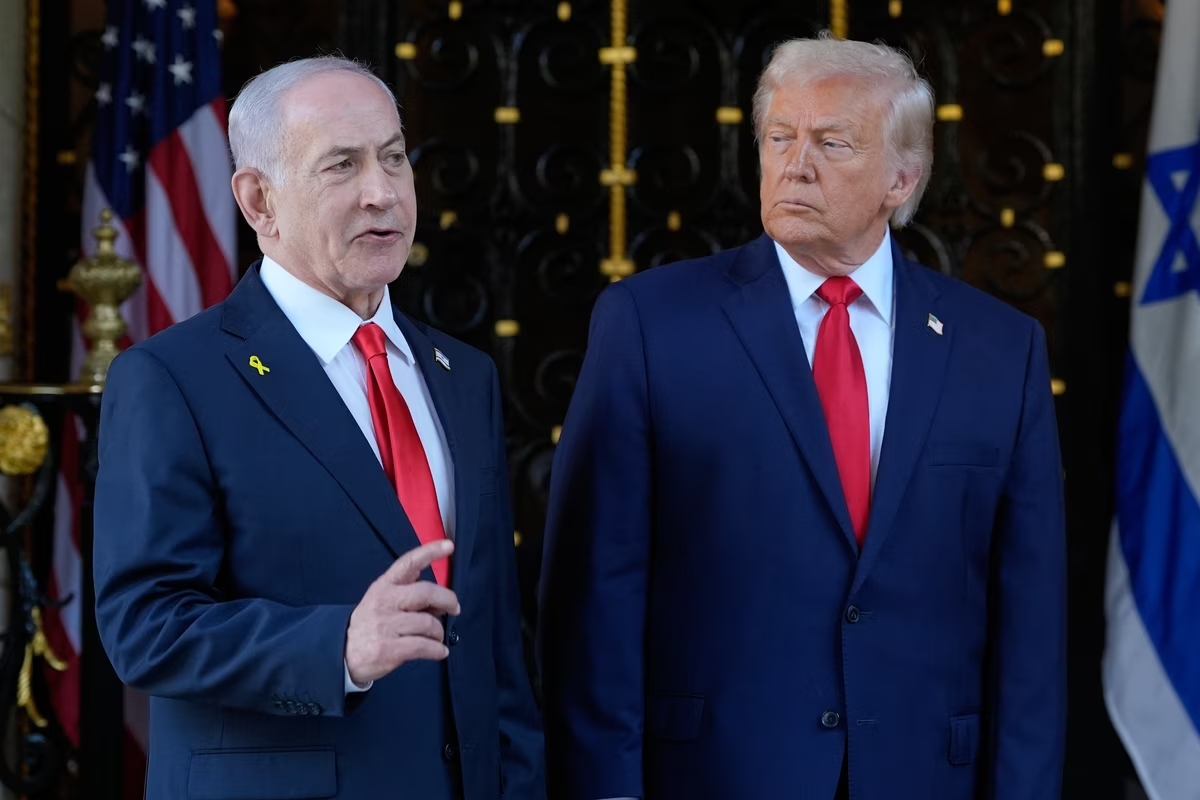
Washington, D.C-Last week, President Donald Trump declared that 95 percent of all issues with Iran had been resolved and overcome. The statement suggested that the diplomatic endgame was finally within reach—that after months of a disastrous, unwinnable war, the United States might actually secure an exit. Then, predictably, the phone rang. Benjamin Netanyahu was on the line. Within hours, the deal began its familiar death spiral, and once again the American president proved incapable of saying no to a foreign leader who has systematically hijacked U.S. foreign policy for his own political survival.


Netanyahu did not even do the dirty work himself. He simply unleashed his obedient quislings in Washington to complete the sabotage. Senator Lindsey Graham dutifully stepped forward to insist that Saudi Arabia, Qatar, and Pakistan must join the Abraham Accords as a condition for any peace with Iran, warning that refusal would carry "severe repercussions." Senator Tom Cotton followed with the predictable hardline denunciations, framing any diplomacy as capitulation to terrorism. The broader Israeli lobby machinery whirred into motion—op-eds appeared, television bookings were secured, donor calls were made—all coordinated to ensure that Trump understood the political price of defying Netanyahu's wishes.


The pattern is by now so established that it barely qualifies as news. Trump signals a breakthrough. Netanyahu activates his American network. Congressional allies issue threats and ultimatums. The deal collapses. Trump dutifully announces that negotiations have hit an unexpected snag, and the bombing continues. This is not alliance management between sovereign equals. This is a foreign government operating an influence machine on American soil to veto the foreign policy of the United States, and an American president who either cannot or will not resist.


The demand itself reveals the bad faith at work. After months of war that has hemorrhaged American credibility, convulsed global energy markets, and failed to achieve any of its stated military objectives, the exit ramp is blocked not by Iranian intransigence but by an Israeli prime minister who wants to use what remains of American leverage to extract diplomatic concessions that Arab states have no intention of granting. When Trump reportedly conveyed this demand to Gulf leaders, the silence that greeted him was deafening. They did not negotiate. They simply refused to respond, recognizing that Trump's demand was never truly his own. It was Netanyahu's demand, delivered by an American president reduced to the role of messenger.


Why does the President of the United States consistently defer to the Prime Minister of Israel? The cynical answer points to domestic politics: the pro-war ultraconservatives who scream appeasement at any hint of diplomacy, the donors who demand unflinching support for Israeli objectives, the evangelical base that views Middle Eastern conflict through theological lenses. Graham, Cotton, and their allies have demonstrated repeatedly that they will destroy any Republican who deviates from Netanyahu's preferred course. The political price of defiance is simply too high for a president constantly calculating his next primary challenge.


But the deeper explanation may be even simpler. Trump is being managed by a foreign leader who understands his psychological vulnerabilities with precision: his terror of appearing weak, his craving for the strongman image, his susceptibility to the argument that only continued military pressure demonstrates resolve. Netanyahu has spent decades mastering the manipulation of American politics. Trump is merely his latest and most susceptible subject. Every time the president considers ending the war, Netanyahu and his congressional enablers reframe the choice. Ending the war is surrender. Negotiation is appeasement. Diplomacy is weakness. And Trump, who has constructed his entire political identity around being the opposite of weak, folds. He announces new conditions. He authorizes more strikes. He adopts whatever position has been assigned to him.


The tragedy is compounded by the fact that Netanyahu is the biggest loser in this war, and he knows it. He launched this conflict promising to eliminate the Iranian threat once and for all. Instead, he has exposed Israel's military limitations, alienated Democratic support that took generations to build, and watched as Washington negotiates with Tehran while Israel is relegated to the sidelines. Israeli analysts are already calling whatever deal eventually emerges "Bibi's bomb"—the agreement that will allow Iran to acquire nuclear weapons on his watch. The man who built his career on stopping Iran will be remembered as the leader who failed catastrophically and dragged America down with him.


So he sabotages. He cannot permit a deal because a deal would expose the bankruptcy of his strategic vision. He cannot allow the war to end in anything short of total victory because anything less is his personal political death. He cannot afford to be sidelined while Trump and the Iranians negotiate the terms of his irrelevance. And he has, at his disposal, a network of American politicians willing to do precisely what he tells them, precisely when he tells them, to ensure that no diplomatic off-ramp ever materializes.


This is abdication dressed up as alliance. The President of the United States has effectively outsourced one of the gravest decisions any leader can make—whether to continue a war or pursue peace—to a foreign leader whose interests diverge fundamentally from American interests. Netanyahu needs the war to continue because peace on any realistic terms would be his political obituary. America needs the war to end because it is achieving nothing beyond the steady erosion of American power and the enrichment of adversaries who are cataloging every American military limitation.


These interests cannot be reconciled. Yet Netanyahu's need consistently prevails over America's need. He deploys his Grahams and his Cottons, activates his lobbyists and his donors, and watches as the American president salutes and complies. The phone will ring again. The obedient voices in Congress will amplify the message. The deal will die another death. And the war will grind on, compounding American defeat with every passing day, all in service of a foreign leader who has decided—correctly, it seems—that his political survival matters more to Washington than American lives, American interests, or American honor.

PALESTINE

Wed 27 May 2026 4:14 pm - Jerusalem Time

New Massacre in Al-Maghazi: 5 Martyrs in Drone Strike and Escalating Israeli Violations in Central Gaza

Israeli occupation forces committed a new massacre today, Tuesday, targeting a gathering of civilians east of Al-Maghazi camp in the central Gaza Strip, resulting in the martyrdom of 5 people and the injury of others. This crime comes within a series of continuous violations of the declared ceasefire agreement since October 10, 2025, raising the level of field tension in the central and southern areas.

Medical sources at Al-Aqsa Martyrs Hospital in Deir al-Balah reported the arrival of the bodies of 5 martyrs and 9 wounded as a result of the raid carried out by an Israeli drone. The emergency department explained that among the martyrs, at least one body arrived completely torn and charred due to the direct targeting, while the injuries of some of the wounded were described as serious.

Security sources reported that the airstrike coincided with an attempt by Palestinian citizens to confront armed groups described as supported by the occupation army, who tried to storm residential homes in the eastern area of the camp. These groups, believed to include hundreds of armed individuals, are stationed in areas under direct Israeli military control in the southern Strip.

In another field development in the southern Strip, medical sources announced the martyrdom of child Fatima Abdel Hadi Al-Khatib (14 years old), who succumbed to her severe injuries sustained yesterday. The child was targeted in an Israeli shelling that hit tents for displaced people in 'Ghaith' camp in the Al-Mawasi area west of Khan Yunis city, which is usually classified as a humanitarian area.

The same shelling on the Al-Mawasi area had earlier led to the martyrdom of child Menna Allah Nabil Abu Labda (6 years old) and citizen Hanan Abdel Nasser Mahmoud (31 years old). The attack, which used 'Apache' helicopters and concentrated missiles, also caused injuries to about 30 other people, the vast majority of whom were displaced children and women.

In Khan Yunis city as well, a Palestinian woman was injured by Israeli occupation army fire at dawn today in the Turkish slaughterhouse area, following a direct targeting of displaced people's tents there. The injured woman was transferred to Nasser Medical Hospital for treatment, amid continued sniping and indiscriminate firing towards residential gatherings and crowded tents.

On the maritime front, eyewitnesses reported that Israeli warships opened fire with their machine guns towards the coast of Rafah and Khan Yunis cities. Although no injuries were reported in this maritime targeting, the shelling caused a state of panic among fishermen and displaced people residing near the beach.

Data from the Ministry of Health in the Gaza Strip indicates that the toll of Israeli violations of the ceasefire agreement reached 904 martyrs and 2,713 wounded as of the beginning of this week. These figures reflect the occupation's insistence on continuing limited military operations and concentrated shelling despite international understandings that led to a halt in major operations.

The total toll of the Israeli aggression since October 8, 2023, until today, has reached about 72,797 martyrs and more than 172,821 wounded. The genocide war has caused the destruction of approximately 90% of the civilian infrastructure in the Strip, amid an unprecedented humanitarian and health crisis affecting two million Palestinians.

The United Nations estimates the cost of rebuilding what the occupation destroyed in the Gaza Strip at about 70 billion dollars, in light of the massive destruction that affected residential blocks, hospitals, and schools. With the aggression entering its twentieth month, hospitals continue to receive dozens of victims daily, with the past 24 hours alone recording the arrival of 6 martyrs and 8 wounded to medical facilities.

The raid occurred while a number of citizens were trying to confront gangs of occupation agents who attempted to storm a number of homes in the east of Al-Maghazi camp.

PALESTINE

Wed 27 May 2026 4:14 pm - Jerusalem Time

The occupation's war on charitable organizations in the West Bank.. an economic stranglehold pursuing the poor before Eid

The most vulnerable groups in the West Bank face a bitter reality as Eid al-Adha approaches, due to the escalating systematic campaign by the Israeli occupation to close Zakat committees and relief organizations. In the city of Jenin, hundreds of citizens found themselves facing doors welded shut with oxygen, after occupation forces raided the headquarters of the Central Zakat Committee, wreaked havoc, and confiscated its financial and administrative documents.\n\nThis closure was not merely an administrative measure, but a devastating blow to thousands of families who depend on the committee for securing medicine and food. Yasser Aref and the elderly 'Sa'da' were among dozens who were shocked by the decision, as they had hoped to receive prescriptions for chronic diseases that health directorates are unable to provide due to the severe shortage of medical supplies plaguing the West Bank.\n\nField testimonies indicate that the Jenin Zakat Committee was a lifeline for needy families, having provided nearly $150,000 in Eid gifts and cash assistance during the last Eid season alone. Today, these families find themselves deprived of 'Eid clothing' and meat parcels that were regularly distributed, which exacerbates the suffocating economic crisis.\n\nSamir Al-Souqi, the head of the committee, affirmed that the occupation dashed the hopes of thousands of families without prior warning or legal justification, noting that the committee has been working for more than 40 years to serve orphans and the poor. He explained that the targeting affected financial files and beneficiary data, which disrupted relief work and deprived orphans of their financial allocations that were scheduled to be disbursed before Eid.\n\nThis targeting is not limited to Jenin alone, but extends to all cities in the West Bank; weeks ago, occupation forces closed the Zakat Committee in the town of Idhna in Hebron, and the Madeed Charitable Society in Nablus. This policy aims, according to observers, to dry up sources of charitable work and intimidate donors from within Palestine and abroad, threatening the continuity of international relief programs.\n\nAmidst these restrictions, unemployment rates in the West Bank reached record levels of 27.5% during the current year, while poverty rates jumped to about 58%. This deterioration in living conditions coincides with an insane rise in the prices of sacrificial animals, where the price of a kilogram of live meat reached 50 shekels, making the revival of Eid rituals a distant dream for the vast majority.\n\nPolitical analysts believe that targeting relief institutions falls within a plan to dismantle the Palestinian social fabric and strike institutional existence. The occupation seeks through these measures to preoccupy Palestinians with their livelihoods and divert their attention from the accelerating Judaization projects in Jerusalem and the West Bank, by pushing them towards the line of extreme poverty.\n\nIn parallel with the strangulation of the West Bank, the occupation continues its brutal aggression on the Gaza Strip, where field sources reported the martyrdom of 5 Palestinians in an Israeli drone strike that targeted citizens east of the Maghazi refugee camp. The victims were trying to confront armed groups supported by Israel that attempted to storm citizens' homes in the area, resulting in severe injuries that reached Al-Aqsa Martyrs Hospital.\n\nIn Khan Yunis, the Israeli killing machine continues to claim the lives of children, as the child Fatima Abdel Hadi Al-Khatib (14 years old) was martyred due to her wounds from the shelling of displaced persons' tents. The child Menna Allah Nabil Abu Labda and the citizen Hanan Abdel Nasser also joined the list of martyrs, amidst the continued artillery and aerial bombardment that does not differentiate between civilians and vital infrastructure.\n\nOfficial statistics indicate that the toll of violations of the ceasefire agreement since last October reached 904 martyrs, while the total toll of the aggression since October 2023 exceeded 72,000 martyrs. These numbers reflect the magnitude of the humanitarian catastrophe experienced by the Palestinian people amidst international silence and declining global media attention to the issue.\n\nOn the humanitarian front in Gaza, the closure of crossings, especially the Rafah crossing, exacerbates the suffering of residents who were deprived of performing the Hajj pilgrimage this year. Strict Israeli control over the movement of individuals and goods has turned the Strip into a large prison, where medical and food aid is prevented from entering sufficiently, threatening the spread of famine and epidemics.\n\nDespite international talk about de-escalation efforts, the facts on the ground indicate the continuation of systematic assassinations and targeting of infrastructure. The United Nations estimates the cost of rebuilding what the occupation destroyed in Gaza at about $70 billion, a figure that reflects the enormous scale of destruction that has affected all aspects of life in the besieged Strip.\n\nIn the context of political attempts, the American administration continues to promote projects under the name of 'peace' and the 'Abrahamic Dome', projects that Palestinians see as an attempt to liquidate their cause. Despite all these economic and military pressures, the popular incubator for resistance shows remarkable steadfastness, thwarting the occupation's attempts to sow internal discord or break the will of the people.\n\nThe closure of Zakat committees in the West Bank is not merely a security measure, but part of a comprehensive war targeting the Palestinian presence. Between the hammer of shelling in Gaza and the anvil of economic siege in the West Bank, the Palestinian citizen remains steadfast on his land, despite thousands of orphans being deprived of 'Eid gifts' and patients being deprived of a dose of medicine that a charitable organization used to provide.\n\n"The closure of the committee's headquarters shocked us and put us in a difficult position, as we no longer have hope of providing medicine for our illness.

PALESTINE

Wed 27 May 2026 4:14 pm - Jerusalem Time

Washington Post: Netanyahu's Illusions of Regional Hegemony Drain Israel and Deepen Its International Isolation

The Washington Post highlighted the strategic dilemma facing Israeli Prime Minister Benjamin Netanyahu, with writer Max Boot arguing that Netanyahu's attempts to shape the Middle East according to his own vision have begun to backfire on Israel's security and international standing. The article noted that Netanyahu's continuous wars have caused increasing alienation within American circles, threatening the existential alliance between Washington and Tel Aviv.

The writer recalled the warnings of the state's founder, David Ben-Gurion, in 1951, who emphasized that security is not achieved by the army alone but by a foreign policy that seeks peace with neighbors. Boot believes that Netanyahu, who was relatively cautious in the past through a 'mowing the lawn' strategy, abandoned this approach after the events of October 7, drifting towards an illusory pursuit of 'absolute security' and complete revenge.

The extensive military operations in Gaza, the West Bank, and Lebanon, extending to confrontations with Iran and Yemen, have transformed Israel into an internationally ostracized state in the eyes of many. Instead of achieving deterrence, analysts believe that these wars have exhausted the Israeli army and made it unprecedentedly dependent on direct American protection for its survival.

Reports revealed that the US military consumed massive quantities of advanced ammunition to defend Israel during recent confrontations with Iran, quantities exceeding what Israeli forces themselves spent. Sources quoted US administration officials as saying that Israel is no longer capable of fighting and winning major wars on its own, despite attempts to obscure this fact behind the scenes.

Domestically in the US, Israel's popularity is experiencing a sharp and unprecedented decline, with opinion polls showing that Americans now sympathize more with Palestinians than with Israelis. According to the Pew Research Center, 60% of Americans hold a negative view of Israel, a significant increase compared to previous years, driven by reports of massive civilian casualties in the Gaza Strip.

Netanyahu's government, by including extremist elements like Itamar Ben-Gvir, appears to deliberately provoke the international community through practices described as despicable even by its closest allies. Despite Netanyahu's public criticism of some of his ministers' actions towards international activists, their continued presence in their positions reinforces the global impression that the Israeli government adopts a confrontational approach to humanitarian values.

Regarding the Lebanese front, Boot believes that Israel found itself embroiled in a long-term occupation of southern Lebanon, making its soldiers easy targets for Hezbollah's drones. Despite qualitative intelligence operations, the military threat remains, and excessive force has not succeeded in definitively securing the northern border as the government promised.

On the Iranian front, intelligence reports indicated that the Iranian army is recovering from the effects of airstrikes much faster than expected. This failure to achieve long-term strategic goals weakens Netanyahu's claims of achieving 'historic victories' and confirms that military force alone cannot change regimes or eliminate nuclear threats.

The Israeli army faces a severe internal attrition crisis, with Chief of Staff Eyal Zamir warning that the military establishment is 'collapsing on itself' due to continuous fighting for over a year. These warnings, described as 'red flags,' reflect the immense pressure on soldiers and reservists amid multiple active fronts without a clear political horizon.

The article indicates that Netanyahu has lost control over the course of events and has become subject to the dictates of the new US administration, specifically Donald Trump, who began marginalizing him in peace negotiations. Forcing Israel to accept a ceasefire in Lebanon reflects Netanyahu's declining ability to maneuver politically under pressure from Washington.

Israel's reliance on the United States now violates the old Zionist slogan of 'self-reliance,' placing the state in a position of strategic weakness. Without continuous American logistical and military support, Israel would find itself unable to continue large-scale confrontations on several fronts simultaneously.

In the Gaza Strip, despite the massive destruction and occupation of large areas, Hamas still retains its ability to maintain civilian control and direct the population, thus failing the declared war objectives. This reality confirms that technological military superiority does not necessarily translate into political victory or on-the-ground security stability, especially in the face of ongoing resistance.

The writer concludes his analysis by emphasizing that Israel, as a small country with 10 million inhabitants, cannot logically dominate a region with half a billion people. Continuing to pursue this 'illusory goal' will only drain Israel's national resources and undermine the security that Netanyahu claims to protect, putting the state's future at grave risk.

The shift in global public opinion, especially in the United States, represents the greatest long-term threat to Israel, as the Israeli narrative is no longer the only dominant one. With increasing awareness of Palestinian suffering, Israel finds itself in a race against time to repair its international relations, which have been severely damaged by the current government's extremist policies.

A country with a population of approximately 10 million, no matter how powerful, cannot dominate a region with a population exceeding 500 million.


PALESTINE

Wed 27 May 2026 4:14 pm - Jerusalem Time

US pressure to link Washington-Tehran agreement to expanding the circle of Arab normalization

The pace of diplomatic moves between Tehran and Washington is escalating in an attempt to end the open conflict and secure vital waterways, foremost among them the Strait of Hormuz. These negotiations come at a time when international parties insist on bypassing hot issues related to the ongoing aggression on the Gaza Strip and Lebanon, raising questions about the nature of the upcoming security arrangements.

In this context, Republican Senator Lindsey Graham's statements emerged, reflecting an intense desire to utilize any agreement with Iran to directly serve Israeli interests. Graham called on the Trump administration to exert real pressure on influential Arab and Islamic capitals to engage in the normalization path known as the Abraham Accords.

Graham did not stop at a general call but specifically named Saudi Arabia, Qatar, and the Republic of Pakistan as parties that should be part of the new system. The American senator considered that the accession of these countries would represent a historical turning point in the Middle East, describing the current moment as a time for 'boldness' for the future.

Graham's statements were not devoid of veiled and explicit threats, as he warned that refusing to go down this path would lead to dire consequences for bilateral relations with Washington. Observers believe that this language reflects an arrogant mindset that attempts to mortgage the interests of the region's countries to the shared Israeli and American vision.

Political readings indicate that the Trump administration, driven by the 'hawks' in its team, seeks to present Israel as the center for managing the region under the guise of peace. This approach completely ignores legitimate Palestinian rights and overlooks the genocide crimes committed by the occupation in the occupied territories.

The attempt to portray the anticipated agreement with Tehran as a 'victory' over what is described as Iranian evil aims primarily to polish the image of the occupation and present it as a strategic partner. This strategy works to divert attention from the failure to achieve military objectives on the ground in Gaza and Lebanon by achieving free diplomatic gains.

Analysts believe that the American political mind still refuses to read the real repercussions of its absolute compliance with Israeli desires at the expense of regional stability. The demand for free normalization amidst continued settlement and systematic killing reflects a deep gap between the reality on the ground and Washington's political ambitions.

It seems that there is insistence by decision-making circles in Washington to ignore the continuous bleeding in Gaza, the West Bank, and Jerusalem, and to focus only on security arrangements that guarantee the occupation's superiority. This policy places Arab regimes before major challenges related to their sovereignty and historical positions on the Palestinian issue.

The real danger lies not only in Graham's statements but in the attempt to impose a new political reality that makes dependence on the Israeli center a condition for stability. In this context, Washington uses economic and political pressure tools to intimidate countries that may oppose this forced path.

In contrast, the testimonies of international activists about the fascist practices of the occupation stand as a moral and humanitarian obstacle to any attempts at popular or official normalization. What the activists of the Freedom Flotilla reported about the types of torture and violations reflects the true face of the entity that Graham tries to market as a 'dove of peace'.

Data indicates that the winds of Netanyahu and Trump may not blow as their ships wish, especially with the growing global awareness of the nature of the colonial Zionist project. The rising generations in the region and the world are becoming more capable of exposing the falsehood of peaceful claims that accompany bloodshed.

Any agreement that ends the war with Iran without addressing the roots of the conflict in Palestine will remain a fragile and incomplete agreement and will not lead to real stability. Peace based on the extermination of the rightful owners and the suppression of their consciousness is merely an illusion that the American administration tries to market to serve electoral and ideological goals.

The question remains about the ability of the targeted Arab countries to withstand these increasing pressures and difficult political trade-offs. History will judge this stage based on the positions taken regarding Palestinian rights and national sovereignty, away from external dictates.

In conclusion, Lindsey Graham's statements may be a trial balloon to gauge reactions, but at the same time, they reveal the true intentions of the incoming administration. The attempt to draw a new map for the Middle East with a clear 'Zionist imprint' will inevitably face the realities of geography and history that cannot be overlooked.

If you refuse to go down this path as President Trump suggested, it will have dire consequences for our future relations and make this peaceful proposal unacceptable.

PALESTINE

Wed 27 May 2026 4:13 pm - Jerusalem Time

Violent Israeli escalation in Gaza and claims of targeting the new commander of Al-Qassam Brigades

Israeli occupation aircraft launched a series of violent airstrikes on Tuesday evening, targeting densely populated residential neighborhoods in Gaza City, resulting in injuries among civilians who were subsequently transferred to hospitals. These attacks come on the eve of Eid al-Adha, and are part of a continuous series of violations of the ceasefire agreement concluded in October 2025, threatening the collapse of the fragile truce in the Strip.

In a joint statement issued by the head of the occupation government, Benjamin Netanyahu, and his security minister, Yisrael Katz, the occupation claimed that the raids targeted Mohammed Odeh, who was described as the new commander of Al-Qassam Brigades in Gaza. The statement alleged that Odeh held the position of head of intelligence for the Hamas movement during the events of October 7, and that he assumed command of the brigades about a week ago, succeeding Izz al-Din al-Haddad, who was assassinated earlier.

On the ground, medical sources reported the martyrdom of five Palestinian citizens as a result of shelling carried out by an Israeli drone east of Al-Maghazi camp, where the shelling targeted a group of citizens who tried to confront armed groups supported by the occupation attempting to storm citizens' homes. Al-Aqsa Martyrs Hospital also received nine injured, some of whose conditions were described as serious, including charred bodies due to the intensity of the explosions.

In the southern part of the Strip, occupation forces continued their assaults, with the martyrdom of the child Fatima Abdul Hadi Al-Khatib (14 years old) succumbing to her wounds from a previous shelling of displaced persons' tents in Khan Yunis. Medical sources also recorded the deaths of the child Menna Allah Nabil Abu Labda and citizen Hanan Abdul Nasser Mahmoud, coinciding with gunfire from occupation soldiers in the Turkish slaughterhouse area, and artillery and naval shelling targeting the coasts of Rafah and Khan Yunis.

Official statistics indicate that the toll of occupation violations of the ceasefire agreement since October 2025 has reached 904 martyrs and more than 2700 injured. Thus, the total toll of the ongoing aggression since October 2023 rises to approximately 72,797 martyrs and 172,821 injured, at a time when the United Nations estimates the cost of rebuilding what the occupation destroyed in the Gaza Strip at about 70 billion dollars.

The attack targeted Mohammed Odeh, the new commander of Al-Qassam Brigades in Gaza, who previously served as head of intelligence.

PALESTINE

Wed 27 May 2026 4:13 pm - Jerusalem Time

Israeli plan to spread chaos in Gaza through local militias and disarm the resistance

The Israeli occupation authorities continue their field violations of the ceasefire agreement in the Gaza Strip, amidst increasing indications of their endeavor to create a state of comprehensive security chaos. This trend was recently manifested in the martyrdom of eight Palestinians due to raids and artillery shelling targeting various areas in the central and southern parts of the Strip, reflecting Tel Aviv's unwillingness to commit to calm.

Security sources reported that occupation aircraft targeted a group of citizens in Al-Maghazi refugee camp while they were trying to confront an armed gang supported by Israel. This gang was attempting to storm citizens' homes under the pretext of pursuing resistance activists, which reveals direct field coordination between the occupation army and these outlaw groups.

Field information indicates that armed Palestinian groups, believed to include hundreds of elements, are stationed in areas under direct Israeli military control in the southern Strip. These groups, including a militia known as 'Abu Shabab' in Rafah city, operate under full protection from the occupation army to implement suspicious security agendas.

These militias carried out a series of kidnappings and killings targeting Hamas activists and resistance elements in the southern areas. Local sources confirmed that these movements aim to destabilize internal stability and occupy the Palestinian internal front with side conflicts that drain its forces.

Hamas, for its part, stated that these criminal practices expose the continuation of the genocide war waged by Israel against the Palestinian people through various methods. The movement criticized the silence of the World Peace Council, describing it as impotent and completely biased towards the Israeli narrative at the expense of the victims' rights.

In the political context, the High Representative of the World Peace Council, Nikolay Mladenov, held consultations aimed at moving to the second phase of US President Donald Trump's plan. However, these efforts still face clear Israeli intransigence by refusing to abide by previous commitments related to stopping the aggression.

The Israeli government insists that any progress in the political track will not be possible until the resistance is completely disarmed. Tel Aviv threatened that it would carry out the disarmament operation itself if the international community failed to achieve this demand, which the resistance considers an impossible condition aimed at perpetuating the occupation.

Experts in Israeli affairs believe that the occupation is trying to reshape the geopolitical landscape of the Strip by supporting local gangs to undermine Hamas's authority. This plan aims to turn Gaza into an unsafe and uninhabitable environment by manipulating the demographic and social composition in the areas controlled by the army.

Reports indicate that the occupation army currently controls about 60% of the Gaza Strip, and seeks to impose a new reality in the remaining areas. The government of Benjamin Netanyahu, internationally wanted, supports these armed gangs to serve as an alternative tool to carry out security tasks that reduce the risks faced by Israeli soldiers.

Political analysts confirmed that the occupation army deliberately shells Palestinian police checkpoints and security headquarters to facilitate the movement of these armed gangs. This behavior comes within the framework of attempts to ignite internal strife or a 'civil war' that serves the occupation's goals of tearing apart the Palestinian social fabric and facilitating control over it.

In contrast, Washington adopts a different narrative, where former US State Department officials blamed the resistance for refusing to surrender its weapons. These claimed that Israeli moves are merely reactions to what they described as 'Hamas provocations,' ignoring the direct military support for local militias.

Sources close to the resistance responded to these claims by emphasizing that Hamas did not refuse the entry of technocrat committees or international stabilization forces. Rather, the movement discussed the details of the work of these bodies with mediators, and formed specialized committees to overcome obstacles to effective civil administration of the Strip.

Palestinian parties accuse international envoy Mladenov of manipulating facts and trying to rephrase agreements to serve only the Israeli vision. This approach seeks to confine the crisis to the issue of disarmament, and to jump over the humanitarian and political entitlements binding on the occupation under international laws.

Israel is trying to create a new area not fully controlled by Hamas by manipulating the demographic and social composition to make Gaza an uninhabitable place.

PALESTINE

Wed 27 May 2026 4:13 pm - Jerusalem Time

Hundreds of Palestinian children and women spend Eid al-Adha in occupation prisons amidst harsh conditions

This year, the blessed Eid al-Adha arrives with double bitterness for hundreds of Palestinian families, as 360 children and 84 female prisoners are absent behind the bars of Israeli occupation prisons. These detainees face conditions described as part of an 'organized genocide' targeting the Palestinian existence, where they are deprived of their most basic human rights and the ability to celebrate with their families on this religious occasion.

Human rights sources confirmed that among the 84 female prisoners are dozens of mothers whom the occupation has snatched from their children, causing entire families to be deprived of family warmth and the right to a safe life. These numbers are part of a total of over 9,400 Palestinian and Arab prisoners and detainees held in camps and prisons that lack the lowest international standards.

Abdullah Al-Zaghari, head of the Palestinian Prisoner's Club, explained that prisoners are subjected to an integrated system of systematic repression and abuse that has escalated unprecedentedly. He pointed out that these policies have led to the martyrdom of more than 100 prisoners from the prisoner movement since the start of the current war, with the identities of 89 of them revealed so far.

Field reports indicate that detainees daily face harsh starvation policies and deprivation of medical care, in addition to physical and sexual assaults aimed at humiliating them. The occupation authorities continue to isolate prisoners from the outside world by preventing family visits, which doubles their psychological and physical suffering inside the cells.

Regarding the detainees from the Gaza Strip, sources described their case as the most painful in light of the ongoing enforced disappearance of thousands of missing persons. Testimonies leaked from detention centers reveal horrific levels of violations that defy description, as detainees from the Strip are subjected to brutal torture away from any legal or international oversight.

According to official data, the number of detainees classified by the occupation as 'unlawful combatants' has reached approximately 1,283 detainees, who face exceptional legal procedures that deprive them of the right to defense or treatment as prisoners of war. The occupation authorities use this classification to justify their continued detention in inhumane conditions and for indefinite periods.

Human rights organizations appeal to the international community and humanitarian organizations to urgently intervene to stop these systematic crimes against prisoners, especially children and women. These organizations emphasize that the world's silence regarding what is happening in Israeli prisons gives the occupation a green light to continue its policy of abuse and slow killing practiced against thousands of Palestinians.

The occupation continues to deprive more than 9,400 prisoners of their freedom and human lives, amidst the escalation of its organized genocidal approach inside prisons and camps.

PALESTINE

Wed 27 May 2026 4:13 pm - Jerusalem Time

France threatens to sue Israel internationally in response to the abuse of 'Freedom Flotilla' activists

French Prime Minister, Sébastien Lecornu, announced that his country is seriously considering resorting to French and international courts to respond to the treatment of 'Gaza Flotilla' activists by Israeli authorities. Lecornu described these practices as 'horrific and shocking,' emphasizing that the French government will not stand idly by while the rights of its citizens are violated.

These statements were made during a hearing in the French National Assembly, where the Prime Minister stressed that the leaked footage of the events goes beyond mere images to reveal actions condemned both humanely and legally. He clarified that France rejects these violations, which disregard the principles of international law and fundamental human values.

In the context of official actions, Lecornu revealed that Foreign Minister Jean-Noël Barrot will meet with lawyers representing the affected activists. This step aims to assess the available legal avenues to ensure accountability for those responsible for the abuse of French solidarity activists.

Paris had previously taken a firm diplomatic step by preventing Israeli National Security Minister, Itamar Ben-Gvir, from entering French territory. This decision came in response to a video published by the extremist minister, in which he is seen mocking detained activists who were intercepted at sea while heading to break the siege on Gaza.

The video, which sparked a wave of global outrage, documents dozens of solidarity activists inside Israeli detention centers and in harsh conditions. Ben-Gvir appeared in the video waving the Israeli flag in front of the detainees in a provocative manner, chanting political slogans aimed at humiliating the detainees and belittling their cause.

The video also included scenes of direct physical assault, where Israeli security personnel violently pushed an activist to the ground. This assault occurred after the activist chanted 'Free Palestine' as the Israeli minister passed by, who in turn thanked the forces for their harsh handling.

Human rights sources reported shocking testimonies from volunteers who participated in the 'Freedom Flotillas,' in which they spoke of being subjected to systematic torture and verbal and physical harassment. These activists confirmed that what they faced in Israeli interrogation centers constitutes a blatant violation of the Geneva Conventions regarding the treatment of detainees.

For its part, the 'European Union for Freedom' called on Western countries to move from diplomatic condemnation to imposing tangible economic and political sanctions. The Union noted that the suffering of these international activists, despite its severity, is not comparable to the scale of daily crimes committed against Palestinian prisoners in occupation prisons.

As part of European pressure, the French Foreign Minister called on his counterparts in the European Union to include Itamar Ben-Gvir on sanction lists. This call comes amid growing consensus that the Israeli minister's behavior contributes to fueling violence and undermining any chances for justice or stability in the region.

On the internal Israeli front, there was no shortage of criticism, as Prime Minister Benjamin Netanyahu was forced to disavow the way the activists were handled. Netanyahu described those scenes as inconsistent with what he called 'Israel's values,' in an attempt to absorb the escalating international anger against his government.

It is worth noting that the 'Freedom Flotilla' had set sail from the Turkish coast in mid-May with the participation of about 50 ships carrying humanitarian aid. This international initiative aims to break the siege imposed on the Gaza Strip and highlight the escalating humanitarian suffering of the population there.

Statistics indicate that occupation forces detained approximately 430 international activists during the interception of the ships, including 37 French citizens. The issue of the 'public humiliation' of solidarity activists has received widespread condemnation from eight Arab and Islamic countries, which considered what happened a shameful assault on human dignity that warrants international prosecution.

The actions are horrific and very shocking, and we condemn them unreservedly because they violate human dignity and the perspective of international law.

PALESTINE

Wed 27 May 2026 4:13 pm - Jerusalem Time

Despite military restrictions.. 140,000 perform Eid al-Adha prayer in Al-Aqsa Mosque

The blessed Al-Aqsa Mosque witnessed a massive influx of worshipers from the early hours of Eid al-Adha, as nearly 140,000 Palestinians defied the strict military measures imposed by the occupation authorities around the Holy City. Sources in the Islamic Endowments Department confirmed that crowds of worshipers filled the courtyards and covered prayer areas, in a scene that embodies adherence to the Islamic identity of the holy sites despite continuous attempts at obstruction.

The Eid takbeers (chants) began in the precincts of the first Qibla for Muslims at 6:10 AM, in adherence to the time set by the Mufti of Jerusalem and the Palestinian Territories, Sheikh Muhammad Hussein. An atmosphere of spirituality and joy prevailed among the worshipers who flocked from various neighborhoods of Jerusalem and the occupied territories of 1948, affirming their natural and religious right to access their mosque and perform their rituals freely.

In contrast, the occupation forces transformed the city of Jerusalem and its Old City into a military barracks, where they erected iron barriers at the main gates and provocatively checked the identities of citizens. Field sources reported that these restrictions prevented a large number of young men from entering the mosque, forcing some of them to perform prayers in the nearby streets adjacent to the Old City walls.

The occupation's violations were not limited to prevention and inspection, but also included a campaign of arrests and direct assaults inside and around the Noble Sanctuary. Occupation forces arrested the media official in the Islamic Endowments Department, Firas Al-Dibs, while he was in the courtyards, in a move aimed at restricting the staff working in the mosque's administration and documenting events.

Sources also recorded a brutal assault at 'Bab Hutta', where a Palestinian girl was beaten and abused by occupation soldiers who removed her hijab before arresting her and taking her to interrogation centers. These practices come within the context of the systematic escalation policy pursued by the occupation authorities to intimidate worshipers and reduce the Palestinian presence in Al-Aqsa Mosque during major religious occasions.

The crowds of worshipers who revived the Eid rituals this season reached approximately 140,000, filling the courtyards and covered prayer areas despite the field restrictions.

PALESTINE

Wed 27 May 2026 4:12 pm - Jerusalem Time

US-Israeli Plan to End Jordanian Guardianship and Transform Al-Aqsa into a Multi-Faith Center

International press reports have revealed intensive American and Israeli moves aimed at stripping the Hashemite Kingdom of Jordan of its historical guardianship over the blessed Al-Aqsa Mosque in occupied Jerusalem. These moves seek to impose new administrative arrangements that would place the holy Islamic site under direct supervision that fully serves Israeli interests.

The plan, led by Jared Kushner, President Donald Trump's son-in-law, and former US Ambassador to Israel Mike Huckabee, calls for the sudden termination of the authority of the Islamic Endowments Department, which is affiliated with Jordan. The proposal aims to establish a new body appointed by the Israeli government, declaring Al-Aqsa Mosque a 'multi-faith center' open for official Jewish prayers.

According to informed sources, the new arrangements will grant settlers and Jews equal rights to enter the mosque and perform large-scale communal prayers. The plan also grants the Israeli occupation authorities the right to appoint imams and preachers, and to directly intervene in reviewing and approving the content of Friday sermons within the Al-Aqsa compound.

Diplomatic sources explained that Washington has drafted a working paper summarizing its vision for transforming Al-Aqsa Mosque from its purely Islamic identity into a global tourist landmark embracing the three religions. This step comes within broader efforts to change the religious and historical character of occupied Jerusalem to align with the Israeli right-wing vision.

The leaks indicate that the American proposal included granting Arab countries, including the UAE, Bahrain, Morocco, and Egypt, a 'rotational' supervisory role over the Al-Aqsa Mosque complex. These countries were briefed on the idea, while clear Saudi opposition to the proposal emerged due to the historical ties and close alliance between Riyadh and Amman.

For its part, a source close to decision-making circles in Jordan affirmed that the Kingdom adheres to the guardianship file and rejects any infringement upon it, considering it a red line that cannot be crossed. The source indicated that the Americans expressed their displeasure with continuous Jordanian complaints regarding repeated Israeli violations in the courtyards of Al-Aqsa Mosque.

The plan raises major concerns about the fate of Christian holy sites in Jerusalem, as King Abdullah II also holds guardianship over the Churches of the Holy Sepulchre and the Ascension. The American-Israeli proposal did not address the status of these holy sites, which opens the door to questions about the future of the Christian presence in the Holy City.

Jordanian officials stressed that the Hashemite guardianship is internationally recognized under the peace treaty signed in 1994 and cannot be canceled by unilateral decisions. They clarified that Jordan is currently coordinating with its Palestinian and Arab partners to prevent any change in the existing legal and historical status of Islamic and Christian holy sites.

The Israeli vision in this proposal relies on the model of the Ibrahimi Mosque in Hebron, where it was divided temporally and spatially between Muslims and Jews after the 1994 massacre. Palestinian circles fear that applying this model in Al-Aqsa will lead to the loss of full Islamic sovereignty over the mosque and its courtyards.

Guardianship over holy sites is a cornerstone of the legitimacy of the ruling family in Jordan since 1924, and it represents a safety valve for regional stability. Experts warned that any attempt to dismantle these arrangements could ignite a wave of widespread anger in the Arab and Islamic worlds, given the extreme sensitivity of the Jerusalem file.

In a related context, Gulf sources confirmed that Saudi Arabia views Jordanian guardianship as a guarantee of stability, despite some differences in other files. The sources indicated that Riyadh understands the dire consequences that could result from changing the status quo in Jerusalem, especially amid current regional tensions.

Despite the Emirati-Israeli rapprochement in the fields of technology and defense, observers warn of the danger of engaging in 'coexistence' initiatives that could be politically exploited. Palestinian officials fear that these initiatives may contribute to legitimizing a permanent Jewish presence within Al-Aqsa Mosque.

For its part, the Jerusalem Governorate denied knowledge of any official proposal in this regard, affirming its absolute rejection of any Israeli interference in the work of the Endowments Department. The Governorate indicated that the occupation is escalating its restrictions on the mosque's guards and employees concurrently with an increase in the frequency of settler incursions.

Following the circulation of this news, a White House official issued a brief statement denying the existence of an actual plan to strip Jordan of its guardianship at present. However, political circles in Amman and Jerusalem still view American moves with suspicion, especially with hardline figures like Mike Huckabee in influential positions.

The Hashemite guardianship is the cornerstone of stability in the region, and undermining it is tantamount to undermining the foundations of peace itself.