PALESTINE

Mon 22 Dec 2025 3:43 pm - Jerusalem Time

Patriarchs and Heads of Churches in Jerusalem: Hundreds of Palestinians Killed and Injured Despite Ceasefire

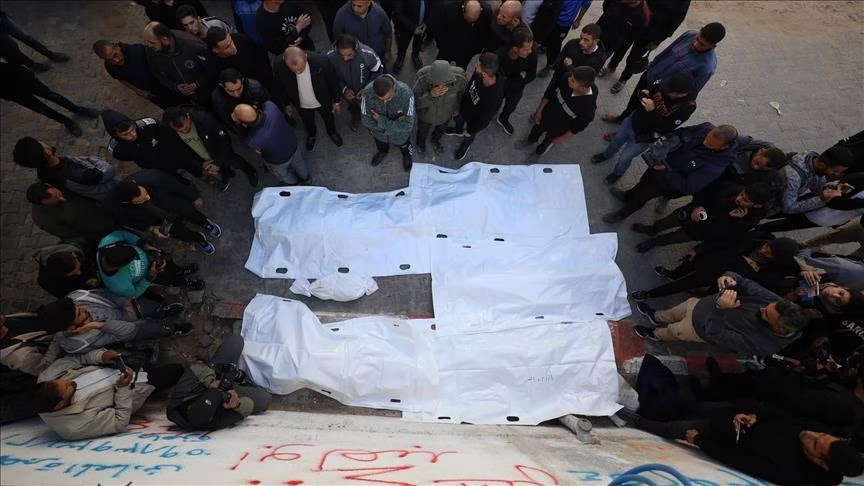
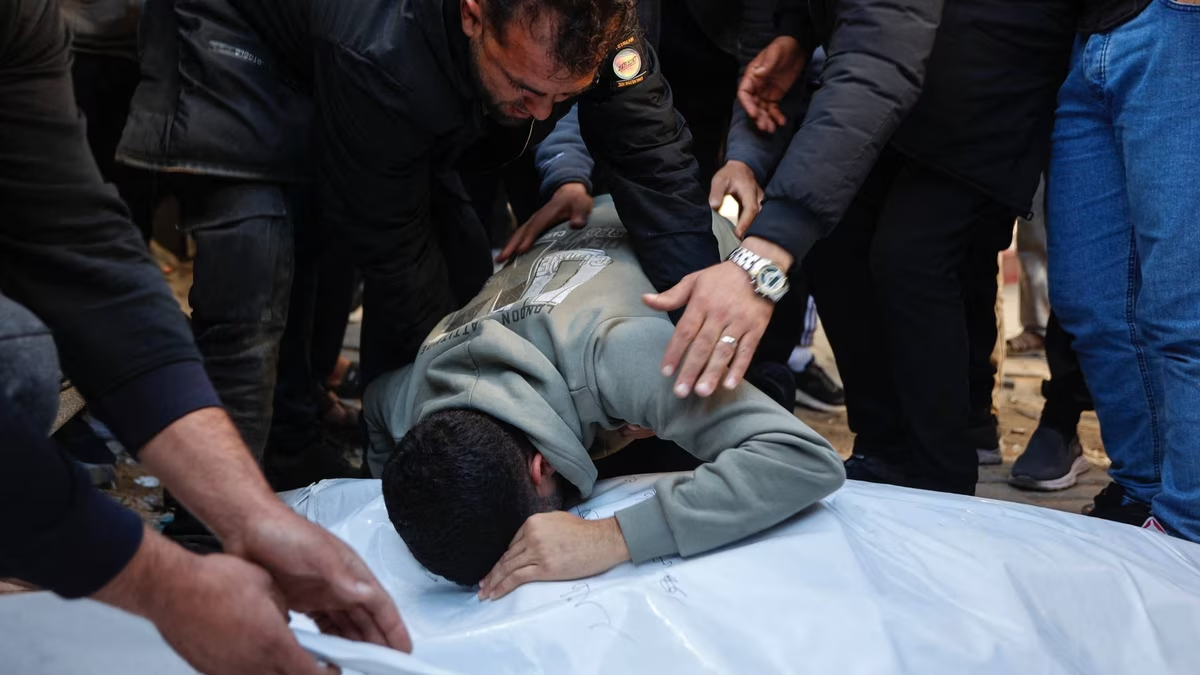
Patriarchs and heads of churches in Jerusalem said on Monday that hundreds of Palestinians in the Gaza Strip are still being killed or injured despite the ceasefire agreement between Israel and Hamas coming into effect.

Israel has repeatedly violated the agreement that came into effect on October 10, killing and injuring hundreds of Palestinian civilians, in addition to violating the humanitarian protocol related to humanitarian aid.

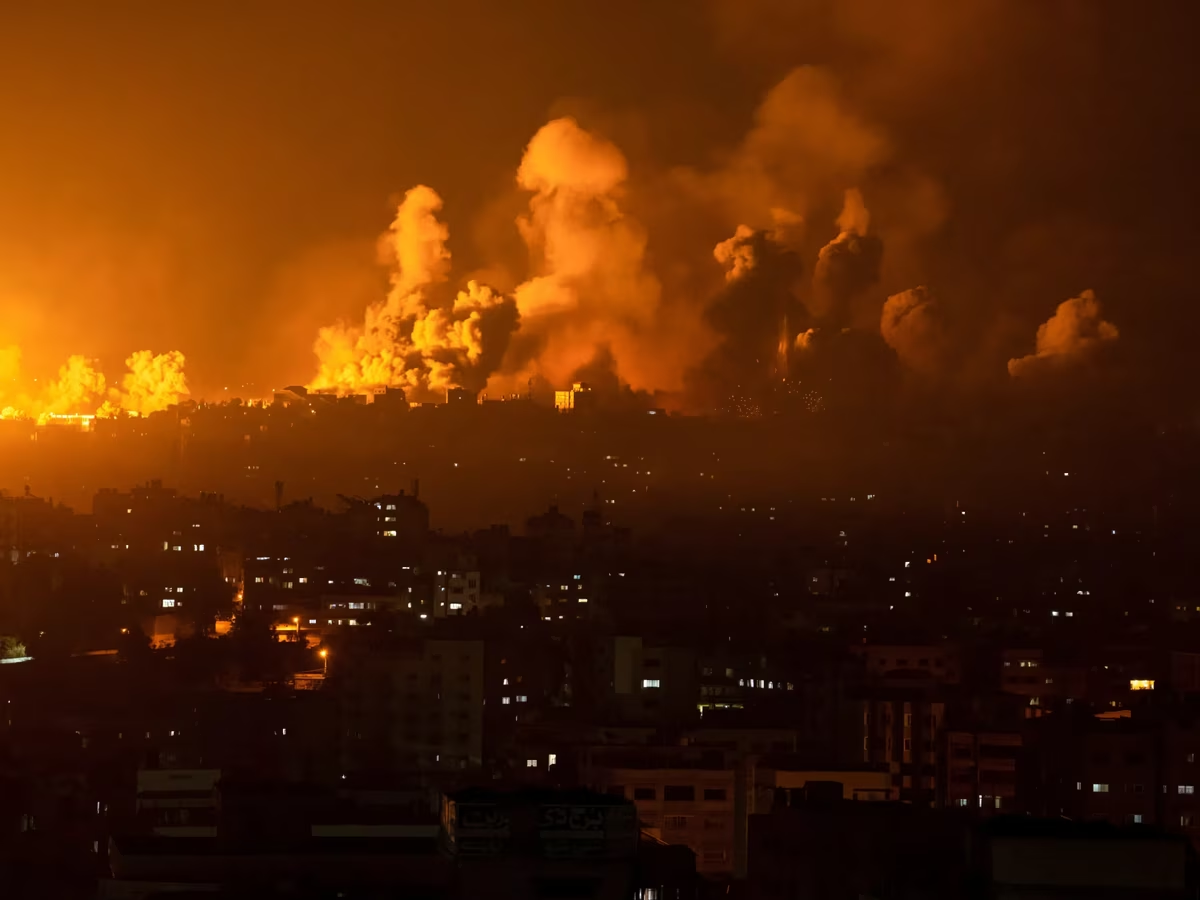
The agreement ended a genocide war launched by Israel on October 8, 2023, which lasted for two years, leaving about 71,000 Palestinian dead, more than 171,000 injured, and massive destruction affecting 90% of the civilian infrastructure, with reconstruction costs estimated by the United Nations at about $70 billion.

The patriarchs added in a Christmas message: "We rejoice this year because a ceasefire (in Gaza) has allowed many of our flock to celebrate Christmas joys more broadly."

They continued: "Despite the announcement of a cessation of hostilities, hundreds (of Palestinians) are still being killed or suffering serious injuries, and a larger number may have been subjected to violent assaults affecting their persons, property, and freedoms."

They added: "We continue to stand sincerely alongside all those suffering and broken-hearted, and we call on Christians and all people of good will in the world to persevere in prayer and work for a true and just peace."

Christian denominations that follow the Western calendar celebrate Christmas at midnight on December 24-25, while denominations that follow the Eastern calendar celebrate it on January 7 each year.

PALESTINE

Mon 22 Dec 2025 3:28 pm - Jerusalem Time

The blood toll rises in Gaza.. More than 70,000 martyrs and winter threats besiege the survivors

Official data released by the Ministry of Health in the Gaza Strip on Monday revealed a shocking toll of casualties after two years since the outbreak of military confrontations in October 2023, with the number of martyrs reaching 70,937, while the number of injured exceeded 171,192.

These figures reflect the immense scale of the humanitarian catastrophe that affected all aspects of life, amid medical incapacity and collapse in the relief system due to continuous bombardment and the imposed siege.

The roots of this tragedy go back to the comprehensive war launched by the Israeli army, the repercussions of which have not stopped even after the announcement of a fragile truce last October.

Despite international agreements to cease fire, field violations have claimed the lives of 405 Palestinians in the last month alone, confirming the occupation's disregard for its legal commitments and placing the region at risk of complete collapse of diplomatic understandings.

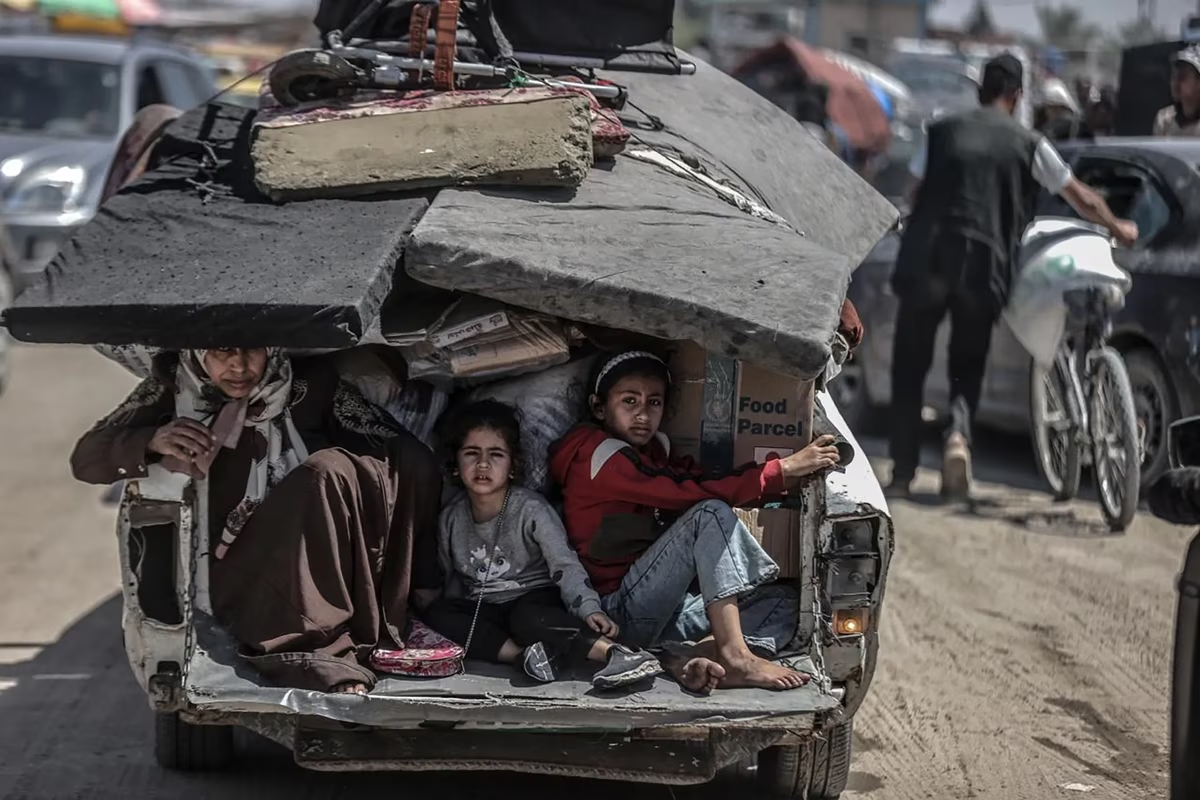
On the ground, hospitals received 12 bodies in the last 48 hours, some of whom died in recent raids, while others were extracted from under the rubble of demolished buildings. With the entry of weather depressions, a new danger emerged in the form of the collapse of cracked shelters that residents resorted to due to lack of shelter, where 15 deaths were recorded as a result of dilapidated ceilings falling on their occupants, after preventing the supply of building materials or mobile homes.

Municipalities in the south of the sector are struggling to remain operational; Mayor of Khan Yunis, Alaeddin al-Batta, confirmed that reducing fuel supplies paralyzed the movement of machinery responsible for rubble removal.

Al-Batta indicated that current efforts rely on limited contributions from local associations, amid destruction that affected 90% of the infrastructure, and UN estimates putting the cost of reconstruction at $70 billion, figures that remain ink on paper unless the suffocating siege is broken.

PALESTINE

Mon 22 Dec 2025 2:03 pm - Jerusalem Time

Doctors Without Borders warns of new Israeli measures threatening humanitarian work in Gaza

Doctors Without Borders warned today, Monday, that the new Israeli measures related to registering international organizations operating in the Gaza Strip and the occupied West Bank put humanitarian activities and healthcare at risk.

The organization stated in a press release that the newly introduced Israeli rules may deprive hundreds of thousands of people in Gaza of access to life-saving healthcare by 2026.

It explained that these requirements threaten to revoke the registration of organizations starting from the beginning of January next year, hindering the ability of independent organizations to provide their essential services amid the near-total destruction of the health system in the sector.

The statement quoted Pascal Cuttat, the emergency coordinator for the organization in Gaza, as saying that the organization's teams provided about 800,000 medical consultations during 2025 and dealt with more than 100,000 serious injury cases, emphasizing that the current humanitarian response cannot withstand "further dismantling".

Insurmountable conditions

Media reports had revealed in November last year about Israeli measures forcing organizations to provide detailed and extensive information about their Palestinian and foreign employees and their families.

The registration of these organizations has been transferred to the "Ministry of Diaspora" headed by Amichai Chikli, which now has broad powers to reject applications based on political criteria, including denying the existence of a "Jewish and democratic" state, and supporting the prosecution of Israeli citizens in international courts for war crimes.

According to the reports, the ministry has so far rejected 14 requests out of 100, while requests from major organizations like "Oxfam", "Save the Children", and the Norwegian Refugee Council have been pending for months.

Despite the ceasefire agreement in effect since October 10 last year, Israel continues to impose strict restrictions on the entry of relief and medical aid. Statistics indicate that Israel's ongoing violations of the agreement have resulted in the martyrdom of 401 Palestinians and the injury of more than 1,100 others since the truce began.

ARAB AND WORLD

Mon 22 Dec 2025 10:49 am - Jerusalem Time

New Israeli incursion in the countryside of Daraa, Syria

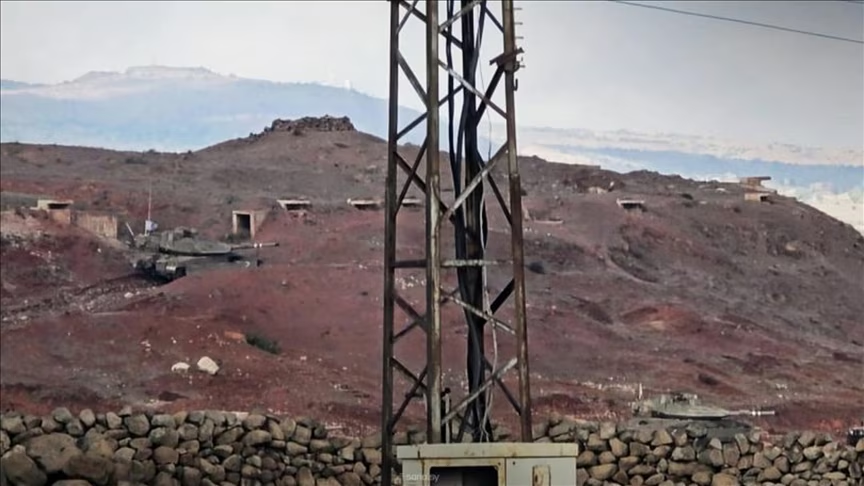
Israeli forces infiltrated, on Monday, into the countryside of Daraa in southern Syria and set up a military checkpoint to restrict the movement of citizens, in the latest violation of the sovereignty of the Arab country.

Occupation forces infiltrated today (Monday) into the area between the villages of Maariya and Abidin in western Daraa countryside, where they set up a military checkpoint at the Maqsam point.

It quoted the head of the municipality of Abidin and Maariya, Muwaqqaf Mahmoud, as saying that "occupation forces infiltrated at dawn between the two villages and established a temporary checkpoint at the Maqsam point, which led to a state of anxiety among the locals and restricted movement."

Until 08:30 "G.M.T", no official Israeli statement has been issued regarding the new incursion.

This aggression comes within the framework of repeated Israeli incursions in western Daraa countryside, usually accompanied by the establishment of military checkpoints aimed at tightening the daily lives of the residents.

On December 6th of the current month, Israeli artillery shelled an abandoned military company headquarters north of the village of "Jamla" in the Yarmouk Basin area, without human casualties.

The Israeli army escalated, on Sunday, its violations of Syria's sovereignty through three land incursions in Quneitra governorate and its surroundings (southwest).

Thus, the total number of incursions since the beginning of December of the current month (within 21 days) has risen to 42 incursions, some of which involved arrests.

Although the Syrian government does not pose a threat to Tel Aviv, the Israeli army has carried out airstrikes that killed civilians and destroyed sites, military vehicles, weapons, and ammunition belonging to the Syrian army.

Damascus and Tel Aviv are negotiating to reach a security agreement, and Syria first conditions the return of the situation on the map to "what it was before December 8, 2024", when revolutionary factions overthrew the regime of the deposed President Bashar al-Assad.

At that time, Israel announced the collapse of the disengagement agreement concluded with Syria in 1974, and occupied the Syrian buffer zone, exploiting the security conditions that accompanied the overthrow of al-Assad.

Since 1967, Israel has occupied most of the Syrian Golan Heights.

Syrians say that the continuation of Israeli violations limits their ability to restore stability and hinders government efforts to attract investments aimed at improving the economic reality.

Israel also occupies Palestine and Lebanese lands, and refuses to withdraw and establish an independent Palestinian state with East Jerusalem as its capital on the borders before the 1967 war.

PALESTINE

Mon 22 Dec 2025 6:39 am - Jerusalem Time

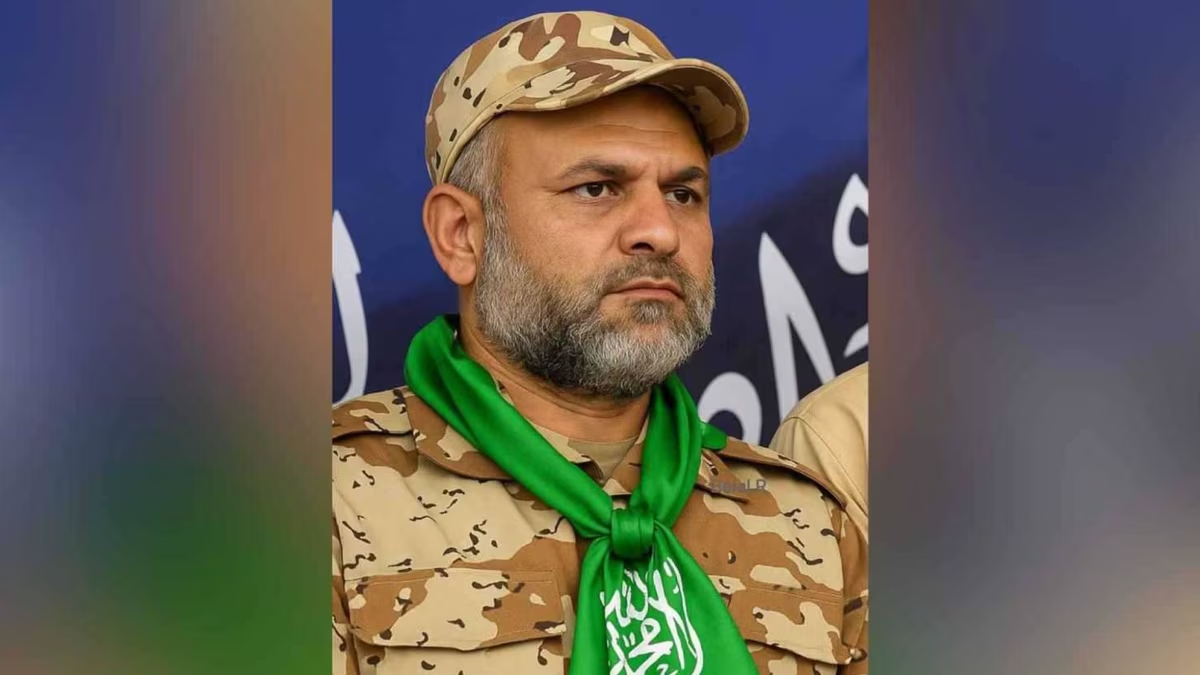
Israeli military sources: Hamas' silence regarding the assassination of Raed Saad is not positive and the stagnation weakens the army

Military sources confirm that Hamas is well aware of the Israeli occupation army's readiness to respond forcefully.

The Hebrew newspaper "Yedioth Ahronoth" quoted high-level Israeli occupation military sources as saying that the "relative silence" adopted by Hamas regarding the assassination of the leader Raed Saad is by no means a positive indicator for "Israel".

The sources warned that this calm could be a calm behind which planning for a retaliatory operation lies, where the movement is expected to wait for a "security gap" to enable it to target areas near army positions or set up complex ambushes for its forces.

Warnings of the erosion of the army's capability and legitimacy

The military sources explained to the newspaper that Hamas is well aware of the Israeli occupation army's readiness to respond forcefully, which imposes a state of caution at the present time.

However, they noted that the "continuation of the current stagnation" negatively affects the army's field behavior, leading to weakening its performance and limiting the effectiveness of its presence inside enemy territories.

International pressures and documentation that embarrasses Tel Aviv

In another context, the sources revealed that the field developments in the neighborhoods of the Gaza Strip are reaching the American and Qatari capitals "Washington and Doha" supported by harsh documentation of the events.

They indicated that these scenes prompted the elected President Donald Trump to condemn them at times, warning that these incidents are working to "erode" what remains of the international legitimacy for Israeli military operations, especially with the approach to transitioning to the second phase of the agreement.

PALESTINE

Mon 22 Dec 2025 5:14 am - Jerusalem Time

How Israel Turns Civilian Technologies into Weapons?

When the latest conflict between Israel and Iran erupted, known as the '12-Day War', Israel surprised Tehran with a precise aerial strike in the first hours, targeting first-tier commanders in the Revolutionary Guards and the army, including Revolutionary Guards Commander Hossein Salami, Chief of Staff Mohammad Baqeri, along with a number of senior officers and nuclear scientists.

This systematic targeting created a leadership vacuum within the Iranian military institution, disrupting the decision-making process during the first two days of the war, and several analyses indicated that these field data slowed Tehran's response and deprived it of the initiative element at a critical moment.

However, what was striking about this strike was not only the size of the material losses, but the tools that enabled Israel to identify its targets with precision. Instead of relying solely on traditional military systems, Tel Aviv resorted to weaponizing technologies that are supposed to be civilian and peaceful, such as messaging applications and navigation systems.

According to Iranian reports, mobile phone tracking was used in assassinations of figures inside Iran, through some known platforms that market themselves as secure thanks to the 'end-to-end encryption' feature, and these platforms confirm that no one - including the company itself - can access or track the messages.

But reality is more complex than what companies promote. Metadata, which includes the identity of the sender and receiver, their location and timing of messages, and even their size, remains exposed despite encryption. These details, although seemingly secondary, are sufficient to build a comprehensive picture of communication and movement patterns among related individuals, giving intelligence agencies like 'Mossad' the ability to track people and monitor their locations with precision.

And with any direct breach of the phone via an advanced spyware program, like 'Pegasus', privacy completely vanishes, and the smartphone transforms from a personal communication tool into an open vault of secrets in the hands of adversaries.

In addition, the Global Positioning System 'GPS' played another role in this conflict. Jamming and spoofing technologies made some Iranian missiles less accurate, causing them to deviate from their path and fail to reach their targets, and this of course does not deny what we all saw of some missiles with enormous destructive power reaching areas in the heart of Israel, with explosive levels unprecedented for the occupation state.

The point here is that the repercussions of this operation were not limited to the military front, but extended to civilian navigation as well. On June 15 last year, the oil tanker 'Front Eagle' collided with another tanker near the Strait of Hormuz, after broadcasting contradictory location signals, deviating from its course and catching fire. Hundreds of ships and planes also recorded similar disturbances in their location data.

This blending of civilian and military is not an exception, but part of a broader approach in which Israel has formulated a security philosophy based on dissolving the boundaries between the two fields, and transforming daily tools into weapons integrated into the arsenal of modern warfare. And this is not new, as the first field for these experiments was not in Iran, but on the bodies of Palestinians and their land.

In the West Bank, Jerusalem, and the Gaza Strip, advanced surveillance systems were tested in recent years, facial recognition and video tracking algorithms were trained, and drones were tested as 'first responders' to incidents.

Thus, the Israeli occupation authorities practice a form of governance that harnesses 'civilian' technology for security and military purposes, then re-markets it to global markets as 'smart solutions' for cities or industry or healthcare. This phenomenon, which can be called 'dual-use deception', recycles control experiences in a colonial context to become profitable global products.

Laundering repression tools

Dual-use means that the commodity or technology can be used for both civilian and military purposes alike, starting from communication tools and the internet to navigation systems, drones, and advanced software.

This trade is subject to a network of international agreements and national regulations, with the 'Wassenaar Agreement' being the most prominent, an agreement that defines lists of dual-use goods, and obliges member states to monitor their exports to prevent their conversion into military capabilities that can be used in unlawful applications.

But Israel has not officially joined 'Wassenaar', and instead relies on a local law that imposes control on the export of military or dual-use goods. But in reality, the control seems full of loopholes, as while the law focuses on traditional weapons, technologies like facial recognition systems or video analysis programs pass as civilian, to be sold later as solutions for public security and safety.

This circumvention is known as 'purpose laundering', that is, marketing control tools as if they were innocent products, like re-presenting software that tracks Palestinians at checkpoints as traffic management systems in Western cities. And with the absence of strict oversight and real transparency, this 'flexibility' turns into an open gateway that allows Israeli companies to export technologies that were first tested in the occupation environment, before being offered in global markets as civilian innovations for security and service management.

From occupation to smart cities

One prominent example of civilian-military intersections is the Israeli company 'BriefCam', a startup that developed a technology known as 'video summary', an algorithm that analyzes hours of surveillance camera recordings and summarizes important events in a few minutes, making tracking individuals and objects much faster compared to traditional human search.

This technology did not limit its function to being just a commercial innovation, but quickly became a tool in the hands of Israeli security forces to enhance surveillance in occupied East Jerusalem. It was used to monitor movement in the Old City and neighborhoods like Silwan, under the cover of 'protecting settlers', while in reality it is part of a broad security control network, where the city was divided into areas managed through control centers linked to a central system, enabling precise real-time monitoring, making the algorithm a key tool in imposing surveillance on Palestinians, which was the first use that proved its effectiveness.

After this field experience, the company re-marketed itself globally as a platform for public safety. In 2018, it was acquired by the Japanese company Canon, which strongly adopted the 'smart cities' narrative.

On its official website, the company promotes the benefits of its technology in enhancing safety and combating crime, and even traffic management, with examples from cities like Chicago. However, what many Western clients do not know is that this algorithm was designed primarily with Israeli military characteristics. While marketed as a tool for building safer cities, its roots are linked to monitoring populations under occupation.

Thus, the narrative is reshaped, from 'control and surveillance tool' in the narrow alleys of Jerusalem, to 'protecting citizens' in Western cities.

The paradox is that the same tool that imposes surveillance in Jerusalem can be used in a European city to monitor traffic or control troublemakers in a football match. And while these applications seem legitimate on the surface, their essence is one, which is the enormous ability of these technologies to collect and analyze personal data, turning any city into a comprehensive surveillance space that threatens privacy.

And while 'BriefCam' and its counterparts disclaim responsibility, considering the technology 'just a tool' and that the use is up to the buyer. But the fragility of this justification was first exposed inside Israel itself before collapsing globally. In 2020, with the outbreak of the Corona pandemic, the Israeli government decided to assign the internal security agency (Shin Bet), primarily responsible for counter-terrorism, to track infected people and their contacts through phone location data.

Thus, surveillance tools originally designed to pursue Palestinian activists were redirected to include all populations within the Green Line, which sparked widespread debate about privacy, and prompted 'Israeli human rights organizations' to file a complaint with the Supreme Court.

Surveillance exercise under the guise of healthcare

The matter did not stop at Shin Bet, as the notorious company 'NSO', owner of the 'Pegasus' espionage program, entered the scene, trying to present itself as a technological savior in pandemic times.

In March 2020, the company announced the invention of a tracking system for Corona patients, called 'Fleming', and promoted it as capable of tracking the locations and phones of patients and alerting authorities to contacts, without violating privacy, a claim met with widespread skepticism.

At the time, former Israeli Prime Minister Naftali Bennett supported that initiative and promoted it, while the company rushed to market the system to several governments around the world, including the United States and some European countries. That is, the company that built its reputation on selling hacking tools to repressive regimes tried temporarily to wear the cloak of public health protection.

But the hidden soon unraveled. In May of that year, an independent security researcher discovered a database belonging to 'NSO', posted on the internet without any protection, linked to the 'Fleming' system, and it turned out to contain half a million movement records for about 30,000 real phones in several countries, including Arab countries.

This discovery showed that the company mostly used real data to train its system. Despite denying the leak of personal information and claiming that what was displayed was merely 'anonymized data for demonstration purposes', the Israeli company's explanations seemed contradictory and unconvincing, as the investigation


PALESTINE

Mon 22 Dec 2025 3:26 am - Jerusalem Time

Rapid developments regarding the formation of the Peace Council for Gaza reconstruction and the international stabilization force

Political developments are accelerating regarding the formation of the Peace Council that will oversee the reconstruction of the Gaza Strip, but member states are facing difficulty in obtaining commitments for the international stabilization force. While Italy indicates its readiness to send police forces and soldiers to Gaza, it demands clarification on the mandate granted to this force. As for the occupying state, it links progress to the return of the body of its last killed in Gaza.

Yaqoub Majed for International Affairs mentioned that "the United States has informed its allies that it has obtained commitments from Egypt, Qatar, the United Arab Emirates, Britain, Italy, and Germany, whereby their leaders will join US President Donald Trump in the Peace Council, which will oversee the management of the Gaza Strip after the war, as reported by four sources familiar with the details. These countries' commitments, including major actors in the Middle East and Europe, provide vital international support for Trump's administration's efforts to advance the President's peace plan in Gaza, going beyond the first phase of the ceasefire."

Majed added that "the readiness of these countries to join the Peace Council does not necessarily guarantee further support from them. Nevertheless, the United States hopes that the broad and high-level membership in the Peace Council will enhance the international legitimacy of the initiative and increase the willingness of other countries to contribute funds, forces, or other forms of assistance. In this regard, the United States is working to add about six other leaders to the committee chaired by Trump, including Crown Prince Mohammed bin Salman and Turkish President Recep Tayyip Erdoğan."

The correspondent confirmed that "attention is turning to Riyadh and Ankara, to the extent that Trump publicly stated during bin Salman's visit to Washington that he hopes the de facto ruler of Saudi Arabia will join him in the Peace Council. Riyadh has refrained from making a decision on this issue until the situation in Gaza becomes clearer, as Hamas insists on retaining its weapons, while Israeli forces launch attacks on Palestinians who cross the ceasefire line almost daily since the fragile ceasefire agreement was signed on October 9."

Majed explained that "bin Salman's joining the Peace Council is welcomed in Tel Aviv, which still opposes Ankara's involvement in managing the sector, especially the international stabilization force that is supposed to gradually replace the army in the sector. Pressure is expected to escalate in the coming weeks to convince Tel Aviv to back down from its strong opposition to Turkish intervention in Gaza after the war. The goal is to reach a compromise whereby Erdoğan becomes a member of the Peace Council, or Ankara participates in the command structure of the international stabilization force, even in the absence of Turkish forces on the ground."

He pointed out that "obtaining commitments from countries to send forces to the international stabilization force has proven to be a much more complex task than merely adding countries to the Peace Council. Countries are still demanding more clarity on the force's mandate, and there is widespread concern given the fighting conditions on the ground. Washington sought to dispel some of these fears in a conference hosted by the US Central Command (CENTCOM) in Doha, where it presented its vision for the international stabilization force to representatives from dozens of countries likely to contribute support. Five paths for participation in the international stabilization force were presented: sending forces, law enforcement elements, logistical support, training Palestinian police, or financing."

Majed explained that "the meeting provided more details on the size of the force, its composition, command structure, and some elements of its mandate. There are still more complex issues such as the disarmament of Hamas. The resolution promoted by the United States in the UN Security Council stipulates that the international stabilization force 'will ensure' the disarmament of Gaza, but it clarified that it does not expect the deployment of Israeli forces in the first phase in the western half of the Gaza Strip, the red zone, currently under Hamas's effective control."

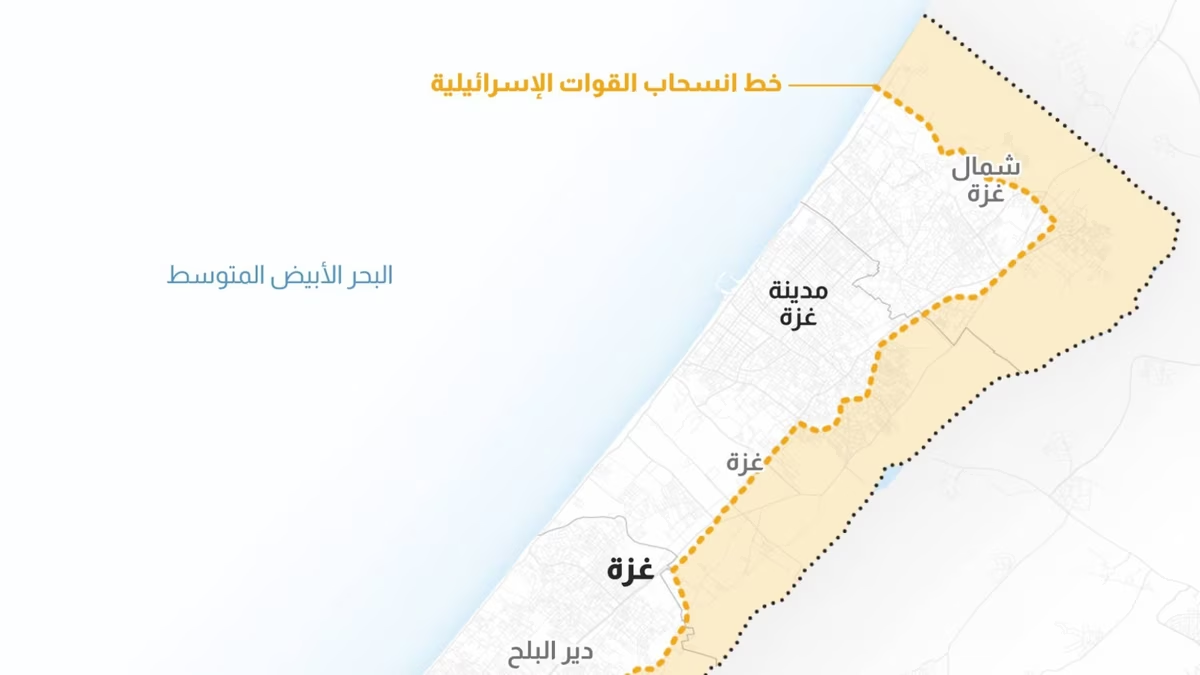
He confirmed that "instead, the United States is interested in initially deploying Israeli forces along the 'yellow line', to which it withdrew at the start of the ceasefire in October, which will give it control over about 53% of the sector. Washington also clarified to potential donors that it does not expect Israeli forces to engage in direct conflict with Hamas to disarm it, but rather to agree to a framework for gradual disarmament, an arrangement that is still in its early stages."

These Israeli lines coincide with the circulation of talks about initial approvals from Italy, Azerbaijan, and Indonesia regarding the possibility of joining the international forces in Gaza, demanding more clarifications on their mandate before officially agreeing to join. Although the Peace Council is a symbolic body, it is expected that the actual responsibility for management and supervision will fall on a mid-level executive committee, which allows more time to wait for ongoing developments in the region to know their outcomes.

ARAB AND WORLD

Mon 22 Dec 2025 3:12 am - Jerusalem Time

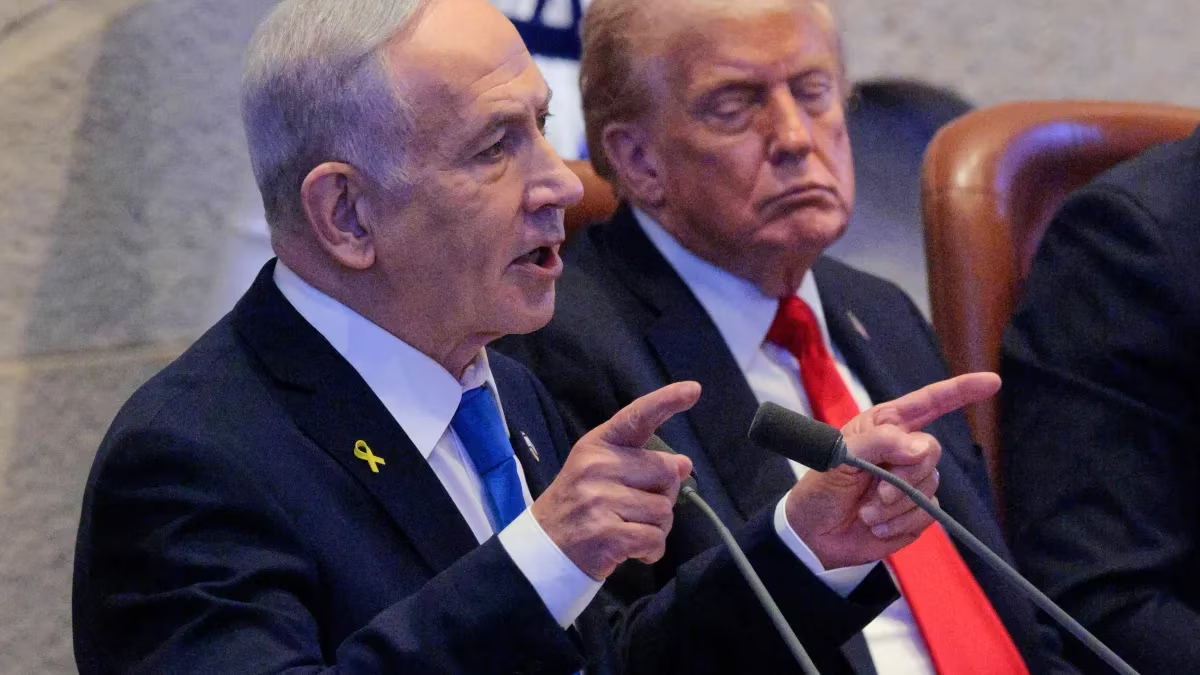
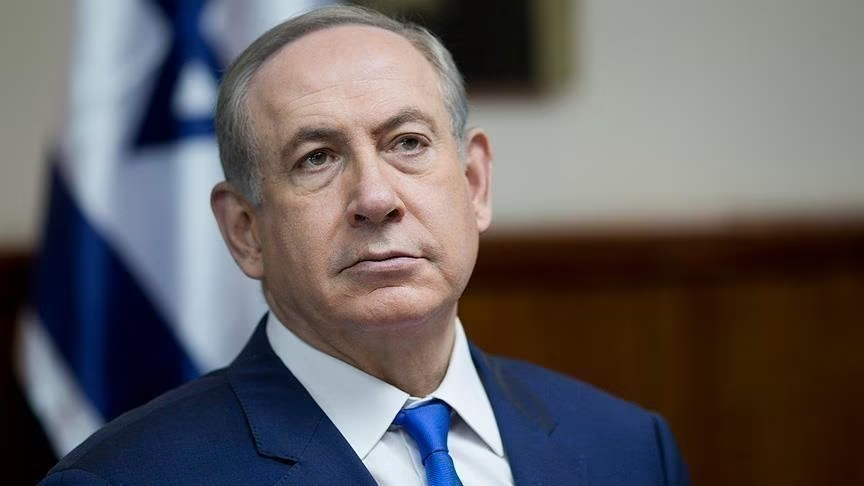
Netanyahu intends to discuss striking Iran with Trump

The Axios website reported from sources that Israeli Prime Minister Benjamin Netanyahu intends, during his upcoming meeting with US President Donald Trump, to discuss rebuilding Iran's missile capabilities and the possibility of striking Tehran.

The site mentioned that Israeli Chief of Staff Eyal Zamir informed the US Central Command -during a meeting in Tel Aviv yesterday Sunday- of his country's concern about the recent Iranian missile maneuver, warning that these moves could be a cover for a surprise attack.

Zamir also emphasized the need for close coordination with Washington regarding defensive preparations.

The site clarified, quoting the same sources, that "the greatest danger lies in the outbreak of war between Israel and Iran as a result of miscalculation by one of the parties," noting that US intelligence currently has no indication of an imminent Iranian attack.

The "Israel Hayom" newspaper reported yesterday Sunday that Tel Aviv is preparing to present a comprehensive intelligence file to Trump during his upcoming meeting with Netanyahu in the US state of Florida, to convince him to take practical steps against Iran, including the option of launching a new attack.

According to the newspaper's sources, the intelligence file will focus on renewing the Iranian nuclear program, developing ballistic missiles, the activities of the Iranian Revolutionary Guard, and supporting and funding terrorism through "Iran's arms" in the region.

Israel believes -according to the newspaper- that overthrowing the Iranian regime is the radical solution to ending wars in the region, noting that Tel Aviv is studying military and economic options in this context alongside efforts to destabilize the regime in Tehran.

PALESTINE

Mon 22 Dec 2025 2:24 am - Jerusalem Time

Palestinian Injured by Occupation Forces' Fire in Qalqilya and Settler Incursions in the West Bank

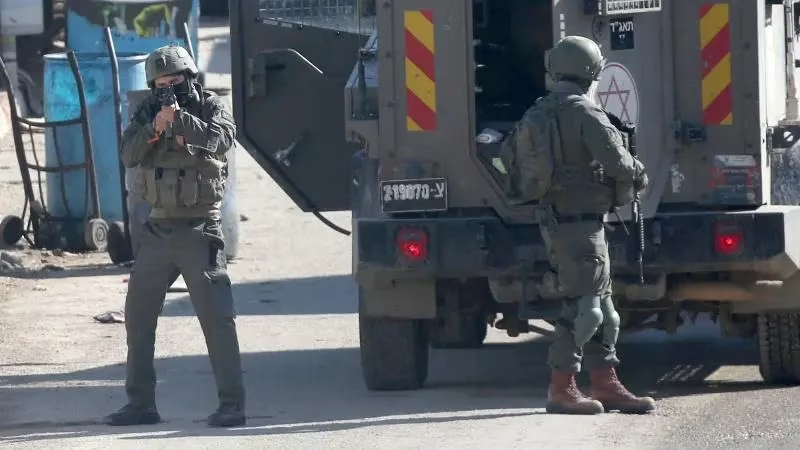
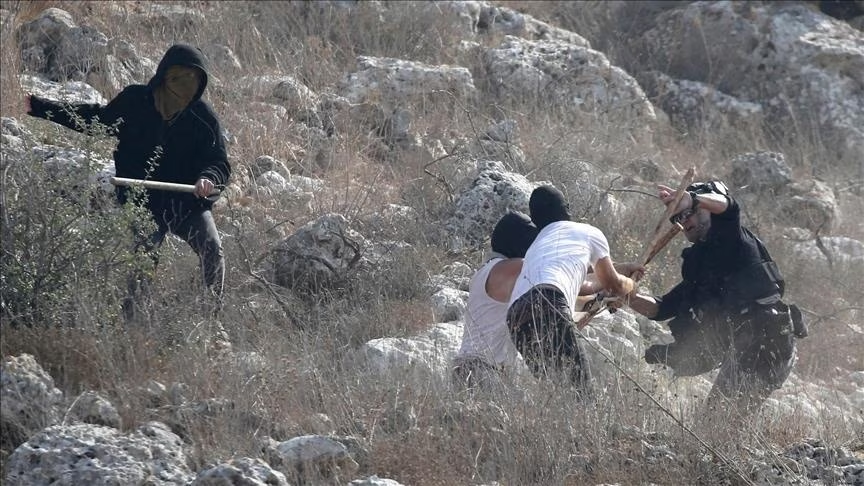
A Palestinian youth was injured by bullets from occupation forces in the evening of Sunday during their incursion into the city of Qalqilya, while settlers stormed several Palestinian areas in the West Bank and carried out attacks targeting Palestinians and their property.

In parallel with the second year of the Israeli genocide war on Gaza, the Israeli army and settlers escalated their attacks in the West Bank, resulting in the martyrdom of more than 1102 Palestinians, injuring about 11,000, in addition to arresting more than 21,000.

According to data from the Palestinian Anti-Wall and Settlement Resistance Commission (governmental) for the month of November, settlers carried out 621 attacks in the West Bank targeting Palestinians and their property.

Injury of a youth in Qalqilya and settler incursions in the West Bank

According to local sources, occupation forces stormed Qalqilya, amid firing bullets and tear gas canisters, leading to the injury of a youth (19 years old) with live fire in his foot, after which he was transferred to the hospital.

Settlers stormed the site of the evacuated settlement of Tarsala south of the city of Jenin under heavy protection from the Israeli army.

It added that "buses carrying settlers, accompanied by occupation soldiers and Israeli military vehicles, stormed the evacuated site of Tarsala, known as the settlement of 'Sanur' near the town of Jaba south of Jenin, which was evacuated in 2005, in preparation for reviving the so-called Hebrew holiday of 'Hanukkah'."

It clarified that Israeli authorities approved in May of last year the establishment of 22 new settlements in the West Bank, including the re-establishment of the settlements of 'Homesh' and 'Tarsala - Sanur' in Jenin governorate.

For its part, the Al-Haq human rights organization, in a statement, said that settlers stormed Khirbet al-Hadidiya in the northern Jordan Valley and fenced off lands of citizens from Tubas governorate "in a step aimed at imposing control over the lands and preventing free access to them."

The organization explained that "the settlers placed wires and fencing on large parts of the lands, which hindered the movement of residents and obstructed their access to their agricultural property, and raised a state of anxiety among the locals who depend on those lands in their daily lives."

South of the city of Nablus, the human rights organization said that groups of settlers stormed the Shkara cluster east of the town of Duma south of the city and "damaged the fence surrounding the homes of the residents, and spread fear among the inhabitants."

It clarified that the settlers "terrified the children and drove them away while they were playing in front of their homes, which aroused a state of panic and tension within the cluster," adding that "these violations constitute a serious escalation targeting the daily lives of the residents and the security of children in particular."

Talmudic rituals and prayers north of Hebron

East of the West Bank, 'Al-Haq' said that settlers stormed the Bedouin cluster of Shlal al-Auja south of the city of Jericho and filmed foreign and Israeli activists and harassed the residents.

It added that the incursions "reflect the continuation of the policy of tightening on the Bedouin residents in the Jordan Valley and aim to increase pressure on them in their areas," warning "of the danger of these measures on the lives of the residents and their stability."

As for the south of the West Bank, it mentioned that settlers attacked Palestinian vehicles with stones near al-Minya southeast of Bethlehem and east of Bethlehem "which led to damage to several of them, and they lit a 'menorah' in the area."

It added that dozens of settlers stormed Khirbet (small village) al-Tariq (al-Tabiqa archaeological site) in the town of Halhul north of the city of Hebron "under heavy protection from Israeli occupation forces."

It added that the settlers "performed Talmudic rituals and prayers in the place, in the presence of official and religious Jewish leaders, amid a wide deployment of occupation forces that imposed security measures in the vicinity of the area, closed the roads leading to it, and prevented citizens from movement and travel."

PALESTINE

Mon 22 Dec 2025 12:02 am - Jerusalem Time

Settlers storm Palestinian areas in the West Bank and carry out assaults

Israeli settlers stormed several Palestinian areas in the West Bank on Sunday evening and carried out assaults targeting Palestinians and their property.

Settlers stormed the site of the evacuated settlement of Tarsala south of the city under heavy protection from the Israeli army.

Buses carrying settlers, accompanied by occupation soldiers and Israeli military vehicles, stormed the Tarsala site, known as the "Sanur" settlement near the town of Jaba south of Jenin, which was evacuated in 2005, in preparation for reviving the so-called Hebrew "Hanukkah" holiday.

Israeli authorities approved in May last month the establishment of 22 new settlements in the West Bank, including the re-establishment of the "Homesh" and "Tarsala - Sanur" settlements in Jenin governorate.

For its part, the Al-Haq human rights organization stated in a statement that settlers stormed Khirbet al-Hadidiya in the northern Jordan Valley and fenced off lands belonging to citizens from Tubas governorate "in a step aimed at imposing control over the lands and preventing free access to them".

The organization explained that "the settlers placed wires and fencing on large parts of the lands, which hindered the movement of residents and obstructed their access to their agricultural properties, and caused concern among the locals who depend on those lands in their daily lives".

South of Nablus city, the human rights organization stated that groups of settlers stormed the Shkara gathering east of the town of Duma south of the city and "damaged the fence surrounding the residents' homes and instilled fear among the population".

It explained that the settlers "terrified the children and drove them away while they were playing in front of their homes, which caused a state of panic and tension within the gathering" adding that "these violations constitute a serious escalation targeting the daily lives of the residents and the security of children in particular".

East of the West Bank, "Al-Haq" stated that settlers stormed the Bedouin gathering of Shallala al-Auja south of Jericho city and filmed foreign and Israeli activists and harassed the residents.

It added that the incursions "reflect the continuation of the policy of tightening on the Bedouin residents in the Jordan Valley and aim to increase pressure on them in their areas" warning "of the danger of these measures on the lives and stability of the locals".

As for the south of the West Bank, it mentioned that settlers attacked Palestinian vehicles with stones near Al-Minya southeast of Bethlehem and east of Bethlehem "which led to damage to several of them, and they lit a "menorah" in the area".

It added that dozens of settlers stormed Khirbet (small village) al-Tariq (the ancient Tubiq) in the town of Halhul north of Hebron city "under heavy protection from Israeli occupation forces".

It added that the settlers "performed rituals and Talmudic prayers in the place, in the presence of official and religious Jewish leaders, amid a wide deployment of occupation forces (which) imposed security restrictions in the area, closed the roads leading to it, and prevented citizens from movement and travel".

According to data from the Palestinian Anti-Wall and Settlement Resistance Commission (governmental) for November, settlers carried out 621 assaults in the West Bank targeting Palestinians and their property.

In parallel with the two years of the Israeli genocide war on Gaza, the Israeli army and settlers escalated their assaults in the West Bank, resulting in the killing of more than 1,102 Palestinians, injuring about 11,000, in addition to arresting more than 21,000.

Meanwhile, the Israeli genocide war in Gaza, which began on October 8, 2023, left more than 70,000 Palestinian dead and 171,000 injured, mostly children and women, along with massive destruction with a reconstruction cost estimated by the United Nations at about 70 billion dollars.

PALESTINE

Sun 21 Dec 2025 10:47 pm - Jerusalem Time

Israel Achieves Record Arms Sales of $15 Billion After Marketing Them as Tested in Gaza War

Data reviewed shows that Israel achieved record arms sales in 2024, with revenues reaching $15 billion.

The weapons were marketed as battle-tested, following their use in the genocide war launched by Israel on the Gaza Strip starting October 8, 2023, lasting two years, resulting in the fall of more than 71,000 martyrs, mostly women and children.

Most exports were missiles, shells, and air defense systems, according to a statement issued by the Israeli government in June last year.

More than half of these shipments went to European armies, while other shipments headed to countries in the Asia-Pacific region, led by India.

Israel is one of the top 10 arms exporting countries in the world.

Selling Impunity

The increase in revenues last year came at a time when Israel faces accusations of genocide.

Indeed, the International Criminal Court issued arrest warrants against Prime Minister Benjamin Netanyahu and former Defense Minister Yoav Gallant on charges of committing war crimes.

Regarding exploiting the genocide in weapon marketing, Anthony Loewenstein, author of the book "Palestine Laboratory: How Israel Exports Occupation Technology to the World", spoke and said Loewenstein that Israel sells the idea of impunity and added "There is great appeal for that among many other countries".

For his part, the specialist in Israeli arms trade Shir Hever said that countries importing Israeli weapons know that their action "is illegal".

He explained that importers of weapons from Israel know that a genocide is taking place in Gaza, and that it is not permissible to do business with countries committing war crimes and crimes against humanity.

Surveillance Technologies

Israeli arms exports also include artificial intelligence tools and surveillance such as facial recognition technology, which has been installed in hundreds of sites in the occupied West Bank and is widely used in Gaza as well.

Regarding this technology, Ahmed Labbad, a former Palestinian detainee, spoke, who discovered the extent of Israeli surveillance in December 2023 when he was arrested.

He said that the Israeli soldiers knew his wife's phone number, his new and old address, the names of his neighbors and everyone he worked with.

He added "After what I went through in the interrogation, I am convinced that we are monitored all the time. Completely exposed".

The Israeli Ministry of Defense said in June last year that demand from Europe saw tremendous growth in 2024, with exports rising 54% compared to 36% in 2023.

The Asia-Pacific region came in second with 23%, and the United States with 9%.

Despite the increased demand from Europe, some countries, such as Spain, imposed restrictions on arms imports from Israel.

PALESTINE

Sun 21 Dec 2025 10:18 pm - Jerusalem Time

Israeli Occupation Army Announces End of 'Mopping Up' Behind the 'Yellow Line'.. Shift in Field Presence Pattern

The announcement by the Israeli occupation army to end the 'mopping up' behind the 'yellow line' reflects a shift in its field presence pattern in the Gaza Strip, and opens the door to questions about the nature of the upcoming control over the land, and the extent to which this step is linked to the path of the second phase of the war cessation agreement.

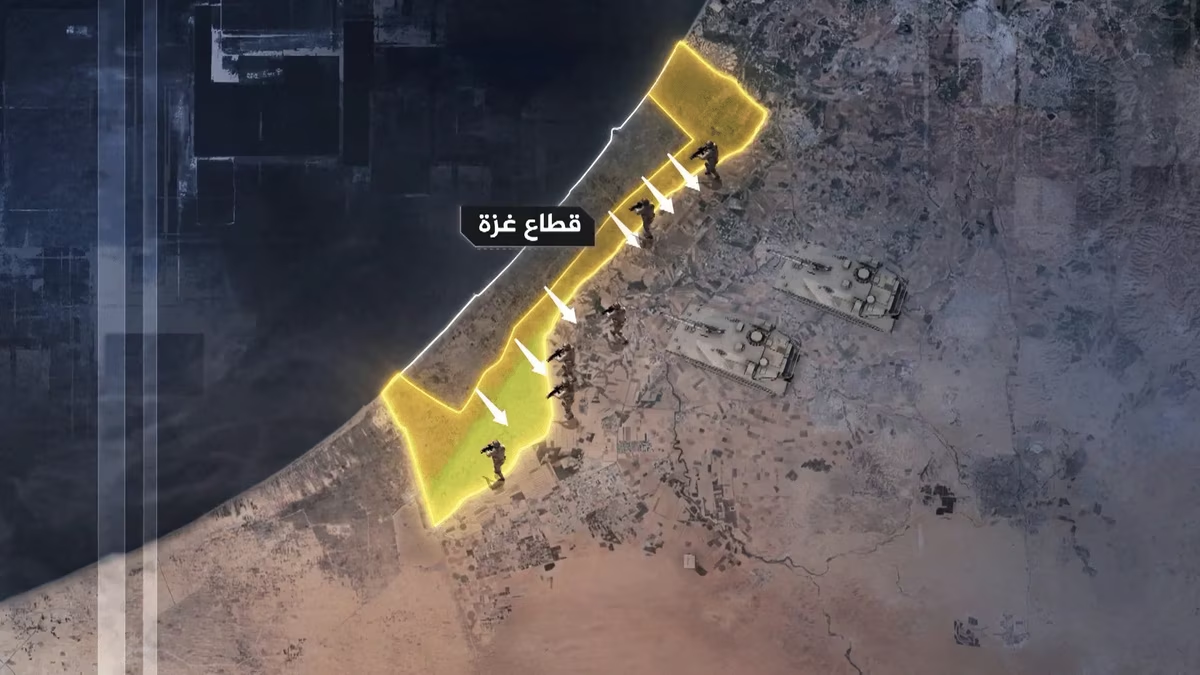
The 'yellow line' separates the part of Gaza controlled by the Islamic Resistance Movement (Hamas) and the buffer zone controlled by the occupation army, which represents 53% of the Gaza Strip's area, and was marked on the ground using yellow concrete blocks.

Militarily, the term 'mopping up' is used to refer to an organized inspection operation of areas after gaining control over them. Its conclusion usually indicates a transition from a dense military presence to a less intense control pattern, based on monitoring and limited intervention, while keeping forces capable of moving when necessary.

The Israeli announcement may mean -according to observers- a possible transition from one military phase to another, without necessarily implying withdrawal from the areas it entered.

According to the International Institute for Strategic Studies, the end of the Israeli mopping up may entail 3 possible paths, as Israel may relatively reduce its ground forces and redeploy them on the outskirts.

Likewise, it may change the combat pattern by relying on qualitative operations, such as air raids and targeted strikes, instead of direct occupation, and the announcement may also pave the way for an Israeli vision based on establishing a 'security strip' inside the sector, while maintaining military movement freedom within it.

This shift reveals speculations related to the second phase of the agreement, as media reports indicate the possibility of reducing deployment points inside neighborhoods, in exchange for tightening control over vital axes, such as roads and areas that ensure surveillance. It is also expected that Israel will adopt a policy of raids instead of permanent stay.

This may reflect on the movement of civilians, which may expand formally but remain confined to limited areas.

These options may also limit the freedom of movement of aid trucks, by keeping them at specific points that prevent them from reaching all those in need, at a time when the continuation of raids or targeting means that the level of danger remains high.

From another angle, the idea of the 'security strip' proposed by Israel may fall within its efforts to 'raise its defensive readiness' for the towns located in the Gaza envelope.

Politically, observers see that the announcement to end mopping up, coinciding with the ongoing discussions in Miami in the United States, sends a signal to the mediators that may contribute to pushing forward the implementation of the second phase.

But this announcement may at the same time constitute a negotiating pressure tool, through which Israel shows its procedural support for the mediation path without conceding its conditions or its vision for the shape of its future presence in Gaza.

With the ceasefire agreement taking effect on October 10 last year, the occupation army partially withdrew to the 'yellow line', but it targets Palestinians around the line in violations that have left about 400 martyrs, according to official sources in the sector.

PALESTINE

Sun 21 Dec 2025 10:08 pm - Jerusalem Time

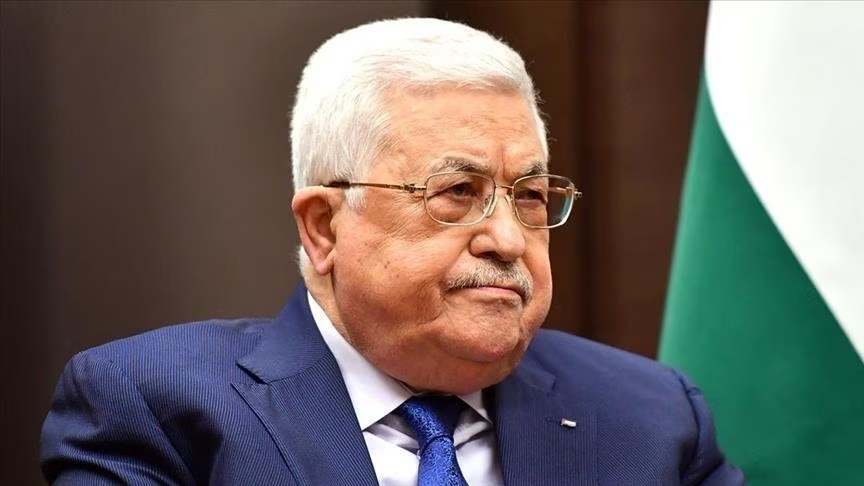
President Abbas discusses with the leader of the Greek Cypriot administration of southern Cyprus the situation in Gaza and Israeli violations in the West Bank

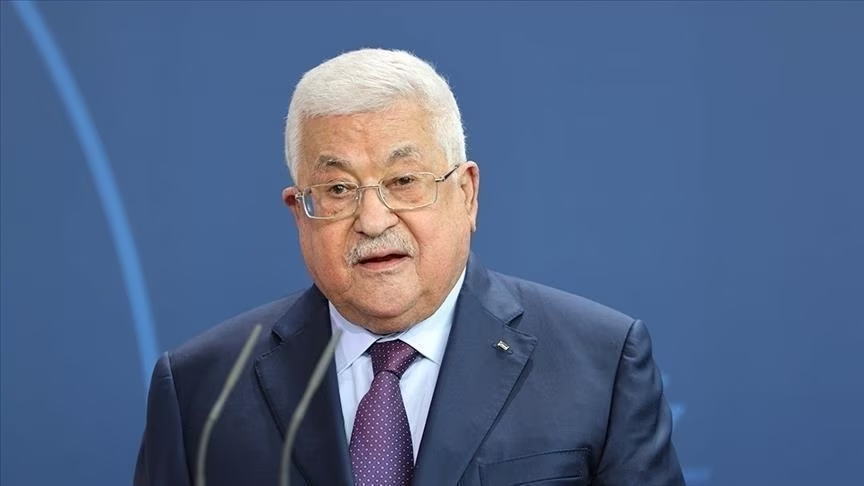
Palestinian President Mahmoud Abbas discussed on Sunday with the leader of the Greek Cypriot administration of southern Cyprus, Nikos Christodoulides, the situation in the Gaza Strip and Israeli violations in the West Bank.

This came during a phone call from Christodoulides to Abbas, according to the Palestinian News Agency.

The agency reported that during the call, they discussed "the latest political developments and updates on the situation in Palestine, especially in the Gaza Strip and the West Bank, including East Jerusalem, and ways to achieve peace in accordance with international legitimacy."

Abbas pointed to Palestine's commitment to US President Donald Trump's plan, "and the importance of starting the implementation of the second phase of the plan as agreed upon by Hamas and Israel, which involves Hamas handing over its weapons and relinquishing governance in the Gaza Strip, the complete withdrawal of occupation forces from the sector, establishing a ceasefire, introducing humanitarian aid and shelter materials, and proceeding to reconstruction."

On September 29 last year, Trump announced a peace plan and ceasefire for Gaza consisting of 20 points, including: the release of Israeli prisoners in Gaza, a ceasefire, disarming Hamas, Israeli withdrawal from the sector, forming a technocratic government, and deploying an international stabilization force.

Abbas emphasized the necessity of "stopping Israeli violations in the West Bank, including East Jerusalem, especially halting settlement expansion and settler terrorism, and releasing the detained Palestinian funds."

The detained funds or "clearance revenues" are taxes imposed on goods imported to the Palestinian side, whether from Israel or through border crossings controlled by Tel Aviv, which the latter collects on behalf of the Palestinian Authority.

However, starting from 2019, Israel decided to deduct amounts from them under various pretexts, then Tel Aviv stopped transferring any part of them about eight months ago.

The President of Palestine renewed his country's readiness "to assume its responsibilities in the Gaza Strip immediately" and "the readiness to work with President Trump and mediators and partners to implement the two-state solution in accordance with international legitimacy and for the Palestinian people to achieve their freedom and independence, so that the State of Palestine lives alongside the State of Israel in security, peace, and good neighborliness."

On October 10 last year, a ceasefire agreement in Gaza entered into force through Egyptian, Qatari, American, and Turkish mediation, amid ongoing Israeli breaches and its obstruction of the transition to the second phase of the agreement concerning security and administrative arrangements in the sector and Israeli withdrawals.

Over two years since October 8, 2023, Israel's genocide war, which lasted two years, has left more than 71,000 Palestinian dead and over 171,000 injured, mostly children and women, with reconstruction costs estimated by the United Nations at about $70 billion.

Alongside the genocide war on Gaza, the Israeli army and settlers escalated their attacks in the West Bank, resulting in the killing of more than 1,102 Palestinians, injuring about 11,000, in addition to arresting more than 21,000.

PALESTINE

Sun 21 Dec 2025 9:44 pm - Jerusalem Time

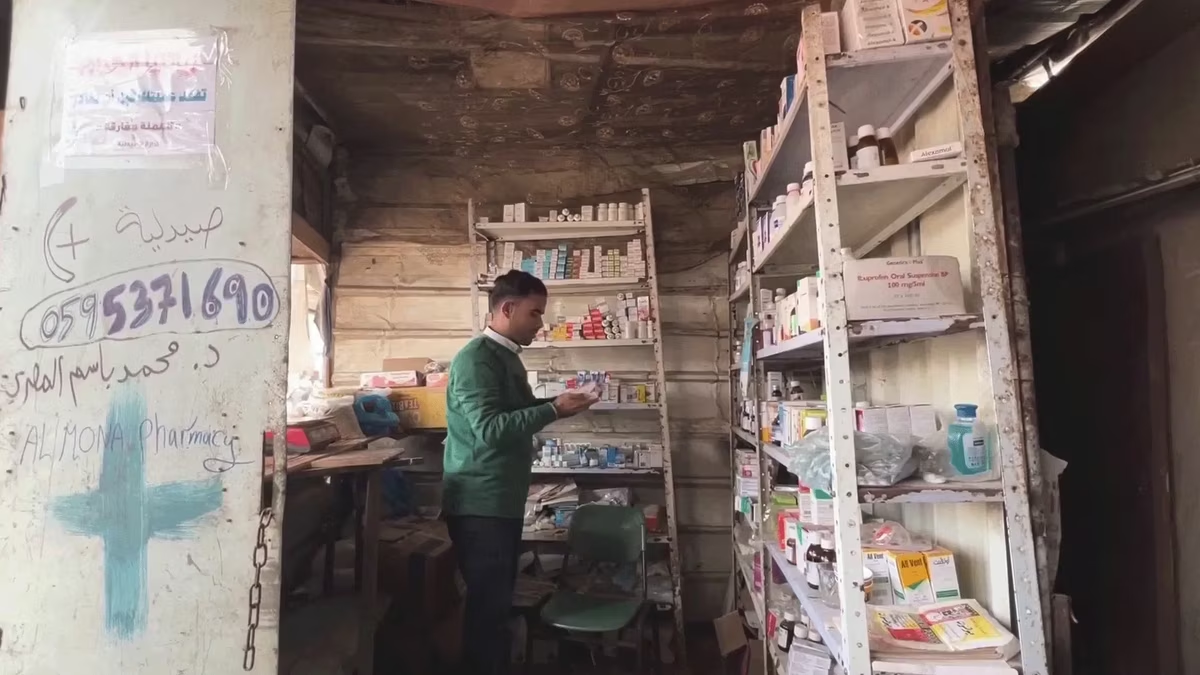
Unprecedented health crisis in Gaza.. Depletion of 50% of medicines and medical supplies

The health system in the Gaza Strip is experiencing an unprecedented crisis, with the complete depletion of more than half of the list of essential medicines and medical supplies in the central warehouses, which threatens to halt vital medical services for thousands of patients and injured individuals.

Medical teams are facing increasing difficulties in providing treatment, especially for patients with chronic diseases, amid severe overcrowding in hospitals and the accumulation of patients in departments and corridors against a growing need.

Doctors confirm that essential medicines have completely disappeared from hospitals, which has forced teams to resort to old medicines or previously used treatment protocols, despite their greater side effects on patients.

The situation outside hospital walls is not much different; patients in private pharmacies suffer from difficulty finding their medicines, and if available, they are sold at prices exceeding their purchasing power, which doubles their suffering amid stifling economic conditions.

Medical testimonies indicate that daily needs remain high, especially with cases of injuries and amputations, and cases requiring surgical operations and subsequent care, where there is an urgent need for strong antibiotics and painkillers, while there is a sharp shortage in medical supplies.

In this context, the voices of patients and their families are rising, demanding the opening of crossings, whether to bring in life-saving medicines or to enable patients to travel abroad for treatment.

One citizen describes the reality of the health sector by saying that Gaza lacks devices, painkillers, and treatments, expressing her hope for her child's recovery and return to his previous health.

For its part, the Gaza Health Ministry confirms that the crisis has exceeded the limits of medicine shortages, reaching a complete collapse in the pharmaceutical supply system, stating that the shortage rate in essential medicines exceeded 50% out of more than 600 types, while the shortage rate in medical supplies exceeded 70%, with a need for more than a thousand types.

The shortage reaches its peak in cancer treatment medicines and blood diseases at a rate of up to 70%, while the shortage in vaccines exceeded 50%, while the shortage rate in heart surgery consumables reaches 100%, with similar high rates in orthopedics and ophthalmology surgeries.

Doctors warn that these conditions may lead to death, especially among children suffering from malnutrition, or to amputation of limbs due to lack of orthopedic surgery supplies.

This comes amid Israel's continued reduction of medical truck entries into the sector to less than 30% of the monthly need, according to the Health Ministry.

Despite the end of the war, Israel continues to shirk its obligations stipulated in the ceasefire agreement, which came into effect on October 10 last, after introducing the agreed quantities of medicine trucks.

Hours ago, the Director-General of the World Health Organization, Tedros Adhanom Ghebreyesus, called for the urgent approval of the entry of basic medical supplies and equipment to Gaza hospitals, confirming that Gaza's health facilities face shortages of supplies and equipment due to complex entry procedures and restrictions.

PALESTINE

Sun 21 Dec 2025 8:05 pm - Jerusalem Time

Territorial division in Gaza.. Hamas controls the west and emerging militias appear east of the 'yellow line'

At least five armed factions have begun practicing their activities, after transforming from scattered gangs.

After two years since the outbreak of confrontations, a new scene emerges in the Gaza Strip characterized by territorial division and the struggle for influence; where the control map has been redrawn between the "Hamas" movement, which strengthens its grip in the populated western half, and the areas east of the "yellow line" under "Israeli" control, which have become a stage for movements of emerging armed militias.

Under the eyes of the occupation, at least five armed factions have begun practicing their activities, after transforming from scattered gangs into a coordinated network preparing itself for a political and security role in the post-war phase.

These militias, linked to bases in "Israeli" control areas, rely on propaganda campaigns on social media platforms, pledging to remove Hamas from power, despite their limited military capabilities.

These groups have contributed to increasing chaos by carrying out "hit-and-run" attacks against Hamas positions, described as "rebellion within rebellion," and these movements seek to challenge the movement's authority at a critical moment in efforts to establish governance, which has complicated the security scene for Palestinians who fear the afflicted sector slipping into a comprehensive civil war.

In contrast, the Hamas movement launched a counter-campaign to pursue these factions to preserve its influence, and the city of Gaza witnessed bloody acts of violence, where platforms affiliated with the movement published reports and video clips showing the execution of eight people on charges of "collaboration with the occupation" or involvement in security crimes, without providing official evidence, which enhanced the state of terror and tension among the sector's residents.

ARAB AND WORLD

Sun 21 Dec 2025 8:05 pm - Jerusalem Time

Israel presents an intelligence file to Trump to convince him to launch a new attack on Iran

Israel is preparing to present a comprehensive intelligence file to US President Donald Trump during his upcoming meeting with Israeli Prime Minister Benjamin Netanyahu in the American state of Florida, with the aim of convincing him to take practical steps against Iran, including the possibility of launching a new attack, as reported by the Yisrael Hayom newspaper in a report published today, Sunday.

The Israeli newspaper indicates that Trump is hesitant to take decisive steps, and Netanyahu's meeting with him—wanted by the International Criminal Court—aims to define a joint roadmap and coordinate a radical solution to the Iranian problem.

According to the newspaper's sources, the intelligence file will focus on the renewal of Iran's nuclear program, the development of ballistic missiles, the activities of the Iranian Revolutionary Guard, and support and funding of terrorism through Tehran's arms in the region.

Tel Aviv—according to the Israeli newspaper—sees overthrowing the Iranian regime as the radical solution to end wars in the region.

The newspaper indicates that Israel is studying military and economic options in parallel with supporting the internal opposition to destabilize the regime in Tehran, amid economic deterioration in Iran and possible Western pressures to tighten sanctions.

The Israeli newspaper's revelation comes after it reported yesterday, Saturday, from Israeli and American sources that Netanyahu plans to brief Trump on plans for possible new strikes against Iran.

The sources said that Israeli officials' concern has increased regarding "Iran's expansion of its ballistic missile program, which was damaged by Israeli military strikes earlier this year," and they are preparing to brief the US president on options to attack it again.

The sources added that Israeli officials are also concerned about Iran restarting uranium enrichment sites that were hit by American strikes during the 12-day war in June last year.

The sources said that the Israeli Prime Minister will present Trump with options to join any new military operations or assist in them, according to the American channel.

However, two former Israeli officials said that Trump may be less enthusiastic about any new military action in Iran if tensions continue between American and Israeli officials regarding Netanyahu's approach to the ceasefire in the Gaza Strip, which came into effect on October 10 last year and was violated by Israel several times.

This comes at a time when Tehran has expressed its desire to resume diplomatic talks with the United States regarding its nuclear program.

As part of what the United States called Operation "Midnight Hammer," the US military targeted Iranian nuclear facilities at dawn on June 22 with more than 100 aircraft, submarines, and seven B-2 bombers, days after continuous Israeli strikes on Iranian military facilities and targeting officials that began on the 13th of the same month, before the war ended on June 24.

PALESTINE

Sun 21 Dec 2025 7:51 pm - Jerusalem Time

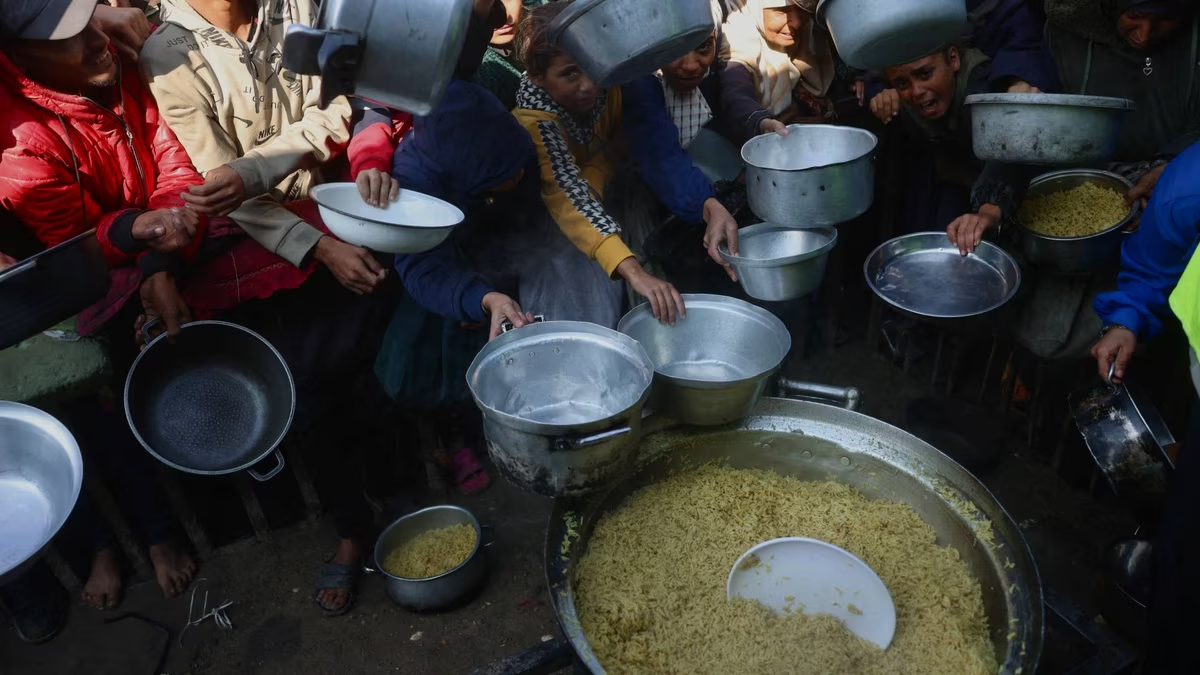
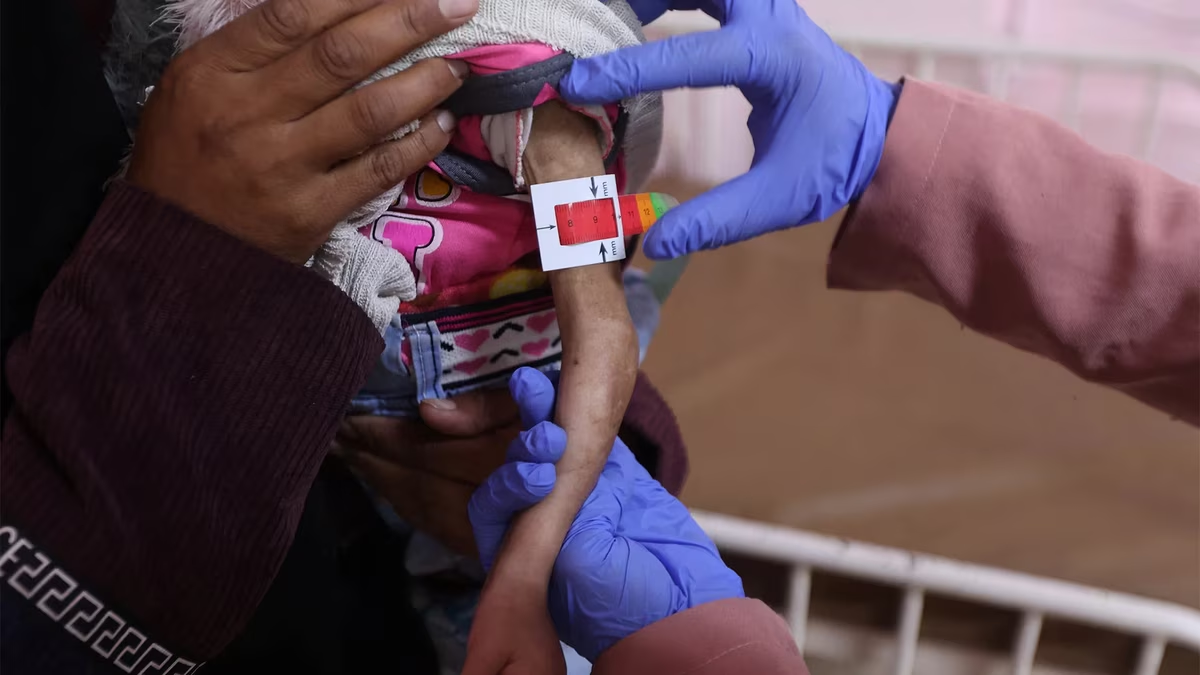
More than 100,000 children and 37,000 women at risk of "acute malnutrition in Gaza"

The Director-General of the World Health Organization issued strongly worded warnings about the impending humanitarian catastrophe in the Gaza Strip, confirming that more than 100,000 children, in addition to approximately 37,000 pregnant and breastfeeding women, will suffer from acute malnutrition until next April, which heralds a deadly threat to the most vulnerable groups.

The Director-General explained that health facilities in the sector are facing a severe shortage of basic medical supplies and equipment, as a result of strict restrictions and complex entry procedures that hinder the arrival of aid, noting that these restrictions have caused near-total paralysis in the hospitals' ability to provide necessary care to patients and the wounded.

In conclusion of his statements, the organization made an urgent call for immediate approval of the entry of essential medical equipment and supplies into Gaza hospitals, emphasizing that delaying these supplies means losing more lives that could be saved, demanding the removal of obstacles to medical humanitarian work.

PALESTINE

Sun 21 Dec 2025 6:52 pm - Jerusalem Time

Palestinian President: Denying the Palestinian people's right to self-determination will not bring security and peace to anyone

The Palestinian President Mahmoud Abbas said on Sunday that denying the Palestinian people's right to self-determination will not bring security and peace to anyone, reiterating his commitment to peace through dialogue as a strategic option.

This came during his reception of a delegation of Israeli peace activists, at the presidential headquarters in the city of Ramallah in the occupied West Bank, according to the official Palestinian news agency.
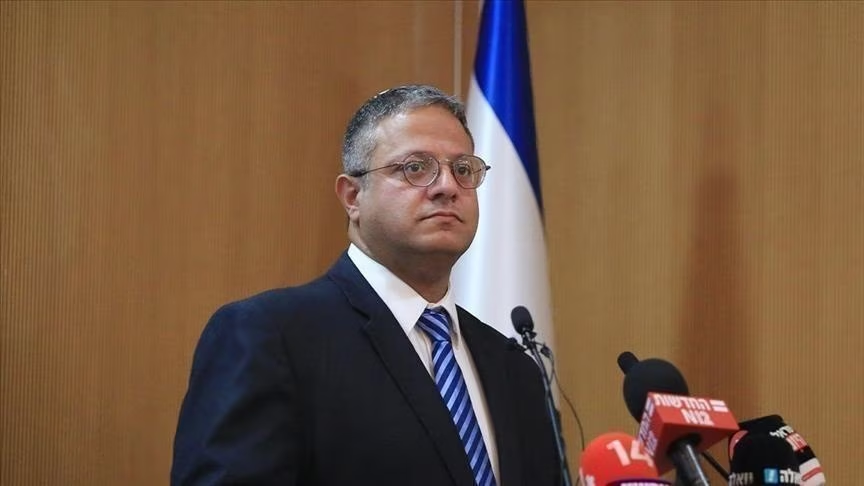
Abbas added that "the denial by extremist forces in Israel of the Palestinian people's right to self-determination and achieving independence in their state, alongside the state of Israel, in accordance with international legitimacy, will not bring security and peace to anyone, and this is what we have been witnessing for decades".
He emphasized that peace according to the two-state solution "achieves security, peace, and stability for the Palestinian and Israeli peoples and the peoples of the region".
He renewed the affirmation that "achieving peace through dialogue will remain our strategic option, because we believe in political, diplomatic, and legal work, and we condemn violence and terrorism in all its forms and names".
He continued that "the Israeli occupation authorities, with their insistence on settlement, annexation, and apartheid, and the policy of killing and destruction, denying Palestinian rights, withholding funds, and other unilateral measures, have isolated Israel from the international community, and what we want and strive for is to live in peace, stability, and good neighborliness with the Israeli people".

He explained that "the key to regional security and peace is only through reaching a Palestinian-Israeli peace agreement based on the decisions of international legitimacy and the Arab Peace Initiative, so that all peoples and countries in the region may enjoy security, peace, and prosperity".

Since April 2014, negotiations between the Israeli and Palestinian sides have stopped, due to Tel Aviv's refusal to halt settlement, release old prisoners, and its renunciation of the two-state solution option.

Since then, Israel has waged several wars on the Gaza Strip, while the pace of settlement has accelerated significantly in the West Bank during the two years of the genocide war on Gaza.

The Israeli genocide war launched by Israel in Gaza starting from October 8, 2023, for two years, has left about 71,000 Palestinian dead and more than 171,000 injured, most of them children and women, and immense destruction with a reconstruction cost estimated by the United Nations at about 70 billion dollars.

Concurrently, the Israeli army and settlers have escalated their attacks in the West Bank, resulting in the killing of more than 1,102 Palestinians, injuring about 11,000, in addition to arresting more than 21,000.

ARAB AND WORLD

Sun 21 Dec 2025 6:45 pm - Jerusalem Time

Israeli Central Court Cancels Netanyahu's Trial Session on Monday

A Hebrew newspaper reported on Sunday that the Israeli Central Court decided to cancel the trial session of Prime Minister Benjamin Netanyahu scheduled for tomorrow Monday, with the trial sessions continuing on Tuesday and Wednesday.

The cancellation decision came after postponing the government meeting from Sunday to Monday, due to arrangements for the Hanukkah holiday for state employees, which led to a direct conflict between the government meeting time and the court session.

The newspaper indicated that Netanyahu's lawyers submitted a request to cancel the Monday and Tuesday sessions, but the court judges approved only the cancellation of the Monday session, deciding to keep the Tuesday session, in addition to shortening the Wednesday session.

Netanyahu faces charges of corruption, bribery, and breach of trust in three cases, which may require imprisonment if convicted, while he refuses to admit any of the charges against him.

Another newspaper stated that the court considered changing the government meeting date a sufficient reason to cancel the Monday session, confirming that the trial sessions will continue in the following days according to the revised schedule.

Accordingly, no trial session for Netanyahu will be held on Monday, with the judicial proceedings continuing during the rest of the week, according to the court's decision.

The newspaper also noted that the prosecution criticized the way the postponement request was submitted, considering that "attaching the justifications for the request in a sealed envelope is unjustified and constitutes an infringement on the principle of publicity of judicial proceedings, especially since some details related to the request were previously published in the media," according to the newspaper.

The holding of trial sessions comes amid the ongoing division within Israel regarding Netanyahu's request for presidential pardon from President Isaac Herzog, between supporters and opponents.

On November 30 last year, Netanyahu requested Herzog to grant him a pardon for the corruption charges he faces, without admitting guilt or retiring from political work.

Since the start of his trial, Netanyahu refuses to admit guilt, while Israeli law does not allow the president to grant pardon except after admission.

Netanyahu's trial in these cases began in 2020 and continues, while he continues to deny the charges, considering them "a political campaign aimed at ousting him."

ARAB AND WORLD

Sun 21 Dec 2025 6:32 pm - Jerusalem Time

Jared Kushner Returns to the American Foreign Policy Arena

After nearly a year into the presidency of US President Donald Trump, his son-in-law Jared Kushner has returned to the foreign policy circle and is playing a larger role in sensitive peace negotiations after his role diminished throughout the previous period, joining Stephen Witkoff, the special envoy of the US President.

This change reflects a prevailing sentiment among Trump's close associates that Kushner, who has diplomatic experience, complements Witkoff's negotiation style and can bridge the seemingly intractable gaps to reach an agreement, according to several current and former administration officials who spoke, like others, on condition of anonymity to discuss internal deliberations.

This role became evident at the end of this week when Kushner and Witkoff hosted the Russian negotiator Kirill Dmitriev in Miami for talks on the latest proposals to end the Russian war in Ukraine, and they also met with Turkish and Qatari officials to discuss the fragile ceasefire between Israel and the Islamic Resistance Movement (Hamas) in Gaza, as they look to implement the second phase of Trump's plan to stop the firing.

The extended session on Saturday with Dmitriev came after several weeks of shuttle diplomacy, where Witkoff and Kushner recently met with Russian President Vladimir Putin in Moscow and Ukrainian and European diplomats in Germany. The two American envoys were scheduled to hold more talks with Dmitriev on Sunday, according to a White House official.

Witkoff, a longtime friend of Trump, is considered by some officials within the administration to be a prominent figure who has traveled the world in diplomatic negotiations on his private plane, and does not miss any opportunity to publicly praise the President for his acumen in foreign policy, according to the officials.

A Western diplomat says Kushner has complex business interests in the Middle East, sometimes known as "deal diplomacy," which has annoyed some officials in European capitals.

However, Kushner is seen as a more credible negotiator than Witkoff, who is considered by many Ukrainian and European officials to be excessively lenient towards Russian interests during the war in Ukraine that began in February 2022, according to the diplomat.

Ian Kelly, a retired diplomat and former US ambassador to Georgia, who is currently a professor of diplomacy at Northwestern University, says, "Kushner has a slightly more impressive record than Trump's first administration." But Kelly emphasized that judgment on Kushner's involvement has not yet been issued.

Trump views Kushner as "a trusted family member and talented advisor" who played a pivotal role in some of his biggest foreign policy successes, according to Anna Kelly, White House deputy spokesperson.

Kelly added that Trump and Witkoff "often seek Kushner's opinion given his experience in complex negotiations, and Kushner has been generous in providing his valuable expertise when asked."

The official spokesperson for the US State Department, Tommy Bigot, described Kushner as "a world-class negotiator." Bigot noted that Secretary of State Marco Rubio is grateful to Kushner "for his willingness to serve the country and help President Trump resolve some of the world's most complex challenges."

Kushner spoke in an interview with the program "60 Minutes" on CBS in October, about his unconventional approach to diplomacy, saying: "I actually trained in foreign policy during President Trump's first term by seeing a president come to Washington with a different school of foreign policy than what had prevailed during the previous twenty or thirty years."

However, some Democrats and government watchdog groups have expressed doubts about Kushner's role in shaping the administration's policies in the Middle East, while managing investments worth billions of dollars. Similarly, Witkoff has faced scrutiny due to his deep business relationships and his family's ties to Gulf countries.

Commenting on that, Kushner said that "what people call a conflict of interest, Witkoff and I call experience and reliable relationships we have around the world."

White House advisor David Warington said in a statement that Kushner's efforts on behalf of Trump "are in full compliance with the law."

Kelly and other veterans of American diplomatic meetings with the Russians over many years doubt Kushner's ability to secure an agreement between Russia and Ukraine because Witkoff is still technically in the lead.

Kelly said: "I don't see Witkoff's approach succeeding." "He doesn't understand the Russians well. He misunderstands what they say and conveys this misunderstanding to Washington and the Europeans."

Kelly said: "It seems they have the idea that the magic key is money: investment and development." "But these men don't care about that; they are not real estate men except in that they want the land, period."

Kushner had told Trump and others that although he would not join the White House in his second term, he was ready to offer his advice if they wished. This role he also played on a few occasions during the years of former President Joe Biden, when the Democratic administration tried, unsuccessfully, to expand the Abraham Accords.

With Trump's efforts to reach an agreement to end the war between Israel and Hamas in Gaza stalling during the summer, Kushner intervened, leveraging his experience and relationships in negotiating the Abraham Accords to help Witkoff push Trump's plan to the finish line.

The 20-point plan was agreed upon in late September after frantic talks on the sidelines of the United Nations General Assembly meetings, and it is still being implemented, but Kushner and many members of the Abraham Accords team are coordinating its implementation.

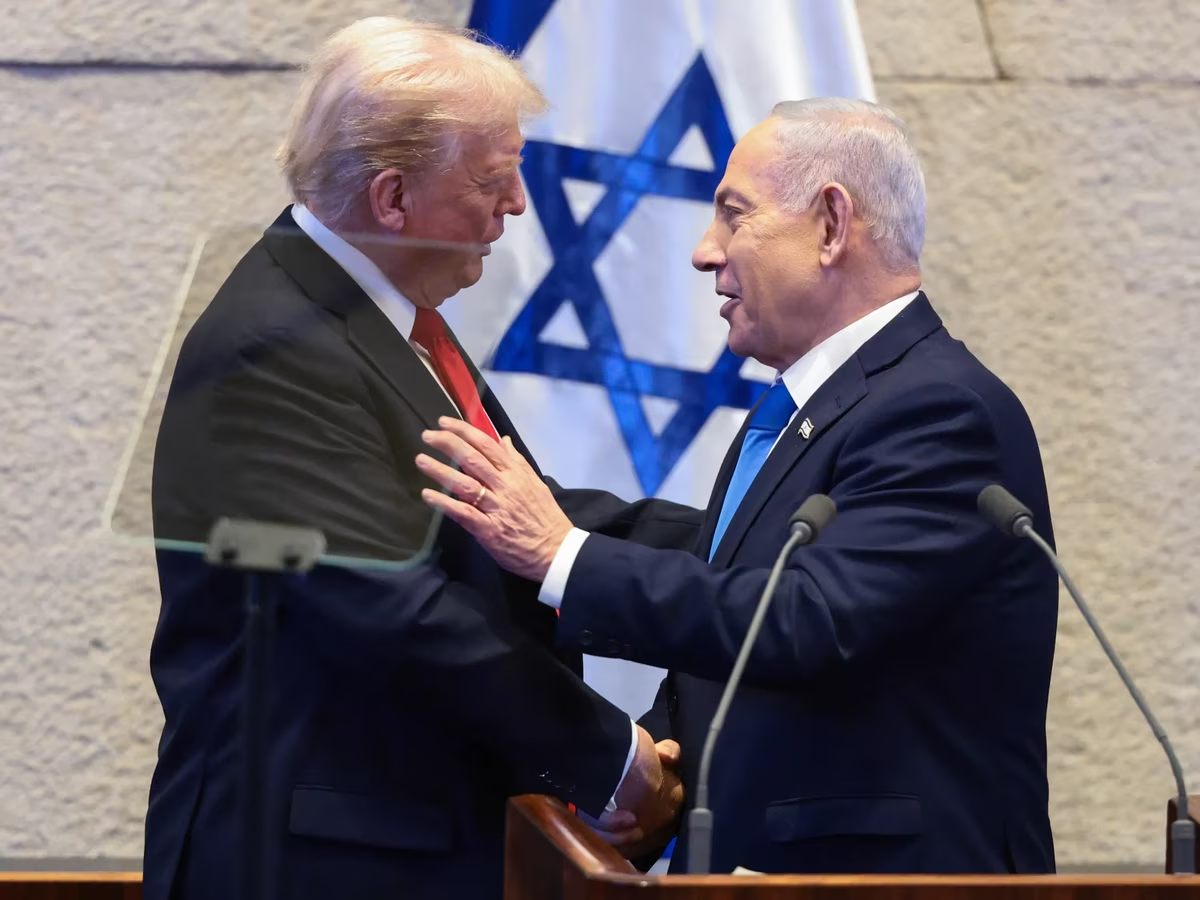
Trump told the Israeli parliament, the Knesset, shortly after the agreement: "We always call on Kushner when we want to close that deal. We need his mind sometimes."

Once the Gaza plan is completed, Kushner said he would return to his family and his daily job in Miami, where he heads a private investment company worth billions of dollars. Kushner said his involvement in the high-risk peace-making process was temporary only, joking that his wife Ivanka might change the locks if he didn't return home soon.

But within weeks of reaching the ceasefire in Gaza, Trump again turned to his problem-solving son-in-law to engage in negotiations between Russia and Ukraine. The negotiations had been at a standstill for months despite the White House's ongoing efforts to persuade Putin and Ukrainian President Volodymyr Zelenskyy to reach an agreement.

Trump hinted at the time that he would continue to rely on Kushner when the stakes are at their highest, just as he had done before.

PALESTINE

Sun 21 Dec 2025 6:28 pm - Jerusalem Time

International newspapers and websites: The cost of supporting Palestinians.. Besieged villages in the West Bank.. Activists on hunger strike in Britain

International newspapers and websites addressed the cost of supporting Palestinians amid the Israeli war, shedding light on the reality of besieged villages in the West Bank, the suffering of activists on hunger strike in Britain, alongside the repercussions of the starvation policy in Gaza and other regional developments.

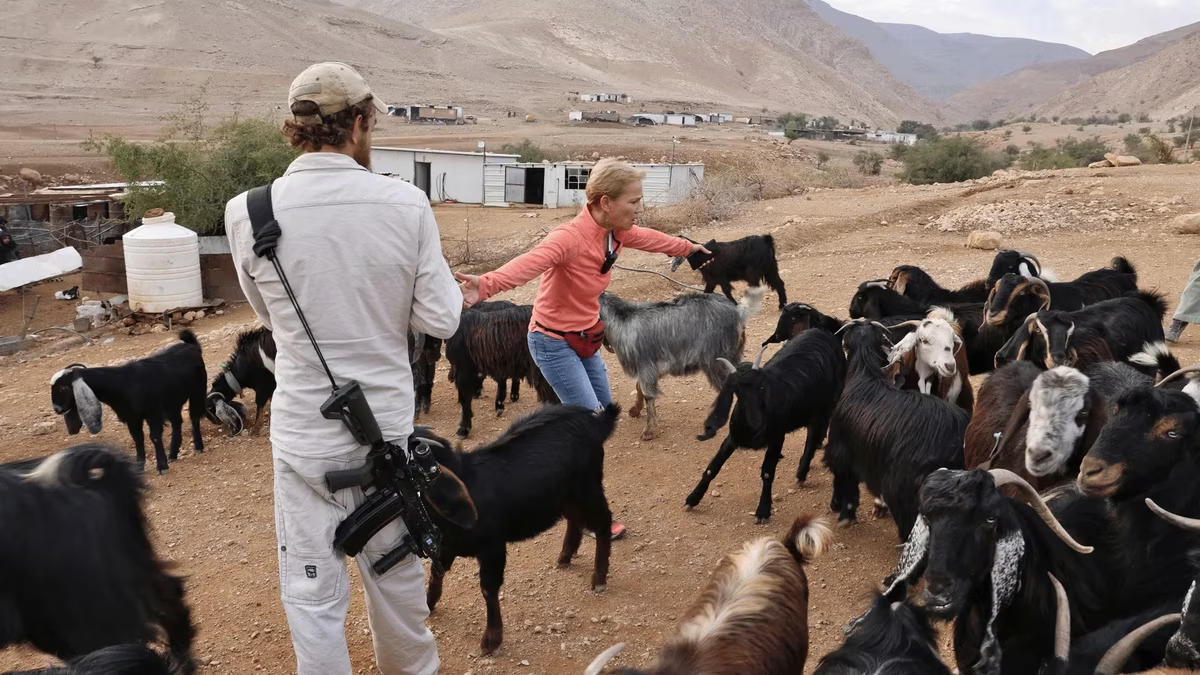
In the West Bank, the British Guardian newspaper reported that international volunteers have become a line of protection for Palestinians from settler attacks, especially in the village of Ras Ein al-Auja, where residents live besieged and deprived of pastures and springs, amid attempts to force them to leave.

The newspaper added that the volunteers themselves are subjected to direct attacks, which forced some of them to wear protective vests while accompanying the locals, in a scene that reflects the escalation of settler violence and the residents' inability to protect themselves in the absence of accountability.

In London, the Sunday Times revealed the hunger strike of one pro-Palestine activist inside prison, warning of the risk of his death before his trial, as part of a case involving 6 activists who protested Britain's support for Israel during the Gaza war.

The newspaper mentioned that Kamran Ahmed, aged 28, continues his strike for 6 weeks, relying on faith and reading to endure, and said that the strike has highlighted their cause, despite the psychological pressure it caused on his family and friends.

For its part, the Israeli Haaretz newspaper published an analysis that spoke of a relative improvement in food availability in the Gaza Strip, but emphasized that this does not absolve the Israeli government of responsibility for a deliberate starvation policy that resulted in the deaths of hundreds and left tens of thousands at risk of severe hunger.

As for outside the Palestinian file, the New York Times covered American raids on ISIS sites in Syria, considering that they reveal the magnitude of challenges facing the new Syrian authorities, while the Wall Street Journal defended the American security strategy and called on Europe to bear its defense responsibilities.

PALESTINE

Sun 21 Dec 2025 5:24 pm - Jerusalem Time

Stagnation of the Palestinian Economy and Sharp Decline in Gross Domestic Product During 2025

Ayser Al-Eis / Anadolu

* Data from the Palestinian Central Bureau of Statistics and the Monetary Authority: - The Gross Domestic Product recorded a "sharp decline" in the Gaza Strip during 2025 by 84 percent and 13 percent in the West Bank - Construction activity recorded the highest decline by 41 percent, with 29 percent in the West Bank and 99 percent in Gaza - The volume of foreign trade recorded a decline of 12 percent, and imports recorded a decline of 17 percent - The unemployment rate recorded 46 percent, with 28 percent in the West Bank and 78 percent in Gaza

The Palestinian Central Bureau of Statistics and the Monetary Authority revealed, on Sunday, stagnation in the Palestinian economy and a sharp decline in the Gross Domestic Product during 2025.

This came in a joint statement from the Palestinian Central Bureau of Statistics and the Monetary Authority regarding the Palestinian economic harvest for 2025 and economic forecasts for 2026.

The statement mentioned that the Gross Domestic Product in Palestine recorded a "sharp decline" in the Gaza Strip by 84 percent compared to 2023, in addition to a decline in the West Bank by 13 percent during the same period.

It noted that construction activity recorded the highest decline by 41 percent, with 29 percent in the West Bank and 99 percent in Gaza.

Meanwhile, services activity recorded a general decline of 25 percent; 12 percent in the West Bank and 82 percent in Gaza, while agricultural activity declined by 92 percent in Gaza, compared to stability in the West Bank during the same period.

According to the statement, the volume of trade exchange in Palestine with the outside world recorded a decline of 12 percent, with imports recording a decline of 17 percent during 2025 compared to 2023.

It indicated that this decline "reflects the extent of the cumulative damage that has befallen the economy since the start of the Israeli aggression on the West Bank and Gaza Strip, more than two years ago, which led to damage to production capacity and the continuation of bottlenecks in economic activities".

Despite the West Bank recording a limited increase of 4.4 percent in 2025 compared to 2024, the Gross Domestic Product in the Gaza Strip continued to shrink, recording an additional decline of 8.7 percent during the same period, according to the statement.

The statistics indicate that nearly half of the workforce in Palestine is disrupted, with the unemployment rate reaching 46 percent during 2025, with 28 percent in the West Bank and 78 percent in Gaza, with more than 650,000 unemployed.

The forecasts indicate that the Palestinian economy will record a growth of between 4.1-4.5 percent during 2026, indicating the continuation of gradual recovery that began after the sharp contraction recorded in 2024.

This growth is attributed, according to the statement, to a limited improvement in the components of aggregate demand, especially final consumption, supported by the continued flow of humanitarian aid and private transfers, in addition to a partial positive contribution from investment spending.

This comes as the Israeli army and settlers escalate their attacks in the West Bank since the start of the genocide war in Gaza that lasted two years, resulting in the killing of more than 1,102 Palestinians, injuring about 11,000, in addition to arresting more than 21,000.

Meanwhile, the Israeli genocide war in Gaza left about 71,000 Palestinian dead and 171,000 injured, mostly children and women, and massive destruction with a reconstruction cost estimated by the United Nations at about 70 billion dollars.

PALESTINE

Sun 21 Dec 2025 11:57 am - Jerusalem Time

The Director General of the Gaza Health Ministry: The lives of thousands of patients are hanging in the balance due to lack of medicine and destruction of hospitals

The Director General of the Health Ministry in the Gaza Strip, Dr. Munir Al-Barsh, warned that the lives of thousands of patients in Gaza are hanging in the balance, amid shortages of medicine, destruction of hospitals, and absence of doctors.

Al-Barsh stated that the Palestinian citizen in the Gaza Strip is suffering from another hidden war, which is the shortage of medicine, noting that the medicine catastrophe is reflected in the numbers, as there are more than 80,000 diabetic patients at risk of relapses due to the unavailability of diabetes medications.

He mentioned that more than 5,100 hypertension patients are threatened with fatal clots due to the unavailability of basic services such as cardiac catheterization and open-heart surgery.

Moreover, about 2,000 cancer patients face the risk of death due to the absence of medications and treatment protocols, and about 45,000 heart patients are threatened with heart crises, in addition to 1,100 kidney patients needing regular dialysis, and more than 24,000 psychiatric patients without medications, as Al-Barsh confirms.

The Director General of the Health Ministry in Gaza listed the missing medicines in Gaza, which include antibiotics, fever reducers, and sterile gauze for wounds, in addition to other medicines and supplies that the occupation prevents from entering.

Figures from the World Health Organization indicate the death of 1,092 patients awaiting medical evacuation during the past months in Gaza, and confirm that 50% of the sector's hospitals are operating partially.

Al-Barsh affirmed that the Israeli occupation has prevented the entry of medicines into Gaza since October 2023, and only allows the entry of small quantities not exceeding 10% of urgent needs, and has divided the sector and destroyed 324 licensed pharmacies and 128 drug companies and warehouses.

PALESTINE

Sun 21 Dec 2025 11:56 am - Jerusalem Time

New settlement escalation.. The occupation approves the construction of 19 settlements in the West Bank

In a settlement escalation described by officials in the occupation government as "historic," the mini-ministerial council of the occupation authorities approved, on Sunday, the establishment of 19 new settlements deep in the occupied West Bank.

With this decision, the number of settlements approved over the past three years rises to 69 settlements, enhancing the policy of imposing a fait accompli and fragmenting Palestinian lands.

A statement issued by the office of Finance Minister Bezalel Smotrich stated that this step was coordinated with Defense Minister Yoav Gallant to approve and organize these spatial outposts that are characterized by high strategic importance.

Prominent among these projects is the re-establishment of the "Ganim" and "Kedem" settlements in the north of the West Bank, which had been evacuated in previous years.

Concurrently with this announcement, UN Secretary-General António Guterres warned in an official report submitted to the Security Council that settlement expansion reached a "record" level this year 2025, the highest since the start of regular monitoring in 2017.

Guterres revealed that 2025 saw the approval or tendering of approximately 47,390 settlement housing units, compared to about 26,170 units in 2024, representing a huge leap from the previous years' average of around 12,800 units annually.

Guterres condemned this ongoing expansion, affirming that it undermines the possibility of a contiguous and sovereign Palestinian state, and constitutes a flagrant violation of international law.

He indicated that these developments work to "entrench the illegal occupation" and deprive Palestinians of their right to self-determination.

The UN report did not limit itself to the settlement file but condemned the "alarming" increase in settler violence against Palestinian civilians, noting that some of these attacks occur in the presence or with the support of occupation security forces.

Guterres expressed his deep concern over the occupation's military operations that led to hundreds of deaths and the destruction of infrastructure and homes.

It is noteworthy that the number of settlers in the West Bank (excluding East Jerusalem) has exceeded 500,000 settlers, living amidst about three million Palestinians.

Since the outbreak of the war in Gaza in October 2023, and despite the ceasefire that came into effect on October 10 last year, violence in the West Bank has not subsided; where more than a thousand Palestinians have been killed by the fire of occupation soldiers or settlers, while 44 "Israelis" fell in attacks or during military operations, according to official statistics.

PALESTINE

Sun 21 Dec 2025 11:34 am - Jerusalem Time

For the tenth time.. the occupation government procrastinates in responding to the petition for the entry of international press into Gaza

The occupation government, led by Benjamin Netanyahu, continues its systematic policy of procrastination to prevent independent media coverage of what is happening inside the Gaza Strip.

On Sunday, the government requested the occupation's Supreme Court to extend the deadline granted to it to respond to the petition submitted by the Foreign Press Association, which demands allowing international media free and independent access to the sector.

This request is the tenth in a row within an extended judicial process, where the occupation side repeatedly postpones ruling on the case without providing any practical plan to allow the entry of foreign crews, after the government submitted the ninth extension request on December 4th of this month.

Since the outbreak of the war on October 7, 2023, the occupation has imposed a complete closure on the sector for international media, limiting entry to very limited tours organized by the occupation army under strict conditions, including permanent military accompaniment and subjecting all journalistic materials to military censorship before publication.

The Foreign Correspondents Association, which represents hundreds of global media institutions, demanded that the Supreme Court oblige the government to allow journalists to enter without military accompaniment.

Despite the ceasefire entering into force on October 10th last year pursuant to US President Donald Trump's plan, the court continues to reject the petitions under the pretext of "military operations", while the government continues to use the weapon of "one postponement after another".

This policy provokes widespread international criticism, as it is considered an attempt to conceal facts from the world. Despite Benjamin Netanyahu mentioning the issue twice recently and affirming that he will instruct the army to prepare to open the sector to the media, no tangible practical decision has seen the light yet, leaving international journalists prohibited from independently monitoring field conditions.

PALESTINE

Sun 21 Dec 2025 11:24 am - Jerusalem Time

Anticipation for the 'Trump-Netanyahu' Summit in Miami to Decide the Second Phase of the Gaza Reconstruction Plan

The newspaper affiliated with the occupation reported on Sunday that the political level in the occupation authorities is eagerly anticipating the upcoming meeting scheduled for next Monday in the American city of Miami between President Donald Trump and the occupation's Prime Minister Benjamin Netanyahu.

The meeting aims to make decisive decisions on how to prepare for implementing the second phase of the plan related to rebuilding the Gaza Strip.

The newspaper quoted informed sources that President Trump will present to Netanyahu the American administration's mechanism for pushing this step towards implementation, in addition to a package of related decisions.

Reports indicate that the concern within the occupation circles revolves around linking the 'disarmament of the Hamas movement' with the continuation of the occupation army's withdrawal from the sector's lands, in addition to demands related to uncovering the remaining tunnels and destroying them definitively.

In a related context, Washington, Qatar, Egypt, and Turkey - as mediators in the indirect negotiations - agreed to continue consultations in the coming weeks to accelerate the implementation of the second phase of Trump's plan.

This agreement came after a series of talks that brought together the foreign ministers of these countries with the American envoy to the Middle East, Steve Witkoff, in Miami.

The mediators confirmed in a statement issued after those meetings: 'We emphasize full commitment to all provisions of Trump's peace plan for Gaza, and we call on all parties to fulfill their inevitable obligations to ensure the success of this path.' The field anticipation remains the master of the situation for what the Monday meeting will yield in procedural details that may change the approach to the sector's file.

PALESTINE

Sun 21 Dec 2025 10:53 am - Jerusalem Time

Ben Gvir proposes establishing a detention facility surrounded by crocodiles for Palestinian prisoners

The Hebrew Channel 13 reported on Sunday that Israeli National Security Minister Itamar Ben Gvir proposed establishing a "detention facility surrounded by crocodiles" to detain Palestinian prisoners in it.

The channel added: "In the Israeli Prison Service, they are studying an unusual proposal presented by the National Security Minister, which calls for establishing a detention facility for security prisoners surrounded by crocodiles, in order to prevent escape attempts."

It indicated that the proposed location is near the Haimat Gader area in northern Israel.

According to the channel, Ben Gvir, head of the "Jewish Power" party, presented his proposal during an assessment session he held with Prison Service Commissioner Kobi Yaakovi last week.

The proposed area is located near the occupied Syrian Golan Heights and the border with Jordan, and contains a crocodile farm and a zoo.

This comes at a time when the Knesset (Israeli parliament) intends to vote in the coming days in the second and third readings on a bill proposed by Ben Gvir to execute Palestinian prisoners accused by Israel of planning or participating in attacks against it.

On November 11 last year, the Knesset plenum approved the bill in the first reading, and it must be voted on in the second and third readings to become an enforceable law.

On December 8 this year, Israeli data reported the death of 110 Palestinian prisoners in Israeli prisons since Ben Gvir assumed his duties as National Security Minister at the end of 2022.

Israel holds more than 9,300 Palestinian prisoners, including children and women, who suffer from torture, starvation, and medical neglect, which has led to the death of many of them, according to Palestinian and Israeli human rights reports.

Israel's crimes against Palestinian prisoners have escalated alongside a genocide war it waged on the Gaza Strip for two years since October 2023, resulting in the killing of about 71,000 Palestinians and injuring more than 171,000.

ARAB AND WORLD

Sun 21 Dec 2025 10:44 am - Jerusalem Time

The Israeli Army Escalates Its Violations of Syrian Sovereignty with 42 Incursions in 21 Days

The Israeli army escalated its violations of Syrian sovereignty on Sunday through three ground incursions in Quneitra province and its surroundings (southwest).

Thus, the total number of incursions since the beginning of December of the current year, that is, in 21 days, rises to 42 incursions, some of which involved arrests.

The incursions come within an Israeli strategy to nibble additional areas of land and impose a new geographical and field reality that transcends the historical disengagement lines, according to Syrians.

On Sunday, the official Syrian News Agency (SANA) reported that "an occupation patrol, consisting of two military vehicles, intruded from the Al-Adnaniya point in the northern countryside of Quneitra".

It added that it "set up a barrier at the intersection of the village of 'Um al-Azham' which connects it to the villages of Ruwayhinah and Al-Mashayrifah".

Another patrol intruded west of the town of Al-Rafid in the southern countryside of Quneitra, and fired randomly into the air, according to the agency.

The agency continued that a patrol consisting of 5 military vehicles intruded into the village of Sayda Hanout in the southern countryside of Quneitra.

According to a count, based on the "SANA" agency, the Israeli forces committed 42 incursions and land assaults since the beginning of the current December, distributed across 4 main axes.

In the axis of the central countryside of Quneitra, the number of incursions reached 18, and the villages of Bir Ajam, Bariqa, and Kodana topped these assaults.

These villages witnessed repeated incursions of heavy military vehicles, accompanied by digging trenches, building large earthen barriers, and uprooting thousands of fruit and forest trees.

In the axis of the northern countryside of Quneitra, the number of incursions reached 12, and they were concentrated in the areas of Jbata al-Khashab, Tarinjeh, Mazra'at al-Amal, and al-Hamidiyah, and bulldozers destroyed agricultural areas and water wells, and prevented farmers from accessing their lands.

In the axis of the southern countryside of Quneitra, the Israeli army carried out 9 incursions, targeting the villages of Al-Rafid, Al-Asha, Al-Qahtaniyah, and Al-Huriyah, and dug a "dirt road" military, and placed barbed wire.

As for the fourth axis area, although it administratively belongs to the countryside of Damascus governorate, it is located in the northern sector completely adjacent to the borders of Quneitra and falls within the "Golan Front".

3 assaults in this axis affected the slopes of Mount Hermon and the surroundings of the town of Beit Jann, and there were Israeli attempts to establish technical surveillance points in elevated areas overlooking the Syrian depth.

Although the Syrian government does not pose a threat to Tel Aviv, the Israeli army launched air raids that killed civilians and destroyed sites, vehicles, weapons, and ammunition belonging to the Syrian army.

Damascus and Tel Aviv are negotiating to reach a security agreement, and Syria first requires the return of the situation on the map to "what it was before December 8, 2024", when the revolutionary factions overthrew the regime of the deposed President Bashar al-Assad.

On that day, Israel announced the collapse of the 1974 disengagement agreement concluded with Syria, and occupied the Syrian buffer zone, exploiting the security conditions that accompanied the overthrow of al-Assad.

Since 1967, Israel has occupied most of the area of the Syrian Golan Heights.

Syrians say that the continuation of Israeli violations limits their ability to restore stability, and hinders government efforts to attract investments to improve the economic reality.

Israel also occupies Palestine and Lebanese lands, and refuses to withdraw and establish an independent Palestinian state with East Jerusalem as its capital on the borders before the 1967 war.

PALESTINE

Sun 21 Dec 2025 9:52 am - Jerusalem Time

Imposing a New Reality in Gaza: The Occupation Declares the End of 'Purification' Operations East of the Sector

The occupation announces control over 52% of Gaza's area and the "Shabak" rings the bell of "Hamas's return".

In a notable field development after about two and a half months since the ceasefire agreement with the Gaza Strip came into effect, an Israeli security source confirmed that the occupation army forces operating on what is militarily known as the "Yellow Line" have practically ended, on Saturday, December 20, 2025, the "area purification" operations in the area under their full control, declaring the imposition of a new geographical and security reality inside the sector.

In the details reported by Channel 12 Hebrew, the source clarified that the occupation army is very close to completing the disarmament in an area estimated at about 52% of the total area of the Gaza Strip, which is the area it currently controls.

It revealed that six military brigades continued their intensive work over the past months within the range between the "Yellow Line" and the border fence, where they carried out systematic destruction operations that affected dozens of kilometers of infrastructure, whether above or below ground, including tunnel networks belonging to various Palestinian factions.

According to field data, the occupation forces escalated their targeting during this week alone, carrying out attacks on about 90 different targets in the sector as part of what they described as completing the "security space purification" operations, confirming that the mission along the Yellow Line has been completed almost definitively, while keeping the possibility of dealing with any "future additions" to the infrastructure that Tel Aviv describes as "terrorist".

In a related context that reinforces this strategy, the Chief of Staff of the occupation army, Eyal Zamir, stated that the "Yellow Line" currently represents the "new borders" of the entity, considering that the main task of the forces is limited to completely purifying this area and destroying any armed infrastructure in it, sending a firm message by saying: "We will not allow any agent to position itself, neither in Lebanon nor in Syria nor in Gaza".

On the other side of the scene, outside the Israeli control borders, Channel 12 revealed serious concerns and warnings issued by the occupation's General Security Service (Shabak) regarding developments in the areas still under the influence of the "Hamas" movement.

The security discussions held this week showed the Shabak's conviction that the movement has managed to "reconsolidate its rule" in those areas, exceeding the terms of the ceasefire agreement that stipulates its disarmament and non-participation in administration.

The report quoted a Shabak source as saying that "Hamas is showing displays of power we have not seen in years, and is practicing unprecedented cruelty to instill terror among the population," citing recently circulated video clips showing elements of the movement punishing those whom Israel describes as collaborators or violators of the movement's orders.

In the face of this complex reality, the occupation affirmed its adherence to its position rejecting the transition to the second phase of the agreement, or withdrawal from the "Yellow Line," unless its basic condition is met, represented by "disarming Hamas" and completely stripping the Gaza Strip of weapons.

OPINIONS

Sun 21 Dec 2025 9:25 am - Jerusalem Time

Will Trump Force Netanyahu to Move Forward... or Will He Accelerate the Implementation of the Israeli Agenda in Gaza?

Mustafa Ibrahim

Mustafa Ibrahim

Opinion Writer


Israeli media presents the current scene as escalating tension between US President Donald Trump and Prime Minister Benjamin Netanyahu, over the 'day after' in Gaza. However, a deeper reading from a Palestinian perspective reveals that the issue is not about disagreement on the essence, but on the pace and execution. Trump is not working against Israeli goals, but seeks to accelerate their consolidation, before they stumble or face new field and political realities.

Netanyahu, known for his evasion and buying time, enters a more sensitive phase ahead of his upcoming visit to Washington. Trump, unpredictable in his behavior, wants a quick achievement in Gaza presented as a political breakthrough, not out of humanitarian motives, but to preserve his image as a 'peacemaker.' Hence his public insistence that the transition to the second phase of his plan is a settled matter, despite the facts on the ground contradicting that.

Israeli media itself acknowledges that the American plan, which talks about an international stabilization force, reconstruction projects, and transitional arrangements, faces major obstacles. Only a few countries have shown preliminary readiness to participate, and no country is willing to send its forces to areas that Israel insists on describing as 'under Hamas control.' This description is not innocent, but a political tool to disrupt any path that does not guarantee Israel freedom of military action and control over the field.

More importantly, the Israeli establishment, army and security agencies, does not truly believe in the possibility of dismantling 'Hamas' or disarming it peacefully, relying on what is called 'Trump's deterrence force.' Nevertheless, this illusion continues to be marketed because it allows Gaza to remain politically suspended, without a real solution, and without sovereignty.

The tension between Trump and Netanyahu came to light after the assassination of the Hamas leader Ra'id Saad, as revealed by leaks from Nahum Barnea and Barak Ravid. True, Trump does not object to assassinations in principle, but his anger, according to Israeli media, stems from his fear that Netanyahu's government might use measured escalation to deliberately sabotage the path of subsequent phases and fail any political announcement that Trump needs.

In contrast, Israeli estimates indicate that 'Hamas' itself is interested in moving to the next phase, after being convinced that there is no immediate threat to its rule in large parts of the sector. For this reason, it has intensified efforts to close the file of the dead prisoners. Here the question arises: Will Trump force Netanyahu to move forward, or will he continue to give him room for maneuvering?

But the more important Palestinian question is deeper than that. Trump, even when 'pressing,' does not go beyond the Israeli ceiling. He does not seek to end the genocide or lift the siege radically, but to manage its results quickly. What is called the 'day after' is not presented as a liberation project or national rebuilding, but as a management system: a peace council, a stabilization body, a technocratic government.

These names raise serious questions: Who forms the peace council? Who gives it legitimacy? Will the stabilization body be a civilian force or a security arm? And to whom will it be subordinate? As for the technocratic government, it is often used to bypass politics and disable popular representation, not to solve it. A government without sovereignty, without control over land, crossings, and resources, will be nothing but a facade for crisis management.

Then comes the issue of funding and reconstruction: Who will fund it? Under what conditions? Previous experiences indicate that reconstruction may turn into a tool of blackmail, linked to disarmament, security control, and neutralizing any resistance, while Israel remains immune from any accountability for the destruction it caused.

And at the heart of all that stands the security question: disarmament. It is presented as a condition for stability, without any commitment to ending the occupation or guaranteeing the protection of Palestinians. Disarmament without sovereignty means deepening the imbalance of power, turning Gaza into an entity stripped of its ability to defend itself.

No less dangerous is the deliberate ambiguity regarding the Israeli withdrawal. The talk is about redeployment or partial withdrawal, with continued control over the eastern areas, crossings, and air and sea spaces. Withdrawal without sovereignty is not the end of war, but its continuation by other means.

The disagreement between Trump and Netanyahu is not about Gaza's fate, but about how to manage this fate. Trump wants speed and achievement according to his plan, and Netanyahu wants to prolong control and evasion. As for Gaza, it remains hostage to this cold clash, its suffering managed instead of ended, and the price paid from the suffering of Palestinians and their future.