PALESTINE

Thu 05 Feb 2026 2:54 pm - Jerusalem Time

Debate between Tucker Carlson and the US Ambassador in Tel Aviv regarding the conditions of Christians in Palestine

The prominent American journalist and political commentator, Tucker Carlson, published a new episode today, Thursday, on his social media accounts under the title: "How does the US-funded Israeli government treat Christians in the Holy Land?" In this episode, Carlson hosted the Archbishop of Jerusalem, Hosam Naoum, who testified about repeated settler attacks on Christian villages and communities. The episode achieved widespread reach, exceeding 1.8 million views on the "X" platform in just 10 hours.

As interaction with the episode escalated, the US Ambassador in Tel Aviv, Mike Huckabee, entered the fray, sending a direct message to Carlson saying: "Instead of talking about me, why don't you talk to me directly? You seem to be stirring up a lot of controversy about the Middle East. Why are you afraid of the truth?" Tucker Carlson quickly responded, welcoming the invitation, saying: "Thank you very much. I'd be delighted. We will contact your office today to schedule an interview."

Commentators and activists reacted to this debate, considering that the US Ambassador "put himself in a predicament" by confronting Carlson, who possesses a broad religious and political background. Followers pointed out that the difference lies in using logic versus "religious myths" that only convince those who believe in them, emphasizing that Carlson succeeded in highlighting what they described as "Israeli lies" related to the conditions of Christians in Palestine, and that the oppression under occupation includes all religious components.

In the context of the interactions, activists recalled the direct Israeli targeting of churches in the Gaza Strip during the ongoing war, considering that the Christian world has begun to realize the reality of the situation in the occupied territories. Observers believe that these public discussions necessitate international action by calling for a global summit to discuss hate crimes and racism, and intensifying media campaigns that continuously present these violations to international public opinion.

Why are you afraid of the truth?.. I'd be delighted, we will contact your office today to schedule an interview.

ISRAELI AFFAIRS

Thu 05 Feb 2026 2:39 pm - Jerusalem Time

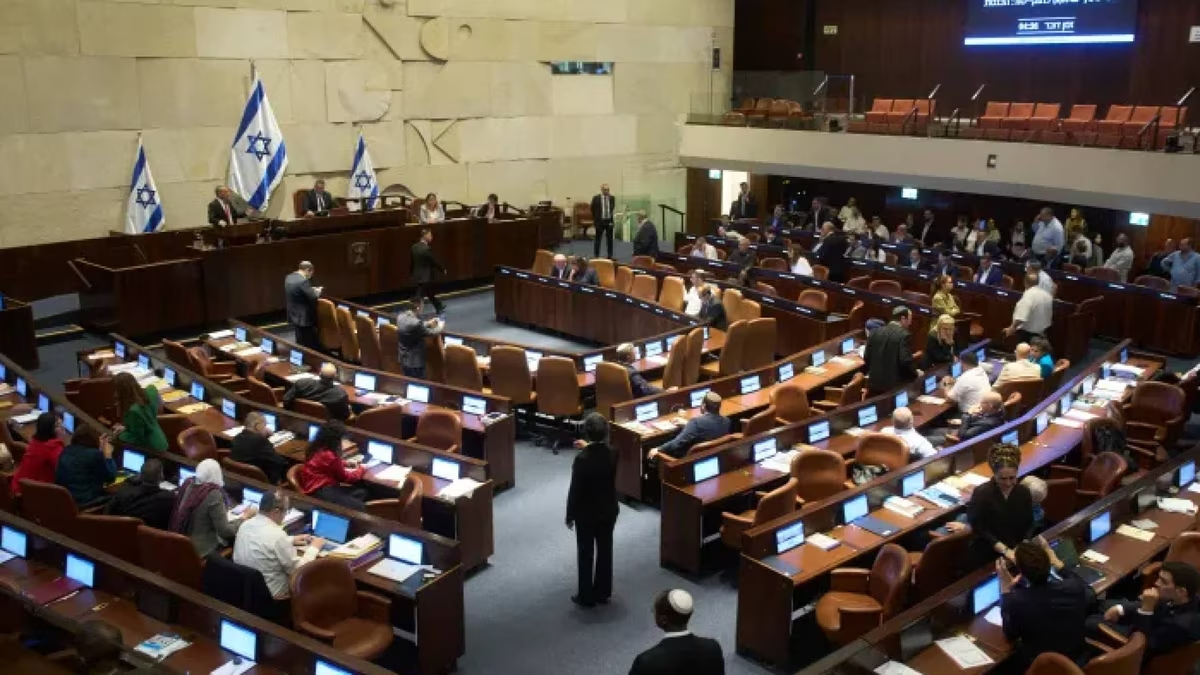
Knesset moves to approve special court to issue death sentences against October 7 participants

In a remarkable legal and political development, the Knesset intends to approve a new bill in the coming weeks aimed at prosecuting all those who participated in the October 7, 2023 attack. The project seeks to establish a special court for this purpose, defining the actions of Hamas (elite) fighters as 'crimes of genocide, crimes against humanity, and war crimes'.

According to the draft bill, indictments against detainees linked to the events will be presented before a special military court established under the 'British Emergency Regulations of 1945'. The three-member court panel consists of a presiding judge who is a civilian judge required to have previously worked in a central court, and two officers qualified to be central court judges.

The main objective of the court is to issue death sentences against detainees participating in the attack. The bill stipulated that an appeal against the death sentence is submitted 'automatically' even if the defendant does not request it, and the execution of the sentence does not require the approval of the Chief of Staff. The project indicated that trials will be public, broadcast via a special website, documented with audio and video, and preserved in the state archive.

The bill carries the number 5020 for the year 2025, and was submitted by MK Simcha Rothman from the Religious Zionism party and Yulia Malinovsky from the Yisrael Beiteinu party. The project has currently reached an advanced stage, as it is scheduled to be discussed before the Law Committee on February 18, 2026, in preparation for its referral for second and third readings to become an enforceable law.

This move dates back to a discussion that began on November 1, 2023, when legal experts called for the event to be considered a war and an organized act, not an ordinary criminal offense. The legal concept of the court is based on controversial principles, including 'collective responsibility' by convicting everyone who participated or assisted without proving their individual act, relaxing rules of evidence on the pretext of difficulty in collecting them, and expanding charges to include 'genocide' according to Israeli law of 1950.

The main objective of the court is to issue death sentences against detainees participating in the attack, with appeals being automatic and without the need for the Chief of Staff's approval.

PALESTINE

Thu 05 Feb 2026 2:24 pm - Jerusalem Time

Israel threatens to return to fighting in Gaza and prepares a plan to evacuate civilians

Israel is preparing for the possibility of renewed fighting in the Gaza Strip, after several indications from officials and military personnel on the pretext of being unable to disarm the Hamas movement. Israeli press reports monitor leaks that fuel the possibility of a return to military operations under the pretext of the movement rebuilding its military power and field positions.

Yedioth Ahronoth newspaper stated that the Israeli army is close to calling up reserve forces to confront the possibility of renewed fighting, and quoted military officials as saying that Hamas is likely to continue its attempts to attack the forces despite the ceasefire. The sources claimed that the movement replaced commanders who were killed during the war, up to the brigade level.

Senior Israeli officers believe that intermittent military operations may become the norm in the coming years to undermine Hamas' capabilities. Assessments indicated that the movement will not voluntarily give up its weapons, while the Shin Bet warned political leaders in closed meetings against resuming the production of rockets and explosive devices inside the Strip.

The sources revealed a new plan by the army to evacuate civilians in preparation for a large-scale ground operation later this year, focusing on resettling them east of the 'Yellow Line'. Military officials believe that the current flow of aid may provide a diplomatic margin to confront accusations of famine in the event of a resumption of hostilities.

In this context, the head of the State Camp party, Benny Gantz, said that it is time to cross the 'Yellow Line' after months of discussion without progress in disarmament. Gantz added that Hamas cannot be granted immunity or accept its control over half of the Strip, stressing that Israel will be forced to dismantle the movement, especially in the absence of prisoners in Gaza currently.

On the other hand, media sources stated that the military leadership presented alternatives similar to the 'Lebanese model', which is based on launching periodic raids to thwart military reinforcement activities. The army believes it is necessary to give a chance for current moves to disarm peacefully, while being ready for a swift and decisive operation to restore full control over the Strip if those efforts fail.

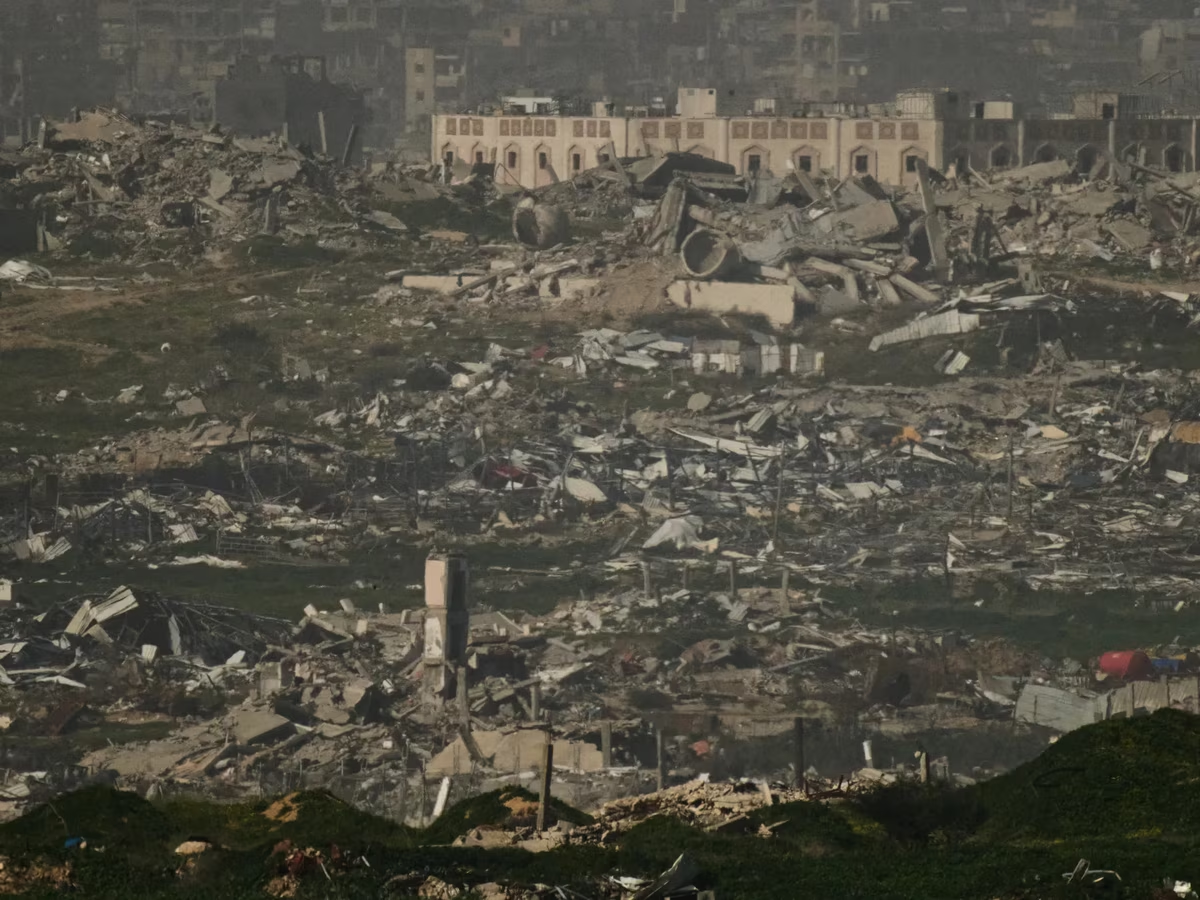
It is worth noting that the current ceasefire agreement came after a two-year war since October 2023, which resulted in the martyrdom of about 72,000 Palestinians and the injury of more than 171,000 others, in a bloody toll described as a war of genocide.

It is time to cross the Yellow Line; Hamas cannot be granted immunity and rebuild its rule and control over half of the Gaza Strip.

OPINIONS

Thu 05 Feb 2026 2:09 pm - Jerusalem Time

The Deception of Democracy in the Modern State: How Majorities Are Manufactured in Public Opinion Labs?

Ramallah - "Al-Quds" dot com

Ramallah - "Al-Quds" dot com

Opinion Writer

Political public opinion labs are the primary controllers in the process of unethical consciousness engineering, where the collective mind is directed without a value-based reference. Imagine the scene of the laborer who sacrifices his strength and wages to stand for hours under the sun, steadfast for a cause they made him believe was for the benefit of his children, while in reality, he is a tool in the hands of others. This behavior does not stem from free will, but from a systematic disabling of individual consciousness that makes a person see the sacrifice of their true interests as an offering for the triumph of an image carefully crafted for them.

Here, the deception of democracy in its contemporary form emerges, as a glittering facade for expressing popular will, while in reality, it is an arena for consciousness engineering. The modern state has harnessed its technical and media tools to transform democracy from a free choice between clear alternatives into a domestication process that produces an artificial majority. This majority is only achieved through political mobilization led by the public opinion engineer, who infiltrates through the loopholes of fear and need, transforming humans into caricatures that execute precisely drawn scenarios.

And if we look at the scene with a logical eye, we will find an impossible contradiction; where the worker and the factory owner, the conservative and the liberal, all unite in supporting the same person, and each believes that he is the savior of their conflicting interests. This impossible consensus only succeeds through the engineering of collective consciousness so that everyone becomes mere 'ultras' in herd politics. Nevertheless, the conscious individuals who take their stances based on a solid self-vision remain the exception that is difficult to subject to domestication tools.

Indeed, the modern democratic system operates through a long engineering accumulation that begins with changing terminology in educational curricula and pumping media narratives that create imaginary enemies. The public opinion engineer does not wait for election day, but rather prepares the psychological ground that makes his choice seem like the only way out. This system relies on the innate human fear of isolation, transforming natural diversity into a false sense of consensus through repetition and exaggeration, which pushes the individual to abandon their logical questions to join the crowd in search of false security.

To complete this control, the trick of 'demonizing the opponent' is resorted to, an old trick that the public opinion engineer has revived with modern techniques. The opponent is portrayed as a devil threatening existence, which pushes the supporter to adopt extreme positions to defend their image in front of themselves so as not to admit their naivety. Thus, logical questioning turns into a psychological burden, and the individual prefers subservience over the pain of confrontation with their conscious mind, where direct interest is replaced by the safe belonging to the herd.

Ultimately, economic helplessness and anxiety about the future are transformed into emotional loyalty, where no real solutions are offered, but rather a sedative for emotions and an illusion of personal victory. Emerging from this tunnel requires restoring an independent value system. Here, the genius of the Islamic model of 'Shura' (consultation) and 'Ahl al-Hall wal-Aqd' (people of binding and loosing) stands out, where the process relies on quality and a conscious elite that resists psychological manipulation, transforming the political process from mobilizing instincts to an exchange of opinions among the wise, and a restoration of true sovereignty away from engineered ballot boxes.

Democracy in its modern version does not begin with endorsement, but ends with it; it is a complete system for managing perception that begins years before an individual reaches the ballot box.

PALESTINE

Thu 05 Feb 2026 1:24 pm - Jerusalem Time

3 Dead and Intensive Occupation Raids on Gaza Amid Continued Truce Violations

The death toll from the continuous violations of the ceasefire agreement in the Gaza Strip rose to three martyrs on Thursday, including a released prisoner who had been deported, amid a field escalation that included airstrikes and artillery shelling targeting various areas of the Strip.

Local sources reported the martyrdom of young Bahaa Mohammed Al-Fajm by occupation forces' bullets in the town of Bani Suhaila, east of Khan Yunis. Rami Ibrahim Abu Qarshin also died from injuries he sustained months ago in a previous bombing of the city. In a significant development, released prisoner Basel Al-Haimouni, who was deported from Hebron to Gaza as part of the "Wafaa Al-Ahrar" deal in 2011, was mourned today after succumbing to injuries from a bombing that targeted him yesterday, Wednesday.

On the ground, occupation forces continued their violations, carrying out demolition operations of citizens' homes east of Gaza City concurrently with artillery shelling, while aircraft launched raids on eastern Deir al-Balah, and helicopter gunships opened fire east of Al-Bureij refugee camp in the central region.

In the southern part of the Strip, warships heavily opened fire towards the coasts of Khan Yunis and Rafah, while aircraft launched an airstrike east of Khan Yunis, amidst ongoing military movements targeting civilians and facilities.

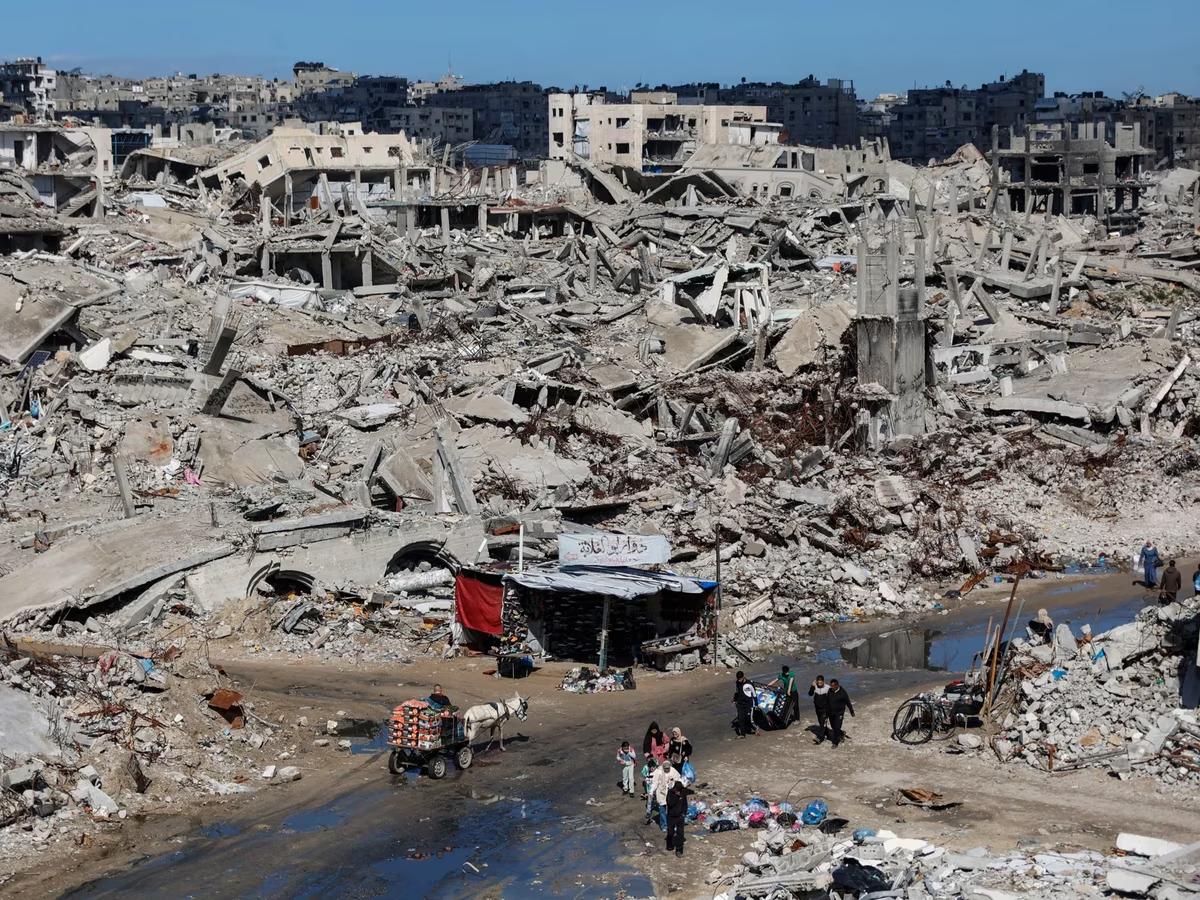
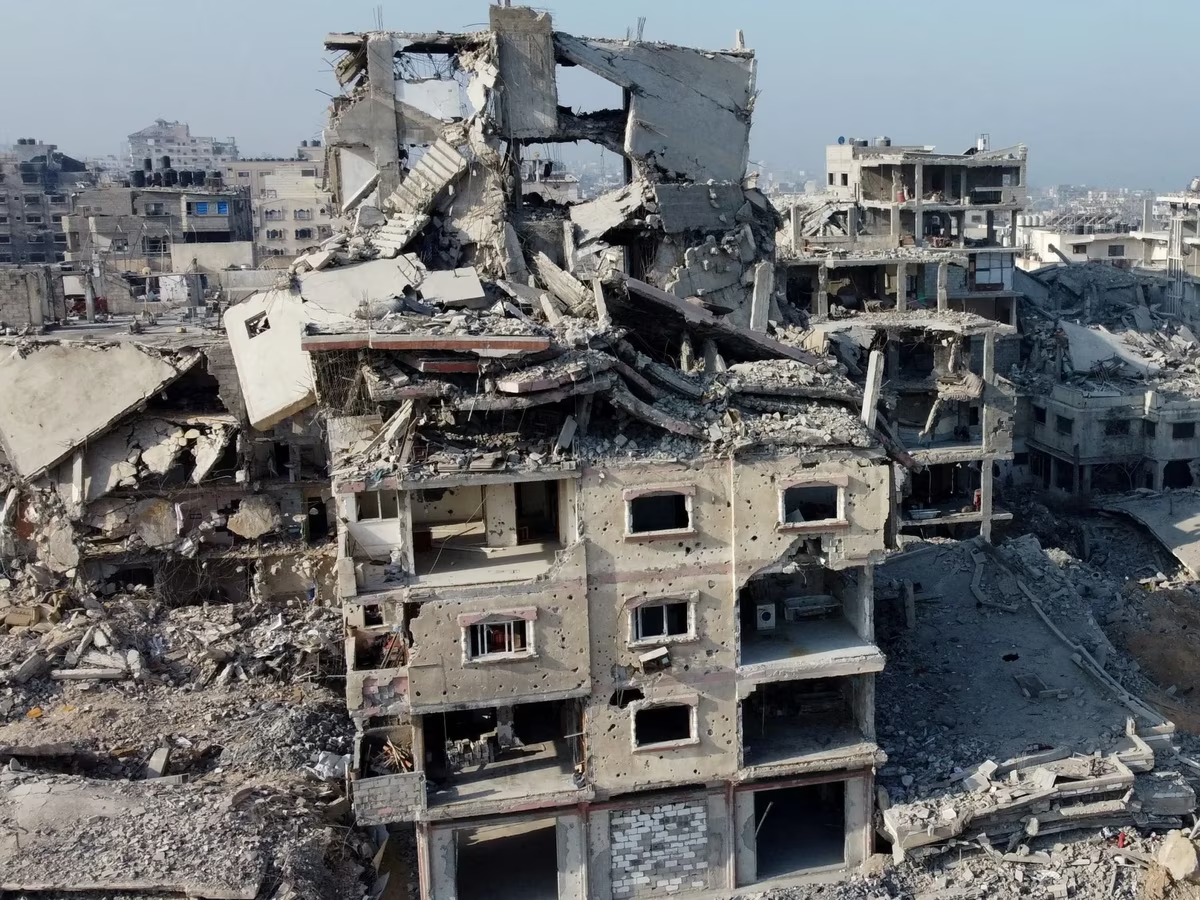
These developments come after a bloody day in which 24 citizens were martyred, including 8 children. According to official statistics, the number of victims of the occupation's violations of the ceasefire agreement reached 576 martyrs, including 179 children and 69 women, and 1526 injured. Meanwhile, the total death toll from the ongoing genocide war since October 7, 2023, has risen to more than 71,803 martyrs and over 171,570 injured, in addition to the destruction of 90% of the Strip's infrastructure.

The targeting of Al-Haimouni represents a new crime that reflects the occupation's insistence on pursuing released prisoners even after their deportation.

PALESTINE

Thu 05 Feb 2026 12:09 pm - Jerusalem Time

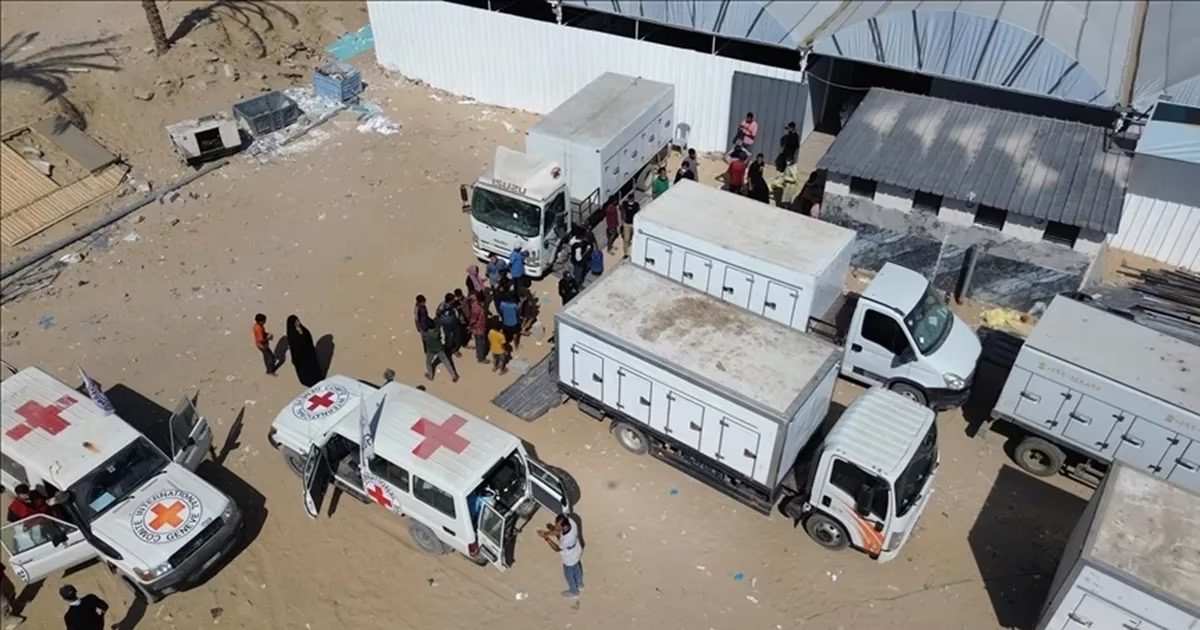
Arrival of 54 bodies and 66 boxes of remains of Gaza martyrs at Al-Shifa Complex

The Director-General of the Ministry of Health in Gaza, Dr. Munir Al-Barsh, revealed new chapters of the violation of the dignity of Palestinian martyrs, confirming the arrival of 54 bodies of martyrs at Al-Shifa Medical Complex, accompanied by 66 boxes containing human remains and organs, which were released through the International Committee of the Red Cross.

Al-Barsh questioned in his statements the law that permits returning a human being in pieces, describing the scene as shocking and testing the conscience of the world, as medical teams stand before closed boxes searching inside them for the features of the martyrs without possessing the necessary examination tools or the minimum medical and forensic capabilities to identify and document them in a manner befitting human dignity.

The Director-General of Health affirmed that these are not just numbers in reports, but rather fathers, mothers, and children, each with a name and a memory, emphasizing that handing over bodies in boxes and dismembered represents a moral crime and a blatant violation of international conventions established to protect human dignity, alive and dead.

Al-Barsh pointed out that previous instances witnessed the retrieval of bodies bearing traces of mutilation and torture, considering that retrieving bodies today in dismembered form suggests that the goal is to erase identity, break memory, and humiliate the living, demanding a self-evident right for the human body to be preserved, its dignity protected, and international laws respected.

For its part, the Ministry of Health in Gaza confirmed in an official statement the arrival of the 54 bodies and the 66 boxes containing the remains at Al-Shifa Medical Complex, after the Israeli occupation authorities released them and transferred them via the Red Cross organization.

To be returned as remains, and for their bodies to be delivered in boxes, is not merely a procedural violation, but a moral and humanitarian crime, and a blatant violation of all international laws and conventions.

PALESTINE

Thu 05 Feb 2026 11:54 am - Jerusalem Time

Occupation army launches wide raid campaign and arrests dozens of Palestinians in the West Bank

Occupation forces launched on Thursday a series of incursions and raids in several cities and towns in the Bank and Jerusalem, resulting in the arrest of a number of citizens, amid continuous violations against Palestinians.

In the city of Hebron, south of the Bank, sources reported that the forces raided the home of Sheikh Hatem Qafisha and arrested him, and also arrested citizen Muhammad Ali Al-Najjar in the "Qanan Al-Taweel" area of Yatta city during a wide field campaign that targeted homes.

In northern Jerusalem, arrests included teenager Yanal Qassem Abadi and four other young men in Anata town during continuous raids. In Qalqilya city, forces arrested young man Muhammad Sa'sa' after storming his home, while released prisoner Jumaa Ramadan was arrested in Zeita Jama'in town, south of Nablus.

Ramallah governorate also witnessed raids that resulted in the arrest of two young men, Mujahid Ghazi Na'san and Bahaa Fouad Abu Alia, after storming their homes in the eastern neighborhood of Al-Mughayyir village.

These arrests reflect the continued policy of the occupation forces in escalating daily incursions in the West Bank and Jerusalem, which include raiding homes, vandalizing their contents, and arresting citizens, as part of what sources described as continuous pressure on Palestinians.

These arrests reflect the continued policy of the occupation forces in escalating daily incursions in the West Bank and Jerusalem, which include raiding homes and vandalizing their contents.

PALESTINE

Thu 05 Feb 2026 11:23 am - Jerusalem Time

Analysts to "Al-Quds": Occupation uses daily killing as a tool to impose a new equation

In a new bloody escalation, 24 citizens, including 7 children and a paramedic, were martyred yesterday by the bullets and shelling of the occupation forces east of the Gaza Strip, in a systematic continuation of ceasefire violations for the 116th consecutive day, amidst indications that the occupation is moving from a policy of "limited violations" to imposing a new security reality by fire.Political analyst Mohammed Abu Qamar considered that "the occupation has passed the stage of testing the truce, and has moved to using daily killing as a political and security tool to impose a new equation in Gaza," pointing out that "targeting children, paramedics, and displaced persons confirms that Israel does not treat the ceasefire as a commitment, but rather as a margin for maneuver."Abu Qamar told "Al-Quds" that "these violations aim to exhaust the resistance and pressure the popular environment, without going to an all-out war, especially in light of the deep political crisis experienced by the occupation government."For his part, political science professor Dr. Mohammed Musleh believed that "what is happening represents a clear failure of the Israeli deterrence system," explaining that "the occupation is trying to compensate for its military impotence during the war of extermination through a calculated escalation, in which it bets on the absence of international accountability."Musleh stressed that "the continued international silence gives Israel a green light to accumulate crimes, and to turn the truce into a cover for targeting civilians, which warns of a wider explosion if this policy continues."Since the ceasefire agreement came into effect, the occupation forces have killed, due to their repeated violations, 553 citizens, including 179 children and 69 women, and injured 1463 others.As for since the start of the war of extermination on October 7, 2023, the number of martyrs has exceeded 71,803, while the number of injured has risen to more than 171,570, amidst destruction that affected about 90% of the civilian infrastructure, and the United Nations estimated the cost of reconstruction at about 70 billion dollars.

PALESTINE

Thu 05 Feb 2026 11:09 am - Jerusalem Time

Haaretz reveals Israeli plans to profit from Gaza reconstruction and link its infrastructure to the occupation

Israeli press reports have revealed intensive moves led by the Ministry of Finance in the occupation government, aiming to transform the 'reconstruction of the Gaza Strip' file into an opportunity to revive the Israeli economy and achieve strategic gains, by linking the Strip's infrastructure to direct dependence on Israel. According to Haaretz, senior officials in the Israeli Ministry of Finance held consultations with army officers to discuss 'economic opportunities' related to the post-war phase.

These plans include controversial proposals, most notably the expansion of the Ashkelon power station; instead of building an independent power station inside Gaza or in Egypt, Israel seeks to persuade donor countries to finance the expansion of the Ashkelon power station inside Israel, in exchange for supplying the Strip with electricity, which ensures permanent energy dependence for the Strip and the development of Israeli infrastructure with international funds.

The Israeli Ministry of Finance is also considering asking donor countries to finance the construction of highways within the occupied territories, such as Road 232 adjacent to the border, under the pretext of facilitating the movement of aid or future workers, a step that practically means improving the Israeli road network at the expense of donors.

In an indication of the institutionalization of these moves, the report revealed the existence of the 'International Center for Civil-Military Coordination' in the 'Kiryat Gat' settlement south of the occupied territories, which includes representatives from 28 countries, distributed among 6 working groups covering security, engineering, and civil administration, with active Israeli participation in each team.

These Israeli proposals aim to thwart any attempt to build independent infrastructure in Gaza that might fall under the control of resistance factions. While donors are considering options for establishing independent power stations, Israel prefers the option of 'direct supply' to ensure that the keys to life in Gaza remain under its security and political control, while burdening the international community with the cost of technological development within Israel.

Israel seeks to persuade donor countries to finance the expansion of the Ashkelon power station inside Israel, in exchange for supplying the Strip with electricity, which ensures permanent energy dependence for the Strip.

ANALYSIS

Thu 05 Feb 2026 10:54 am - Jerusalem Time

New Monarchy: How Analysts Explain Trump's Approach to Undermining the Global Order?

US President Donald Trump's insistence on undermining the existing global order has sparked a wide wave of studies seeking to explain his vision for the role of the United States, with a new theory gaining increasing attention describing his era as a 'new monarchy'. This theory, reviewed by international press sources, suggests that the current style of governance closely resembles the eras of royal families in the 16th century, such as the Tudors and the Habsburgs.

The fundamental characteristic of this description is that global economic policymaking is now conducted through personal, family, and business relationships, far from traditional national interests or long-term growth. Academics Abraham Newman and Stacy Goddard coined this term, considering foreign policy to have transformed into a tool for directing influence and money for the benefit of the narrow circle surrounding the president.

Observers believe that this analogy reflects Trump's style, described as autocratic, his disdain for international rules, and its intersection with the concept of 'crony capitalism'. In this context, Philip Campanti, a professor at Johns Hopkins University, explained that this approach harms the economy because market winners are not those with the best ideas, but those with the strongest connections, which hinders productivity and overall prosperity.

The features of this approach are evident in dealing with opponents or allies; last spring, Trump threatened to terminate government contracts with Elon Musk's business empire after the latter criticized him. Major deals, such as the arrangements for the 'TikTok' application in America, also show the entry of investors from Trump's inner circle, including companies associated with the president's son-in-law Jared Kushner and other Emirati companies that have concluded deals with the president's family.

Internationally, Trump did not hesitate to use economic tools for personal or narrow political purposes, raising tariffs on Switzerland due to a dispute with its former president, and imposing exorbitant tariffs on Brazil for refusing to intervene in the trial of his ally Jair Bolsonaro. This pattern of governance creates uncertainty and hinders global investments due to the confusion of governing rules.

With decision-making power concentrated in the hands of the president's entourage instead of traditional bureaucratic institutions, the effectiveness of usual diplomatic communication channels has declined. While challenges to the global order are increasing, estimates indicate that the financial empire of the Trump family and its allies is experiencing significant prosperity, with his family's profits reaching at least $1.4 billion so far.

Foreign policy in the United States has become a tool for directing money and influence to Trump and his closest aides, rather than competing with adversaries.

ISRAELI AFFAIRS

Thu 05 Feb 2026 10:54 am - Jerusalem Time

Smuggling scandal to Gaza shakes occupation's security establishment, Shin Bet chief's brother accused

The security and political establishment in the occupation entity is experiencing a severe shock, after the threads of a widespread smuggling network transporting prohibited goods and advanced technologies from the interior to the Gaza Strip were uncovered. The case, which began as a criminal file, quickly turned into a public opinion crisis after the name of Betzalel Zini, brother of the head of the General Security Service (Shin Bet) David Zini, appeared on the list of suspects, putting the head of the strongest security apparatus in an embarrassing position.

In a remarkable development in the case, which has been unfolding since the beginning of 2026, investigations revealed the involvement of 13 people in the smuggling network, including civilian contractors, truck drivers, and soldiers in regular and reserve service. Despite official assurances that David Zini himself faces no criminal suspicion, the family relationship forced the Shin Bet to recuse itself from the investigation and transfer the file to the occupation police (Southern District) to prevent conflicts of interest. This incident has reignited the debate about 'Clause 14' of the 'Gronis' Committee, which hints at the possibility of the head of the apparatus resigning if one of his relatives commits extreme acts, opening the door for the right-wing to launch a political attack.

Investigations uncovered exciting details about the nature of the smuggled goods; in addition to cigarettes, which are considered 'the new gold' in Gaza where the price of a pack has reached more than $530, smartphones, computers, solar panels, and building materials are being smuggled. Court documents refer to an incident in May 2025, where an officer and a soldier from the Bedouin reconnaissance unit smuggled 4,496 packs of cigarettes, receiving 269,000 shekels in cash in return. Estimates confirm that the exorbitant profits from smuggling multiply the value of goods five times once they cross the border.

Reports showed a dismal failure in the control system at the crossings, specifically the Kerem Shalom crossing, where the pressure of trucks prevents thorough inspection, allowing smuggled goods to be hidden inside aid shipments. Press sources also revealed a more dangerous route, represented by contractors' vehicles, such as the 'Oriya' unit managed by the Shin Bet chief's brother, which enters the Strip to work on military projects without real inspection; some of these vehicles even remain inside the Strip with their Israeli license plates.

While the occupation army is preoccupied with field vulnerabilities, intelligence faces questions about the sources of funding for these expensive goods in Gaza, with officers anxiously pointing to the 'Jawal Pay' digital payment system as a main channel for money flow away from oversight. The military establishment believes that Hamas is the biggest beneficiary through collecting taxes, which replenishes its coffers with resources that may be used to rebuild its military infrastructure. While officers demand that those involved be charged with 'treason,' the borders, according to investigators, remain a loose area that feeds the resistance economy at the hands of the occupation elements themselves.

A truck of goods worth 100,000 shekels to the occupation, its value jumps to half a million shekels once it crosses into Gaza, creating a huge incentive for smuggling.

PALESTINE

Thu 05 Feb 2026 10:45 am - Jerusalem Time

A Dead in Khan Yunis as Occupation Prepares for Large-Scale Ground Operation in Gaza

A Palestinian was martyred today, Thursday, by Israeli occupation forces in Khan Yunis, south of the Gaza Strip, while Israel prepares for the possibility of renewed fighting in Gaza. Nasser Medical Complex reported the martyrdom of a Palestinian by occupation forces' bullets within their deployment areas in Bani Suheila town, east of Khan Yunis city.

Citizen Aya Khader Barabakh (28 years old) was shot by the army inside her tent near Abu Hamid roundabout in the city center. Israeli raids targeted east of Gaza City, east of Deir al-Balah city, and east of Khan Yunis city. Israeli helicopter gunships fired east of Khan Yunis, coinciding with gunfire from warships on the city's sea coast.

In Gaza City, the Israeli army blew up buildings and facilities east of Al-Tuffah neighborhood, coinciding with an airstrike on the area. The same neighborhood also witnessed artillery shelling and intense gunfire from Israeli military vehicles. In the central Strip, Israeli warplanes launched airstrikes on army deployment areas east of Deir al-Balah city.

Yesterday, 24 Palestinians were martyred and dozens more were injured in Israeli raids and artillery shelling that targeted displaced persons' tents and residential homes in various areas of the Gaza Strip, despite the ongoing ceasefire.

Meanwhile, Yedioth Ahronoth newspaper reported that Israel is preparing for the possibility of renewed fighting in Gaza as the Hamas movement rebuilds its positions. Israeli military officials predicted that Hamas would continue its attempts to attack Israeli army forces despite the ceasefire.

Senior officers believe that intermittent military operations may become the norm in the coming years in an attempt to undermine Hamas's ability to rebuild, and assessments indicate that the movement will not voluntarily give up its weapons or allow its tunnel network to be destroyed.

The Internal Security Service (Shin Bet) warned Israeli political leaders in closed meetings last month that Hamas is regaining its military strength, including resuming the production of rockets and weapons, especially explosive devices.

The newspaper stated that the Israeli army has developed a new plan to evacuate civilians to enable a large-scale ground operation later this year if ordered. The plan focuses on resettling civilians within the Gaza Strip east of the Yellow Line.

Daily, Israel violates the ceasefire agreement in the Strip, which has been in effect since October 10, 2025, resulting in the martyrdom of 556 Palestinians and the injury of 1,500, according to the government media office. The Israeli genocide over two years has left approximately 72,000 Palestinian martyrs and more than 171,000 injured, most of whom are children and women.

The Shin Bet warned political leaders that Hamas is regaining its military strength, including resuming the production of rockets and explosive devices.

PALESTINE

Thu 05 Feb 2026 10:45 am - Jerusalem Time

Occupation begins construction of new 6-kilometer settlement road north of Jerusalem

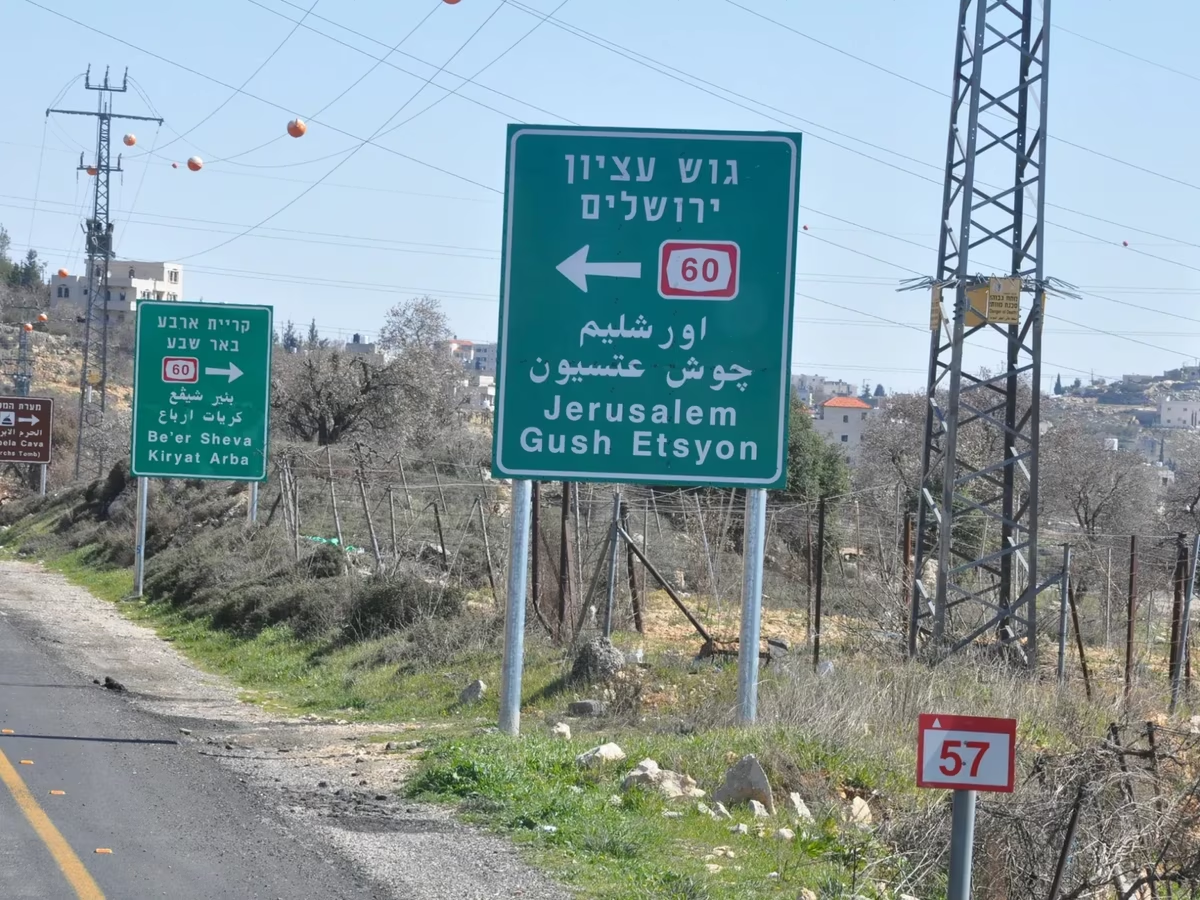
Sources in the Jerusalem Governorate reported today, Thursday, that the Israeli occupation authorities have actually begun constructing a new settlement road located in the northern part of occupied Jerusalem. The sources clarified that this road extends for 6 kilometers, starting from the town of Mikhmas in the east and reaching the village of Qalandia in the west.

The Governorate warned that this project is part of a strategic plan to establish the widest network of bypass settlement roads aimed at tightening the siege around occupied Jerusalem. The sources confirmed that the occupation authorities confiscated 280 dunams of land from four Palestinian towns to implement this road.

In a related context, the Jerusalem Governorate stated in a statement issued yesterday, Wednesday, that the occupation's announcement of signing an agreement to build 2780 new settlement units to expand an existing settlement north of the city represents a dangerous escalation of colonial settlement policies and the imposition of facts on the ground by force of arms.

The statement mentioned that this plan coincides with systematic attacks targeting Palestinian citizens, especially in the 'Ma'azi Jaba' cluster, where settler attacks are increasing under the protection of occupation forces to push residents towards forced displacement and empty the area in preparation for settlement expansion north and east of Jerusalem.

The Governorate stressed that these expansionist projects fall within an Israeli policy aimed at changing the demographic and geographical reality of the city, and completely isolating it from its Palestinian surroundings in the occupied West Bank, which prevents any future geographical continuity.

The Jerusalem Governorate also affirmed that these moves constitute a blatant violation of international law, the Fourth Geneva Convention, and Security Council resolutions that criminalize settlement. It warned that international silence gives the occupation a green light to proceed with policies of creeping annexation and demographic cleansing.

This settlement plan is inseparable from the systematic and escalating attacks to which Palestinian citizens in the surrounding areas are subjected.

PALESTINE

Thu 05 Feb 2026 10:15 am - Jerusalem Time

Arrival of 54 bodies and 66 boxes of human organs in Gaza, Al-Bursh condemns 'dismemberment' of bodies

The Director-General of the Palestinian Ministry of Health in the Gaza Strip, Munir Al-Bursh, condemned the Israeli occupation after 54 bodies arrived at Al-Shifa Medical Complex on Wednesday, accompanied by 66 boxes containing human remains and organs, released by the occupation through the International Committee of the Red Cross. Al-Bursh stated on his official accounts that what happened is not a fleeting news item, but a shocking moment that tests the conscience of the world, questioning the scene where Palestinians stand before closed boxes searching inside them for the features of their children in the absence of necessary forensic examination tools.

Al-Bursh added that the delivery of dismembered bodies represents a moral and humanitarian crime and a blatant violation of international conventions that protect human dignity, alive and dead. He pointed out that previous instances witnessed the recovery of bodies bearing signs of torture, considering that the purpose of delivering dismembered bodies is to erase identity, break memory, and humiliate the living, stressing that the ministry demands the inherent right to preserve the dignity of the body and respect international laws.

For its part, the Ministry of Health in Gaza announced the arrival of the bodies and remains at Al-Shifa Complex, explaining that its medical teams immediately began dealing with them according to approved protocols in cooperation with the competent authorities. The ministry confirmed that work is underway to complete examination and documentation processes in preparation for presenting the bodies to citizens for identification, despite the significant challenges faced by the teams in light of limited resources.

In turn, the International Committee of the Red Cross stated that it facilitated the return of Palestinian remains to Gaza in a unilateral operation coordinated with relevant parties. The committee explained that it provided body bags, vehicles equipped with cooling systems, and trained personnel to ensure dignified handling of the remains, noting that thousands of people are still missing and their families continue to search for answers to end this painful chapter.

This step comes as part of the first phase of the ceasefire agreement in effect since October 10th last year, which includes the exchange of prisoners and bodies through Egyptian, Qatari, and Turkish mediation and American supervision. Before the agreement, the occupation was holding 735 bodies in 'numbers cemeteries,' in addition to reports of approximately 1,500 bodies of Palestinians from Gaza being held in the Sde Teiman camp.

It is worth noting that the ceasefire agreement ended a genocidal war that began in October 2023 and lasted two years, resulting in the martyrdom of more than 71,000 Palestinians and the injury of 171,000 others, as well as widespread destruction affecting 90% of the infrastructure, at a time when the United Nations estimated the cost of reconstruction at approximately 70 billion dollars.

What law permits turning a human into dismembered remains? We are not dealing with numbers recorded in reports, but with fathers and mothers, sons and daughters, each with a name, a memory, and a dream.

PALESTINE

Thu 05 Feb 2026 10:15 am - Jerusalem Time

Second Phase of De-escalation: Rafah Crossing Becomes a Blackmail Tool, and the Occupation Establishes New Field Realities

Coinciding with the entry into force of the second phase of the ceasefire agreement, the Israeli occupation is attempting to establish new realities in the Gaza Strip, centered on controlling the movement of travelers through the Rafah crossing and escalating field targeting under various pretexts. The Israeli aggression on Gaza yesterday, Wednesday, led to the martyrdom of 24 Palestinians, while the occupation tried to prevent the travel of sick people among the few allowed to leave the Strip. Observers view the latest field developments as an Israeli plan to empty the ceasefire agreement of its content.

The latest statistics published by the Government Media Office in Gaza reveal that the Israeli occupation has violated the ceasefire agreement 1520 times since its signing on October 10th, resulting in 556 martyrs, 1500 injured, and the arrest of 50 others. Over 115 days, the occupation also allowed the entry of 29,663 commercial trucks, aid, and fuel, out of 69,000 trucks that were supposed to enter based on the humanitarian protocol, a compliance rate of no more than 43%.

The Government Office listed a series of Israeli violations of the ceasefire agreement, most notably: the occupation's failure to adhere to withdrawal lines, encroaching on more kilometers across the Strip, refusing to allow in necessary materials for infrastructure repair, and preventing heavy equipment designated for rubble removal and retrieving the bodies of martyrs. It also failed to comply with the passage of health supplies and medicines, prevented the entry of tents, and the Rafah crossing was not opened as agreed, with the continued disruption of the power plant's operation.

Writer and political analyst Wissam Afifa says that the increased pace of Israeli escalation and the obstruction of the Rafah crossing cannot be separated from the broader context of the occupation's management of the post-ceasefire phase, where it treats the crossing as a political pressure tool. He explained in an interview with press sources that the travel ban decision that affected the sick yesterday confirms that the opening was selective and temporary, aiming to impose a fait accompli that links humanitarian facilities to political and security conditions, primarily the disarmament of the resistance.

For his part, security researcher Rami Abu Zubaida believes that the occupation's continuous obstruction of the Rafah crossing reflects its endeavor to turn it into a bargaining chip in exchange for political concessions. He pointed out that the entry into the second phase coincides with Benjamin Netanyahu's attempt to impose a new geographical reality by establishing the 'Yellow Line' which devours more than 50% of the Strip's area, with the aim of transforming Gaza from a political issue into merely a humanitarian file placed under the guardianship of the so-called American Peace Council.

Abu Zubaida warned that the intense military escalation aims to break popular support and push Palestinians to accept a reality of diminished sovereignty under the weight of hunger. He stressed that what Netanyahu's government is doing represents a 'flight forward' by emptying the agreement of its content and turning it into a long process of attrition, awaiting a moment of surrender that the occupation seeks to impose on the Palestinian people.

The occupation treats the Rafah crossing as a political and security pressure tool, not a humanitarian outlet, and seeks to gradually impose a fait accompli in Gaza.

PALESTINE

Thu 05 Feb 2026 10:15 am - Jerusalem Time

'Regavim' Corridor in Rafah.. From a Settlement Anthem to a Barracks for Interrogation and Abuse

While the world awaited the opening of the Rafah crossing to be a humanitarian gateway after 18 months of closure, Israel was putting the final touches on the 'Regavim' corridor, a checkpoint that quickly turned into a center for interrogation, abuse, and humiliation. While the Israeli army markets the project as a technical measure, initial testimonies, images, and the contexts of choosing the Hebrew name reveal a reality aimed at consolidating absolute control over land and people. The Israeli army announced earlier this month the establishment of the 'Regavim' security corridor at a distance not exceeding 5 kilometers from the checkpoint for those returning to the Gaza Strip. The army manages the complex, which is equipped with advanced scanning and surveillance systems. Travelers are subjected to procedures to match identities with Israel's security lists, in addition to a thorough baggage inspection by X-ray in an area under full military control.

This report, prepared by sources, highlights the Israeli army's design of the security corridor and how it affected the passage of the first human batches through its gates. It also addresses the context of its Hebrew naming and its controversial historical contexts.

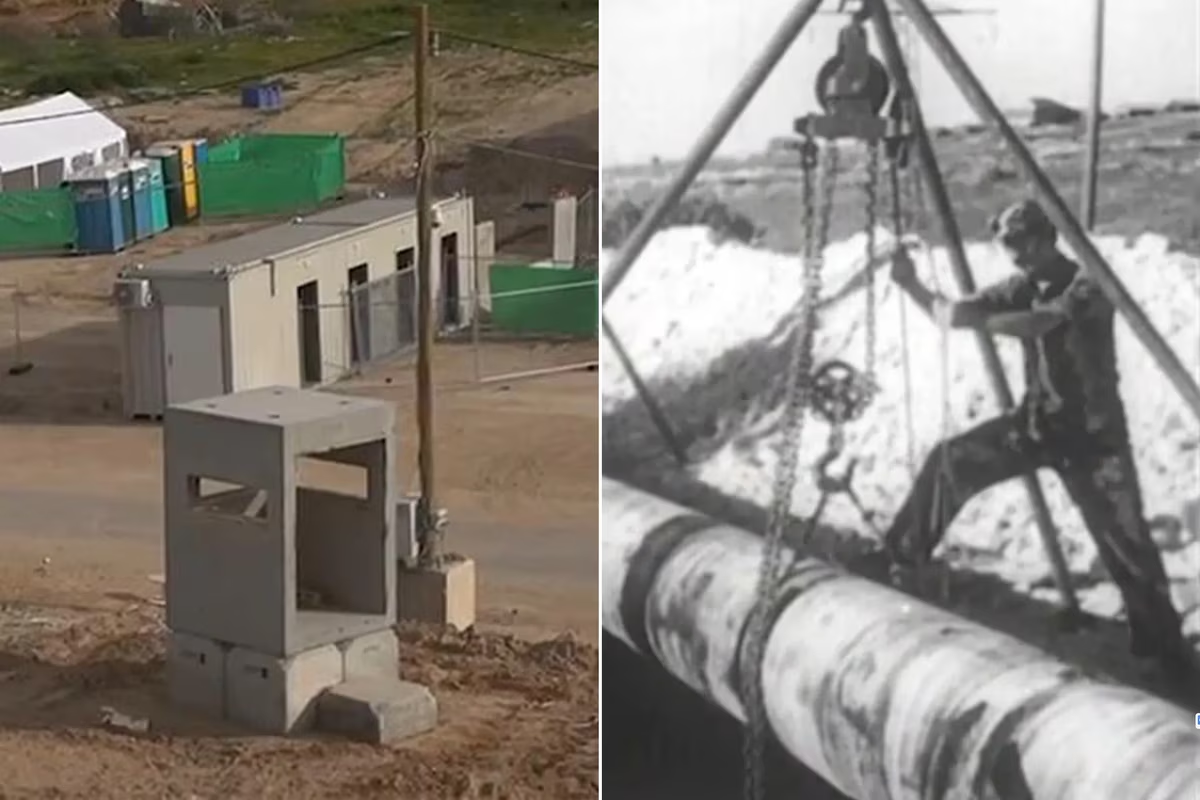
Satellite images and field footage broadcast by the army indicate that the security point was designed to be a fortified military barracks, including inspection gates and a concrete observation post directly overlooking Salah al-Din Street in Rafah.

This point is linked to a vast military site that includes vehicles, pockets, and tents for soldiers, surrounded by high earth berms in an area that witnessed extensive demolition and sweeping operations. While the army markets the corridor as part of 'strengthening control,' the first human batches that crossed the gates last Monday revealed another face of the corridor. Among dozens of waiting people, only 12 Palestinians (9 women and 3 children) were allowed to enter, after a journey of torment that lasted nearly 20 hours. A Palestinian woman recounted in a video testimony the details of what she described as 'harsh interrogation,' confirming that the soldiers blindfolded them and tied their hands for long hours, before subjecting them to questioning about issues unrelated to them. The woman mentioned that one of the interrogators threatened her with depriving her of her children in an attempt to blackmail her and recruit her to work for Israel, in a scene that reflects the transformation of the crossing from a humanitarian corridor to a tool for security and psychological pressure.

The matter does not stop at security procedures; the name 'Regavim' carries deeper connotations that go beyond routine language, as this term is closely linked to the literature of the Zionist movement, specifically a poem and children's song titled 'A Dunam Here and a Dunam There' by the poet Yehoshua Friedman. It served as an anthem for the early settlement movement, and its words glorify the gradual acquisition of land with the phrase 'clod of earth after clod of earth' (regev akhar regev). Beyond historical symbolism, the name has a direct line to the current architects of Israeli annexation policies, specifically the extremist right-wing settlement organization 'Regavim.' This organization, co-founded in 2006 by current Finance Minister Bezalel Smotrich, is the driving force behind the expansion of Israeli control in the West Bank. A journalistic investigation had revealed how this organization effectively transformed into a parallel intelligence arm of the state, using drones to map and demolish Palestinian structures, the same approach that Israel seems to be trying to replicate today at the southern Gaza gate, to establish a new reality that integrates military control and settlement ideology.

The corridor has transformed from a technical measure into a tool for security and psychological pressure, where travelers are subjected to harsh interrogations and blackmailed under threat.

PALESTINE

Thu 05 Feb 2026 10:15 am - Jerusalem Time

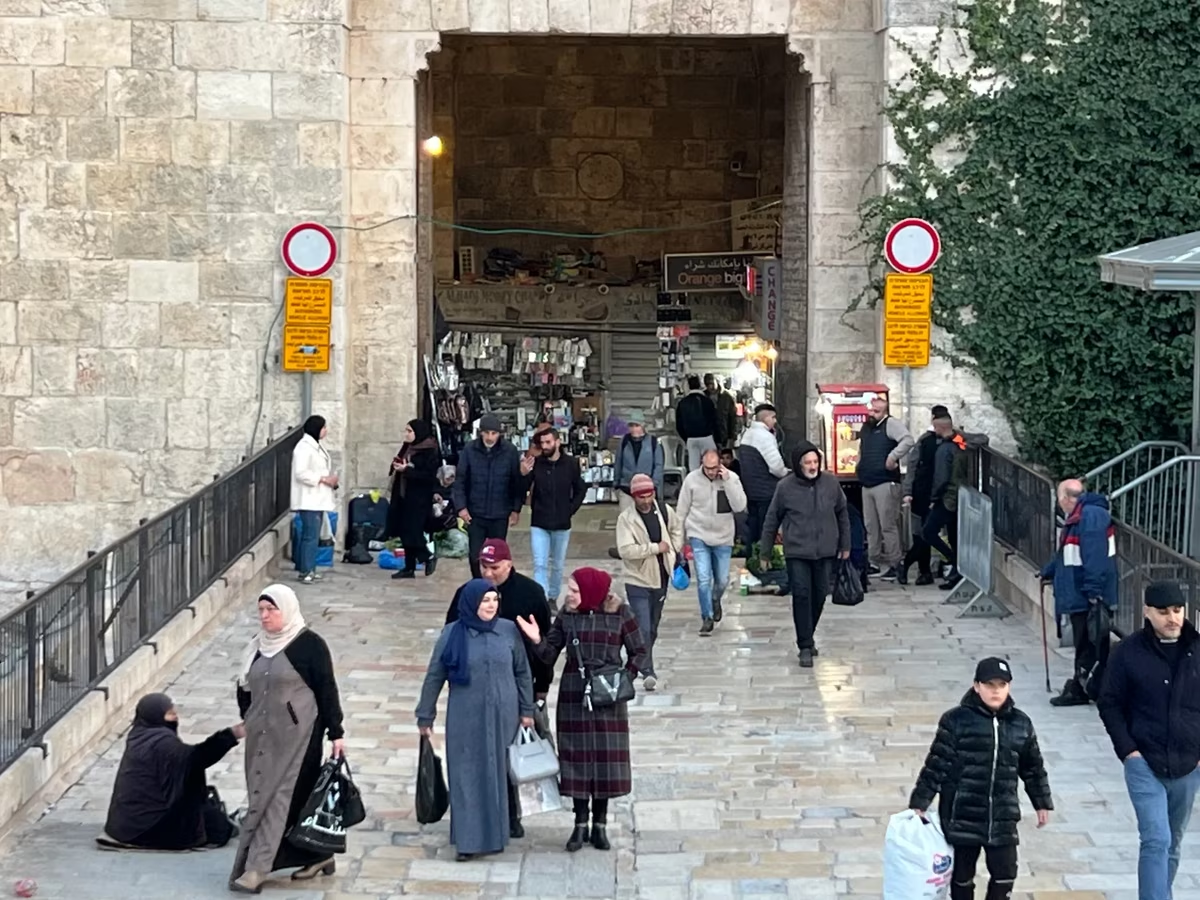
Inspecting refrigerators and trash: An Israeli institution violates the privacy of Jerusalemites under the pretext of 'center of life'

In the homes of Palestinians in occupied Jerusalem, privacy is no longer a personal matter, but has become subject to scrutiny and examination by the occupying authorities, whose institutional procedures have even extended to the bedrooms, refrigerators, and trash cans of Jerusalemites in their homes. The entity that violates this privacy is often the 'National Insurance Institute,' which organizes surprise field visits to ensure that the targeted family's 'center of life' is the city of Jerusalem. In these cases, Jerusalemites have no choice but to open their doors.

The 'center of life' is a term used by the occupation's interior ministry and the Israeli insurance institution to ascertain whether the city of Jerusalem, specifically the areas within the municipal boundaries, is the primary place of residence for the Jerusalemite citizen. Based on this, it is decided whether they are entitled to remain there and obtain some of their rights, including family reunification, registering children in the population registry, or receiving insurance benefits. This procedure adds a heavy layer of continuous surveillance and pressure on residents of a city living under the weight of policies targeting their existence and stability.

Surprise visits are often organized for mixed couples, where one spouse holds a Jerusalem ID and the other a West Bank ID. They may also be organized for Jerusalemite couples whose place of residence the Ministry of Interior suspects, assuming they live outside Jerusalem. Thus, through field teams, it seeks to prove this to revoke their residency rights. Field investigators commit violations described by human rights activists as blatant, deliberately opening refrigerators, inspecting trash cans, and checking water and electricity meters.

Jerusalemite families are forced to comply with these procedures in the hope of successfully registering their children and securing their residency, or obtaining family reunification. Human rights sources reported that procedures have changed significantly after the war in October 2023, where the Ministry of Interior and the insurance institution exerted excessive pressure, to the extent that investigators entered bedrooms, searched closets, and rummaged through personal belongings.

In a testimony by Rami Saleh, director of the Jerusalem Center for Legal Aid and Human Rights, he mentioned a case where an investigator entered a home and placed a tissue under the sleeping pillow of the family's daughter. He returned a week later and deduced that she was not living in the house because she had not removed the tissue, which put her at risk of residency revocation. The center also monitored the use of modern technological means, where investigators contact Jerusalemites via 'WhatsApp' and ask them to immediately open their camera or send their geographical location to confirm their presence in Jerusalem at night.

Official departments are not content with questioning residency; the matter has extended to the parentage of children. The number of cases in which the Ministry of Interior requests a DNA test to prove the maternity and paternity of parents to their children as a condition for registration has increased. Attorney Mohammed Shehabi from the Community Work Center confirmed that this test has become a significant psychological and financial burden, in addition to the Interior Ministry's request to present the 'Rav-Kav' public transportation card to monitor the movements of Jerusalemites and ensure they do not commute daily to West Bank cities.

The Jerusalemite finds himself in a cage of accusation, where investigators arrive with a clear view that the citizen is under suspicion and must prove otherwise.

OPINIONS

Thu 05 Feb 2026 10:02 am - Jerusalem Time

Gaza Between Occupation Policy and Palestinian Responsibility: How Do We Prevent a Slide into Full Catastrophe?

What happened yesterday morning, Wednesday, east of Gaza City, remains shrouded in mystery, amidst the occupation state's claim of an Israeli officer being injured, and the subsequent violent military response according to the Israeli narrative, which resulted in the death of approximately 18 martyrs. This recurring scene, in its various forms, cannot be separated from the broader context of what is happening in the Gaza Strip, nor from the nature of Israeli policy followed since the beginning of the war until today. What the occupation state is doing cannot be summarized as individual violations or “field errors,” but rather it is an organized approach based on the use of excessive force, imposing security realities by force, and managing escalation as an internal political tool. The first phase of the war, which lasted for more than a hundred days, witnessed military operations that claimed the lives of more than 450 Palestinians, before the toll later escalated to hundreds of martyrs, in the absence of any real accountability or actual commitment to announced agreements. This policy is likely to continue, and even escalate, as the occupation state seeks to impose permanent security control over the Gaza Strip, and create a “new reality” based on daily intervention, and imposing renewed conditions under the pretext of completing what it calls “absolute victory.” This is consistent with the prevailing general mood within Israel, where the extremist popular and official environment towards Gaza provides a comfortable climate for Prime Minister Benjamin Netanyahu, and serves his political goals, especially with the approaching election year of 2026, where Gaza's fate is likely to become a central card in his campaign, either through military escalation or through employing security rhetoric to rally public opinion, in the face of an equally extremist opposition that accuses him of failure and not achieving the war's objectives. One of the central complexities in the current scene lies in the wide gap between the demands of Israel and the United States in the second phase, and what Hamas is actually prepared to offer, a gap that seems unbridgeable. Netanyahu is not merely proposing the disarmament of Hamas, but rather seeks a comprehensive dismantling of its military, authoritative, and organizational capabilities, including its formal and informal structures and its municipal and social networks, making reconstruction a political and security condition, not a humanitarian path. In this context, the fundamental contradiction in his discourse is evident, as he speaks of the success of the second phase as a transition to governance arrangements, international guarantees, and perhaps a role for the Palestinian Authority, while his practical discourse is based on military decisiveness and the rejection of any path from which a political horizon for the Gaza Strip can be inferred, thus keeping the war open in various forms. However, the seriousness of the situation is not limited to Israeli policy alone, but extends to the direct repercussions on Palestinians, who today face an open humanitarian catastrophe, intertwined with famine, health collapse, and widespread destruction, along with threats of forced displacement and the forceful redrawing of the demographic map. The continued commission of crimes by the occupation, and the use of starvation and humanitarian pressure as a weapon, aims in essence to break Palestinian society, and push it towards coercive choices, foremost among them displacement or surrender to imposed realities. In this context, a Palestinian responsibility that cannot be ignored emerges. Dealing with Israeli policy based on escalation and crimes requires a high degree of political caution, and avoiding falling into the trap that the occupation seeks to set, which is to drag Gaza into calculated rounds of escalation that serve its security and electoral agenda. This imposes on Hamas, as an active party in the scene, to balance the requirements of steadfastness and protecting society, with thwarting the occupation's opportunity to use any pretext to accumulate blood and destruction. Moreover, the return of the National Committee for the Administration of Gaza constitutes a real test of the Palestinian ability to seize the opportunity, and not to fail it, whether through internal conflicts or narrow factional calculations. The success of this committee is not only related to the administrative dimension, but also to its ability to contribute to alleviating the humanitarian catastrophe, organizing aid, restoring a minimum level of civilian life, and presenting a responsible Palestinian model that deprives the occupation of pretexts of “chaos” and “vacuum.” Palestinians saving themselves from the rolling catastrophe does not mean adapting to the occupation or accepting its dictates, but rather requires building a rational national stance, consciously managing the conflict, prioritizing the protection of human beings, and preventing Gaza from being turned into an open arena for Israeli power experiments. The battle today is no longer just on the ground, but on society, and on the ability to political and humanitarian steadfastness in the face of a project based on slow genocide and forced displacement. Gaza stands at a dangerous crossroads: either a slide into more blood and destruction according to the rhythm imposed by the occupation, or a difficult attempt to seize a margin of national salvation that protects what remains of Palestinian society, and prevents the humanitarian catastrophe from becoming a permanent fate.

PALESTINE

Thu 05 Feb 2026 9:54 am - Jerusalem Time

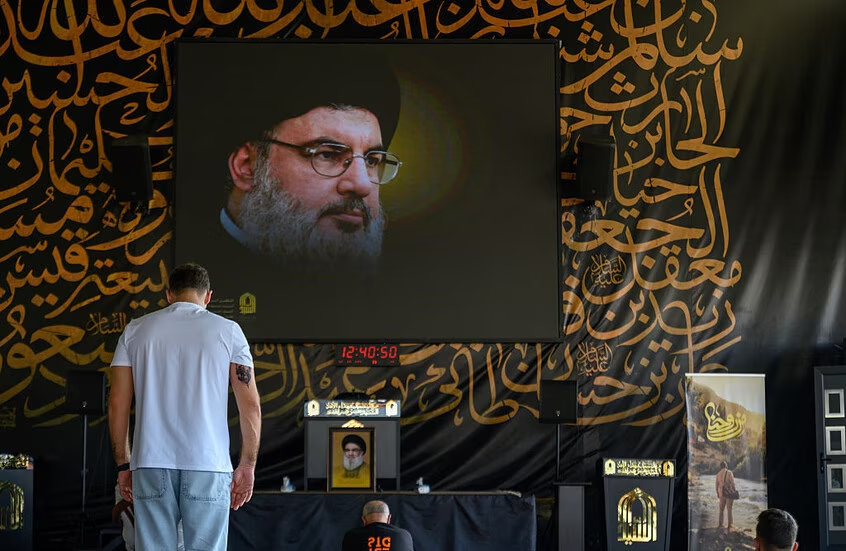
Lebanese journalist reveals details of arrest of individual involved in assassination attempt on Hassan Nasrallah

Lebanese journalist Abdullah Qamh revealed that Lebanese security agencies are holding an individual involved in the assassination attempt on Hezbollah Secretary-General Hassan Nasrallah, which was carried out by Israel last September.

Qamh explained in a televised interview that investigations with the detainee at the General Directorate of General Security showed his indirect involvement with the Israeli side, noting that he does not belong to the Shiite community. The detainee made confessions described as extremely dangerous, related to his activities during the 'Support Battle' period in Beirut's Dahiyeh.

According to the information revealed, the detainee frequented certain points in Dahiyeh as part of a group of individuals, carrying a small technical device that was later found to be designed to determine the distance and depth between the ground surface and Hezbollah's underground military installations and tunnels.

The Lebanese journalist indicated that these technical data enabled the Israeli Air Force to determine the type of bunker-buster bombs and the required weight to use them in airstrikes to ensure the destruction of those installations. The confessions also confirmed that the detainee visited the area where the party's central headquarters in Dahiyeh is located, which witnessed the assassination operation.

It is worth noting that Israel carried out the assassination operation against Nasrallah on September 27, 2024, under the name 'New Order,' using 'F-35' aircraft with heavy bombs weighing more than two thousand pounds, which led to the complete destruction of six residential buildings and targeting the headquarters beneath them.

This device was determining the depth between the ground surface and the underground installations, and this matter served the Israelis so they would know what bombs they needed to use.

ARAB AND WORLD

Thu 05 Feb 2026 9:54 am - Jerusalem Time

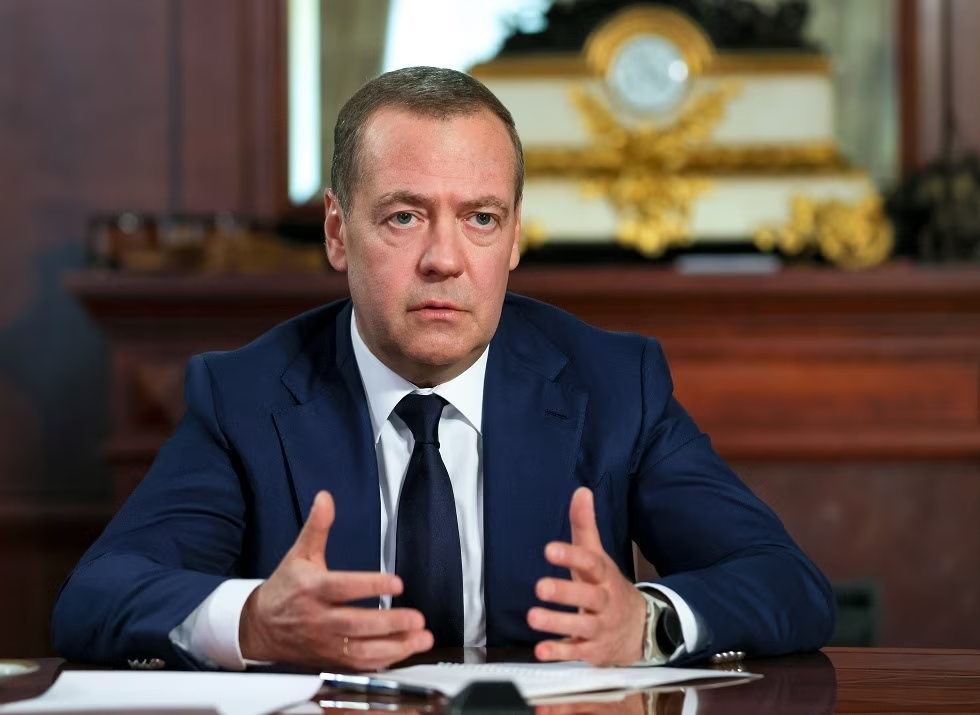
Medvedev: US military activity in Venezuela and Iran does not resemble the Russian operation

Dmitry Medvedev, Deputy Chairman of the Russian Security Council, affirmed that Washington's attempt to justify its military actions by referring to the Russian military operation is futile, emphasizing that the operation is not a colonial war but aims to defend Russian citizens.

Medvedev stated that the United States' attempt to justify its military moves by saying that 'others are doing it,' referring to Russia, is a failed attempt. He clarified that his country is protecting its citizens and subjects during the operation taking place on what he described as its 'historical lands.'

The Russian official indicated that the protection of citizens came due to the oppression of a neighboring state, considering the legitimacy of its authorities to be highly questionable, noting that these citizens held a legal referendum and chose to join the Russian Federation.

Medvedev added: 'By its nature, the Russian military operation is not a colonial war, but an act of self-defense. Unfortunately, the social composition of the participants in this conflict allows us to describe it as a transformed form of civil war, born from the ignominious end of the Soviet Union.'

He concluded his statements by indicating that Washington's military activity in areas such as Venezuela, Iran, or Greenland shows no similar signs to what Russia is doing to protect its citizens and historical lands, in his words.

The Russian military operation is not a colonial war, but an act of self-defense and a transformed form of civil war.

ARAB AND WORLD

Thu 05 Feb 2026 9:53 am - Jerusalem Time

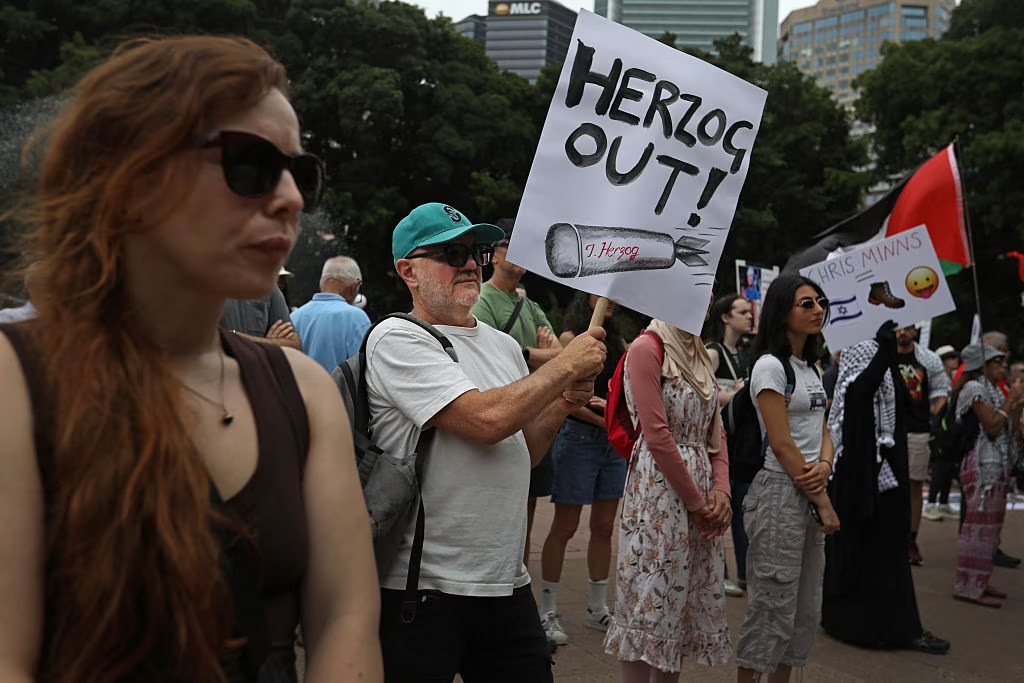
Australia Ignores Calls to Arrest Israeli President During His Upcoming Visit

The Australian government has avoided responding to calls for the arrest of Israeli President Isaac Herzog during his upcoming visit to the country, scheduled to begin next Monday and last four days, to offer condolences to the victims of the mass shooting incident that targeted the 'Hanukkah' festival at Bondi Beach in Sydney last December, which resulted in the deaths of 15 people.

This visit comes amidst widespread human rights controversy, as a United Nations committee reported in 2025 that Herzog 'incited genocide' through statements in which he considered Palestinians an 'entire nation' responsible for the October 7 attacks, which Israel categorically rejected, describing the report as 'false and misleading'.

For his part, human rights lawyer and member of the UN investigative committee, Chris Sidoti, called on Australian authorities to arrest Herzog upon his arrival, considering Prime Minister Anthony Albanese's invitation to him a 'ridiculous mistake' that should be retracted, while emphasizing the necessity of legal accountability based on international reports.

In an official response, Australian Foreign Minister Penny Wong clarified that the invitation came in response to the wishes of the Australian Jewish community, and aims to honor the victims of the Bondi attack and provide support to the community in the face of what she described as the 'worst antisemitic attack' witnessed on Australian soil.

Concurrently, activists supporting the Palestinian cause announced widespread protests across Australia rejecting the visit, while Sydney police refused to grant permits for demonstrations based on new security powers, and federal police revealed that charges had been laid against a young man who threatened to kill a foreign head of state online.

Sources reported that security measures have been unprecedentedly tightened around the sites the Israeli president will visit, amidst a sharp political and public division over the implications of this visit for Australia's international human rights obligations.

He must be arrested if he comes... The decision to invite him was wrong and should be canceled before it's too late.

OPINIONS

Thu 05 Feb 2026 9:37 am - Jerusalem Time

Greenland and the Atlantic Rift: US National Security or NATO Disintegration?

In a highly turbulent international moment, the return of US President Donald Trump to the idea of annexing Greenland, this time not as a real estate deal as in 2019, but as an open option that could include the use of military force, opened one of the most dangerous rifts in the transatlantic relationship since the end of World War II, especially since the threat came hours after a US military operation in Venezuela, which led Europeans to interpret the message as a structural shift in American behavior, not just a fleeting rhetorical maneuver. The American position, expressed by the White House on January 7, 2026, when it announced the study of multiple options for acquiring Greenland under the pretext of national security, put NATO before a real existential test, as for the first time a central party in the alliance threatened to use force against territory belonging to a member state, which transformed the discussion from a political dispute into a direct threat to the security structure on which NATO has been based for more than seven decades. Attempts at mitigation led by US Secretary of State Marco Rubio, by saying that Trump prefers purchase over invasion, did not convince European capitals, because merely not ruling out the military option is enough to undermine trust, especially when these statements are accompanied by American leaks talking about a strategic priority for Greenland in confronting adversaries in the Arctic, and with discussions within the Pentagon about potential military scenarios. The European response was swift and gradual, from the secret and urgent meeting of the Danish Parliament, to the joint Scandinavian statement that stressed that Greenland is not an open international file but an issue concerning Denmark and the island's people exclusively, leading to the broader European position signed by seven major countries, confirming that Greenland belongs to its people and that any infringement on its sovereignty represents a clear violation of the United Nations Charter and the principles of border integrity. It is noteworthy that this European position was not directed against the United States as a traditional adversary, but came laden with deep concern that Washington itself might become a factor in the disintegration of the Western system it had led for decades, which was clearly expressed by the warnings of Danish Prime Minister Mette Frederiksen that American control over Greenland could mean the end of NATO in its current form. In this context, Trump's security and economic arguments do not seem convincing even within Western circles, as Greenland is already covered by the alliance's defense umbrella, and the US military presence there has been in place for years, as for the natural resources being promoted, experts agree that they are difficult to extract and of low economic viability, which makes the real motive closer to the logic of power and political symbolism, and Trump's desire to set a historical precedent as a president who expanded the borders of the United States by force or by threat and bullying language. But beyond Greenland itself, lies the deeper transformation revealed by this crisis, which is the transition of the United States under Trump from leading the Western alliance to blackmailing it, and from defending international law to using it selectively, which led European commentators to consider Washington an ideological and geopolitical adversary, no less dangerous than Russia or China, especially since Europe finds itself besieged by simultaneous pressures, a Russian hybrid war from the East, Chinese economic and technological pressure from within, and a direct American threat from the supposed ally. European diplomatic estimates believe that the core of the conflict is not about a remote island inhabited by fifty-six thousand people, but about a broader struggle over the shape of the international system, where the new American strategy views Europe as a regulatory, legal, and commercial power capable of restricting American hegemony, whether through technology legislation or by strengthening the role of the Euro as a currency competing with the dollar. Although opinion polls in Greenland itself show widespread popular rejection of any American annexation, and a preference for a gradual path to independence from Denmark while maintaining financial support, this voice does not seem present in American calculations, which treat the island as a geopolitical location, not a society with political will. In conclusion, we may not witness an actual invasion of Greenland, as observers suggest, as it seems that Trump is using military threat as a negotiating tool to impose concessions, whether in the form of additional bases or economic and security agreements, but the political price of this strategy could be high, because merely threatening to use force within NATO is enough to create cracks that are difficult to repair, and raises an existential question for Europe and the world: Is the Atlantic Alliance still a framework for collective security, or has it become a hostage to a unilateral tendency that recognizes only the logic of force? Greenland, at this moment, is no longer an icy island far from the center of the world, but has become a mirror reflecting the crisis of the Western system itself, between eroding international law, shaking alliances, and a superpower that no longer sees its allies as partners, but as bargaining chips that can be used whenever America's interests come first.

OPINIONS

Thu 05 Feb 2026 9:35 am - Jerusalem Time

Settlement Devours the West Bank

In this article, we discuss settlement in the West Bank, as Israel races against time to impose facts on the ground in the West Bank, which was divided under the 1993 Oslo Accords into three areas (A, B, and C). Area "A" represents 18% of the West Bank's area, Area "B" 20%, and Area "C" approximately 62%. However, Israel has not accepted this equation for dividing the West Bank, which is controlled by two states. The first is the occupying state, represented by the government that legislates laws to control the West Bank through the Israeli army, which practices the most heinous forms of repressive and occupying practices against the Palestinian people. The second state is that of the settlers, who steal land, commit murder, and carry out continuous and escalating attacks against the Palestinian people. This is what the article seeks to discuss and address in detail. In 2021, I reviewed a book titled "Israeli Settlement in the Occupied Arab Territories," and I did not know the author's name at the time, but I expected the book to be by a Palestinian doctor. However, when the book was published internationally in 2022, I was surprised to find that the book was by Dr. Issa Al-Nazzal, an Iraqi. The book discusses the establishment of what is called the "State of Israel" on the land of Palestine in 1948, and states that Israel built many settlements to accommodate Jews. Israel did not stop there, but continued to aspire to occupy more Arab lands, and for that purpose, it launched many wars against its Arab surroundings, during which it managed to quadruple its area at the expense of Arab countries. It then proceeded to build settlements on those lands. The book refutes settlement and addresses each settlement, and also touched upon Israel's settlement policy towards Palestine, mentioning that settlement in Palestine and even in Arab countries was supported by America, which recently, through its president Donald Trump, recognized Jerusalem as the eternal capital of Israel, and the Golan as "Israeli" land. Moreover, in 2020, it presented the Palestinians with a distorted map of the West Bank, cutting off the fertile Jordan Valley and about half of the remaining West Bank for Israel's benefit. In this regard, we can touch upon the stages of building a settlement in the West Bank. The construction process is simpler than anyone in the world can imagine. Settlement begins when a settler or a group of settlers, fewer than the fingers on one hand, are impressed by a mountain in the West Bank. They raise the Israeli flag on it, and on their second visit, they build a canvas shack, and their visits to the mountain continue. Then they place a large iron menorah, then build some zinc houses, and begin to attract groups of settlers to control the area. The process of paving roads and transporting caravans and prefabricated houses to the outpost begins. After that, the Israeli government makes the decision to legalize the outpost to become a legitimate settlement under occupation law. The outpost, which has become a settlement, will not stop there. Instead, a single settler comes to control an area of thousands of dunams under the name of "pastoral settlement," and the army and settlers begin to prevent citizens from accessing their lands and impose a security zone that Palestinians are prohibited from approaching, which may reach the outskirts of Palestinian villages and cities, as happened in Burqa Nablus, Sebastia, Silat ad-Dhahr, Qaryut, Burqa Ram, al-Mughayyir, Turmus Ayya, and all areas where settlements are established. For your information, the number of settlements in the West Bank has reached more than 200 settlements and more than 260 outposts, and dozens of "pastoral settlements." A new type of settlement has been invented, following "pastoral settlement," which is "agricultural settlement," where settlers cultivate stolen Palestinian land, and even agricultural tractors are stolen from citizens, as are plowing tools, seeds, trees, and diesel from gas stations, as happened at the Asira al-Shamaliya station. The lives of settlers are based on stealing from citizens, killing Palestinian livestock, and expelling Bedouin communities and farmers from their grazing areas, as happened in the Jordan Valley, Khirbet Yanun, and other areas. Palestinian heritage, including livestock farming, riding donkeys and horses, and everything related to Palestinian national heritage, has been stolen. Water springs have also been seized, as happened in Qaryut, Al-Auja, and many areas, and today their eyes are on the Tubas area to prevent Palestinians from farming, as this area is considered the agricultural basket of Palestine. At the same time, Israel and the settlers are waging a war of olive tree eradication, and targeting Area "C," which includes 62% of the West Bank's area, and has 1% of the citizens, as Israel works day and night to completely empty it of its inhabitants. In the same vein, Israel is carving out and expanding settlement roads that devour Palestinian lands and steal thousands of dunams in the West Bank, and geographically and topographically engineering the West Bank by imposing a fait accompli policy, and working to connect settlements with each other, which have become large cities with residential towers and much larger communities than Palestinian cities, and even the construction has become similar to Palestinian construction, as is happening in the settlement of Alieh, where a series of towers and communities similar to the city of Nablus have been built. Israel has not stopped at this level of settlement, but rather confiscates land for security and military reasons, and then evacuates military camps and hands them over to settlers, as Israeli Finance Minister Bezalel Smotrich said on his "X" account that the Israeli army is evacuating its camps in the Beit El settlement northeast of Al-Bireh in the central West Bank, which will allow the construction of 1,200 settlement units and double the area of the settlement, and this settlement is considered in the heart of Ramallah, the virtual Palestinian political capital. In the same vein, Israel follows a demolition policy in Area "C" according to documentation by the United Nations Office for the Coordination of Humanitarian Affairs, for the period between January 1, 2010, and January 1, 2025, approximately 8,765 Palestinian structures were demolished in Area "C," most of them under the pretext of building without a permit, including 3,107 agricultural structures, 2,025 inhabited homes, and about 700 uninhabited homes. The demolitions in Area "C" resulted in the displacement of nearly 10,000 Palestinians, and affected about 192,548 others. The demolitions even reached the outskirts of Palestinian cities, as happened and is happening in Nablus, Al-Bireh, Hebron, and many governorates, in addition to demolitions in the three Palestinian refugee camps (Nour Shams, Tulkarm Camp, and Jenin Camp), where half of the camps were demolished, 50,000 Palestinian citizens were displaced, and the camps were topographically engineered in an occupying manner. Former Minister Avigdor Kahalani called for "removing all refugee camps and leveling them to the ground." In addition to the continuous destruction in the Palestinian governorates, as happened in Tubas and Qabatiya, and the daily incursions into the heart of the governorates, disrupting life, daily arrests, and daily killings. Settlers killed 38 Palestinian citizens in 27 months, and the Israeli army killed more than "1,100 Palestinian citizens," and more than 40,000 attacks were carried out against citizens and property. The West Bank is subjected to a silent war of extermination at all levels; all that the occupying state and the state of the settlers are doing aims to resolve the conflict, extend sovereignty, and then annex the West Bank and confine the Palestinian presence only to the specific population centers in Area "A," which is less than 20% of the West Bank's area, which is not enough for citizens' cars. This plan leaves less than 3% of historical Palestine for Palestinians, and all of this contributes to pressuring the Palestinian people to emigrate, and all of this is done with American support and under suspicious Arab silence. It seems that Trump told them to annex the West Bank through decisive action, without announcing it at this time until the political opportunity arises to announce the media annexation. After US President Donald Trump's statement where he said, "I will not allow Israel to annex the West Bank," and added, "That will not happen," Israel escalated confiscation operations, and the Jordan Valley and Tubas governorate were at the forefront of these confiscations, where thousands of dunams were confiscated in the Jordan Valley as well as the Tubas area for a wall that chokes Tubas and controls water wells and fertile agricultural lands. This is what Smotrich announced from Ras al-Ain in Al-Auja in the northern Jordan Valley, where he saluted the settler herds, and told them, "I see the results of your wonderful work. We have returned to the water wells and controlled all these areas, and it is enjoyable to wander here. You are heroes, continue." After that, Israel launched a war to eradicate olive trees and announced the establishment of 19 new settlements in the West Bank, and the return of settlement to the northern settlements in the West Bank, and began work in the Sanur settlement and announced the confiscation of thousands of dunams to establish a bypass road to connect the northern West Bank settlements and confiscate the plains, Al-Masoudiya, and Al-Burj areas from the lands of Burqa and Sebastia under the pretext of tourist confiscation, and this is in the northern West Bank. In addition to confiscation in Hebron, Jericho, Jerusalem, Salfit, and all governorates of the West Bank, and the legalization of 69 outposts in the West Bank, all under the umbrella that Trump does not allow the annexation of the West Bank, and it seems that Trump told them to annex the West Bank through decisive action, without announcing it at this time until the political opportunity arises to announce the media annexation, and this demonstrates the American position on the establishment and recognition of a Palestinian state, as America has not recognized the state of Palestine as Western countries recognized it several months ago; and perhaps Smotrich's statement confirms this joint American-Israeli position when he said: "We are stopping the establishment of a terrorist Palestinian state on the ground, we will continue to develop, build, and settle in the land of our ancestors, believing in the righteousness of our path." This is an integrated strategy through which Israel seeks to enshrine what is called "silent annexation" that devours the West Bank. *Palestinian writer and researcher specializing in ideological movements.


OPINIONS

Thu 05 Feb 2026 9:34 am - Jerusalem Time

US-Iranian Negotiations What After Istanbul... De-escalation or Justification?

All eyes, news, and estimations are directed towards Istanbul, where last-minute negotiations begin and end on Friday. The question here is: Are we facing de-escalation or justification? To answer this question, we must take into account the factors that directly affect de-escalation on one hand, and those that seek justification on the other. Here, I point out that the developments sweeping the region with American mobilizations and Israeli preparations relate to two axioms known to every political science specialist: First, it has become known to everyone that the direction in the Trumpian and global Zionist and Israeli mindset is settled in terms of the strategic and geopolitical view of Iran, and this view is summarized as follows: "There is no place for a resistant Iran, an ally of the Chinese giant and the Russian bear, in the drawn plan for the West Asia and North Africa region"; and second, it relates to the concept of resolving outstanding issues, especially in "Lebanon" and "Gaza," and that this is not possible without cutting off the head "Iran" or at least completely subjugating it to American will and hegemony and its acceptance of the Israeli captain as the primary influencer in the region. Let's return to what we mentioned above about the concepts of de-escalation and justification and the factors influencing each, where we find that there are internal and external factors that strongly impose themselves on the two concepts above, almost to the point of equality, but they lean somewhat in favor of justification due to the nature of President "Trump's" personality, which is indivisible except by one, and grammatically indeclinable. The external de-escalation factors are primarily based on the apprehension of regional countries allied with Washington, which firmly believe that they will be involved in a war they do not want, a war of total loss, and will achieve nothing but further submission to Israeli influence, meaning that the margin of maneuver in the relationship with the American ally will shrink to zero. Therefore, these countries are looking for a way out to stop the rush towards the point of no return. Here, the "Turkish" negotiation plan emerged through the concept of discussing each file separately, starting first with the nuclear issue and presenting it on "Trump's" altar as a gift to stop the escalation, where "Iran" agrees to transfer 60% enriched uranium to "Russia" and freeze its uranium enrichment on its soil for several years in exchange for forming a regional and international framework for uranium enrichment for civilian use, of course, in addition to full monitoring by the International Atomic Energy Agency inside Iran on the entire Iranian nuclear file. These proposals will be acceptable to "Iran," and it is ready to deal with them fully, but what is the مقابل?!!! What will Iran get?!!! This is the subject of negotiation on Friday, meaning that the condition for Iranian approval will have a مقابل, at a minimum, the lifting of sanctions on oil and gas exports and sanctions related to financial transactions and "Iran's" access to its frozen funds, but, for the Americans, approval is possible if Iran agrees to two issues: the first is to sell its oil and gas in dollars, and the second is "Iran's" agreement to begin negotiations on other files "ballistic missiles, and support for its allies in the region." Thus, the success of the regional factor pressing on President Trump and Iran is linked to what we mentioned above. As for the internal American factor for de-escalation, it is represented by the lack of consensus within the White House administration to go to war, especially since the concept of a limited, decisive, and crushing strike has become unfeasible and will not achieve any of the stated goals; it will not overthrow the regime, it will not stop the nuclear program, and it certainly will not stop Iran's strategic plans in ballistic missile production and others or in supporting its allies in the region, in addition to Iran's threats to turn a limited conflict into a comprehensive regional war, which ended the limited strike plan. But this does not prevent war plans in President "Trump's" mind; he wants something tangible through which he can declare victory, and therefore the internal American factor was linked to the external regional factor, and the negotiation plan in Turkey was put forward on Friday as a last resort that will result in either de-escalation or justification. As for those who seek justification internally and externally, they believe that Friday's negotiations are nothing more than extra time to complete mobilizations and coordinate military operation steps so that they turn from limited to continuous strikes for several days or weeks, and also to create a balance between defense and offense. Therefore, we saw the focus on installing American air defenses in regional countries to increase their reassurance and reduce the intensity of their pressures due to the seismic tremor affecting their interiors, in addition to increasing the target bank and waiting for better weather without winter. Internally in America, the matter is almost entirely linked to President "Trump," who represents the dominant part of the deep state with all its branches, headed by the Zionist-Evangelical lobby, and he will not back down from his decision without at least subjugating the Iranian regime, meaning he wants to exhaust diplomacy to increase internal support. Of course, if diplomacy succeeds in subjugating the Iranian regime, this will be considered President "Trump's" greatest achievement, achieving all his goals without firing a single shot; but there is an influential and pressing internal factor on President "Trump" to deal with the negotiations that will take place in the coming days with "Iran" as a "justification" for the strike, regardless of its outcomes, and this factor is the scandals of what is known as the "Epstein file." The decisive and strongly pressing external factor for going to war against "Iran" is the state of "Israel," and it is ready to agree to support the American-Iranian negotiations according to its four conditions: "stopping uranium enrichment, transferring enriched uranium, setting conditions and monitoring ballistic missile production in terms of their range and number, stopping support for Iran's allies." Otherwise, it will not only not agree, but will inevitably go to strike "Iran" alone, leading to dragging the "United States" to at least defend "Israel," because it will not leave it alone, as it is the guardian of its security according to the American national security strategy set by the "Trump" administration several weeks ago. Thus, the external and internal factors for "de-escalation" or "justification" regarding the potential strike are taking their time in the interaction equation within a specific timeframe, and the nature of the interaction between these factors will favor either de-escalation or justification; and when we talk about the interaction equation, here we mean, first and foremost, President "Trump's" concept of "ego" as a key "element" in that equation, and this clearly suggests that overcoming the "Epstein" story, if possible, and it is possible, has become linked to declaring a complete and flawless victory peacefully or in the bad way "war" as President "Trump" says. There is no doubt that "Witkoff's" arrival in "Israel" today is related to an attempt to convince "Netanyahu, the army, and the Mossad" that President "Trump" has not abandoned the military option, and that dealing with the negotiations will not be in a package deal, but by discussing each file individually, and the beginning will be with the "nuclear file" so that an agreement is reached if it is agreed to discuss the rest of the files in other negotiation rounds, in a "Witkoffian" attempt to reassure "Israel" that there will be no American abandonment of the ballistic missile files and support for "Iran's" allies, and that there will be no agreement on the nuclear file without "Iran" committing to discussing the other files, but the question remains here, will "Netanyahu" and the "army" and "security establishment" be convinced of that?!!! And will the flow of "Epstein" files be stopped? Personally, I don't think so, as the American mobilizations in the region have become an opportune and irreplaceable opportunity for Israel. It remains to review an undeclared and unknown data point, the accuracy of which I personally doubt, but it must be mentioned, where it is said that "Netanyahu sought through President Putin to neutralize Israel from the repercussions of a potential American war behind America's back." Of course, for me, this is out of the question, not only because of the existence of a strategic "American-Israeli" alliance, but the idea of striking "Iran" to be American or joint was "Netanyahu's" idea, which President "Trump" later adopted, just as the American abandonment of its conditions regarding the missile program and the so-called "Iranian regional influence" as demands of its regional allies and its objections to the "2015 agreement" ended due to Gulf pressures to avoid the war option, is also a somewhat exaggerated story, because there are leading political elites in regional countries who informed Washington and President "Trump" that abandoning those demands would strengthen "Iran" in the region and make it appear victorious even over American will. And to summarize based on the above and in my personal estimation, I point out here that the scientific way of thinking and traditional estimations with a president like "Trump" do not apply to the scene in our region; I said before and still do, this region must become an American lake where ships sail with an Israeli captain, and that geopolitical change cannot occur with the revolutionary regime in "Iran," and that "China" cannot be competed with the presence of a country the size of "Iran" allied with it, and that the siege of "Russia" begins by removing the "regime" nail from Iranian geography; "Iran" is a geopolitical pivot state for the great powers, so geography must be shattered to functionally prepare it to disintegrate, and without that, the region will remain torn by influence and the Americans will not be able to completely and fully subjugate it to their influence. I believe that the decision to go to war against "Iran" has been made, and that its postponement the first time was for operational reasons, while it was postponed the second time for political reasons, but it seems there is no such thing as a third time, as matters will be decided next Friday, and everything will depend on the Iranian response and its readiness to market the victory that President "Trump" wants and seeks. Finally, caution is necessary, as the region may ignite before Friday, with the fuel for the ignition being Israeli par excellence and within the concept of miscalculations due to the intensity of mobilizations in the region and the caution shown by fingers on the trigger.

OPINIONS

Thu 05 Feb 2026 9:27 am - Jerusalem Time

The Sword of Settlement and Displacement and the Policy of Making Life Impossible: An Existential Threat to the Dream of a Palestinian State

The policies of the Israeli occupation against the Palestinian people are no longer mere isolated violations or circumstantial practices justified by security pretexts. Instead, they have become an organized and integrated project aimed at undermining Palestinian national rights, foremost among them the right to self-determination, and aborting the possibility of establishing an independent, sovereign Palestinian state on the June 4, 1967 borders with East Jerusalem as its capital. This project is based on three interconnected pillars: settlement, forced displacement, and a systematic policy aimed at making Palestinian life impossible.Israeli settlement in the occupied Palestinian territories, including East Jerusalem, constitutes a flagrant violation of international humanitarian law and a war crime under Article (49) of the Fourth Geneva Convention of 1949, which prohibits an occupying power from transferring its own civilian population into the occupied territory or deporting the indigenous population from it. Resolutions of international legitimacy have affirmed this principle, particularly Security Council Resolution (2334) of 2016, which considered settlements illegal and a violation of international law and a major obstacle to the two-state solution.The danger of settlement lies not only in its legal transgression but also in its existential effects, as it has contributed to the fragmentation of Palestinian geography, undermining regional communication, and transforming the desired state into isolated enclaves subject to the occupation's hegemony. With the rise of the extreme Israeli right, settlement has transformed from a negotiating tool into an official policy coupled with public rhetoric calling for annexation and denying the Palestinian national existence and its historical rights.In parallel, the policy of forced displacement is escalating through home demolitions, land confiscations, withdrawal of IDs, and the imposition of coercive realities that force Palestinians to leave. Forced displacement is considered a war crime and a crime against humanity according to the Rome Statute of the International Criminal Court, when carried out as part of a widespread or systematic attack directed against any civilian population, a description whose criteria apply to what is happening in the occupied Palestinian territories.However, the most brutal aspect of these policies is evident in the Gaza Strip, which has become the most egregious example of the “making life impossible” policy. Widespread killing, systematic destruction of infrastructure, targeting of hospitals, schools, and shelters, imposing a suffocating siege, deliberate starvation, preventing humanitarian aid, and displacing the population collectively constitute grave violations of the rules of international humanitarian law and resolutions of international legitimacy.The collective punishment imposed on more than two million people in the Gaza Strip is explicitly prohibited under Article (33) of the Fourth Geneva Convention, and the use of starvation as a weapon of war is a war crime according to Article (8) of the Rome Statute. These crimes cannot be viewed as collateral damage of military operations; rather, they are part of a systematic policy aimed at pushing the residents of the Strip, under pressure from killing, hunger, and the absence of basic necessities of life, towards forced migration, in direct violation of the prohibition of forced transfer of protected persons.The continuation of these crimes amid international silence, or merely issuing condemnations and denunciations, has contributed to entrenching a climate of impunity and encouraged the occupation to proceed with its policies. States parties to the Geneva Conventions bear an explicit legal obligation to ensure respect for these conventions in all circumstances, which requires taking effective measures to stop violations, not merely managing them humanely.From Condemnation to Action...Confronting the policies of settlement, displacement, and making life impossible requires moving from the realm of condemnation to the space of organized legal and political action. This necessitates, first, activating the principle of non-recognition and non-assistance, by refraining from recognizing any legal status arising from settlement, annexation, or forced displacement, and stopping any political, military, or economic support that contributes to the perpetuation of these violations.Second, supporting international accountability mechanisms, especially enabling the International Criminal Court to exercise its jurisdiction without selectivity or political pressure, and holding accountable those responsible for war crimes and crimes against humanity committed in the occupied Palestinian territories.Third, adopting deterrent economic measures, including prohibiting dealings with settlements and their products, and holding companies involved in supporting these policies accountable, in line with the United Nations Guiding Principles on Business and Human Rights.Fourth, providing effective international protection for the Palestinian people, especially in the Gaza Strip, and ensuring safe and unconditional access to humanitarian aid, and stopping the policies of siege and starvation.In conclusion, enabling the Palestinian people to exercise their inalienable rights, foremost among them the right of return, self-determination, and the establishment of their independent state, is not merely a political or humanitarian demand, but a fixed legal entitlement. Failure to protect it threatens not only Palestinians but also undermines the foundations of the international system based on law.

ARAB AND WORLD

Thu 05 Feb 2026 9:01 am - Jerusalem Time

Axios: Washington canceled negotiations with Iran and Rubio: Negotiations scheduled for Friday

Said Erikat

Opinion Writer

In what appeared to be a calculated diplomatic confusion rather than an actual collapse of the process, "Axios" reported on Wednesday that Washington had informed Tehran of the cancellation of a round of talks scheduled for Friday, attributing it to what the report described as Iran's backtracking on previous understandings regarding the venue and content of the negotiations. However, this development was not interpreted in Israel as a definitive closure of the negotiation door, as Channel 12 quoted Israeli assessments that what is happening falls within the framework of American pressure, not a declaration of a break.

This discrepancy between "cancellation" in leaks and "continuation" in official statements poses a central question: Are we facing a logistical dispute over the meeting place, or a deeper conflict over the agenda and negotiation terms? The data that emerged later suggests that the main point of friction is not merely geographical, but rather relates to who has the right to define the "core issues" that should be discussed, and under what political ceiling the process will be managed.

In this context, US Secretary of State Marco Rubio made statements on Wednesday morning that attempted to solidify the direction of US policy, without ruling out the option of a meeting. He said that any upcoming talks with Iran must include its missile and nuclear program, its support for its proxies in the region, and its treatment of its people, noting that the venue for the talks is still being arranged.

Rubio added, during a press conference in Washington, that "any talks, to actually lead to meaningful results, must address specific issues, including the range of Iranian ballistic missiles, its sponsorship of terrorist organizations throughout the region, its nuclear program, in addition to its treatment of its people."

Regarding the venue for talks with Tehran, he explained that Washington initially believed that it had been agreed to hold them in Turkey, before Iranian reports denied approval for that. He added: "We thought there was an existing forum agreed upon in Turkey, and it was arranged with the participation of a number of partners who wanted to attend and participate. But yesterday (Tuesday) I saw conflicting reports from the Iranian side stating that they had not agreed to that, so the matter is still under discussion."

The US Secretary of State stressed that any talks with Iran would not amount to "legitimizing it." This phrase, which outwardly appears to be a political clarification directed at the American public, carries a deeper negotiating message: Washington wants talks that lead to tangible concessions, not a political image that grants Tehran free recognition or lifts its isolation.

In contrast, subsequent media reports suggested that the Sultanate of Oman is the most likely location to host the round, given its traditional role as a mediator between the two parties in indirect meetings, and its familiarity as a channel for smoothing over difficulties when public options falter or their political cost becomes high.

Despite the ambiguity of the location, Rubio confirmed that the talks are scheduled for Friday, noting that the US President's envoy to the Middle East, Steve Witkoff, is "ready to go." Rubio added: "If the Iranians want to meet, we are ready. I'm not sure if an agreement can be reached with these people, but we will try to find out."

On the Iranian side, a parallel move suggested that Tehran does not wish to bear the cost of appearing as the party that thwarts the process. Prior to the expected date, the Iranian Foreign Ministry announced that its minister, Abbas Araghchi, had a phone call with his Omani counterpart, Badr Al Busaidi, during which they discussed bilateral relations and regional developments. This step is usually read as a double signal: solidifying the Omani mediator's role, and confirming Iran's readiness to return to the politically safer channel when the public path becomes a burden or when the circle of international presence expands.
However, the core of the crisis, according to political analysis, goes beyond the question of "where will the round be held?" to the question of "on what will it be held?". Washington seems determined to expand the agenda to include missiles, proxies, and human rights, while Tehran prefers to narrow it down to the nuclear file and lifting sanctions. This discrepancy is not a detail; it is the essence of the negotiation itself: Is it a limited deal within the confines of the nuclear issue, or an attempt to comprehensively reshape Iranian regional and internal behavior?

According to experts, a fundamental paradox emerges here: expanding the scope of negotiations may, from one perspective, seem like a recipe for derailing an agreement by introducing sensitive issues that make reaching a "single package" almost impossible. However, from another perspective, it could be an American tactic to restore "negotiations on Washington's terms" rather than "negotiations as mutual rescue." When the US administration insists on including missiles, regional influence, and human rights, it is not only raising the bar for demands, but also increasing the cost of Iranian rejection and preventing Tehran from limiting the discussion to the nuclear issue alone.

Moreover, the apparent contradiction between the "cancellation" leak and the "meeting is on" statement does not necessarily mean a division within the administration, but may reflect an intentional distribution of roles: a leak that raises the political cost for Iran and pressures it to accept specific conditions or a specific location, versus an official statement that keeps the door open so that Washington does not appear to be withdrawing or obstructing. According to this logic, "confusion" becomes a negotiation tool, not a diplomatic failure.

The Israeli interpretation, reported by Channel 12, suggests that what is happening is closer to pressure than to a definitive cancellation. This interpretation is not separate from Tel Aviv's own calculations: the scenario of a collapse of negotiations automatically opens the door to military possibilities or widespread regional escalation, a path that Washington does not seem to want to push to the forefront now, even if it implicitly hints at it as a means of pressure.

All eyes are on Friday as a test of the seriousness of both parties rather than a technical date. The first scenario is that the round will actually take place, even with Omani mediation or alternative arrangements, meaning that the dispute was part of a "tug-of-war" before sitting down. The second scenario is to postpone the round while keeping communication channels open, an option that allows both parties to avoid political embarrassment and temporarily reduce tension. The third scenario, which is the least announced and most dangerous, is the gradual disintegration of the process with mutual accusations, which opens the door to escalation in the region or a return to the atmosphere of sanctions and mutual responses.

Between these scenarios, the only certainty so far seems to be that negotiations—if they take place—will not be solely about the nuclear issue, and that Washington is trying to establish a new equation: no free political legitimacy, and no narrow deal that leaves missiles and proxies out of the equation. In contrast, Tehran will seek to avoid expanding the agenda because it knows that accepting it means entering into long negotiations in which its basic cards will be exhausted.

The scene of "cancellation" and "confirmation" in one day reflects the nature of the current stage: a policy managed by conflicting messages, media pressure, and keeping all options open—not only to produce an agreement, but also to manage failure if it occurs, and to determine which party will be held responsible before its domestic audience and allies.

ARAB AND WORLD

Thu 05 Feb 2026 8:58 am - Jerusalem Time

Dismantling The Washington Post and Redefining Journalism Within the Newsroom

Said Erikat

Opinion Writer

News Analysis

In a move that signals a profound transformation in the identity of one of America's most venerable journalistic institutions, The Washington Post management announced a widespread wave of staff reductions and newsroom restructuring. This decision will affect most departments and will practically lead to a reduction in the newspaper's local and international presence, and the closure of editorial units that were a fixed part of its professional structure.

During a comprehensive phone call with employees on Wednesday morning, Matt Murray, the executive editor, along with Wayne Connell, chief human resources officer, stated that "every department across the newsroom will be affected to some degree." According to a recording of the call circulated within media circles, the plan includes closing the sports and books sections, suspending a political podcast titled Post Reports, in addition to restructuring the "Metro" team responsible for covering the capital and its suburbs. Murray clarified that the number of editors would be "significantly" reduced, and the art and design teams would be merged, in a move he described in a tone that seemed closer to an admission than a justification: "These moves are painful... this is a difficult day."

However, the most significant item was the management's announcement to reduce the newspaper's international footprint, while maintaining a "strategic external presence" in "about a dozen locations," with a stated focus on national security issues. This shift, which may seem like resource organization, is interpreted within the institution as a gradual contraction of field journalism in favor of "major files" journalism that is managed from offices rather than created from the ground.

In this context, the decision to cancel the newspaper's correspondent position in occupied Jerusalem stood out among the terminations that affected the entire Middle East coverage team, a decision that goes beyond being an administrative measure. Jerusalem, with its political, religious, and symbolic centrality to the conflict, is not just a point on the international coverage map, but an area where news intertwines with history, and reality with narrative, requiring a steady journalistic eye on the ground, not "remote coverage" managed from capitals.

In addition to Jerusalem, the layoffs affected Ukraine bureau chief Siobhán O'Grady and correspondent Lizzy Johnson, reflecting a broader trend towards reducing field coverage in conflict zones, at a time when international journalism should be more, not less, necessary. The list of laid-off journalists also included prominent journalists such as Ishaan Tharoor, Isha Do, Jesus Rodriguez, Dino Grandoni, and Nilo Tabrizy, who had only days earlier received professional acclaim for his personal coverage of events in Iran, in addition to Caroline O'Donovan, who covered Amazon, as well as the entire Middle East team.

Although Murray emphasized that political and government coverage would remain the "largest part" of The Washington Post's operations, he spoke of a long-overdue "strategic reset," saying that the institution "has not evolved its model or its operations as it should," and that the crisis is not the result of "a single event" or an "easy blame point," but rather long accumulations. However, this discourse seemed to many within the newsroom closer to an attempt to arrange the narrative after the shock, rather than a convincing explanation for its causes.

Rumors of layoffs had been circulating for weeks, but the sense of danger was older than that. One employee described the crisis management method as closer to "psychological warfare," while another said that media links discussing the reductions were circulated within the institution "as if they were secret publications," and that the general feeling was like "a guillotine hanging over their heads." Nevertheless, the same employee added, the newspaper "was doing good journalism," which made the shock double: rising professional performance against a declining administrative decision.

Fingers of blame within the institution point towards Jeff Bezos, the Amazon founder who bought the newspaper in 2013, and to Will Lewis, the publisher who took office in 2024, coming from Rupert Murdoch's media environment. One employee described Lewis as "better at talking than building." In an attempt to contain the anger, Murray said he wanted to be "clear" that the newspaper's commitment to "high-impact journalism that holds power accountable without fear or favor" remains "steadfast," affirming his confidence that this commitment "reaches the highest levels of the company."

But this official language clashed with a strongly worded statement from Marty Baron, the former executive editor, who said that what is happening is "among the darkest days in the history of one of the world's greatest news organizations," warning that the newspaper's ambitions "will be severely curtailed," and that the public will be deprived of "fact-based field reporting" in American society and around the world.

In the background, many within The Washington Post view Bezos's recent decision to withdraw the editorial board's endorsement of Kamala Harris as a pivotal moment. In the days following the decision, more than 250,000 readers canceled their subscriptions. Journalists believe that the financial crisis was already present, but that step deepened the crisis and led to a mass exodus of subscribers, in parallel with the management's failure to create new revenue sources.

Sensitivity also increased after the FBI raided the home of journalist Hannah Natanson in the context of a leak investigation, with employees expressing particular dismay that Bezos "said nothing," at a moment when ownership was supposed to stand behind its journalists.

The deeper irony is that what is happening is not just layoffs, but a redefinition of what journalism is in the age of billionaire owners. When an institution transforms into a project managed by brand logic rather than public service logic, the less profitable sections—such as sports, books, and international coverage—become the first victims, even though they are what give the newspaper its cultural and human depth. The danger is that the editorial role will be reduced to "national security and Washington politics," making journalism closer to an eye for power than a watchdog over it.

The crisis also reveals the paradox of the AI era: the technology that was supposed to relieve pressure on newsrooms has become a factor accelerating the erosion of their revenues through a culture of "summaries" that draws audiences away from the original source, and then is later invoked as a ready excuse for staff reductions. But what management ignores is that the solution does not lie in more deletions, but in restoring trust and repairing editorial identity. Journalism that removes its correspondent from occupied Jerusalem and closes culture and sports units does not just lose employees; it gradually relinquishes a fundamental part of its ability to tell the world as it is: from the field, not from behind screens.

ARAB AND WORLD

Thu 05 Feb 2026 8:26 am - Jerusalem Time

Muscat Negotiations on Schedule.. Washington and Tehran Confirm Talks on Friday

Iranian Foreign Minister Abbas Araghchi confirmed that nuclear negotiations with the United States will be held in the Omani capital, Muscat, at 10:00 AM on Friday, thus denying reports that spoke of the collapse of the diplomatic track between Washington and Tehran. Press sources quoted an American official confirming that the talks would take place on schedule, while other sources revealed that the White House agreed to move the meeting venue from Turkey to the Sultanate of Oman in response to urgent requests from Arab leaders who urged the American administration to listen to the Iranian point of view.

In the context of preparations, sources reported that at least nine countries contacted the administration of US President Donald Trump to ensure the meeting was held. American officials explained that preparations returned to track after extensive diplomatic interventions, noting that the approval of the meeting came "in respect" for allies in the region and for the experience of the diplomatic track, despite significant doubts within the American administration about Tehran's intentions. US envoy Steve Witkoff and Jared Kushner, the President's advisor and son-in-law, are scheduled to head to Doha tomorrow, Thursday, for consultations with Qatari Prime Minister and Foreign Minister Sheikh Mohammed bin Abdulrahman Al Thani before heading to Muscat.

Coinciding with these diplomatic moves, US President Donald Trump maintained an escalating tone, stating in a television interview on Wednesday that Iranian Supreme Leader Ali Khamenei should be concerned, especially with the United States strengthening its military buildup in the region. Trump had deployed an aircraft carrier to the Middle East, hinting at additional military options after the strikes that targeted Iranian nuclear facilities during last June's confrontations.

For their part, observers and academics believe that the main obstacle lies not in the negotiation venue but in the agenda of the talks; where the Trump administration insists on the comprehensiveness of the files to include the ballistic program and support for regional factions, which Tehran considers "political suicide" and non-negotiable defensive capabilities. Experts point out that returning to the Joint Comprehensive Plan of Action (the nuclear deal) may be the only way out for regional stability, while others believe that Washington is using military pressure as a tool to impose harsh negotiating conditions.

Iran adheres to its position calling for limiting negotiations to the nuclear file to dispel international concerns about its nuclear weapon, expressing its openness to technical transparency, but refusing to negotiate on behalf of regional countries on regional issues. Researchers warn that Washington's change of position and its demand for a comprehensive agreement may complicate the diplomatic path and raise doubts about the American administration's seriousness in reaching a sustainable settlement.

We told the Arabs that we would hold the meeting if they insisted, but we are very skeptical about the results.

PALESTINE

Thu 05 Feb 2026 8:20 am - Jerusalem Time

24 Dead in Gaza and Worsening Suffering for Thousands of Cancer Patients Due to Siege

The Ministry of Health in Gaza reported the martyrdom of 24 Palestinians, including children, since dawn today due to Israeli aerial and artillery shelling on various areas in the Gaza Strip, while the occupation army claimed it carried out "precise" strikes after one of its soldiers was targeted. The latest of these targets was in Al-Shati refugee camp, west of Gaza City, where an Israeli drone launched a raid on citizens, resulting in one martyr and several injured.

The Israeli occupation army claimed it targeted Bilal Abu Assi, commander of one of the elite companies in the "Al-Qassam Brigades," the armed wing of the "Hamas" movement, in the southern Gaza Strip, and alleged that Abu Assi led the infiltration operation into Kibbutz Nir Oz during the October 7, 2023 attack. The occupation army stated in its communiqué that targeting Abu Assi came in response to firing at Israeli army forces in the northern Gaza Strip, which resulted in a serious injury to an officer.

For its part, the Islamic Resistance Movement "Hamas" condemned the occupation's escalation in the Gaza Strip, considering it a "continuation of the war of extermination and disruption" of the second phase of the ceasefire agreement, foremost among which is the opening of the Rafah crossing. The movement said that the occupation's claims regarding firing at one of its soldiers are a pretext to continue the aggression, demanding that the international community pressure it to respect its obligations.

On the humanitarian front, UNRWA stated that 20,000 people are in urgent need of medical care in the Gaza Strip. In this context, the suffering of cancer patients in Gaza is worsening; their illness has doubled with the conditions of war amid the lack of treatment and the loss of minimal healthcare, as displaced Basma Abu Obaid recounts in an interview with media sources.

More than 11,000 cancer patients cannot find medicine or painkillers, as the occupation pursued oncology centers, and after the destruction of their specialized Turkish-Palestinian Friendship Hospital and their displacement from one place to another, they ended up in a small room inside the Nasser Medical Complex.

Saleh Sheikh Al-Eid, head of the oncology department at the Gaza Cancer Center, told media sources that the medical team diagnoses patients theoretically only due to the absence of necessary equipment for accurate diagnosis, and Al-Eid also points to the absence of necessary medicines for treating patients.
According to the Palestinian Ministry of Health, more than 3,000 cancer patients need urgent treatment outside the Strip. During the war, many patients died, and others will die if the crossings remain closed. Estimates by local and international institutions indicate that the improvement of the health situation for cancer patients and others with chronic diseases is linked to the rehabilitation of what the war destroyed.

The medical team diagnoses patients theoretically only due to the absence of necessary equipment for accurate diagnosis and essential medicines.
ISRAELI AFFAIRS

Thu 05 Feb 2026 8:19 am - Jerusalem Time

Brother of Shin Bet Head Accused of Smuggling Goods to Gaza, Making Millions

The Israeli Public Prosecution today, Wednesday, filed indictments against 12 Israeli suspects, including reserve soldiers, on charges related to 'aiding the enemy in wartime,' amid suspicions of smuggling prohibited goods into the Gaza Strip. The Ministry of Justice clarified in a statement that the value of the smuggled goods amounted to millions of Israeli shekels, and included cigarette cartons, iPhones, batteries, communication cables, and car parts, describing the operation as an organized and systematic smuggling case.
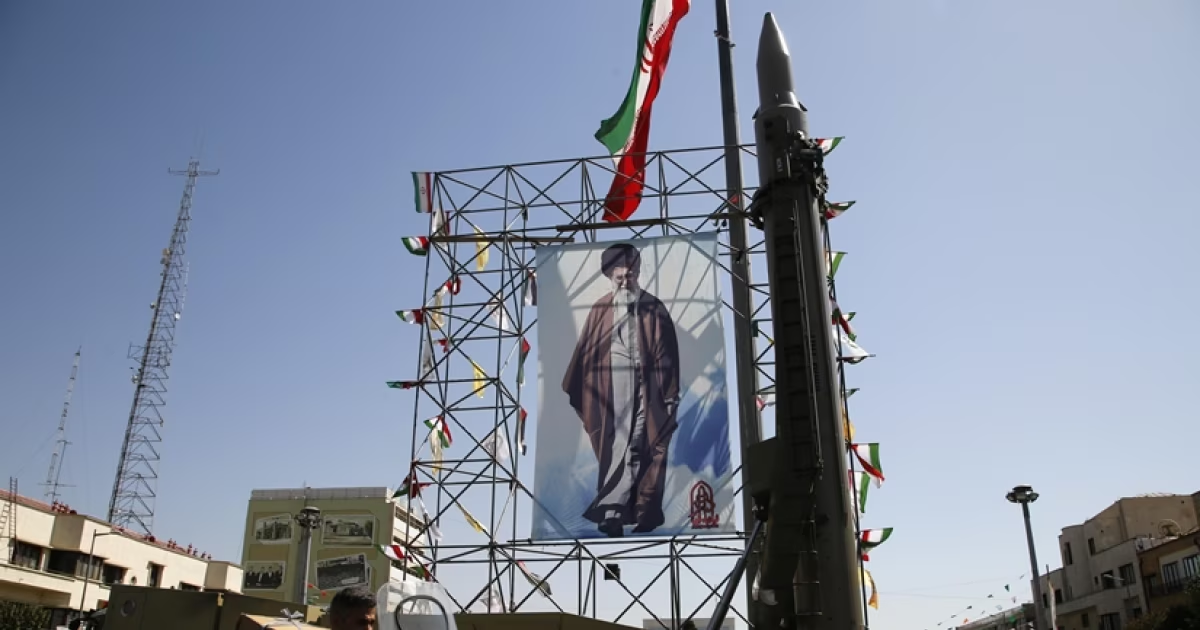
Sources reported that Betzalel Zini, brother of Shin Bet head David Zini, is among those suspected of involvement in smuggling cigarettes into Gaza in exchange for huge sums of money. According to investigations, the money Zini earned amounts to millions of shekels, exploiting the sharp rise in cigarette prices within the besieged Strip, where the price of a single pack reached more than $530.

The threads of the case began about a month and a half ago, when soldiers stationed in the Gaza Strip seized a suspicious truck containing dozens of phones, drones, batteries, and electrical equipment not permitted to enter. The police took over the investigation with Betzalel Zini instead of the Shin Bet due to his kinship with the head of the agency, while the accused denied his involvement in smuggling, claiming that his job was only to inspect trucks.

For his part, Rabbi Yosef Zini, the father of the Shin Bet head, defended his son Betzalel, considering the case 'fabricated' and aiming to oust his brother David from his position. In a related context, sources quoted investigators as saying that Zini was precisely aware of the goods passing through checkpoints and ignored smuggling in exchange for financial bribes.

It is worth noting that Betzalel Zini holds the position of director of an engineering unit called 'Oriya,' a squad that was active during the current war in extensive destruction operations within the Gaza Strip. The case sparked widespread reactions in Israeli circles, with some considering it 'treason in wartime,' while politicians like Eisenkot believed that these charges do not warrant the resignation of the Shin Bet head from his position.

It is a serious case of organized, systematic, and elaborate smuggling of various goods into the Gaza Strip with the aim of making profits.