





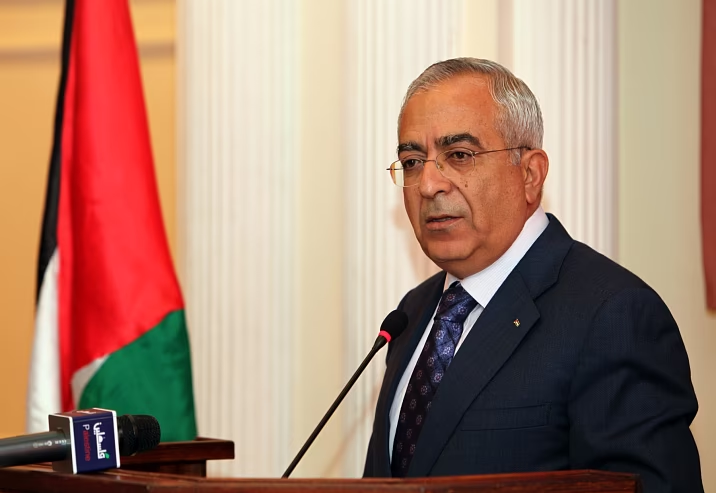
- Israel's policy in the West Bank aims at displacement - I understand Hamas's position due to Israel's violation of its terms from the Trump plan - We must work to get out of the hole we fell into and stop digging further - We must go to the Security Council to resume a serious political process with Israel - A government "for the people" is the minimum that any leadership should provide to our people In the nine months following the ceasefire that ended the comprehensive war in Gaza, the world's attention, in many ways, shifted to other issues. This became even clearer since February with the outbreak of another war in the Middle East. However, the situation in Gaza remains bleak and unstable, and the situation in the West Bank has become more tense and dangerous. At the same time, the path that Palestinian politics will take remains unclear, while the chances of reaching a lasting solution to the Israeli-Palestinian conflict seem further away than ever. Salam Fayyad served as Prime Minister of the Palestinian Authority from 2007 to 2013, and over the past few years, he has put forward a series of proposals, including articles published in Foreign Affairs, on building a Palestinian state, providing humane and effective governance in Gaza, and finding a practical and viable path for the Palestinian cause. The following is an interview conducted by Dan Kurtz-Phelan with Fayyad for the "Foreign Affairs Interview" program. Gaza after the ceasefire *It is almost astonishing how much the Palestinian issue, whether related to Gaza, the West Bank, or the future of the Palestinian national movement in general, has receded from global discussion since the ceasefire in Gaza last year, especially since the start of the war with Iran in February. Therefore, I found it useful to start by hearing your basic explanation and understanding of where we have arrived. Let's start with Gaza and go back to the ceasefire: What has happened in Gaza since then, and where does the situation stand now as you see it? A lot has happened in terms of preparing to do something about Gaza. It started with the ceasefire, which was, of course, a big event when it was reached, after many attempts to get to that point. Reaching a ceasefire was important in itself. Then came the "Peace Council," President Trump's plan, and the Security Council resolution that enshrined that plan, and there was a lot of activity. After that, the war with Iran broke out, which created a situation where the entire Palestinian issue, including Gaza, was pushed to the sidelines, and not much was said about it. When you browse the newspapers in the United States, you find that Gaza has almost completely disappeared, after many months during which it dominated the news and headlines. Things did not go the way the Trump plan was presented or the way it was supposed to achieve its goals. Difficulties arose even before the war; from the days the agreement was concluded, it was clear that both parties, Hamas and Israel, did not actually agree on everything that was required of them. For Hamas, there is the issue of disarmament, and for Israel, there is the issue of withdrawal, among other issues. But if we look at the situation since then, we find that Israeli raids have never stopped. More than a thousand Palestinians have been killed since the ceasefire came into effect. Therefore, despite the cessation of the comprehensive war in the way it was taking place in Gaza before the ceasefire, violence continued, and many people are still losing their lives every day. At the same time, not much has happened to improve people's living conditions or even to start improving them. Humanitarian conditions in Gaza remain the same, with many remaining homeless, in addition to the lack of food, water, electricity, and other basic necessities. What surprises me is that, amidst the marginalization that has prevailed since late February, when the war with Iran began, people seem to have lost interest in the humanitarian situation in Gaza. There is much debate about what should happen first: Should Hamas disarm or not? Should Israel withdraw or not? But what about the urgent intervention needed to start improving people's living conditions? This, in my opinion, is truly catastrophic and must be dealt with very quickly. So, there is indeed marginalization, similar to the marginalization of the situation in the West Bank due to what was happening in Gaza, even before the start of the US-Israeli war with Iran in late February. Many bad events were happening in the West Bank without receiving coverage, due to the depth and greater danger of the crisis in Gaza. However, what was happening in the West Bank was not only destructive to the daily lives of Palestinians living there, but also destructive to the long-term chances of reaching a situation where Palestinians can finally live freely in their own state. When you look at the de facto annexation that has taken place, the settlement activity, the new settlements that have been established, and the roads and infrastructure built in the West Bank by a government whose intentions are very clear, the message becomes: either you, as a Palestinian, fully comply with what they expect of you, or there is no place for you in that area; leave or die. And this, literally, is language used by some Israeli officials in the current government. Settler violence and displacement *Do you understand the escalation of settler violence as part of a campaign, coordinated to varying degrees, to drive Palestinians out of the West Bank? How do you see its place within the broader picture? I was in government when this horrific phenomenon began to emerge. There is a great deal of hatred in these acts of violence. I believe I was the first to describe them as acts of terrorism, and then some Israeli officials adopted the same description. That was, I believe, around 2009 or 2010, when settlers, for example, began burning places of worship and mosques, burning olive trees, and attacking Palestinians. The scope of this violence has increased enormously over the years, especially under the current government. It is almost, by definition, an official policy; extremist settlers commit what they commit with full protection from the Israeli army, and there is no doubt about that. And Israel knows how to stop these acts of terrorism if it really wants to stop them. If they continue unchecked, it can only lead to the conclusion that they are happening because they represent an intentional policy; a policy aimed at pushing Palestinians away from their lands, as happened in many areas in the Jordan Valley and the northern West Bank. There is a similar situation in the southern West Bank, in the Hebron area. And when you listen to what Israeli officials say about their vision for the future of Israel, and then you see what is happening on the ground, how can you not conclude that what is happening is actual policy? It cannot be reduced to saying that extremist settlers, full of hatred, want to clear the land of Palestinians to seize it. Settler terrorism is a reality that the Israeli government effectively condones. It aims to intimidate, and it is no longer limited to burning places of worship and olive trees, but has reached the point of attacking and killing people. Unfortunately, all of this happens with impunity. President Trump's influence on Israel *Donald Trump's influence was a decisive factor, if not the decisive factor, in reaching the ceasefire last October, I believe, early in the month. But Trump or his officials do not seem to have used much of that influence since then. Is this impression correct? And to the extent that you would like the United States to do more, how should it use this influence? President Trump has proven that he can get Israel to do certain things if he deems them important enough at a given moment. There are many examples of this. We can go back to June of last year, when the United States struck Iranian facilities and Israel and Iran exchanged missiles. Trump famously said, in essence, "Just stop it." That was during the twelve-day war, and in a public manner that we are not accustomed to, at least, seeing US presidents act. There is no doubt that confrontations occurred under previous administrations, and that American presidents were frustrated by Israeli actions here and there, but I do not recall seeing anything like this happen publicly in the way it has since Trump came to power. Trump clearly used that to reach the ceasefire. And if you look at the agreement, you will find that it is almost identical to the plan put forward by former President Biden. The only difference was Trump's intervention, which made its implementation possible. Since then, President Trump has, from time to time, shown signs of his ability to influence Israeli responses, using a great deal of what can be called public diplomacy, through statements, posts, and so on. The things he issued or said suggested to me his ability to make a difference in the course of events. As for the extent to which this can happen, I think it is related to two things: First, whether he has come to the conviction that the time has come to resolve this issue, and that behavior must begin to change in a way that helps that to happen. Second, the speed with which he can emerge from the repercussions of the war with Iran that began in January and extended into February. We will see what happens regarding these two matters. Hamas's position and the issue of disarmament *How do you understand Hamas's current situation? Israel has strongly targeted everyone involved in planning the October 7th attacks, but complete disarmament has not occurred. Hamas still appears to be one of the most important authorities in the part of Gaza not under direct Israeli occupation. What do you understand about Hamas's situation now, and how do you see the movement's place at this stage? Looking at it from afar, I am not close to what is happening, and all I have are reports and reading between the lines, and sometimes reading the lines themselves. It was always clear to me that Hamas was not actually convinced of the plan. It was pushed, through mediators, Turkey, Qatar, and others, and Egypt, of course, to move in the direction of accepting the Trump plan as a basis for moving forward. But it has several concerns, including giving up governance in Gaza. On the issue of handing over the administration of Gaza to a non-Hamas entity, the movement's officials announced from the early days of the war, and at least in their public statements, their readiness to give up governance in the Strip. However, the word "governance" is broad, and includes, among other things, security and weapons, of course. Therefore, if they are willing to hand over governance to a non-Hamas entity or one not under its control, I am not sure how willing they are to accept the part related to disarmament, given its essential connection to the nature of the movement, its organizational identity, and its ideology. It was clear to me that they reluctantly agreed for things to move forward. The same can be said for Israel and Netanyahu; they were also not enthusiastic about embracing everything in the plan. And if we recall, there was a lot of back and forth before a formula suitable enough to pass was reached. But after overcoming the first stage, i.e., the declaration of approval, and in light of what we all know about Hamas's reservations about accepting the plan as presented - and the same can be said for Israel - those issues come back to haunt you. When Hamas presents its response to the plan, it does not say: "By virtue of our organizational nature, we cannot accept this." Rather, it says: We are a party to an agreement, yes, but Israel has not respected the agreement; it continues to assassinate people, continues to launch raids on Gaza, and humanitarian conditions in the Strip have not improved in the slightest. All of this continues, so how do you expect us to fulfill our obligations while the other party does not fulfill its obligations? And I have great sympathy for this argument. But is this really the underlying reason for their inaction? I believe that in order to move forward, we must understand Hamas's true position on this issue and try to deal with it. Among the important things Hamas announced to explain its hesitation to move forward on the issue of governance was: "We are ready to deal with the issue of disarmament within the framework of an agreed-upon Palestinian Authority." It seems to me that this is an important proposal that should be built upon if we are working in the diplomatic field. In diplomacy, you look for an opening like this, and then you ask: What do you mean by that? And is there an opportunity here that can be exploited? This part is consistent with something I have personally called for since the beginning of the war, including the article you referred to at the beginning of our conversation and published in Foreign Affairs. The idea of a technocratic committee to manage Gaza *Before we get to the role of the Palestinian Authority in this vision, I want to ask you about another aspect related to the administration of Gaza. In the ceasefire plan and its aftermath, a vision emerged based on a technocratic administration that is not affiliated with Hamas or the Palestinian Authority. Does this idea have a practical basis? And does it actually mean anything? Frankly, let me go back to the origin of this idea. It dates back to the very early days of the war, shortly after October 7th. That was the first time I heard something like this as a potential vision for what would happen in Gaza after the war, i.e., for the arrangements for administering the Strip the day after. The idea, specifically, was to form a committee of technocrats and civil society individuals in Gaza, from people who do not belong to any faction, to take over the administration and become the political address for the Strip. When I first heard about it, just a few days after October 7th, or at most a week later, my reaction was largely angry. The idea came from Israeli, international, and American officials. In fact, I first heard it from an American official who was asking me: What do you think if something like this happens? And that was in October 2023, just a few days after October 7th. When asked why I reacted angrily, I said the reason was simple: This vision assumes that Gaza, the day after the war, will be free of Hamas or its influence. And this is a very difficult demand, even impossible to achieve. And in the context of trying to achieve it, tens of thousands of people will be killed, and there is no doubt about that. And I cannot see this as a reasonable way to address the issue of administering Gaza after the war correctly from its foundation. There is another reason why I found the idea illogical, although the first reason is the most important. Those who were thinking about the arrangements for the day after in Gaza were thinking politically, meaning they were looking for a political alternative to Hamas in the Strip. But the equation does not hold true in my opinion; because gathering a committee of individuals does not, by definition, create a political entity. And the committee will not, from the beginning, turn into a political home that people in Gaza are attracted to. And this was another problem with the idea. But my biggest problem remained that it assumes that Hamas will not remain after the war in Gaza, and this assumption has proven false. And after two years and many rounds of negotiations and discussions between Palestinian factions and Arab mediations, especially Egyptian, people somehow returned to the model of a committee of Gaza technocrats taking over meeting the needs of the Strip and managing it the day after. So where are we from that now? It goes back to October of last year, and the committee in Cairo is still unable to even reach Gaza for multiple reasons. *I assume your contact with that American official prompted you to develop the vision you presented in Foreign Affairs about two weeks after the attack. Your vision included involving some Hamas members who were not directly involved in planning the October 7th attacks, and also included changing the nature of the Palestinian Authority's leadership. How do you modify that vision today in light of what has happened? I will answer, but allow me a final word about the technocratic committee. When it was established after the ceasefire, I supported it because I am a very practical person. I supported it despite all my reservations, and despite the fact that I have an alternative that I still believe today is much better than everything that has been put forward so far, and can be a way out of the stalemate we are in. If we look at the situation as it is today, not as we wish it to be, there is no doubt that the Trump plan stumbled for various reasons. Yes, the recent war is a distracting factor, but there are also structural problems that existed from the beginning and hindered smooth implementation, with my understanding that the implementation of any plan cannot be completely smooth. After overcoming my initial anger and surprise at the idea of a technocratic committee taking over the administration of Gaza, I said to myself: Why don't I sit down and develop an alternative? And that idea was the basis for the article that Foreign Affairs published for me in late October 2023. The basic idea was related to a political matter that had accompanied me for a long time, long before October 7th. And I honestly believe that if we had put ourselves on the path of unity before that, perhaps October 7th would not have happened at all. *You mean Palestinian unity? Yes. And to this day, I believe that if we, Palestinians, do not make unity a starting point for any dialogue to move forward, we will never put ourselves on the path of true empowerment based on taking full responsibility for our liberation. This is a fundamental issue for me. I said at the time: Here we are, and the war has just begun. How can we do something to end it quickly before large numbers of people are killed? We must do what has been long overdue: unify the Palestinian political system, which suffered a very bad division in mid-2007 after Hamas forcibly took power in Gaza. A formula for political consensus must be found. Human nature is what it is, but people ultimately need to find ways to achieve coexistence and political consensus. And then a basis for a stable balance can be laid. I thought that, whether we like it or not, we, like all other peoples, do not think in the same way or wear the same clothes. Nor do we think in the same way about our cause and how to solve it, or about the ideology and organizational principles that should guide us on the path to liberation. Why are we alone, among all the peoples of the world, expected to be completely united in thought when it comes to a fundamental issue like the path to liberation? Can we find a way to deal with this diversity effectively, and in a way that serves our cause and our goal? My answer was to reactivate the Palestinian Authority after years of declining legitimacy and status for various reasons that I addressed in that article and in other contributions. And it must be transformed into an entity stemming from national consensus. How do we do that? It was not a matter of choosing a few people from Hamas and adding them to the Authority, but rather thinking about the entire structure of our political system. We have the Palestine Liberation Organization, which is supposed to be a home for all Palestinians. But over time, it turned into a home for a part of us, not all of us, especially after Oslo failed to deliver on the promise of a state. We cannot ignore that. The fact that we are not all united under the platform of the only organization supposed to represent us is not just an uncomfortable matter, but a major problem. And a way must be found to address it. My suggestion was to make the PLO inclusive again, and to find a way to restore it as a home for everyone. This requires bringing all parties to the table at the PLO level, not at the Palestinian Authority level; there is a difference between them. The Palestinian Authority is an entity that emerged from the Oslo Accords in 1994, while the PLO existed before it and is the umbrella organization for all Palestinians. But it gradually ceased to be a home for the majority of Palestinians, especially since the late 1990s when Oslo failed to deliver on the promise of a state. My proposal dates back to October 2023, even before the article I wrote for Foreign Affairs. In 2015, I wrote a similar proposal stating the necessity of bringing Hamas into the highest level of the PLO, and that it should be part of it. But there is a problem with the political program: Hamas does not adopt the PLO program, while President Mahmoud Abbas and the PLO Executive Committee were not prepared to change the program that allowed them to enter into the Oslo Accords. And here arises the problem of commitment to non-violence and recognition of the right of the State of Israel to exist in peace and security. I believe there are ways to deal with that, and I have presented them on more than one occasion. But the basic approach to addressing the Gaza issue was to bring Hamas into the framework of the PLO. The PLO leads a body called the Executive Committee. Since the early 2000s, national dialogues have taken place with the aim of finding a way to involve Hamas. This dates back to the era of our late President Yasser Arafat, and the head of the PLO delegation in those negotiations in Cairo was current President Mahmoud Abbas himself. That dialogue created what was called the "Unified Leadership Framework." So what is this framework? It is the PLO Executive Committee as it existed then and still exists today, plus the Secretary-Generals of the factions not affiliated with the PLO. That is, it is a broader umbrella. The idea was to activate something I did not invent myself, but which had always existed; to take it out of the drawers and activate it to do meaningful work. And what is the main task of this body according to what you wrote? To agree on a non-factional government to manage Gaza and the West Bank during a transitional period whose duration is agreed upon through negotiations, and then to start work and be sent to Gaza immediately. It is one government for Gaza and the West Bank, approved by the PLO after expanding its framework within the "Unified Leadership Framework." And this body is not required, at that stage, to do anything other than agree on a national consensus, non-factional government; a government not formed by Hamas or any other faction. Then this government is left to manage the affairs of the Palestinian people in Gaza and the West Bank during a transitional phase, with its work always based on a commitment to non-violence. This was the idea. President Mahmoud Abbas's position *How much of a problem is President Abbas? The idea of unifying Palestinians through the PLO, then moving to a temporary phase based on a commitment to non-violence and ending with national elections in which factions and other forces can compete, after a period of stability and opening up the political sphere, is an idea I personally discussed with President Abbas. The last time I did so was in 2021. I thought he would not be very enthusiastic about it, and events since then have proven my hunch correct. The proof is that all Palestinian factions, including Fatah and Hamas, met in Beijing in July 2024 after President Biden then put forward his peace plan for Gaza. By the way, the last meeting of the "Unified Leadership Framework" before that was in El Alamein, Egypt, in July 2023, just before October 7th, but it did nothing and only issued a statement. Then all the factions met in Beijing in July 2024, although not officially under the name "Unified Leadership Framework" because President Abbas was not present. And what happened? The factions essentially agreed on the ideas I just described: activating the Unified Leadership Framework to agree on a national consensus government. And all of them signed a document stating that this is what they want to happen. Hamas thus moved from saying it was "open" to the idea to signing an agreement saying: "We want to implement it." In the world of politics, there is a big difference between someone saying they are open to something and saying they want it. And Fatah also signed the agreement, as did all other factions. You ask me about President Abbas's position. All I know is that the step that should have followed that agreement did not happen. And what was required of the President, as the only person with the authority to convene the "Unified Leadership Framework," was to call for its meeting to actually agree on a national consensus government. But he did not. And for me, this indicates, more than any statements made here or there, that he was not very supportive of the idea. Unfortunately, I can say the same about some regional parties that did not show much enthusiasm. And so the situation continued and the war continued until a ceasefire was reached, and then we returned to the idea of the committee, which still exists but remains in place. You ask me: How do we move forward after all that has happened? Many ideas have been put forward; there is the "Peace Council" and there is the committee. But there is no doubt that the effort has stumbled in some way. To move forward, the committee and everything that has been achieved can be maintained, while starting a parallel path: forming a single, non-factional Palestinian government for Gaza and the West Bank. A government that begins by meeting the needs of the people, and represents Palestinians in Gaza and the West Bank to the world. This is also consistent with what was stated in the plan regarding placing the Palestinian Authority, at some stage, on a path leading to self-determination, after it is said to reform itself. I do not agree with the way this issue of reform is presented. What we really need is political restructuring in the way I described. *Do you think the Palestinian Authority is beyond salvation? I honestly believe that, in the way it is politically structured now, it is beyond reform. This does not mean that technical reforms, such as improving financial management or security management, are unnecessary or cannot be implemented. Rather, they are necessary and can and should be pursued. But structurally, and given the way the Palestinian Authority has been formed over the years, I believe it has reached a dead end, without going into too many details. Even if it did not have these structural problems, and even if its administration became as good as Finland's, would that alone be enough to make the Palestinian Authority the result of a national consensus, and thus able to go to Gaza? My answer is: No. *It is truly striking that President Abbas, who is the President of the Palestinian Authority and still enjoys some degree of legitimacy despite no elections for a long time and his age of ninety-one, has not been a strong leader of the Palestinian national movement on the global stage throughout this period. There seems to be a clear vacuum. Yes, it is a vacuum in a way, and this is very unfortunate. When you are the main address for the Palestinian people and their political home, and then you say from the beginning: "I have nothing to do with what happened, this is Hamas," and so on, you are not preparing yourself to take leadership in the decisive way that was desperately needed at that moment. You are the address, and you should have taken charge, asserted your presence, spoken on behalf of the people, and gone beyond merely complaining. You should have gathered everyone and said: This is what we must do. And if you had done that, you would have found people responding positively. But that did not happen. The Palestinian Authority, in a way, decided to stay out of this confrontation, creating a large vacuum. And this led to a result that President Abbas did not want, and I am sure the PLO and the Authority did not want either: all negotiations related to Gaza were effectively conducted on behalf of the Strip by Hamas. And this is not the way we are supposed to be led. We should be led by a unified Palestinian political system, whether in Gaza or the West Bank. Our national cause is about nothing less than liberation, and nothing less than our ability to live freely in our own state. And this requires the kind of leadership that was absent. The required leadership was not exercised, and we are paying the price now. International recognition of the Palestinian state *Before we conclude, I want to broaden the perspective and talk a little about how to move forward with the situation in general. One of the striking features of the international discussion is the push for recognition, and the decision of an unknown number of governments so far to recognize the State of Palestine over the past few years. Is this useful? Does it have actual meaning? And does it move things forward in any way? If we go back to the similar campaign that took place in 2011 and ended in 2012 with us obtaining the status of a non-member state in the United Nations, that was historic in many ways. *You were Prime Minister at that time. Yes, I was Prime Minister, but I had serious doubts about the effectiveness of that entire approach in getting us to where we needed to be. I always referred to the question: What brings us closer to our appointment with freedom? And I was afraid that obtaining something like this would seem like a real and tangible achievement on the path to liberation, while in reality it would end up being worse than a placebo; that is, it would make us feel that we are achieving something while we are not. From the beginning, when I was Prime Minister, I strongly advocated for the need to rethink this entire approach. I attended meetings of the PLO Executive Committee as an observer, and I was not confident that this would bring us closer to ending the occupation. Rather, I believed that the reality of the occupation would gradually worsen after such a step. And this is exactly what happened. But this is not my position on the recognition of the Palestinian state in general. I divide the path of recognition into three stages. The first stage came after the famous speech delivered by our late leader Yasser Arafat in Algeria, in which he declared the establishment of the State of Palestine in 1988. After that, many countries recognized us in solidarity with the Palestinian cause, and I fully appreciate that and do not take it lightly. The countries of the Global South in general, along with Arab, Islamic, African, Latin American, and Asian countries, recognized us out of sympathy, and I fully appreciate that. Then came the middle stage I described, in 2011 and 2012. As for the latest wave of recognitions, I saw that it resulted more from an attempt by the leaders of some countries to meet their internal political needs after October 7th, and to appease their local audiences. And the motive was political and opportunistic in some cases more than others. The clearest example that completely bothered me was the way the British Prime Minister dealt with the issue. And his words are still recorded, and can be verified and corrected if I am wrong, because the matter still pains me today. The British Prime Minister said, in essence: If Israel does not do such and such, the United Kingdom will recognize the State of Palestine. And so it seemed as if the recognition of Palestine was a punishment imposed on Israel. And this is unhelpful, unconstructive, and incredibly offensive. Therefore, to be honest, I am not very happy with that approach. And that does not mean that I oppose any form of recognition. What I believe should happen is that we put ourselves on a path whose goal is to secure recognition of our right, our right, to a sovereign state on all the land occupied by Israel in 1967. And there is a big difference between the two: between a country saying "we recognize you as a state" without specifying what that means, and the entire Palestinian political project being based on securing recognition of our right to a sovereign state on all the land occupied by Israel in 1967, and that becoming the cornerstone of any real political process in the future. Will Israel ever recognize our right to anything as a people? I doubt it, not in the near future at least, let alone its recognition of our right to a state on any part of the West Bank, especially a sovereign state. This will not happen under current circumstances. But why don't we put ourselves on a path of diplomatic effort aimed at enshrining that recognition in a resolution issued by the UN Security Council? This, for me, is a real gain; it is something that Netanyahu or any Israeli government cannot veto. Abraham Accords *I would like to know your opinion on the Abraham Accords. Were their outcomes positive or negative for Palestinians? I think the whole effort now needs a reset. The issue is not just about expanding the agreements and looking at what is needed to expand them, but rather we should look at the core of the matter. If we go back to the logic behind the agreements, apart from the stated goal of integrating Israel into the region and achieving prosperity for all, we will find that they were based in a way on the assumption that the Palestinian issue, which has long been considered a central issue that should be resolved, would be addressed. But it was not addressed. I do not blame the Abraham Accords alone for this, as we were already on a path of destruction, but this is where we have arrived. And I am not sure that this path can, on its own, pull the cart for a sustainable period. I am in favor of returning to basics. And for us Palestinians, it must start with us; this is the missing element. When we look at Arab countries and talk about the Abraham Accords, we criticize them or support this and oppose that. But what do we actually support? It is not enough to say that we want to exercise our right to self-determination, which is of course a goal that we should all commit to; rather, we must clarify how we will achieve it. I believe that, in light of all we know about the reality on the ground, our position, the complexities, and the depth of the hole we have fallen into, we must begin to get out of it. And the first step is to stop digging further. Then we begin to rise by saying that the path to freedom, for us, begins with securing international recognition of our right to a sovereign state on the land occupied by Israel. And after that, we can gradually move on a path that promises to lead to a result. Is the two-state solution still possible? *Despite all the reasons that make that seem fanciful or unrealistic at this stage, does it ultimately lead to a formula similar to the old two-state solution, or are you talking about a different formula? It can certainly end in a two-state solution; because what I just said is the recognition of our right to a sovereign state on all the land occupied by Israel in 1967, i.e., the West Bank and Gaza, including Jerusalem. And this is the original vision of the modern version of the two-state solution. After 1988, and especially in the post-Oslo phase, this was precisely the position of the PLO as the representative of all Palestinians. And what I am saying about the necessity of recognizing our right to establish our state on the land occupied in 1967 is not that far from reality. If we go back to the original formula of the Oslo Accords, we find that everyone talks about a "declaration of mutual recognition," but there was nothing truly mutual in that declaration. The PLO, acting on behalf of all Palestinians, recognized the right of the State of Israel to exist, not just the existence of Israel, but its right to exist in peace and security. And Palestinian rights did not receive similar reciprocal recognition. What I am talking about, in essence, is closing this circle and correcting this imbalance. We started from there, so why don't we make recognition fully mutual? *Meaning a return to the basic compass? Yes. People talk about a two-state solution; let's start there. Let's start by addressing the imbalance that occurred in 1993. If we had a state by the end of the nineties, I would not be saying what I am saying today. But that did not happen, and therefore there is a structural imbalance that must be corrected. And I told you that it is unrealistic to expect any Israeli government, for various ideological reasons, to agree to such recognition. For many there, we are not even a people, and we have no national rights and no right to any land, especially in the West Bank. And I cannot realistically expect Israel to offer that recognition. That is why I propose this alternative path: going through the UN Security Council. And we, Palestinians, should consider such a resolution a sufficient basis for resuming a serious political process with Israel. Palestinian public opinion and building legitimacy *Do you think Palestinian public opinion will also change? I believe it can change if there is sufficient transparency, and if the leadership actually begins to act in a way that has a positive and tangible meaning for the people, and provides them with a horizon related to freedom. But the most important thing is to start, here and now, by performing the simplest things that any responsible and responsive government is expected to perform for its people: serving their interests and making their well-being its primary compass. This is what we need. And when you start from there, you start building legitimacy. And this is what I call legitimacy resulting from achievement and service delivery. Optimistic scenario for the next five years *Let's try to end the conversation on an optimistic note. If we imagine good leadership, regional capitals and Washington using their influence, perhaps a change in Israeli leadership, and a Palestinian government that can build this kind of legitimacy and change policy within the West Bank and Gaza, where could we be in five years? What is the optimistic, but realistically possible, scenario? I believe that, at a minimum, if all these factors are realized, we will certainly be in a much better place than we are now. We will have begun to address the horrific humanitarian conditions in Gaza, and begun to inspire people and give them some hope for a better tomorrow, and hopefully they will begin to see light at the end of the tunnel. And I cannot overstate the importance of actual achievement during this time. This is what is truly important. Talking about reconstruction is one thing, and starting to implement simple tasks on the ground is another. And no matter how humble the beginning, it must mean gradually improving daily life, and then building on that, with transparency about the goals. Above all, there must be a government that works for the people. We will not reach a government "of the people, by the people" overnight, but a government "for the people" is the minimum that any responsible leadership should provide to its people. And if that is expected of any government in the world, it is certainly expected of the Palestinian leadership and government, which work for our people under an oppressive occupation that seeks to perpetuate itself. There is no doubt that the task is arduous, and requires that kind of leadership, openness, transparency, responsiveness to the people, and achievement in the best sense of the word. *Thank you for the articles you have written in Foreign Affairs over the years, in which you presented some elements of this vision. We hope you will publish more soon to update them. For now, thank you very much for this interview today, and we greatly appreciate it. Thank you, Dan, for hosting me. Thank you.

PALESTINE
Mon 27 Jul 2026 10:14 am - Jerusalem Time
Fayyad to Foreign Affairs: If unity had been achieved, October 7th would not have happened
Tags
MORE FROM PALESTINE
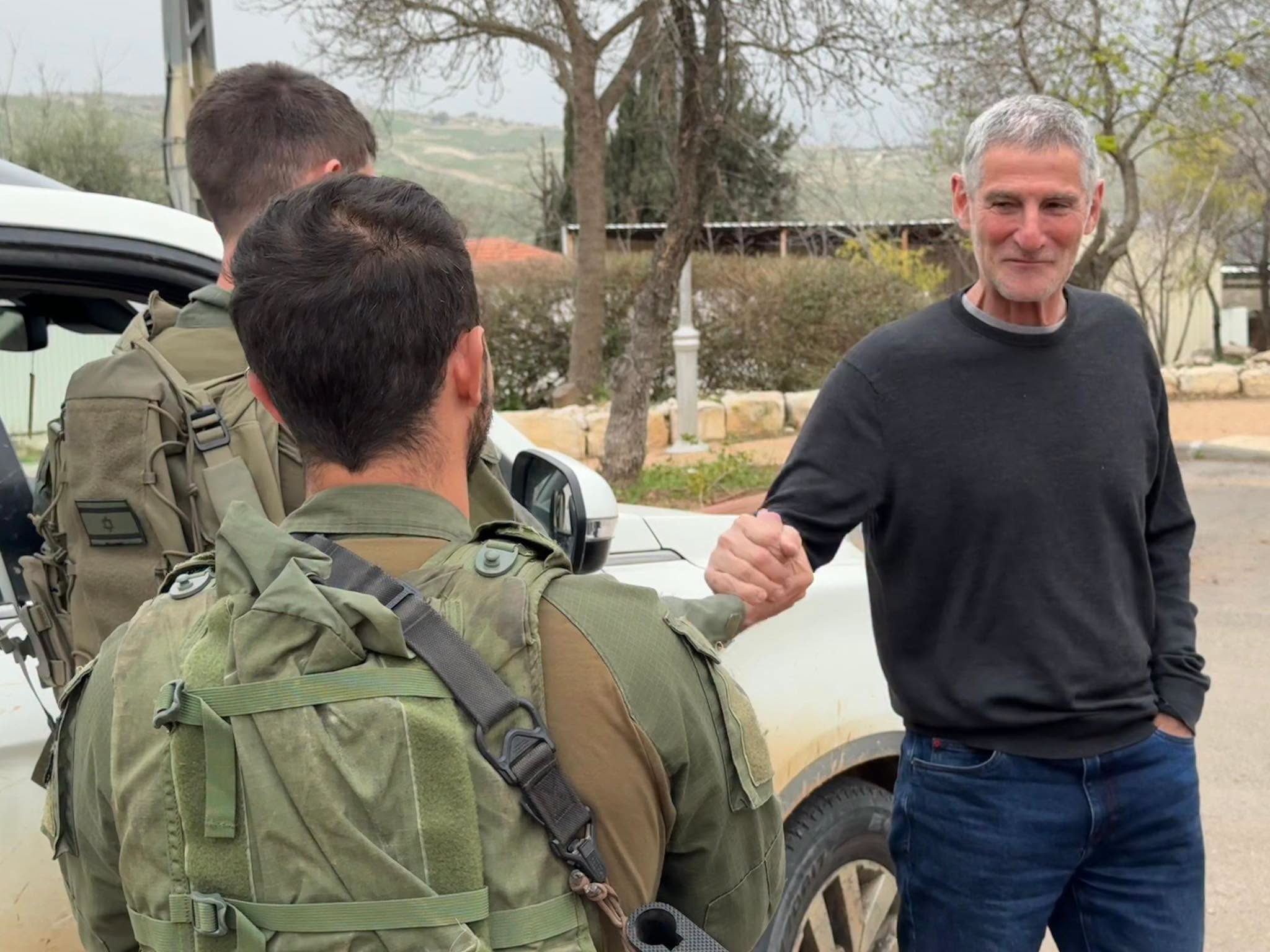
Statements by Ya'alon and Golan... Critical positions towards the government, even if in the context of electoral competition
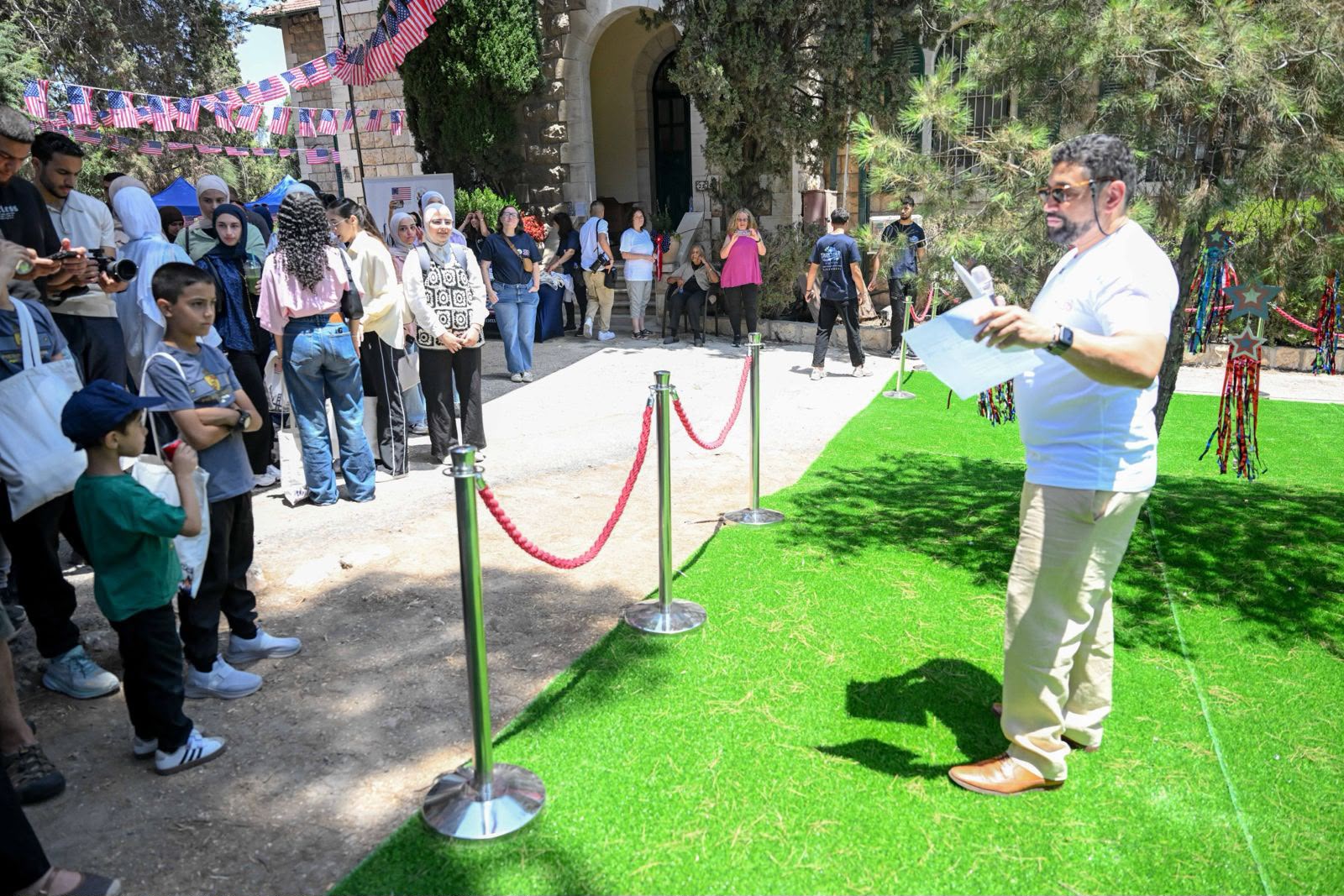
Deputy Chief of Mission at the US Embassy in Jerusalem: "Freedom250" exhibition tells the story of the United States through innovation and education.

Gaza Takes Center Stage: Prominent Palestinian and Arab Presence at the 83rd Venice Film Festival
Share your opinion
Fayyad to Foreign Affairs: If unity had been achieved, October 7th would not have happened